- Market Value (2025):USD 899.1 Mn
- Estimated Value (2026): USD 980.0 Mn
- Forecast Value (2036): USD 2,320.0 Mn
- CAGR (2026-2036): 9.0%
What is the Low-Bitterness Cocoa Powders Market forecast to be worth by 2036?
USD 980.0 million in 2026 to USD 2,320.0 million by 2036 at a 9.0% CAGR.
- The Low-Bitterness Cocoa Powders Market reached USD 899.1 million in 2025.
- Demand is projected to increase from USD 980.0 million in 2026 to USD 2,320.0 million by 2036.
- The market is forecast to record 9.0% CAGR from 2026 to 2036 as confectionery makers and beverage developers seek smoother cocoa taste in repeat-use recipes.
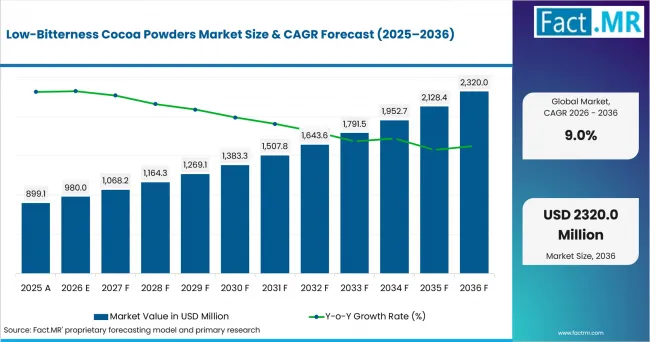
Low Bitterness Cocoa Powders Market Value Analysis | Source: Fact.MR
What are the defining numbers behind Low-Bitterness Cocoa Powders Market growth?
An absolute opportunity of USD 1,340.0 million is expected between 2026 and 2036.
- Demand Drivers in the Market
- Confectionery manufacturers need cocoa notes that keep chocolate character while reducing aftertaste in coated sweets, fillings and molded products.
- Beverage developers need fine powder that disperses cleanly in mixes where bitter taste becomes more visible after dilution.
- Bakery teams need controlled color and flavor delivery because cakes and biscuit inclusions expose cocoa powder to heat.
- Dairy-alternative brands need cocoa systems that mask plant-base notes while keeping a familiar ingredient statement for retail shelves.
- Key Segments Analyzed
- By Product: Cocoa alternatives are expected to hold 37.0% share in 2026 because brands use them to reduce bitterness and cocoa-cost exposure across chocolate ingredients.
- By Function: Flavor delivery is projected to account for 35.0% share in 2026 as formulators use low-bitterness systems to protect chocolate taste.
- By Application: Confectionery is anticipated to capture 39.0% share in 2026 due to the high sensitivity of sweet products to bitter notes.
- By Form: Powder is estimated to represent 48.0% share in 2026 owing to easier blending, storage and dosage in industrial recipes.
- Analyst Opinion at Fact.MR
- Shambhu Nath Jha, Principal Consultant at Fact.MR, states, “The commercial test for this market is whether a powder keeps the cocoa signal after sugar reduction, dairy replacement or heat exposure. Suppliers are expected to win when sensory proof, color control and application guidance are offered together. The next sourcing step is expected to link taste panels with processing data so manufacturers qualify powders faster.”
- Strategic Implications
- Powder suppliers should document taste performance by application so product teams compare bitter perception after processing.
- Ingredient distributors should offer sample kits across cocoa alternatives, perception powders and blended systems to shorten trials.
- Confectionery brands should test low-bitterness powders in fillings and coatings before changing full bar or tablet recipes.
- Beverage manufacturers should validate dispersion and aftertaste in cold and hot formats because bitterness changes with serving method.
- Portfolio teams should separate cocoa reduction from full cocoa replacement so each claim has its own sensory and sourcing proof.
The USA is projected to record 9.9% CAGR through 2036 supported by confectionery renovation and cocoa-cost control. Germany is anticipated to post 9.5% CAGR as processing depth keeps powder trials close to industrial users. Japan is estimated to advance at 8.8% CAGR through premium foods and tariff-sensitive cocoa sourcing. France is forecast to reach 8.5% CAGR as bakery and confectionery processors manage cocoa-based price pressure. Brazil is expected to hold 8.1% CAGR due to local cacao supply and industrial chocolate channels.
How does the Low-Bitterness Cocoa Powders Market break down by segment?
Cocoa alternatives lead Product at 37.0% share in 2026; while Powder leads Form at 48.0% share.
Which Product dominates?
Cocoa alternatives are expected to hold 37.0% share in 2026.
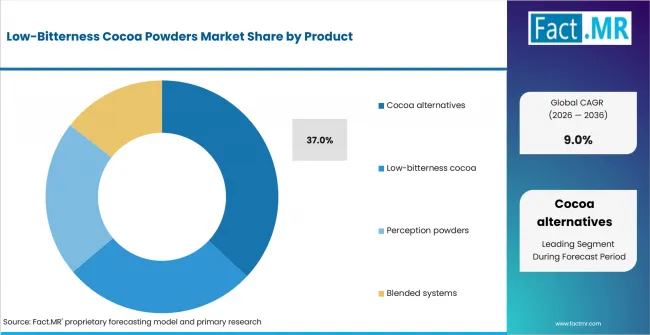
Low Bitterness Cocoa Powders Market Analysis By Product | Source: Fact.MR
Cocoa alternatives lead the product split because manufacturers are trying to keep chocolate taste while reducing bitter perception and cocoa input risk. These systems work beside cocoa-free chocolate routes while still keeping a clear cocoa cue. Low-bitterness cocoa, perception powders and blended systems serve recipes where the brand needs recognizable cocoa identity.
Product teams approve alternatives only when flavor remains stable after fat changes, sugar reduction and storage. The segment therefore rewards suppliers that explain pH, particle size and roasting profile in plain application terms. Cocoa alternatives are less about replacement language and more about controlling sensory variation during recipe trials.
What leads the Function segment?
Flavor delivery is projected to account for 35.0% share in 2026.
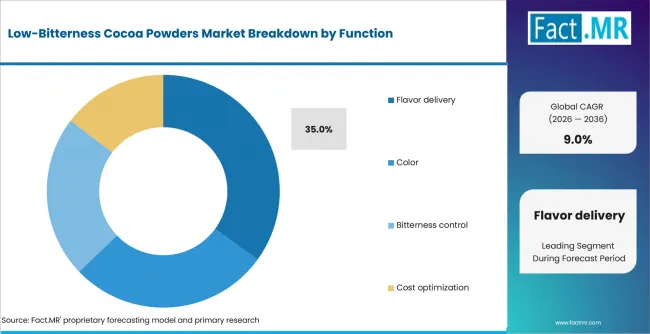
Low Bitterness Cocoa Powders Market Analysis By Function | Source: Fact.MR
Flavor delivery leads because low-bitterness powders are bought first for taste correction. Formulators use them when a cocoa note must remain rounded after sugar reduction, fat changes or plant-base masking. Color and bitterness control still guide trials, but flavor delivery carries the purchase decision when consumers compare taste directly.
Function demand is linked to the amount of adjustment a product team wants to avoid. A powder that delivers a clearer cocoa note at controlled dosage lowers trial waste. Lower rework risk reduces the chance that a recipe fails during shelf-life or consumer panel review.
How does Application shape demand?
Confectionery is anticipated to lead with 39.0% share in 2026.
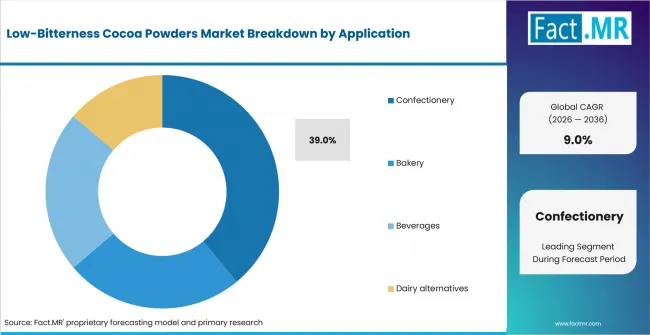
Low Bitterness Cocoa Powders Market Analysis By Application | Source: Fact.MR
Confectionery leads because bitter notes are noticed quickly in fillings, coatings and molded sweets. The application gives suppliers a broad testing base linked to confectionery demand and repeat purchase. Low-bitterness powders help brands review cocoa dosage when higher input costs push recipe teams to rebalance flavor.
Destatis reported in December 2025 that Germany produced approximately 12.8 kilograms of chocolate per person in 2024. Chocolate and confectionery manufacturers evaluate sensory attributes such as taste, appearance, mouthfeel and flavor across different formulations and applications.
What supports Powder within Form?
Powder is estimated to represent 48.0% share in 2026.
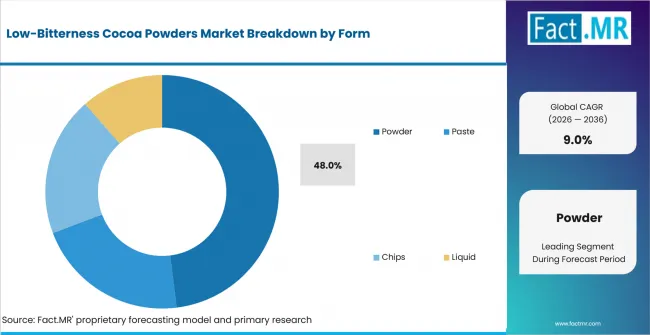
Low Bitterness Cocoa Powders Market Analysis By Form | Source: Fact.MR
Powder leads the form split because it fits dry blending, bakery mixes, beverage premixes and confectionery inclusions. The form gives better dosing control than paste or liquid formats. Chips and liquids serve narrower uses where particle form or flow behavior matters less than convenience in compound chocolate and coatings.
Manufacturers favor powder when factories need fast line trials and manageable storage. Powder is weighed, sifted and blended with fewer changes to existing production steps. Handling advantage is central when low-bitterness approval depends on repeated sensory tests across several recipes.
What is accelerating Low-Bitterness Cocoa Powders Market adoption, and what is holding it back?
Demand is expected to rise through confectionery reformulation and cocoa-cost pressure. Growth is constrained by sensory validation and label review.
Drivers Impact Analysis
| DRIVER | (~) % IMPACT ON CAGR | GEOGRAPHIC RELEVANCE | IMPACT TIMELINE |
|---|---|---|---|
| Cocoa-cost pressure and taste reformulation | +1.4% | Global | Short term (<= 2 years) |
| Confectionery renovation and filled-product trials | +1.1% | North America, Europe | Medium term (2-4 years) |
| Beverage mix and powder-format expansion | +0.8% | Global | Medium term (2-4 years) |
| Plant-based dairy and dessert masking | +0.6% | North America, East Asia | Long term (>= 4 years) |
Source: Fact.MR analysis. Updated Aug 28, 2026
- Cocoa-cost pressure and taste reformulation: Price pressure is expected to make formulators compare cocoa dosage with perceived chocolate intensity. Low-bitterness powders help brands seek smoother taste while avoiding a full flavor-system reset.
- Confectionery renovation and filled-product trials: Filled sweets and coatings are expected to provide a direct trial base because bitterness is easy to detect in high-sugar systems. Suppliers that provide application data shorten approval work.
- Beverage mix and powder-format expansion: Dry beverage mixes are projected to favor powders that disperse well and keep cocoa taste rounded after dilution. Bitter carryover is harder to hide in hot cocoa and nutrition beverages.
Opportunity Impact Analysis
| OPPORTUNITY | (~) % IMPACT ON CAGR | GEOGRAPHIC RELEVANCE | IMPACT TIMELINE |
|---|---|---|---|
| Sensory panels for low-sugar confectionery | +1.0% | North America, Europe | Short term (<= 2 years) |
| Mild cocoa systems for dairy alternatives | +0.8% | Global | Medium term (2-4 years) |
| Powder blends for bakery and dry mixes | +0.7% | East Asia, Europe | Long term (>= 4 years) |
Source: Fact.MR analysis. Updated Aug 28, 2026
- Sensory panels for low-sugar confectionery: Brands are expected to seek powders that offset sharper cocoa notes when sugar levels fall. A clear panel result helps the ingredient move from pilot batch to plant trial.
- Mild cocoa systems for dairy alternatives: Plant bases often carry cereal or bean notes that interfere with chocolate taste. Low-bitterness cocoa powders are expected to support masking where labels still need familiar cocoa wording.
- Powder blends for bakery and dry mixes: Bakery processors are anticipated to value powders that hold color after heat exposure. Dry-mix makers benefit when flavor stays stable after storage and reconstitution.
Restraints Impact Analysis
| RESTRAINT | (~) % IMPACT ON CAGR | GEOGRAPHIC RELEVANCE | IMPACT TIMELINE |
|---|---|---|---|
| Sensory mismatch after processing | -0.5% | Global | Short term (<= 2 years) |
| Color and pH approval work | -0.4% | Europe, Japan | Medium term (2-4 years) |
| Procurement caution during cocoa volatility | -0.3% | Global | Medium term (2-4 years) |
Source: Fact.MR analysis. Updated Aug 28, 2026
- Sensory mismatch after processing: A powder often tastes smooth in bench trials yet behaves differently after baking, chilling or dilution. That risk is expected to extend approval timelines for national brands.
- Color and pH approval work: Low bitterness must be balanced with the shade expected in each application. Higher alkalization changes labeling review and product appearance at the same time.
- Procurement caution during cocoa volatility: Purchasing teams are expected to test fewer new ingredients when raw cocoa budgets move sharply. Smaller trial budgets are expected to delay broader qualification even when taste results are promising.
Which countries are scaling the Low-Bitterness Cocoa Powders Market through 2036?
- The country comparison spans 1.8 percentage points between the USA and Brazil across the forecast period.
- The USA remains 0.4 percentage point above Germany as confectionery reformulation and cost pressure support low-bitterness powder trials.
- Germany remains 0.7 percentage point above Japan because chocolate processing depth and domestic grinding activity keep suppliers close to industrial users.
- Japan remains 0.3 percentage point above France as premium foods and import rules shape cocoa-powder sourcing decisions.
- France remains 0.4 percentage point above Brazil through bakery, confectionery and beverage reformulation needs.
- Brazil closes the displayed range while local cacao supply supports regional powder economics.
Comparable CAGRs create different entry conditions because cocoa sourcing, finished-product categories and sensory standards vary by country. Full report coverage includes North America, Latin America, Western Europe, Eastern Europe, East Asia, South Asia & Pacific, Middle East & Africa.
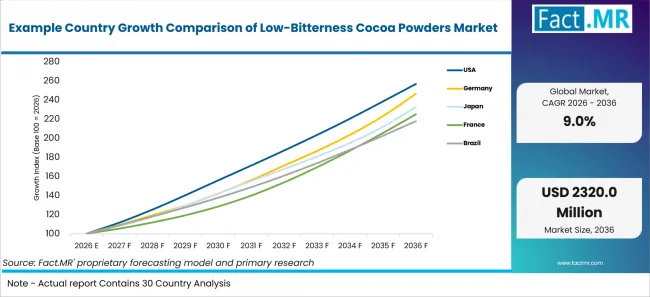
Example Country Growth Comparison Of Low Bitterness Cocoa Powders Market | Source: Fact.MR
| Country | CAGR (2026-2036) |
|---|---|
| USA | 9.9% |
| Germany | 9.5% |
| Japan | 8.8% |
| France | 8.5% |
| Brazil | 8.1% |
Source: Fact.MR analysis. Updated Aug 28, 2026
What supports USA adoption?
9.9% CAGR, supported by confectionery reformulation and cocoa-cost control.
U.S. confectionery and beverage developers evaluate low-bitterness cocoa powders when higher sweet-goods costs push recipe teams to protect taste with fewer formula changes. The U.S. Bureau of Labor Statistics reported on August 12, 2026 that sugar and sweets prices were 7.4% higher in July 2026 than in July 2025. The USA to post 9.9% CAGR through 2036 and interprets powder formats as useful in hot cocoa, nutrition beverages, fillings and bakery coatings where aftertaste control matters.
How is Germany scaling demand?
9.5% CAGR, shaped by chocolate manufacturing depth and cocoa grinding activity.
German processors have a dense chocolate and confectionery base that tests mild cocoa powders across molded products, coated wafers and bakery inclusions. BMEL-Statistik reports, citing the German Confectionery Industry Association (BDSI), that German cocoa bean grindings fell 10.1% to 358,000 tonnes in 2025. Germany is anticipated to record 9.5% CAGR through 2036 as suppliers pair flavor proof with repeatable color and pH records.
What supports the Japan outlook?
8.8% CAGR, led by premium foods and import-sensitive cocoa sourcing.
Japanese food manufacturers use mild cocoa taste in desserts, beverages and gift confectionery where balance is central to repeat purchase. MAFF reported in February 2026 that Japan’s agricultural, forestry, fishery and food exports reached JPY 1.7005 trillion in 2025. Japan will advance at 8.8% CAGR through 2036 and interprets premium applications as supportive of powders that soften bitterness while maintaining a clean chocolate finish.
What supports France adoption?
8.5% CAGR, supported by bakery, confectionery and beverage reformulation.
French bakery and confectionery makers assess low-bitterness cocoa powders when cocoa-based product prices affect pastry, dessert and drinking-chocolate recipes. INSEE recorded a turnover index of 130.26 in December 2025 for manufacture of cocoa, chocolate and sugar confectionery. France will reach 8.5% CAGR through 2036 and interprets the confectionery manufacturing base as supportive of work on cocoa color and aroma stability across bakery, beverage and chilled-dessert formats.
How does Brazil perform?
8.1% CAGR, supported by local cacao supply and regional processing channels.
Brazilian processors benefit from local cacao availability when testing powder blends that connect bean origin, roast profile and bitter perception. IBGE's January 2026 estimate, released on February 12, placed Brazil's 2026 cacao bean production at 310.7 thousand tonnes. Brazil is expected to hold 8.1% CAGR through 2036 as regional chocolate, bakery and beverage brands use local sourcing links to refine cocoa flavor while managing supply variation.
Who leads the Low-Bitterness Cocoa Powders Market?
Barry Callebaut AG is an active provider through cocoa powders, alkalized systems and Bensdorp specialty cocoa capabilities. Its portfolio gives industrial users options across color, fat level and taste profile. Its fit is clearest where large chocolate and bakery manufacturers need consistent supply across regions.
ofi participates through deZaan cocoa powders, cocoa liquors and application support. In February 2026, ofi launched three deZaan single-origin cocoa liquors from Papua New Guinea, Uganda and the Dominican Republic, designed to deliver fine-flavor characteristics with consistency at scale.
Cargill, Incorporated competes through Gerkens cocoa powders and broader cocoa and chocolate ingredient systems. Its May 2026 North American launch of NextCoa with Voyage Foods added a cocoa-free confectionery alternative alongside Cargill, Incorporated’s conventional cocoa and chocolate portfolio. Blommer Chocolate Company, Guan Chong Berhad and JB Foods Limited add cocoa-processing, ingredient-manufacturing and regional supply capabilities across cocoa powder, cocoa butter, cocoa liquor or mass, chocolate and related products.
Which companies are the key providers?
Key companies include Barry Callebaut AG; ofi; Cargill, Incorporated; Blommer Chocolate Company; Guan Chong Berhad; and JB Foods Limited.
- Barry Callebaut AG
- ofi
- Cargill, Incorporated
- Blommer Chocolate Company
- Guan Chong Berhad
- JB Foods Limited
Bibliography
- U.S. Bureau of Labor Statistics. (2026, August 12). Consumer Price Index—July 2026.
- Cargill. (2026, May 12). Cargill and Voyage Foods to bring NextCoa™ cocoa-free confectionery alternatives to North America.
- Federal Statistical Office (Destatis). (2025, December 2). 12,8 Kilo Schokolade pro Kopf wurden 2024 produziert [12.8 kilograms of chocolate per capita were produced in 2024].
- Institut national de la statistique et des études économiques. (2026, July 30). Indice de chiffre d’affaires - Marché intérieur et export - Fabrication de cacao, chocolat et de produits de confiserie (NAF rév. 2, niveau classe, poste 10.82) (Série 010774188).
- Institut national de la statistique et des études économiques. (2025, June 24). The surge in tropical commodity prices in 2024 is being passed on to consumer prices for chocolate and coffee in 2025.
- Brazilian Institute of Geography and Statistics. (2026, February 12). In January, IBGE estimates a harvest of 342.7 million tonnes for 2026. IBGE News Agency.
- ofi. (2026, February 2). ofi's deZaan brand launches single origin cocoa liquor range, advancing fine flavor consistency at scale.
This Report Answers
- The report explains where low-bitterness cocoa powders are used across product, function, application and form.
- Segment analysis identifies the leading subsegments and the operational reasons product teams prioritize them.
- Country analysis examines the listed markets and the processing or sourcing mechanisms supporting powder qualification.
- Competitive analysis reviews current providers across cocoa powders, specialty cocoa systems and adjacent chocolate-like technologies.
- Application analysis assesses how bitterness, color and recipe handling influence purchase decisions across food and beverage uses.
What does the Low-Bitterness Cocoa Powders Market cover?
The Low-Bitterness Cocoa Powders Market covers cocoa powders, alkalized powders, perception powders and blended systems used to soften bitter notes in finished recipes. It is assessed across food applications where chocolate formulations need clear taste and color while controlling recipe cost.
The assessment covers confectionery, bakery, beverages and dairy alternatives across powder, paste, chip and liquid formats. The assessment considers how cocoa supply pressure affects qualification work when manufacturers compare mild taste, roast character and application stability.
What is included in the scope?
The scope includes cocoa powders and cocoa-based systems used by brands, contract manufacturers and ingredient distributors to reduce bitter perception. It includes products serving cocoa butter adjacent recipes when powder choice affects color and chocolate flavor.
The scope covers low-bitterness cocoa, perception powders, cocoa alternatives and blended systems used in confectionery, bakery, beverages and dairy alternatives. The scope includes certified and premium ingredient pathways that overlap with organic cocoa where sourcing documentation affects buyer approval.
What is excluded from the scope?
The scope excludes finished chocolate bars, cocoa beans, cocoa liquor sold as a separate primary ingredient, commodity cocoa powder sold only for standard bitterness profiles and retail drinking-chocolate mixes sold as consumer products.
It excludes flavors, sweeteners, emulsifiers and color additives when sold separately from a cocoa powder or cocoa-based blend. The scope excludes cocoa-free confectionery alternatives when they are sold as finished consumer products outside ingredient supply.
How Was the Analysis Built?
The analysis draws on 120+ sources, 35+ company portfolios, 25+ countries, and more than 20 industry interviews.
- Primary Research: Primary research includes discussions with manufacturers, service providers, technology developers, distributors, end users, and subject-matter experts. These conversations examine purchasing priorities, product adoption, operational challenges, approval requirements, competitive positioning, and the factors that influence wider market acceptance.
- Desk Research: Desk research covers government statistics, regulatory publications, company filings, trade data, technical studies, industry associations, standards, public policy, and other authoritative sources. Every source used in the analysis is documented in the bibliography.
- Market Sizing and Forecasting: Market estimates combine historical performance, demand indicators, pricing and volume trends, segment shares, company participation, country-level growth, adoption patterns, investment activity, and barriers to market expansion.
- Data Validation and Update Cycle: Findings are validated by comparing primary interviews with public data, company activity, regulatory changes, trade patterns, and industry developments. Regular updates review new product launches, capacity changes, partnerships, approvals, and shifts in commercial adoption.
Segmentation
What is the report’s scope and coverage?
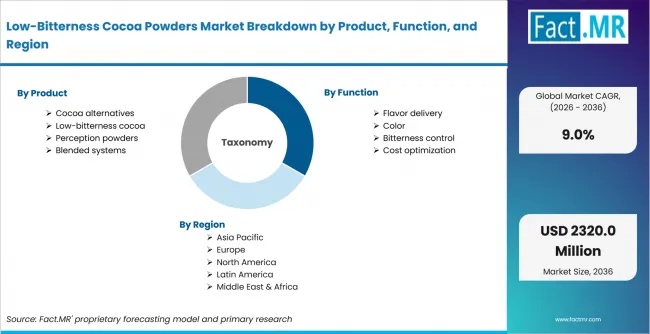
Low Bitterness Cocoa Powders Market Breakdown By Product, Function, And Region | Source: Fact.MR
| Attribute | Details |
|---|---|
| Quantitative Units | USD million |
| Market Definition | Cocoa powders and cocoa-based blends designed to reduce bitter perception while preserving chocolate taste, color delivery and application performance in food and beverage recipes. |
| Product | Cocoa alternatives; Low-bitterness cocoa; Perception powders; Blended systems |
| Function | Flavor delivery; Color; Bitterness control; Cost optimization |
| Application | Confectionery; Bakery; Beverages; Dairy alternatives |
| Form | Powder; Paste; Chips; Liquid |
| Regions Covered | North America; Latin America; Western Europe; Eastern Europe; East Asia; South Asia & Pacific; Middle East & Africa |
| Countries Covered | USA; Germany; Japan; France; Brazil |
| Key Companies Profiled | Barry Callebaut AG; ofi; Cargill, Incorporated; Blommer Chocolate Company; Guan Chong Berhad; JB Foods Limited |
| Forecast Period | 2026 to 2036 |
| Approach | Hybrid top-down and bottom-up approach using cocoa ingredient demand, recipe qualification patterns, application mix, country growth, supplier portfolio review and adoption barriers. |
Source: Fact.MR analysis. Updated Aug 28, 2026
How is the market segmented?
-
By Product:
- Cocoa alternatives
- Low-bitterness cocoa
- Perception powders
- Blended systems
-
By Function:
- Flavor delivery
- Color
- Bitterness control
- Cost optimization
-
By Application:
- Confectionery
- Bakery
- Beverages
- Dairy alternatives
-
By Form:
- Powder
- Paste
- Chips
- Liquid
-
By Region:
- North America
- Latin America
- Western Europe
- Eastern Europe
- East Asia
- South Asia & Pacific
- Middle East & Africa
Frequently Asked Questions
How big is the low-bitterness cocoa powders market in 2026?
What is the CAGR of the low-bitterness cocoa powders market from 2026 to 2036?
Which product leads the low-bitterness cocoa powders market?
Which function leads the low-bitterness cocoa powders market?
Who are the leading companies in the low-bitterness cocoa powders market?
Who worked on this report


Preview the report firsthand - request a free sample
Free SampleGet the brochure for pricing and purchase details
Download PDF