Chocolate Market
Chocolate Market Size and Share Forecast Outlook 2026 to 2036
Chocolate market is projected to grow from USD 127.1 billion in 2026 to USD 195.3 billion by 2036, at a CAGR of 4.4%. Traditional will dominate with a 99.0% market share, while supermarkets & hypermarkets will lead the distribution channel segment with a 46.0% share.
Chocolate Market Forecast and Outlook 2026 to 2036
The global chocolate market is projected to reach USD 195.25 billion by 2036. The market is valued at USD 127.05 billion in 2026 and is set to rise at a CAGR of 4.4% during the assessment period. Demand for chocolates will advance 1.5x during the same period, supported by increasing consumer demand for premium and artisanal chocolate products worldwide, driving adoption of high-quality cocoa formulations with superior taste profiles and ethical sourcing credentials across confectionery and gifting sectors globally.
Key Takeaways from the Chocolate Market
- Chocolate Market Value (2026): USD 127.05 billion
- Chocolate Market Forecast Value (2036): USD 195.25 billion
- Chocolate Market Forecast CAGR: 4.4%
- Leading Product in Chocolate Market: Traditional (99.0%)
- Key Growth Regions in Chocolate Market: Asia Pacific, North America, and Europe
- Top Players in Chocolate Market: Barry Callebaut, Chocoladefabriken Lindt & Sprüngli AG, Mondelēz International, Nestlé S.A., THE HERSHEY COMPANY, Ferrero, Mars, Incorporated, The Australian Carob Co., Meiji Holdings Co., Ltd., Arcor
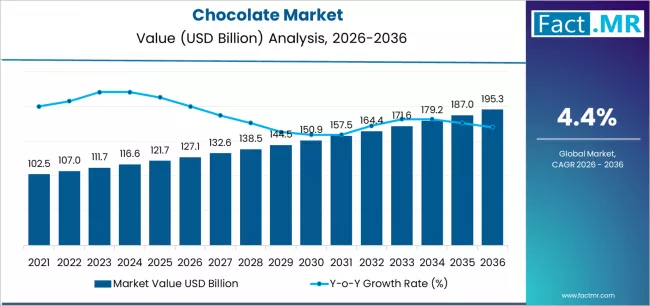
The traditional chocolate segment dominates market activity, driven by established consumer preferences for milk, dark, and white chocolate varieties across snacking occasions and gifting applications worldwide. Consumers increasingly recognize the pleasure and emotional benefits of traditional chocolate, with typical product offerings providing familiar taste experiences and versatile consumption formats at accessible price points through widespread retail distribution.
The supermarkets & hypermarkets distribution channel demonstrates robust market presence, supported by convenient shopping experiences and extensive product variety enabling consumer comparison and impulse purchasing. Milk chocolate emerges as the dominant product variety within traditional chocolate, reflecting mainstream taste preferences and broad demographic appeal.
Chocolate Market
| Metric | Value |
|---|---|
| Market Value (2026) | USD 127.05 billion |
| Market Forecast Value (2036) | USD 195.25 billion |
| Forecast CAGR (2026-2036) | 4.4% |
Category
| Category | Segments |
|---|---|
| Product | Traditional Chocolate (Dark; Milk; White); Artificial Chocolate |
| Distribution Channel | Supermarkets and Hypermarkets; Convenience Stores; Online |
| Region | Asia Pacific; North America; Europe; Latin America; Middle East & Africa |
Segmental Analysis
By Product, Which Segment Accounts for the Dominant Market Share?
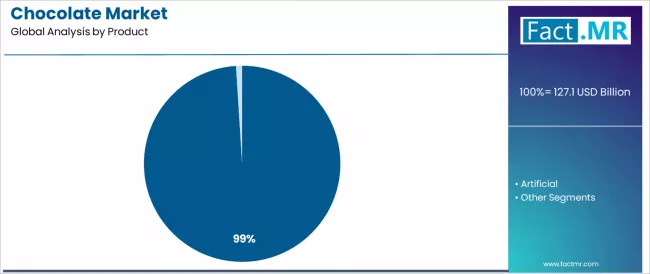
Traditional chocolate is the most widely consumed category, capturing 99.0% of total market share in 2026. Traditional chocolates encompass cocoa-based formulations including dark chocolate with high cocoa content, milk chocolate combining cocoa with dairy ingredients, and white chocolate utilizing cocoa butter without cocoa solids, including premium single-origin varieties and mass-market confectionery bars that enable diverse taste experiences across snacking occasions, dessert applications, and gifting contexts worldwide.
By Distribution Channel, Which Segment Accounts for the Largest Market Share?
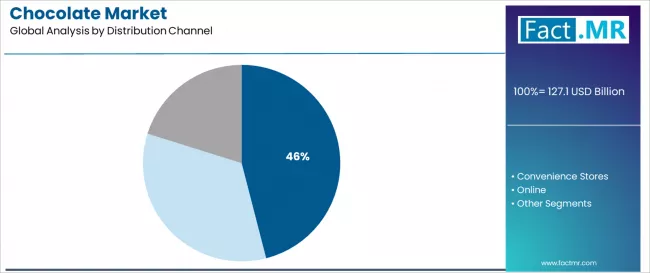
Supermarkets & hypermarkets dominate the chocolate distribution landscape with approximately 46.0% market share in 2026, reflecting the critical role of large-format retail stores in supporting convenient shopping experiences and extensive product variety across chocolate categories worldwide.
The supermarkets & hypermarkets segment's market leadership is reinforced by one-stop shopping convenience, promotional activities including seasonal displays and bundle offers, and impulse purchasing opportunities that characterize modern grocery retailing.
What are the Drivers, Restraints, and Key Trends of the Chocolate Market?
Rising disposable incomes and expanding middle-class populations in emerging economies, supporting higher spending on premium and indulgent products, drive the chocolate market. A strong gifting culture and seasonal celebrations continue to generate predictable demand spikes across global retail markets. Growing health awareness is also reshaping consumption, with dark chocolate benefiting from antioxidant positioning and perceived wellness attributes.
Market restraints include volatility in cocoa prices and sustainability-related supply risks, particularly from West African producing regions, which affect input costs and margin stability. Health concerns around sugar intake and obesity, along with sugar taxation policies, are moderating consumption frequency among health-conscious consumers. Competition from alternative snacks, including functional foods and premium confectionery, further pressures category relevance.
Key trends include premiumization and the growth of craft and bean-to-bar chocolates in developed markets. Ethical sourcing and sustainability certifications such as Fair Trade and direct trade are becoming important differentiators, while evolving formulations may influence future consumption patterns.
Analysis of the Chocolate Market by Key Countries

| Country | CAGR (2026-2036) |
|---|---|
| USA | 4.0% |
| Germany | 3.8% |
| France | 3.9% |
| UK | 4.2% |
| China | 6.5% |
| Brazil | 5.1% |
| UAE | 7.5% |
How Is the USA Leading Global Market Value in Chocolate Consumption?
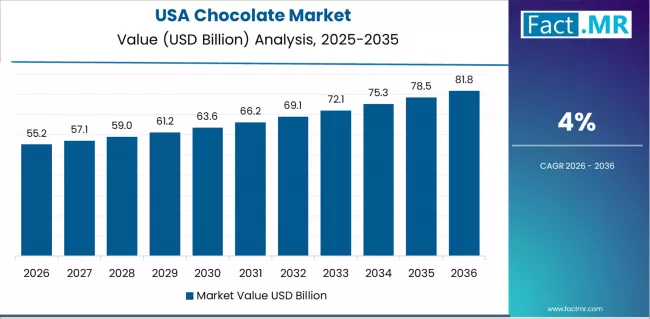
The USA holds the largest market value in the global chocolate market, expanding at a 4.0% CAGR between 2026 and 2036. Leadership is driven by strong premium chocolate consumption, a deeply rooted gifting culture, and broad consumer preferences spanning mass-market to ultra-premium segments. Demand is concentrated in affluent and metropolitan regions such as New York, California, Texas, and Illinois, where consumers consistently pay higher prices for quality, brand differentiation, and innovative flavors.
A well-developed retail ecosystem, including specialty stores, gourmet retailers, and direct-to-consumer platforms, ensures widespread access. Seasonal gifting occasions such as Valentine’s Day, Easter, Halloween, and Christmas provide recurring demand surges, supporting market stability and sustained value growth.
Why Is China Emerging as a High-Growth Chocolate Market?
China is expanding at a 6.5% CAGR through 2036, driven by rapid urbanization, rising disposable incomes, and evolving consumer lifestyles. Chocolate consumption is increasing among young professionals and affluent households in major cities such as Shanghai, Beijing, Guangzhou, and Shenzhen.
Imported brands and premium domestic offerings are gaining traction, often adapted to local taste preferences through reduced sweetness and localized flavors. E-commerce platforms play a critical role in market expansion, enabling broad reach and efficient brand discovery. Growing gifting traditions during Chinese New Year and Mid-Autumn Festival, alongside Western celebrations, are further strengthening demand.
What drives Germany’s Mature but Stable Chocolate Market?
Germany remains Europe’s largest chocolate market, growing at a steady 3.8% CAGR through 2036. High per-capita consumption, strong domestic manufacturing capacity, and established consumer loyalty underpin market stability. German consumers exhibit sophisticated preferences, increasingly favoring organic, sustainably sourced, and origin-specific chocolates.
While market maturity limits rapid expansion, premium niches continue to grow, supported by environmental certifications and transparent sourcing practices. Domestic producers maintain strong positions across European distribution networks, reinforcing Germany’s role as a manufacturing and consumption hub.
How does France Sustain Premium Chocolate Positioning?
France records a 3.9% CAGR, supported by strong culinary heritage and premium-focused consumption patterns. Chocolate is positioned as a gastronomic product rather than a mass indulgence, with demand concentrated in artisanal boutiques and high-end retailers across Paris, Lyon, and regional centers.
French consumers prioritize craftsmanship, dark chocolate varieties, and refined flavor profiles. Premium pricing is supported by cultural appreciation for quality and origin, allowing artisanal producers to maintain brand prestige and consistent demand.
What positions the UK for Organic and Ethical Chocolate Growth?
The UK market grows at a 4.2% CAGR, driven by rising demand for organic, ethical, and sustainably sourced chocolate. Consumers in major cities increasingly favor products with clean labels, Fair Trade certification, and reduced sugar content.
Specialty retailers and premium supermarket segments play a central role in distribution, while online platforms support brand discovery. Health awareness and sustainability considerations are shaping purchasing behavior, supporting steady premiumization despite broader economic pressures.
How does Brazil Demonstrate Strong Cultural Demand for Chocolate?
Brazil’s chocolate market grows at a 5.1% CAGR, supported by strong cultural consumption patterns and expanding middle-class demand. Easter remains a key sales period, driven by the tradition of gifting chocolate eggs. Domestic manufacturers benefit from local cocoa production, enabling competitive pricing and tailored product formats.
While brand loyalty remains strong, premium imported chocolates are gaining visibility among affluent urban consumers. Broad retail access through supermarkets and neighborhood stores supports nationwide penetration.
Why does the UAE Represent a Luxury-Driven Chocolate Market?
The UAE records the fastest growth at a 7.5% CAGR through 2036, supported by high-income consumers, tourism-driven demand, and a strong gifting culture. Premium chocolate sales are concentrated in luxury malls, duty-free outlets, and flagship brand stores across Dubai and Abu Dhabi.
Elaborate packaging and presentation play a central role in purchase decisions, particularly during religious festivals and international holidays. Climate-controlled retail environments ensure product integrity, reinforcing the UAE’s position as a regional hub for luxury chocolate distribution.
Competitive Landscape of the Chocolate Market

The chocolate market is moderately concentrated, with roughly 10-15 major players accounting for a significant share of global sales through strong brands, global manufacturing scale, and extensive retail distribution. Competition is driven more by brand equity, product differentiation, and shelf presence than by price alone, spanning mass-market, premium, and artisanal segments.
Leading companies such as Barry Callebaut, Chocoladefabriken Lindt & Sprüngli AG, and Mondelēz International maintain strong positions through B2B cocoa and ingredient supply, premium brand portfolios, and globally recognized consumer brands. Continuous product innovation, marketing investment, and retailer partnerships support their expansion in premium categories and emerging markets.
Challengers including Nestlé S.A., The Hershey Company, and Ferrero compete through diversified confectionery portfolios, seasonal offerings, and strong regional dominance. Other established players such as Mars, Meiji Holdings, and Arcor focus on family brands, regional taste preferences, and value-oriented positioning.
Smaller craft and artisanal producers add competitive pressure in developed markets through bean-to-bar models, transparency, and origin-focused branding. Overall competitiveness favors companies combining scale efficiency, brand building, and sustainable cocoa sourcing across the value chain.
Key Players in the Chocolate Market
- Barry Callebaut
- Chocoladefabriken Lindt & Sprüngli AG
- Mondelēz International
- Nestlé S.A.
- The Hershey Company
- Ferrero
- Mars, Incorporated
- The Australian Carob Co.
- Meiji Holdings Co., Ltd.
- Arcor
Scope of the Report
| Items | Values |
|---|---|
| Quantitative Units | USD 127.05 Billion |
| Product | Traditional (Dark, Milk, White), Artificial |
| Distribution Channel | Supermarkets & Hypermarkets, Convenience Stores, Online |
| Regions Covered | Asia Pacific, North America, Europe, Latin America, MEA |
| Country Covered | USA, Germany, France, UK, China, Brazil, UAE, and 40+ countries |
| Key Companies Profiled | Barry Callebaut, Chocoladefabriken Lindt & Sprüngli AG, Mondelēz International, Nestlé S.A., THE HERSHEY COMPANY, Ferrero, Mars, Incorporated, The Australian Carob Co., Meiji Holdings Co., Ltd., Arcor |
| Additional Attributes | Dollar sales by product and distribution channel categories, regional consumption trends across Asia Pacific, North America, and Europe, competitive landscape with chocolate manufacturers and confectionery companies, product specifications and cocoa content requirements, integration with retail merchandising strategies and seasonal promotional programs, innovations in sustainable sourcing and sugar reduction technologies, and development of specialized applications with premium positioning and ethical certification capabilities. |
Chocolate Market by Segments
-
Product :
- Traditional
- Dark
- Milk
- White
- Artificial
- Traditional
-
Distribution Channel :
- Supermarkets & Hypermarkets
- Convenience Stores
- Online
-
Region :
- Asia Pacific
- China
- Japan
- South Korea
- India
- Australia
- Thailand
- Rest of Asia Pacific
- North America
- USA
- Canada
- Mexico
- Europe
- Germany
- UK
- France
- Italy
- Spain
- Denmark
- Sweden
- Norway
- Rest of Europe
- Latin America
- Brazil
- Argentina
- Rest of Latin America
- MEA
- South Africa
- Saudi Arabia
- UAE
- Kuwait
- Rest of MEA
- Asia Pacific
Table of Content
- Executive Summary
- Global Market Outlook
- Demand to side Trends
- Supply to side Trends
- Technology Roadmap Analysis
- Analysis and Recommendations
- Market Overview
- Market Coverage / Taxonomy
- Market Definition / Scope / Limitations
- Market Background
- Market Dynamics
- Drivers
- Restraints
- Opportunity
- Trends
- Scenario Forecast
- Demand in Optimistic Scenario
- Demand in Likely Scenario
- Demand in Conservative Scenario
- Opportunity Map Analysis
- Product Life Cycle Analysis
- Supply Chain Analysis
- Investment Feasibility Matrix
- Value Chain Analysis
- PESTLE and Porter’s Analysis
- Regulatory Landscape
- Regional Parent Market Outlook
- Production and Consumption Statistics
- Import and Export Statistics
- Market Dynamics
- Global Market Analysis 2021 to 2025 and Forecast, 2026 to 2036
- Historical Market Size Value (USD Million) Analysis, 2021 to 2025
- Current and Future Market Size Value (USD Million) Projections, 2026 to 2036
- Y to o to Y Growth Trend Analysis
- Absolute $ Opportunity Analysis
- Global Market Pricing Analysis 2021 to 2025 and Forecast 2026 to 2036
- Global Market Analysis 2021 to 2025 and Forecast 2026 to 2036, By Product
- Introduction / Key Findings
- Historical Market Size Value (USD Million) Analysis By Product, 2021 to 2025
- Current and Future Market Size Value (USD Million) Analysis and Forecast By Product, 2026 to 2036
- Traditional
- Artificial
- Y to o to Y Growth Trend Analysis By Product, 2021 to 2025
- Absolute $ Opportunity Analysis By Product, 2026 to 2036
- Global Market Analysis 2021 to 2025 and Forecast 2026 to 2036, By Distribution Channel
- Introduction / Key Findings
- Historical Market Size Value (USD Million) Analysis By Distribution Channel, 2021 to 2025
- Current and Future Market Size Value (USD Million) Analysis and Forecast By Distribution Channel, 2026 to 2036
- Supermarkets & Hypermarkets
- Convenience Stores
- Online
- Y to o to Y Growth Trend Analysis By Distribution Channel, 2021 to 2025
- Absolute $ Opportunity Analysis By Distribution Channel, 2026 to 2036
- Global Market Analysis 2021 to 2025 and Forecast 2026 to 2036, By Region
- Introduction
- Historical Market Size Value (USD Million) Analysis By Region, 2021 to 2025
- Current Market Size Value (USD Million) Analysis and Forecast By Region, 2026 to 2036
- North America
- Latin America
- Western Europe
- Eastern Europe
- East Asia
- South Asia and Pacific
- Middle East & Africa
- Market Attractiveness Analysis By Region
- North America Market Analysis 2021 to 2025 and Forecast 2026 to 2036, By Country
- Historical Market Size Value (USD Million) Trend Analysis By Market Taxonomy, 2021 to 2025
- Market Size Value (USD Million) Forecast By Market Taxonomy, 2026 to 2036
- By Country
- USA
- Canada
- Mexico
- By Product
- By Distribution Channel
- By Country
- Market Attractiveness Analysis
- By Country
- By Product
- By Distribution Channel
- Key Takeaways
- Latin America Market Analysis 2021 to 2025 and Forecast 2026 to 2036, By Country
- Historical Market Size Value (USD Million) Trend Analysis By Market Taxonomy, 2021 to 2025
- Market Size Value (USD Million) Forecast By Market Taxonomy, 2026 to 2036
- By Country
- Brazil
- Chile
- Rest of Latin America
- By Product
- By Distribution Channel
- By Country
- Market Attractiveness Analysis
- By Country
- By Product
- By Distribution Channel
- Key Takeaways
- Western Europe Market Analysis 2021 to 2025 and Forecast 2026 to 2036, By Country
- Historical Market Size Value (USD Million) Trend Analysis By Market Taxonomy, 2021 to 2025
- Market Size Value (USD Million) Forecast By Market Taxonomy, 2026 to 2036
- By Country
- Germany
- UK
- Italy
- Spain
- France
- Nordic
- BENELUX
- Rest of Western Europe
- By Product
- By Distribution Channel
- By Country
- Market Attractiveness Analysis
- By Country
- By Product
- By Distribution Channel
- Key Takeaways
- Eastern Europe Market Analysis 2021 to 2025 and Forecast 2026 to 2036, By Country
- Historical Market Size Value (USD Million) Trend Analysis By Market Taxonomy, 2021 to 2025
- Market Size Value (USD Million) Forecast By Market Taxonomy, 2026 to 2036
- By Country
- Russia
- Poland
- Hungary
- Balkan & Baltic
- Rest of Eastern Europe
- By Product
- By Distribution Channel
- By Country
- Market Attractiveness Analysis
- By Country
- By Product
- By Distribution Channel
- Key Takeaways
- East Asia Market Analysis 2021 to 2025 and Forecast 2026 to 2036, By Country
- Historical Market Size Value (USD Million) Trend Analysis By Market Taxonomy, 2021 to 2025
- Market Size Value (USD Million) Forecast By Market Taxonomy, 2026 to 2036
- By Country
- China
- Japan
- South Korea
- By Product
- By Distribution Channel
- By Country
- Market Attractiveness Analysis
- By Country
- By Product
- By Distribution Channel
- Key Takeaways
- South Asia and Pacific Market Analysis 2021 to 2025 and Forecast 2026 to 2036, By Country
- Historical Market Size Value (USD Million) Trend Analysis By Market Taxonomy, 2021 to 2025
- Market Size Value (USD Million) Forecast By Market Taxonomy, 2026 to 2036
- By Country
- India
- ASEAN
- Australia & New Zealand
- Rest of South Asia and Pacific
- By Product
- By Distribution Channel
- By Country
- Market Attractiveness Analysis
- By Country
- By Product
- By Distribution Channel
- Key Takeaways
- Middle East & Africa Market Analysis 2021 to 2025 and Forecast 2026 to 2036, By Country
- Historical Market Size Value (USD Million) Trend Analysis By Market Taxonomy, 2021 to 2025
- Market Size Value (USD Million) Forecast By Market Taxonomy, 2026 to 2036
- By Country
- Kingdom of Saudi Arabia
- Other GCC Countries
- Turkiye
- South Africa
- Other African Union
- Rest of Middle East & Africa
- By Product
- By Distribution Channel
- By Country
- Market Attractiveness Analysis
- By Country
- By Product
- By Distribution Channel
- Key Takeaways
- Key Countries Market Analysis
- USA
- Pricing Analysis
- Market Share Analysis, 2025
- By Product
- By Distribution Channel
- Canada
- Pricing Analysis
- Market Share Analysis, 2025
- By Product
- By Distribution Channel
- Mexico
- Pricing Analysis
- Market Share Analysis, 2025
- By Product
- By Distribution Channel
- Brazil
- Pricing Analysis
- Market Share Analysis, 2025
- By Product
- By Distribution Channel
- Chile
- Pricing Analysis
- Market Share Analysis, 2025
- By Product
- By Distribution Channel
- Germany
- Pricing Analysis
- Market Share Analysis, 2025
- By Product
- By Distribution Channel
- UK
- Pricing Analysis
- Market Share Analysis, 2025
- By Product
- By Distribution Channel
- Italy
- Pricing Analysis
- Market Share Analysis, 2025
- By Product
- By Distribution Channel
- Spain
- Pricing Analysis
- Market Share Analysis, 2025
- By Product
- By Distribution Channel
- France
- Pricing Analysis
- Market Share Analysis, 2025
- By Product
- By Distribution Channel
- India
- Pricing Analysis
- Market Share Analysis, 2025
- By Product
- By Distribution Channel
- ASEAN
- Pricing Analysis
- Market Share Analysis, 2025
- By Product
- By Distribution Channel
- Australia & New Zealand
- Pricing Analysis
- Market Share Analysis, 2025
- By Product
- By Distribution Channel
- China
- Pricing Analysis
- Market Share Analysis, 2025
- By Product
- By Distribution Channel
- Japan
- Pricing Analysis
- Market Share Analysis, 2025
- By Product
- By Distribution Channel
- South Korea
- Pricing Analysis
- Market Share Analysis, 2025
- By Product
- By Distribution Channel
- Russia
- Pricing Analysis
- Market Share Analysis, 2025
- By Product
- By Distribution Channel
- Poland
- Pricing Analysis
- Market Share Analysis, 2025
- By Product
- By Distribution Channel
- Hungary
- Pricing Analysis
- Market Share Analysis, 2025
- By Product
- By Distribution Channel
- Kingdom of Saudi Arabia
- Pricing Analysis
- Market Share Analysis, 2025
- By Product
- By Distribution Channel
- Turkiye
- Pricing Analysis
- Market Share Analysis, 2025
- By Product
- By Distribution Channel
- South Africa
- Pricing Analysis
- Market Share Analysis, 2025
- By Product
- By Distribution Channel
- USA
- Market Structure Analysis
- Competition Dashboard
- Competition Benchmarking
- Market Share Analysis of Top Players
- By Regional
- By Product
- By Distribution Channel
- Competition Analysis
- Competition Deep Dive
- Barry Callebaut
- Overview
- Product Portfolio
- Profitability by Market Segments (Product/Age /Sales Channel/Region)
- Sales Footprint
- Strategy Overview
- Marketing Strategy
- Product Strategy
- Channel Strategy
- Chocoladefabriken Lindt & Sprüngli AG
- Mondelēz International
- Nestlé S.A.
- THE Hershey Company
- Ferrero
- Mars, Incorporated
- The Australian Carob Co.
- Meiji Holdings Co., Ltd.
- Arcor
- Barry Callebaut
- Competition Deep Dive
- Assumptions & Acronyms Used
- Research Methodology
List Of Table
- Table 1: Global Market Value (USD Million) Forecast by Region, 2021 to 2036
- Table 2: Global Market Value (USD Million) Forecast by Product, 2021 to 2036
- Table 3: Global Market Value (USD Million) Forecast by Distribution Channel, 2021 to 2036
- Table 4: North America Market Value (USD Million) Forecast by Country, 2021 to 2036
- Table 5: North America Market Value (USD Million) Forecast by Product, 2021 to 2036
- Table 6: North America Market Value (USD Million) Forecast by Distribution Channel, 2021 to 2036
- Table 7: Latin America Market Value (USD Million) Forecast by Country, 2021 to 2036
- Table 8: Latin America Market Value (USD Million) Forecast by Product, 2021 to 2036
- Table 9: Latin America Market Value (USD Million) Forecast by Distribution Channel, 2021 to 2036
- Table 10: Western Europe Market Value (USD Million) Forecast by Country, 2021 to 2036
- Table 11: Western Europe Market Value (USD Million) Forecast by Product, 2021 to 2036
- Table 12: Western Europe Market Value (USD Million) Forecast by Distribution Channel, 2021 to 2036
- Table 13: Eastern Europe Market Value (USD Million) Forecast by Country, 2021 to 2036
- Table 14: Eastern Europe Market Value (USD Million) Forecast by Product, 2021 to 2036
- Table 15: Eastern Europe Market Value (USD Million) Forecast by Distribution Channel, 2021 to 2036
- Table 16: East Asia Market Value (USD Million) Forecast by Country, 2021 to 2036
- Table 17: East Asia Market Value (USD Million) Forecast by Product, 2021 to 2036
- Table 18: East Asia Market Value (USD Million) Forecast by Distribution Channel, 2021 to 2036
- Table 19: South Asia and Pacific Market Value (USD Million) Forecast by Country, 2021 to 2036
- Table 20: South Asia and Pacific Market Value (USD Million) Forecast by Product, 2021 to 2036
- Table 21: South Asia and Pacific Market Value (USD Million) Forecast by Distribution Channel, 2021 to 2036
- Table 22: Middle East & Africa Market Value (USD Million) Forecast by Country, 2021 to 2036
- Table 23: Middle East & Africa Market Value (USD Million) Forecast by Product, 2021 to 2036
- Table 24: Middle East & Africa Market Value (USD Million) Forecast by Distribution Channel, 2021 to 2036
List Of Figures
- Figure 1: Global Market Pricing Analysis
- Figure 2: Global Market Value (USD Million) Forecast 2021 to 2036
- Figure 3: Global Market Value Share and BPS Analysis by Product, 2026 and 2036
- Figure 4: Global Market Y to o to Y Growth Comparison by Product, 2026 to 2036
- Figure 5: Global Market Attractiveness Analysis by Product
- Figure 6: Global Market Value Share and BPS Analysis by Distribution Channel, 2026 and 2036
- Figure 7: Global Market Y to o to Y Growth Comparison by Distribution Channel, 2026 to 2036
- Figure 8: Global Market Attractiveness Analysis by Distribution Channel
- Figure 9: Global Market Value (USD Million) Share and BPS Analysis by Region, 2026 and 2036
- Figure 10: Global Market Y to o to Y Growth Comparison by Region, 2026 to 2036
- Figure 11: Global Market Attractiveness Analysis by Region
- Figure 12: North America Market Incremental Dollar Opportunity, 2026 to 2036
- Figure 13: Latin America Market Incremental Dollar Opportunity, 2026 to 2036
- Figure 14: Western Europe Market Incremental Dollar Opportunity, 2026 to 2036
- Figure 15: Eastern Europe Market Incremental Dollar Opportunity, 2026 to 2036
- Figure 16: East Asia Market Incremental Dollar Opportunity, 2026 to 2036
- Figure 17: South Asia and Pacific Market Incremental Dollar Opportunity, 2026 to 2036
- Figure 18: Middle East & Africa Market Incremental Dollar Opportunity, 2026 to 2036
- Figure 19: North America Market Value Share and BPS Analysis by Country, 2026 and 2036
- Figure 20: North America Market Value Share and BPS Analysis by Product, 2026 and 2036
- Figure 21: North America Market Y to o to Y Growth Comparison by Product, 2026 to 2036
- Figure 22: North America Market Attractiveness Analysis by Product
- Figure 23: North America Market Value Share and BPS Analysis by Distribution Channel, 2026 and 2036
- Figure 24: North America Market Y to o to Y Growth Comparison by Distribution Channel, 2026 to 2036
- Figure 25: North America Market Attractiveness Analysis by Distribution Channel
- Figure 26: Latin America Market Value Share and BPS Analysis by Country, 2026 and 2036
- Figure 27: Latin America Market Value Share and BPS Analysis by Product, 2026 and 2036
- Figure 28: Latin America Market Y to o to Y Growth Comparison by Product, 2026 to 2036
- Figure 29: Latin America Market Attractiveness Analysis by Product
- Figure 30: Latin America Market Value Share and BPS Analysis by Distribution Channel, 2026 and 2036
- Figure 31: Latin America Market Y to o to Y Growth Comparison by Distribution Channel, 2026 to 2036
- Figure 32: Latin America Market Attractiveness Analysis by Distribution Channel
- Figure 33: Western Europe Market Value Share and BPS Analysis by Country, 2026 and 2036
- Figure 34: Western Europe Market Value Share and BPS Analysis by Product, 2026 and 2036
- Figure 35: Western Europe Market Y to o to Y Growth Comparison by Product, 2026 to 2036
- Figure 36: Western Europe Market Attractiveness Analysis by Product
- Figure 37: Western Europe Market Value Share and BPS Analysis by Distribution Channel, 2026 and 2036
- Figure 38: Western Europe Market Y to o to Y Growth Comparison by Distribution Channel, 2026 to 2036
- Figure 39: Western Europe Market Attractiveness Analysis by Distribution Channel
- Figure 40: Eastern Europe Market Value Share and BPS Analysis by Country, 2026 and 2036
- Figure 41: Eastern Europe Market Value Share and BPS Analysis by Product, 2026 and 2036
- Figure 42: Eastern Europe Market Y to o to Y Growth Comparison by Product, 2026 to 2036
- Figure 43: Eastern Europe Market Attractiveness Analysis by Product
- Figure 44: Eastern Europe Market Value Share and BPS Analysis by Distribution Channel, 2026 and 2036
- Figure 45: Eastern Europe Market Y to o to Y Growth Comparison by Distribution Channel, 2026 to 2036
- Figure 46: Eastern Europe Market Attractiveness Analysis by Distribution Channel
- Figure 47: East Asia Market Value Share and BPS Analysis by Country, 2026 and 2036
- Figure 48: East Asia Market Value Share and BPS Analysis by Product, 2026 and 2036
- Figure 49: East Asia Market Y to o to Y Growth Comparison by Product, 2026 to 2036
- Figure 50: East Asia Market Attractiveness Analysis by Product
- Figure 51: East Asia Market Value Share and BPS Analysis by Distribution Channel, 2026 and 2036
- Figure 52: East Asia Market Y to o to Y Growth Comparison by Distribution Channel, 2026 to 2036
- Figure 53: East Asia Market Attractiveness Analysis by Distribution Channel
- Figure 54: South Asia and Pacific Market Value Share and BPS Analysis by Country, 2026 and 2036
- Figure 55: South Asia and Pacific Market Value Share and BPS Analysis by Product, 2026 and 2036
- Figure 56: South Asia and Pacific Market Y to o to Y Growth Comparison by Product, 2026 to 2036
- Figure 57: South Asia and Pacific Market Attractiveness Analysis by Product
- Figure 58: South Asia and Pacific Market Value Share and BPS Analysis by Distribution Channel, 2026 and 2036
- Figure 59: South Asia and Pacific Market Y to o to Y Growth Comparison by Distribution Channel, 2026 to 2036
- Figure 60: South Asia and Pacific Market Attractiveness Analysis by Distribution Channel
- Figure 61: Middle East & Africa Market Value Share and BPS Analysis by Country, 2026 and 2036
- Figure 62: Middle East & Africa Market Value Share and BPS Analysis by Product, 2026 and 2036
- Figure 63: Middle East & Africa Market Y to o to Y Growth Comparison by Product, 2026 to 2036
- Figure 64: Middle East & Africa Market Attractiveness Analysis by Product
- Figure 65: Middle East & Africa Market Value Share and BPS Analysis by Distribution Channel, 2026 and 2036
- Figure 66: Middle East & Africa Market Y to o to Y Growth Comparison by Distribution Channel, 2026 to 2036
- Figure 67: Middle East & Africa Market Attractiveness Analysis by Distribution Channel
- Figure 68: Global Market - Tier Structure Analysis
- Figure 69: Global Market - Company Share Analysis
- FAQs -
How big is the chocolate market in 2026?
The global chocolate market is estimated to be valued at USD 127.1 billion in 2026.
What will be the size of chocolate market in 2036?
The market size for the chocolate market is projected to reach USD 195.3 billion by 2036.
How much will be the chocolate market growth between 2026 and 2036?
The chocolate market is expected to grow at a 4.4% CAGR between 2026 and 2036.
What are the key product types in the chocolate market?
The key product types in chocolate market are traditional and artificial.
Which distribution channel segment to contribute significant share in the chocolate market in 2026?
In terms of distribution channel, supermarkets & hypermarkets segment to command 46.0% share in the chocolate market in 2026.