- Base Value(2025): 310 Mn
- Estimated Value(2026): 335 Mn
- Forecast Value (2036): 640 Mn
- CAGR (2026 - 2036): 6.7%
Low-Sodium Cheese Cultures Market Size, Share and Forecast and Outlook By FACT.MR
In 2025, the low-sodium cheese cultures market was valued at USD 310 million. Fact MR analysis indicates demand for low-sodium cheese cultures is expected to reach USD 335 million in 2026 and USD 640 million by 2036. FMR estimates the market will expand at a CAGR of 6.7% across the forecast period.
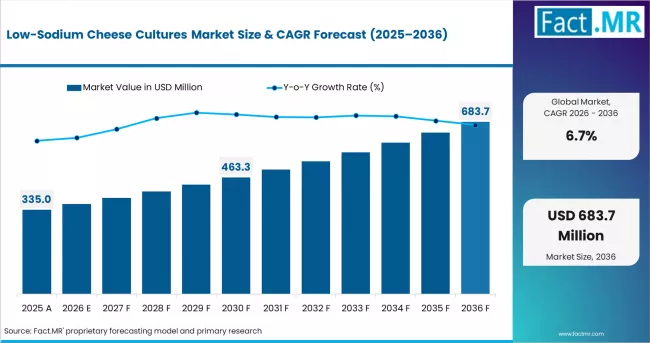
Low Sodium Cheese Cultures Market Market Value Analysis | Source: Fact.MR
Low-Sodium Cheese Cultures Market
| Metric | Details |
|---|---|
| Industry Size (2026E) | USD 335 million |
| Industry Value (2036F) | USD 640 million |
| CAGR (2026 to 2036) | 6.7% |
Source: Fact.MR analysis. Updated Apr 24, 2026
Summary of Low-Sodium Cheese Cultures Market
- Market Definition
- The low-sodium cheese cultures market comprises microbial starter and adjunct cultures specifically formulated to enable cheese production with reduced sodium content while maintaining fermentation performance, flavor profile, microbial stability, and texture structure. These cultures are used in natural and processed cheese manufacturing to support sodium reduction initiatives aligned with nutrition guidelines and reformulation strategies across dairy processing industries.
- Demand Drivers
- Increasing regulatory and public health focus on sodium reduction in processed foods encouraging reformulation of cheese products.
- Rising demand for functional dairy ingredients capable of maintaining flavor intensity despite reduced salt concentration.
- Expansion of processed and specialty cheese manufacturing requiring microbial cultures optimized for controlled fermentation performance.
- Growing adoption of culture blends capable of improving microbial stability in reduced sodium environments with higher water activity.
- Increased R&D investment by dairy processors focused on maintaining texture and maturation behavior in low-salt cheese matrices.
- Rising consumer preference for reduced sodium food formulations supporting long-term ingredient innovation in cultured dairy products.
- Key Segments Analyzed
- Culture Type: Lactic acid bacteria cultures lead with 43% share due to central role in acidification kinetics and fermentation stability in reduced sodium cheese processing.
- Function: Flavor development dominates with 36% share reflecting requirement for cultures capable of compensating for sensory intensity reduction caused by lower salt concentration.
- Application: Cheddar and semi-hard cheese represent key application categories due to structured fermentation processes requiring stable microbial performance.
- Geography: China and India demonstrate higher growth rates supported by expansion of processed dairy manufacturing, while the United States, Germany, and the United Kingdom reflect reformulation-driven demand patterns.
- Analyst Opinion at Fact MR
- Shambhu Nath Jha, Principal Consultant, Fact MR, opines, 'In this updated edition of the Low-Sodium Cheese Cultures Market report, industry participants observe a specialized fermentation ingredient segment shaped by sodium reduction targets across processed dairy formulations. Market participants are aligning microbial strain development strategies with fermentation efficiency requirements and sensory profile preservation in reduced salt environments. Demand patterns indicate increasing reliance on adjunct and protective cultures capable of stabilizing microbial balance and supporting flavor complexity across cheese maturation processes. Competitive positioning is influenced by strain performance consistency, compatibility with industrial cheese production conditions, and ability to maintain product quality through 2036.'
- Strategic Implications/Executive Takeaways
- Strengthen development of microbial strain blends capable of maintaining fermentation stability under reduced sodium concentration conditions.
- Expand R&D capability supporting optimization of proteolysis and lipolysis pathways contributing to balanced flavor formation.
- Improve formulation compatibility of adjunct cultures supporting microbial stability across extended shelf life requirements.
- Support development of customized culture solutions aligned with processed cheese and semi-hard cheese production workflows.
- Maintain regulatory compliance alignment with sodium reduction guidelines influencing dairy product reformulation strategies.
- Enhance technical collaboration with cheese manufacturers improving consistency of texture and sensory characteristics in low-sodium variants.
- Methodology
- Built on primary interviews with dairy culture manufacturers, fermentation technologists, cheese processors, and ingredient distributors.
- Benchmarked against dairy production statistics, sodium reduction policy frameworks, and functional ingredient adoption trends across cheese manufacturing.
- Applied hybrid market sizing model combining supplier revenue analysis with top down evaluation of reduced sodium dairy formulation demand.
- Validated through triangulation using technical literature, microbial strain data, and supplier product documentation.
- Periodically updated to reflect regulatory nutrition targets, fermentation technology improvements, and evolving demand for functional dairy ingredients.
A CAGR of 6.7%, with market value rising from USD 335 million to USD 640 million, suggests moderate peak-to-trough variation within a steadily expanding functional dairy ingredient segment. Demand is supported by sodium reduction targets in processed foods and reformulation activity among cheese producers, while fluctuations may occur due to culture performance variability, cost sensitivity among manufacturers, and labeling compliance requirements across regional food safety frameworks.
China records the fastest growth at 7.9%, supported by increasing production of reduced-salt dairy formulations for processed cheese applications. India follows at 7.5%, driven by rising demand for functional dairy ingredients used in controlled sodium content cheese variants. The United Kingdom shows 7.3% growth, linked to reformulation activity aligned with salt reduction targets in packaged foods. Germany at 7.1% and the United States at 6.7% represent mature markets where demand is largely replacement-driven due to stable consumption of established cheese product formats. A structural constraint across mature markets is sensory profile stability requirements, which limits rapid reformulation of traditional cheese varieties.
Segmental Analysis
Low-Sodium Cheese Cultures Market Analysis by Culture Type
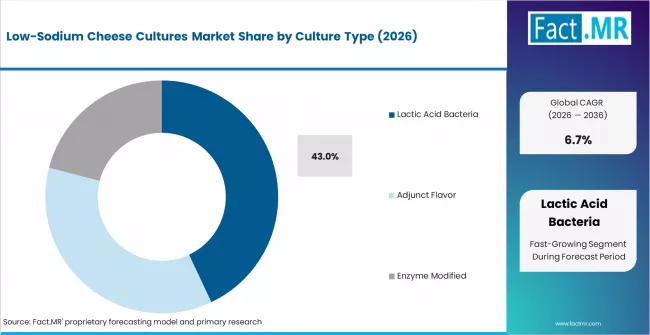
Low Sodium Cheese Cultures Market Analysis By Culture Type | Source: Fact.MR
- Market Overview: Lactic acid bacteria cultures are projected to hold 43% share of the low-sodium cheese cultures market in 2026. Dominance reflects the functional role of bacterial strains in regulating acidification kinetics and maintaining microbial stability in cheese formulations where sodium reduction alters traditional preservation dynamics. Culture selection strategies prioritize strains capable of compensating for reduced salt activity while maintaining consistent fermentation performance.
- Demand Drivers:
- Fermentation Control: Lactic acid bacteria enable controlled acid production, supporting texture formation and microbial balance in reduced-sodium cheese processing environments.
- Microbial Stability: Selected bacterial strains support preservation performance by limiting growth of spoilage organisms typically inhibited through sodium concentration.
- Process Consistency: Culture suppliers develop strain blends designed to maintain predictable fermentation curves across varying milk compositions and standardized industrial cheese production conditions.
Low-Sodium Cheese Cultures Market Analysis by Function
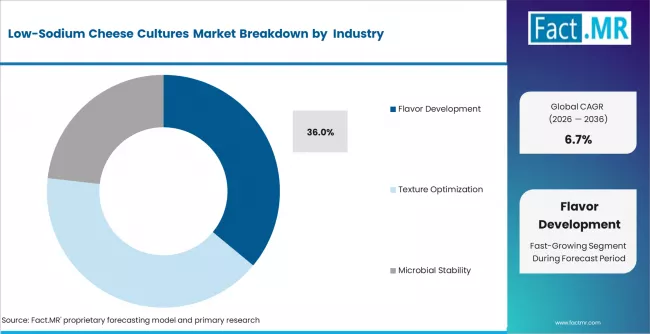
Low Sodium Cheese Cultures Market Analysis By Function | Source: Fact.MR
- Market Overview: Flavor development is estimated to account for 36% share in 2026, reflecting the requirement for culture systems capable of compensating for taste reduction associated with lower sodium concentration in cheese formulations. Enzymatic activity of selected cultures supports formation of characteristic aromatic and savory profiles expected across diverse cheese categories.
- Demand Drivers:
- Taste Profile Compensation: Enzymatic pathways associated with culture metabolism support generation of volatile flavor compounds that enhance sensory perception in reduced-sodium cheese variants.
- Consumer Reformulation Demand: Food producers prioritize culture systems capable of maintaining familiar taste characteristics while aligning with sodium reduction formulation targets.
- Strain Optimization: Ingredient developers select culture strains demonstrating controlled proteolysis and lipolysis activity to maintain balanced flavor development across aging and maturation stages.
Key Dynamics
Low-Sodium Cheese Cultures Market Drivers, Restraints, and Opportunities
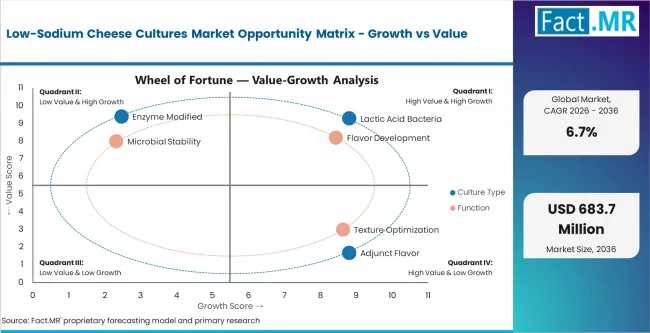
Low Sodium Cheese Cultures Market Opportunity Matrix Growth Vs Value | Source: Fact.MR
Fact MR analysis indicates the market reflects a transitioning functional culture segment shaped by structural pressure to reformulate processed dairy products with reduced sodium content while maintaining microbial stability and flavor development. Market size exists because sodium chloride plays a technical role in regulating fermentation kinetics, moisture control, and microbial inhibition, creating formulation complexity when salt levels are reduced. The current valuation reflects increased R&D investment by dairy processors seeking starter cultures and adjunct bacterial strains capable of maintaining texture and shelf stability in reduced-salt cheese matrices.
Current dynamics show declining reliance on conventional starter cultures optimized for standard sodium concentrations, while demand increases for tailored cultures that compensate for higher water activity and altered proteolysis behavior in reduced-sodium formulations. Specialty cultures command higher per-unit pricing due to strain selection and fermentation optimization requirements, offsetting moderate production volumes. The market reflects a structural shift where health-driven reformulation increases ingredient value intensity despite incremental adoption across mainstream cheese categories.
- Public Health Reformulation: WHO sodium reduction initiatives and front-of-pack labeling frameworks are encouraging dairy processors to adopt culture systems that maintain taste while lowering sodium content in processed foods.
- Europe Innovation Base: Western European dairy producers are leading adoption due to regulatory pressure and established expertise in microbial culture engineering for specialty cheese variants.
- Functional Culture Premium: Adjunct cultures designed to manage bitterness and proteolysis in low-salt environments increase formulation cost per kilogram while stabilizing product quality.
Regional Analysis
The low-sodium cheese cultures market is assessed across Asia Pacific, Europe, and North America, segmented by country-level demand for reduced-sodium dairy cultures used in processed cheese, natural cheese fermentation, and functional dairy formulation. Regional demand reflects clean label preferences, sodium reduction guidelines, and dairy product reformulation initiatives. The full report offers market attractiveness analysis.
.webp "Top Country Growth Comparison Low Sodium Cheese Cultures Market Cagr (2026 2036)")
Top Country Growth Comparison Low Sodium Cheese Cultures Market Cagr (2026 2036) | Source: Fact.MR
CAGR Table
| Country | CAGR (2026–2036) |
|---|---|
| China | 7.9% |
| India | 7.5% |
| United Kingdom | 7.3% |
| Germany | 7.1% |
| United States | 6.7% |
Source: Fact.MR analysis. Updated Apr 24, 2026
Source: Fact MR analysis, based on proprietary forecasting model and primary research
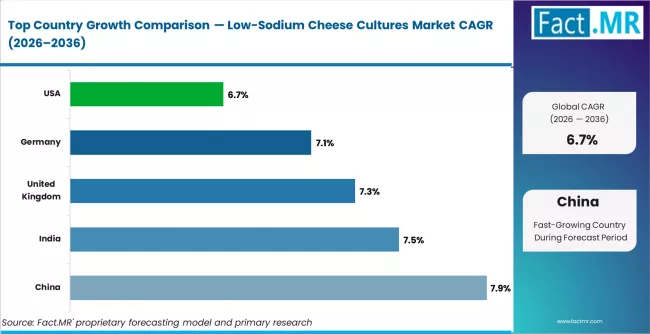
Low Sodium Cheese Cultures Market Cagr Analysis By Country | Source: Fact.MR
Asia Pacific
Asia Pacific functions as the dairy reformulation growth hub supported by rising demand for functional dairy products and sodium reduction initiatives in processed food manufacturing. Chr. Hansen Holding A/S strengthens reduced-sodium culture strain development capability. Sacco System expands dairy fermentation culture portfolio depth. DSM-Firmenich supports functional microbial ingredient innovation.
- China: China is projected to record 7.9% CAGR in low-sodium cheese cultures through 2036. National Nutrition Plan update (National Health Commission, January 2023) supports sodium reduction targets in processed foods. Chr. Hansen expanded dairy culture application research collaboration (June 2023).
- India: India is expected to observe 7.5% CAGR in low-sodium cheese cultures through 2036. Eat Right India initiative expansion (FSSAI, March 2023) promotes reduced sodium food reformulation. DSM-Firmenich expanded microbial culture development capability (May 2023).
Europe
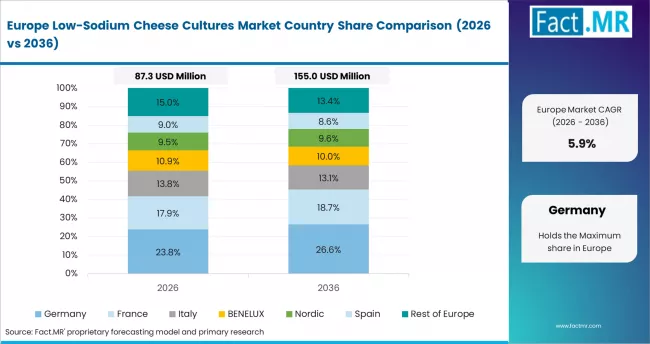
Low Sodium Cheese Cultures Market Europe Country Market Share Analysis, 2026 & 2036 | Source: Fact.MR
Europe operates as the dairy culture regulatory laboratory supported by structured food safety frameworks and reformulation requirements targeting salt reduction in processed dairy products. Chr. Hansen Holding A/S strengthens specialty culture strain optimization expertise. Sacco System expands fermentation culture innovation capability. DSM-Firmenich supports functional dairy ingredient development.
- United Kingdom: The United Kingdom is anticipated to expand at 7.3% CAGR in low-sodium cheese cultures through 2036. UK salt reduction programme update (Public Health England, February 2023) supports lower sodium dairy reformulation. Sacco System expanded culture strain application trials (April 2023).
- Germany: Germany is forecast to grow at 7.1% CAGR in low-sodium cheese cultures through 2036. National Reduction Strategy for sugar and salt update (Federal Ministry of Food and Agriculture, January 2023) supports reduced sodium dairy formulation targets. Chr. Hansen strengthened fermentation culture optimization research (March 2023).
North America
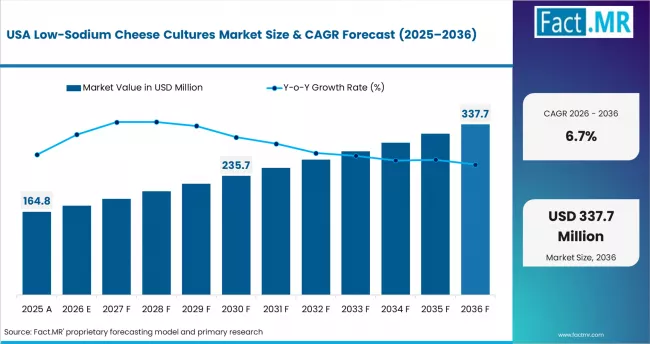
Low Sodium Cheese Cultures Market Country Value Analysis | Source: Fact.MR
North America functions as the clean label dairy formulation center supported by consumer preference for reduced sodium processed foods and functional ingredient adoption in cheese manufacturing. International Flavors & Fragrances Inc. strengthens microbial culture development capability. DSM-Firmenich expands functional ingredient portfolio depth. Chr. Hansen Holding A/S supports dairy fermentation innovation.
- United States: The United States is projected to register 6.7% CAGR in low-sodium cheese cultures through 2036. FDA voluntary sodium reduction guidance update (October 2023) supports reformulation of processed dairy products. International Flavors & Fragrances Inc. expanded microbial culture product development capability (June 2023).
Fact MR's analysis of low-sodium cheese cultures market in global regions consists of country-wise assessment that includes China, India, United Kingdom, Germany, and United States. Readers can find dairy reformulation trends, sodium reduction initiatives, fermentation innovation developments, and competitive culture strain positioning insights.
Competitive Landscape
What is the Competitive Structure of the Low-Sodium Cheese Cultures Market?
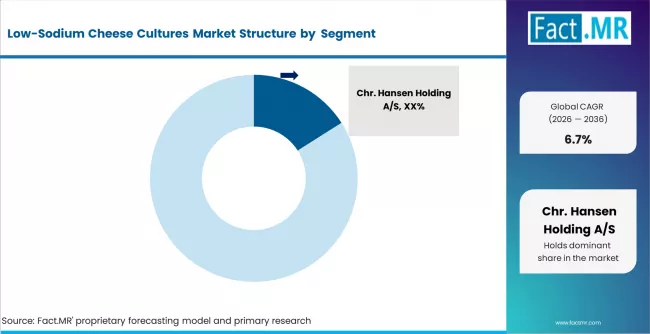
Low Sodium Cheese Cultures Market Analysis By Company | Source: Fact.MR
The Low-Sodium Cheese Cultures Market reflects a moderately concentrated competitive structure, supported by a limited group of microbial culture developers with expertise in dairy fermentation technologies. Leading companies including Chr. Hansen Holding A/S, DSM Firmenich AG, DuPont Nutrition and Biosciences (IFF), Lallemand Inc., Kerry Group plc, and Sacco System S.r.l. collectively account for nearly 60–70% of global market share, particularly in functional starter cultures designed to maintain flavor balance under reduced sodium formulations. Competitive positioning is primarily determined by culture stability, salt tolerance performance, flavor development consistency, and compatibility with industrial cheese processing conditions. High technical entry barriers related to microbial strain development and fermentation optimization restrict rapid participation by new suppliers, reinforcing the presence of established biotechnology firms with validated culture portfolios.
Structural advantages are observed among companies possessing proprietary microbial strain libraries and long-term relationships with dairy processors. Chr. Hansen Holding A/S and DSM Firmenich AG benefit from advanced fermentation expertise and established supply agreements with industrial cheese manufacturers seeking sodium reduction solutions without compromising texture and taste. Buyers typically manage supplier dependency through qualification of equivalent starter cultures and performance benchmarking across multiple vendors. Procurement decisions often consider fermentation efficiency, shelf-life stability, and sensory outcome consistency across batch production cycles. Pricing power remains relatively balanced, though suppliers retain moderate leverage where proprietary culture strains and formulation validation create switching constraints for cheese producers implementing reduced sodium product strategies.
Key Players of the Low-Sodium Cheese Cultures Market
- Chr. Hansen Holding A/S
- DSM Firmenich AG
- DuPont Nutrition and Biosciences (IFF)
- Sacco System S.r.l.
- CSK Food Enrichment B.V.
- Lallemand Inc.
- Biochem SRL
- Kerry Group plc
- Dalton Biotechnologies Ltd.
- Meito Sangyo Co. Ltd.
Bibliographies
- [1] National Health Commission (China). (2023, January). National Nutrition Plan update.
- [2] Food Safety and Standards Authority of India. (2023, March). Eat Right India initiative expansion.
- [3] Public Health England. (2023, February). UK salt reduction programme update.
- [4] Federal Ministry of Food and Agriculture (Germany). (2023, January). National Reduction Strategy for sugar and salt update.
- [5] U.S. Food and Drug Administration. (2023, October). Voluntary sodium reduction guidance update.
- [6] Chr. Hansen Holding A/S. (2023, June). Dairy culture application research collaboration expansion.
- [7] DSM-Firmenich AG. (2023, May). Microbial culture development capability expansion.
- [8] Sacco System S.r.l. (2023, April). Culture strain application trials expansion.
- [9] International Flavors & Fragrances Inc. (2023, June). Microbial culture product development capability expansion.
- [10] Kerry Group plc. (2023). Functional microbial ingredient innovation expansion.
This Report Addresses
- Market size estimation and revenue forecasts from 2026 to 2036, supported by validated dairy fermentation capacity benchmarks and functional culture adoption trends across cheese manufacturing systems.
- Growth opportunity mapping across lactic acid bacteria cultures, adjunct cultures, and enzyme-modified strains aligned with sodium reduction formulation requirements in processed and natural cheese categories.
- Segment and regional revenue forecasts covering culture types, functional roles, and cheese applications including cheddar, mozzarella, processed cheese, specialty cheese, and cream cheese production systems.
- Competition strategy assessment including microbial strain development capability benchmarking and evaluation of fermentation performance stability across reduced sodium dairy processing environments.
- Regulatory impact analysis covering sodium reduction guidelines, front-of-pack labeling frameworks, and food safety compliance standards influencing functional culture adoption in dairy processing.
- Market report delivery in PDF, Excel, PPT, and structured data formats designed for dairy processors, fermentation specialists, and ingredient procurement teams.
Supply chain vulnerability assessments identifying concentration risks in microbial strain libraries, fermentation media production capacity, and cold-chain distribution networks supporting functional dairy cultures.
Low-Sodium Cheese Cultures Market Definition
The low-sodium cheese cultures market refers to microbial starter cultures specifically designed to support cheese production with reduced sodium content. These cultures maintain fermentation efficiency, texture, and flavor despite lower salt levels. They are used by dairy manufacturers producing healthier cheese formulations for retail, foodservice, and functional nutrition applications.
Low-Sodium Cheese Cultures Market Inclusions
The report covers global and regional market size assessment and forecast outlook across the defined study period. It includes segmentation by culture type such as mesophilic and thermophilic strains, application across natural and processed cheese categories, and end users including dairy processors and specialty cheese manufacturers. Pricing trends, supply chain structure, and trade flow dynamics are also evaluated.
Low-Sodium Cheese Cultures Market Exclusions
The scope excludes standard cheese starter cultures not specifically optimized for sodium reduction, as well as finished cheese products sold directly to consumers. It does not include salt substitutes, flavor enhancers, or non-microbial processing aids unless integrated within culture formulations. Adjacent dairy ingredients such as enzymes and stabilizers are excluded from core analysis.
Low-Sodium Cheese Cultures Market Research Methodology
- Primary Research: Interviews were conducted with dairy culture manufacturers, fermentation specialists, cheese processors, and ingredient distributors involved in reduced-sodium dairy formulation.
- Desk Research: Public sources including dairy science journals, culture supplier technical literature, regulatory food guidelines, and trade publications were reviewed to assess formulation trends and adoption patterns.
- Market-Sizing and Forecasting: A hybrid approach combining bottom-up supplier revenue evaluation and top-down assessment of reduced-sodium dairy demand was applied to estimate market size and growth outlook.
- Data Validation and Update Cycle: Findings were verified through triangulation using technical publications, supplier product data, and expert consultation. Updates reflect changes in nutrition regulations, sodium reduction initiatives, and formulation advances in cultured dairy products.
Segmentation
Report Scope
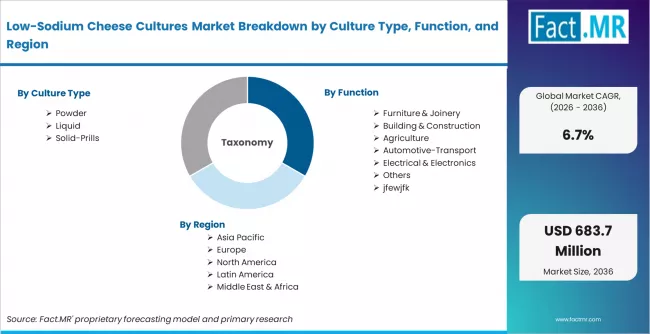
Low Sodium Cheese Cultures Market Breakdown By Culture Type, Function, And Region | Source: Fact.MR
| Metric | Value |
|---|---|
| Quantitative Units | USD 335 million (2026) to USD 640 million (2036), at a CAGR of 6.7% |
| Market Definition | The low-sodium cheese cultures market includes microbial cultures and enzyme systems used to produce cheese with reduced sodium content while maintaining flavor profile, texture structure, and microbial stability. These cultures support sodium reduction strategies in dairy processing through controlled fermentation activity, flavor compound development, and preservation performance across natural and processed cheese varieties. |
| Culture Type Segmentation | Lactic acid bacteria cultures, Adjunct flavor cultures, Protective cultures, Enzyme-modified cultures |
| Application Segmentation | Cheddar and semi-hard cheese, Mozzarella and fresh cheese, Processed cheese, Specialty cheese, Cream cheese |
| Function Segmentation | Flavor development, Texture optimization, Microbial stability, Salt reduction enhancement |
| Regions Covered | North America, Latin America, Europe, East Asia, South Asia, Oceania, Middle East and Africa |
| Countries Covered | United States, Canada, Mexico, Brazil, Argentina, Germany, France, United Kingdom, Italy, Spain, China, India, Japan, South Korea, Indonesia, Australia, and 40+ countries |
| Key Companies Profiled | Chr. Hansen Holding A/S, DSM Firmenich AG, DuPont Nutrition and Biosciences (IFF), Sacco System S.r.l., CSK Food Enrichment B.V., Lallemand Inc., Biochem SRL, Kerry Group plc, Dalton Biotechnologies Ltd., Meito Sangyo Co. Ltd. |
| Forecast Period | 2026 to 2036 |
| Approach | Hybrid top-down and bottom-up market estimation validated through primary interviews with dairy ingredient suppliers, cheese manufacturers, fermentation technology providers, and food formulation specialists, supported by production volume analysis, regulatory sodium reduction guidelines assessment, and benchmarking of microbial culture adoption across commercial cheese processing facilities |
Source: Fact.MR analysis. Updated Apr 24, 2026
Low Sodium Cheese Cultures Market Key Segments
-
Culture Type:
- Lactic Acid Bacteria Cultures
- Adjunct Flavor Cultures
- Protective Cultures
- Enzyme Modified Cultures
-
Application:
- Cheddar and Semi Hard Cheese
- Mozzarella and Fresh Cheese
- Processed Cheese
- Specialty Cheese
- Cream Cheese
-
Function:
- Flavor Development
- Texture Optimization
- Microbial Stability
- Salt Reduction Enhancement
-
Region:
- North America
- USA
- Canada
- Mexico
- Europe
- Germany
- UK
- France
- Italy
- Spain
- Nordic Countries
- BENELUX
- Rest of Europe
- Asia Pacific
- China
- Japan
- South Korea
- India
- Australia
- Rest of Asia Pacific
- Latin America
- Brazil
- Argentina
- Rest of Latin America
- Middle East and Africa
- Kingdom of Saudi Arabia
- United Arab Emirates
- South Africa
- Rest of Middle East and Africa
- Other Regions
- Oceania
- Central Asia
- Other Markets
- North America
Frequently Asked Questions
How large is the demand for Low Sodium Cheese Cultures in the global market in 2026?
What will be the market size of Low Sodium Cheese Cultures in the global market by 2036?
What is the expected demand growth for Low Sodium Cheese Cultures in the global market between 2026 and 2036?
Which Culture Type is poised to lead global demand by 2026?
What is Driving Low Sodium Cheese Culture Demand in China?
What is the China Growth Outlook in this Report?
What is Driving Low Sodium Cheese Culture Demand in India?
What is the India Growth Outlook in this Report?
What is Driving Low Sodium Cheese Culture Demand in the United Kingdom?
What is the United Kingdom Growth Outlook in this Report?
What is Driving Low Sodium Cheese Culture Demand in Germany?
What is the Germany Growth Outlook in this Report?
What is Driving Low Sodium Cheese Culture Demand in the United States?
What is the United States Growth Outlook in this Report?
Which Companies are Identified as Leading Participants in the Low Sodium Cheese Cultures Market?
What are Low Sodium Cheese Cultures and What are They Mainly Used For?
What does Low Sodium Cheese Cultures Market Mean in this Report?
What is Included in the Scope of this Low Sodium Cheese Cultures Market Report?
What is Excluded from the Scope of this Report?
What does Market Forecast Mean on this Page?
How is the Low Sodium Cheese Cultures Market Forecast Developed in this Report?
What does Data Validation Approach Mean in this Report?
Who worked on this report


Preview the report firsthand - request a free sample
Free SampleGet the brochure for pricing and purchase details
Download PDF