- Market Value (2025): USD 98.5 Mn
- Estimated Value (2026): USD 108.0 Mn
- Forecast Value (2036): USD 270.0 Mn
- CAGR (2026-2036): 9.6%
What is the Magnetic Booth Panels Market forecast to be worth by 2036?
USD 108.0 million in 2026 to USD 270.0 million by 2036 at 9.6% CAGR.
- The magnetic booth panels market crossed a valuation of USD 98.5 million in 2025 as exhibitors increased spending on reusable booth walls and faster graphic replacement.
- Demand is projected to increase from USD 108.0 million in 2026 to USD 270.0 million by 2036.
- The market is forecast to record 9.6% CAGR from 2026 to 2036. Growth is expected to come from shorter setup windows and repeat use across event programs.
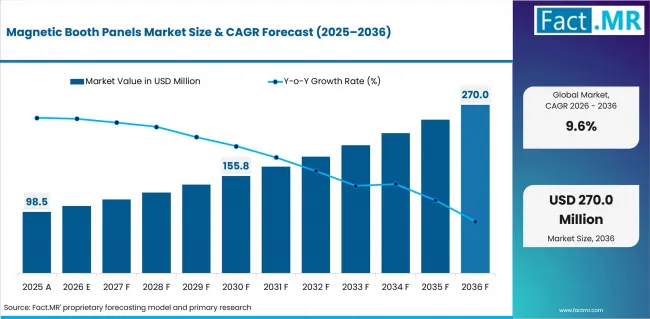
Magnetic Booth Panels Market Value Analysis | Source: Fact.MR
What are the defining numbers behind Magnetic Booth Panels Market growth?
USD 162.0 million absolute opportunity by 2036, led by Magnetic graphic skins and Strip magnets alongside Fast graphic changeouts and Exhibit houses.
- Demand Drivers in the Market
- Rapid graphic changeouts: Event teams need booth surfaces that can be changed without disturbing the frame. Magnetic panels support this need when panels stay aligned after repeated handling.
- Reusable wall programs: Exhibitors gain more value when one wall structure supports several campaigns. Magnetic panels are expected to help when storage, removal and replacement steps are clearly documented.
- Reduced installation labor: Short move-in windows are expected to favor panels that reduce fastening and field adjustment. Crews can work faster when each panel has a visible orientation check.
- Multi-brand booth adaptation: Agencies often need one booth package for several clients. Magnetic interfaces are expected to help when new graphics fit the same frame without extra site work.
- Key Segments Analyzed
- By Panel Type: Magnetic graphic skins are estimated to command 31.0% share in 2026. The lead reflects their fit with fast artwork replacement on reusable booth walls.
- By Magnetic Interface: Strip magnets are projected to hold 33.0% share in 2026. The format is familiar to crews and works across many portable display frames.
- By Use Case: Fast graphic changeouts are expected to account for 34.0% share in 2026. Exhibitors use this format when the message changes more often than the booth structure.
- By Buyer: Exhibit houses are anticipated to capture 31.0% share in 2026. Their role in design, production and installation gives them direct control over panel approval.
- By Booth System Fit: Portable booths are forecast to represent 27.0% share in 2026. Lighter frames gain the clearest benefit from panels that can be carried and reset quickly.
- Analyst Opinion at Fact.MR
- Shambhu Nath Jha, Senior Analyst at Fact.MR, states, "Magnetic booth panels are tested first on holding force and repeatable alignment. Edge condition after several changes is equally important. Event teams need clear limits before they approve a panel package for recurring shows. Service ownership reduces the risk of a problem during setup."
- Strategic Implications
- Event buyers need to test every panel size in its installed position before approving a magnetic booth program. The test must reflect the actual frame, graphic weight and crew process used at the venue.
- Providers can group magnetic skins and rigid panels with rails and attachment parts while keeping them separate from unrelated display equipment. This gives customers a clearer view of the complete booth-wall offer.
- Venue and agency teams benefit from recording panel fit, edge condition and handling instructions before reusing one package across several clients. Clear records make repeat installations easier to control.
UAE is expected to grow at a 10.3% CAGR during the same period. USA is forecast to achieve a 9.6% CAGR through 2036. Japan is anticipated to progress at a 9.5% CAGR over the forecast period. UK is estimated to advance at a 9.3% CAGR. Germany is likely to register a 9.0% CAGR between 2026 and 2036.
How does the Magnetic Booth Panels Market break down by segment?
Magnetic graphic skins are expected to lead Panel Type at 31.0% share in 2026. Strip magnets are projected to lead Magnetic Interface at 33.0% share in 2026.
Why do Magnetic graphic skins lead Panel Type?
Magnetic graphic skins are projected to account for 31.0% share in 2026.
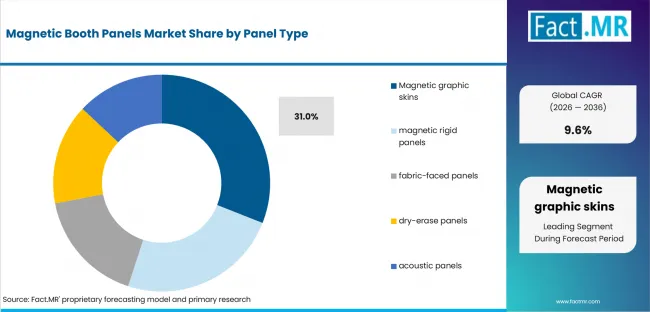
Magnetic Booth Panels Market Analysis By Panel Type | Source: Fact.MR
Their position comes from giving exhibitors more freedom to refresh booth visuals while keeping the main structure unchanged. This reduces redesign work for brands attending several events with different campaigns. The format also suits short installation windows because graphics can be applied without complex tools. Buyers are most likely to approve these skins when print quality remains sharp and the surface does not curl after repeated packing.
Why do Strip magnets lead Magnetic Interface?
Strip magnets hold 33.0% share in 2026.
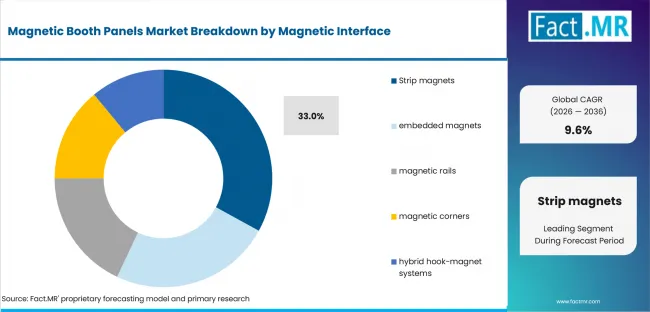
Magnetic Booth Panels Market Analysis By Magnetic Interface | Source: Fact.MR
Strip magnets hold the largest share because they provide continuous support along panel edges instead of relying on isolated contact points. This helps crews maintain a more even connection across wider graphics and rigid sections. Their simple shape also makes replacement and inspection easier during booth preparation. Demand remains strongest where suppliers can prove consistent holding strength across different frame materials and after repeated installation cycles.
Why do Fast graphic changeouts lead Use Case?
Fast graphic changeouts are expected to account for 34.0% share in 2026.
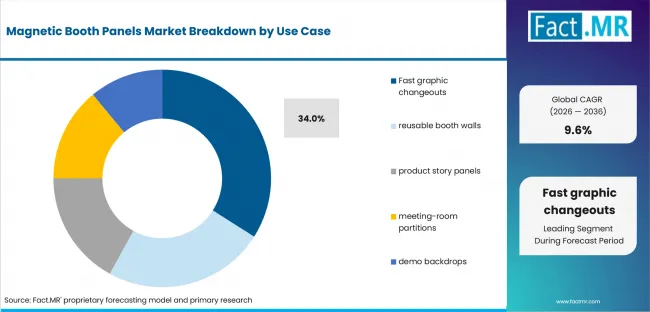
Magnetic Booth Panels Market Analysis By Use Case | Source: Fact.MR
This use case stands out because exhibitors often need to update messages between shows without delaying booth preparation. Magnetic systems allow teams to replace a campaign, product image or regional message within the same wall layout. The value is especially clear for brands managing several event dates close together. Adoption improves when graphics are labelled, packed in order and designed to fit without on-site trimming.
Why do Exhibit houses lead Buyer?
Exhibit houses lead with 31.0% share in 2026.
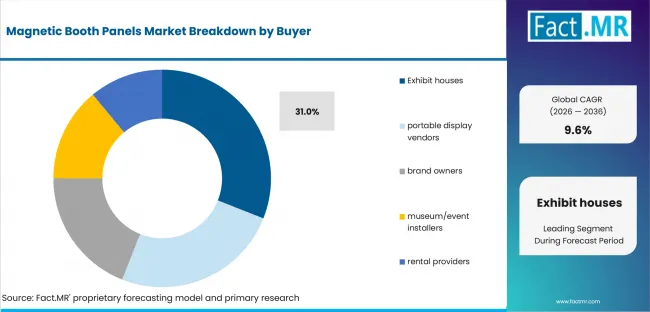
Magnetic Booth Panels Market Analysis By Buyer | Source: Fact.MR
Exhibit houses hold the leading buyer position because they manage both the creative plan and the practical build process. Their teams select materials, confirm compatibility and prepare installation instructions before the booth reaches the venue. They also influence whether a system can be reused across different client programs. This purchasing role gives them more control over repeat orders than brands that source panels only for a single event.
Why do Portable booths lead Booth System Fit?
Portable booths account for 27.0% share in 2026.
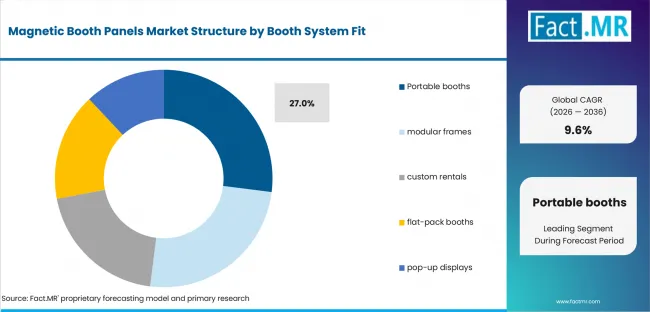
Magnetic Booth Panels Market Analysis By Booth System Fit | Source: Fact.MR
Portable booths gain the strongest fit because their value depends on quick movement, limited packing space and simple assembly. Magnetic panels support these needs by reducing the number of separate clips, screws and fastening tools carried between venues. The format is particularly useful for smaller teams handling their own setup. Performance is judged mainly by whether the panels remain straight after transport and attach correctly without repeated adjustment.
What is accelerating Magnetic Booth Panels Market adoption, and what is holding it back?
Demand will grow as exhibitors need faster graphic updates and reusable booth walls. Adoption may slow because magnetic strength can vary and repeated removal can damage panel surfaces.
Drivers Impact Analysis
| DRIVER | (~) % IMPACT ON CAGR | GEOGRAPHIC RELEVANCE | IMPACT TIMELINE |
|---|---|---|---|
| Rapid graphic changeouts | +2.6% | China and UAE | Short term (<=2 years) |
| Reusable wall programs | +2.0% | Mature exhibition markets | Short term (<=2 years) |
| Reduced installation labor | +1.5% | Global | Medium term (2-4 years) |
| Multi-brand booth adaptation | +1.1% | North America and Europe | Medium term (2-4 years) |
Source: Fact.MR analysis. Updated Jul 28, 2026
- Rapid graphic changeouts: Campaign messages often change while booth frames remain usable. Magnetic panels are expected to support demand when exhibitors can refresh graphics without rebuilding the wall.
- Reusable wall programs: Repeat event schedules make reusable structures more valuable. This driver is strongest when the same panels can be removed, stored and reinstalled with visible quality checks.
- Reduced installation labor: Short setup windows are expected to favor systems that reduce fastening steps. The driver matters most when crews can finish changeovers with fewer field adjustments.
- Multi-brand booth adaptation: Agencies need display packages that can serve several brands without starting from a blank structure. Magnetic interfaces support this model when graphics can change while the frame stays in use.
Opportunity Impact Analysis
| OPPORTUNITY | (~) % IMPACT ON CAGR | GEOGRAPHIC RELEVANCE | IMPACT TIMELINE |
|---|---|---|---|
| Acoustic magnetic panels | +1.7% | Germany and Japan | Short term (<=2 years) |
| Standard magnetic alignment grids | +1.2% | China and UAE | Medium term (2-4 years) |
| Printed skin subscription services | +0.9% | USA and UK | Medium term (2-4 years) |
Source: Fact.MR analysis. Updated Jul 28, 2026
- Acoustic magnetic panels: Acoustic surfaces are expected to add value where meeting areas or demo zones need quieter spaces. Providers still need to prove that the added panel weight does not weaken grip.
- Standard magnetic alignment grids: Alignment grids are expected to create an upgrade route for repeat users. The opportunity is strongest when crews can check placement quickly and correct errors before the show opens.
- Printed skin subscription services: Subscription programs are expected to support recurring artwork replacement. Customers are likely to accept the model when the provider manages print fit and replacement timing.
Restraints Impact Analysis
| RESTRAINT | (~) % IMPACT ON CAGR | GEOGRAPHIC RELEVANCE | IMPACT TIMELINE |
|---|---|---|---|
| Holding-force variation | -1.8% | Highly regulated venues | Short term (<=2 years) |
| Surface damage from repeated removal | -1.3% | Global | Medium term (2-4 years) |
| Compatibility across booth systems | -1.0% | Cost-sensitive regional markets | Short term (<=2 years) |
Source: Fact.MR analysis. Updated Jul 28, 2026
- Holding-force variation: Magnetic panels lose appeal when customers cannot predict how firmly the surface holds across orientations. Acceptance improves when providers define size limits and installed-position tests.
- Surface damage from repeated removal: Repeated handling can weaken the economic case if graphic edges curl or scratch. Packaging, removal instructions and replacement thresholds are expected to reduce this risk.
- Compatibility across booth systems: Different frame designs can create fit uncertainty for magnetic panels. Providers can reduce the restraint by publishing compatibility checks and escalation steps.
Which countries are scaling Magnetic Booth Panels Market fastest?
The country comparison is defined by the distance between China and Germany instead of a single adoption story. China and UAE track above the global 9.6% CAGR. USA and Japan remain close to the global benchmark. UK and Germany track below it. The spread from China to Germany is 1.8% points. Differences reflect event frequency and the level of proof exhibitors need before approving reusable magnetic wall packages.
- UAE remains close to China because high event throughput rewards faster surface replacement and stronger site support. International participation raises the need for booth packages that adapt across brands.
- USA stays aligned with the global CAGR because exhibitors compare display decisions against event outcomes. Magnetic panels are expected to gain attention where changeout speed can support program efficiency.
- Japan records a measured position because compact booth layouts make attachment quality visible quickly. Providers need clear orientation tests before smaller displays rely on magnetic skins or rigid panels.
- UK demand is supported by recurring exhibitions and a broad exhibitor base. Growth remains below UAE because purchasing is expected to depend more on service quality.
- Germany tracks the slowest listed CAGR because venue routines and technical expectations raise the proof burden. Customers are expected to require cleaner documentation around holding force and frame fit.
Comparable CAGRs can therefore produce different market entry conditions across these countries. Deployment timing depends on event frequency, local service readiness and evidence that panels remain aligned after repeated handling.
The full report provides country-level CAGR analysis across North America; Latin America; Europe; East Asia; South Asia & Oceania; and the Middle East & Africa.
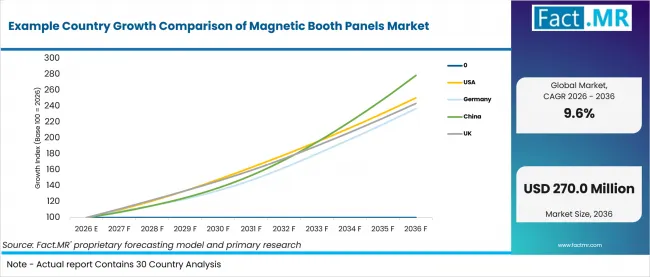
Example Country Growth Comparison Of Magnetic Booth Panels Market | Source: Fact.MR
| Country | CAGR (2026-2036) |
|---|---|
| UAE | 10.3% |
| USA | 9.6% |
| Japan | 9.5% |
| UK | 9.3% |
| Germany | 9.0% |
Source: Fact.MR analysis. Updated Jul 28, 2026
Why is event turnover accelerating UAE demand?
10.3% CAGR, driven by event throughput and international participation.
UAE demand is shaped by a dense event calendar, international exhibitors and short venue setup windows. Magnetic panels help suppliers refresh graphics quickly across multi-brand booths without rebuilding the main wall system. This flexibility is valuable when campaigns change between closely scheduled events. Market growth will also depend on local service capacity, prepared panel surfaces and fast replacement support. Providers that can manage last-minute changes while maintaining a clean finish are likely to gain stronger acceptance.
What supports magnetic booth panel adoption in USA?
9.6% CAGR, supported by measurement-led exhibitor procurement.
USA adoption reflects exhibitor demand for measurable performance across regional and national event programs. Magnetic alignment systems become more attractive when they reduce installation time, limit hardware use and preserve graphic quality after removal. Buyers are likely to compare setup records, labor requirements and post-event panel condition before approving wider use. Providers can strengthen their position by standardizing installation steps and showing that the same wall package performs consistently across different venues, crews and booth layouts.
How are compact booth systems shaping Japan’s outlook?
9.5% CAGR, led by compact systems and reliable operation.
Japan's growth is linked to compact booth layouts, careful finishing standards and limited room for installation error. Portable displays and smaller modular frames require magnetic panels that sit evenly without repeated adjustment. This makes panel size, edge fit and attachment strength important buying considerations. Providers can support adoption by testing each panel in its final position and supplying clear handling instructions. Lightweight components and reliable alignment are expected to matter more than broad system complexity in this market.
Which factors are strengthening UK market expansion?
9.3% CAGR, supported by recurring exhibitions and service-led replacement programs.
UK growth is expected to come from exhibitors that reuse booth walls across recurring trade shows and seasonal campaigns. Magnetic skins fit this pattern because artwork can be replaced without changing the complete frame. Subscription-based print and replacement services may support regular refresh cycles when graphics arrive correctly labelled and sized. Adoption will depend on consistent service quality, reliable fit instructions and careful storage between events. Providers that reduce rework during repeat installations are likely to secure longer-term client programs.
Why are technical trade fairs supporting Germany’s growth?
9.0% CAGR, driven by technical trade-fair requirements and documentation-led approval.
Germany's growth reflects strong technical trade-fair activity and a purchasing culture that values documented installation performance. Magnetic booth panels must fit established contractor routines, maintain clean edges and remain stable after several removal cycles. Buyers are likely to prefer systems with clear compatibility records across frames, rails and panel formats. Providers can differentiate repeatable solutions from one-off offers by supplying inspection guidance, load information and surface-care limits that support formal approval before the booth reaches the venue.
Who leads the Magnetic Booth Panels Market?
Nomadic Display and Nimlok show the direct relevance in reusable booth systems. Ultima Displays, Skyline Exhibits and beMatrix add active alternatives across portable displays and modular frames.
Competition is expected to depend on panel fit, repeatable alignment and service support through the forecast period. Customers are likely to compare how each provider manages storage, replacement graphics and booth-system compatibility. Providers with clear installation guides and quick replacement access are expected to gain stronger consideration from exhibit houses and recurring event customers.
Which companies are the key providers?
Key companies include Nomadic Display; Nimlok; Ultima Displays; Skyline Exhibits; and beMatrix.
- Nomadic Display
- Nimlok
- Ultima Displays
- Skyline Exhibits
- beMatrix
Bibliography
- U.S. Geological Survey. (2025). Methodology and technical input for the 2025 U.S. list of critical minerals: Assessing the potential effects of mineral commodity supply chain disruptions on the U.S. economy (Open-File Report 2025–1047).
- Advanced Research Projects Agency–Energy. (2025, August 25). Energy Department announces $60 million to secure domestic critical mineral supply and strengthen magnet manufacturing. U.S. Department of Energy.
- Advanced Materials and Manufacturing Technologies Office. (2025, January 8). DOE announces Phase 1 winners of E-Scrap Prize to advance critical material recovery from electronics waste. U.S. Department of Energy.
- European Climate, Infrastructure and Environment Executive Agency. (2025, April 28). LIFE INSPIREE: Mining for valuable metals in our waste at large scale. European Commission.
- Office for National Statistics. (2025, September 30). Enterprises in the printing industry for 2025.
This Report Answers
- The report provides strategic intelligence on Magnetic Booth Panels Market across Panel Type and Magnetic Interface choices that shape event-display purchasing.
- Segment analysis covers Magnetic graphic skins and Strip magnets as the share leaders within the 2026 market.
- Country outlook evaluates China and UAE alongside USA and Japan. UK and Germany complete the growth comparison across the profiled markets.
- Competitive analysis profiles Nomadic Display and Nimlok alongside Ultima Displays and Skyline Exhibits. beMatrix completes the provider set.
- Use-case assessment covers Fast graphic changeouts and reusable booth walls. Product story panels and meeting-room partitions complete the view alongside demo backdrops.
What does the Magnetic Booth Panels Market cover?
Reusable booth surfaces use magnetic interfaces to attach and replace graphics or functional panels during exhibitions and related business events.
The Magnetic Booth Panels Market covers magnetic skins, rigid panels and attachment systems used as part of a booth-wall package. Coverage extends to fabric-faced panels, dry-erase panels and acoustic panels when the product is built for event use. The market includes portable and modular booth systems where quick panel replacement is part of the customer need.
The market differs from general display equipment because the commercial value comes from reusable wall surfaces that can be refreshed between events. General magnetic signs remain outside the boundary. Office partitions and non-event architectural panels are excluded when they do not serve the booth-wall function.
What is included in the scope?
Magnetic booth panels are used by exhibit houses and portable display vendors. Brand owners, museum or event installers and rental providers are included.
The scope includes Panel Type and Magnetic Interface. Use Case, Buyer and Booth System Fit complete the scope. Coverage spans magnetic graphic skins and magnetic rigid panels. Fabric-faced, dry-erase and acoustic panels are included when they serve a booth-wall purpose. Strip magnets and embedded magnets follow the same use rule. Magnetic rails, magnetic corners and hybrid hook-magnet systems remain included when they serve the booth-wall function.
What is excluded from the scope?
General magnetic signs and office partitions remain outside the scope of this market. Loose printed sheets and non-event architectural panels are excluded.
The scope excludes unrelated venue construction, floor-space rental and general event management services. Loose graphics are excluded when they are not sold with a magnetic booth-panel system. The value of the event, venue or exhibitor business is not counted unless it directly represents the defined panel product.
How Was the Analysis Built?
The analysis draws on 120+ sources; 35+ company portfolios; 25+ countries; and more than 20 industry interviews.
- Primary Research: Primary research includes discussions with manufacturers and service providers. Technology developers, distributors and end users are included. Procurement teams and subject-matter experts help review purchasing priorities and approval requirements.
- Desk Research: Desk research covers government statistics and regulatory publications. Company filings, trade data and technical studies are reviewed. Industry associations and standards help support the bibliography.
- Market Sizing and Forecasting: Market estimates combine historical performance and demand indicators. Pricing and volume trends support the review. Segment shares, company participation and country-level growth are checked before final sizing.
- Data Validation and Update Cycle: Findings are validated by comparing primary interviews with public data. Company activity, regulatory changes and trade patterns are reviewed. Regular updates review product launches and shifts in commercial adoption.
Segmentation
What is the report's scope and coverage?
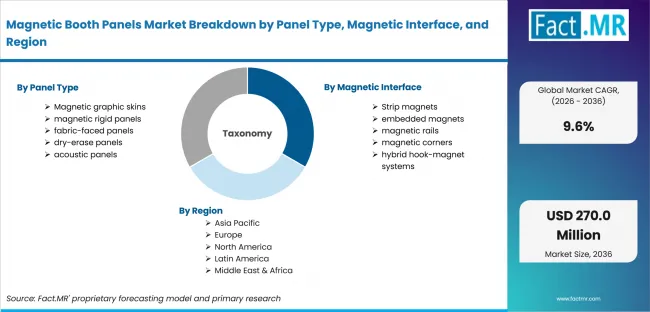
Magnetic Booth Panels Market Breakdown By Panel Type, Magnetic Interface, And Region | Source: Fact.MR
| Attribute | Details |
|---|---|
| Quantitative Units | USD million in 2026 to USD million by 2036 at CAGR |
| Market Definition | Reusable booth surfaces that use magnetic interfaces for quick attachment and replacement of graphics or functional panels when sold as a commercial event solution |
| Panel Type | Magnetic graphic skins; magnetic rigid panels; fabric-faced panels; dry-erase panels; acoustic panels |
| Magnetic Interface | Strip magnets; embedded magnets; magnetic rails; magnetic corners; hybrid hook-magnet systems |
| Use Case | Fast graphic changeouts; reusable booth walls; product story panels; meeting-room partitions; demo backdrops |
| Buyer | Exhibit houses; portable display vendors; brand owners; museum/event installers; rental providers |
| Booth System Fit | Portable booths; modular frames; custom rentals; flat-pack booths; pop-up displays |
| Regions Covered | North America; Latin America; Europe; East Asia; South Asia & Oceania; Middle East & Africa |
| Countries Covered | USA; Canada; Brazil; Mexico; Germany; U.K.; France; Italy; Spain; South Korea; Japan; Australia & New Zealand; GCC Countries; South Africa; UAE |
| Key Companies Profiled | Nomadic Display; Nimlok; Ultima Displays; Skyline Exhibits; beMatrix |
| Forecast Period | 2026 to 2036 |
| Approach | Hybrid top-down and bottom-up approach using panel type demand; magnetic interface use; event schedules; buyer needs; booth system fit; country adoption patterns and company portfolio review |
Source: Fact.MR analysis. Updated Jul 28, 2026
How is the market segmented?
-
By Panel Type:
- Magnetic graphic skins
- magnetic rigid panels
- fabric-faced panels
- dry-erase panels
- acoustic panels
-
By Magnetic Interface:
- Strip magnets
- embedded magnets
- magnetic rails
- magnetic corners
- hybrid hook-magnet systems
-
By Use Case:
- Fast graphic changeouts
- reusable booth walls
- product story panels
- meeting-room partitions
- demo backdrops
-
By Buyer:
- Exhibit houses
- portable display vendors
- brand owners
- museum/event installers
- rental providers
-
By Booth System Fit:
- Portable booths
- modular frames
- custom rentals
- flat-pack booths
- pop-up displays
-
By Region:
- North America
- USA
- Canada
- Latin America
- Brazil
- Mexico
- Rest of Latin America
- Europe
- Germany
- U.K.
- France
- Italy
- Spain
- Rest of Europe
- East Asia
- South Korea
- Japan
- China
- South Asia & Oceania
- India
- Australia & New Zealand
- Rest of South Asia & Oceania
- Middle East & Africa
- GCC Countries
- South Africa
- UAE
- Rest of Middle East & Africa
- North America
Frequently Asked Questions
Which Panel Type leads the Magnetic Booth Panels Market?
Which Magnetic Interface leads the Magnetic Booth Panels Market?
Which Use Case leads the Magnetic Booth Panels Market?
Which Buyer leads the Magnetic Booth Panels Market?
Which Booth System Fit leads the Magnetic Booth Panels Market?
Which country records the highest listed CAGR?
What is the primary driver in the Magnetic Booth Panels Market?
What is the main restraint in the Magnetic Booth Panels Market?
Who worked on this report


Preview the report firsthand - request a free sample
Free SampleGet the brochure for pricing and purchase details
Download PDF