- Market Value (2025): USD 67.3 Mn
- Estimated Value (2026): USD 73.0 Mn
- Forecast Value (2036): USD 165.0 Mn
- CAGR (2026-2036): 8.5%
What is the Manhole Biofilter Market forecast to be worth by 2036?
USD 73.0 million in 2026 to USD 165.0 million by 2036, at 8.5% CAGR from 2026 to 2036.
- The manhole biofilter market was valued at USD 67.3 million in 2025. Demand came from their regular use near sewer access points and lift stations.
- The market is projected to grow from USD 73.0 million in 2026 to USD 165.0 million by 2036. Growth is expected as utilities install small odor-control systems near homes and other busy public areas.
- The market is forecast to expand at an 8.5% CAGR from 2026 to 2036. Regular filter-media replacement and the treatment of hydrogen sulfide without added power are expected to support repeat purchases.
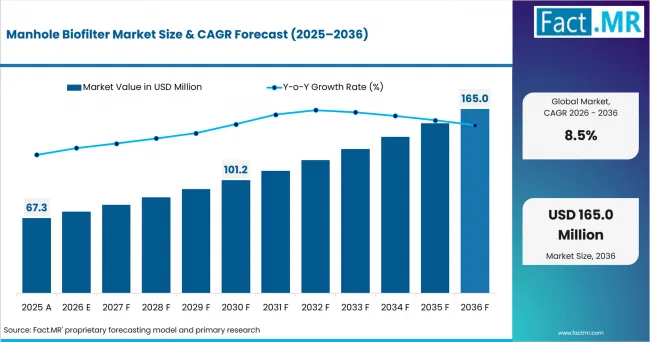
Manhole Biofilter Market Value Analysis | Source: Fact.MR
What are the defining numbers behind Manhole Biofilter Market growth?
USD 92.0 million absolute opportunity by 2036, led by Vent cap biofilter and Compost-based media within their respective segments.
- Demand Drivers in the Market
- A biological filter can be placed below or next to a manhole. This gives utilities a local way to control odor where long air ducts are not practical.
- Sites near homes require quiet systems that stay mostly out of sight. Installation also needs to cause as little disruption as possible.
- Compost-based and specially designed filter materials help control airflow and hold enough moisture for the treatment process. They also support the bacteria that break down the odor-causing gases.
- A clear replacement plan helps the filter keep working after installation. This becomes especially important when moisture levels change with the seasons.
- Key Segments Analyzed
- By Biofilter Format: Vent cap biofilter is expected to hold 35.0% share in 2026 because it creates a defined gas path and keeps the medium accessible for service.
- By Biological Media: Compost-based media is projected to account for 30.0% share in 2026 supported by microbial habitat and practical moisture retention.
- By Gas Target: Hydrogen sulfide is anticipated to capture 49.0% share in 2026 as it is the best-known sewer odor gas and a corrosion concern for collection systems.
- By Application Location: Residential-adjacent manholes are estimated to represent 32.0% share in 2026 since odor complaints are most urgent near homes and foot traffic.
- By Service Model: Media replacement is forecast to account for 38.0% share in 2026 because biological media ages and needs planned renewal.
- Analyst Opinion at Fact.MR
- Shambhu Nath Jha, Senior Analyst at Fact.MR, states, “A biofilter may appear to be a basic system, but its performance depends on steady airflow and enough moisture in the filter material. Utilities are expected to prefer products that let workers check the filter condition easily and complete maintenance without making the job difficult.”
- Strategic Implications
- Before choosing a biofilter, utilities are expected to check the type of gas present and the moisture level at the site. Manhole size alone is not enough to guide product selection.
- Manufacturers are more likely to receive repeat orders when the filter material is easy to replace and maintenance staff can clearly confirm that the work has been completed.
- Service companies are expected to track airflow resistance and signs of odor returning. This helps workers identify a drop in filter performance before nearby residents begin to complain again.
- Engineering consultants are expected to separate sites that can use a passive biofilter from locations with heavier gas loads. High-load sites may require powered airflow or extra hydrogen sulfide control earlier in the sewer system.
Germany is expected to record a 10.0% CAGR from 2026 to 2036, supported by strong experience in biological odor control and rising demand to upgrade older sewer sites. The United Kingdom is projected to post a 9.3% CAGR during the same period as many homes are located close to sewer networks. The United States is anticipated to grow at a 9.2% CAGR because its local sewer systems create many separate odor problem points. France is estimated to expand at an 8.6% CAGR as operators address complaints without installing large equipment above ground. The Netherlands is forecast to post an 8.4% CAGR because pumped sewer networks often create clear locations where odor problems return.
How does the Manhole Biofilter Market break down by segment?
Vent cap biofilter leads at 35.0% by Biofilter Format, while Compost-based media leads at 30.0% by Biological Media in 2026.
Why do vent cap biofilters lead the format mix?
Vent cap biofilters hold 35.0% share in 2026.
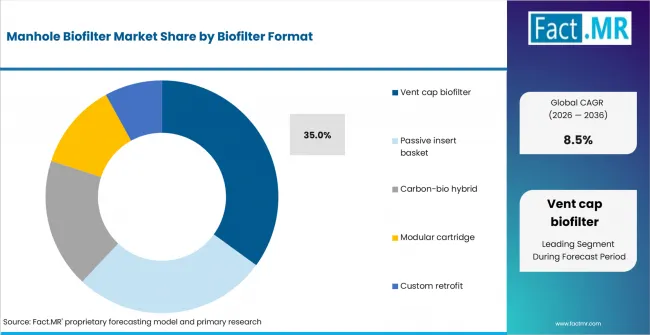
Manhole Biofilter Market Analysis By Biofilter Format | Source: Fact.MR
Vent cap biofilters are projected to lead with 35.0% share in 2026 because they create a controlled gas path while keeping the unit easy to inspect and service. Utilities can install them without changes to the manhole structure, which helps reduce disruption and labour needs. Their compact design also suits locations where above-ground odor equipment is not practical or may attract public concern.
What keeps compost-based media in the leading position?
Compost-based media accounts for 30.0% share in 2026.
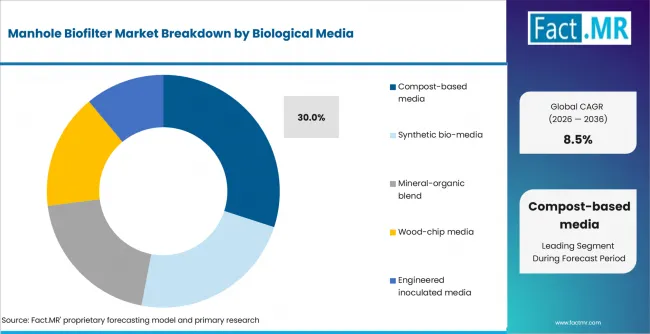
Manhole Biofilter Market Analysis By Biological Media | Source: Fact.MR
Compost-based media is estimated to hold 30.0% share in 2026 due to its ability to retain moisture and support the microorganisms that break down odor-causing gases. The material offers a practical balance between biological activity, availability and operating cost. It is also familiar to many wastewater operators, which makes replacement and routine care easier across municipal systems with limited technical staff or service budgets.
Why is hydrogen sulfide the main treatment target?
Hydrogen sulfide holds 49.0% share in 2026.
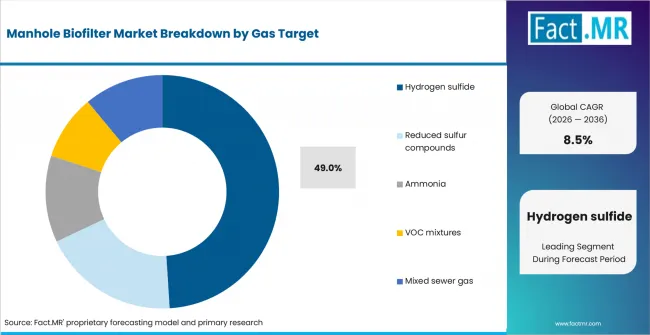
Manhole Biofilter Market Analysis By Gas Target | Source: Fact.MR
Hydrogen sulfide is forecast to account for 49.0% share in 2026 because it creates strong sewer odors and can also damage concrete, metal and equipment. Utilities therefore treat it as both a public complaint issue and an infrastructure risk. Biological biofilters are well suited to locations where hydrogen sulfide appears repeatedly, especially near manholes, force main outlets and other points where wastewater releases trapped gas.
What makes residential-adjacent manholes the leading location?
Residential-adjacent manholes hold 32.0% share in 2026.
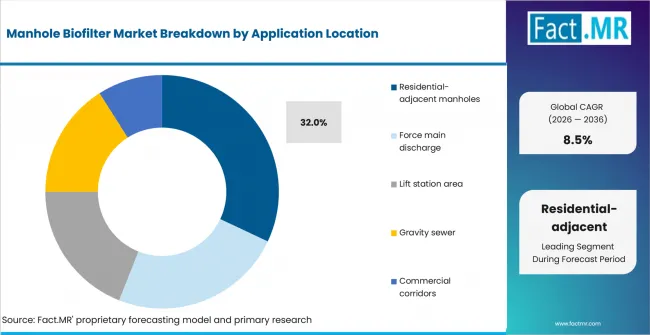
Manhole Biofilter Market Analysis By Application Location | Source: Fact.MR
Residential-adjacent manholes are projected to represent 32.0% share in 2026 because even short odor events near homes, footpaths and streets can lead to repeated complaints. Utilities need a low-profile treatment method that works without adding visible equipment above ground. Biofilters placed at these points help control gas close to its release source while allowing normal access for inspection, cleaning and sewer maintenance.
Why does media replacement lead the service model?
Media replacement holds 38.0% share in 2026.
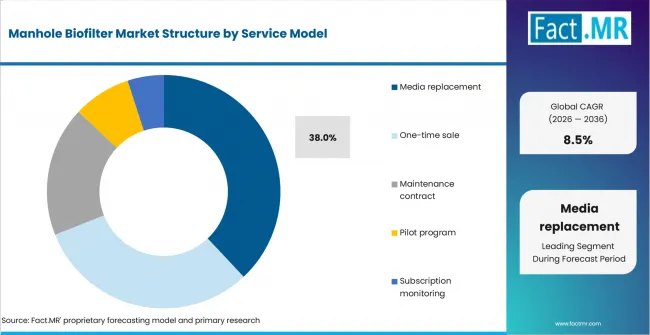
Manhole Biofilter Market Analysis By Service Model | Source: Fact.MR
Media replacement is forecast to generate 38.0% share in 2026 because biological media gradually loses moisture balance, structure and treatment activity during use. Regular replacement helps operators restore odor removal without buying a complete new unit. This service model also creates predictable maintenance cycles for utilities and gives providers recurring work through media supply, condition checks and performance support across installed manhole biofilter systems.
What is accelerating Manhole Biofilter Market adoption, and what is holding it back?
Localized biological odor control is anticipated to drive market growth, while media condition and peak gas loading restrain wider deployment.
Drivers Impact Analysis
| DRIVER | (~) % IMPACT ON CAGR | GEOGRAPHIC RELEVANCE | IMPACT TIMELINE |
|---|---|---|---|
| Residential odor sensitivity | +1.3% | Europe and North America | Short term (<= 2 years) |
| Force-main discharge control | +1.1% | Global | Medium term (2-4 years) |
| Passive biological treatment | +0.9% | Municipal sewer networks | Short term (<= 2 years) |
| Media renewal demand | +0.8% | Germany and United Kingdom | Medium term (2-4 years) |
| Urban sewer expansion | +0.6% | Expanding urban sewer networks | Long term (>= 4 years) |
Source: Fact.MR analysis. Updated Jul 17, 2026
- Residential odor sensitivity: Utilities face direct pressure where manholes sit near homes and commercial streets. Compact biofilters are expected to offer a local intervention without long duct runs.
- Force-main discharge control: Gas release often intensifies when pressurized wastewater returns to gravity flow. Biofilters are projected to gain demand where airflow is disciplined enough for treatment at the vent.
- Passive biological treatment: Passive systems reduce the need for blowers and electrical service at scattered access points. Adoption is anticipated to improve where pressure drop stays low and media remains moist.
- Media renewal demand: Installed units create recurring replacement work because biological media needs moisture and porosity to preserve microbial activity. Renewal revenue is forecast to support service-oriented providers.
- Urban sewer expansion: New sewer access points in dense districts are expected to expand the number of odor locations that need small-footprint treatment.
Opportunity Impact Analysis
| OPPORTUNITY | (~) % IMPACT ON CAGR | GEOGRAPHIC RELEVANCE | IMPACT TIMELINE |
|---|---|---|---|
| Hybrid carbon-biological media | +0.7% | Global | Medium term (2-4 years) |
| Moisture-managed cartridges | +0.6% | Dry and seasonal climates | Short term (<= 2 years) |
| Performance-based maintenance | +0.5% | North America and Europe | Long term (>= 4 years) |
| Tool-free retrofit kits | +0.4% | Asia-Pacific | Short term (<= 2 years) |
Source: Fact.MR analysis. Updated Jul 17, 2026
- Hybrid carbon-biological media: A carbon layer absorbs short peaks while the biological medium handles recurring loading. This design is expected to improve fit at variable sewer vents.
- Moisture-managed cartridges: Media packages that retain enough moisture without flooding are projected to widen the practical operating window across seasonal climates.
- Performance-based maintenance: Contracts tied to inspection and pressure drop are anticipated to replace calendar-only media changes for larger utilities.
- Tool-free retrofit kits: Hanger systems and cartridge designs are expected to shorten field time for crews working in streets and narrow access points.
Restraints Impact Analysis
| RESTRAINT | (~) % IMPACT ON CAGR | GEOGRAPHIC RELEVANCE | IMPACT TIMELINE |
|---|---|---|---|
| Moisture imbalance | -0.6% | Global | Short term (<= 2 years) |
| Cold-weather activity | -0.5% | Northern climates | Medium term (2-4 years) |
| Peak gas loading | -0.4% | Force-main and lift-station sites | Short term (<= 2 years) |
| Media handling burden | -0.3% | Resource-constrained utilities | Long term (>= 4 years) |
Source: Fact.MR analysis. Updated Jul 17, 2026
- Moisture imbalance: Microorganisms need moisture, but standing water blocks airflow and washes nutrients from the bed. Poor moisture control is expected to reduce removal before the planned service date.
- Cold-weather activity: Low temperatures slow biological activity even when the housing remains intact. Northern installations are projected to need design margin and media protection.
- Peak gas loading: Sudden hydrogen sulfide spikes pass through a passive bed faster than microbes respond. Variable sites are anticipated to need hybrid adsorption or upstream sulfide control.
- Media handling burden: Crews need safe access and simple replacement instructions. Adoption is expected to slow where utilities lack staff for recurring field service.
Where is the Manhole Biofilter Market growing?
Germany 10.0%, United Kingdom 9.3%, the United States 9.2%, France 8.6%, Netherlands 8.4%.
Regional analysis covers North America and Europe with country sections for Germany; the United Kingdom; the United States; France; and the Netherlands.
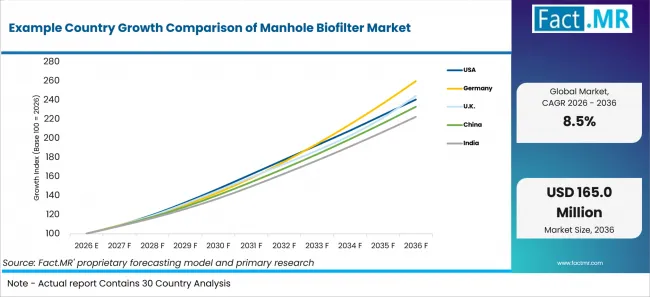
Example Country Growth Comparison Of Manhole Biofilter Market | Source: Fact.MR
| COUNTRY | CAGR (2026 to 2036) |
|---|---|
| Germany | 10.0% |
| United Kingdom | 9.3% |
| United States | 9.2% |
| France | 8.6% |
| Netherlands | 8.4% |
Source: Fact.MR analysis. Updated Jul 17, 2026
Why is Germany the leading manhole biofilter market?
10.0% CAGR, driven by biological odor-control expertise and sewer retrofit work.
German utilities are expected to use compact biological odor-control products where manhole vents sit near housing or public streets. In February 2026, the German Federal Environment Ministry reported that around 97% of wastewater from private households and public facilities is processed in wastewater treatment plants. Procurement is projected to reward documented media stability and quick access during planned wastewater asset maintenance.
What is supporting biofilter deployment in the United Kingdom?
9.3% CAGR, supported by dense housing and compact retrofit needs.
United Kingdom water utilities need odor-control options that fit narrow streets and residential sewer corridors without large visible equipment. Hybrid media is expected to gain attention where rainfall and intermittent gas loads challenge a purely biological bed.
How is manhole biofilter demand developing in the United States?
9.2% CAGR, backed by decentralized collection systems and localized odor points.
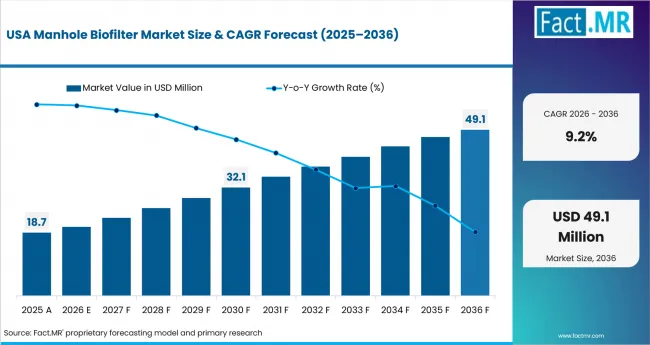
Manhole Biofilter Market Country Value Analysis | Source: Fact.MR
United States municipal utilities often manage force-main discharges and residential odor hot spots across large service areas. The ASCE 2025 Infrastructure Report Card stated that US sewers are worth more than USD 1 trillion and include nearly 17,500 wastewater treatment plants. Trial installations are anticipated to precede broader purchasing where crews need field evidence on media life and service effort.
What is driving French utilities toward manhole biofilters?
8.6% CAGR, led by low-visibility treatment near dense urban locations.
French wastewater operators are expected to use below-cover biofilter inserts where odor complaints occur near housing or heritage areas. Demand in France is forecast at an 8.6% CAGR from 2026 to 2036. Products that service crews handle during routine network visits are projected to fit the operating model of large utility groups.
Why do Dutch networks suit biological odor control?
8.4% CAGR, linked to pumped networks with predictable odor release points.
The Netherlands uses pressure mains and pumping stations that concentrate septic gas release at known access points. Dutch demand is projected at an 8.4% CAGR by 2036. Standardized inserts sized for repeated configurations are expected to support repeatable orders across similar network locations.
Who leads the Manhole Biofilter Market?
Bioteg and RJM Company compete through products made directly for manhole odor control. Continental Carbon Group, COALSI, and Syneco Systems, Inc. add wider experience in biological treatment and wastewater odor control.
The market includes companies that sell manhole biofilters as well as companies with related odor-control products. Bioteg and RJM Company are the closest match for direct manhole systems. Continental Carbon Group and COALSI bring experience in biological air treatment and wastewater filtration. Syneco Systems, Inc. offers another option for controlling odor at sewer access points.
Bioteg focuses on passive biofilters for manholes and vent pipes. Its products are used to reduce sewer odor and hydrogen sulfide. This suits utilities that want to use existing access covers without building a large treatment unit. RJM Company offers a manhole biofilter that can be removed quickly when workers need access. This makes maintenance and inspection easier while keeping odor under control.
Which companies are the key providers?
The company set includes Bioteg and RJM Company alongside Continental Carbon Group, COALSI and Syneco Systems, Inc..
- Bioteg
- RJM Company
- Continental Carbon Group
- COALSI
- Syneco Systems, Inc.
Bibliography
- American Society of Civil Engineers. (2025). Wastewater. In 2025 report card for America’s infrastructure.
- Department for Environment, Food & Rural Affairs. (2026, January 20). A new vision for water: White paper. UK Government.
- Federal Ministry for the Environment, Climate Action, Nature Conservation and Nuclear Safety. (2026, February 11). General information on waste water treatment plants.
- Environment Agency. (2025, July 18). Water and sewerage companies in England: Pollution incident report for 2016 to 2024.
- European Climate, Infrastructure and Environment Executive Agency. (2025, January 24). Bringing urban wastewater back to LIFE.
This Report Addresses
- The report quantifies global market revenue from the 2025 through the 2036 forecast.
- It analyzes Germany; the United Kingdom; the United States; France; and the Netherlands within coverage of 30+ countries.
- It reviews the competitive positions of Bioteg; RJM Company; Continental Carbon Group; COALSI; and Syneco Systems, Inc..
- It compares vent caps and insert baskets with hybrid units; modular cartridges; and custom retrofits.
- It examines residential manholes and force-main discharges alongside lift-station areas; gravity sewers; and commercial corridors.
- It evaluates forecast evidence around sewer expansion and odor sensitivity alongside media replacement and biological operating constraints.
What does the Manhole Biofilter Market cover?
The study follows biologically active manhole odor-control systems from initial installation through planned media replacement and maintenance renewal.
Revenue includes purpose-built housings and hangers along with vent caps and biological or hybrid media. New installations and replacement cycles are modeled separately to avoid overstating installed-base growth.
The five segment dimensions capture product architecture and service model along with medium; target gas; and site location. Country estimates are informed by sewer-network activity and climate with utility practice and company access.
What is included in the scope?
Included equipment must use a biologically active medium as a principal odor-removal mechanism at the manhole or related vent.
Compost and synthetic media are included when they are sold for compact systems. Mineral-organic; wood-chip; and engineered inoculated media are also included under the same boundary. Hybrid carbon-biological products are counted when the biological stage remains material to treatment performance.
Media replacement and one-time system sales are recognized according to the stated service taxonomy. Maintenance contracts; paid pilots; and monitoring subscriptions follow the same boundary.
What is excluded from the scope?
Adsorption-only cartridges and broader wastewater odor-control infrastructure are outside the boundary.
The study excludes standalone activated-carbon inserts and chemical feed systems. Large engineered biofilter beds; full air-collection networks; and civil works remain outside the boundary. Sensor revenue is excluded unless it is inseparable from a covered biofilter service package.
How Was the Analysis Built?
The analysis draws on 120+ sources, 35+ company portfolios, 25+ countries, and more than 20 industry interviews.
- Primary Research: Primary research includes discussions with manufacturers, service providers, technology developers, distributors, end users, procurement teams, and subject-matter experts. These conversations examine purchasing priorities, product adoption, operational challenges, approval requirements, competitive positioning, and the factors that influence wider market acceptance.
- Desk Research: Desk research covers government statistics, regulatory publications, company filings, trade data, technical studies, industry associations, standards, public policy, and other authoritative sources. Every source used in the analysis is documented in the bibliography.
- Market Sizing and Forecasting: Market estimates combine historical performance, demand indicators, pricing and volume trends, segment shares, company participation, country-level growth, adoption patterns, investment activity, and barriers to market expansion.
- Data Validation and Update Cycle: Findings are validated by comparing primary interviews with public data, company activity, regulatory changes, trade patterns, and industry developments. Regular updates review new product launches, capacity changes, partnerships, approvals, procurement trends, and shifts in commercial adoption.
Segmentation
What is the report’s scope and coverage?
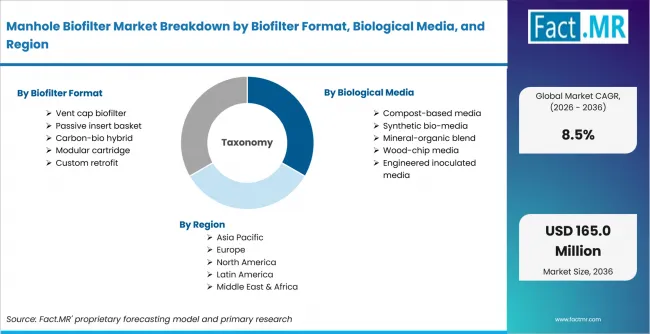
Manhole Biofilter Market Breakdown By Biofilter Format, Biological Media, And Region | Source: Fact.MR
| Attribute | Details |
|---|---|
| Quantitative Units | USD million in 2026 to USD million by 2036 at a CAGR |
| Market Definition | The market comprises compact biological filters installed in or at wastewater manholes and related vents to biologically oxidize hydrogen sulfide and other odorous sewer gases. |
| Biofilter Format | Vent cap biofilter; Passive insert basket; Carbon-bio hybrid; Modular cartridge; Custom retrofit |
| Biological Media | Compost-based media; Synthetic bio-media; Mineral-organic blend; Wood-chip media; Engineered inoculated media |
| Gas Target | Hydrogen sulfide; Reduced sulfur compounds; Ammonia; VOC mixtures; Mixed sewer gas |
| Application Location | Residential-adjacent manholes; Force main discharge; Lift station area; Gravity sewer; Commercial corridors |
| Service Model | Media replacement; One-time sale; Maintenance contract; Pilot program; Subscription monitoring |
| Regions Covered | North America; Europe; Asia Pacific; Latin America; Middle East and Africa |
| Countries Covered | Germany; United Kingdom; United States; France; Netherlands. Analysis covers 30+ countries in the full report. |
| Key Companies Profiled | Bioteg; RJM Company; Continental Carbon Group; COALSI; Syneco Systems, Inc. |
| Forecast Period | 2026 to 2036 |
| Approach | The market is sized from new biofilter placements, replacement-media volumes, realized equipment and service prices, installed-base renewal, and verified utility project activity. |
Source: Fact.MR analysis. Updated Jul 17, 2026
How is the market segmented?
-
By Biofilter Format
- Vent cap biofilter
- Passive insert basket
- Carbon-bio hybrid
- Modular cartridge
- Custom retrofit
-
By Biological Media
- Compost-based media
- Synthetic bio-media
- Mineral-organic blend
- Wood-chip media
- Engineered inoculated media
-
By Gas Target
- Hydrogen sulfide
- Reduced sulfur compounds
- Ammonia
- VOC mixtures
- Mixed sewer gas
-
By Application Location
- Residential-adjacent manholes
- Force main discharge
- Lift station area
- Gravity sewer
- Commercial corridors
-
By Service Model
- Media replacement
- One-time sale
- Maintenance contract
- Pilot program
- Subscription monitoring
-
By Region
- North America
- United States
- Europe
- Germany
- United Kingdom
- France
- Netherlands
Frequently Asked Questions
Which biofilter format has the largest share?
Which biological medium leads the market?
What is the primary target gas?
Which application location has the largest share?
Which countries lead adoption?
Who worked on this report


Preview the report firsthand - request a free sample
Free SampleGet the brochure for pricing and purchase details
Download PDF