- Market Value (2025): USD 43.6 Mn
- Estimated Value (2026): USD 47 Mn
- Forecast Value (2036): USD 100 Mn
- CAGR (2026-2036): 7.8%
What is the Manhole Odor Eliminator Market forecast to be worth by 2036?
USD 47 million in 2026 to USD 100 million by 2036, at 7.8% CAGR.
- The manhole odor eliminator market was valued at USD 43.6 million in 2025, reflecting a specialized maintenance category for wastewater collection systems.
- Revenue is forecast to increase from USD 47 million in 2026 to USD 100 million by 2036 as utilities formalize odor-response work at manholes and force-main discharge points.
- The market is projected to record a 7.8% CAGR from 2026 to 2036, supported by low-disruption retrofits and recurring cartridge replacement.
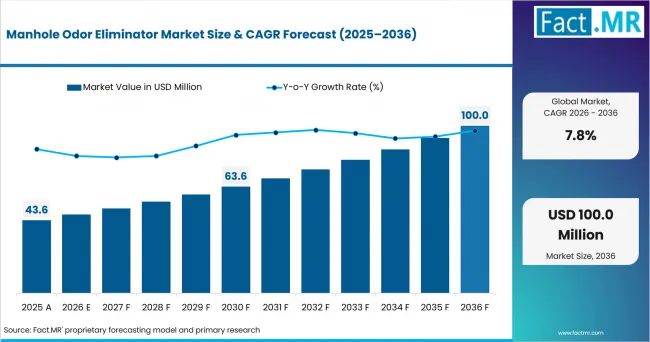
Manhole Odor Eliminator Market Value Analysis | Source: Fact.MR
What are the defining numbers behind Manhole Odor Eliminator Market growth?
USD 53 million absolute opportunity by 2036, led by Impregnated activated carbon and Drop-in manhole insert within their respective segments.
- Demand Drivers in the Market
- Utilities are expected to control odor at the exact locations where complaints affect nearby homes and shops. Sewer access points near parks and busy public areas can create similar problems.
- Removing hydrogen sulfide helps reduce bad smells and protects concrete sewer parts from damage.
- Replaceable cartridges make odor control easier to plan. Utilities can schedule the work and budget for it instead of paying for repeated emergency visits.
- Passive systems work well at manholes without power or data connections. They are also useful where there is not enough space for equipment above ground.
- Key Segments Analyzed
- By Odor Control Media: Impregnated activated carbon is expected to hold 45.0% share in 2026 supported by broad gas capture inside compact cartridges.
- By Installation Format: Drop-in manhole inserts are projected to account for 48.0% share in 2026 owing to easy installation through existing access openings.
- By Gas Target: Hydrogen sulfide is anticipated to capture 53.0% share in 2026 due to its strong link with sewer odor and corrosion damage.
- By Replacement Cycle: Quarterly replacement is estimated to represent a 21.0% share in 2026 as three-month service visits align with planned utility maintenance schedules.
- By Buyer Type: Municipal wastewater utilities are forecast to hold 50.0% share in 2026 driven by direct ownership of sewer access points and responsibility for public odor complaints.
- Analyst Opinion at Fact.MR
- Shambhu Nath Jha, Senior Analyst at Fact.MR states “Product success depends on how well the system works at the site. Crews are more likely to choose filters that are easy to install and service without adding extra maintenance work. The stated life of the filter material must match the airflow and amount of gas passing through it. Moisture levels and manhole conditions also affect how often the material needs to be replaced.”
- Strategic Implications
- Wastewater utilities can first check the type of gas and the airflow at each complaint site before using the same manhole odor-control product across several locations. Site access also affects the final choice.
- Clear cartridge-change signs help manufacturers support repeat orders. A regular replacement plan also makes future purchases easier to manage.
- Before installation, contractors check the manhole cover shape and drainage. The insert must not block normal sewer inspection or maintenance work.
- Commercial property managers benefit from service plans that cover both the odor-control device and the condition of the sewer. A filter alone may not solve the problem when large amounts of odor form farther upstream.
In May 2024, the U.S. Environmental Protection Agency reported at least USD 630 billion in clean water infrastructure needs over the next 20 years. That infrastructure gap supports a practical market for targeted odor products that help utilities handle small but visible complaint points while larger sewer investments remain scheduled over many years.
Canada is expected to record a 9.3% CAGR from 2026 to 2036 as utilities look for odor-control systems that continue working through harsh winters and across widely spread sewer sites. Germany is projected to post an 8.6% CAGR because its dense sewer networks suit compact systems that do not require visible equipment above ground. The United States is anticipated to register an 8.5% CAGR as large sewer networks deal with odor problems at individual locations. The United Kingdom is estimated to grow at an 8.2% CAGR as utilities seek low-disruption options for sites close to homes. France is forecast to advance at an 8.0% CAGR as odor-control work expands from treatment plants to sewer networks.
How does the Manhole Odor Eliminator Market break down by segment?
Impregnated activated carbon leads at 45.0% by Odor Control Media, while Drop-in manhole insert leads at 48.0% by Installation Format in 2026.
Why does impregnated activated carbon lead odor-control media demand?
Impregnated activated carbon holds 45.0% share in 2026.
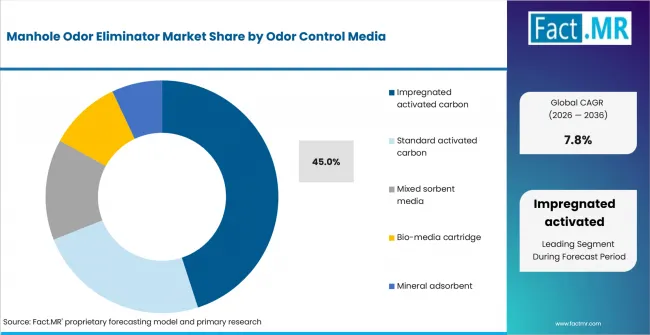
Manhole Odor Eliminator Market Analysis By Odor Control Media | Source: Fact.MR
Impregnated activated carbon is expected to account for 45.0% share in 2026, supported by chemical treatment that improves capture of hydrogen sulfide and other sewer gases. The media fits inside compact cartridges, which suits manholes with limited space. Its broad gas-removal range also reduces the need for separate materials at locations where odor conditions change over time.
What makes the drop-in manhole insert the leading installation format?
Drop-in manhole inserts account for 48.0% share in 2026.
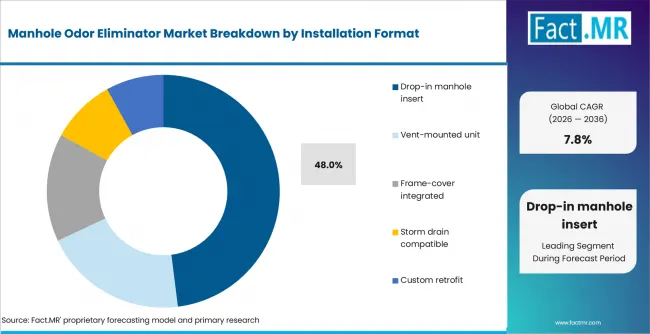
Manhole Odor Eliminator Market Analysis By Installation Format | Source: Fact.MR
Drop-in manhole inserts are projected to capture 48.0% share in 2026. Installation crews can place the unit inside the existing access opening without major civil work or changes to nearby structures. This format keeps installation time short and allows easy removal during sewer inspection. It is especially practical for utilities managing many odor points across established networks.
Why is hydrogen sulfide the main gas target?
Hydrogen sulfide captures 53.0% share in 2026.
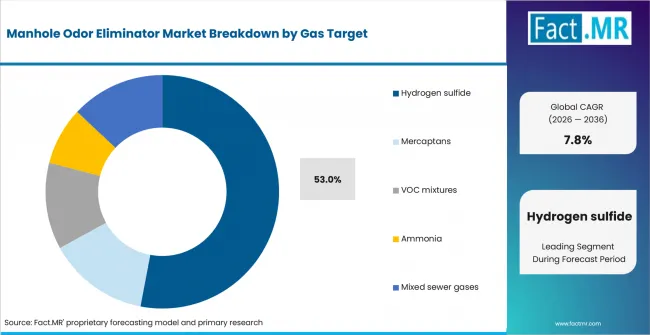
Manhole Odor Eliminator Market Analysis By Gas Target | Source: Fact.MR
Hydrogen sulfide is anticipated to represent 53.0% share in 2026, reflecting its strong connection with rotten-egg odor and sewer corrosion. Even low concentrations can trigger complaints near homes, streets and public spaces. Higher exposure also damages concrete and metal equipment over time. These combined odor and maintenance concerns make hydrogen sulfide the first treatment priority at many problem manholes.
What supports quarterly replacement across utility maintenance programs?
Quarterly holds 21.0% share in 2026.
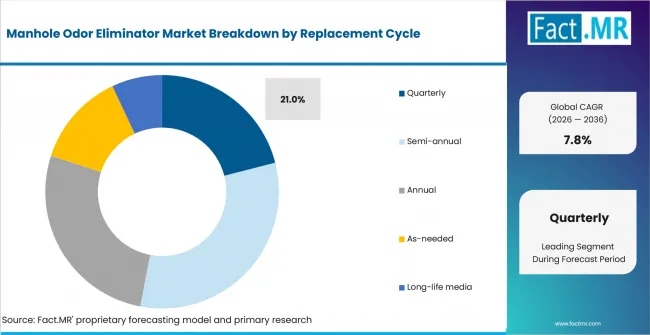
Manhole Odor Eliminator Market Analysis By Replacement Cycle | Source: Fact.MR
Quarterly replacement is estimated to hold a 21.0% share in 2026 across frequently serviced utility odor-control installations. A three-month cycle helps utilities maintain dependable media performance at locations with persistent odor exposure and variable operating conditions. Scheduled replacement can be incorporated into routine inspection visits before cartridge efficiency declines or odor breakthrough becomes noticeable. This interval also supports closer performance control at high-risk sites without requiring monthly servicing and substantially higher labour costs.
Why do municipal wastewater utilities lead buyer demand?
Municipal wastewater utilities represent 50.0% share in 2026.
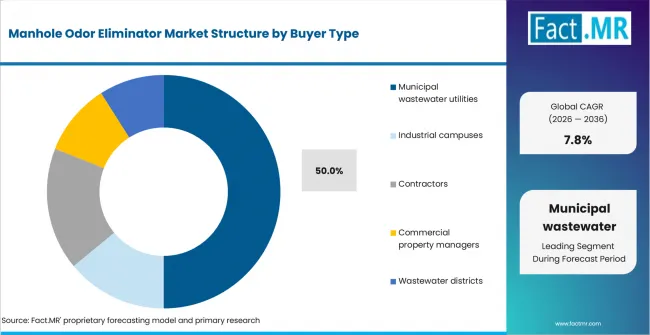
Manhole Odor Eliminator Market Analysis By Buyer Type | Source: Fact.MR
Municipal wastewater utilities are forecast to account for 50.0% share in 2026 since they own sewer access points and handle public odor complaints directly. They also control inspection schedules, maintenance budgets and product approval across local networks. A single utility may manage many affected manholes, creating repeat demand for inserts, replacement media and field servicing across residential and commercial areas.
What is accelerating Manhole Odor Eliminator Market adoption, and what is holding it back?
Complaint-point remediation is anticipated to drive adoption, while uncertain media life restrains wider use.
Drivers Impact Analysis
| DRIVER | (~) % IMPACT ON CAGR | GEOGRAPHIC RELEVANCE | IMPACT TIMELINE |
|---|---|---|---|
| Complaint-point remediation | +1.2% | North America and Europe | Short term (<= 2 years) |
| Hydrogen sulfide management | +1.0% | Global wastewater networks | Medium term (2-4 years) |
| Passive equipment preference | +0.9% | Municipal collection networks | Short term (<= 2 years) |
| Recurring media programs | +0.7% | United States and Canada | Medium term (2-4 years) |
| Collection-system densification | +0.5% | Asia-Pacific urban networks | Long term (>= 4 years) |
Source: Fact.MR analysis. Updated Jul 17, 2026
- Complaint-point remediation: Utilities need a visible response when odor reaches homes or shops. Point-mounted products are expected to support field trials without network-wide construction.
- Hydrogen sulfide management: Hydrogen sulfide links odor complaints with sewer corrosion. Inserts are anticipated to create a practical gas-phase barrier at release points, although upstream control may still be required.
- Passive equipment preference: Many manholes lack economical power or telemetry. Passive airflow is projected to keep installation simple and limit additional assets that crews must maintain.
- Recurring media programs: Cartridge replacement turns each installed unit into a service route. Manufacturers with clear changeout rules are expected to support repeat municipal purchasing.
- Collection-system densification: Dense urban sewer networks create more release points near people and commercial activity. Compact inserts are forecast to help utilities treat priority sites without visible equipment.
Opportunity Impact Analysis
| OPPORTUNITY | (~) % IMPACT ON CAGR | GEOGRAPHIC RELEVANCE | IMPACT TIMELINE |
|---|---|---|---|
| Cartridge condition indicators | +0.5% | North America and Europe | Medium term (2-4 years) |
| Network odor mapping | +0.4% | United States and Germany | Medium term (2-4 years) |
| Storm-drain compatible formats | +0.3% | United Kingdom and Canada | Long term (>= 4 years) |
| Contractor service bundles | +0.3% | North America | Medium term (2-4 years) |
Source: Fact.MR analysis. Updated Jul 17, 2026
- Cartridge condition indicators: A saturation signal helps crews replace media by condition instead of relying only on a calendar. Adoption is projected to improve when utilities can avoid premature changeouts and missed saturation.
- Network odor mapping: Utilities are expected to combine complaint records with portable monitoring. The work helps identify priority manholes before a device is selected and installed.
- Storm-drain compatible formats: Wet-weather designs are anticipated to address odor points beyond sanitary manholes. Drainage behavior must be verified first because standing water can shorten cartridge life.
- Contractor service bundles: Sewer maintenance contractors already visit access points for inspection and repair. Bundled odor checks are expected to reduce scheduling friction for smaller utilities.
Restraints Impact Analysis
| RESTRAINT | (~) % IMPACT ON CAGR | GEOGRAPHIC RELEVANCE | IMPACT TIMELINE |
|---|---|---|---|
| Uncertain media life | -0.7% | Global | Medium term (2-4 years) |
| Access and fit variation | -0.5% | Older urban networks | Medium term (2-4 years) |
| Source-control substitution | -0.4% | High-sulfide sewer zones | Short term (<= 2 years) |
| Drainage interference concerns | -0.3% | Storm-drain applications | Long term (>= 4 years) |
Source: Fact.MR analysis. Updated Jul 17, 2026
- Uncertain media life: Cartridge life changes with gas concentration and airflow. Humidity also affects service life. A fixed interval is expected to waste usable media or leave a saturated device in service.
- Access and fit variation: Manhole dimensions and cover styles differ by network age. Steps and debris baskets add fit checks before crews approve the installation. Drainage paths require a separate review.
- Source-control substitution: Severe sulfide generation often needs dosing or ventilation. Upstream process change can also be required. A manhole device then works as a polishing measure after the main source is controlled.
- Drainage interference concerns: Inserts must not block flow paths or complicate safe access. Adoption is anticipated to slow where stormwater loading raises bypass and maintenance concerns.
Which countries are scaling Manhole Odor Eliminator Market fastest?
Canada 9.3%; Germany 8.6%; United States 8.5%; United Kingdom 8.2%; France 8.0%.
Regional analysis covers North America and Europe. Country sections cover Canada and Germany. The United States and the United Kingdom are included. France completes the country set.
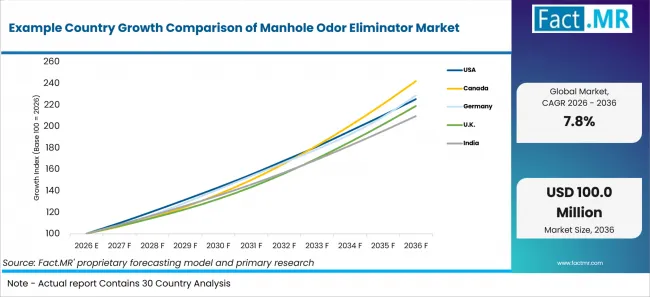
Example Country Growth Comparison Of Manhole Odor Eliminator Market | Source: Fact.MR
| COUNTRY | CAGR |
|---|---|
| Canada | 9.3% |
| Germany | 8.6% |
| United States | 8.5% |
| United Kingdom | 8.2% |
| France | 8.0% |
Source: Fact.MR analysis. Updated Jul 17, 2026
Why does Canada lead growth?
9.3% CAGR, supported by winter-resilient and low-power odor control.
Canada’s growth is linked to wastewater assets spread across large municipal service areas rather than dense urban networks alone. By 2025, federal infrastructure programs had supported the construction or rehabilitation of 2,500 km of drinking-water, wastewater and stormwater pipes. Manhole inserts give municipalities a low-power option for treating isolated odor points along these routes, while cartridge selection must account for freezing weather, condensation and seasonal changes in gas flow.
What is driving manhole odor eliminator adoption in Germany?
8.6% CAGR, driven by dense sewer networks and compact treatment needs.
Germany’s 8.6% CAGR reflects the need to control odor inside established urban sewer systems where space for large treatment units is limited. With nearly the entire population connected to public wastewater infrastructure, utilities manage many access points near housing, transport routes and commercial districts. Drop-in inserts suit these settings because they remain below street level, preserve maintenance access and avoid adding visible equipment to crowded public areas.
How will the United States market for manhole odor eliminators develop?
8.5% CAGR, backed by large networks and localized odor points.
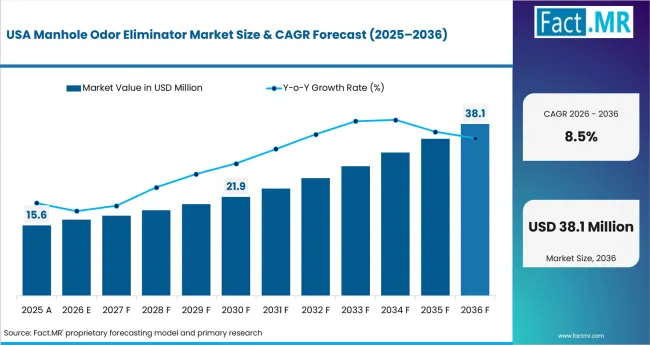
Manhole Odor Eliminator Market Country Value Analysis | Source: Fact.MR
The United States market has a clear role for small odor-control projects within a much larger infrastructure backlog. The EPA estimated at least USD 630 billion in wastewater, stormwater and clean-water investment needs over the next 20 years. Utilities cannot rebuild every odor-prone sewer section at once, so manhole inserts offer a focused response at force-main outlets, residential complaint points and other locations awaiting wider network upgrades.
Why is demand rising in the United Kingdom?
8.2% CAGR, owing to low-disruption corrective action near housing and shops.
England has around 14,500 storm overflows, and all are now fitted with event-duration monitors that record discharge activity. This wider focus on individual sewer assets creates a practical setting for manhole odor products near monitored problem areas. Compact inserts allow operators to address smells at street level without excavating the network, which suits access points located beside homes, shops and public paths.
What supports French demand for manhole odor eliminators?
8.0% CAGR, supported by odor control moving from treatment plants into the network.
France manages wastewater collection through local public services responsible for transporting and treating household effluent. The national water-services observatory reported an average collective sanitation charge of EUR 2.37 per cubic metre at the start of 2024, showing the operating cost already carried by these systems. Manhole inserts offer municipalities a targeted way to manage neighborhood odor complaints without committing to a larger treatment-plant or sewer-renewal project.
Who leads the Manhole Odor Eliminator Market?
IRI Products and BioAir Solutions lead direct manhole and wastewater odor-control coverage, while OMI Industries and Evoqua/Xylem add broader odor-control capabilities.
IRI Products has a strong place in the manhole-insert segment through passive carbon filters used in sewer vents and storm drains. BioAir Solutions offers equipment for controlling wastewater odor. OMI Industries supplies odor-control products for industrial and municipal sites. Evoqua/Xylem covers a wider range of water and wastewater odor-control work, while Odor Control Technologies provides field support for local odor problems.
Competition mainly depends on how well the filter material works and how easily crews can reach it for service. Utilities also look for cartridges that can be replaced on a clear schedule. Companies that explain airflow and moisture requirements in simple terms have a better chance of passing product reviews. Fast local support is also important because odor complaints often require attention before the next planned sewer visit.
Which companies are the key providers?
The company set includes IRI Products and BioAir Solutions. OMI Industries and Evoqua/Xylem complete the provider set alongside Odor Control Technologies.
- IRI Products
- BioAir Solutions
- OMI Industries
- Evoqua/Xylem
- Odor Control Technologies
Bibliography
- Department for Environment, Food & Rural Affairs, & Reed, S. (2025, July 19). Reed: Government to cut sewage pollution in half by 2030. UK Government.
- Federal Ministry for the Environment, Climate Action, Nature Conservation and Nuclear Safety. (2026, February 11). General information on waste water treatment plants.
- United States Environmental Protection Agency. (2024, May 14). New EPA survey highlights wastewater infrastructure needs to protect waterbodies in communities across the country.
- Housing, Infrastructure and Communities Canada. (2025, July 7). Protecting our natural water resources. Government of Canada.
- Department for Environment, Food & Rural Affairs. (2025, March 24). Storm overflows: Policy and guidance. GOV.UK.
This Report Addresses
- The report establishes the 2025 market baseline and the revenue forecast to 2036.
- Segment analysis covers Impregnated activated carbon and Drop-in manhole insert as the 2026 share.
- Regional outlook evaluates Canada and Germany. The United States and the United Kingdom are included. France completes the country comparison.
- Competitive analysis profiles IRI Products and BioAir Solutions. OMI Industries and Evoqua/Xylem are included. Odor Control Technologies completes the provider comparison.
- Media assessment compares impregnated carbon and standard carbon. Mixed sorbent media and bio-media cartridges are included. Mineral adsorbents complete the media view.
- Installation assessment covers drop-in inserts and vent-mounted units. Frame-cover integrated products and storm-drain formats are included. Custom retrofits complete the format view.
What does the Manhole Odor Eliminator Market cover?
Manhole inserts and vent units used at sewer access points. Integrated covers and recurring odor-control media are also covered.
The Manhole Odor Eliminator Market covers hardware and recurring media revenue attached to point-source odor control in wastewater collection systems. Coverage begins with the initial insert or vent unit. Integrated cover devices and paid cartridge replacement are followed through the installed life.
The market differs from centralized odor-control systems because commercial value comes from treating a specific release point. Broader chemical dosing and plant-level air treatment remain outside the boundary. General sewer rehabilitation is excluded unless it is sold with a manhole odor device.
What is included in the scope?
Point-source manhole odor-control systems used by utilities and contractors. Industrial campuses and commercial property managers are also included.
The scope includes impregnated activated carbon and standard activated carbon systems alongside mixed sorbent media. Bio-media cartridges and mineral adsorbents are also covered. It covers drop-in inserts and vent-mounted units. Frame-cover integrated products and storm-drain compatible formats are included. Custom retrofits are covered around target gases such as hydrogen sulfide and mercaptans.
What is excluded from the scope?
Plant-level odor-control systems and upstream sulfide-control chemicals are outside the core scope.
The scope excludes centralized scrubbers and full ventilation systems when they are sold without a manhole-mounted device. Chemical dosing programs are outside the core scope. General sewer maintenance services are also excluded unless the paid activity includes a defined odor-control insert or cartridge.
How Was the Analysis Built?
The analysis draws on 120+ sources, 35+ company portfolios, 25+ countries, and more than 20 industry interviews.
- Primary Research: Primary research includes discussions with manufacturers, service providers, technology developers, distributors, end users, procurement teams, and subject-matter experts. These conversations examine purchasing priorities, product adoption, operational challenges, approval requirements, competitive positioning, and the factors that influence wider market acceptance.
- Desk Research: Desk research covers government statistics, regulatory publications, company filings, trade data, technical studies, industry associations, standards, public policy, and other authoritative sources. Every source used in the analysis is documented in the bibliography.
- Market Sizing and Forecasting: Market estimates combine historical performance, demand indicators, pricing and volume trends, segment shares, company participation, country-level growth, adoption patterns, investment activity, and barriers to market expansion.
- Data Validation and Update Cycle: Findings are validated by comparing primary interviews with public data, company activity, regulatory changes, trade patterns, and industry developments. Regular updates review new product launches, capacity changes, partnerships, approvals, procurement trends, and shifts in commercial adoption.
Segmentation
What is the report's scope and coverage?
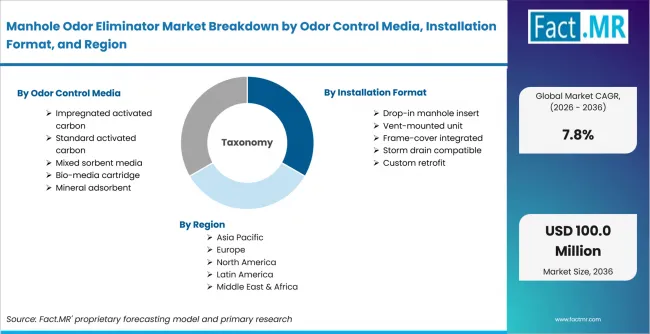
Manhole Odor Eliminator Market Breakdown By Odor Control Media, Installation Format, And Region | Source: Fact.MR
| Attribute | Details |
|---|---|
| Quantitative Units | USD million in 2026 to USD million by 2036 at CAGR |
| Market Definition | Manhole-mounted inserts, cartridges, vent units, and integrated cover devices that reduce odorous gases released from wastewater collection systems |
| Odor Control Media | Impregnated activated carbon; Standard activated carbon; Mixed sorbent media; Bio-media cartridge; Mineral adsorbent |
| Installation Format | Drop-in manhole insert; Vent-mounted unit; Frame-cover integrated; Storm drain compatible; Custom retrofit |
| Gas Target | Hydrogen sulfide; Mercaptans; VOC mixtures; Ammonia; Mixed sewer gases |
| Replacement Cycle | Quarterly; Semi-annual; Annual; As-needed; Long-life media |
| Buyer Type | Municipal wastewater utilities; Industrial campuses; Contractors; Commercial property managers; Wastewater districts |
| Regions Covered | North America; Europe; Asia Pacific; Latin America; Middle East and Africa |
| Countries Covered | Canada; Germany; United States; United Kingdom; France |
| Key Companies Profiled | IRI Products; BioAir Solutions; OMI Industries; Evoqua/Xylem; Odor Control Technologies |
| Forecast Period | 2026 to 2036 |
| Approach | Hybrid top-down and bottom-up approach using installed units, replacement-cartridge frequency, average realized prices by format, contractor purchases, and municipal procurement activity |
Source: Fact.MR analysis. Updated Jul 17, 2026
How is the market segmented?
-
By Odor Control Media
- Impregnated activated carbon
- Standard activated carbon
- Mixed sorbent media
- Bio-media cartridge
- Mineral adsorbent
-
By Installation Format
- Drop-in manhole insert
- Vent-mounted unit
- Frame-cover integrated
- Storm drain compatible
- Custom retrofit
-
By Gas Target
- Hydrogen sulfide
- Mercaptans
- VOC mixtures
- Ammonia
- Mixed sewer gases
-
By Replacement Cycle
- Quarterly
- Semi-annual
- Annual
- As-needed
- Long-life media
-
By Buyer Type
- Municipal wastewater utilities
- Industrial campuses
- Contractors
- Commercial property managers
- Wastewater districts
-
By Region
- North America
- United States
- Canada
- Europe
- Germany
- United Kingdom
- France
Frequently Asked Questions
Which Odor Control Media leads the Manhole Odor Eliminator Market?
Which Installation Format leads the Manhole Odor Eliminator Market?
Which Gas Target leads the Manhole Odor Eliminator Market?
Which Buyer Type leads the Manhole Odor Eliminator Market?
Which country records the highest CAGR?
How does Germany perform in the Manhole Odor Eliminator Market?
What is the primary driver in the Manhole Odor Eliminator Market?
What is the main restraint in the Manhole Odor Eliminator Market?
Why do municipal wastewater utilities dominate demand?
Who worked on this report


Preview the report firsthand - request a free sample
Free SampleGet the brochure for pricing and purchase details
Download PDF