- Market Value (2025): USD 25.7 Bn
- Estimated Value (2026): USD 27.5 Bn
- Forecast Value (2036): USD 54.0 Bn
- CAGR (2026-2036): 7.0%
What is the Maritime Safety Market forecast to be worth by 2036?
USD 27.5 Billion in 2026 to USD 54.0 Billion by 2036, at a 7.0% CAGR.
- As per Fact.MR analysis, the maritime safety market reached USD 25.7 Billion in 2025.
- Demand will increase from USD 27.5 Billion in 2026 to USD 54.0 Billion in 2036.
- The market is forecast to record a 7.0% CAGR during 2026 to 2036 driven by strict IMO maritime safety mandates, heightened protection of offshore energy assets, rising container traffic across congested straits, and rapid adoption of autonomous vessel navigation technologies.
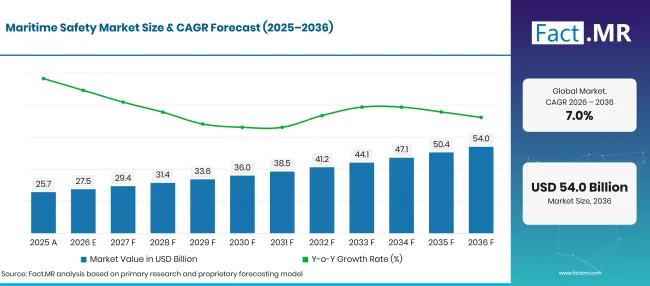
Factmr Maritime Safety Market Forecast Global | Source: Fact.MR
| Year | Basis | Market Value (USD Billion) |
|---|---|---|
| 2025 | Actual | 25.7 |
| 2026 | Estimate | 27.5 |
| 2036 | Forecast | 54.0 |
| CAGR 2026 to 2036 | Forecast period | 7.0% |
Source: Fact.MR analysis. Updated Oct 21, 2026
What are the defining numbers behind Maritime Safety Market growth?
USD 26.5 Billion absolute chance between 2026 and 2036, with solutions components and commercial end-users generating the largest deployment volume.
- Demand Drivers in the Market
- International Maritime Organization (IMO) SOLAS conventions and federal navigation safety regulations mandate that all commercial vessels over 300 gross tons maintain certified bridge equipment, automatic radar plotting aids (ARPA), and multi-band AIS transponders [1]. Maritime safety administrations actively enforce port-state inspection regimes, compelling shipping operators to replace legacy bridge systems with cyber-secure integrated navigation bridges. Port operators install shore-based Vessel Traffic Services (VTS) to maintain real-time oversight of congested approaches.
- Escalating asymmetric maritime threats, regional maritime boundary skirmishes, and piracy incidents along critical chokepoints like the Red Sea, Strait of Malacca, and Gulf of Aden require round-the-clock coastal surveillance. High-fidelity synthetic aperture radar (SAR) imagery coupled with lightweight deep learning object detection models enables coastal commands to identify dark vessels operating with disabled AIS transponders in complex sea clutter [2]. Coast guard fleets deploy long-range optical thermal sensors to intercept illegal trafficking and unauthorized incursions.
- Accelerated deployment of automated, remotely operated, and maritime autonomous surface ships (MASS) demands resilient human-autonomy collaboration and shore control center communications. Scoping reviews into remote maritime team cognition demonstrate that shared mental models between vessel AI and shore captains depend critically on ultra-low-latency sensor telemetries and standardized situational displays [3]. Commercial shipping lines invest heavily in redundant satellite communications to maintain fail-safe emergency remote override capabilities.
- Decarbonization mandates and environmental protection directives are forcing commercial fleets to integrate eco-routing algorithms that optimize safety margins while minimizing bunker fuel emissions. Peer-reviewed routing models combining real-time AIS positional data and land-aware hydrodynamic simulations prevent grounding incidents in hazardous coastal fairways while reducing fuel expenditure [4]. Shipping lines integrate weather routing platforms that dynamically divert vessels away from severe maritime storms and dangerous wave actions.
- Key Segments Analyzed
- By Component: Solutions holds 62.4% share in 2026, encompassing integrated bridge systems, coastal radar surveillance arrays, AIS transponders, distress beacons, and maritime security software platforms.
- By Technology: Surveillance and Tracking accounts for 30.3% share in 2026, driven by continuous deployment of coastal VTS radars, satellite vessel tracking, and AI-powered optical surveillance.
- By Application: Port and Critical Infrastructure Security accounts for 35.3% share in 2026 as global terminal operators safeguard container berths, LNG bunkering piers, and petrochemical jetties against unauthorized incursions.
- By End-User: Commercial represents 63.4% share in 2026, propelled by private merchant cargo fleets, container carriers, bulk carriers, oil tankers, and passenger cruise operators adhering to international maritime safety codes.
- Analyst Opinion at Fact.MR
- Shambhu Nath Jha, Lead Consultant at Fact.MR, states, “Maritime safety is undergoing a structural paradigm shift from passive, reactive collision warning instruments to proactive, AI-driven autonomous collision avoidance suites. Shipowners and port terminal operators can no longer treat bridge navigation, cybersecurity, and physical perimeter protection as isolated silos. Marine technology contractors who provide unified, cyber-certified platforms integrating satellite AIS, machine-learning radar tracking, and cloud-based fleet operations will capture multi-year fleet retrofit contracts as the commercial maritime sector embraces digital autonomous shipping.”
- Strategic Implications
- Naval architecture firms and defense contractors are embedding neural-dynamic and game-based safe trajectory algorithms into commercial vessel autopilots. Advanced maritime control research confirms that multi-target radar tracking combined with cooperative game-theoretic navigation models prevents close-quarters collision situations even in high-density merchant fairways [5]. Automated collision-avoidance software delivers quantifiable risk reduction for commercial fleet insurers.
- Port terminal authorities are investing in unified perimeter monitoring platforms that integrate thermal imaging cameras, sonar diver-detection arrays, and automated aerial surveillance drones. Connecting physical gate security with seaside berth surveillance protects multi-billion-dollar cargo terminals from sabotage, contraband smuggling, and unauthorized boarding attempts.
- Commercial shipping lines are formalizing partnerships with low-Earth-orbit (LEO) satellite constellation providers to guarantee ubiquitous high-bandwidth connectivity across transoceanic shipping routes. Seamless satellite data backhaul enables cloud-based engine diagnostics, automated regulatory voyage logging, and real-time cybersecurity telemetry monitoring across global merchant fleets.
- Marine electronics manufacturers are upgrading system firmware architectures to achieve compliance with stringent IACS UR E26 and UR E27 cybersecurity standards. Ensuring that maritime sensors, dynamic positioning controllers, and ECDIS navigation terminals resist spoofing and denial-of-service attacks prevents catastrophic electronic hijackings on the high seas.
Germany is projected to record an 8.3% CAGR, driven by cutting-edge commercial shipbuilding technologies, advanced maritime sensor engineering, and European clean port initiatives. Brazil expands at 7.6%, propelled by deepwater offshore pre-salt oil exploration security, naval patrol fleet modernization, and expanding agricultural export ports. The United States advances at 6.8%, supported by vast commercial port infrastructure, US Coast Guard navigation modernization contracts, and major naval defense procurements. The United Kingdom achieves a 6.1% CAGR, underpinned by its world-leading maritime insurance and classification societies, Royal Navy autonomous vessel testing, and offshore wind farm security. Japan registers a 5.4% CAGR, driven by pioneering autonomous cargo ship commercial trials, sophisticated port automation, and coastal strait surveillance systems.
How does the Maritime Safety Market break down by segment?
Solutions 62.4%; Surveillance and Tracking 30.3%; Port and Critical Infrastructure Security 35.3%; Commercial 63.4% in 2026.
Which Component dominates?
Solutions holds 62.4% share in 2026.
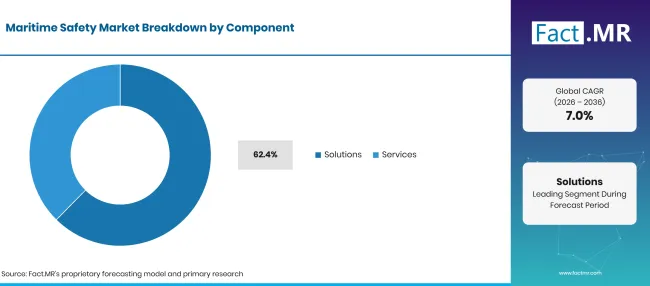
Factmr Maritime Safety Market Breakdown Component | Source: Fact.MR
| Component | Share (2026) |
|---|---|
| Solutions (Leading segment) | 62.4% |
| Other segments combined | 37.6%* |
| Total | 100.0% |
Source: Fact.MR analysis. Updated Oct 21, 2026
Hardware and software solutions dominate overall maritime safety procurement, propelled by massive worldwide investments in integrated bridge systems (IBS), coastal surveillance radar towers, satellite transceivers, and automated emergency beacons. Shipbuilders specify complete, factory-integrated navigation bridges that consolidate radar, electronic chart display and information systems (ECDIS), and autopilot controls into unified touchscreen consoles. Fleet managers deploy advanced ship automation suites to streamline bridge workflows and minimize human navigational errors. At critical marine oil and container terminals, harbor masters deploy specialized berth load monitoring systems to prevent mooring line failures and vessel collisions during heavy wave surges. Modern merchant ships rely on high-bandwidth connected ship systems that link onboard navigational computers with shore-based fleet operations centers in real time.
What leads the Technology segment?
Surveillance and Tracking accounts for 30.3% share in 2026.
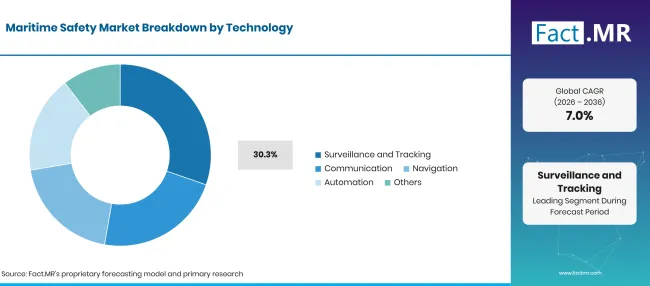
Factmr Maritime Safety Market Breakdown Technology | Source: Fact.MR
| Technology | Share (2026) |
|---|---|
| Surveillance and Tracking (Leading segment) | 30.3% |
| Other segments combined | 69.7%* |
| Total | 100.0% |
Source: Fact.MR analysis. Updated Oct 21, 2026
Surveillance and tracking technologies represent the foundational pillar of modern maritime security, enabling coast guards and port authorities to monitor tens of thousands of vessels simultaneously. Vessel Traffic Service operators track vessel tracks using high-frequency coastal radars and space-based AIS satellite constellations. Critical auxiliary vessel power systems, such as marine emergency generators sourced from marine gensets, guarantee uninterrupted electrical power to bridge surveillance and tracking systems during catastrophic engine room blackouts. Specialized gas carriers and chemical tankers install automated monitoring on cryogenic marine loading arms to avert catastrophic hazardous material leaks during seaside transfer operations. Modern naval architects also integrate ruggedized solid-state marine sensors across hull structures to detect hull stresses and watertight bulkhead breaches before catastrophic structural failures occur.
What drives Port and Critical Infrastructure Security?
Port and Critical Infrastructure Security accounts for 35.3% share in 2026.
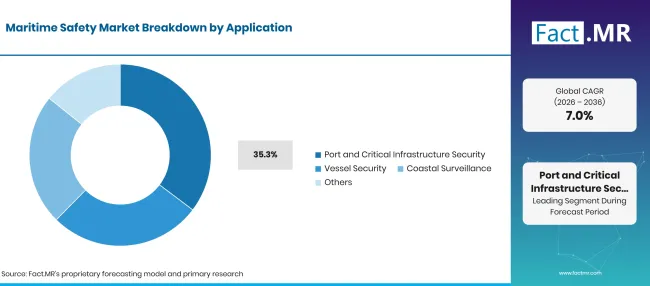
Factmr Maritime Safety Market Breakdown Application | Source: Fact.MR
| Application | Share (2026) |
|---|---|
| Port and Critical Infrastructure Security (Leading segment) | 35.3% |
| Other segments combined | 64.7%* |
| Total | 100.0% |
Source: Fact.MR analysis. Updated Oct 21, 2026
Port and critical infrastructure security accounts for the largest application revenue share, driven by mandatory International Ship and Port Facility Security (ISPS) Code compliance and heightened protection of coastal energy terminals. Port authorities deploy multi-layered perimeter defense architectures featuring intelligent access control gates, seaside optical infrared surveillance towers, and underwater diver detection sonars. Shipyards engaged in commercial ship and boat building incorporate military-grade fire-suppression and safety interlocking systems into modern vessel designs. Container terminals invest extensively in heavy-duty port equipment equipped with proximity sensors and anti-sway collision avoidance technologies. Furthermore, automated terminal operators deploy collision-sensing container handling equipment to eliminate pedestrian struck-by accidents across congested container marshaling yards. High-durability transportation sensors deployed across terminal cranes monitor mechanical stresses and wind shear thresholds during high-risk loading operations.
What is accelerating Maritime Safety Market adoption, and what is holding it back?
Strict IMO navigational safety mandates, rising geopolitical maritime chokepoint conflicts, and commercial deployment of autonomous cargo ships accelerate market expansion. High capital retrofit expenditure on legacy merchant vessels, maritime satellite bandwidth subscription costs, and cyber vulnerabilities in digitized bridge networks restrict frictionless adoption.
Drivers Impact Analysis
| DRIVER | (~) % IMPACT ON CAGR | GEOGRAPHIC RELEVANCE | IMPACT TIMELINE |
|---|---|---|---|
| Mandatory IMO SOLAS navigation safety standards and port-state enforcement | +1.3% | Global | Short term (<= 2 years) |
| Heightened geopolitical tensions and piracy threats in critical trade chokepoints | +1.2% | Middle East, South Asia, Africa | Short term (<= 2 years) |
| Integration of AI-driven radar tracking and autonomous collision avoidance | +1.0% | East Asia, Western Europe | Medium term (2–4 years) |
| Protection of offshore energy installations, LNG terminals, and wind farms | +0.9% | North America, Europe | Medium term (2–4 years) |
| Growth of space-based AIS satellite tracking and coastal VTS networks | +0.7% | Global | Long term (>= 4 years) |
Source: Fact.MR analysis. Updated Oct 21, 2026
Opportunity Impact Analysis
| OPPORTUNITY | (~) % IMPACT ON CAGR | GEOGRAPHIC RELEVANCE | IMPACT TIMELINE |
|---|---|---|---|
| Autonomous vessel safety suites for uncrewed commercial cargo prototypes | +1.3% | Western Europe, Japan | Short term (<= 2 years) |
| Cyber-secure bridge firmware meeting IACS UR E26 and UR E27 requirements | +1.1% | Global | Medium term (2–4 years) |
| Low-Earth-orbit satellite tracking arrays providing real-time dark ship alerts | +0.9% | North America, East Asia | Medium term (2–4 years) |
| Integrated drone surveillance platforms for coastal environmental policing | +0.7% | Europe, Latin America | Long term (>= 4 years) |
Source: Fact.MR analysis. Updated Oct 21, 2026
Restraints Impact Analysis
| RESTRAINT | (~) % IMPACT ON CAGR | GEOGRAPHIC RELEVANCE | IMPACT TIMELINE |
|---|---|---|---|
| High capital expense of drydocking and retrofitting legacy commercial vessels | -1.1% | Global | Short term (<= 2 years) |
| Expensive recurring airtime fees for broadband satellite maritime communication | -0.9% | Emerging Markets, South Asia | Medium term (2–4 years) |
| Cybersecurity vulnerabilities in interconnected ECDIS and cloud bridge systems | -0.7% | Global | Medium term (2–4 years) |
| Divergent national regulations governing autonomous maritime surface vessels | -0.5% | North America, East Asia | Long term (>= 4 years) |
Source: Fact.MR analysis. Updated Oct 21, 2026
Which countries are scaling the Maritime Safety Market through 2036?
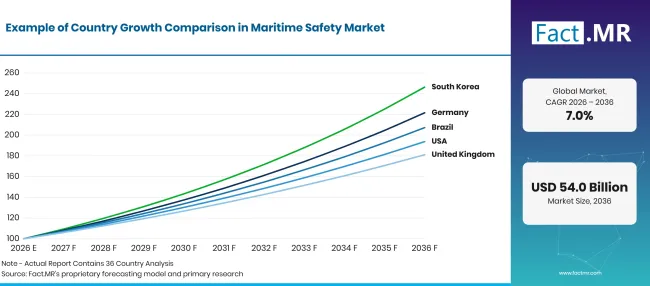
Factmr Maritime Safety Market Growth Index | Source: Fact.MR
| Country | CAGR (2026–2036) |
|---|---|
| Germany | 8.3% |
| Brazil | 7.6% |
| USA | 6.8% |
| UK | 6.1% |
| Japan | 5.4% |
Source: Fact.MR analysis. Updated Oct 21, 2026
Why is Germany leading European maritime safety development?
8.3% CAGR, driven by Germany’s advanced naval engineering sector, heavy container throughput across Hamburg and Bremerhaven, and strict federal environmental and navigational standards.
Germany represents a powerhouse of maritime engineering and marine sensor innovation, housing world-leading manufacturers of marine automation, gyroscopic compasses, and coastal radar systems. German shipyards and maritime technology clusters along the North Sea and Baltic coasts pioneer the development of green, cyber-hardened integrated bridges for container feeder ships and luxury expedition vessels. The Port of Hamburg deploys cutting-edge smart port traffic management systems that synchronize automated vessel arrivals with tidal windows to prevent navigation bottlenecks. Strict compliance with German Federal Maritime and Hydrographic Agency (BSH) regulations compels vessel operators to maintain state-of-the-art navigation redundancy.
What opportunities are unfolding across Brazil?
7.6% CAGR, supported by deepwater Santos Basin pre-salt oil operations, Brazilian Navy fleet modernization programs, and expanded security across Amazon basin riverways.
Brazil commands an expansive 7,400-kilometer Atlantic coastline and manages immense offshore energy assets in the Campos and Santos basins. State-run energy giant Petrobras and international oil concessionaires invest heavily in maritime safety systems, deploying dynamic positioning transponders, offshore support vessel collision-warning systems, and flare boom surveillance arrays. The Brazilian Navy’s SisGAAz (Blue Amazon Management System) program drives sustained procurement of coastal radar networks, maritime patrol aircraft sensors, and satellite vessel surveillance. Furthermore, increasing agricultural commodity exports through ports like Santos and Paranaguá necessitates upgraded harbor traffic management and channel depth monitoring.
How is the United States maintaining premier market scale?
6.8% CAGR, propelled by massive commercial cargo traffic across coastal ports, multi-billion-dollar US Coast Guard modernization initiatives, and US Navy maritime domain awareness programs.
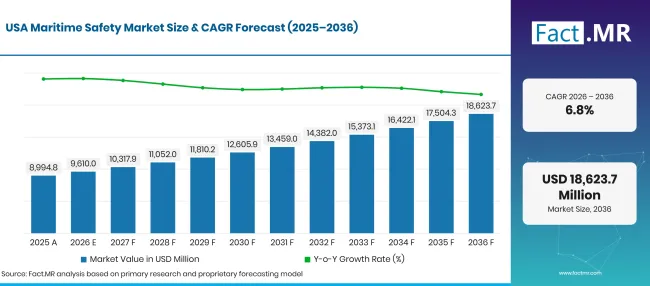
Factmr Maritime Safety Market Forecast Usa | Source: Fact.MR
The United States operates some of the world's most critical maritime logistics hubs across Los Angeles, Long Beach, New York/New Jersey, and the Houston Ship Channel. Federal homeland security mandates and US Coast Guard navigation safety regulations enforce rigorous electronic surveillance, automatic radar plotting, and AIS compliance across all commercial traffic entering American waters. US defense contractors and commercial maritime electronics providers in Virginia, California, and Maryland receive steady contract funding to develop autonomous unmanned surface vessels (USVs) and advanced maritime cyber defense architectures. Growing offshore wind energy projects along the Atlantic coast further spur deployment of safety perimeter monitoring platforms.
What sustains maritime safety leadership in the United Kingdom?
6.1% CAGR, rooted in London's historic maritime insurance and legal clusters, Royal Navy technological modernization, and expanding offshore wind farm security requirements.
The United Kingdom serves as the global capital for maritime commerce, home to the International Maritime Organization headquarters, Lloyd's Register, and premier maritime risk underwriting syndicates. British maritime insurers mandate stringent navigational safety equipment and crew training certifications before issuing commercial hull coverage, directly driving vessel hardware upgrades. The UK Maritime and Coastguard Agency (MCA) is actively funding testbeds in Southampton and Orkney for autonomous and remotely operated commercial vessels. The rapid expansion of massive offshore wind installations in the North Sea requires automated perimeter surveillance, radar wave interference mitigation, and emergency response safety vessels.
Why is Japan registering steady technological advancements?
5.4% CAGR, propelled by Japan’s world-renowned commercial shipbuilding industry, government-backed autonomous cargo vessel initiatives, and heavy coastal traffic across Tokyo Bay.
Japan is a premier commercial shipbuilding nation that commands leadership in naval architecture, bridge robotics, and marine automation. The Nippon Foundation’s MEGURI 2040 autonomous ship project has completed successful fully autonomous voyage trials of coastal container vessels and car ferries, establishing Japan as a global pioneer in autonomous navigation safety software. Heavy commercial vessel congestion across the Kanmon and Uraga straits compels the Japan Coast Guard to deploy highly sophisticated Vessel Traffic Service radar towers and laser speed-measuring systems. Japanese marine electronics conglomerates develop ultra-reliable solid-state marine radars and satellite ECDIS displays tailored for demanding commercial fleets.
Who leads the Maritime Safety Market?
Honeywell International Inc. delivers comprehensive industrial security, toxic gas detection, and building safety solutions widely installed across commercial marine ports, LNG export berths, and chemical cargo vessels. ABB Ltd. is a global leader in marine electric propulsion, automated dynamic positioning systems, and integrated vessel control solutions that enhance operational navigation safety. BAE Systems plc provides world-class naval defense electronics, shipboard tactical radar systems, and maritime cyber protection platforms for military and coast guard fleets. Kongsberg Gruppen ASA stands as an undisputed global titan in commercial maritime electronics, supplying integrated bridge systems, dynamic positioning, autonomous vessel navigation controllers, and Vessel Traffic Services (VTS).
L3Harris Technologies supplies tactical maritime communications, coastal surveillance networks, and electro-optical infrared targeting systems used by naval and maritime police forces globally. Leonardo S.p.A. engineers coastal radar systems, vessel traffic monitoring arrays, and naval combat management suites protecting critical ports and offshore exclusive economic zones. Northrop Grumman Corporation commands leadership in marine navigation through its Sperry Marine subsidiary, manufacturing marine gyrocompasses, autopilot suites, and military-grade ECDIS navigation platforms. RTX Corporation (through Raytheon) manufactures advanced naval surveillance radars, ship self-defense systems, and coastal maritime border surveillance architectures. Rolls-Royce Holdings plc delivers advanced marine gensets, vessel automation suites, and naval propulsion safety systems. Saab AB develops industry-standard maritime AIS transponders, coastal surveillance radar networks, and port management information systems deployed across major international harbors.
Which companies are the key providers?
Key companies include Honeywell International Inc.; ABB Ltd.; BAE Systems plc; Kongsberg Gruppen ASA; L3Harris Technologies; Leonardo S.p.A.; Northrop Grumman Corporation; RTX Corporation; Rolls-Royce Holdings plc; and Saab AB.
- Honeywell International Inc.
- ABB Ltd.
- BAE Systems plc
- Kongsberg Gruppen ASA
- L3Harris Technologies
- Leonardo S.p.A.
- Northrop Grumman Corporation
- RTX Corporation
- Rolls-Royce Holdings plc
- Saab AB
What is the report’s scope and coverage?
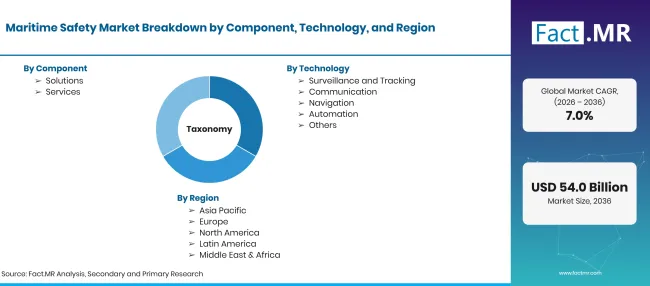
Factmr Maritime Safety Market Taxonomy | Source: Fact.MR
| Attribute | Details |
|---|---|
| Quantitative Units | USD Billion in 2026 to USD Billion by 2036 at 7.0% CAGR |
| Market Definition | Commercial shipments and deployments of shipboard navigation systems, integrated bridges, coastal surveillance radars, AIS transponders, port security systems, and maritime safety software. |
| Component | Solutions; Services |
| Technology | Surveillance and Tracking; Communication; Navigation; Automation; Others |
| Application | Port and Critical Infrastructure Security; Vessel Security; Coastal Surveillance; Others |
| End-User | Commercial; Defense; Government; Others |
| Regions Covered | North America; Latin America; Western Europe; Eastern Europe; East Asia; South Asia & Pacific; Middle East & Africa |
| Countries Covered | Germany; Brazil; USA; UK; Japan |
| Companies Profiled | Honeywell International Inc.; ABB Ltd.; BAE Systems plc; Kongsberg Gruppen ASA; L3Harris Technologies; Leonardo S.p.A.; Northrop Grumman Corporation; RTX Corporation; Rolls-Royce Holdings plc; Saab AB |
| Forecast Period | 2026 to 2036 |
| Approach | Primary interviews with naval architects, maritime safety superintendents, port authority harbor masters, and marine electronics engineers combined with global shipbuilding and maritime trade data audits. |
Source: Fact.MR analysis. Updated Oct 21, 2026
How is the market segmented?
-
By Component
- Solutions
- Services
-
By Technology
- Surveillance and Tracking
- Communication
- Navigation
- Automation
- Others
-
By Application
- Port and Critical Infrastructure Security
- Vessel Security
- Coastal Surveillance
- Others
-
By End-User
- Commercial
- Defense
- Government
- Others
-
By Region
- North America
- Latin America
- Western Europe
- Eastern Europe
- East Asia
- South Asia & Pacific
- Middle East & Africa
Bibliography
- [1] U.S. Coast Guard. (2025). Navigation Safety Regulations: Bridge Equipment, Radar Plotting Aids, and Automatic Identification Systems (33 CFR Part 164). eCFR.
- [2] Mallam, S. C., et al. (2026). Team cognition in remote maritime operations: A scoping review and cross-domain theoretical synthesis. Frontiers in Psychology, 17, 1489211.
- [3] Chen, X., et al. (2026). SLA-YOLO: A Lightweight SAR Ship Detection Model for Real-Time Maritime Surveillance. Sensors, 26(19), 6542.
- [4] Hansen, M., et al. (2026). AIS-Informed and Land-Aware Eco-Routing for Maritime Decision Support. Journal of Marine Science and Engineering, 14(10), 1089.
- [5] Lisowski, J., et al. (2026). Application of Radar Measurements in Neural-Dynamic and Game-Based Safe Ship Controls. Electronics, 15(19), 3891.
This Report Answers
- The report evaluates technology adoption curves, cyber compliance standards, and sensor fusion architectures across shipboard and shore-based maritime safety solutions.
- Application assessments detail why port terminal infrastructure and commercial vessel operations represent the vast majority of ongoing capital investments.
- Country-level analysis investigates the naval modernization plans and smart port initiatives enabling Germany and Brazil to achieve rapid market growth.
- Sensor comparisons examine target detection probabilities, clutter suppression, and false-alarm rates across marine radar, optical infrared, and sonar systems.
- Competitive profiling benchmarks cybersecurity certifications, government defense contracts, and autonomous navigation software patents across leading maritime electronics contractors.
What does the Maritime Safety Market cover?
The market encompasses commercial shipments, system integrations, and lifecycle support services for vessel bridge equipment, coastal vessel traffic systems, maritime domain awareness software, and port perimeter physical security. It evaluates hardware and software flows into merchant shipping fleets, offshore support vessels, naval warships, coast guard cutters, and commercial port container terminals. The analysis tracks marine electronics original equipment manufacturers (OEMs), defense contractors, and specialized maritime software vendors.
What is included in the scope?
The scope covers merchant revenues derived from marine radar systems, automatic radar plotting aids (ARPA), electronic chart display and information systems (ECDIS), AIS transponders, marine distress communications (GMDSS), satellite tracking terminals, port surveillance cameras, sonar systems, and maritime cybersecurity software suites. Revenue values reflect factory-gate hardware shipments, commercial software licensing, and shipyard engineering integration services. Both newbuild vessel installations and aftermarket bridge retrofits are fully integrated within market revenue totals.
What is excluded from the scope?
The scope excludes physical ship hull steel construction, main marine diesel propulsion engines, unguided commercial cargo rigging, and non-navigational interior cabin fittings. Recreational personal watercraft safety vests and small pleasure craft flares are outside the commercial and defense market scope. Heavy civil engineering costs for port dredging, concrete breakwater construction, and dockyard paving are excluded from electronics and safety system valuation totals.
How Was the Analysis Built?
The analysis draws on 120+ sources, 35+ company portfolios, 25+ countries, and more than 20 industry interviews.
- Primary Research: Primary research includes discussions with manufacturers, service providers, technology developers, distributors, end users, and subject-matter experts. These conversations examine purchasing priorities, product adoption, operational challenges, approval requirements, competitive positioning, and the factors that influence wider market acceptance.
- Desk Research: Desk research covers government statistics, regulatory publications, company filings, trade data, technical studies, industry associations, standards, public policy, and other authoritative sources. Every source used in the analysis is documented in the bibliography.
- Market Sizing and Forecasting: Market estimates combine historical performance, demand indicators, pricing and volume trends, segment shares, company participation, country-level growth, adoption patterns, investment activity, and barriers to market expansion.
- Data Validation and Update Cycle: Findings are validated by comparing primary interviews with public data, company activity, regulatory changes, trade patterns, and industry developments. Regular updates review new product launches, capacity changes, partnerships, approvals, and shifts in commercial adoption.
Frequently Asked Questions
How big is the maritime safety market in 2026?
What is the CAGR from 2026 to 2036?
Which component leads?
Which application leads?
Which companies participate in maritime safety?
Who worked on this report


Preview the report firsthand - request a free sample
Free SampleGet the brochure for pricing and purchase details
Download PDF