- Market Value (2025): USD 2.1 Bn
- Estimated Value (2026): USD 2.4 Bn
- Forecast Value (2036): USD 8.8 Bn
- CAGR (2026-2036): 13.9%
What is the Material Jetting Process 3D Printing Market forecast to be worth by 2036?
USD 2.4 billion in 2026 to USD 8.8 billion by 2036 at a 13.9% CAGR.
- The Material Jetting Process 3D Printing Market reached USD 2.1 billion in 2025.
- Demand is projected to increase from USD 2.4 billion in 2026 to USD 8.8 billion by 2036.
- The market is valued at USD 2.4 billion in 2026.
- Demand is projected to increase to USD 8.8 billion by 2036.
- The market is forecast to record a 13.9% CAGR from 2026 to 2036 and create an absolute opportunity of USD 6.4 billion.
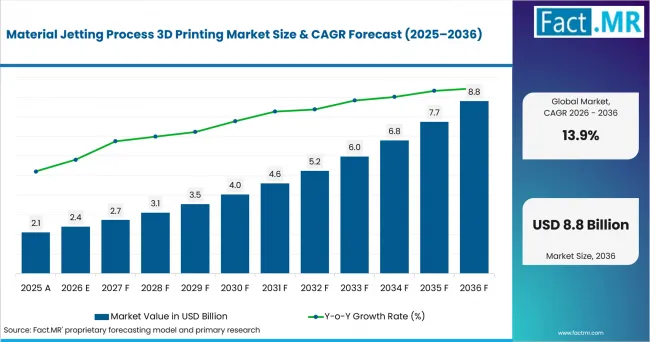
Material Jetting Process 3d Printing Market Value Analysis | Source: Fact.MR
What are the defining numbers behind Material Jetting Process 3D Printing Market growth?
An absolute opportunity of USD 6.4 billion is expected between 2026 and 2036.
- What demand drivers are shaping the market?
- Product development teams use material jetting when one build must communicate geometry, color, transparency and soft-touch behavior before tooling is released.
- Medical and dental users value detailed anatomical models, surgical guides and dental models, but they require documented materials, validated workflows and repeatable post-processing.
- Manufacturers use jetted prototypes, jigs, fixtures, molds and casting patterns to shorten the interval between a design change and a physical evaluation.
- Service bureaus lower the entry barrier for companies that need occasional access to industrial printers without committing capital to equipment, maintenance and operator training.
- Why does PolyJet lead Technology?
- By Technology: PolyJet is the leading technology and accounts for 56% share in 2026.
- By Material: Photopolymers lead with 61% share in 2026.
- By Application: Prototyping leads with 39% share in 2026.
- By End User: Manufacturing leads with 36% share in 2026.
- By Printer Type: Industrial 3D Printers lead with 68% share in 2026.
- What is Fact.MR's analyst opinion?
- Shambhu Nath Jha, Principal Consultant at Fact.MR, states, "Material jetting wins when visual fidelity, material combination and short design cycles matter more than the lowest unit cost. Suppliers should separate prototype economics from production economics because resin behavior, support removal and qualification requirements change the buying decision as volumes rise. Application-specific materials and dependable service coverage will decide where trial activity converts into repeat use. Fact.MR opines that material-jetting suppliers will be assessed on multi-material accuracy, surface quality, and service support."
- What are the strategic implications?
- Printer suppliers should sell a validated workflow rather than a machine alone. Buyers need material selection, build preparation, support removal, curing and quality checks to work as one process.
- Material developers can create defensible positions by improving durability, biocompatibility, transparency and color stability for named applications instead of expanding undifferentiated resin catalogs.
- Service providers should quote against the business purpose of the part. A visual model, a functional prototype and a casting pattern require different materials, inspection steps and delivery commitments.
South Korea records the highest listed country CAGR at 14.98%. The USA follows at 14.43%, while Canada is projected at 13.97%. The UK advances at 13.73%, Australia at 13.66%, Germany at 13.51% and Japan at 13.17% through 2036.
How does the Massive Open Online Course Mooc Market break down by segment?
Why does Photopolymers lead Material?
PolyJet leads Technology with 56% share in 2026. Photopolymers lead Material with 61% share. Prototyping leads Application with 39% share. Manufacturing leads End User with 36% share, while Industrial 3D Printers lead Printer Type with 68% share.
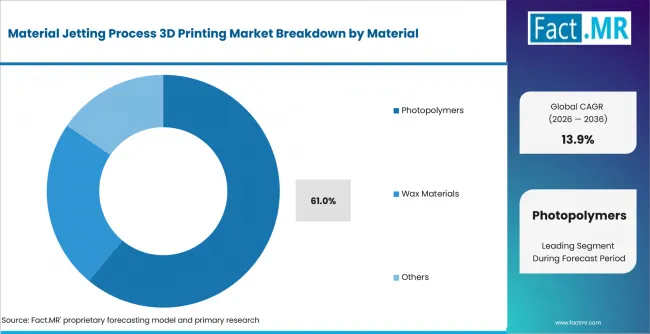
Material Jetting Process 3d Printing Market Analysis By Material | Source: Fact.MR
Why does Prototyping lead Application?
PolyJet is projected to account for 56% share in 2026.
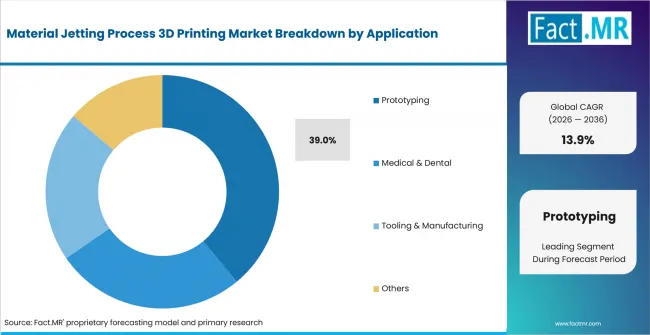
Material Jetting Process 3d Printing Market Analysis By Application | Source: Fact.MR
PolyJet holds the largest technology share because product teams can combine rigid, flexible, transparent and colored photopolymers in a single print. That capability makes the process useful when a prototype must communicate appearance and tactile behavior before an engineering team approves tooling. Full-color PolyJet and multi-material PolyJet broaden the addressable workflow from concept review to ergonomic testing. MultiJet Printing remains important for high-resolution photopolymer parts and wax patterns, while NanoParticle Jetting and Custom Material Jetting serve specialized programs that need functional particles or tailored deposition behavior.
Why does Manufacturing lead End User?
Photopolymers hold 61% share in 2026.
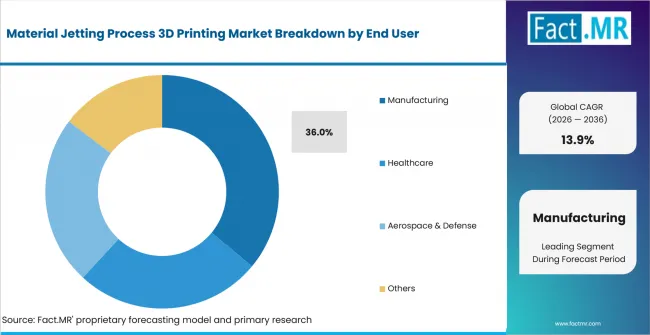
Material Jetting Process 3d Printing Market Analysis By End User | Source: Fact.MR
Photopolymers lead because they can be deposited as controlled droplets and cured immediately with ultraviolet light, which supports fine layers, smooth surfaces and detailed features. Rigid photopolymers are used for visual models, form-and-fit checks and tooling aids. Flexible photopolymers allow seals, grips, overmold simulations and soft-tissue analogs to be represented within the same design review. Wax materials retain a clear role in investment casting, while biocompatible resins and transparent materials expand medical, dental and fluid-flow applications when the supplier can document the relevant performance requirements.
Why do Industrial 3D Printers lead Printer Type?
Prototyping accounts for 39% share in 2026.
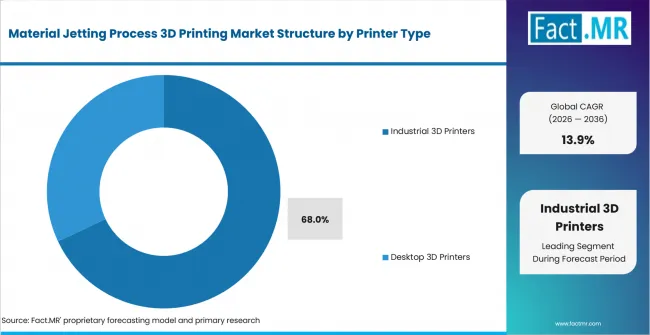
Material Jetting Process 3d Printing Market Analysis By Printer Type | Source: Fact.MR
Prototyping leads because material jetting converts detailed digital designs into presentation-ready physical models without separate tooling or manual assembly of each material zone. Concept prototypes help designers secure internal approval, communicate color and review proportions. Functional prototypes let engineers test fit, seals, grip and assembly access before a design freeze. Medical and dental applications depend on patient-specific data and controlled materials, while tooling and manufacturing applications require stronger evidence that a printed mold, jig or fixture can withstand the intended load, temperature and production cycle.
What is accelerating Material Jetting Process 3D Printing Market adoption, and what is holding it back?
Adoption is being accelerated by multi-material design review, high-resolution prototyping, medical and dental modeling, casting workflows and wider service access. Expansion is constrained by resin economics, end-use material limits, operator safety, post-processing requirements and the need to validate repeatability before printed parts enter regulated or production-critical use.
Which drivers have the greatest commercial effect?
| DRIVER | (~) % IMPACT ON CAGR | GEOGRAPHIC RELEVANCE | IMPACT TIMELINE |
|---|---|---|---|
| Multi-material and full-color design review | Qualitative | USA; Japan; South Korea | Short term (<= 2 years) |
| Faster prototype iteration before tooling | Qualitative | Germany; UK; Canada | Short term (<= 2 years) |
| Medical and dental model workflows | Qualitative | USA; Germany; Japan | Medium term (2-4 years) |
| Service-bureau access to industrial systems | Qualitative | Canada; Australia; UK | Medium term (2-4 years) |
| Compact systems for design and education | Qualitative | Japan; South Korea; Australia | Long term (>= 4 years) |
Source: Fact.MR analysis. Updated Aug 5, 2026
- Multi-material and full-color design review: A single model can show color, transparency, stiffness and flexible zones, reducing the need to assemble separate prototypes for one review meeting.
- Faster prototype iteration before tooling: Engineering teams can print a revised geometry after a design change and identify fit or usability problems before committing to a mold or machining program.
- Medical and dental model workflows: Detailed models improve communication between imaging, planning and clinical teams, but adoption depends on material documentation and process control.
Where are the clearest market opportunities?
| OPPORTUNITY | (~) % IMPACT ON CAGR | GEOGRAPHIC RELEVANCE | IMPACT TIMELINE |
|---|---|---|---|
| Durable and biocompatible photopolymer development | Qualitative | USA; Germany; Canada | Medium term (2-4 years) |
| Wax patterns for jewelry and precision casting | Qualitative | Japan; South Korea; Germany | Short term (<= 2 years) |
| Point-of-care anatomical and dental models | Qualitative | USA; UK; Australia | Medium term (2-4 years) |
| NanoParticle and custom functional jetting | Qualitative | South Korea; Japan; Germany | Long term (>= 4 years) |
Source: Fact.MR analysis. Updated Aug 5, 2026
- Durable and biocompatible photopolymer development: Materials that retain detail while improving heat resistance, mechanical behavior or biological compatibility can move material jetting beyond visual models into higher-value workflows.
- Wax patterns for jewelry and precision casting: MJP systems can produce detailed sacrificial patterns without dedicated tooling, which supports customized pieces and shorter casting runs.
- Point-of-care anatomical and dental models: Hospitals and dental laboratories can justify investment when image conversion, printer operation, cleaning and clinical review are governed as a repeatable workflow.
Which restraints limit wider use?
| RESTRAINT | (~) % IMPACT ON CAGR | GEOGRAPHIC RELEVANCE | IMPACT TIMELINE |
|---|---|---|---|
| Resin cost and proprietary material ecosystems | Qualitative | Global industrial users | Short term (<= 2 years) |
| Limited heat and load performance of many photopolymers | Qualitative | Automotive; industrial equipment | Short term (<= 2 years) |
| Uncured resin handling and workplace controls | Qualitative | Hospitals; schools; service bureaus | Medium term (2-4 years) |
| Support removal, cleaning and printer maintenance | Qualitative | All operating regions | Medium term (2-4 years) |
| Qualification and traceability requirements | Qualitative | Medical; aerospace; defense | Long term (>= 4 years) |
Source: Fact.MR analysis. Updated Aug 5, 2026
- Resin cost and proprietary material ecosystems: Buyers compare material consumption, support waste, service contracts and idle-machine risk against outsourced printing and alternative additive processes.
- Uncured resin handling and workplace controls: Operators need documented storage, ventilation, personal protection and waste procedures because exposure controls are part of responsible deployment.
- Qualification and traceability requirements: Regulated and production-critical buyers require evidence that the digital file, material lot, machine settings, post-processing and inspection route produce repeatable results.
Which countries are scaling the Material Jetting Process 3D Printing Market fastest?
The listed country outlook reflects distinct adoption pathways rather than one regional cycle. South Korea and Japan combine advanced manufacturing programs with domestic engineering capacity. The USA brings standards work, medical-device guidance and broad service access. Canada and Australia rely more heavily on public research infrastructure, while Germany and the UK connect additive manufacturing to specification-driven industry, prototyping and shared technology centers.
Across all seven countries, purchase timing depends on application engineering, qualified materials, operator controls and dependable service coverage. This favors suppliers that can demonstrate a complete workflow for a named use rather than sell the printer on resolution, color or material count alone. Full report coverage includes North America; Latin America; Europe; East Asia; South Asia and Pacific; Middle East and Africa.
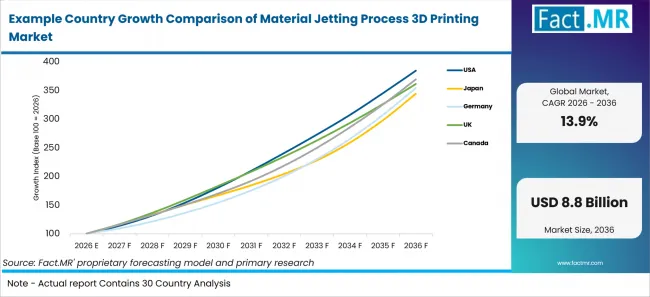
Example Country Growth Comparison Of Material Jetting Process 3d Printing Market | Source: Fact.MR
| Country | CAGR (2026-2036) |
|---|---|
| South Korea | 14.98% |
| USA | 14.4% |
| Canada | 13.97% |
| UK | 13.73% |
| Australia | 13.66% |
| Germany | 13.51% |
| Japan | 13.17% |
Source: Fact.MR analysis. Updated Aug 5, 2026
What is driving South Korea's growth through 2036?
14.98% CAGR, supported by advanced manufacturing research and application-focused 3D printing infrastructure.
South Korea combines electronics, precision manufacturing, healthcare technology and defense demand with public institutes that support additive manufacturing process development. KITECH maintains research activity in 3D printing, process monitoring, micro and nano manufacturing and medical implant production. This environment favors material jetting trials where a team needs detailed polymer models, multi-material demonstrations or small functional structures before a process moves into production. Suppliers still need local application engineering because Korean buyers expect equipment to integrate with disciplined manufacturing systems rather than operate as a stand-alone prototyping tool.
How does the USA scale demand?
14.4% CAGR, driven by product development, medical and dental use, standards work and broad service availability.
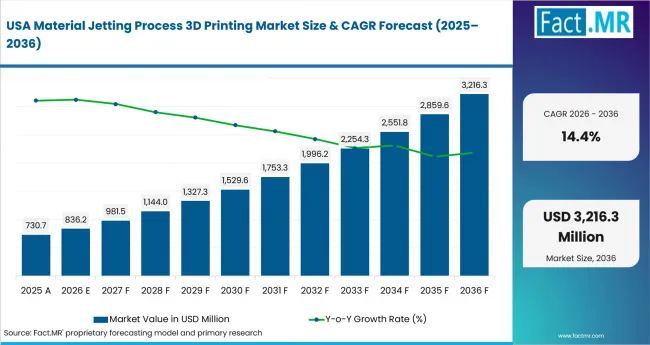
Material Jetting Process 3d Printing Market Country Value Analysis | Source: Fact.MR
The USA has a large base of design centers, medical-device developers, dental laboratories, aerospace suppliers and outsourced manufacturing platforms. NIST research on material jetting and polymer additive manufacturing supports measurement and process understanding, while FDA guidance requires manufacturers of additively manufactured medical devices to address testing, characterization and process controls. NIOSH attention to additive manufacturing hazards also raises the operating standard for resin handling. Market conversion therefore depends on validated materials, documented workflows and service support, not only print quality.
What supports Canada's growth?
13.97% CAGR, supported by advanced materials research, collaborative manufacturing programs and service-based adoption.
Canada benefits from National Research Council capabilities in advanced materials, polymer and composite manufacturing, printed electronics and 2D or 3D printing for integrated functions. These programs create a pathway from laboratory material development to industrial demonstration. Many Canadian buyers are geographically dispersed and may not run enough material-jetting volume to justify a dedicated industrial platform, which strengthens the role of research facilities and service providers. Suppliers that combine design support, material advice and predictable turnaround can convert project-based demand into repeat accounts.
What is driving the UK's growth?
13.73% CAGR, led by prototyping, customized manufacturing, rapid tooling and the High Value Manufacturing network.
UK government research on 3D printing adoption identifies prototyping, customized manufacturing and rapid tooling as practical routes for smaller manufacturers. The country also has Catapult centers, university laboratories and defense manufacturing programs that help companies evaluate additive processes before committing capital. Material jetting is most relevant where a buyer needs realistic prototypes, anatomical models, ergonomic studies or low-volume patterns. The commercial constraint is not awareness but access to trained operators, workflow validation and a clear cost comparison with service bureaus and other printing methods.
What supports Australia's growth?
13.66% CAGR, supported by shared research infrastructure and high-value aerospace, medical and industrial projects.
Australia relies on national research facilities and university-industry collaboration to give manufacturers access to equipment that would be difficult to justify at one site. CSIRO describes Lab22 as an additive manufacturing center accessible to industry and documents rapid prototyping, aerospace and medical projects. Material jetting suppliers can benefit by supporting design visualization, anatomical communication, education and service-bureau applications that do not need heavy metal-printing infrastructure. Compact full-color systems and outsourced industrial builds are especially relevant where users are spread across major cities and regional manufacturing locations.
How does Germany perform?
13.51% CAGR, led by polymer research, industrial engineering discipline and specification-driven adoption.
Germany has a dense automotive, industrial equipment, medical engineering and research base. Fraunhofer institutes work on additive process chains, factory planning, polymer materials and light-curing technologies, including materials for medical applications. German buyers are likely to test material jetting against measurable requirements for geometry, surface, temperature, durability and repeatability. This favors suppliers that can document material behavior and connect the printer to quality and production planning systems. It also limits casual expansion into end-use parts when a photopolymer cannot meet the required service conditions.
What is shaping Japan's growth?
13.17% CAGR, supported by high-value production programs, precision manufacturing and domestic full-color inkjet expertise.
Japan combines precision product development with national programs that promote additive manufacturing for high-value production. NEDO identifies 3D printing as part of next-generation manufacturing systems, while Mimaki has commercialized full-color UV-curable inkjet 3D printers for design, education and visual communication. Material jetting fits Japanese demand when detailed color, surface quality and compact system design reduce manual model finishing. Adoption can take longer where established manufacturers require extended evaluation, local service and proof that the printed model improves a tightly controlled development process.
Who leads the Material Jetting Process 3D Printing Market?
Stratasys Ltd. is an active provider among the profiled companies. Other profiled providers include 3D Systems Corporation, HP Inc., Materialise NV, Proto Labs, Inc., Voxeljet AG (adjacent additive-manufacturing provider), Mimaki Engineering Co., Ltd., Xometry, Inc., Shining 3D Tech Co., Ltd. and Keyence Corporation.
Competition spans direct material-jetting printer manufacturers, material portfolios, software and outsourced production services. Stratasys competes through PolyJet systems and multi-material photopolymers. 3D Systems addresses photopolymer and wax workflows through MultiJet Printing. Mimaki focuses on full-color UV inkjet models, while Materialise and Proto Labs provide access through service-based production. Broader additive manufacturing suppliers and digital procurement platforms influence buyer comparisons even when their main process is adjacent to material jetting. Fact.MR opines that the strongest positions will come from application proof, service response and material credibility rather than unsupported claims of universal process superiority.
Which companies are the key providers?
Key companies include Stratasys Ltd.; 3D Systems Corporation; HP Inc.; Materialise NV; Proto Labs, Inc.; Voxeljet AG (adjacent additive-manufacturing provider); Mimaki Engineering Co., Ltd.; Xometry, Inc.; Shining 3D Tech Co., Ltd.; and Keyence Corporation.
- Stratasys Ltd.
- 3D Systems Corporation
- HP Inc.
- Materialise NV
- Proto Labs, Inc.
- Voxeljet AG (adjacent additive-manufacturing provider)
- Mimaki Engineering Co., Ltd.
- Xometry, Inc.
- Shining 3D Tech Co., Ltd.
- Keyence Corporation
Bibliography
- International Organization for Standardization. (2021). ISO/ASTM 52900:2021, Additive manufacturing - General principles - Fundamentals and vocabulary.
- National Institute of Standards and Technology. (2024, November 20). Material Jetting.
- National Institute of Standards and Technology. (2024, November 13). Additive Manufacturing of Polymers.
- U.S. Food and Drug Administration. (2017, December 5). Technical Considerations for Additive Manufactured Medical Devices: Guidance for Industry and Food and Drug Administration Staff.
- National Institute for Occupational Safety and Health. (2026, March 3). 3D Printing (Additive Manufacturing). Centers for Disease Control and Prevention.
- National Institute for Occupational Safety and Health. (2019, April 9). Potential Hazards of Additive Manufacturing.
- New Energy and Industrial Technology Development Organization. (2024, October 1). Industrial Technology.
- Fraunhofer Institute for Applied Polymer Research. (n.d.). 3D Printing Technologies for Medical Applications. Accessed August 4, 2026.
- Fraunhofer Institute for Casting, Composite and Processing Technology. (n.d.). Additive Manufacturing (AM). Accessed August 4, 2026.
- Department for Business and Trade. (2025, August 22). Factors Affecting Adoption of 3D Printing by SMEs: The Case of Greater Manchester. GOV.UK.
- High Value Manufacturing Catapult. (n.d.). Additive Manufacturing (3D Printing). Accessed August 4, 2026.
- National Research Council Canada. (2026, February 18). Advanced Materials for Additive Manufacturing.
- National Research Council Canada. (2023, October 30). NRC Capabilities in Advanced Manufacturing.
- Commonwealth Scientific and Industrial Research Organisation. (n.d.). Lab22: Australia's Centre for Innovation in Metallic Additive Manufacturing. Accessed August 4, 2026.
- Korea Institute of Industrial Technology. (n.d.). R&D in Three Key Areas: Intelligent Manufacturing and Materials Technology. Accessed August 4, 2026.
- Stratasys Ltd. (n.d.). PolyJet Technology for 3D Printing. Accessed August 4, 2026.
- 3D Systems Corporation. (n.d.). MultiJet 3D Printing. Accessed August 4, 2026.
- Mimaki Engineering Co., Ltd. (n.d.). 3DUJ Full-Color UV-Curable Inkjet 3D Printing. Accessed August 4, 2026.
- Materialise NV. (n.d.). PolyJet 3D Printing Service. Accessed August 4, 2026.
- Proto Labs, Inc. (n.d.). PolyJet 3D Printing. Accessed August 4, 2026.
This Report Answers
- The report provides strategic intelligence on the Material Jetting Process 3D Printing Market across Technology, Material, Application, End User and Printer Type choices that shape equipment and material selection.
- Segment analysis covers PolyJet, Photopolymers, Prototyping, Manufacturing and Industrial 3D Printers as the share leaders within the 2026 market.
- Country outlook compares South Korea and the USA with Canada, the UK, Australia, Germany and Japan across the forecast period.
- Competitive analysis profiles Stratasys Ltd. alongside 3D Systems Corporation, Mimaki Engineering Co., Ltd., service providers and the wider profiled company set.
- Application assessment examines concept and functional prototypes, surgical guides, dental models, molds, jigs, fixtures, jewelry, consumer products and education or research use.
What does the Material Jetting Process 3D Printing Market cover?
The market covers material jetting printers, jettable build materials and related printing services used for prototypes, models, patterns, tooling aids and selected end-use or clinical applications.
Coverage includes PolyJet, MultiJet Printing and other defined material-jetting routes. It includes photopolymers, wax materials, biocompatible resins, transparent materials and custom jettable formulations when revenue is tied to the defined process. Applications span prototyping, medical and dental work, tooling and manufacturing and other named uses. Printer coverage includes industrial and desktop systems, while service-bureau revenue is included when the purchased output is produced through material jetting.
What is included in the scope?
The scope includes Technology, Material, Application, End User, Printer Type and Region, with company coverage tied to the profiled provider list.
Technology coverage spans PolyJet, Full-Color PolyJet, Multi-Material PolyJet, MultiJet Printing, Wax-Based MJP, Photopolymer MJP, NanoParticle Jetting and Custom Material Jetting. Material coverage includes rigid and flexible photopolymers, casting and modeling wax, biocompatible resins and transparent materials. The country view includes the USA, Japan, Germany, UK, Canada, Australia and South Korea. Company coverage includes the named providers listed in the competitive section.
What is excluded from the scope?
Unrelated additive manufacturing processes and conventional 2D inkjet printing are outside this market unless the associated revenue is specifically attributable to material jetting.
The scope excludes material extrusion, powder bed fusion, binder jetting, vat photopolymerization, directed energy deposition and sheet lamination when they are sold as independent processes. General CAD software, scanning equipment, subtractive machining and injection molding are excluded unless their revenue forms part of a material-jetting service contract. Raw chemicals that are not sold as qualified or formulated jetting materials are outside the assessed market.
How Was the Analysis Built?
The analysis combines primary interviews, public technical and regulatory records, company portfolios, country-level manufacturing evidence and structured market modeling. Quantitative estimates are validated across printer, material and service revenue pools, application adoption, channel checks and forecast assumptions.
- Primary Research: Primary research includes discussions with printer manufacturers, material formulators, service bureaus, distributors, manufacturing engineers, healthcare users, dental laboratories, procurement teams and subject-matter experts. These discussions examine purchase criteria, application fit, utilization, material constraints, maintenance and qualification needs.
- Desk Research: Desk research reviews standards, government and public research publications, regulatory guidance, occupational safety material, company technical literature, product portfolios and country manufacturing programs. The bibliography documents the external sources used for qualitative context.
- Market Sizing and Forecasting: Market sizing combines printer, material and service demand with Technology, Material, Application, End User and Printer Type shares. Country growth is assessed against local manufacturing depth, research access, clinical or industrial qualification, service coverage and adoption barriers.
- Data Validation and Update Cycle: The analysis combines primary interviews with structured review of public company disclosures, official statistics, regulatory material, and sector publications. Forecast interpretation considers market conditions, adoption requirements, competitive positioning, and regional operating context.
Segmentation
What is the report's scope and coverage?
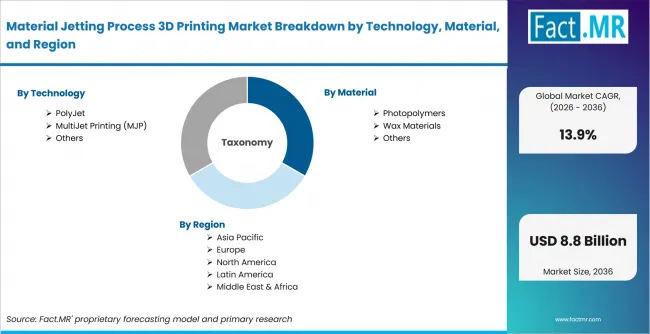
Material Jetting Process 3d Printing Market Breakdown By Technology, Material, And Region | Source: Fact.MR
| Attribute | Details |
|---|---|
| Quantitative Units | USD Billion |
| Market Definition | Printers, jettable build materials and related services used to deposit and solidify droplets layer by layer for material jetting 3D printing |
| Technology | PolyJet; MultiJet Printing (MJP); Others |
| Material | Photopolymers; Wax Materials; Others |
| Application | Prototyping; Medical & Dental; Tooling & Manufacturing; Others |
| End User | Manufacturing; Healthcare; Aerospace & Defense; Others |
| Printer Type | Industrial 3D Printers; Desktop 3D Printers |
| Regions Covered | North America; Latin America; Europe; East Asia; South Asia and Pacific; Middle East and Africa |
| Countries Covered | USA; Japan; Germany; UK; Canada; Australia; South Korea |
| Key Companies Profiled | Stratasys Ltd.; 3D Systems Corporation; HP Inc.; Materialise NV; Proto Labs, Inc.; Voxeljet AG; Mimaki Engineering Co., Ltd.; Xometry, Inc.; Shining 3D Tech Co., Ltd.; Keyence Corporation |
| Forecast Period | 2026 to 2036 |
| Approach | Hybrid top-down and bottom-up assessment using printer and material demand, application workflows, segment shares, country growth, service availability, qualification requirements and company portfolio review |
Source: Fact.MR analysis. Updated Aug 5, 2026
How is the market segmented?
-
By Technology:
- PolyJet
- Full-Color PolyJet
- Multi-Material PolyJet
- MultiJet Printing (MJP)
- Wax-Based MJP
- Photopolymer MJP
- Others
- NanoParticle Jetting
- Custom Material Jetting
- PolyJet
-
By Material:
- Photopolymers
- Rigid Photopolymers
- Flexible Photopolymers
- Wax Materials
- Casting Wax
- Modeling Wax
- Others
- Biocompatible Resins
- Transparent Materials
- Photopolymers
-
By Application:
- Prototyping
- Concept Prototypes
- Functional Prototypes
- Medical & Dental
- Surgical Guides
- Dental Models
- Tooling & Manufacturing
- Molds
- Jigs & Fixtures
- Others
- Jewelry
- Consumer Products
- Education & Research
- Prototyping
-
By End User:
- Manufacturing
- Automotive
- Industrial Equipment
- Healthcare
- Hospitals
- Dental Laboratories
- Aerospace & Defense
- Aircraft Components
- Defense Prototyping
- Others
- Education
- Consumer Goods
- Service Bureaus
- Manufacturing
-
By Printer Type:
- Industrial 3D Printers
- High-Volume Production
- Professional Prototyping
- Desktop 3D Printers
- Engineering Desktop Systems
- Educational Desktop Systems
- Industrial 3D Printers
-
By Region:
- North America
- Latin America
- Western Europe
- Eastern Europe
- East Asia
- South Asia and Pacific
- Middle East & Africa
Frequently Asked Questions
Which technology leads the Material Jetting Process 3D Printing Market?
Which material leads the market?
Which application leads the market?
Which end user leads the market?
Which printer type leads the market?
Which country records the highest listed CAGR?
Who worked on this report


Preview the report firsthand - request a free sample
Free SampleGet the brochure for pricing and purchase details
Download PDF