- Market Value (2025): USD 2.9 Mn
- Estimated Value (2026): USD 15.8 Bn
- Forecast Value (2036): USD 1,150 Bn
- CAGR (2026-2036): 18.5%
What is the Medical Drone Delivery Services Market forecast to be worth by 2036?
USD 2.9 billion in 2026 to USD 15.8 billion by 2036, at 18.5% CAGR.
- The Medical Drone Delivery Services Market reached USD 2.4 billion in 2025.
- Demand is projected to increase from USD 2.9 billion in 2026 to USD 15.8 billion by 2036.
- The market is valued at USD 2.9 billion in 2026 as hospitals, laboratories, pharmaceutical distributors, public health agencies, and logistics providers expand paid drone routes for medical cargo.
- The market is forecast to record an 18.5% CAGR from 2026 to 2036 and create an absolute opportunity of USD 12.9 billion as approved beyond-visual-line-of-sight operations and repeat healthcare routes move into routine service.
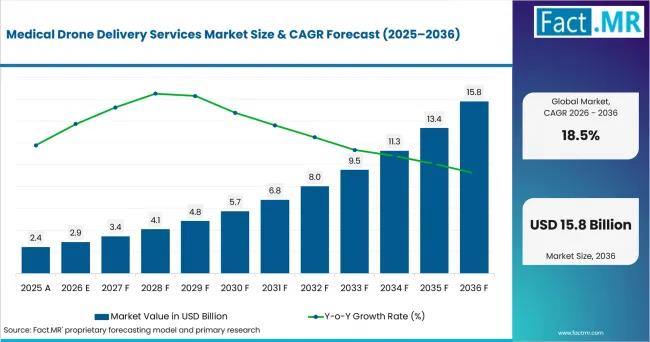
Medical Drone Delivery Services Market Value Analysis | Source: Fact.MR
What are the defining numbers behind Medical Drone Delivery Services Market growth?
USD 12.9 billion absolute opportunity by 2036, led by Medical Supply Delivery, Fixed-Wing Drones, Hospitals & Healthcare Networks, Hospitals, and Short Range (<50 km) services.
- Demand Drivers in the Market
- Hospital and laboratory networks need faster transfer of medicines, blood products, diagnostic specimens, surgical items, and emergency equipment when road congestion or long rural routes delay clinical decisions.
- Public health programs need dependable access to remote communities because vaccines, essential medicines, and return diagnostic samples must move even where roads, ferries, or seasonal weather disrupt conventional distribution.
- Healthcare buyers need services that preserve identity, temperature, tamper evidence, handoff records, and escalation procedures because medical cargo cannot be treated as an ordinary parcel after flight approval is obtained.
- Operators need route density and bidirectional payloads because recurring deliveries from hospitals and pharmacies become more economical when return flights carry laboratory specimens, records, or reusable medical containers.
- Key Segments Analyzed
- By Service Type: Medical Supply Delivery is expected to hold 44% share in 2026 supported by recurring demand for Medicines and Vaccines across scheduled healthcare replenishment routes.
- By Drone Type: Fixed-Wing Drones are projected to account for 42% share in 2026 owing to the range and energy efficiency required for Long-Range UAV and Hybrid Fixed-Wing Systems.
- By Application: Hospitals & Healthcare Networks are anticipated to capture 38% share in 2026 because Inter-Hospital Logistics and Emergency Supply Transport create repeat, time-sensitive routes.
- By End User: Hospitals are estimated to represent 36% share in 2026 as Public Hospitals and Private Hospitals control clinical acceptance, pharmacy dispatch, laboratory schedules, and urgent handoff procedures.
- By Range: Short Range (<50 km) is forecast to account for 35% share in 2026 driven by Urban Healthcare Delivery and Campus Logistics routes that can be integrated with existing hospital operations.
- Analyst Opinion at Fact.MR
- Shambhu Nath Jha, Principal Consultant at Fact.MR, states: “Medical drone delivery becomes commercially durable only when flight operations disappear into the healthcare workflow. A hospital should be able to request a payload, verify packaging, track the route, receive the item, and document custody without creating a separate aviation process for clinical staff. Fact.MR opines that providers able to combine regulatory approval, reliable aircraft, medical packaging, autonomous ground infrastructure, and measurable service levels will convert more pilots into multi-route contracts.”
- Strategic Implications
- Health systems should select route pairs with measurable delay, recurring payload demand, secure origin and destination sites, and clear clinical owners before building a wider drone network.
- Service providers should validate temperature, vibration, tamper control, sample integrity, packaging, and handoff procedures for each payload class rather than applying one parcel workflow to medicines, blood, specimens, and organs.
- Operators should design bidirectional routes wherever possible because a supply delivery outbound and a laboratory sample return can improve aircraft utilization and strengthen the healthcare business case.
- Hospitals, regulators, and operators should define weather limits, diversion procedures, backup transport, incident reporting, cybersecurity, and data ownership before routine service begins.
South Korea records the highest listed country CAGR at 19.66%, followed by the USA at 18.93% and Canada at 18.57%. The UK reaches 18.34%, Australia 18.28%, Germany 18.11%, and Japan 17.73%. The range is relatively narrow because each country is working through the same commercial transition from demonstration flights to authorized, repeatable healthcare logistics. Adoption timing still depends on airspace rules, hospital procurement, route density, aircraft certification, public acceptance, local weather, and the ability to prove that medical handoffs remain controlled from dispatch to receipt.
How does the Medical Drone Delivery Services Market break down by segment?
Medical Supply Delivery leads at 44%, Fixed-Wing Drones at 42%, Hospitals & Healthcare Networks at 38%, Hospitals at 36%, and Short Range (<50 km) at 35% in 2026.
Why does Medical Supply Delivery lead Service Type?
Medical Supply Delivery holds 44% share in 2026.
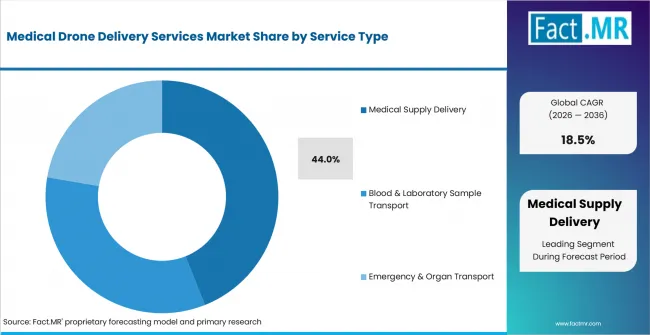
Medical Drone Delivery Services Market Analysis By Service Type | Source: Fact.MR
Medical Supply Delivery is expected to hold 44% share in 2026 because Medicines and Vaccines create the broadest base of planned, repeatable healthcare movements. Hospitals, pharmacies, health departments, and remote clinics can schedule replenishment around defined stock levels and receiving windows, which helps operators build route frequency and predictable utilization. UNICEF notes that drones have been used to move vaccines, medicines, diagnostic samples, blood products, and other commodities to and from hard-to-access locations. Blood & Laboratory Sample Transport remains commercially important because return specimens can make a route bidirectional and shorten diagnostic turnaround. Emergency & Organ Transport carries high clinical value, but Organ Delivery and Emergency Medical Equipment missions are less frequent and require stricter redundancy, monitoring, and escalation procedures. The leading share therefore reflects route volume and contract repeatability rather than the clinical importance of any single payload.
Why do Fixed-Wing Drones lead Drone Type?
Fixed-Wing Drones hold 42% share in 2026.
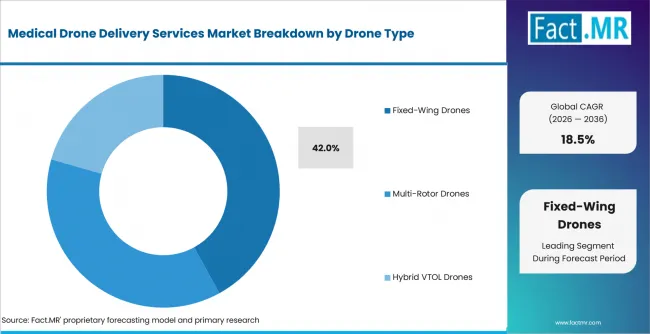
Medical Drone Delivery Services Market Analysis By Drone Type | Source: Fact.MR
Fixed-Wing Drones are projected to account for 42% share in 2026 because medical logistics often connect facilities separated by distance rather than serving only a local neighborhood. Long-Range UAVs can use lift more efficiently during forward flight, while Hybrid Fixed-Wing Systems add vertical takeoff or landing capability where runways are unavailable. A Johns Hopkins study selected a fixed-wing aircraft for laboratory specimen transport because it offered strong range capability for its takeoff weight and lower mechanical complexity. Multi-Rotor Drones remain well suited to Quadcopters and Hexacopters used for hospital campuses, dense urban corridors, and precise lowering to small receiving zones. Hybrid VTOL Drones become more attractive as operators need the range of a wing with the site flexibility of vertical flight. Fixed-wing leadership therefore reflects the need to cover regional and rural routes without surrendering payload control or daily sortie capacity.
Why do Hospitals & Healthcare Networks lead Application?
Hospitals & Healthcare Networks hold 38% share in 2026.
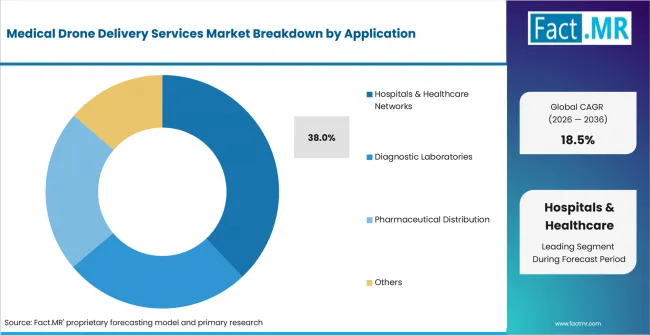
Medical Drone Delivery Services Market Analysis By Application | Source: Fact.MR
Hospitals & Healthcare Networks are anticipated to capture 38% share in 2026 because Inter-Hospital Logistics and Emergency Supply Transport provide identifiable origins, destinations, clinical owners, and service-level targets. A health network can compare drone performance with an existing courier route using delivery time, missed collections, urgent request response, and diagnostic turnaround. The FAA records that UPS Flight Forward used Matternet aircraft to move medical supplies at the WakeMed hospital campus after receiving Part 135 authority. Diagnostic Laboratories follow because Sample Collection and Test Specimen Delivery benefit directly from shorter and more predictable transfer windows. Pharmaceutical Distribution also expands through Drug Distribution and Vaccine Distribution, particularly where remote clinics or patient delivery routes are difficult to serve. Other uses in Rural Healthcare, Disaster Relief, and Blood Banks remain strategically important, but hospital networks lead because they can aggregate demand across pharmacy, laboratory, operating room, blood bank, and materials-management workflows.
Why does Hospitals lead End User?
Hospitals hold 36% share in 2026.
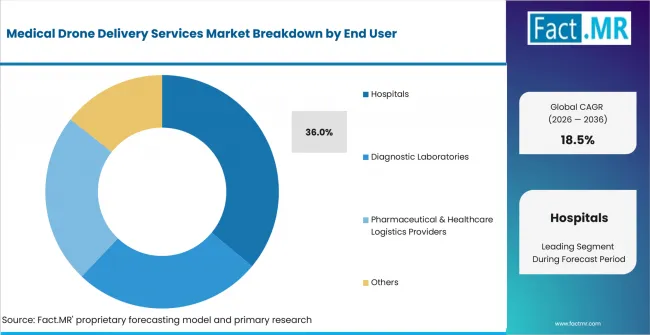
Medical Drone Delivery Services Market Analysis By End User | Source: Fact.MR
Hospitals are estimated to represent 36% share in 2026 because Public Hospitals and Private Hospitals control the point where medical urgency, inventory availability, laboratory timing, and patient care meet. Hospital buyers can assign drone routes to pharmacy, pathology, surgery, blood bank, or central stores and measure whether the service changes a specific operating outcome. Cleveland Clinic began prescription deliveries with Zipline in August 2026, illustrating how a health system can extend drone service from facility logistics to selected patient homes. Diagnostic Laboratories use drones to move specimens between collection sites and central testing facilities, while Pharmaceutical & Healthcare Logistics Providers connect manufacturers, pharmacies, and medical customers. Government Health Agencies, NGOs, and Blood Banks remain important in remote and emergency programs. Hospitals retain the leading share because they can sponsor recurring routes, define medical packaging requirements, provide secure receiving sites, and integrate exceptions into clinical escalation processes.
Why does Short Range (<50 km) lead Range?
Short Range (<50 km) holds 35% share in 2026.
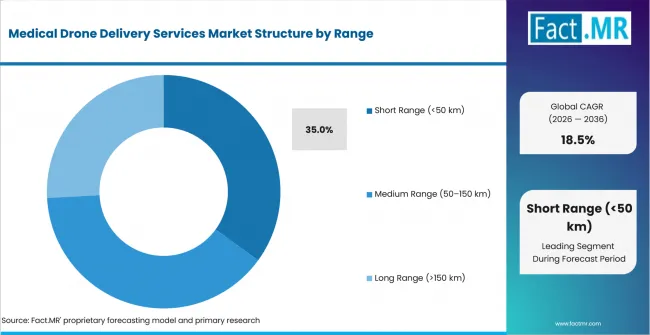
Medical Drone Delivery Services Market Analysis By Range | Source: Fact.MR
Short Range (<50 km) is forecast to account for 35% share in 2026 because Urban Healthcare Delivery and Campus Logistics provide the most practical starting point for routine service. Routes below 50 km can connect nearby hospitals, laboratories, pharmacies, distribution sites, and patient neighborhoods while limiting battery exposure, communications complexity, recovery planning, and weather variation. Wingcopter reported that blood samples moved across a 26-kilometer route in Germany in an average of 18 minutes, nearly twice as fast as ground transport. Medium Range services support Regional Medical Transport and Rural Healthcare Delivery where road distance is materially longer than direct flight distance. Long Range (>150 km) routes can transform Remote Area Delivery and Cross-Regional Medical Logistics, but they require stronger endurance, communications, contingency landing, and airspace coordination. Short-range leadership reflects easier operational integration, not a ceiling on the eventual network opportunity.
What is accelerating Medical Drone Delivery Services Market adoption, and what is holding it back?
Time-sensitive healthcare logistics, remote access, clearer BVLOS pathways, and route automation are anticipated to accelerate adoption, while airspace approval, clinical validation, weather exposure, and uneven route economics restrain it.
Drivers Impact Analysis
| DRIVER | DIRECTIONAL IMPACT | GEOGRAPHIC RELEVANCE | IMPACT TIMELINE |
|---|---|---|---|
| Time-critical hospital and laboratory transfers | Strong positive | North America, Europe, East Asia | Short term (<= 2 years) |
| Remote and rural healthcare supply access | Strong positive | Australia, Canada, Asia Pacific, Africa | Medium term (2-4 years) |
| BVLOS and commercial drone operating frameworks | Strong positive | USA, UK, Europe, Canada, Japan | Medium term (2-4 years) |
| Bidirectional medical supply and specimen routes | Moderate positive | Hospital and public health networks | Medium term (2-4 years) |
| Automated dispatch, docking, and fleet supervision | Moderate positive | Dense healthcare networks | Long term (>= 4 years) |
Source: Fact.MR analysis. Updated Aug 5, 2026
- Time-critical clinical transfers: Road travel does not offer the same response time on every route. WHO reported that Zipline reduced some blood delivery journeys in Rwanda from four hours to 15 minutes. The commercial value is highest when the drone service replaces an urgent trip rather than a low-priority parcel movement.
- Remote healthcare access: The World Bank documented a Meghalaya service that moved essential medicines more than 100 kilometers to distant health centers and returned blood samples for testing. These routes show why drone services can become part of the health supply chain where terrain and road reliability create recurring access gaps.
- Regulatory pathways: The FAA uses Part 135 as the route for compensated BVLOS property carriage in the United States. The UK CAA, Transport Canada, EASA, CASA, Japan MLIT, and South Korean authorities are also developing or applying structured approval pathways that can move operators from one-off demonstrations toward repeat services.
Opportunity Impact Analysis
| OPPORTUNITY | DIRECTIONAL IMPACT | GEOGRAPHIC RELEVANCE | IMPACT TIMELINE |
|---|---|---|---|
| Bidirectional supply and laboratory sample networks | Positive | Hospitals, laboratories, rural health systems | Short term (<= 2 years) |
| Cold-chain vaccines, biologics, blood, and specialty medicines | Positive | Global public health and hospital routes | Medium term (2-4 years) |
| Hospital micro-hubs and autonomous receiving infrastructure | Positive | Urban and multi-campus health systems | Medium term (2-4 years) |
| Long-range hybrid VTOL regional medical networks | Positive | Remote and cross-regional routes | Long term (>= 4 years) |
Source: Fact.MR analysis. Updated Aug 5, 2026
- Bidirectional networks: Services gain more value when outbound Medicines, Vaccines, or Emergency Medical Equipment are matched with inbound Diagnostic Samples. Swoop Aero has described two-way healthcare networks that deliver vaccines and collect patient samples, demonstrating how reverse logistics can support both service utilization and diagnostic access.
- Hospital micro-hubs: Operators can reduce manual handling by integrating secure loading, autonomous docking, charging, payload verification, and controlled receipt at selected hospitals or laboratories. The opportunity is not simply a faster aircraft. It is a smaller, repeatable logistics node that connects pharmacy, laboratory, and materials-management workflows.
Restraints Impact Analysis
| RESTRAINT | DIRECTIONAL IMPACT | GEOGRAPHIC RELEVANCE | IMPACT TIMELINE |
|---|---|---|---|
| Route-specific airspace authorization and safety cases | Negative | Global | Short term (<= 2 years) |
| Weather, payload, range, and landing constraints | Negative | All operating environments | Medium term (2-4 years) |
| Medical chain-of-custody and payload validation burden | Negative | Hospitals, laboratories, public health | Short term (<= 2 years) |
| Low utilization on irregular or one-way routes | Negative | Early commercial networks | Long term (>= 4 years) |
Source: Fact.MR analysis. Updated Aug 5, 2026
- Authorization burden: Medical urgency does not remove aviation obligations. BVLOS routes may require risk assessment, operational authorization, aircraft and operator approvals, communications evidence, contingency procedures, and local coordination before a paid service can begin. Each change in route, airspace, payload, or operating condition can reopen part of that review.
- Clinical validation burden: Laboratory specimens, blood products, vaccines, biologics, organs, and medicines have different packaging, temperature, vibration, security, and acceptance rules. Peer-reviewed studies support the feasibility of drone specimen transport, but health systems still need local validation for their own payloads, containers, analytes, exposure conditions, and handoff processes.
- Route economics: An aircraft can complete a flight successfully and still fail the purchasing test if demand is infrequent, staff handling remains high, backup couriers stay fully retained, or weather cancels too many sorties. Providers must show cost per completed clinical movement and service availability, not only flight speed.
Which countries are scaling Medical Drone Delivery Services Market fastest?
South Korea 19.66%, USA 18.93%, Canada 18.57%, UK 18.34%, Australia 18.28%, Germany 18.11%, and Japan 17.73% through 2036.
Regional analysis covers North America, Latin America, Europe, East Asia, South Asia and Oceania, and the Middle East and Africa.
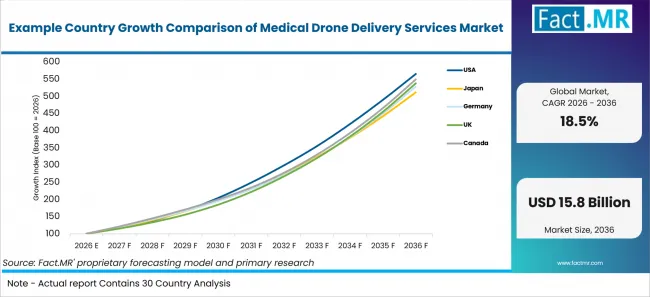
Example Country Growth Comparison Of Medical Drone Delivery Services Market | Source: Fact.MR
| COUNTRY | CAGR (2026-2036) |
|---|---|
| South Korea | 19.66% |
| USA | 18.93% |
| Canada | 18.57% |
| UK | 18.34% |
| Australia | 18.28% |
| Germany | 18.11% |
| Japan | 17.73% |
Source: Fact.MR analysis. Updated Aug 5, 2026
What is driving South Korea's growth through 2036?
19.66% CAGR through 2036.
South Korea records the highest listed rate because public programs are widening the operational base for drone delivery while healthcare use cases move closer to urban and inter-facility service. The Ministry of Land, Infrastructure and Transport outlined K-Drone work that includes delivery of medical supplies and emergency automated external defibrillators. Official Korean communication has also described drone delivery of first-aid supplies to island and inland communities. These programs give operators practical experience with route management, public receiving points, remote supervision, and local coordination before medical cargo volumes scale. Demand is projected to expand at 19.66% CAGR through 2036.
What supports USA adoption?
18.93% CAGR through 2036.
The USA is forecast to record 18.93% CAGR through 2036.
How is Canada scaling demand?
18.57% CAGR through 2036.
Canada is expected to post 18.57% CAGR through 2036.
What supports the UK outlook?
18.34% CAGR through 2036.
The UK is anticipated to advance at 18.34% CAGR through 2036.
How is Australia developing demand?
18.28% CAGR through 2036.
Australia is forecast to post 18.28% CAGR through 2036.
How does Germany perform?
18.11% CAGR through 2036.
Germany is projected to record 18.11% CAGR through 2036.
What underpins Japan's growth?
17.73% CAGR through 2036, attributable to Level 4 rules, remote-island logistics, and gradual adoption within a mature transport system.
Japan is estimated to record 17.73% CAGR through 2036.
Who leads the Medical Drone Delivery Services Market?
Zipline International Inc. is an active provider, while Wingcopter GmbH, Matternet Inc., DroneUp LLC, Wing Aviation LLC, Skyports Drone Services, Swoop Aero Pty Ltd., Flytrex Inc., and EHang Holdings Limited compete through different combinations of aircraft, operating authority, medical workflow integration, autonomous infrastructure, and route-management services.
Zipline International Inc. holds the competitive position and anchors its position in healthcare through long-running delivery networks for blood, medicines, and other medical supplies. WHO documentation from Rwanda shows how an integrated service can shorten urgent blood delivery, while Cleveland Clinic’s 2026 prescription program extends the model into a major United States health system.
Wingcopter GmbH brings long-range fixed-wing VTOL capability and has supported blood-sample transport in Germany along with medical-supply and diagnostic-sample networks in other regions. Matternet Inc. focuses on urban and hospital logistics through its M2 aircraft, stations, software, and operating model. Its central London NHS operation moves clinical samples, blood products, pharmaceuticals, and other time-sensitive payloads between hospital facilities.
DroneUp LLC combines aircraft, software, airspace tools, and automated ground infrastructure. Its Virginia healthcare work has tested prescription and sample movement across rural and island routes. Wing Aviation LLC brings high-volume small-parcel operating experience and has worked with Apian, NHS partners, and Medtronic on medical supplies and samples. Skyports Drone Services operates managed delivery programs and has worked with NHS organizations in Scotland and London.
Swoop Aero Pty Ltd. has established healthcare supply-chain experience with medicines, vaccines, diagnostics, cold-chain cargo, and return specimens in remote regions. These providers compete most directly where healthcare customers need an end-to-end service instead of a stand-alone aircraft.
Flytrex Inc. contributes autonomous last-mile delivery experience that can support selected pharmacy or low-weight healthcare routes when medical controls are added.EHang Holdings Limited adds autonomous aerial-vehicle and emergency-response capabilities, although its role is broader than routine medical parcel delivery.
Competition through 2036 is expected to turn on approved operating geography, route uptime, payload range, medical packaging, autonomous supervision, cybersecurity, landing infrastructure, hospital integration, and the provider’s ability to maintain a backup logistics plan when flight is unavailable. No ranking beyond company coverage is inferred.
Which companies are the key providers?
Zipline International Inc. is the active provider. Wingcopter, Matternet, DroneUp, Wing, Skyports, and Swoop Aero add direct medical-logistics experience, while Flytrex, EHang complete the assessed provider set.
- Zipline International Inc.
- Wingcopter GmbH
- Matternet Inc.
- DroneUp LLC
- Wing Aviation LLC
- Skyports Drone Services
- Swoop Aero Pty Ltd.
- Flytrex Inc.
- EHang Holdings Limited
Bibliography
- Unmanned Aerial Systems (Drones) Be Used for the Routine Transport of Chemistry, Hematology, and Coagulation Laboratory Specimens? PLOS ONE.
- Amukele, T. K., Ness, P. M., Tobian, A. A. R., Boyd, J., and Street, J. (2016). Drone Transport of Microbes in Blood and Sputum Laboratory Specimens. Journal of Clinical Microbiology.
- Civil Aviation Safety Authority. (2024, October 11). Drone delivery services. Australian Government.
- Cleveland Clinic. (2026, August 3). Cleveland Clinic Launches Drone Delivery Program for Prescription Medications.
- Department for Transport. (2024, March 18). UK Future of Flight Action Plan. Government of the United Kingdom.
- DroneUp. (2024, March 1). Virginia Eastern Shore Drone Medical Delivery Program Showcased at Demonstration for U.S. Department of Transportation.
- DroneUp. (2024, October 24). Medicine-By-Drone Demonstration Helps Health Program Soar on Tangier Island.
- EHang Holdings Limited. (2020, April 28). EHang Applies AAVs in Flood Emergency Response Exercise in China.
- European Union Aviation Safety Agency. (2025, September 29). ED Decision 2025/018/R.
- European Union Aviation Safety Agency. (2026, June 30). Easy Access Rules for Unmanned Aircraft Systems, June 2026 revision.
- Federal Aviation Administration. (n.d.). Package Delivery by Drone under Part 135.
- Federal Aviation Administration. (n.d.). Unmanned Aircraft System or Drone Operations for Hazardous Materials.
- Matternet Inc. (2026, April 24). Matternet Expands to the UK, Launching NHS Drone Delivery Operations in Central London.
- Ministry of Land, Infrastructure and Transport. (2025, February 14). K-Drone to Save Lives and More. Republic of Korea.
- Ministry of Land, Infrastructure, Transport and Tourism. (2023, March 17). Unmanned Aircraft Level 4 Flight Web Portal. Government of Japan.
- Scalea, J. R., Pucciarella, T., Talaie, T., et al. (2021). Successful Implementation of Unmanned Aircraft Use for Delivery of a Human Organ for Transplantation. Annals of Surgery.
- Skyports. (n.d.). Medical drone delivery work with the National Health Service.
- Swoop Aero. (n.d.). Strengthening health supply chains in Malawi.
- Transport Canada. (2026, April 20). 2025 Summary of Changes to Canada’s Drone Regulations.
- UK Civil Aviation Authority. (n.d.). Beyond Visual Line of Sight Operations.
- UNICEF Office of Innovation. (n.d.). Drones.
- UNICEF Supply Division. (n.d.). Drones to Reach the Last Mile.
- University of Maryland, Baltimore. (2019, April 26). Historic Flight Delivers Organ for Transplantation.
- Wing. (2024, July 2). Drone Delivery in South Dublin: Medtronic Medical Supplies Supporting Local Hospitals.
- Wingcopter GmbH. (2021, September 14). Wingcopter Drones Fly Blood Samples in Germany.
- World Bank. (2023, July 18). Drones Deliver Medicines to Distant Health Centers in Rural Meghalaya.
- World Health Organization. (2019, June 12). Drones Take Rwanda’s National Blood Service to New Heights.
This Report Answers
- The report provides strategic intelligence on medical drone delivery services across Service Type and Drone Type choices that determine payload suitability, flight profile, and operating responsibility.
- Segment analysis covers Medical Supply Delivery and Fixed-Wing Drones as the supplied 2026 share leaders within the market structure.
- Application assessment evaluates Hospitals & Healthcare Networks alongside Diagnostic Laboratories, Pharmaceutical Distribution, Rural Healthcare, Disaster Relief, and Blood Banks.
- Country outlook compares South Korea, the USA, Canada, the UK, Australia, Germany, and Japan using the listed country growth rates and country-specific operating pathways.
- Competitive analysis profiles Zipline International Inc. as the active provider alongside Wingcopter, Matternet, DroneUp, Wing, Skyports, Swoop Aero, Flytrex, EHang.
- Buyer analysis covers Hospitals, Diagnostic Laboratories, Pharmaceutical & Healthcare Logistics Providers, Government Health Agencies, NGOs, and Blood Banks across short-, medium-, and long-range services.
What does the Medical Drone Delivery Services Market cover?
Paid drone logistics services that move defined medical payloads between healthcare facilities, distribution points, public health sites, laboratories, and selected patient locations.
The market covers contracted services for Medical Supply Delivery, Blood & Laboratory Sample Transport, and Emergency & Organ Transport. Covered service elements may include aircraft access, route operation, remote supervision, dispatch, loading and receiving procedures, payload containers, flight tracking, operational authorization support, maintenance, landing or lowering infrastructure, and service-level reporting when these elements are sold as part of the delivery service.
Commercial value arises from the purchased drone delivery service rather than the value of the medicine, vaccine, blood product, diagnostic specimen, organ, or medical equipment being transported. The boundary is centered on healthcare cargo movement and its operating controls. Drone hardware sales are included only when inseparable from a qualifying service contract and are not counted as a stand-alone aircraft market.
What is included in the scope?
Medical drone delivery services are included when the contracted function is transport of the defined healthcare cargo across an approved route.
The scope includes Medical Supply Delivery across Medicines and Vaccines, Blood & Laboratory Sample Transport across Blood Products and Diagnostic Samples, and Emergency & Organ Transport across Organ Delivery and Emergency Medical Equipment. Fixed-Wing Drones include Long-Range UAVs and Hybrid Fixed-Wing Systems. Multi-Rotor Drones include Quadcopters and Hexacopters. Hybrid VTOL Drones include VTOL Medical Drones and Long-Endurance Hybrid UAVs.
Application coverage includes Hospitals & Healthcare Networks across Inter-Hospital Logistics and Emergency Supply Transport, Diagnostic Laboratories across Sample Collection and Test Specimen Delivery, Pharmaceutical Distribution across Drug Distribution and Vaccine Distribution, and other services across Rural Healthcare, Disaster Relief, and Blood Banks. End-user coverage includes Hospitals, Diagnostic Laboratories, Pharmaceutical & Healthcare Logistics Providers, Government Health Agencies, NGOs, and Blood Banks. Short-, medium-, and long-range service contracts are included where the provider is responsible for a material part of flight operations and delivery performance.
What is excluded from the scope?
Drone hardware sold without a qualifying medical-delivery service and non-medical drone operations are outside the scope.
The scope excludes consumer drone sales, military unmanned aircraft, mapping, inspection, surveillance, photography, agricultural spraying, passenger eVTOL services, air ambulances carrying patients, and conventional helicopter or fixed-wing medical transport. It excludes road courier, postal, rail, maritime, and conventional air-freight revenue even when those modes carry medical cargo.
The value of pharmaceuticals, vaccines, blood products, laboratory tests, organs, medical devices, emergency equipment, packaging materials, hospital inventory, clinical care, and insurance reimbursement is excluded. Stand-alone software, air-traffic services, charging systems, landing infrastructure, consulting, certification support, and drone manufacturing are excluded unless a material portion of the purchased offering is inseparable from the covered medical drone delivery service. Research flights without a paid or contracted service component remain outside the commercial boundary.
How Was the Analysis Built?
120+ sources, 40+ company and product portfolios, 25+ countries, and 20+ interviews.
- Primary Research: Primary research includes interviews with medical drone operators, aircraft and payload-system providers, hospitals, pathology laboratories, blood banks, pharmacies, pharmaceutical distributors, public health agencies, humanitarian organizations, aviation specialists, healthcare logistics managers, procurement leaders, and regulatory professionals. Discussions test route selection, payload mix, utilization, service reliability, pricing, staffing, medical validation, weather limits, backup logistics, and renewal decisions.
- Desk Research: The analysis combines primary interviews with structured review of public company disclosures, official statistics, regulatory material, and sector publications. Forecast interpretation considers market conditions, adoption requirements, competitive positioning, and regional operating context.
- Market-Sizing and Forecasting: Forecasting uses the 2026 and 2036 market values, service-contract revenue, route counts, flight frequency, payload class, range, drone type, hospital and laboratory participation, public health adoption, managed-service attachment, operating authorization, autonomous infrastructure, end-user demand, country growth rates, and provider portfolio coverage. Models also consider route utilization, bidirectional logistics, weather availability, clinical handoff requirements, replacement by road transport, and movement from demonstration projects toward recurring service contracts.
- Data Validation and Update Cycle: The analysis combines primary interviews with structured review of public company disclosures, official statistics, regulatory material, and sector publications. Forecast interpretation considers market conditions, adoption requirements, competitive positioning, and regional operating context.
Segmentation
What is the report's scope and coverage?
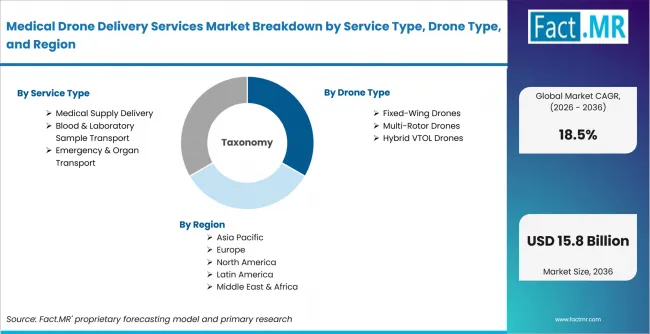
Medical Drone Delivery Services Market Breakdown By Service Type, Drone Type, And Region | Source: Fact.MR
| Attribute | Details |
|---|---|
| Quantitative Units | USD billion |
| Market Definition | Paid drone logistics services used to transport medical supplies, medicines, vaccines, blood products, diagnostic specimens, organs, emergency equipment, and related healthcare cargo across approved routes |
| Service Type | Medical Supply Delivery, Blood & Laboratory Sample Transport, Emergency & Organ Transport |
| Drone Type | Fixed-Wing Drones, Multi-Rotor Drones, Hybrid VTOL Drones |
| Application | Hospitals & Healthcare Networks, Diagnostic Laboratories, Pharmaceutical Distribution, Others |
| End User | Hospitals, Diagnostic Laboratories, Pharmaceutical & Healthcare Logistics Providers, Others |
| Range | Short Range (<50 km), Medium Range (50-150 km), Long Range (>150 km) |
| Regions Covered | North America, Latin America, Europe, East Asia, South Asia and Oceania, Middle East and Africa |
| Countries Covered | USA, Japan, Germany, UK, Canada, Australia, South Korea |
| Key Companies Profiled | Zipline International Inc., Wingcopter GmbH, Matternet Inc., DroneUp LLC, Wing Aviation LLC, Skyports Drone Services, Swoop Aero Pty Ltd., Flytrex Inc., Volansi, Inc., EHang Holdings Limited |
| Forecast Period | 2026 to 2036 |
| Approach | Hybrid top-down and bottom-up approach using contracted medical-drone service revenue, active route counts, flight frequency, payload type, range, aircraft configuration, hospital and laboratory adoption, public health programs, regulatory authorization, service-level requirements, country growth rates, and provider portfolio mapping |
Source: Fact.MR analysis. Updated Aug 5, 2026
How is the market segmented?
-
By Service Type:
- Medical Supply Delivery
- Medicines
- Vaccines
- Blood & Laboratory Sample Transport
- Blood Products
- Diagnostic Samples
- Emergency & Organ Transport
- Organ Delivery
- Emergency Medical Equipment
- Medical Supply Delivery
-
By Drone Type:
- Fixed-Wing Drones
- Long-Range UAVs
- Hybrid Fixed-Wing Systems
- Multi-Rotor Drones
- Quadcopters
- Hexacopters
- Hybrid VTOL Drones
- VTOL Medical Drones
- Long-Endurance Hybrid UAVs
- Fixed-Wing Drones
-
By Application:
- Hospitals & Healthcare Networks
- Inter-Hospital Logistics
- Emergency Supply Transport
- Diagnostic Laboratories
- Sample Collection
- Test Specimen Delivery
- Pharmaceutical Distribution
- Drug Distribution
- Vaccine Distribution
- Others
- Rural Healthcare
- Disaster Relief
- Blood Banks
- Hospitals & Healthcare Networks
-
By End User:
- Hospitals
- Public Hospitals
- Private Hospitals
- Diagnostic Laboratories
- Pathology Laboratories
- Clinical Laboratories
- Pharmaceutical & Healthcare Logistics Providers
- Pharmaceutical Companies
- Medical Logistics Providers
- Others
- Government Health Agencies
- NGOs
- Blood Banks
- Hospitals
-
By Range:
- Short Range (<50 km)
- Urban Healthcare Delivery
- Campus Logistics
- Medium Range (50–150 km)
- Regional Medical Transport
- Rural Healthcare Delivery
- Long Range (>150 km)
- Remote Area Delivery
- Cross-Regional Medical Logistics
- Short Range (<50 km)
-
By Region:
- North America
- USA
- Canada
- Latin America
- Brazil
- Mexico
- Argentina
- Chile
- Europe
- Germany
- UK
- France
- Italy
- Spain
- Benelux
- Nordics
- East Asia
- Japan
- South Korea
- South Asia and Oceania
- ASEAN
- Australia
- New Zealand
- Middle East and Africa
- GCC Countries
- South Africa
- Turkey
- Rest of Middle East and Africa
- North America
Frequently Asked Questions
Which Service Type leads the Medical Drone Delivery Services Market?
Which Drone Type leads the market?
Which Application leads the market?
Which End User leads the market?
Which Range leads the market?
Which country records the highest CAGR in the market?
How does the USA perform in the market?
How does Canada perform in the market?
How does the UK perform in the market?
How does Australia perform in the market?
How does Germany perform in the market?
How does Japan perform in the market?
Which companies are active in the market?
What is the primary driver in the market?
What is the main restraint in the market?
Why are bidirectional routes important?
Why do fixed-wing and hybrid aircraft matter?
Who worked on this report


Preview the report firsthand - request a free sample
Free SampleGet the brochure for pricing and purchase details
Download PDF