- Market Value (2025): USD 1.36 Bn
- Estimated Value (2026): USD 1.42 Bn
- Forecast Value (2036): USD 2.16 Bn
- CAGR (2026-2036): 4.3%
What is the Methylene Chloride Market forecast to be worth by 2036?
USD 1.4 billion in 2026 to USD 2.2 billion by 2036, at a 4.3% CAGR.
- As per Fact.MR analysis, the methylene chloride market reached USD 1.36 billion in 2025.
- Global sales are projected to move from USD 1.42 billion in 2026 to USD 2.16 billion by 2036.
- The market is forecast to grow at a 4.3% CAGR from 2026 to 2036, with purchases concentrated in permitted chemical processing and qualified industrial uses.
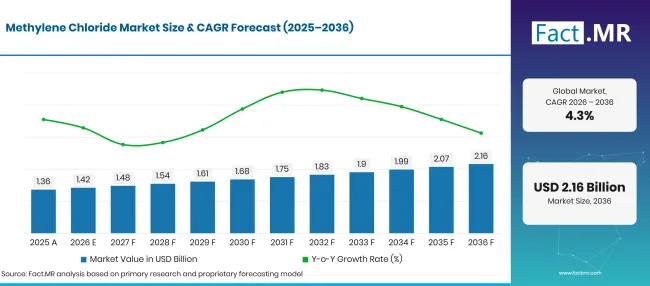
Factmr Methylene Chloride Market Forecast Global | Source: Fact.MR
| Year | Basis | Market Value (USD billion) |
|---|---|---|
| 2025 | Actual | 1.36 |
| 2026 | Estimate | 1.42 |
| 2036 | Forecast | 2.16 |
| CAGR 2026 to 2036 | Forecast period | 4.3% |
Source: Fact.MR analysis. Updated Oct 17, 2026
What are the defining numbers behind Methylene Chloride Market growth?
USD 0.8 billion in additional market value by 2036, with technical grade, paint-removal applications and automotive end users forming the leading segments.
- Demand Drivers in the Market
- Chemical plant operators use methylene chloride as a process solvent when its separation properties suit an approved reaction or recovery system. Equipment design and exposure control influence repeat orders more directly than a general preference for solvent strength.
- Pharmaceutical manufacturers assess solvent purity and residual-solvent limits when selecting a processing material. Their purchasing teams need traceable batches and process documentation alongside the technical specification for each approved use.
- Industrial surface-treatment specialists compare coating removal performance against workplace restrictions. In the United States, the Environmental Protection Agency prohibits most commercial paint-removal uses, leaving a narrower category of safety-critical aerospace work [1].
- Materials processors that retain authorised uses place value on contained transfer and solvent recovery. Their operating costs depend on equipment compatibility and loss control, which can make long-running supply arrangements preferable to occasional spot purchases.
- Key Segments Analyzed
- By Grade: Technical accounts for 50.7% share in 2026, reflecting use in industrial processes where a defined commercial specification is suitable.
- By Application: Paint Remover represents 32.4% share in 2026 across the defined global application mix.
- By End-User Industry: Automotive holdd 38.6% share in 2026, within the specified industry classification and subject to the permitted applications in each country.
- Analyst Opinion at Fact.MR
- Shambhu Nath Jha, Principal Consultant at Fact.MR, states, “Chemical processors are expected to favour suppliers that can support qualified uses with consistent grades and complete handling documents. Closed transfer and recovery systems remain relevant to maintaining approved industrial operations.”
- Strategic Implications
- Chemical producers should map each customer application against current national restrictions before confirming long-term sales arrangements.
- Industrial distributors should maintain clear end-use records and communicate handling instructions in the documentation accompanying each shipment.
- Plant engineering teams should assess containment and solvent recovery before replacing an established process input or increasing throughput.
- Pharmaceutical quality teams should qualify purity specifications against validated manufacturing processes and the applicable residual-solvent requirements.
Germany is forecast to grow at a 4.8% CAGR, followed by Brazil at 4.4% and the United States at 4.0%. The United Kingdom is projected at 3.6%, while Japan has a 3.2% CAGR across 2026 to 2036.
How does the Methylene Chloride Market break down by segment?
Technical 50.7%; Paint Remover 32.4%; Automotive 38.6% in 2026.
Which Grade accounts for the greater share?
Technical holds 50.7% share in 2026.
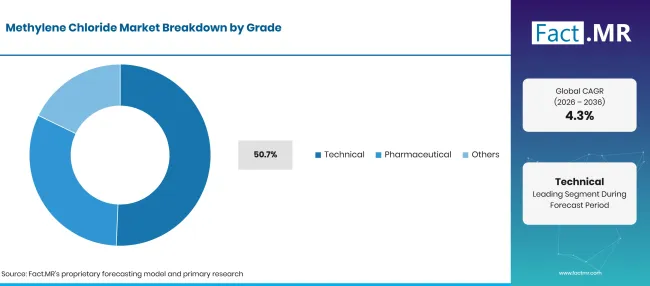
Factmr Methylene Chloride Market Breakdown Grade | Source: Fact.MR
| accounts | Share (2026) |
|---|---|
| Technical (Leading segment) | 50.7% |
| Other segments combined | 49.3% |
| Total | 100.0% |
Source: Fact.MR analysis. Updated Oct 17, 2026
Technical grade is projected to account for 50.7% share in 2026. Industrial processors select this grade when the stated quality specification suits their production methods. Pharmaceutical grade serves users whose validated processes require closer control of impurities. Other grades are evaluated against customers’ acceptance limits. Across these categories, documented product identity influences repeat purchases.
What leads the Application segment?
Paint Remover accounts for 32.4% share in 2026.
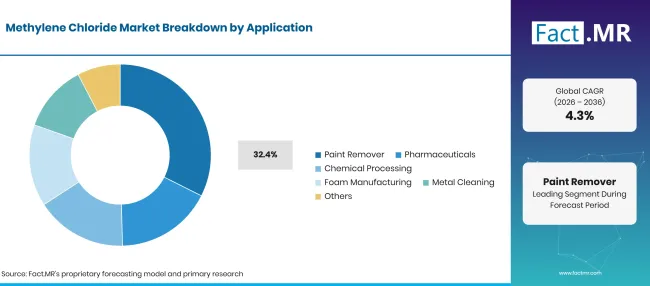
Factmr Methylene Chloride Market Breakdown Application | Source: Fact.MR
| Segment | Share (2026) |
|---|---|
| Paint Remover (Leading segment) | 32.4% |
| Other segments combined | 67.6% |
| Total | 100.0% |
Source: Fact.MR analysis. Updated Oct 17, 2026
Paint Remover is forecast to represent 32.4% share in 2026. This segment requires careful country-level interpretation because methylene chloride use in paint removal faces substantial restrictions in the United States. Pharmaceutical processing and chemical manufacturing are separate applications depending on process qualification. Foam manufacturing and metal cleaning must also be assessed against the rules governing each location and use.
How does End-User Industry shape purchases?
Automotive leads with 38.6% share in 2026.
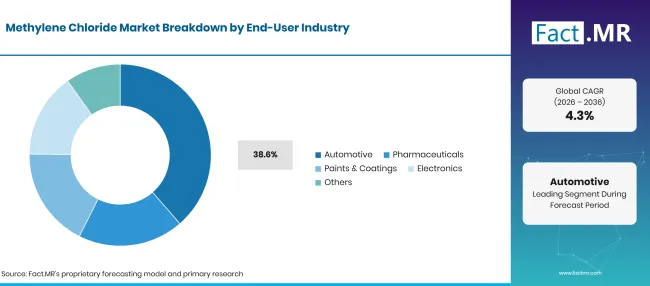
Factmr Methylene Chloride Market Breakdown End User Industry | Source: Fact.MR
| Segment | Share (2026) |
|---|---|
| Automotive (Leading segment) | 38.6% |
| Other segments combined | 61.4% |
| Total | 100.0% |
Source: Fact.MR analysis. Updated Oct 17, 2026
Automotive applications are estimated to represent 38.6% share in 2026. Purchasing depends on which specific task is approved within each production or maintenance setting. Pharmaceutical customers examine residual-solvent specifications and consistency between deliveries. Paints and coatings customers face application-specific rules, while electronics users assess handling and material compatibility. These differences affect the choice of grade and supporting technical records
What is accelerating Methylene Chloride Market adoption, and what is holding it back?
Approved industrial processes support sales, while worker-exposure rules and use restrictions limit other applications.
Drivers Impact Analysis
| DRIVER | (~) % IMPACT ON CAGR | GEOGRAPHIC RELEVANCE | IMPACT TIMELINE |
|---|---|---|---|
| Qualified chemical processing | +1.0% | Global | Medium term (2–4 years) |
| Solvent recovery systems | +0.8% | Industrial markets | Medium term (2–4 years) |
| Defined pharmaceutical uses | +0.7% | Global | Long term (>= 4 years) |
| Stable technical-grade supply | +0.5% | Asia, Latin America | Short term (<= 2 years) |
| Approved specialty applications | +0.4% | Selected markets | Medium term (2–4 years) |
Source: Fact.MR analysis. Updated Oct 17, 2026
Opportunity Impact Analysis
| OPPORTUNITY | (~) % IMPACT ON CAGR | GEOGRAPHIC RELEVANCE | IMPACT TIMELINE |
|---|---|---|---|
| Closed-loop handling | +0.8% | Global | Medium term (2–4 years) |
| Higher-purity supply | +0.6% | Pharmaceutical hubs | Medium term (2–4 years) |
| End-use documentation | +0.5% | Regulated markets | Short term (<= 2 years) |
| Technical service | +0.4% | Industrial plants | Long term (>= 4 years) |
Source: Fact.MR analysis. Updated Oct 17, 2026
Restraints Impact Analysis
| RESTRAINT | (~) % IMPACT ON CAGR | GEOGRAPHIC RELEVANCE | IMPACT TIMELINE |
|---|---|---|---|
| U.S. use restrictions | -0.8% | United States | Short term (<= 2 years) |
| Workplace exposure controls | -0.6% | Global | Medium term (2–4 years) |
| Substitute solvents | -0.5% | Europe, North America | Medium term (2–4 years) |
| Operating compliance costs | -0.4% | Global | Long term (>= 4 years) |
Source: Fact.MR analysis. Updated Oct 17, 2026
Which countries are scaling the Methylene Chloride Market through 2036?
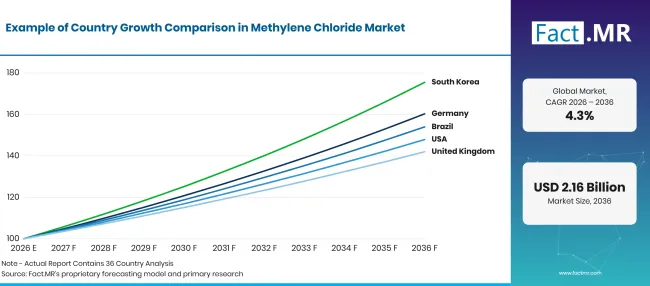
Factmr Methylene Chloride Market Growth Index | Source: Fact.MR
| Country | CAGR (2026–2036) |
|---|---|
| Germany | 4.8% |
| Brazil | 4.4% |
| United States | 4.0% |
| United Kingdom | 3.6% |
| Japan | 3.2% |
Source: Fact.MR analysis. Updated Oct 17, 2026
Why is Germany advancing in methylene chloride use?
4.8% CAGR, linked to qualified chemical manufacturing.
German chemical manufacturers assess methylene chloride against established production methods and customer-grade specifications. In February 2026, Destatis reported that industrial production in Germany declined by 1.1% across 2025 [3]. That wider manufacturing result gives chemical sellers reason to protect existing accounts through steady batch quality.
How is Brazil shaping methylene chloride purchases?
4.4% CAGR, influenced by chemical-sector processing activity.
Brazilian chemical processors assess solvent supplies against the needs of their production lines and the reliability of delivered grades. In July 2026, IBGE reported a 3.1% monthly rise in chemical production for May 2026 [4]. Industrial customers can place repeat orders where methylene chloride is qualified for a specific process.
What supports the United States outlook?
4.0% CAGR, shaped by permitted industrial applications.
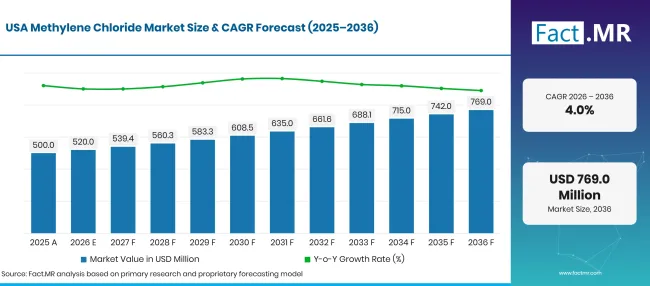
Factmr Methylene Chloride Market Forecast Usa | Source: Fact.MR
The United States has a more selective market for methylene chloride because federal rules limit many traditional applications. In November 2025, the Environmental Protection Agency extended compliance deadlines for non-federal laboratories by 18 months [2]. Permitted manufacturing processes still create a sales channel for qualified industrial solvent grades.
How is the United Kingdom managing solvent selection?
3.6% CAGR, influenced by processing costs and product selection.
British chemical businesses evaluate methylene chloride according to process requirements and their ability to handle solvent safely. In September 2026, the Office for National Statistics reported a 3.8% decline in chemical-products manufacturing output during 2025 [5]. Pharmaceutical processes may call for solvent purity checks and detailed batch records.
Why is Japan maintaining a measured outlook?
3.2% CAGR, linked to industrial qualification practices.
Japanese chemical plants tend to assess process solvents through established quality checks and detailed operating specifications. In February 2026, the Ministry of Economy, Trade and Industry reported a 2.2% monthly increase in industrial production for January 2026 [6]. Qualified manufacturing uses can support repeat methylene chloride orders.
Who leads the Methylene Chloride Market?
The competitive review centres on product identity and documented chlorinated-chemical capabilities. OxyChem (Berkshire Hathaway) and Shin-Etsu Chemical Co., Ltd. have chemical businesses that warrant product-level review for the specific grade and geography.
INEOS Group Ltd. operates in chemicals, while Kem One and Tokuyama Corporation have broader chemical activities. Competitive comparisons should rely on confirmed current product listings and authorised supply channels, not general company scale.
Which companies are the key providers?
Key companies include OxyChem (Berkshire Hathaway); INEOS Group Ltd.; Kem One; Shin-Etsu Chemical Co., Ltd.; Tokuyama Corporation.
- OxyChem (Berkshire Hathaway)
- INEOS Group Ltd.
- Kem One
- Shin-Etsu Chemical Co., Ltd.
- Tokuyama Corporation
Bibliography
- [1] U.S. Environmental Protection Agency. (n.d.). Risk management for methylene chloride.
- [2] U.S. Environmental Protection Agency. (2025, November 10). EPA extends compliance deadlines for methylene chloride rule, easing challenges for non-federal laboratories.
- [3] Statistisches Bundesamt (Destatis). (2026, February 6). Production in December 2025: -1.9% on the previous month.
- [4] Instituto Brasileiro de Geografia e Estatística. (2026, July 3). Industrial production changes -0.2% in May.
- [5] Office for National Statistics. (2026, September 11). 20: Manufacture of chemicals and chemical products: CVM: annual & monthly growth.
- [6] Ministry of Economy, Trade and Industry. (2026, February 27). Indices of Industrial Production: Preliminary report for January 2026.
- [7] Office for National Statistics. (2026, February 12). Index of Production, UK: December 2025.
- [8] Ministry of Economy, Trade and Industry. (2026, January 30). Indices of Industrial Production: Preliminary report for December 2025.
This Report Answers
- The report assesses how technical and pharmaceutical grades are selected for authorised methylene chloride applications.
- Application analysis explains how paint removal, pharmaceutical processing, chemical manufacturing, foam manufacturing, and metal cleaning differ under country-specific restrictions.
- The country comparison examines how industrial activity, regulatory limits, and solvent qualification influence methylene chloride purchases.
- Competitive analysis reviews supplier participation based on documented chlorinated-chemical capabilities, relevant grades, and authorised supply channels.
- End-user analysis shows how automotive, pharmaceutical, paints and coatings, and electronics customers differ in handling, quality, and process requirements.
What does the Methylene Chloride Market cover?
The market covers sales of methylene chloride in defined grades and industrial application categories. It compares solvent use in chemical processes with selected cleaning and manufacturing activities, while recognising legal limits that differ across countries. Related Fact.MR work on halogenated solvent cleaners and paint strippers provides context for adjacent chemical purchasing categories.
What is included in the scope?
Coverage includes technical and pharmaceutical grades when sold as methylene chloride for a qualifying downstream task. Applications cover chemical processing and other named end uses within each country’s legal framework. A manufacturer or distributor is counted for the covered chemical, not for unrelated product lines. Product handling, quality checks and approved industrial uses remain central to the boundaries of the analysis.
What is excluded from the scope?
Products that do not contain methylene chloride fall outside the market even when they replace it in paint stripping or metal cleaning. Equipment sales and service fees for solvent recovery are outside the chemical revenue boundary. Activities prohibited in a particular jurisdiction are not treated as an available legal sales channel in that jurisdiction.
How Was the Analysis Built?
The analysis draws on 120+ sources, 35+ company portfolios, 25+ countries, and more than 20 industry interviews.
- Primary Research: Primary research includes discussions with manufacturers, service providers, technology developers, distributors, end users, and subject-matter experts. These conversations examine purchasing priorities, product adoption, operational challenges, approval requirements, competitive positioning, and the factors that influence wider market acceptance.
- Desk Research: Desk research covers government statistics, regulatory publications, company filings, trade data, technical studies, industry associations, standards, public policy, and other authoritative sources. Every source used in the analysis is documented in the bibliography.
- Market Sizing and Forecasting: Market estimates combine historical performance, demand indicators, pricing and volume trends, segment shares, company participation, country-level growth, adoption patterns, investment activity, and barriers to market expansion.
- Data Validation and Update Cycle: Findings are validated by comparing primary interviews with public data, company activity, regulatory changes, trade patterns, and industry developments. Regular updates review new product launches, capacity changes, partnerships, approvals, and shifts in commercial adoption.
Segmentation
What is the report’s scope and coverage?
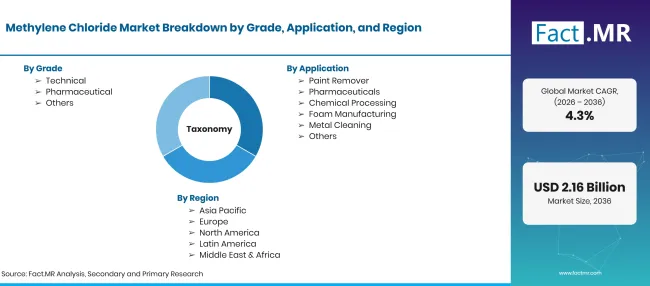
Factmr Methylene Chloride Market Taxonomy | Source: Fact.MR
| Attribute | Details |
|---|---|
| Quantitative Units | USD billion in 2026 to USD billion by 2036 at CAGR |
| Market Definition | Methylene chloride (dichloromethane) traded for authorised industrial and process applications |
| Grade | Technical; Pharmaceutical; Others |
| Application | Paint Remover; Pharmaceuticals; Chemical Processing; Foam Manufacturing; Metal Cleaning; Others |
| End-User Industry | Automotive; Pharmaceuticals; Paints & Coatings; Electronics; Others |
| Regions Covered | North America; Latin America; Western Europe; Eastern Europe; East Asia; South Asia & Pacific; Middle East & Africa |
| Countries Covered | Germany; Brazil; United States; United Kingdom; Japan |
| Companies Profiled | OxyChem (Berkshire Hathaway); INEOS Group Ltd.; Kem One; Shin-Etsu Chemical Co., Ltd.; Tokuyama Corporation. |
| Forecast Period | 2026 to 2036 |
| Approach | Assessment of grade qualification, industrial applications, end-user requirements, country restrictions, worker-exposure controls, official regulatory publications, and chemical production indicators |
Source: Fact.MR analysis. Updated Oct 17, 2026
How is the market segmented?
-
By Grade
- Technical
- Pharmaceutical
- Others
-
By Application
- Paint Remover
- Pharmaceuticals
- Chemical Processing
- Foam Manufacturing
- Metal Cleaning
- Others
-
By End-User Industry
- Automotive
- Pharmaceuticals
- Paints & Coatings
- Electronics
- Others
-
By Region
- North America
- Latin America
- Western Europe
- Eastern Europe
- East Asia
- South Asia & Pacific
- Middle East & Africa
Frequently Asked Questions
How big is the methylene chloride market in 2026?
What is the CAGR from 2026 to 2036?
Which grade leads?
Which application leads?
Who are the main companies in the methylene chloride market?
Who worked on this report


Preview the report firsthand - request a free sample
Free SampleGet the brochure for pricing and purchase details
Download PDF