- Base Value(2025): 25.4 Bn
- Estimated Value(2026): 26.8 Bn
- Forecast Value (2036): 46.2 Bn
- CAGR (2026 - 2036): 5.6%
Mobile Food Services Market Forecast and Outlook By Fact.MR
In 2025, the global mobile food services market was valued at USD 25.4 billion. Based on Fact.MR analysis, demand for mobile food services is estimated to grow to USD 26.8 billion in 2026 and USD 46.2 billion by 2036. FACT.MR projects a CAGR of 5.6% during the forecast period.
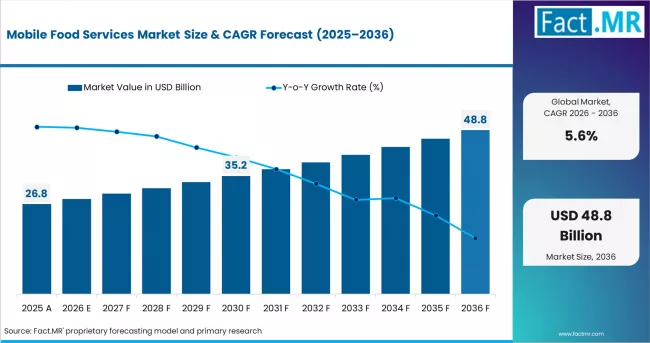
Mobile Food Services Market Market Value Analysis | Source: Fact.MR
| Metric | Value |
|---|---|
| Estimated Value in 2026 | USD 26.8 billion |
| Forecast Value in 2036 | USD 46.2 billion |
| Forecast CAGR (2026 to 2036) | 5.6% |
Source: Fact.MR analysis. Updated Apr 15, 2026
Summary of the Mobile Food Services Market
- Market Definition
- Covers food truck and removable container operations serving prepared food and beverages across urban, event, and corporate markets globally.
- Demand Drivers
- U.S. operators integrated with Roaming Hunger and DoorDash are expanding into suburban and corporate event demand through digital ordering.
- South Korea’s MSME programme is enabling new entrants through subsidised licences and setup support.
- UK and Germany festival expansion is creating structured seasonal demand for premium operators.
- Key Segments Analyzed
- By Application: Food Trucks lead with 65% share in 2026 due to higher revenue, branding, and digital integration advantages.
- By Product: Food leads with 70% share in 2026 as the main revenue driver, with beverages as add-ons.
- By Geography: USA leads growth at 6.5% CAGR through 2036, supported by strong ecosystem and platform adoption.
- Analyst Opinion at FACT.MR
- Shambhu Nath Jha, Principal Consulatant at Fact.MR states that operators lacking digital integration will lose share to app-enabled competitors accessing corporate and delivery channels.
- Strategic Implications
- Operators should integrate with Roaming Hunger, DoorDash, and Uber Eats to access higher-value channels.
- Entry into South Korea and Japan should leverage government support programmes.
- Premium brands should target UK and Germany festivals for consistent high-footfall revenue.
- Methodology
- Market sizing based on operator counts, revenue per unit, and platform transactions validated with industry data.
- Regulatory inputs from USDA, South Korea MSME data, UK licensing, and Japan guidelines supported analysis.
- Forecasts include urban dining trends, digital adoption, event growth, and expert insights.
The market is expected to generate USD 19.4 billion in incremental revenue during the forecast period, reflecting strong and sustained growth. Growth is driven by rising consumer preference for street food and premium mobile dining experiences and expansion of app-based food truck discovery platforms across urban markets. However, challenges remain. Food safety regulatory compliance costs are increasing. Fuel and ingredient cost volatility constrains margins. Competition from quick service restaurants and ghost kitchen delivery models limits faster revenue growth in saturated urban markets.
Procurement and consumer spending is shifting away from informal street vending toward premium food truck operators with established digital ordering and brand presence. Food trucks integrated with third-party delivery platforms and loyalty programmes are displacing unconnected vendors. These premium digital-enabled operators generate significantly higher revenue per event and per day than traditional street vendors, sustaining overall market revenue growth even where total operator unit counts grow more slowly.
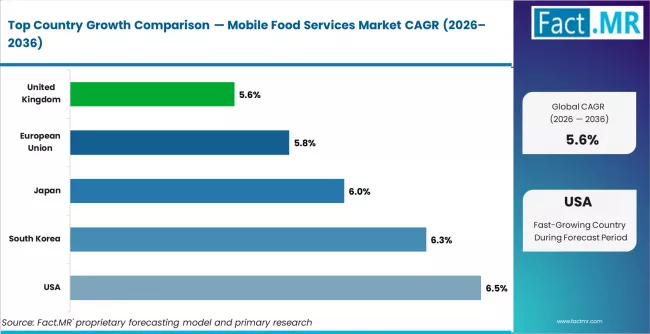
Country growth reflects food truck culture maturity, digital ordering penetration, urban consumer street food spending, and food safety regulation stringency. The USA leads at 6.5% CAGR driven by the most established food truck culture, strong app-based discovery platform adoption, and premium food truck brand expansion into suburban and event markets. South Korea follows at 6.3% through rapid urban food truck culture growth supported by government small business support programmes. Japan records 6.0% through organised removable container food markets and urban outdoor dining festival expansion. The European Union records 5.8% through growing food truck festival culture and digital ordering adoption across German and French urban markets. The United Kingdom records 5.6%, supported by established street food festival infrastructure and growing premium food truck brand development in London and Manchester urban markets.
Segmental Analysis
Mobile Food Services Market Analysis by Application
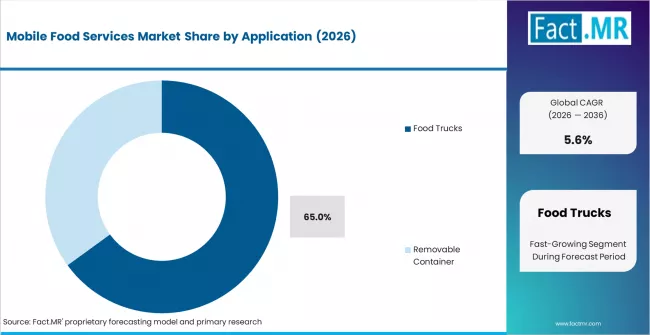
Mobile Food Services Market Analysis By Application | Source: Fact.MR
Food Trucks are projected to hold 65% share in 2026. Growth is driven by higher revenue potential, branding, social media visibility, and platform integration.
• Roaming Hunger Platform Expansion: Expanded to 60 U.S. cities in 2024 with corporate pre-booking features, enabling predictable revenue for operators. [4]
• McDonald’s Food Truck Technology: Expanded mobile food truck pilots in 2024 with app-based ordering at events in the U.S. and South Korea. [5]
• Removable Container Growth Trend: Japan reported 19% growth in container stall revenue in 2024 due to urban event expansion. [6]
Mobile Food Services Market Analysis by Product
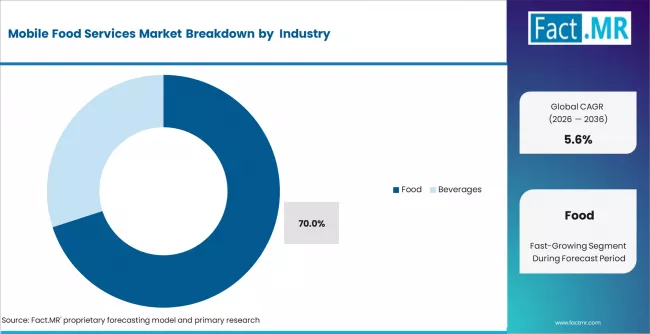
Mobile Food Services Market Analysis By Product | Source: Fact.MR
Food products are expected to hold 70% share in 2026. Growth is driven by strong demand for fresh and diverse street food offerings.
• Kogi BBQ Brand Expansion: Expanded fleet and catering services in 2024, increasing revenue through pre-booked corporate events. [7]
• Starbucks Mobile Beverage: Expanded mobile coffee trucks in 2024 with app-based ordering at campuses and events. [8]
• Plant-Based Food Adoption Trend: 34% of U.S. operators added plant-based options in 2024, reflecting rising consumer demand. [9]
Drivers, Restraints, and Opportunities
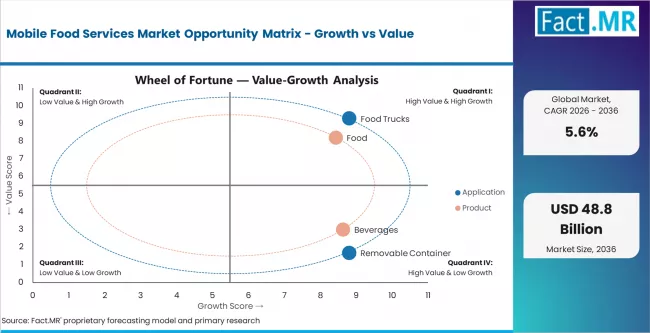
Mobile Food Services Market Opportunity Matrix Growth Vs Value | Source: Fact.MR
FACT.MR notes that the market has shifted from informal vending to structured premium dining. Growth is driven by urban dining culture, digital ordering, and corporate catering demand. Premium food trucks generate significantly higher revenue than traditional vendors.
The market is moving toward platform-integrated operations. Traditional vendors face declining foot traffic, while app-enabled trucks achieve higher bookings and revenue. This premium shift supports overall market growth even in mature cities.
• South Korea MSME Programme: The government expanded its support programme in 2024 with KRW 15 billion funding for licences, equipment, and location access, supporting new operator entry and market growth. [3]
• U.S. Platform Discovery Growth: Roaming Hunger reported 28% growth in corporate catering bookings in 2024, with increased demand from corporate campuses using rotating food truck programmes. [1]
• UK Street Food Licensing Reform: Updated 2024 licensing guidance improved transparency in pitch allocation for festivals and markets, benefiting established operators. [2]
Regional Analysis
The mobile food services market is assessed across North America, Asia Pacific, Europe, Latin America, and Middle East and Africa, covering 40+ countries with distinct demand profiles shaped by food truck culture maturity, digital ordering platform penetration, urban outdoor dining event infrastructure, municipal licensing frameworks, and consumer street food spending levels. The full report provides market attractiveness analysis by region and country.
.webp "Top Country Growth Comparison Mobile Food Services Market Cagr (2026 2036)")
Top Country Growth Comparison Mobile Food Services Market Cagr (2026 2036) | Source: Fact.MR
| Country | CAGR (2026 to 2036) |
|---|---|
| United States | 6.5% |
| South Korea | 6.3% |
| Japan | 6.0% |
| European Union | 5.8% |
| United Kingdom | 5.6% |
Source: Fact.MR analysis. Updated Apr 15, 2026
Source: Fact.MR (FACT.MR) analysis, based on proprietary forecasting model and primary research
Mobile Food Services Market Cagr Analysis By Country | Source: Fact.MR
North America Mobile Food Services Market Analysis
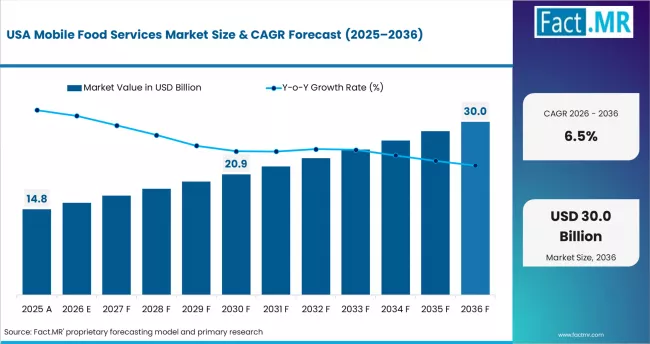
Mobile Food Services Market Country Value Analysis | Source: Fact.MR
North America is the highest-value region, led by the United States’ strong food truck culture, premium operators, and app-based platforms. Roaming Hunger, Domino’s, and McDonald’s drive innovation, while brands like Kogi BBQ highlight premium independent positioning.
- United States: Corporate catering and premium food truck brands are driving growth, projected at 6.5% CAGR through 2036. Roaming Hunger expanded to 60 cities in 2024 with corporate pre-booking features, enabling advance revenue commitments. The National Food Truck Association reported U.S. industry revenue of USD 2.7 billion in 2024, with premium operators earning ~40% higher daily revenue. The U.S. model is platform-driven, unlike South Korea’s subsidy-led approach.
FACT.MR’s North America analysis includes the U.S., Canada, and Mexico, covering platform trends, licensing data, and forecasts by application and product.
Asia Pacific Mobile Food Services Market Analysis
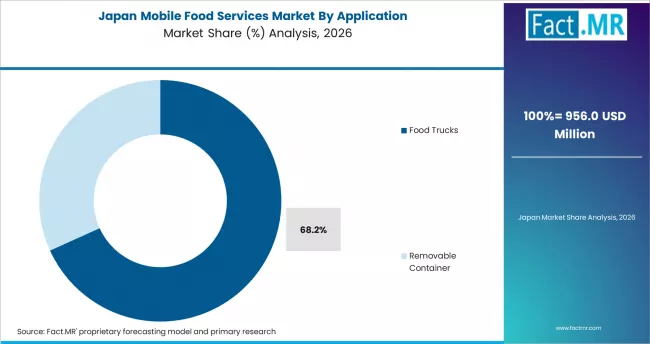
Mobile Food Services Market Japan Market Share Analysis By Application | Source: Fact.MR
Asia Pacific is a fast-growing region driven by South Korea’s government support and Japan’s organised event market infrastructure. Global brands like Starbucks and McDonald’s are expanding mobile formats, while local operators serve rising urban demand.
- Japan: Organised outdoor dining and event expansion are driving growth, projected at 6.0% CAGR through 2036. Updated 2024 hygiene guidelines clarified compliance for mobile vendors, supporting expansion of licensed market zones. JETRO reported 19% growth in outdoor food festival revenue, with increasing corporate sponsorship. Japan’s model is event-driven, unlike South Korea’s subsidy-based system.
- South Korea: Government support and urban adoption are driving growth, projected at 6.3% CAGR through 2036. The MSME programme allocated KRW 15 billion in 2024 for licences, equipment, and location access. McDonald’s expanded food truck pilots with app-based ordering at event locations. South Korea’s model is subsidy-driven, unlike Japan’s event infrastructure-led growth.
FACT.MR’s Asia Pacific analysis covers South Korea, Japan, China, India, ASEAN, and Australia & New Zealand, including programme data and market forecasts.
Europe Mobile Food Services Market Analysis
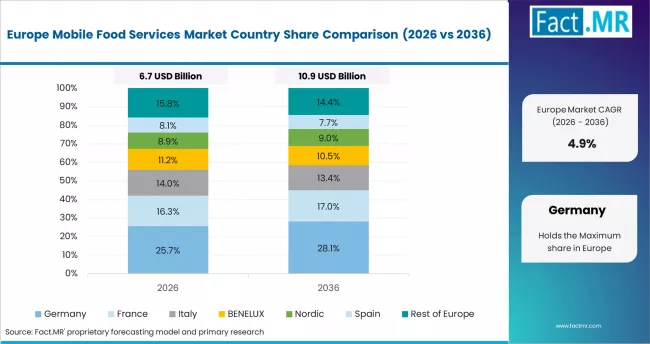
Mobile Food Services Market Europe Country Market Share Analysis, 2026 & 2036 | Source: Fact.MR
Europe is a growing premium market supported by food festival expansion and digital ordering adoption. Domino’s and Starbucks lead branded deployments, while independent operators benefit from organised public market infrastructure.
- European Union: Festival growth and digital adoption are driving the market, projected at 5.8% CAGR through 2036. Updated 2024 hygiene guidance under Regulation (EC) No 852/2004 simplified cross-border participation for mobile food units. Domino’s expanded mobile delivery trucks at major events across Germany and France in 2024.
- United Kingdom: Street food festivals and organised markets are supporting growth, projected at 5.6% CAGR through 2036. Updated 2024 licensing guidance improved pitch allocation transparency. KERB reported operating 28 markets in London, with average operator revenue of GBP 8,500 per market day.
FACT.MR’s Europe analysis includes Germany, France, the UK, Italy, Spain, and Rest of Western Europe, covering regulatory data, market trends, and forecasts.
Competitive Aligners for Market Players
Mobile Food Services Market Analysis By Company | Source: Fact.MR
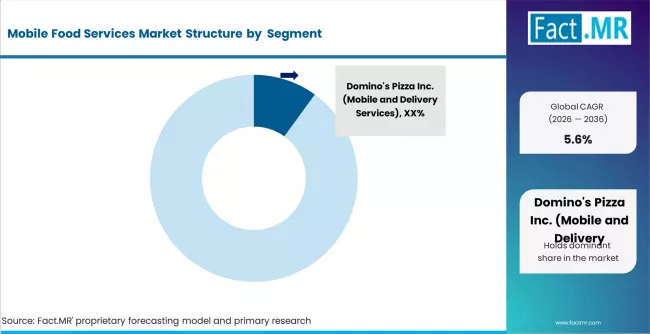
The mobile food services market is highly fragmented, especially at the operator level. Thousands of independent food truck businesses compete alongside large corporate brands such as McDonald’s, Domino’s, and Starbucks. While operators are fragmented, the platform side is more concentrated. Roaming Hunger holds a strong position in the U.S., particularly in food truck aggregation and corporate event bookings. Today, competition is less about scale and more about brand visibility and digital presence, as customers increasingly discover food options through apps rather than street traffic.
Large brands have clear advantages. Companies like Domino’s and McDonald’s benefit from strong brand recognition and large marketing budgets that keep them visible on social media. They also have integrated mobile ordering systems that independent operators often cannot match. Starbucks takes a different approach by using its existing loyalty app to drive traffic to mobile trucks at events, reducing the need for new customer acquisition.
Platforms like Roaming Hunger are also shaping the market. Their strength comes from network effects. A larger base of food truck operators attracts more customers and corporate clients. This brings more operators onto the platform, creating a cycle that reinforces its position. Corporate buyers are increasingly choosing platform-managed services instead of dealing with individual vendors. This simplifies logistics, especially for events that require multiple food trucks. As a result, individual operators have less pricing power unless they have strong branding or a premium offering. Overall, the market is becoming more structured, with digital platforms and brand strength playing a central role.
Key Players
- Domino's Pizza Inc. (Mobile and Delivery Services)
- McDonald's Corporation (McDelivery and Mobile Food Trucks)
- Starbucks Corporation (Mobile Coffee Services and Food Trucks)
- Roaming Hunger (Food Truck Aggregator Platform)
- Kogi BBQ (Independent Gourmet Food Truck Chain)
Bibliography
- [1] Roaming Hunger. (2024). Platform Expansion Update: 60 U.S. City Coverage Addition with Corporate Catering Pre-Booking Module Targeting Enterprise Campus Food Truck Programme Management and Advance Revenue Commitment Tools for Operators. 2024. roaminghunger.com/newsroom
- [2] UK Local Government Association. (2024). Updated Street Trading Licence Guidance: Food Truck and Mobile Food Unit Pitch Allocation Process for Local Authority-Organised Public Markets and Events Under Local Government (Miscellaneous Provisions) Act 1982. 2024. local.gov.uk
- [3] Ministry of SMEs and Startups, Republic of Korea. (2024). Food Truck Small Business Support Programme Expansion: KRW 15 Billion Allocation for Subsidised Licence Fees, Equipment Grants, and Designated Urban Pitch Access for Young Entrepreneur Food Truck Operators in Seoul and Busan. 2024. mss.go.kr
- [4] Roaming Hunger. (2024). Corporate Event Food Truck Catering Platform: 28% Year-on-Year Growth in Corporate Campus Booking Revenue and Expansion to Technology and Financial Services Company Food Truck Programme Management Clients. 2024. roaminghunger.com
- [5] McDonald's Corporation. (2024). Mobile Food Truck Pilot Programme Expansion: App-Integrated Mobile Order Pickup Capability at Outdoor Event Locations in United States and South Korea for Testing Mobile-First Service Models Beyond Fixed Restaurant Footprint. October 2024. corporate.mcdonalds.com
- [6] Japan External Trade Organization. (2024). Street Food Market Review 2024: Removable Container Food Stall Revenue Growth of 19% Year-on-Year at Organised Outdoor Food Festival Events in Tokyo, Osaka, and Fukuoka Urban Public Park and Waterfront Locations. 2024. jetro.go.jp
- [7] Kogi BBQ. (2024). Fleet Expansion and Catering Programme Launch: 12 Active Truck Fleet Expansion with Corporate Event Catering Programme Targeting Southern California Technology and Entertainment Industry Corporate Client Bookings. 2024. kogibbq.com
- [8] Starbucks Corporation. (2024). Mobile Coffee Truck Deployment Expansion: U.S. College Campus and Stadium Event Location Food Truck Deployment with Starbucks Mobile App Integration for Event Venue Beverage Order Pickup Outside Fixed Store Coverage. September 2024. stories.starbucks.com
- [9] Food Truck Nation Association. (2024). 2024 Operator Survey: Plant-Based Menu Item Adoption as Fastest-Growing Food Product Category with 34% of Surveyed U.S. Food Truck Operators Adding or Expanding Vegan and Flexitarian Street Food Options. 2024. foodtrucknation.us
This Report Addresses
- Strategic insights on mobile food services demand across U.S. corporate catering platform integration, South Korea government MSME food truck support programmes, Japan organised outdoor food market infrastructure, EU cross-border festival food truck participation, and UK local authority-organised premium street food market expansion.
- Market forecast from USD 26.8 billion in 2026 to USD 46.2 billion by 2036 at a CAGR of 5.6%.
- Growth opportunity mapping across U.S. Roaming Hunger corporate event catering platform expansion, South Korea MSME programme-backed operator market entry, Japan municipal outdoor dining zone infrastructure growth, EU multi-country festival circuit participation, and UK KERB-model premium street food market development.
- Segment-wise analysis by application (food truck, removable container) and product (food, beverages).
- Regional outlook covering North America platform-integrated premium food truck leadership, Asia Pacific government-supported food truck culture development, and Europe festival and outdoor market-driven premium operator adoption.
- Competitive landscape analysis of Domino's Pizza mobile trucks, McDonald's food truck pilots, Starbucks mobile coffee trucks, Roaming Hunger aggregator platform, and Kogi BBQ independent premium brand covering digital integration strategies, event catering programme development, and platform ecosystem positioning.
- Technology tracking including app-based food truck discovery and pre-ordering integration, cashless payment system adoption, mobile order pickup logistics, third-party delivery platform partnership development, and social media-driven food truck brand building strategies.
- Report delivery in PDF, Excel datasets, and presentation formats supported by primary interviews, operator licensing data, Roaming Hunger and McDonald's corporate disclosures, UK Local Government Association guidance data, and South Korea MSME programme statistics.
Mobile Food Services Market Definition
The mobile food services market includes food trucks, removable container stalls, and other mobile units serving food and beverages at temporary or semi-permanent locations. These operate across events, streets, corporate campuses, and markets globally.
Mobile Food Services Market Inclusions
Covers forecasts from 2026 to 2036 by application and product. Includes food trucks and removable container units serving food and beverages across major regions and consumer environments.
Mobile Food Services Market Exclusions
Excludes fixed restaurants, ghost kitchens without mobile units, delivery-only platforms, and catering services without mobile vending presence.
Mobile Food Services Research Methodology
- Primary Research: Interviews with operators, platform aggregators, licensing authorities, event organisers, and corporate buyers across key regions.
- Desk Research: Analysis of licensing data, government programmes, and platform disclosures from 2024–2025.
- Market Sizing and Forecasting: Based on operator counts, average revenue per unit, platform transactions, and street food spending benchmarks.
- Data Validation and Update Cycle: Validated through licensing data, platform revenues, industry statistics, and expert inputs with periodic updates.
Segmentation
Scope of Report
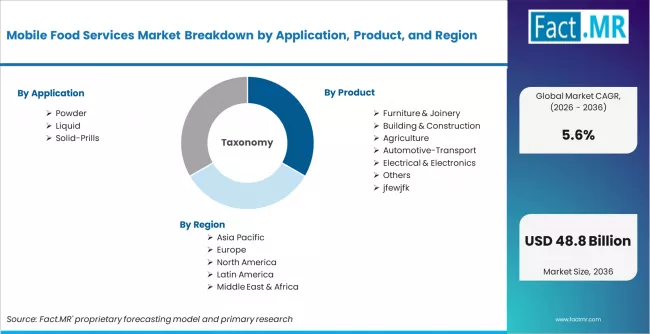
Mobile Food Services Market Breakdown By Application, Product, And Region | Source: Fact.MR
| Attribute | Details |
|---|---|
| Quantitative Units | USD 26.8 billion (2026) to USD 46.2 billion (2036), at a CAGR of 5.6% |
| Market Definition | Market Includes Food truck and removable container mobile food preparation and vending units serving prepared food and beverages at temporary urban, event, corporate campus, and festival locations across consumer markets globally. |
| Application Segmentation | Food Truck, Removable Container |
| Product Segmentation | Food, Beverages |
| Application Coverage | Urban street food truck gourmet dining, corporate campus rotating food truck catering, outdoor festival and event food service, removable container urban market food stall operation, mobile coffee and beverage truck service, and third-party delivery platform-integrated mobile food order fulfilment. |
| Regions Covered | North America, Europe, Asia Pacific, Latin America, Middle East and Africa |
| Countries Covered | USA, Canada, Mexico, Germany, UK, France, Italy, Spain, Nordic, BENELUX, China, Japan, South Korea, India, ASEAN, Australia and New Zealand, Brazil, Argentina, Chile, Saudi Arabia, GCC, Turkey, South Africa, Rest of MEA |
| Key Companies Profiled | Domino's Pizza Inc. (Mobile and Delivery Services), McDonald's Corporation (McDelivery and Mobile Food Trucks), Starbucks Corporation (Mobile Coffee Services and Food Trucks), Roaming Hunger (Food Truck Aggregator Platform), Kogi BBQ (Independent Gourmet Food Truck Chain) |
| Forecast Period | 2026 to 2036 |
| Approach | Hybrid top-down and bottom-up model using food truck and mobile food unit operator counts by region, average annual revenue per operator, app-based platform transaction volume data, consumer street food spending benchmarks, and primary interviews with food truck operators, platform aggregators, and municipal licensing administrators. |
Source: Fact.MR analysis. Updated Apr 15, 2026
Mobile Food Services Market by Segments
-
By Application:
- Food Truck
- Removable Container
-
By Product:
- Food
- Beverages
-
By Region:
- North America
-
United States
-
Canada
-
Mexico
-
- Latin America
-
Brazil
-
Mexico
-
Argentina
-
Chile
-
Rest of Latin America
-
-
Western Europe
-
Germany
-
United Kingdom
-
France
-
Italy
-
Spain
-
Nordic Countries
-
BENELUX
-
Rest of Western Europe
-
- Eastern Europe
-
Russia
-
Poland
-
Hungary
-
Balkan and Baltic
-
Rest of Eastern Europe
-
- East Asia
-
China
-
Japan
-
South Korea
- South Asia and Pacific
-
India
-
ASEAN
-
Australia and New Zealand
-
Rest of South Asia and Pacific
-
- Middle East and Africa
-
Kingdom of Saudi Arabia
-
Other GCC Countries
-
Turkey
-
South Africa
-
Rest of Middle East and Africa
-
- North America
Frequently Asked Questions
How large is the global mobile food services market in 2025?
What will the market size be in 2026?
What is the projected market size by 2036?
What is the expected CAGR of the mobile food services market?
What is the absolute dollar opportunity in this market?
Which application segment leads the market?
Which product segment holds the largest share?
Which region grows fastest?
Which country shows the fastest growth?
What factors are driving market growth?
Who worked on this report


Preview the report firsthand - request a free sample
Free SampleGet the brochure for pricing and purchase details
Download PDF