- Market Value (2025): USD 45.8 Bn
- Estimated Value (2026): USD 47.7 Bn
- Forecast Value (2036): USD 71.3 Bn
- CAGR (2026-2036): 4.1%
What is the Network Office Document Solutions Market forecast to be worth by 2036?
USD 47.7 billion in 2026 to USD 71.3 billion by 2036 at a 4.1% CAGR.
- The network office document solutions market was valued at USD 45.8 billion in 2025, with most revenue tied to installed office device fleets and their service contracts.
- By 2036 the network office document solutions market will reach USD 71.3 billion, up from USD 47.7 billion in 2026, as offices replace aging fleets with secure, cloud-linked devices.
- Office print and scan spending will compound at a 4.1% CAGR through 2036, since workflow software and security services add value to each placed unit.
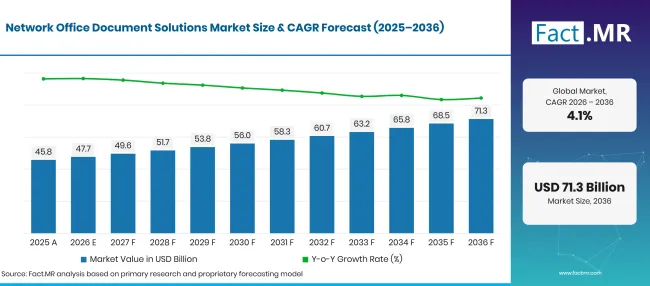
Network Office Document Solutions Market Forecast Global | Source: Fact.MR
| Year | Basis | Market Value (USD billion) |
|---|---|---|
| 2025 | Actual | 45.8 |
| 2026 | Estimate | 47.7 |
| 2036 | Forecast | 71.3 |
| CAGR 2026 to 2036 | Forecast period | 4.1% |
Source: Fact.MR analysis. Updated Oct 23, 2026
What are the defining numbers behind Network Office Document Solutions Market growth?
Between 2026 and 2036 the market will gain USD 23.6 billion, drawn mainly from device refresh and managed service contracts.
- Demand Drivers in the Market
- Cloud document workflows are changing what buyers expect from an office device. Eurostat reported that 52.74% of EU enterprises bought cloud computing services in 2025, and 71.69% of those buyers used them for office software [1]. A scanner or MFP that sends files straight into those cloud folders saves a manual upload step.
- Printer security has moved onto the IT agenda. ENISA analysed 4,875 cyber incidents in its 2025 threat landscape, covering July 2024 to June 2025 [2]. Networked printers store documents and credentials, so IT teams now ask for secure boot, encrypted drives and firmware that updates itself.
- Hybrid office layouts are reshaping fleet design. Firms with fewer desks in use each day are consolidating single-user printers into shared MFPs with badge release, which cuts waste from uncollected prints.
- Managed print contracts turn hardware into an operating expense. Dealers bundle devices, toner, parts and fleet monitoring into a per-page or per-month fee, which suits finance teams that want a predictable cost.
- Paper-heavy sectors keep a steady base of demand. Schools, courts, hospitals and tax offices still handle signed forms, records and notices that must be scanned, filed or printed on request.
- Key Segments Analyzed
- By Product Type: Multifunction Devices will hold 38.2% share in 2026, because one networked unit replaces a separate printer, scanner, copier and fax on each office floor.
- By Application: Corporate Offices will account for 32.7% share in 2026, given that finance, legal and HR teams still run contract and invoice workflows through shared devices.
- By Deployment Mode: On-Premises will command 64.2% share in 2026, as many IT teams keep print servers and document routing inside their own firewall.
- By End-User: Large Enterprises will capture 58.6% share in 2026 through multi-site fleet contracts that bundle hardware, software and service.
- Analyst Opinion at Fact.MR
- Shambhu Nath Jha, Principal Consultant at Fact.MR, states, “Office print volumes are flat in many companies, yet the value per device keeps rising. Buyers now pay for authentication, scan-to-cloud routing and fleet security as much as for pages. Vendors that can manage mixed fleets across offices and remote sites will win the renewals through 2036.”
- Strategic Implications
- Device makers should ship every new office model with signed firmware and remote update tools, since security reviews now gate most enterprise tenders.
- Channel dealers should move clients from transactional sales to managed contracts that include fleet analytics and consumables replenishment.
- IT managers should map document flows before a fleet refresh, so that fewer shared devices can serve hybrid teams without long queues.
- Software partners should build connectors for common cloud storage and records platforms, given that scan routing is now a deciding feature in device selection.
Brazil heads the country list at 5.3% CAGR, helped by a fast-growing count of formal companies. The United Kingdom follows at 4.7%, where hybrid working and a dense SME base reshape office fleets. Japan will grow at 4.2% as half of its enterprises run telework programs. Germany moves at 3.4% with home office use and cloud services spreading across firms. The United States rounds out the five at 3.0%, a mature market driven mainly by fleet replacement.
How does the Network Office Document Solutions Market break down by segment?
Multifunction Devices will lead Product Type at 38.2%; Corporate Offices will head Application at 32.7%; On-Premises will top Deployment Mode at 64.2%; Large Enterprises will rank first in End-User at 58.6%.
Which Product Type dominates?
Multifunction Devices take 38.2% of 2026 sales.
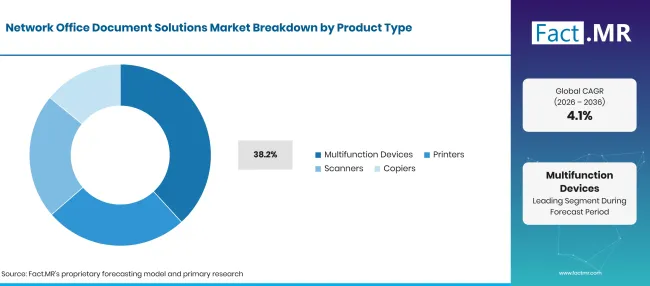
Network Office Document Solutions Market Breakdown Product Type | Source: Fact.MR
| Product Type | Share (2026) |
|---|---|
| Multifunction Devices (Leading segment) | 38.2% |
| Other segments combined | 61.8%* |
| Total | 100.0% |
Source: Fact.MR analysis. Updated Oct 23, 2026
Office managers want one footprint per floor that can print, copy, scan and send. A networked multifunction printer does all four, and its touch panel hosts apps for scan-to-email, secure release and form capture. Fewer boxes also mean fewer service calls and one toner supply chain. Single-function printers stay in departments with heavy output, such as billing or dispatch. Standalone scanners serve records rooms and mailrooms that convert paper into searchable files for document imaging systems. Copiers without network functions are a shrinking base, kept mostly for walk-up copying in schools and print rooms.
What leads the Application segment?
Corporate Offices represent 32.7% of 2026 demand.
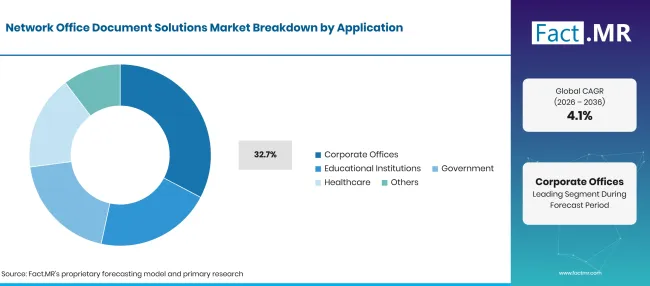
Network Office Document Solutions Market Breakdown Application | Source: Fact.MR
| Application | Share (2026) |
|---|---|
| Corporate Offices (Leading segment) | 32.7% |
| Other segments combined | 67.3%* |
| Total | 100.0% |
Source: Fact.MR analysis. Updated Oct 23, 2026
Contract signing, invoice processing and HR onboarding still create paper at most companies. Finance and legal teams scan signed originals for audit trails, and that habit keeps shared office devices busy. Corporate buyers also tend to sign multi-year service contracts across many sites. Education, government and healthcare form large public buyer groups with their own record rules. The U.S. Bureau of Labor Statistics counted about 9.1 million educational instruction and library workers and about 9.8 million healthcare practitioners in May 2025 [3]. The same survey placed the public sector at 14.6% of employment [3]. These workforces handle exam papers, permits and patient forms that must be printed, scanned or archived.
How does Deployment Mode shape demand?
On-Premises installations make up 64.2% of 2026 sales.
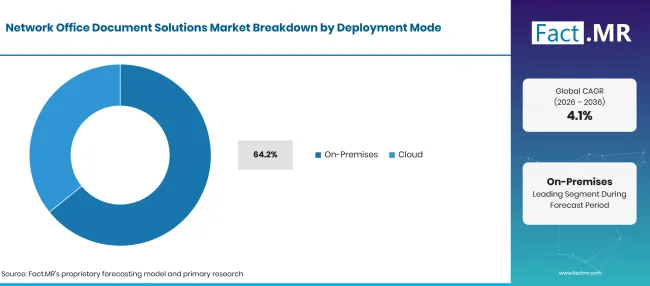
Network Office Document Solutions Market Breakdown Deployment Mode | Source: Fact.MR
| Deployment Mode | Share (2026) |
|---|---|
| On-Premises (Leading segment) | 64.2% |
| Other segments combined | 35.8%* |
| Total | 100.0% |
Source: Fact.MR analysis. Updated Oct 23, 2026
IT security teams in banks, ministries and hospitals often want print servers, job logs and scan archives kept inside their own data center. Local print management also keeps working during an internet outage. Installed bases of on-site servers and licensed software change slowly, since replacement is tied to hardware refresh cycles. Cloud print management removes the local server and lets users release jobs from any office. Vendors now offer serverless print queues, cloud scan routing and remote fleet monitoring, which suit firms with many small branches. Shared content platforms that store scanned files link these services to wider knowledge management tools.
What supports Large Enterprises within End-User?
Large Enterprises generate 58.6% of 2026 revenue.
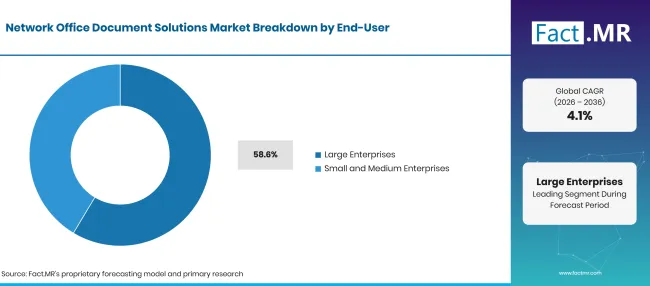
Network Office Document Solutions Market Breakdown End User | Source: Fact.MR
| End-User | Share (2026) |
|---|---|
| Large Enterprises (Leading segment) | 58.6% |
| Other segments combined | 41.4%* |
| Total | 100.0% |
Source: Fact.MR analysis. Updated Oct 23, 2026
Multi-site organizations run hundreds or thousands of devices and need one contract, one dashboard and one security policy across them. Eurostat found that 84.67% of large EU enterprises bought cloud services in 2025, compared with 49.3% of small enterprises [1]. That gap shows why large buyers are first to adopt scan-to-cloud and remote fleet tools. Small and medium enterprises buy fewer devices per site, often through local dealers or online stores. Desktop A4 MFPs with simple cloud connectors fit their needs. Many SMEs still keep an office supply of writing paper and toner on hand and order consumables as needed.
What is accelerating Network Office Document Solutions Market adoption, and what is holding it back?
Adoption will gain from cloud document workflows, device security rules and managed print contracts that spread cost over time. Lower page volumes, longer device lifespans and the shift to digital signatures limit how fast fleets expand.
Drivers Impact Analysis
| DRIVER | (~) % IMPACT ON CAGR | GEOGRAPHIC RELEVANCE | IMPACT TIMELINE |
|---|---|---|---|
| Cloud office software and scan-to-cloud workflows in enterprises | +1.2% | North America, Western Europe, East Asia | Short term (<= 2 years) |
| Security requirements for networked print and scan devices | +1.0% | North America, Western Europe | Short term (<= 2 years) |
| Managed print service contracts replacing outright purchase | +0.8% | Global | Medium term (2-4 years) |
| Fleet consolidation for hybrid and shared-desk offices | +0.6% | Western Europe, North America, East Asia | Medium term (2-4 years) |
| Record-keeping rules in education, government and healthcare | +0.4% | Global | Long term (>= 4 years) |
Source: Fact.MR analysis. Updated Oct 23, 2026
Opportunity Impact Analysis
| OPPORTUNITY | (~) % IMPACT ON CAGR | GEOGRAPHIC RELEVANCE | IMPACT TIMELINE |
|---|---|---|---|
| Cloud print management for multi-branch SMEs | +0.8% | Latin America, Western Europe | Medium term (2-4 years) |
| Intelligent capture and automated filing of scanned documents | +0.6% | North America, East Asia | Medium term (2-4 years) |
| Remanufactured and recycled-content devices for sustainability tenders | +0.4% | Western Europe | Long term (>= 4 years) |
Source: Fact.MR analysis. Updated Oct 23, 2026
Restraints Impact Analysis
| RESTRAINT | (~) % IMPACT ON CAGR | GEOGRAPHIC RELEVANCE | IMPACT TIMELINE |
|---|---|---|---|
| Declining print volumes per office worker | -0.7% | North America, Western Europe, East Asia | Medium term (2-4 years) |
| Longer device replacement cycles under budget pressure | -0.5% | Global | Short term (<= 2 years) |
| Digital signatures and paperless forms in public services | -0.4% | Western Europe, Latin America | Long term (>= 4 years) |
Source: Fact.MR analysis. Updated Oct 23, 2026
Which countries are scaling the Network Office Document Solutions Market through 2036?
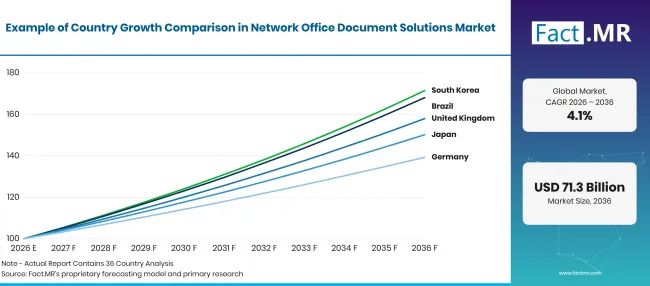
Network Office Document Solutions Market Growth Index | Source: Fact.MR
| Country | CAGR (2026 to 2036) |
|---|---|
| Brazil | 5.3% |
| United Kingdom | 4.7% |
| Japan | 4.2% |
| Germany | 3.4% |
| United States | 3.0% |
Source: Fact.MR analysis. Updated Oct 23, 2026
How is Brazil scaling demand?
5.3% CAGR, driven by growth in formal companies and salaried office jobs.
Office printing in Brazil grows with the number of registered firms. IBGE reported that companies and other organizations rose from 10.0 million in 2023 to 10.6 million in 2024, while salaried personnel increased from 52.6 million to 54.2 million [4]. Each new office needs a shared device for invoices, contracts and tax documents. Local dealers sell MFPs under rental plans that suit small firms with tight cash flow.
What supports United Kingdom adoption?
4.7% CAGR, backed by a broad SME base and hybrid working routines.
UK office printer demand rests on a wide business population. The Department for Business and Trade estimated 5.7 million private sector businesses at the start of 2025, with SMEs providing 60% of employment [5]. The Office for National Statistics found that 28% of working adults in Great Britain hybrid worked between January and March 2025 [6]. Firms with part-time desk use are moving to shared MFPs with secure release.
How is Japan developing demand?
4.2% CAGR, helped by telework programs and wide cloud service use among companies.
Document workflows in Japan are shifting toward remote access. The Ministry of Internal Affairs and Communications reported that 50.1% of companies had introduced telework in its 2025 survey, and that more than 80% of companies used cloud services [7]. Offices still rely on seals, paper forms and fax, so scan-to-cloud features on MFPs bridge the two ways of working. Domestic vendors supply most of the installed fleet.
What supports Germany’s growth?
3.4% CAGR, reflecting home office use and paid cloud services in German firms.
Germany’s office fleets are adjusting to split work locations. Destatis reported that 24.6% of all employed persons worked from home in 2025 [8]. A separate release found that 54% of companies with at least 10 employees used paid cloud services in 2025, rising to 86% among large firms [9]. Strict data protection rules lead many buyers to keep print servers on site while adding cloud scanning.
How does the United States perform?
3.0% CAGR, as replacement of an installed fleet drives most spending.
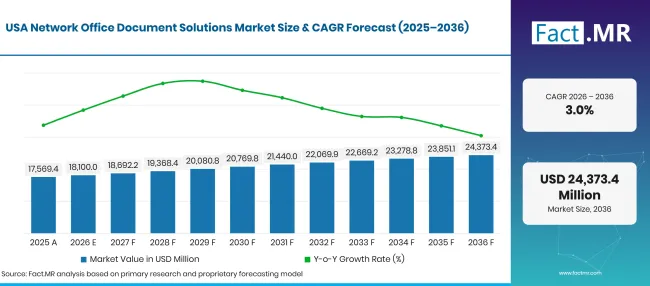
Network Office Document Solutions Market Forecast Usa | Source: Fact.MR
American offices already have high device density, so new sales follow refresh cycles and security upgrades. The SBA Office of Advocacy reported that the number of small businesses reached 36.2 million, accounting for almost 46% of private sector employment [10]. These firms favor desktop MFPs and cloud print services. Federal and state agencies run large managed print contracts with security audits attached.
Who leads the Network Office Document Solutions Market?
Three supplier groups compete for office fleets. Japanese imaging groups such as Canon, Ricoh, Konica Minolta, Kyocera Document Solutions, Sharp and Toshiba Tec sell A3 and A4 MFPs through direct branches and dealer networks, and they pair hardware with print management and capture software.
Canon added five imageFORCE series and one model in September 2025, including models with a Security Environment Estimation feature that recommends device security settings [11]. Konica Minolta launched four monochrome bizhub models in October 2025, including units with OCR scanning and scan to SharePoint [12]. Ricoh introduced six A3 black-and-white IM Series MFPs in April 2026, built for cloud-enabled workflows with automatic firmware updates [13]. Xerox and HP compete through managed print services and large enterprise contracts, with HP strong in A4 LaserJet fleets. Brother Industries sells business printers and all-in-ones, from high-volume fleet devices to compact small-office units. Security certification, cloud connectors and fleet service coverage will decide which vendors keep renewals.
Which companies are the key providers?
Key companies include Canon Inc.; Ricoh Company, Ltd.; Konica Minolta, Inc.; Xerox Holdings Corporation; HP Inc.; Kyocera Document Solutions Inc.; Sharp Corporation; Toshiba Tec Corporation; and Brother Industries, Ltd.
- Canon Inc.
- Ricoh Company, Ltd.
- Konica Minolta, Inc.
- Xerox Holdings Corporation
- HP Inc.
- Kyocera Document Solutions Inc.
- Sharp Corporation
- Toshiba Tec Corporation
- Brother Industries, Ltd.
Bibliography
- [1] Eurostat. (2026, January). Cloud computing - statistics on the use by enterprises.
- [2] European Union Agency for Cybersecurity (ENISA). (2025, October 1). ENISA Threat Landscape 2025.
- [3] U.S. Bureau of Labor Statistics. (2026, May 15). Occupational Employment and Wages - May 2025.
- [4] Instituto Brasileiro de Geografia e Estatística (IBGE). (2026, June 25). Number of Brazilian companies grows in 2024; average salary remains stable.
- [5] Department for Business and Trade. (2025, October 2). Business population estimates for the UK and regions 2025: statistical release.
- [6] Office for National Statistics. (2025, June 11). Who has access to hybrid work in Great Britain?.
- [7] Ministry of Internal Affairs and Communications, Japan. (2026, May 29). 令和7年通信利用動向調査の結果 [Results of the 2025 Communications Usage Trend Survey].
- [8] Statistisches Bundesamt (Destatis). (2026, July 23). Erwerbstätige, die von zu Hause aus arbeiten [Employed persons working from home].
- [9] Statistisches Bundesamt (Destatis). (2025, November 24). Jedes zweite Unternehmen nutzt kostenpflichtige Cloud-Services [Every second company uses paid cloud services].
- [10] U.S. Small Business Administration, Office of Advocacy. (2025, June 30). New Advocacy Report Shows the Number of Small Businesses in the U.S. Exceeds 36 million.
- [11] Canon U.S.A., Inc. (2025, September 23). Canon Expands its imageFORCE Portfolio to Deliver a Broad Range of Print Solutions for Today’s Modern Businesses.
- [12] Konica Minolta Business Solutions U.S.A., Inc. (2025, October 30). Konica Minolta Launches Four Monochrome bizhub Models for High Performance in a Fit-anywhere Size.
- [13] Ricoh USA, Inc. (2026, April 29). Ricoh redefines the future of workplace print with its latest, cloud-ready intelligent MFP platform.
This Report Answers
- How large office document fleets are in value terms, split across product type, application, deployment mode and end-user.
- Why multifunction devices, corporate offices, on-premises setups and large enterprises hold first place in their segments in 2026.
- Where Brazil, the United Kingdom, Japan, Germany and the United States differ in business formation, hybrid work and cloud use.
- Which imaging groups, IT vendors and office printer specialists compete for office fleets, and on what terms.
- What security rules, managed print contracts and falling page volumes mean for device replacement cycles.
What does the Network Office Document Solutions Market cover?
Office printers, scanners, copiers and multifunction devices connected to a local or cloud network fall within this market. Revenue includes the devices, their consumables and the software that manages users, queues and scan destinations.
Service revenue from managed print contracts, maintenance and fleet monitoring is counted as well. Buyers include corporate offices, schools and universities, public agencies and healthcare providers of all sizes.
What is included in the scope?
A3 and A4 office MFPs, desktop and departmental printers, network document scanners and office copiers are in scope. Toner, ink and drums sold for these devices are included. Wear parts such as the printer and copier magnetic roller in toner developer units count at service value.
Print management, secure release, scan routing and capture software sold for office fleets are counted. Managed print services that bundle devices and supplies under one fee are also included.
What is excluded from the scope?
Commercial and industrial presses used by print service providers fall outside this market, as do production page volume systems in central reprographic departments. Home printers sold for personal use are also excluded.
Standalone document management software not bundled with office devices is excluded. Wide-format plotters, label printers and receipt printers are left out as well.
How Was the Analysis Built?
The analysis draws on 120+ sources, 35+ company portfolios, 25+ countries, and more than 20 industry interviews.
- Primary Research: Primary research includes discussions with manufacturers, service providers, technology developers, distributors, end users, and subject-matter experts. These conversations examine purchasing priorities, product adoption, operational challenges, approval requirements, competitive positioning, and the factors that influence wider market acceptance.
- Desk Research: Desk research covers government statistics, regulatory publications, company filings, trade data, technical studies, industry associations, standards, public policy, and other authoritative sources. Every source used in the analysis is documented in the bibliography.
- Market Sizing and Forecasting: Market estimates combine historical performance, demand indicators, pricing and volume trends, segment shares, company participation, country-level growth, adoption patterns, investment activity, and barriers to market expansion.
- Data Validation and Update Cycle: Findings are validated by comparing primary interviews with public data, company activity, regulatory changes, trade patterns, and industry developments. Regular updates review new product launches, capacity changes, partnerships, approvals, and shifts in commercial adoption.
Segmentation
What is the report’s scope and coverage?
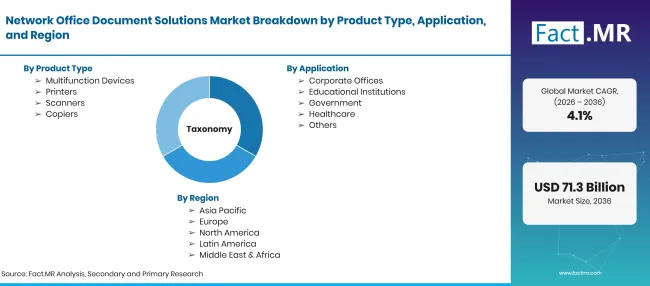
Network Office Document Solutions Market Taxonomy | Source: Fact.MR
| Attribute | Details |
|---|---|
| Quantitative Units | USD billion in 2026 to USD billion by 2036 at CAGR |
| Market Definition | Networked office print, scan and copy devices together with the print management, capture and fleet services sold with them. The scope covers hardware, consumables, software and service contracts for office use. |
| Product Type | Multifunction Devices; Printers; Scanners; Copiers |
| Application | Corporate Offices; Educational Institutions; Government; Healthcare; Others |
| Deployment Mode | On-Premises; Cloud |
| End-User | Large Enterprises; Small and Medium Enterprises |
| Regions Covered | North America; Latin America; Western Europe; Eastern Europe; East Asia; South Asia & Pacific; Middle East & Africa |
| Countries Covered | Brazil; United Kingdom; Japan; Germany; United States |
| Companies Profiled | Canon Inc.; Ricoh Company, Ltd.; Konica Minolta, Inc.; Xerox Holdings Corporation; HP Inc.; Kyocera Document Solutions Inc.; Sharp Corporation; Toshiba Tec Corporation; Brother Industries, Ltd. |
| Forecast Period | 2026 to 2036 |
| Approach | Hybrid top-down and bottom-up approach using office employment and business counts; installed device fleets and replacement cycles; revenue per device for hardware, consumables and services; cloud adoption by firm size; and vendor portfolio review. |
Source: Fact.MR analysis. Updated Oct 23, 2026
How is the market segmented?
- Multifunction Devices
- Printers
- Scanners
- Copiers
-
By Application
- Corporate Offices
- Educational Institutions
- Government
- Healthcare
- Others
-
By Deployment Mode
- On-Premises
- Cloud
-
By End-User
- Large Enterprises
- Small and Medium Enterprises
-
By Region
- North America
- Latin America
- Western Europe
- Eastern Europe
- East Asia
- South Asia & Pacific
- Middle East & Africa
Frequently Asked Questions
How big is the network office document solutions market in 2026?
What is the CAGR of the network office document solutions market from 2026 to 2036?
Which product type leads the network office document solutions market?
Which application leads the network office document solutions market?
Which deployment mode leads the network office document solutions market?
Which end-user leads the network office document solutions market?
Which country will grow the most in the network office document solutions market?
Who are the main companies in the network office document solutions market?
Who worked on this report


Preview the report firsthand - request a free sample
Free SampleGet the brochure for pricing and purchase details
Download PDF