- Market Value (2025): USD 60.0 Mn
- Estimated Value (2026): USD 85.0 Mn
- Forecast Value (2036): USD 4500 Mn
- CAGR (2026-2036): 48.7%
What is the neurodata privacy & neurorights compliance services market forecast to be worth by 2036?
- The neurodata privacy and neurorights compliance services market crossed a valuation of USD 60.0 million in 2025. Demand is expected to increase from USD 85.0 million in 2026 to USD 4,500 millionby 2036.
- The market is forecast to record 48.7% CAGR during 2026 to 2036 as neural data laws and neurotechnology ethics standards create a new compliance service category.
- Neural data privacy and compliance services form the core of this market. These services support brain-computer interface firms and consumer neurotech companies as neural data laws become stronger.
- Colorado’s HB24-1058 protects biological data and neural data under the Colorado Privacy Act.This creates demand for privacy reviews, consent mapping and data protection assessments.
- California’s SB 1223 also treats neural data as sensitive personal information.Neurotechnology firms now need clearer collection notices, user rights processes and stronger data protection controls.
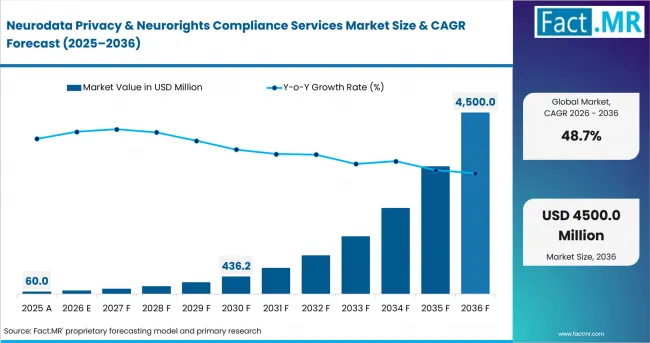
Neurodata Privacy & Neurorights Compliance Services Market Value Analysis | Source: Fact.MR
Summary of the Neurodata Privacy & Neurorights Compliance Services Market
- Demand Drivers in the Market
- Neural data laws create a need for privacy notices and user consent controls.
- Consumer EEG firms need data governance before brain data enters wellness and productivity apps.
- BCI developers need compliance support before moving from research into commercial use.
- Privacy teams need neurorights mapping because standard data policies do not fully address mental privacy.
- Key Segments Analyzed
- By Service Type: Neural Data Privacy Compliance is expected to hold 34.0% share in 2026 because new laws create the first paid service need.
- By Compliance Scope: Consumer Neurotech Data leads because consumer EEG and wellness devices create early privacy exposure. The segment is projected to capture 38.0% share in 2026.
- By Customer Type: Neurotech Device Makers are likely to account for 41.0% share in 2026 because product teams need privacy controls before scale.
- By Delivery Model: Boutique Privacy Advisory is projected to hold 44.0% share in 2026 because the market is early and specialist interpretation is limited.
- By End Use: Consumer EEG Wearables are expected to hold 36.0% share in 2026 since non-clinical devices create the first large compliance surface.
- By Geography: The United States is projected to record 55.2% CAGR through 2036 as state-level neural data laws create the strongest early base.
- Analyst Opinion at Fact.MR
- Shambhu Nath Jha, Senior Analyst at Fact.MR, states, “Neurodata privacy is set to become a specialist compliance category as consumer neurotechnology expands. Early demand will come from firms that collect brain activity data but still need stronger consent and user rights controls. Providers with privacy law expertise and clear understanding of neural data sensitivity will gain early advisory opportunities.”
- Strategic Implications
- Neurotech firms should separate neural data from standard wellness data in privacy controls.
- Consumer EEG product teams need consent withdrawal and data deletion paths before scale.
- Privacy advisers should build neurorights assessment templates for early client demand.
- Wearable companies need clear data-use limits before brain signals become product features.
| Metric | Details |
|---|---|
| Industry Size 2026 | USD 85.0 million |
| Industry Value 2036 | USD 4,500 million |
| CAGR 2026 to 2036 | 48.7% |
Source: Fact.MR analysis. Updated Jun 19, 2026
The United States is projected to record 55.2% CAGR from 2026 to 2036 as Colorado and California laws create the strongest early compliance base. Chile is likely to post 52.7% CAGR because neurorights policy precedent supports advisory demand. Germany is expected to register 49.4% CAGR as privacy teams apply GDPR-style controls to neural data. The United Kingdom is forecast to advance at 47.8% CAGR by 2036 as neurotechnology ethics and data protection reviews expand. Japan is set to record 45.6% CAGR as consumer neurotech and wellness wearables create controlled rollout needs.
How does the neurodata privacy & neurorights compliance services market break down by segment?
Neurodata Privacy & Neurorights Compliance Services Market Analysis by Service Type
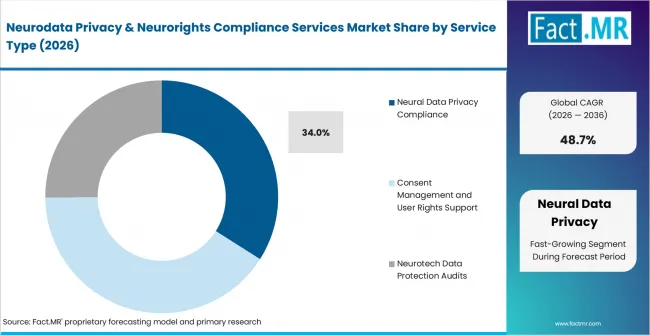
Neurodata Privacy & Neurorights Compliance Services Market Analysis By Service Type | Source: Fact.MR
Neural Data Privacy Compliance is expected to hold 34.0% share in 2026 because new laws create the first paid service need. Colorado and California both move neural data into stronger privacy protection. Service demand starts with data classification and consent design. Neurotech firms need help deciding which brain-signal data requires sensitive-data treatment before commercial product rollout.
Neurodata Privacy & Neurorights Compliance Services Market Analysis by Compliance Scope
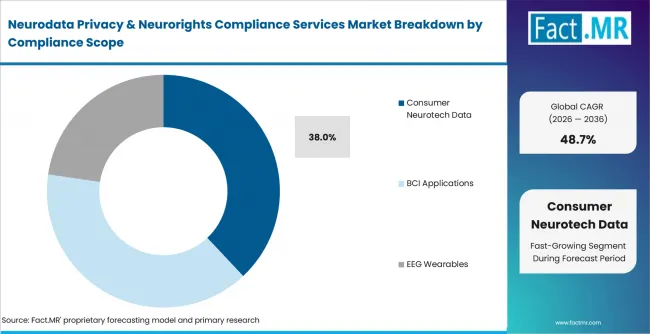
Neurodata Privacy & Neurorights Compliance Services Market Analysis By Compliance Scope | Source: Fact.MR
Consumer Neurotech Data leads because consumer EEG and wellness devices collect signals outside traditional medical settings. Product teams need practical rules for retention, sharing and deletion. The segment is projected to capture 38.0% share in 2026 as non-clinical neurotechnology expands.
Neurodata Privacy & Neurorights Compliance Services Market Analysis by Customer Type
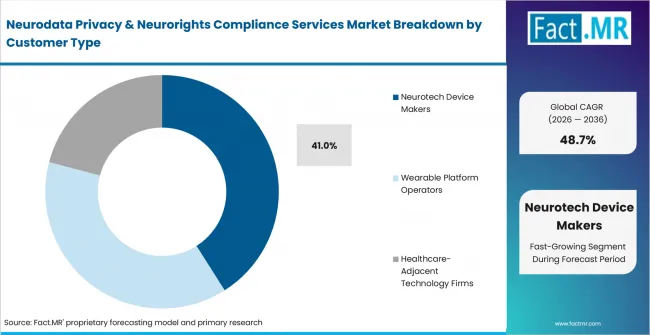
Neurodata Privacy & Neurorights Compliance Services Market Analysis By Customer Type | Source: Fact.MR
Neurotech Device Makers are likely to account for 41.0% share in 2026 because product teams need privacy controls before scale. Device makers collect neural or EEG-derived information directly through headsets, headphones and BCI tools. Compliance work begins before launch because product design decides consent screens, data retention and third-party sharing. Early demand will come from firms moving neurotechnology from research settings into consumer use.
Neurodata Privacy & Neurorights Compliance Services Market Analysis by Delivery Model
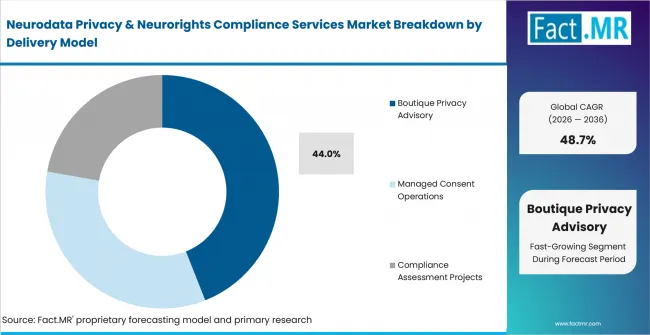
Neurodata Privacy & Neurorights Compliance Services Market Analysis By Delivery Model | Source: Fact.MR
Boutique Privacy Advisory leads because the market is early and specialist interpretation is limited. Large compliance teams often lack neural data expertise. The delivery model is projected to hold 44.0% share in 2026 as neurotech companies seek targeted advice on consent and data handling. Advisory work can later convert into managed rights support as device fleets and user bases grow.
Neurodata Privacy & Neurorights Compliance Services Market Analysis by End Use
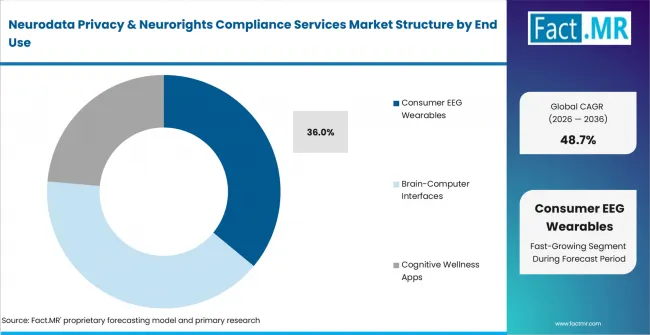
Neurodata Privacy & Neurorights Compliance Services Market Analysis By End Use | Source: Fact.MR
Consumer EEG Wearables lead early demand because non-clinical devices create the first large compliance surface. Neurable launched BCI-enabled headphones in 2024 for the consumer market. The segment is expected to hold 36.0% share in 2026 as brain-signal products move into productivity and wellness use. Privacy controls must address consent, data security and derived cognitive insights before consumer adoption widens.
What is accelerating neurodata privacy & neurorights compliance services adoption, and what is holding it back?
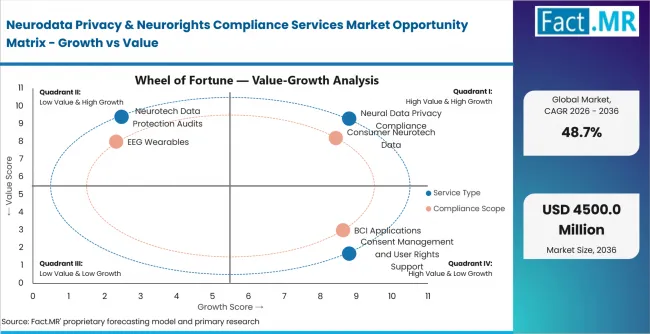
Neurodata Privacy & Neurorights Compliance Services Market Opportunity Matrix Growth Vs Value | Source: Fact.MR
State-level privacy law is the primary driver. Colorado’s law expands privacy protection to biological and neural data. California’s SB 1223 protects neural data under sensitive personal information. These laws create a service need for audits, notices and consent-management workflows.
Global ethics standards add demand. UNESCO’s Recommendation on the Ethics of Neurotechnology highlights protection of neural data and freedom of thought. This gives privacy advisers and standards teams a wider framework for neurorights compliance programs.
The main restraint is early market uncertainty. Many neurotech companies are small and may not have large compliance budgets. Some device data may be hard to classify because raw neural signals and inferred cognitive states have different risk levels. Service providers must explain risk without overstating current technical capability.
Opportunities in the Neurodata Privacy & Neurorights Compliance Services Market
- Consent Controls: Providers can build consent flows for EEG wearables and BCI products.
- Neural Data Audits: Privacy firms can review storage, sharing and deletion practices.
- Neurorights Advisory: Standards teams can help firms map neural data practices to emerging policy.
Which countries are scaling neurodata privacy & neurorights compliance services demand fastest?
Based on regional analysis, the neurodata privacy and neurorights compliance services market is segmented into North America, Latin America, Western Europe, East Asia, South Asia and Pacific, and Middle East and Africa.
.webp "Top Country Growth Comparison Neurodata Privacy & Neurorights Compliance Services Market Cagr (2026 2036)")
Top Country Growth Comparison Neurodata Privacy & Neurorights Compliance Services Market Cagr (2026 2036) | Source: Fact.MR
| Country | CAGR |
|---|---|
| United States | 55.2% |
| Chile | 52.7% |
| Germany | 49.4% |
| United Kingdom | 47.8% |
| Japan | 45.6% |
Source: Fact.MR analysis. Updated Jun 19, 2026
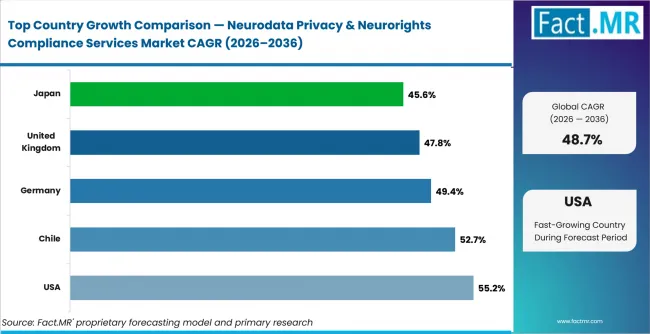
Neurodata Privacy & Neurorights Compliance Services Market Cagr Analysis By Country | Source: Fact.MR
North America Neurodata Privacy & Neurorights Compliance Services Market Analysis
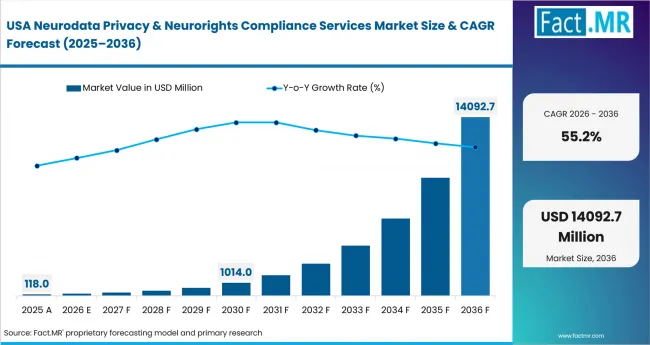
Neurodata Privacy & Neurorights Compliance Services Market Country Value Analysis | Source: Fact.MR
North America demand is led by state privacy laws and consumer neurotechnology activity. The United States has the strongest early base because Colorado and California directly address neural data.
- United States: The United States is projected to record 55.2% CAGR through 2036 as Colorado and California create the strongest early compliance base. Consumer neurotech firms need privacy reviews before collecting brain-signal data at scale. Colorado’s law adds neural data to sensitive-data protection. California’s SB 1223 strengthens protection for neural data under the CCPA framework.
Latin America Neurodata Privacy & Neurorights Compliance Services Market Analysis
Latin America demand is shaped by Chile’s neurorights precedent. The country is small in revenue terms but important for policy design and legal reference.
- Chile: Chile created an early neurorights reference point before most countries had direct neural data rules. The country is likely to post 52.7% CAGR from 2026 to 2036 because policy advisory starts from a low base. Compliance service demand will come from legal review, ethics mapping and research-to-consumer neurotechnology programs. Chilean precedent also supports regional discussion around mental privacy. Providers can gain by helping institutions translate constitutional principles into data policies. The market will favor specialist advisers with neuroethics understanding and privacy law experience.
Western Europe Neurodata Privacy & Neurorights Compliance Services Market Analysis
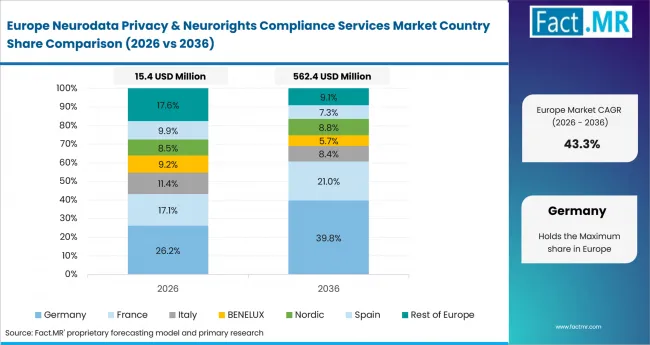
Neurodata Privacy & Neurorights Compliance Services Market Europe Country Market Share Analysis, 2026 & 2036 | Source: Fact.MR
Western Europe demand is tied to GDPR-style privacy controls and global neurotechnology ethics work. Germany and the United Kingdom have strong privacy advisory bases.
- Germany: Germany is expected to register 49.4% CAGR by 2036 as privacy teams apply GDPR-style controls to neural data. Neurotechnology firms and research commercialization teams will need consent and data minimization reviews. German clients will likely ask whether EEG-derived insights require sensitive-data handling. Service providers can support documentation, lawful-basis review and data protection impact assessments. Adoption will favor firms that can separate medical use from consumer wellness use.
- United Kingdom: Neurotechnology ethics and data protection reviews are expanding in the United Kingdom as consumer BCI tools become more practical. Privacy advisers will need to assess how neural signals and inferred mental states are collected. The country is forecast to advance at 47.8% CAGR through 2036 as universities and startups move research into commercial pilots. Service demand will focus on consent language, privacy impact assessments and user rights support. UK adoption will favor boutique firms that can combine legal interpretation with neurotechnology product knowledge.
East Asia Neurodata Privacy & Neurorights Compliance Services Market Analysis
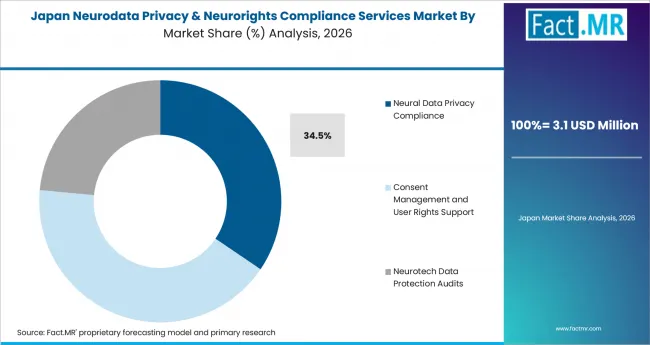
Neurodata Privacy & Neurorights Compliance Services Market Japan Market Share Analysis By Service Type | Source: Fact.MR
East Asia demand is emerging through wellness wearables, robotics and consumer electronics. Japan has early potential because product reliability and user trust influence technology adoption.
- Japan: Japan is set to record 45.6% CAGR from 2026 to 2036 as consumer neurotech and wellness wearables create controlled rollout needs. Device makers and wellness platforms will need privacy language that explains brain-signal use clearly. Japanese users may expect cautious deployment and strong trust controls. Service providers can support consent design, data retention review and vendor risk assessment.
Who leads the neurodata privacy & neurorights compliance services market landscape?
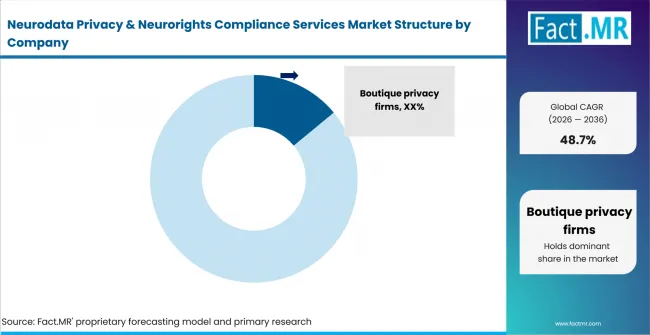
Neurodata Privacy & Neurorights Compliance Services Market Analysis By Company | Source: Fact.MR
Neurodata privacy and neurorights compliance services are used by firms that collect or process brain-related data. TrustArc are early providers because the work needs specialist legal interpretation. VeraSafe supports standards discussion and public awareness around neural data protection. Emotiv and Neurable represent consumer neurotechnology firms that need strong compliance controls as product use expands.
EY can enter the market as larger neurotech and wearable clients ask for global privacy programs. Their advantage will be cross-border privacy delivery. Boutique firms can move faster in the early stage because they can interpret neural data laws and ethics standards with more focus.
Competition through 2036 will depend on specialist credibility and privacy engineering depth. Providers that can review consent, storage and sharing practices will be better placed. Firms that understand BCI product design and user rights operations can convert advisory work into recurring compliance support.
Which companies are the key players?
- TrustArc
- VeraSafe
- Deloitte
- EY
Bibliography
- Colorado General Assembly. (2024). HB24-1058: Protect Privacy of Biological Data.
- Becker, J. (2024, September 27). Governor signs Senator Becker’s first-in-the-nation legislation on neurorights. Office of Senator Josh Becker.
- Neurable Inc. (2024, September 24). Neurable Inc. launches first smart brain-computer interface enabled headphones for consumer market. Business Wire.
- UNESCO. (2025, November 11). Recommendation on the Ethics of Neurotechnology. UNESCO Legal Affairs.
This Report Addresses
- Strategic intelligence on neurodata privacy and neurorights compliance services across service type, compliance scope and customer type.
- Forecast mapping from USD 85.0 million in 2026 to USD 4,500 million by 2036.
- Segment analysis covering Neural Data Privacy Compliance, Consumer Neurotech Data, Neurotech Device Makers, Boutique Privacy Advisory and Consumer EEG Wearables.
- Regional outlook covering the United States, Chile, Germany, United Kingdom and Japan.
- Competitive analysis of TrustArc, VeraSafe, Deloitte and EY.
- Service assessment covering consent management, data protection audits and neurorights advisory.
- Compliance assessment covering consumer neurotech data, EEG wearables and derived cognitive insights.
- Primary interviews, provider checks, official source review and neurotechnology policy validation support the forecast.
What does the neurodata privacy & neurorights compliance services market cover?
The neurodata privacy and neurorights compliance services market covers privacy and compliance support for neural data collected by neurotechnology systems. It includes services for brain-computer interfaces and cognitive wellness devices. The market differs from general privacy consulting because neural data can reveal mental states and requires specialized consent and ethical review.
Neurodata Privacy & Neurorights Compliance Services Market Inclusions
The scope includes neural data privacy compliance and consent-management support. It covers data protection audits for consumer neurotech products and brain-computer interfaces. It includes neurorights policy advisory and vendor risk review. It also covers managed user rights support for access and withdrawal of consent.
Neurodata Privacy & Neurorights Compliance Services Market Exclusions
The scope excludes clinical neurodiagnostic services with no consumer data use. It excludes general privacy consulting with no neural data focus. It excludes neuroscience research services unless commercial neurodata compliance is included. It excludes device manufacturing and EEG hardware sales unless compliance advisory is sold with the product.
Neurodata Privacy & Neurorights Compliance Services Market Research Methodology
- Primary Research:
- Primary research includes interviews with privacy lawyers and neurotechnology compliance leads. It includes input from consumer EEG product teams and BCI policy advisers.
- Desk Research:
- Desk research reviews neural data privacy laws and neurorights policy sources. It covers consumer neurotech privacy reports and company product disclosures.
- Market-Sizing and Forecasting:
- Forecasting uses neurotech firm counts and compliance intensity. Consumer EEG adoption and privacy law expansion support the market assessment.
- Data Validation and Update Cycle:
- Forecasts are validated through privacy firm checks and neurotech policy monitoring. New neural data laws and standards updates help confirm market direction.
Segmentation
What is the report’s scope and coverage?
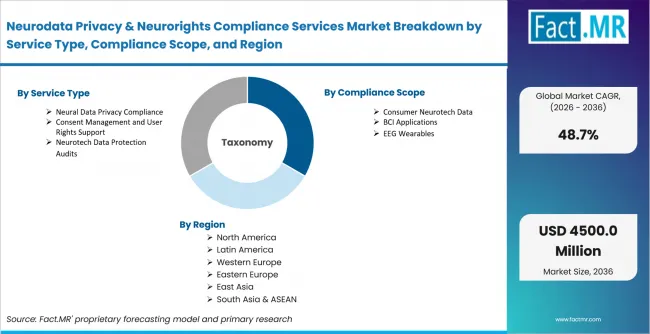
Neurodata Privacy & Neurorights Compliance Services Market Breakdown By Service Type, Compliance Scope, And Region | Source: Fact.MR
| Attribute | Details |
|---|---|
| Quantitative Units | USD 85.0 million in 2026 to USD 4,500 million by 2036 at 48.7% CAGR |
| Market Definition | Compliance, consent-management and data-protection services for brain-computer interfaces and consumer neurotech |
| Service Type | Neural Data Privacy Compliance, Consent Management and User Rights Support, Neurotech Data Protection Audits, Neurorights Policy Advisory, Vendor and Device Risk Assessment |
| Compliance Scope | Consumer Neurotech Data, BCI Applications, EEG Wearables, Research-to-Consumer Neurodata, Derived Cognitive Insights |
| Customer Type | Neurotech Device Makers, Wearable Platform Operators, Healthcare-Adjacent Technology Firms, Research Commercialization Teams, Large Enterprise Privacy Offices |
| Delivery Model | Boutique Privacy Advisory, Managed Consent Operations, Compliance Assessment Projects, Standards Mapping and Training, Privacy Engineering Support |
| End Use | Consumer EEG Wearables, Brain-Computer Interfaces, Cognitive Wellness Apps, Workplace Neurotech Programs, Research Data Commercialization |
| Regions Covered | North America, Latin America, Western Europe, East Asia, South Asia and Pacific, Middle East and Africa |
| Countries Covered | United States, Chile, Germany, United Kingdom, Japan |
| Key Companies and Ecosystem Participants | TrustArc, VeraSafe, Deloitte and EY |
| Forecast Period | 2026 to 2036 |
| Approach | Hybrid top-down and bottom-up approach using neurotech company counts, legal triggers, privacy service intensity, consumer EEG adoption and standards activity |
Source: Fact.MR analysis. Updated Jun 19, 2026
How is the market segmented?
-
By Service Type:
- Neural Data Privacy Compliance
- Consent Management and User Rights Support
- Neurotech Data Protection Audits
- Neurorights Policy Advisory
- Vendor and Device Risk Assessment
-
By Compliance Scope:
- Consumer Neurotech Data
- BCI Applications
- EEG Wearables
- Research-to-Consumer Neurodata
- Derived Cognitive Insights
-
By Customer Type:
- Neurotech Device Makers
- Wearable Platform Operators
- Healthcare-Adjacent Technology Firms
- Research Commercialization Teams
- Large Enterprise Privacy Offices
-
By Delivery Model:
- Boutique Privacy Advisory
- Managed Consent Operations
- Compliance Assessment Projects
- Standards Mapping and Training
- Privacy Engineering Support
-
By End Use:
- Consumer EEG Wearables
- Brain-Computer Interfaces
- Cognitive Wellness Apps
- Workplace Neurotech Programs
- Research Data Commercialization
-
By Region:
- North America
- United States
- Canada
- Europe
- Germany
- United Kingdom
- France
- Italy
- Spain
- Asia Pacific
- China
- Japan
- South Korea
- Taiwan
- Singapore
- Latin America
- Brazil
- Mexico
- Argentina
- Middle East & Africa
- GCC Countries
- South Africa
- Israel
- North America
Who worked on this report


Preview the report firsthand - request a free sample
Free SampleGet the brochure for pricing and purchase details
Download PDF