- Market Value (2025): USD 46.52 Mn
- Estimated Value (2026): USD 53.5 Mn
- Forecast Value (2036): USD 216.6 Mn
- CAGR (2026-2036): 15.0%
Neuroscience Performance Footwear Market Forecast and Outlook 2026 to 2036
As per the Fact.MR analysis, the neuroscience performance footwear market was valued at USD 46.52 million in 2025 and is projected to grow from USD 53.5 million in 2026 to USD 216.6 million by 2036. Demand for neuroscience performance footwear is likely to grow at a CAGR of 15.0% over the forecast period.
Sales of neuroscience performance footwear are increasing as athletes, rehabilitation centers and fitness consumers seek footwear-based solutions for gait monitoring and movement assessment. Demand is supported by growing adoption of pressure-sensing insoles and connected footwear that measure foot movement, balance and pressure distribution. Integration with smartphone applications and cloud-based analytics is expanding sales across sports training and rehabilitation applications. Manufacturers are focusing on sensor-enabled footwear and personalized feedback technologies to strengthen product adoption among professional athletes and individual consumers.
Key Takeaways from the Neuroscience Performance Footwear Market
- Neuroscience Performance Footwear Market Value (2025): USD 46.52 million
- Neuroscience Performance Footwear Market Value (2026): USD 53.5 million
- Neuroscience Performance Footwear Market Forecast Value (2036): USD 216.6 million
- Neuroscience Performance Footwear Market Forecast CAGR (2026–2036): 15.0%
- Leading Neurofeedback Modality: Pressure-sensing insoles (25.4%)
- Leading Device Form Factor: Home tabletop / fixture (35.4%)
- Leading Data Processing Segment: Cloud AI (27.1%)
- Leading Sales Channel: Brand direct online (26.6%)
- Key Market Participants: Moticon, FeetMe, Walk With Path, Nike, Orpyx Medical Technologies, Plantiga Technologies and Sensoria Health
- Key Growth Regions: United States, China, Japan, Germany and South Korea
Demand for connected gait monitoring and personalized performance feedback is supporting market expansion. Pressure-sensing insoles account for 25.4% of neurofeedback modality revenue, while cloud AI represents 27.1% of data processing demand. These technologies enable users and professionals to evaluate movement patterns, identify gait abnormalities and monitor performance changes over time. Direct online distribution is also gaining importance as specialized wearable technology providers reach athletes, rehabilitation users and fitness-conscious consumers through their own digital channels.
Neuroscience Performance Footwear Market
| Metric | Value |
|---|---|
| Estimated Value (2026) | USD 53.5 million |
| Forecast Value (2036) | USD 216.6 million |
| Forecast CAGR (2026 to 2036) | 15.0% |
Source: Fact.MR analysis. Updated Nov 18, 2026
Source: Fact.MR analysis.
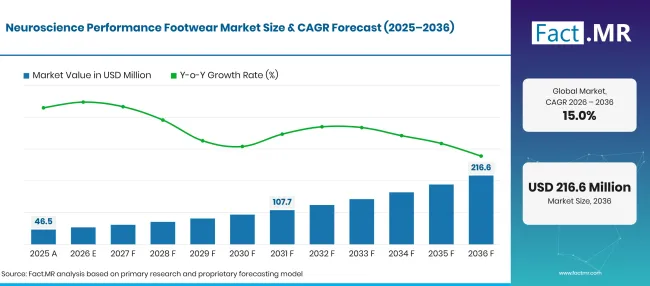
Neuroscience Performance Footwear Market Forecast Global | Source: Fact.MR
Category
| Category | Segments |
|---|---|
| Footwear Neurofeedback Modality | Pressure-sensing insoles, Haptic gait cueing, Balance biofeedback, Motion-capture gait analytics, Multimodal neuro-motor feedback |
| Device Form Factor | Home tabletop / fixture, Head / ear wearable, Foot / body wearable, Wrist / finger wearable, Portable accessory |
| Data Processing | Cloud AI, Smartphone companion, On-device algorithm, Clinician-linked dashboard, Hybrid edge-cloud |
| Sales Channel | Brand direct online, Retail electronics, Pharmacy / wellness retail, Clinical / professional, B2B / institutional |
| Region | United States, China, Japan, Germany, South Korea |
Source: Fact.MR analysis. Updated Nov 18, 2026
Segmental Analysis
Why do pressure-sensing insoles lead the Neuroscience Performance Footwear Market by neurofeedback modality?
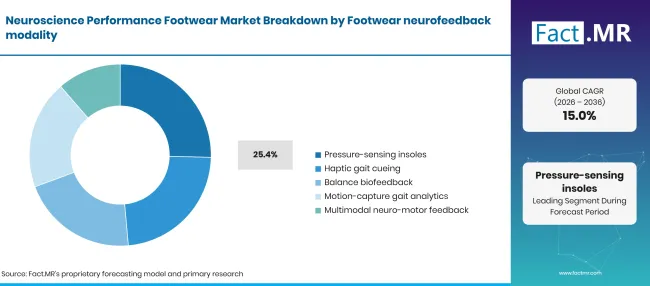
Neuroscience Performance Footwear Market Breakdown Footwear Neurofeedback Modality 1 | Source: Fact.MR
Demand for pressure-sensing insoles accounts for 25.4% of the market in 2026, about USD 13.59 million. These systems measure plantar pressure distribution, foot loading patterns and changes in gait during walking, running and athletic activity. The collected information helps athletes and rehabilitation professionals evaluate movement efficiency, identify abnormal loading and monitor progress during training or recovery. Wearable sensor integration is supporting the development of footwear-based monitoring solutions that provide continuous biomechanical information. Manufacturers are focusing on improving sensor accuracy, wireless connectivity and real-time feedback to expand applications in sports performance and rehabilitation.
How are home tabletop and fixture-based systems shaping the Neuroscience Performance Footwear Market?
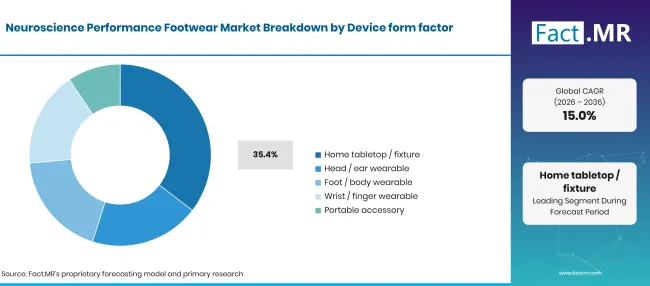
Neuroscience Performance Footwear Market Breakdown Device Form Factor | Source: Fact.MR
The report assigns 35.4% of device form factor revenue in 2026, about USD 18.94 million, to home tabletop / fixture systems. This internally defined category requires scope validation because the broader market centers on footwear-based technologies. These systems support structured performance assessment and movement monitoring in home-based and controlled environments. Their relevance is associated with the growing preference for accessible training and rehabilitation technologies that can complement professional assessments. Integration with connected footwear sensors and digital monitoring platforms can help users evaluate balance, movement and training progress. Manufacturers are focusing on convenient assessment systems that combine wearable measurements with accessible feedback interfaces.
Which factors make cloud AI lead data processing demand in the Neuroscience Performance Footwear Market?
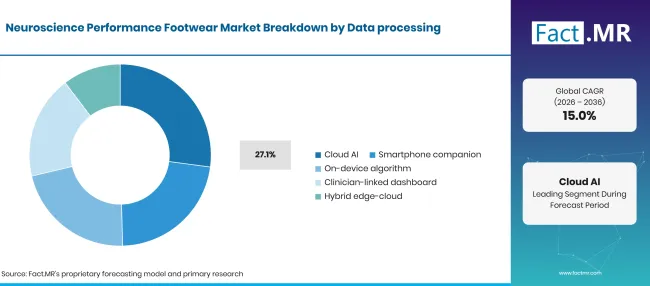
Neuroscience Performance Footwear Market Breakdown Data Processing | Source: Fact.MR
Sales of neuroscience performance footwear with cloud-based AI capabilities are increasing as athletes and rehabilitation professionals seek detailed movement analysis and personalized performance insights. Cloud AI represents 27.1% of data processing demand in 2026, with an estimated segment value of USD 14.50 million. According to the OECD Digital Economy and Society Outlook 2026, more than half of firms across OECD countries used cloud computing in 2025, while AI adoption among firms reached 20%. These are economy-wide figures rather than footwear-specific sales data. Wider adoption of cloud infrastructure is supporting the development of connected analytics platforms. Similar developments are projected to drive sales of neuroscience performance footwear with cloud-based gait monitoring and performance assessment capabilities.
Why are brand-direct online channels gaining importance in the Neuroscience Performance Footwear Market?
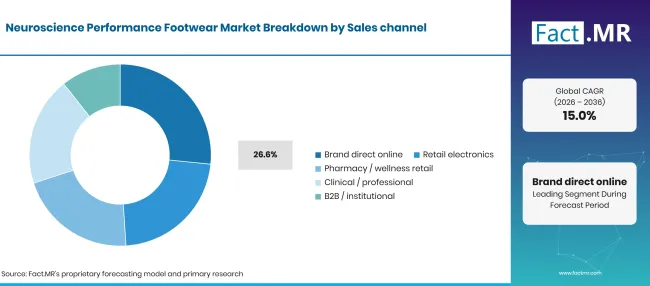
Neuroscience Performance Footwear Market Breakdown Sales Channel 1 | Source: Fact.MR
Brand direct online sales hold 26.6% of sales channel revenue in 2026, about USD 14.22 million. According to the U.S. Census Bureau’s August 2026 release, seasonally adjusted U.S. retail e-commerce sales reached USD 340.2 billion in the second quarter of 2026, increasing 12.2% year over year and representing 17.1% of total U.S. retail sales. Growing online purchasing activity is creating opportunities for footwear technology providers to demonstrate product features and reach athletes and rehabilitation users directly. Broader digital retail activity provides a potential distribution route for neuroscience performance footwear through company-owned websites and online platforms, but does not establish category-specific sales. Online channels are particularly relevant for technology-intensive products that require detailed product information and application guidance. Manufacturers are strengthening digital sales platforms and customer support to reach athletes, fitness enthusiasts and rehabilitation users.
Neuroscience Performance Footwear Market – Drivers, Restraints & Trends
-
Drivers
- Demand for neuroscience performance footwear is increasing as sports organizations, rehabilitation centers and individual athletes seek objective measurements of movement and physical performance. Pressure-sensing insoles can measure plantar pressure, ground reaction forces and gait characteristics outside conventional laboratory environments. For example, Moticon's OpenGo system combines wireless sensor insoles with pressure and motion measurements for sports science and clinical research. Similar mobile monitoring solutions are projected to drive sales of neuroscience performance footwear across athletic training and rehabilitation applications.
-
Restraints
- Sales of neuroscience performance footwear is constrained by the technical requirements of sensor accuracy, calibration, comfort, battery performance and reliable data interpretation. Wearable systems must maintain consistent measurements across different footwear types, walking speeds, body weights and movement conditions. Manufacturers also need to address data privacy and interoperability when connecting wearable devices with cloud platforms and clinical dashboards. These requirements can increase development costs and slow adoption among price-sensitive consumers and smaller rehabilitation providers.
-
Opportunity
- Neuroscience-Integrated Footwear Platforms: Adoption of footwear incorporating neuroscience principles is increasing as manufacturers explore the relationship between sensory stimulation, foot movement and cognitive responses. In October 2025, Nike introduced its Mind 001 and Mind 002 footwear models, incorporating specialized underfoot structures designed to stimulate sensory receptors in the feet. The products were scheduled for commercial availability in January 2026. Similar neuroscience-oriented footwear innovations are projected to expand consumer awareness and create opportunities for specialized performance footwear manufacturers.
-
Trend
- Cloud-Connected Gait Analytics: Demand for connected gait-monitoring solutions is rising as athletes and rehabilitation professionals seek access to movement data across multiple sessions and environments. Moticon's ReGo system combines wireless sensor insoles with cloud-based processing, standardized movement tests and automated reporting. Similar developments are projected to support the adoption of connected performance footwear and improve access to longitudinal movement assessments.
Neuroscience Performance Footwear Market by Analysis by Key Country
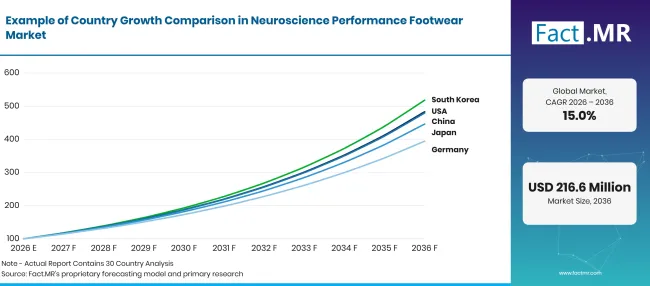
Neuroscience Performance Footwear Market Growth Index | Source: Fact.MR
| Country | CAGR (2026–2036) |
|---|---|
| South Korea | 17.9% |
| United States | 17.1% |
| China | 17.0% |
| Japan | 16.1% |
| Germany | 14.7% |
Source: Fact.MR analysis. Updated Nov 18, 2026
Source: Fact.MR analysis.
What is driving neuroscience performance footwear demand in the United States?
The United States is expected to record a 17.1% CAGR through 2036, supported by its established sports technology ecosystem and growing adoption of wearable performance-monitoring solutions.
Sales are gaining momentum as professional sports organizations and fitness consumers seek accurate measurements of gait, foot pressure and movement efficiency. Nike's introduction of its Mind footwear platform in 2025 further demonstrates commercial interest in neuroscience-oriented footwear. Manufacturers are focusing on connected insoles and sensory-feedback technologies to strengthen adoption across athletic training and movement assessment.
How is China's sports technology ecosystem supporting market growth?
Demand for neuroscience performance footwear in China is anticipated to witness a 17.0% CAGR through 2036 as sports participation, wearable technology adoption and digital fitness solutions create opportunities for connected performance products.
According to China's State Council Information Office, retail sales of wearable smart devices, including smart glasses, increased by more than 100% in the first half of 2026. Additionally, China's General Administration of Sport reported in October 2026 that outdoor sports participation exceeded 500 million people, with the outdoor sports industry reaching approximately CNY 3.17 trillion. These developments are expanding opportunities for connected fitness products and movement-monitoring technologies. Manufacturers are integrating pressure sensors and motion-tracking capabilities into footwear to reach sports and rehabilitation users. Similar adoption trends are expected to drive sales of neuroscience performance footwear through online retail and specialized sports technology channels.
What is sustaining neuroscience performance footwear demand in Japan?
Sales of neuroscience performance footwear in Japan country holds 16.1% CAGR through 2036.
Demand is supported by interest in precision movement monitoring, sports performance optimization and rehabilitation technologies. Japanese consumers and professional users are increasingly exposed to wearable electronics and sensor-based measurement solutions. Manufacturers are focusing on compact sensor components, comfortable footwear integration and accurate motion analytics. Similar advancements are projected to support adoption across sports training, clinical assessment and mobility monitoring applications.
How is Germany strengthening demand for neuroscience performance footwear?
Germany is set to lead with 14.7% CAGR through 2036, supported by its established engineering capabilities and medical technology industry.
According to Germany's Federal Statistical Office (Destatis), published on January 6, 2026, approximately 25.6% of German households owned at least one fitness equipment item in 2023, representing around 10.5 million households. Additionally, Destatis reported in March 2026 that Germany's research and development expenditure reached EUR 137.1 billion in 2024, equivalent to 3.17% of GDP. These developments indicate a strong foundation for sports technology innovation and fitness equipment adoption. Moticon's wireless sensor insoles and gait-analysis software further demonstrate the availability of specialized movement-monitoring solutions in Germany. Similar developments are expected to drive sales of neuroscience performance footwear across sports training and rehabilitation applications.
Why is South Korea emerging as a high-growth market for neuroscience performance footwear?
Sales of neuroscience performance footwear in South Korea are projected to grow at a 17.9% CAGR, the fastest among the five key countries.
Demand is supported by consumer interest in connected fitness technologies, wearable electronics and personalized health monitoring. Integration of smartphone applications, pressure-sensing components and AI-enabled movement analytics is expected to improve the functionality of performance footwear. Manufacturers and technology providers can benefit from the country's digital infrastructure and established consumer electronics ecosystem. Similar developments are projected to accelerate adoption across athletic training, rehabilitation and personal fitness applications.
Competitive Landscape for Neuroscience Performance Footwear Market
Competition in the neuroscience performance footwear market includes specialized sensor-insole developers, digital gait-analysis companies, assistive mobility technology providers and established sportswear manufacturers. Moticon participates through wireless sensor insoles and software for foot dynamics analysis, while FeetMe and Plantiga Technologies are associated with connected insole and movement-monitoring technologies. Walk With Path and Orpyx Medical Technologies represent specialized assistive and foot-monitoring technology participants. Sensoria Health contributes through sensor-enabled wearable and connected health solutions. Nike occupies a distinct position through neuroscience-oriented footwear designed around sensory stimulation and the mind-body connection.
Competition is increasingly shaped by the integration of footwear hardware, biomechanical sensing and digital analytics. Specialized technology providers are focusing on measurement accuracy, real-time data collection and clinical or sports applications, while established footwear brands are exploring sensory stimulation and differentiated product experiences. Companies that combine comfortable footwear integration with reliable sensing, actionable feedback and accessible digital platforms are positioned to capture opportunities across athletic performance and rehabilitation.
Recent Developments
- In January 2026, Nike's Mind 001 and Mind 002 neuroscience-based footwear models became commercially available following their October 2025 announcement. The products use specialized underfoot structures to stimulate sensory receptors in the feet.
Key Players in Neuroscience Performance Footwear Market
Key companies profiled include Moticon; FeetMe; Walk With Path; Nike, Inc.; Orpyx Medical Technologies; Plantiga Technologies; and Sensoria Health.
- Moticon
- FeetMe
- Walk With Path
- Nike, Inc.
- Orpyx Medical Technologies
- Plantiga Technologies
- Sensoria Health
Bibliography
- Federal Statistical Office (Destatis). (2026, January 6). 26% of households have fitness equipment.
- Federal Statistical Office (Destatis). (2026, March 27). Research and development expenditure increased by 3.8% in 2024.
- General Administration of Sport of China. (2026, October).[Outdoor sports industry continues to gain momentum: Interpretation of the China Outdoor Sports Industry Development Report].
- Latsch, B., Herbst, F., Suppelt, M., Seiler, J., Schaumann, S., Suppelt, S., Altmann, A. A., Grimmer, M., & Kupnik, M. (2026). Sensor insoles: A review. IEEE Sensors Journal, 26(3), 3577–3596.
- Moticon ReGo AG. (2026, January). OpenGo price list: Europe.
- Moticon ReGo AG. (2026, July). OpenGo Release Note – #1 2026.
- NIKE, Inc. (2025, October 23). Nike debuts its first neuroscience-based footwear to help athletes feel calm, focused and present.
- Organisation for Economic Co-operation and Development. (2026, November 5). OECD Digital Economy and Society Outlook 2026. OECD Publishing.
- State Council of the People’s Republic of China. (2026, July 24). China issues five-year plan for national fitness.
- U.S. Census Bureau. (2026, August 18). Quarterly retail e-commerce sales: Second quarter 2026.
Segmentation
Scope of Report
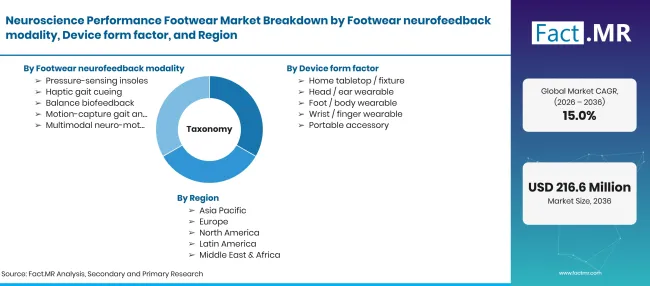
Neuroscience Performance Footwear Market Taxonomy | Source: Fact.MR
| Items | Values |
|---|---|
| Quantitative Units (2026) | USD 53.5 Million |
| Footwear Neurofeedback Modality | Pressure-sensing insoles, Haptic gait cueing, Balance biofeedback, Motion-capture gait analytics, Multimodal neuro-motor feedback |
| Device Form Factor | Home tabletop / fixture, Head / ear wearable, Foot / body wearable, Wrist / finger wearable, Portable accessory |
| Data Processing | Cloud AI, Smartphone companion, On-device algorithm, Clinician-linked dashboard, Hybrid edge-cloud |
| Sales Channel | Brand direct online, Retail electronics, Pharmacy / wellness retail, Clinical / professional, B2B / institutional |
| Regions Covered | North America, Latin America, Europe, East Asia, South Asia and Pacific, Middle East & Africa |
| Countries Covered | United States, China, Japan, Germany, South Korea, and other countries |
| Key Companies Profiled | Moticon, FeetMe, Walk With Path, Nike, Inc., Orpyx Medical Technologies, Plantiga Technologies, Sensoria Health |
| Additional Attributes | Dollar revenue in the neuroscience performance footwear market is segmented by neurofeedback modality, device form factor, data processing, sales channel and region. |
Source: Fact.MR analysis. Updated Nov 18, 2026
Neuroscience Performance Footwear Market by Segments
-
Footwear Neurofeedback Modality
- Pressure-sensing insoles
- Haptic gait cueing
- Balance biofeedback
- Motion-capture gait analytics
- Multimodal neuro-motor feedback
-
Device Form Factor
- Home tabletop / fixture
- Head / ear wearable
- Foot / body wearable
- Wrist / finger wearable
- Portable accessory
-
Data Processing
- Cloud AI
- Smartphone companion
- On-device algorithm
- Clinician-linked dashboard
- Hybrid edge-cloud
-
Sales Channel
- Brand direct online
- Retail electronics
- Pharmacy / wellness retail
- Clinical / professional
- B2B / institutional
-
Region
- North America
- United States
- Canada
- Mexico
- Europe
- Germany
- United Kingdom
- France
- Italy
- Spain
- Rest of Europe
- Asia Pacific
- China
- India
- Japan
- South Korea
- Australia
- Rest of Asia Pacific
- Latin America
- Brazil
- Mexico
- Argentina
- Rest of Latin America
- Middle East & Africa
- GCC Countries
- South Africa
- Rest of Middle East & Africa
- North America
Frequently Asked Questions
How big is the global Neuroscience Performance Footwear Market in 2026?
What was the value of the Neuroscience Performance Footwear Market in 2025?
What will be the size of the Neuroscience Performance Footwear Market by 2036?
How fast will the Neuroscience Performance Footwear Market grow during the forecast period?
Which neurofeedback modality segment holds the largest share of the Neuroscience Performance Footwear Market?
Which country is expected to experience the fastest growth in the Neuroscience Performance Footwear Market?
Who are the key companies operating in the Neuroscience Performance Footwear Market?
Who worked on this report


Preview the report firsthand - request a free sample
Free SampleGet the brochure for pricing and purchase details
Download PDF