- Market Value (2025): USD 3.9 Bn
- Estimated Value (2026): USD 4.1 Bn
- Forecast Value (2036): USD 8.0 Bn
- CAGR (2026-2036): 6.8%
What is the Non-BPA Personal Care Coatings Market forecast to be worth by 2036?
USD 4.1 billion in 2026 to USD 8.0 billion by 2036 at a 6.8% CAGR.
- As per Fact.MR analysis, the Non-BPA personal care coatings market was valued at USD 3.9 billion in 2025.
- Demand is projected to increase from USD 4.1 billion in 2026 to USD 8.0 billion by 2036.
- The market is anticipated to record a 6.8% CAGR from 2026 to 2036 as aerosol canmakers and tube producers shift toward non-BPA internal protection.
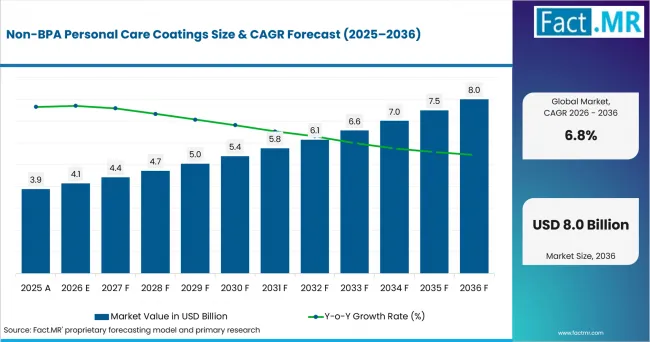
Non Bpa Personal Care Coatings Value Analysis | Source: Fact.MR
What are the defining numbers behind Non-BPA Personal Care Coatings Market growth?
According to Fact.MR analysis, an absolute opportunity of USD 3.8 billion is projected by 2036.
- Demand Drivers in the Market
- Aerosol can makers need non-BPA inner coatings that protect aluminum from deodorants, hair care, and shaving products.
- Tube makers need coatings that stay flexible when aluminum tubes are shaped and keep the product away from the metal.
- Personal care brands need clear packaging and product records across many products. In March 2025, the European Commission stated that BPA use in covered food-contact varnishes and coatings had been banned from 20 January 2025 [1].
- Aerosol and tube makers need coatings that prevent corrosion and stay strong during forming when coating materials change. Suppliers with several approved non-BPA coating options can meet different personal care packaging needs.
- Key Segments Analyzed
- By Coating Chemistry: Polyester will hold 34.0% share in 2026 since its flexibility and adhesion support use across formed metal packages that require chemical resistance.
- By Package Type: Beverage cans will account for 31.0% share in 2026, supported by established coating qualification across high-volume metal packaging lines.
- By Coating Position: Internal lining will capture 36.0% share in 2026 because it directly separates the personal care product from the metal package.
- By Performance: Corrosion resistance will represent 29.0% share in 2026 since liners must protect metal packages from alcohols, propellants, and other personal care formulations.
- Analyst Opinion at Fact.MR
- Shambhu Nath Jha, Principal Consultant at Fact.MR states: “Removing BPA is only the first step. Personal care packaging still needs coatings that work well during filling, forming, and product testing. Suppliers with several approved coating options can better meet the needs of different product formulas.”
- Strategic Implications
- Coating suppliers can test coatings with deodorant, hair care, shaving, and personal care products. Clear testing helps brands compare how each coating works with different products.
- Can makers can test new inner coatings with their current spraying, heating, and forming process before using them across the plant. Early tests help find production problems before wider use.
- Personal care brands can check coating details, product safety, and product compatibility during packaging approval. Clear records help packaging and product teams review the same changes.
- Packaging companies can compare heating and drying needs before changing coatings. In April 2026, ACTEGA announced that it would showcase ACTNext® UV and UV/LED coatings for aerosol cans at METPACK 2026, stating that the system eliminates the need for large, energy-intensive drying ovens [2].
As per Fact.MR analysis, China is forecast to post 8.1% CAGR through 2036. Japan follows at 7.0% over the same period. The USA and France are each estimated at 6.6%, while Germany is forecast at 6.4%.
How does the Non-BPA Personal Care Coatings Market break down by segment?
Polyester leads Coating Chemistry at 34.0%; Internal lining leads Coating Position at 36.0%.
Which Coating Chemistry dominates?
Polyester is estimated to hold 34.0% share in 2026.
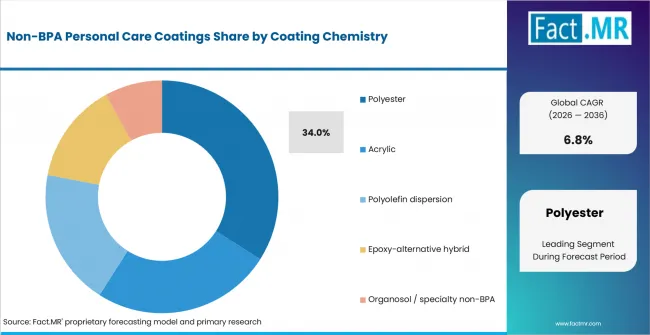
Non Bpa Personal Care Coatings Analysis By Coating Chemistry | Source: Fact.MR
Polyester is expected to lead because it stays flexible, sticks well to metal, and protects against chemicals. Acrylic and polyolefin coatings meet different product needs. In November 2025, AkzoNobel introduced its Accelshield BPAni coating range in Brazil for the inside of metal cans [3]. These coatings suit shaped metal packaging that needs flexibility and protection.
What leads the Package Type segment?
Beverage cans are projected to account for 31.0% share in 2026.
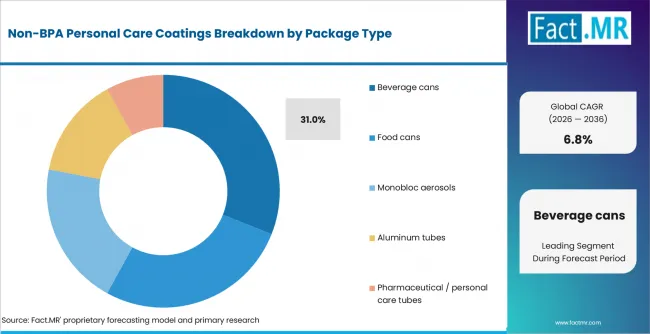
Non Bpa Personal Care Coatings Analysis By Package Type | Source: Fact.MR
Beverage cans hold the largest share because non-BPA coatings are widely tested and approved on large can production lines. Aerosol cans and aluminum tubes need coatings that stay flexible during forming and resist the product inside. Food cans and personal care or medicine tubes use similar inner coatings but have different filling and safety needs. The same coating knowledge can be used across different metal packaging types.
How does Coating Position shape demand?
Internal lining is anticipated to represent 36.0% share in 2026.
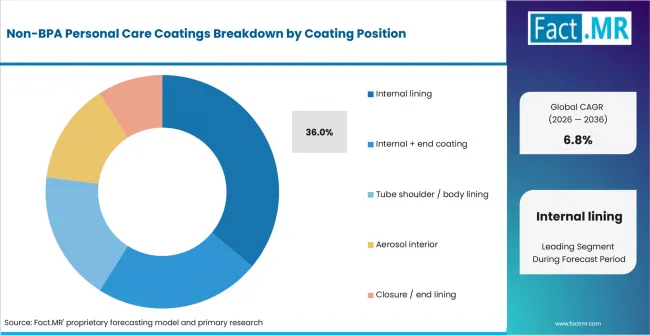
Non Bpa Personal Care Coatings Analysis By Coating Position | Source: Fact.MR
Internal linings lead because they keep the product away from the metal. Tube body and shoulder coatings need to stay strong during forming. Aerosol coatings need to resist the product inside, while end and closure coatings protect seams and contact areas. Each area needs the right coating thickness and drying conditions.
What supports demand by Performance?
Corrosion resistance is forecast to capture 29.0% share in 2026.
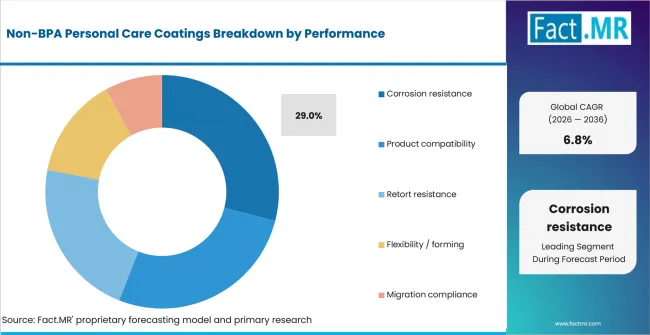
Non Bpa Personal Care Coatings Analysis By Performance | Source: Fact.MR
Corrosion resistance leads because coating damage can affect the package and the product inside. Flexible coatings are important for shaped aerosol cans and collapsible tubes. Personal care packaging also needs coatings that work safely with the product and meet safety rules. A stable inner coating helps protect both the package and the product.
What is accelerating Non-BPA Personal Care Coatings Market adoption, and what is holding it back?
BPA replacement and product-safe packaging increase demand, while approval time and product testing can slow the change.
Drivers Impact Analysis
| DRIVER | (~) % IMPACT ON CAGR | GEOGRAPHIC RELEVANCE | IMPACT TIMELINE |
|---|---|---|---|
| BPA and bisphenol substitution in coating portfolios | +1.5% | Western Europe, North America | Short term (<= 2 years) |
| Personal care aerosol and tube compatibility requirements | +1.2% | Global | Medium term (2-4 years) |
| Expansion of cosmetic product portfolios and registrations | +0.9% | North America, East Asia | Medium term (2-4 years) |
| Need for corrosion-resistant internal liners | +0.7% | Global | Long term (>= 4 years) |
| Converter preference for chemistry platforms that fit existing lines | +0.5% | Global | Medium term (2-4 years) |
Source: Fact.MR analysis. Updated Oct 7, 2026
Opportunity Impact Analysis
| OPPORTUNITY | (~) % IMPACT ON CAGR | GEOGRAPHIC RELEVANCE | IMPACT TIMELINE |
|---|---|---|---|
| Non-BPA liners for monobloc aerosols and tubes | +1.0% | North America, Western Europe, East Asia | Short term (<= 2 years) |
| Multi-chemistry portfolios for different filling goods | +0.8% | Global | Medium term (2-4 years) |
| Low-temperature and energy-curing coating systems | +0.6% | Western Europe, East Asia | Medium term (2-4 years) |
| Migration and regulatory documentation services | +0.4% | North America, Western Europe | Long term (>= 4 years) |
Source: Fact.MR analysis. Updated Oct 7, 2026
Restraints Impact Analysis
| RESTRAINT | (~) % IMPACT ON CAGR | GEOGRAPHIC RELEVANCE | IMPACT TIMELINE |
|---|---|---|---|
| Long qualification cycles for replacement chemistries | -0.9% | Global | Medium term (2-4 years) |
| Compatibility failures with aggressive personal care formulations | -0.7% | Global | Short term (<= 2 years) |
| Cost and process changes during chemistry conversion | -0.5% | Western Europe, North America | Medium term (2-4 years) |
| Different regulatory and labeling requirements by country | -0.4% | East Asia, Western Europe | Long term (>= 4 years) |
Source: Fact.MR analysis. Updated Oct 7, 2026
Which countries are scaling the Non-BPA Personal Care Coatings Market through 2036?
- China is forecast to keep a 1.1-point lead over Japan as cosmetics volume supports broader metal-package conversion.
- Japan is projected to remain 0.4 points ahead of the United States as formal product review supports careful package qualification.
- The United States and France are each estimated at 6.6%, reflecting different demand paths across domestic product activity and export-oriented beauty packaging.
- France is anticipated to remain 0.2 points above Germany as its perfume and cosmetics base supports premium aerosol and tube formats.
- Germany is forecast at 6.4%, supported by steady personal care retail activity and established metal-packaging conversion capability.
Comparable CAGRs create different entry conditions because product mix and coating qualification vary by country. Full coverage spans North America, Latin America, Western Europe, Eastern Europe, East Asia, South Asia & Pacific, and Middle East & Africa.
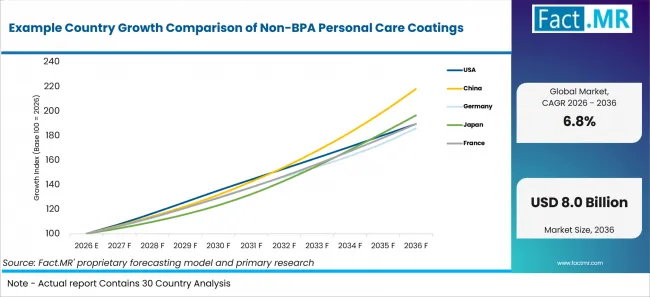
Example Country Growth Comparison Of Non Bpa Personal Care Coatings | Source: Fact.MR
| Country | CAGR (2026-2036) |
|---|---|
| China | 8.1% |
| Japan | 7.0% |
| USA | 6.6% |
| France | 6.6% |
| Germany | 6.4% |
Source: Fact.MR analysis. Updated Oct 7, 2026
What supports China adoption?
8.1% CAGR, supported by cosmetics retail growth and a broad personal care packaging base.
China has a large cosmetics market that supports demand for packaging used for deodorants, hair care, and other personal care products. In January 2026, China’s National Bureau of Statistics reported that cosmetics retail sales by enterprises above the designated size reached 465.3 billion yuan in 2025 [4]. Can and tube makers need coatings that prevent corrosion and stay strong during forming.
How is Japan scaling demand?
7.0% CAGR, shaped by structured cosmetic review and careful package qualification.
Japanese personal care brands carefully review products before changing packaging materials or coatings. In March 2025, Japan’s Ministry of Health, Labour and Welfare updated its guidance on special labeling for specific cosmetic ingredients [5]. Clear product and packaging records help companies manage coating changes for aerosol cans and aluminum tubes.
What supports the United States outlook?
6.6% CAGR, backed by personal care spending and established aerosol use.
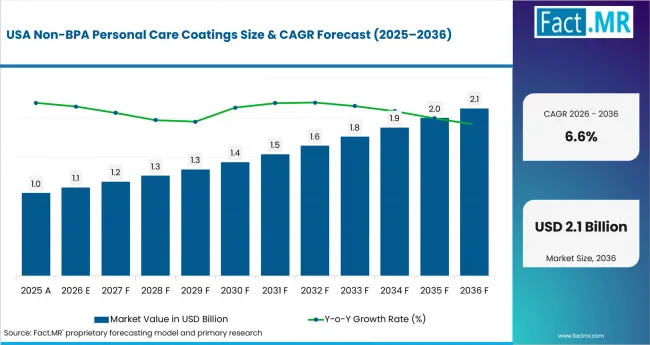
Non Bpa Personal Care Coatings Country Value Analysis | Source: Fact.MR
U.S. demand comes from deodorants, hair care, shaving, and other personal care products that use metal aerosols and tubes. In August 2026, the U.S. Bureau of Labor Statistics reported that prices for cosmetics, perfume, bath and nail products were 3.0% higher than a year earlier [6]. The data also covers bath and nail products. Sales across these products support testing of inner coatings that protect the metal from the product inside.
How does France perform?
6.6% CAGR, supported by a large perfume and cosmetics export base.
France has a strong premium beauty industry that uses aerosol and tube packaging for exports. In October 2025, the Directorate General of the Treasury reported that French exports of perfumes and toiletries to the United States reached EUR 1.5 billion in the first seven months of 2025 [7]. Export brands need coatings that keep packaging quality consistent across different markets.
What supports Germany adoption?
6.4% CAGR, led by personal care retail activity and metal-packaging capability.
Germany has an established retail and manufacturing base for personal care products that supports steady package conversion work. In January 2026, Destatis reported that real retail sales of pharmacies and cosmetic, pharmaceutical and medical products increased by 3.4% from January to November 2025 compared with the same period of 2024 [8]. The measure also covers pharmaceutical and medical products.
Who leads the Non-BPA Personal Care Coatings Market?
PPG, AkzoNobel, Sherwin-Williams, and ACTEGA offer coatings for personal care aerosol cans and tubes.
PPG offers HOBA® non-BPA coatings, while AkzoNobel offers BPA-NI coatings for aerosols and cosmetic tubes. Sherwin-Williams offers valPure® non-BPA epoxy, polyester, and acrylic coatings. ACTEGA offers coatings for metal cans and tubes.
In April 2025, Sherwin-Williams highlighted its valPure® V70 non-BPA epoxy coating. It is used for beverage cans, cosmetics, and personal care packaging. Buyers can compare coating quality, safety, ease of use, and technical support.
Which companies are the key providers?
Key companies include PPG Industries; AkzoNobel; Sherwin-Williams (including Valspar); and ACTEGA.
- PPG Industries
- AkzoNobel
- Sherwin-Williams (including Valspar)
- ACTEGA
Bibliography
- [1] European Commission. (2025, March 7). EU prohibition on the use and trade of Bisphenol A from 20 January 2025. Access2Markets.
- [2] ACTEGA. (2026, April 2). ACTEGA to Showcase Next-Generation Metal Packaging Solutions at METPACK 2026.
- [3] AkzoNobel Packaging Coatings. (2025, November 4). AkzoNobel introduces next-generation BPAni coatings to Brazilian beverage market at Abralatas 2025.
- [4] National Bureau of Statistics of China. (2026, January 20). Total Retail Sales of Consumer Goods in December 2025.
- [5] Ministry of Health, Labour and Welfare, Japan. (2025, March 10). [Notice on special display of specific ingredients in cosmetics].
- [6] U.S. Bureau of Labor Statistics. (2026, August 12). Consumer Price Index – July 2026.
- [7] Nkoa Zoa, M. (2025, October 17). Flash conjoncture France – Les exportations cosmétiques françaises face aux droits de douanes américains. Direction générale du Trésor.
- [8] Statistisches Bundesamt (Destatis). (2026, January 7). Einzelhandelsumsatz im Jahr 2025 real voraussichtlich um 2,4 % höher als im Vorjahr.
- [9] PPG. (2025, February 3). PPG launches non-BPA PPG HOBA coatings for aluminum bottles at Paris Packaging Week.
- [10] Sherwin-Williams. (2025, April 16). Discovering a New Epoxy Coating – How valPure® V70 Changed the Game [Video].
- [11] U.S. Food and Drug Administration. (2026, September 9). FDA Clarifies It Does Not Provide Certificates or Other Documents to Verify Compliance for Cosmetic Product Facility Registration
This Report Addresses
- The report explains Coating Chemistry and Package Type, with added analysis by Coating Position and Performance. Related packaging coating analysis place adjacent coating chemistry in a wider packaging context.
- Segment analysis identifies Polyester at 34.0% and Internal lining at 36.0% for 2026. The non-BPA internal can coatings page provides a close comparison for internal metal-package liners.
- Country analysis compares China, Japan, USA, France and Germany through CAGR differences and country evidence. The aerosol cans page gives adjacent demand context for personal care aerosol formats.
- Competitive analysis reviews PPG Industries, AkzoNobel, Sherwin-Williams, and ACTEGA across relevant coating portfolios. The metal packaging coatings page provides a broader view of suppliers serving coated metal packaging.
- Technology assessment covers polyester, acrylic, polyolefin dispersion, epoxy-alternative hybrid and organosol or specialty non-BPA coatings. The metal coatings page provides adjacent chemistry context across protective metal surfaces.
- Package analysis covers beverage cans, food cans, monobloc aerosols, aluminum tubes and pharmaceutical or personal care tubes. The tube packaging page adds context for aluminum and other tube formats used in personal care.
- Performance analysis compares corrosion resistance, product compatibility, retort resistance, flexibility or forming, and migration compliance. The metal cans page adds context for coated rigid metal containers.
- Official statistics, company portfolio checks and first-party developments support the forecast logic. The aerosol caps page provides adjacent closure-system context for aerosol packages.
What does the Non-BPA Personal Care Coatings Market cover?
Polyester, acrylic, polyolefin dispersion, epoxy-alternative hybrid and specialty non-BPA coatings used on personal care metal packages.
The market covers protective non-BPA coatings for personal care metal packaging, especially internal aerosol and tube surfaces. It includes chemistries designed to preserve adhesion, corrosion resistance and compatibility with the filled formulation. Related plastic aerosol packaging research covers adjacent plastic aerosol formats used in personal care.
The boundary is narrower than the full packaging-coatings sector. Decorative-only finishes and unrelated flexible-packaging barriers are treated separately unless they form part of the same specified metal-package coating system.
What is included in the scope?
Non-BPA coating systems used on aerosol cans, tubes, can bodies, ends and related personal care metal-package surfaces.
Coverage includes polyester, acrylic, polyolefin dispersion, epoxy-alternative hybrid and specialty non-BPA systems. It tracks internal lining, end coating, tube or shoulder lining and aerosol interiors. Package coverage includes cans, monobloc aerosols, aluminum tubes and pharmaceutical or personal care tubes. Performance analysis covers corrosion resistance, product compatibility, retort resistance, flexibility and migration compliance. Related bag-on-valve aerosol systems research provides context for aerosol formats that separate product and propellant.
What is excluded from the scope?
Decorative-only exterior finishes and non-metal flexible packaging coatings are tracked separately from the core scope.
The scope tracks decorative-only paints separately from the defined revenue scope, standalone printing inks, plastic bottles and unrelated flexible-film barriers. Sealants and surface treatments are discussed only when they affect aerosol-can production and are counted only when part of the defined coating system.
How Was the Analysis Built?
The analysis draws on 120+ sources, 35+ company portfolios, 25+ countries, and more than 20 industry interviews.
- Primary Research: Primary research includes discussions with manufacturers, service providers, technology developers, distributors, end users, and subject-matter experts. These conversations examine purchasing priorities, product adoption, operational challenges, approval requirements, competitive positioning, and the factors that influence wider market acceptance.
- Desk Research: Desk research covers government statistics, regulatory publications, company filings, trade data, technical studies, industry associations, standards, public policy, and other authoritative sources. Every source used in the analysis is documented in the bibliography.
- Market Sizing and Forecasting: Market estimates combine historical performance, demand indicators, pricing and volume trends, segment shares, company participation, country-level growth, adoption patterns, investment activity, and barriers to market expansion.
- Data Validation and Update Cycle: Findings are validated by comparing primary interviews with public data, company activity, regulatory changes, trade patterns, and industry developments. Regular updates review new product launches, capacity changes, partnerships, approvals, and shifts in commercial adoption.
Segmentation
What is the report’s scope and coverage?
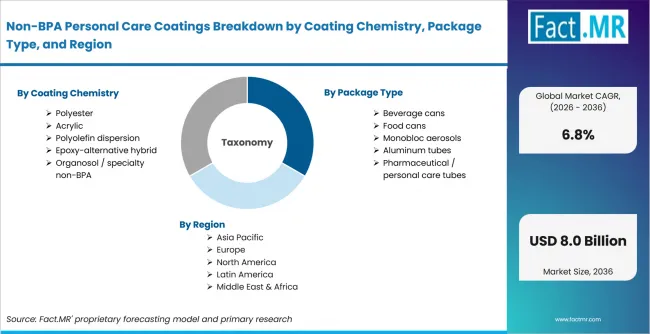
Non Bpa Personal Care Coatings Breakdown By Coating Chemistry, Package Type, And Region | Source: Fact.MR
| Attribute | Details |
|---|---|
| Quantitative Units | USD billion |
| Market Definition | Internal and protective coating systems for metal personal care packages that use non-BPA or BPA non-intent chemistry, including liners and related coating positions on aerosols, tubes and connected package components. |
| Coating Chemistry | Polyester; Acrylic; Polyolefin dispersion; Epoxy-alternative hybrid; Organosol / specialty non-BPA |
| Package Type | Beverage cans; Food cans; Monobloc aerosols; Aluminum tubes; Pharmaceutical / personal care tubes |
| Coating Position | Internal lining; Internal + end coating; Tube shoulder / body lining; Aerosol interior; Closure / end lining |
| Performance | Corrosion resistance; Product compatibility; Retort resistance; Flexibility / forming; Migration compliance |
| Regions Covered | North America; Latin America; Western Europe; Eastern Europe; East Asia; South Asia & Pacific; Middle East & Africa |
| Countries Covered | China; Japan; USA; France; Germany |
| Key Companies Profiled | PPG Industries; AkzoNobel; Sherwin-Williams (including Valspar); ACTEGA |
| Forecast Period | 2026 to 2036 |
| Approach | Hybrid top-down and bottom-up assessment using personal care package formats, coating chemistry mix, qualification requirements, country demand signals, and supplier portfolio review. |
Source: Fact.MR analysis. Updated Oct 7, 2026
How is the market segmented?
-
By Coating Chemistry:
- Polyester
- Acrylic
- Polyolefin dispersion
- Epoxy-alternative hybrid
- Organosol / specialty non-BPA
-
By Package Type:
- Beverage cans
- Food cans
- Monobloc aerosols
- Aluminum tubes
- Pharmaceutical / personal care tubes
-
By Coating Position:
- Internal lining
- Internal + end coating
- Tube shoulder / body lining
- Aerosol interior
- Closure / end lining
-
By Performance:
- Corrosion resistance
- Product compatibility
- Retort resistance
- Flexibility / forming
- Migration compliance
-
By Region:
- North America
- Latin America
- Western Europe
- Eastern Europe
- East Asia
- South Asia & Pacific
- Middle East & Africa
Frequently Asked Questions
How big is the Non-BPA Personal Care Coatings Market in 2026?
What is the CAGR of the Non-BPA Personal Care Coatings Market from 2026 to 2036?
Which coating chemistry leads the Non-BPA Personal Care Coatings Market?
Which coating position leads the Non-BPA Personal Care Coatings Market?
Who are the leading companies in the Non-BPA Personal Care Coatings Market?
Who worked on this report


Preview the report firsthand - request a free sample
Free SampleGet the brochure for pricing and purchase details
Download PDF