- Market Value (2025): USD 446.9 Bn
- Estimated Value (2026): USD 482.6 Bn
- Forecast Value (2036): USD 1041.9 Bn
- CAGR (2026-2036): 8.0%
What is the Non-Carbonated Soft Drinks Market forecast to be worth by 2036?
USD 482.6 billion in 2026 to USD 1,041.9 billion by 2036, at 8.0% CAGR.
- The non-carbonated soft drinks market reached USD 446.9 billion in 2025 as tea, hydration, and lower-sugar beverage portfolios widened across retail channels.
- Demand is projected to increase from USD 482.6 billion in 2026 to USD 1041.9 billion by 2036.
- The market is forecast to record an 8.0% CAGR from 2026 to 2036 as beverage companies align formulation, packaging, and distribution with changing refreshment preferences.
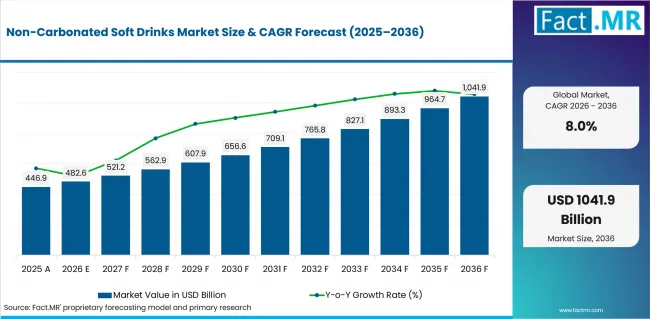
Non Carbonated Soft Drinks Market Value Analysis | Source: Fact.MR
What are the defining numbers behind Non-Carbonated Soft Drinks Market growth?
USD 595.0 billion absolute opportunity by 2036, led by Ready-to-drink Tea, Supermarkets & Hypermarkets; and PET Bottles.
- Demand Drivers in the Market
- Consumers need portable drinks that fit work, travel, meals; and daily hydration without the sensory profile of a carbonated beverage.
- Retailers are expanding lower- and no-sugar ranges as front-of-package labeling and levy exposure make formulation choices more visible.
- Functional hydration gives brands a route to separate electrolyte, energy, and wellness propositions from undifferentiated refreshment.
- High-volume channels reward pack formats that support shelf efficiency, direct-store delivery, vending; and repeated household purchase.
- Key Segments Analyzed
- By Product: Ready-to-drink Tea is projected to hold 29.0% share in 2026 as black, green, and herbal tea drinks combine familiar flavors with portable consumption.
- By Distribution Channel: Supermarkets & Hypermarkets are projected to account for 46.0% share in 2026 because broad assortments, promotions, and routine shopping trips support trial and repeat purchase.
- By Packaging: PET Bottles are projected to capture 58.0% share in 2026 due to their fit with single-serve, family-size, vending; and high-throughput retail formats. Packaging and shelf-life requirements also affect the ready to drink tea and coffee and ready to drink packaging markets.
- Analyst Opinion at Fact.MR
- Shambhu Nath Jha, Principal Consultant at Fact.MR, states: “Revenue will not come from adding a wellness label to a sweet beverage. Suppliers must define the drinking occasion; keep sugar and calorie architecture defensible; and select packaging that works in the target country. Functional claims need a formulation; label; and price point that survive retailer review. The strongest portfolios will connect product renovation with channel-specific execution.”
- Strategic Implications
- Ready-to-drink tea developers should balance tea character, sweetness, and shelf stability before expanding across large retail networks.
- Functional hydration brands should state a specific benefit and support it with compliant formulation and labeling rather than broad wellness language.
- PET users should address recycled content, collection compatibility, and returnability during pack design instead of treating them as later compliance tasks.
- Commercial teams should align pack size, price point, promotion; and replenishment with the economics of supermarkets; convenience stores; wholesale clubs; and vending channels.
How does the Non-Carbonated Soft Drinks Market break down by segment?
Ready-to-drink Tea leads Product at 29.0%, Supermarkets & Hypermarkets lead Distribution Channel at 46.0%, and PET Bottles lead Packaging at 58.0%.
Why does Ready-to-drink Tea lead Product?
Ready-to-drink Tea is projected to hold 29.0% share in 2026.
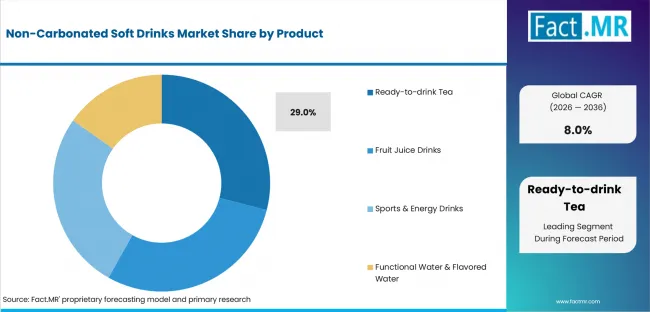
Non Carbonated Soft Drinks Market Analysis By Product | Source: Fact.MR
Ready-to-drink tea gives manufacturers several ways to serve the same broad refreshment need. Black tea drinks support familiar flavor profiles, green tea drinks fit lighter positioning, and herbal tea drinks widen caffeine and ingredient choices. The category works across single-serve and take-home formats without requiring preparation at the point of consumption. Its leadership therefore rests on flavor range; daypart flexibility; and established retail familiarity rather than one narrow functional claim.
Why do Supermarkets & Hypermarkets lead Distribution Channel?
Supermarkets & Hypermarkets are projected to account for 46.0% share in 2026.
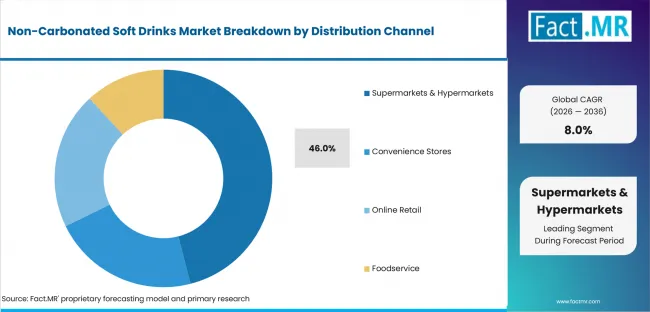
Non Carbonated Soft Drinks Market Analysis By Distribution Channel | Source: Fact.MR
Supermarkets and hypermarkets combine assortment, refrigeration, ambient shelf space; price comparison; promotion; and routine household traffic. They can place tea drinks; fruit-based beverages; enhanced water; and hydration products in adjacent sets while using multipacks and temporary price programs to drive trial. Wholesale clubs add volume for large packs; while convenience and vending channels remain important for immediate consumption. The leading channel benefits from controlling both discovery and repeat purchase within the same shopping trip.
Why do PET Bottles lead Packaging?
PET Bottles are projected to capture 58.0% share in 2026.
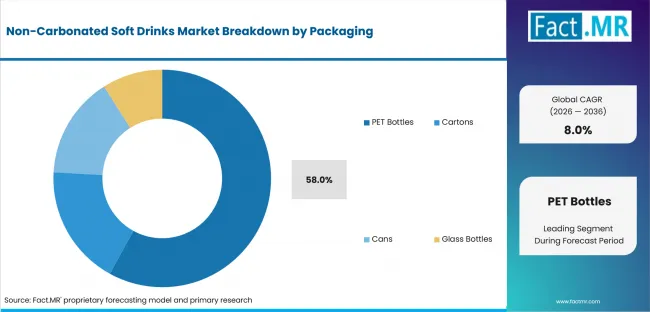
Non Carbonated Soft Drinks Market Analysis By Packaging | Source: Fact.MR
PET bottles fit the operating needs of high-volume non-carbonated beverages. Small bottles support single-serve and on-the-go occasions, family-size formats extend at-home use, and recycled PET variants help brands respond to material and collection requirements. The format also works across supermarket shelves; convenience coolers; wholesale packs; and vending machines. Its position is increasingly tied to collection compatibility and recycled-content strategy; not only to weight and handling efficiency.
How do Application and Consumer Group shape demand?
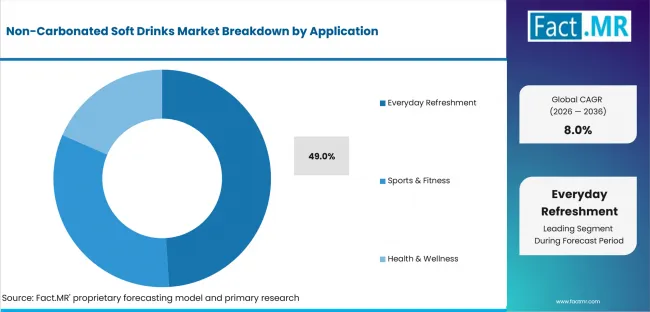
Non Carbonated Soft Drinks Market Analysis By Application | Source: Fact.MR
Application demand spans Everyday Refreshment, On-the-go Consumption, Meal Accompaniment; and Daily Hydration. Consumer coverage includes Adults; Working Professionals; Family Consumers; and Health-conscious Adults. These groups do not evaluate the category in the same way. A commuter may prioritize portability; a family may compare pack value; and a health-conscious buyer may examine sugar; ingredients; and function claims. Product design must therefore connect a clear occasion with an appropriate pack and channel.
What is accelerating Non-Carbonated Soft Drinks Market adoption, and what is holding it back?
Convenient hydration and lower-sugar refreshment support adoption, while labeling and packaging obligations raise execution costs. Functional beverages create the clearest premium opportunity. Channel economics connect this demand with the functional drinks and functional beverage markets.
Drivers Impact Analysis
| DRIVER | QUALITATIVE RELEVANCE | GEOGRAPHIC RELEVANCE | IMPACT TIMELINE |
|---|---|---|---|
| Convenient hydration across everyday occasions | High | Global, with North America and East Asia emphasis | Medium term (2-4 years) |
| Lower- and no-sugar portfolio reformulation | High | USA, Canada, and United Kingdom | Short term (<= 2 years) |
| Retail, convenience, and vending availability | Medium | USA and Japan | Medium term (2-4 years) |
Source: Fact.MR analysis. Updated Aug 4, 2026
- Everyday hydration: Non-carbonated drinks cover several recurring occasions without requiring a carbonated taste profile. Everyday Refreshment, On-the-go Consumption, Meal Accompaniment; and Daily Hydration give beverage portfolios more than one route to repeat use.
- Lower-sugar reformulation: Front-of-package nutrition systems and soft-drink levy exposure make sugar architecture commercially visible. Brands must reformulate without losing taste, price competitiveness, or shelf clarity.
- Channel availability: National retail systems, convenience stores, wholesale clubs; and vending networks turn product fit into volume. Suppliers need reliable replenishment and pack formats that match each channel rather than one universal package.
Opportunity Impact Analysis
| OPPORTUNITY | QUALITATIVE RELEVANCE | GEOGRAPHIC RELEVANCE | IMPACT TIMELINE |
|---|---|---|---|
| Differentiated functional beverages | High | USA, Canada, and Japan | Short term (<= 2 years) |
| Electrolyte hydration for family and everyday use | High | USA and United Kingdom | Medium term (2-4 years) |
| Recycled and returnable PET programs | Medium | Germany and wider Europe | Medium term (2-4 years) |
Source: Fact.MR analysis. Updated Aug 4, 2026
- Functional hydration: Recent launches show companies extending established beverage brands into electrolyte water and family hydration. The commercial opening is strongest when the benefit is specific, the taste is repeatable, and the price remains credible for frequent use.
- Packaging renewal: Recycled PET and returnable or collection-compatible formats give suppliers a way to address regulation and buyer expectations while protecting the convenience of bottles. Progress depends on supply availability and market-specific collection systems. Ingredient and processing decisions remain relevant to the energy drinks and sports drinks markets.
Restraints Impact Analysis
| RESTRAINT | QUALITATIVE RELEVANCE | GEOGRAPHIC RELEVANCE | IMPACT TIMELINE |
|---|---|---|---|
| Front-of-package labeling and function-claim compliance | High | USA, Canada, and Japan | Short term (<= 2 years) |
| Sugar levy exposure and low-sugar price architecture | High | United Kingdom | Short term (<= 2 years) |
| Packaging collection and returnability obligations | High | Germany and wider Europe | Medium term (2-4 years) |
Source: Fact.MR analysis. Updated Aug 4, 2026
- Labeling and claims: A beverage can satisfy consumer interest but still lose momentum if nutrition symbols, ingredient disclosure, or function claims complicate the pack. Regulatory review is therefore part of product development; not a final artwork check.
- Packaging obligations: Germany illustrates how returnability and collection compatibility affect purchasing decisions. Packaging changes can require new material sourcing, line trials, labeling; and channel coordination before a product reaches scale.
Which countries are scaling Non-Carbonated Soft Drinks Market fastest?
France 9.2%, United Kingdom 8.6%, USA 8.3%; Canada 8.0%; Germany 7.7%; and Japan 7.4% through 2036.
Regional analysis covers North America, Latin America, Western Europe; Eastern Europe; East Asia; South Asia and Pacific; and the Middle East and Africa.
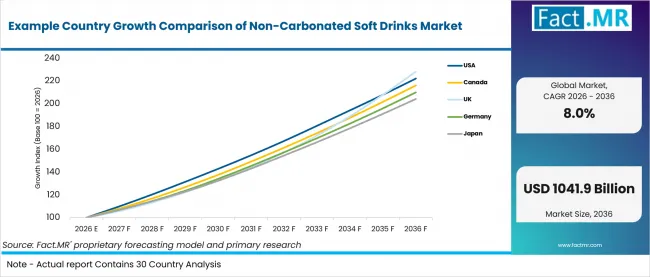
Example Country Growth Comparison Of Non Carbonated Soft Drinks Market | Source: Fact.MR
| COUNTRY | CAGR, 2026 to 2036 |
|---|---|
| France | 9.2% |
| United Kingdom | 8.6% |
| USA | 8.3% |
| Canada | 8.0% |
| Germany | 7.7% |
| Japan | 7.4% |
Source: Fact.MR analysis. Updated Aug 4, 2026
What is shaping France's outlook through 2036?
9.2% CAGR through 2036, the highest listed country growth rate.
France is forecast to record the strongest growth among the listed markets. Suppliers will need to convert lower-sugar refreshment and functional beverage propositions into ranges that fit local retail price points and packaging expectations. The opportunity is not limited to one product type because tea, hydration, and flavored or functional water can address different occasions. Repeat purchase will still depend on taste; a clear pack message; and disciplined channel execution.
What is shaping the United Kingdom's outlook through 2036?
8.6% CAGR through 2036, supported by low- and no-sugar range development.
United Kingdom grocery and convenience buyers use levy exposure, price points, and low- or no-sugar credentials as practical screening tools. Demand is forecast to expand at 8.6% CAGR through 2036 as suppliers redesign formulas and pack architecture around changing levy conditions. Commercial progress will favor brands that protect taste while controlling the cost of sweeteners; ingredients; and packaging. Retailer acceptance remains tied to margin; promotion; and repeat rate rather than reformulation alone.
What is shaping USA's outlook through 2036?
8.3% CAGR through 2036, driven by rapid innovation and large retail systems.
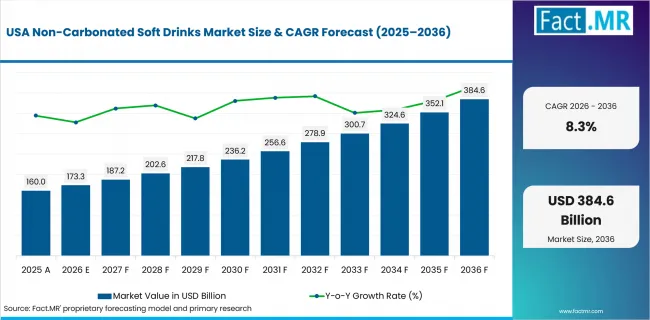
Non Carbonated Soft Drinks Market Country Value Analysis | Source: Fact.MR
U.S. retailers and convenience operators buy through national and regional systems that reward rapid innovation, promotional support, and dependable direct-store delivery. Demand is forecast to rise at 8.3% CAGR through 2036. The market offers room for tea; enhanced water; and electrolyte hydration; but a launch must move quickly from novelty to repeat use. Suppliers need sufficient production; distribution coverage; and a pack proposition that works across supermarket shelves and immediate-consumption channels. Buyer occasions also influence the herbal tea and beverage vending machine markets.
What is shaping Canada's outlook through 2036?
8.0% CAGR through 2036, shaped by bilingual presentation and visible nutrition labeling.
Canadian retailers favor national execution, but products must accommodate bilingual presentation, regional logistics; and a front-of-package nutrition regime that is becoming more visible at shelf. Sales are forecast to expand at 8.0% CAGR through 2036. Suppliers need packaging and artwork processes that handle compliance without delaying renovation. Functional drinks can gain attention; although the value proposition must remain clear across large urban markets and more dispersed distribution routes.
What is shaping Germany's outlook through 2036?
7.7% CAGR through 2036, influenced by returnability and collection economics.
German beverage purchasing places unusual weight on package returnability, collection compatibility, and the economics of reusable versus single-use formats. Demand is forecast to rise at 7.7% CAGR through 2036. PET remains commercially important; but suppliers must treat packaging as part of market access rather than a neutral container choice. Product renovation therefore combines formulation work with pack sourcing; line capability; deposit-system fit; and retailer requirements.
What is shaping Japan's outlook through 2036?
7.4% CAGR through 2036, supported by convenience, vending; and seasonal product rotation.
Japanese consumers buy heavily through convenience stores, supermarkets, and vending channels; with close attention to taste; package size; seasonality; and credible functional claims. Sales are forecast to expand at 7.4% CAGR through 2036. Suppliers need precise single-serve formats and a product story that can be understood quickly at the point of purchase. Functional positioning can support differentiation; but notification requirements and claim discipline shape how benefits are communicated.
Who leads the Non-Carbonated Soft Drinks Market?
Large beverage portfolios shape competition, while functional hydration launches are widening the category boundary.
Competition is organized around portfolio reach, bottling and distribution capability, and the ability to renovate products without losing repeat purchase. PepsiCo moved Gatorade into unflavored electrolyte water in 2024. Keurig Dr Pepper added Electrolit to its U.S. sales and distribution system. The Kraft Heinz Company extended Capri Sun into children-focused electrolyte hydration in 2026. These moves show that suppliers are competing for specific hydration occasions rather than treating non-carbonated beverages as one undifferentiated category.
The provider set also includes The Coca-Cola Company, Nestlé S.A., Danone S.A.; Suntory Holdings Limited; Unilever PLC; Arizona Beverages USA LLC; and Britvic PLC. Competitive credibility through 2036 will depend on clear product positioning; country-ready formulation and labeling; packaging execution; and reliable access to high-frequency retail channels. Retail execution creates a related demand signal in the non alcoholic beverage packaging and plant based beverage markets.
In February 2024, PepsiCo, Inc. launched Gatorade Water nationwide in the USA as the brand’s first unflavored water. The electrolyte-infused alkaline water moved Gatorade into a broader hydration occasion and increased competition across sports drinks; enhanced water; and everyday refreshment.
In October 2023, Keurig Dr Pepper Inc. entered a long-term agreement with Grupo PiSA to sell, distribute; and merchandise Electrolit across the United States. The transition brought a premium hydration beverage into KDP’s retail system from early 2024.
In April 2026, The Kraft Heinz Company introduced Capri Sun Hydrate, an electrolyte drink designed for children and positioned with 50% less sugar than the leading sports drinks cited by the company. The launch connected family beverage equity with a functional hydration benefit.
Which companies are the key providers?
The Coca-Cola Company and PepsiCo, Inc. are leading companies in the market.
- The Coca-Cola Company
- PepsiCo, Inc.
- Nestlé S.A.
- Keurig Dr Pepper Inc.
- Danone S.A.
- Suntory Holdings Limited
- Unilever PLC
- The Kraft Heinz Company
- Arizona Beverages USA LLC
- Britvic PLC
Bibliography
- U.S. Food and Drug Administration (2025, January 14). FDA Proposes Requiring At-a-Glance Nutrition Information on the Front of Packaged Foods.
- Health Canada (2026, January 5). Nutrition Labelling: Front-of-Package Nutrition Symbol.
- HM Revenue & Customs (2026, July 13). Soft Drinks Industry Levy Changes.
- German Environment Agency (2025, February 5). Reusable Quota for Beverages Far from Legal Target.
- Consumer Affairs Agency, Government of Japan (2024, August 30). Manual for Notifications Related to Foods with Function Claims.
This Report Addresses
- What is the Non-Carbonated Soft Drinks Market worth in 2026, and what value is forecast for 2036?
- Which demand, purchasing, and operating pressures shape the market?
- Why do Ready-to-drink Tea, Supermarkets & Hypermarkets, and PET Bottles lead their segments?
- How do country growth rates differ across the profiled markets?
- Which companies are profiled, and what determines competitive credibility?
- What scope boundary, evidence base, and methodology support the market assessment?
What does the Non-Carbonated Soft Drinks Market cover?
Packaged ready-to-drink tea, fruit juice drinks, hydration beverages; and functional or flavored water sold within the defined channel; packaging; application; and consumer universe.
The market covers packaged non-carbonated soft drinks sold by brand owners and manufacturers. It includes products whose commercial value comes from a finished beverage proposition rather than an ingredient or package component. Coverage spans retail and immediate-consumption channels, several PET bottle formats, everyday and hydration applications; and the consumer groups defined in the segmentation framework.
What is included in the scope?
The scope includes Ready-to-drink Tea and its black, green, and herbal variants; Supermarkets & Hypermarkets and their listed channel formats; PET Bottles and the listed bottle formats; Everyday Refreshment; On-the-go Consumption; Meal Accompaniment; and Daily Hydration; Adults; Working Professionals; Family Consumers; and Health-conscious Adults; and all regions listed in the regional taxonomy. Product-positioning choices also matter in the beverage emulsions and better for you beverages markets.
What is excluded from the scope?
The scope excludes carbonated soft drinks, alcoholic beverages, plain commodity water outside the named functional or flavored water boundary; beverage ingredients and concentrates sold as inputs; packaging components; beverage equipment; and downstream retailer or foodservice service markups.
How was the analysis built?
- Primary Research
- Structured discussions with beverage manufacturers, bottlers, packaging and ingredient suppliers; distributors; retailers; foodservice buyers; and category specialists test the revenue boundary; purchase criteria; channel economics; formulation trends; packaging choices; and country-specific frictions.
- Desk Research
- Company filings, official company announcements, government nutrition and labeling rules; deposit and packaging guidance; trade and retail evidence; and relevant standards are reviewed.
- Market-Sizing and Forecasting
- The model reconciles the established 2025 and 2026 values with product, channel, packaging; application; consumer; country; price; and volume assumptions through 2036.
- Data Validation and Update Cycle
- Top-down category checks are compared with bottom-up company, channel, and country evidence; followed by scope and numerical consistency review.
Segmentation
What is the report’s scope and coverage?
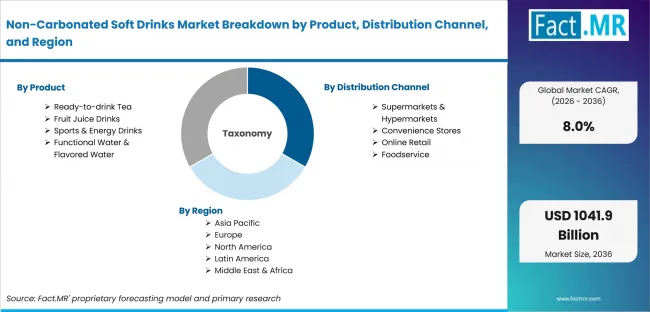
Non Carbonated Soft Drinks Market Breakdown By Product, Distribution Channel, And Region | Source: Fact.MR
| Attribute | Details |
|---|---|
| Quantitative Units | USD 446.9 Billion in 2025; USD 482.6 Billion in 2026; USD 1,041.9 Billion by 2036; 8.0% CAGR |
| Market Definition | Revenue from packaged non-carbonated soft drinks sold by brand owners and manufacturers within the defined tea, fruit juice drink, hydration; functional or flavored water; channel; package; application; and consumer universe. |
| Product | Ready-to-drink Tea; Black Tea Drinks; Green Tea Drinks; Herbal Tea Drinks |
| Distribution Channel | Supermarkets & Hypermarkets; Hypermarkets; Supermarkets; Wholesale Clubs |
| Packaging | PET Bottles; Small PET Bottles; Family-size PET Bottles; Recycled PET Bottles |
| Application | Everyday Refreshment; On-the-go Consumption; Meal Accompaniment; Daily Hydration |
| Consumer Group | Adults; Working Professionals; Family Consumers; Health-conscious Adults |
| Regions Covered | North America; Latin America; Western Europe; Eastern Europe; East Asia; South Asia and Pacific; Middle East and Africa |
| Countries Covered | USA; Canada; United Kingdom; Germany; Japan; France |
| Key Companies Profiled | The Coca-Cola Company; PepsiCo, Inc.; Nestlé S.A.; Keurig Dr Pepper Inc.; Danone S.A.; Suntory Holdings Limited; Unilever PLC; The Kraft Heinz Company; Arizona Beverages USA LLC; Britvic PLC |
| Forecast Period | 2026 to 2036 |
| Approach | Hybrid bottom-up and top-down sizing that reconciles company, channel, product; packaging; country; and macroeconomic evidence within the defined revenue boundary. |
Source: Fact.MR analysis. Updated Aug 4, 2026
How is the market segmented?
-
By Product
- Ready-to-drink Tea
- Black Tea Drinks
- Green Tea Drinks
- Herbal Tea Drinks
- Fruit Juice Drinks
- 100% Fruit Juice
- Juice Drinks
- Nectar Drinks
- Sports & Energy Drinks
- Isotonic Drinks
- Electrolyte Drinks
- Hydration Drinks
- Functional Water & Flavored Water
- Flavored Water
- Vitamin Water
- Enhanced Water
- Ready-to-drink Tea
-
By Distribution Channel
- Supermarkets & Hypermarkets
- Hypermarkets
- Supermarkets
- Wholesale Clubs
- Convenience Stores
- Neighborhood Stores
- Fuel Station Stores
- Independent Retailers
- Online Retail
- E-commerce Platforms
- Quick Commerce
- Brand Websites
- Foodservice
- Restaurants
- Cafés
- Vending Machines
- Supermarkets & Hypermarkets
-
By Packaging
- PET Bottles
- Small PET Bottles
- Family-size PET Bottles
- Recycled PET Bottles
- Cartons
- Aseptic Cartons
- Multi-layer Cartons
- Single-serve Cartons
- Cans
- Aluminum Cans
- Slim Cans
- Multipack Cans
- Glass Bottles
- Returnable Bottles
- Premium Glass Bottles
- Single-serve Glass
- PET Bottles
-
By Application
- Everyday Refreshment
- On-the-go Consumption
- Meal Accompaniment
- Daily Hydration
- Sports & Fitness
- Pre-workout Hydration
- Post-workout Recovery
- Endurance Sports
- Health & Wellness
- Functional Nutrition
- Immune Support
- Low-calorie Consumption
- Everyday Refreshment
-
By Consumer Group
- Adults
- Working Professionals
- Family Consumers
- Health-conscious Adults
- Children & Teenagers
- School-age Children
- Teen Consumers
- Young Adults
- Senior Consumers
- Healthy Aging Consumers
- Diet-specific Consumers
- Functional Beverage Users
- Adults
-
By Region
- North America
- Latin America
- Western Europe
- Eastern Europe
- East Asia
- South Asia and Pacific
- Middle East & Africa
Frequently Asked Questions
Which Product leads the Non-Carbonated Soft Drinks Market?
Which Distribution Channel leads the market?
Which Packaging format leads the market?
Which country records the highest listed CAGR?
How does the United Kingdom perform in the market?
How does the USA perform in the market?
How does Canada perform in the market?
How does Germany perform in the market?
How does Japan perform in the market?
What is the primary driver in the market?
What is the main opportunity in the market?
What is the main restraint in the market?
Why is Ready-to-drink Tea important?
Why are PET Bottles important?
Who worked on this report


Preview the report firsthand - request a free sample
Free SampleGet the brochure for pricing and purchase details
Download PDF