- Market Value (2025): USD 8.3 Bn
- Estimated Value (2026): USD 8.7 Bn
- Forecast Value (2036): USD 13.9 Bn
- CAGR (2026-2036): 4.8%
What is the Non-Fluoropolymer Elastomers Market forecast to be worth by 2036?
USD 8.7 billion in 2026 to USD 13.9 billion by 2036 at a 4.8% CAGR.
- The Non-Fluoropolymer Elastomers Market crossed a valuation of USD 8.3 billion in 2025.
- Demand is projected to increase from USD 8.7 billion in 2026 to USD 13.9 billion by 2036.
- The market is forecast to record a 4.8% CAGR from 2026 to 2036 as automotive manufacturers, industrial users and construction product producers keep qualifying durable rubber compounds.
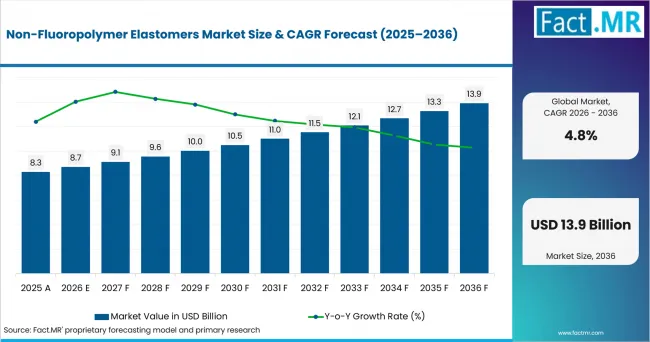
Non Fluoropolymer Elastomers Market Value Analysis | Source: Fact.MR
What are the defining numbers behind Non-Fluoropolymer Elastomers Market growth?
USD 5.2 billion absolute opportunity is expected between 2026 and 2036.
- Demand Drivers in the Market
- Automotive manufacturers need weatherseals and hoses that combine heat resistance with aging stability across long model cycles.
- The Federal Reserve Board reported in August 2026 that U.S. plastics and rubber products output was 2.2% higher in July 2026 than a year earlier, indicating year-over-year expansion in downstream plastics and rubber manufacturing activity.
- Construction product producers continue to specify EPDM profiles and roofing accessories where weather resistance supports service life.
- Industrial equipment producers use NBR and HNBR where oil resistance and sealing reliability influence machine uptime.
- Key Segments Analyzed
- By Product: Ethylene Propylene Diene Monomer (EPDM) Elastomers are projected to hold 44.80% share in 2026 due to wide use in weatherseals, hoses and building profiles.
- By Application: Automotive Applications are estimated to account for 76.20% share in 2026, supported by sealing systems and under-hood rubber parts used across vehicle platforms.
- By End Use: Automotive Manufacturers are anticipated to represent 58.70% share in 2026 as OEM qualification cycles keep direct influence over compound selection.
- By Technology: Compounding Technology is forecast to capture 33.60% share in 2026 because filler integration and additive dispersion determine heat aging and tensile performance.
- By Formulation: High Performance Elastomer Formulations are expected to hold 69.40% share in 2026, shaped by heat and chemical resistance requirements in automotive parts.
- By Distribution Channel: Direct Industrial Sales are projected to account for 52.80% share in 2026 owing to qualification records, technical service and repeat OEM supply programs.
- Analyst Opinion at Fact.MR
- Shambhu Nath Jha, Principal Consultant at Fact.MR, states, "Non-fluoropolymer elastomer demand is becoming less about generic rubber volume and more about compound approval discipline. Automotive and industrial users are expected to favor materials that pass heat aging, oil resistance and compression-set tests over full product life. Suppliers that connect polymer consistency, compound design and application support are better placed to retain qualified business."
- Strategic Implications
- Polymer producers should document EPDM, NBR, silicone and SBR performance so engineers compare grades without restarting full qualification work.
- Compounders should improve filler dispersion control because processing stability affects extrusion quality, molding consistency and customer rejection risk.
- The Office for National Statistics reported in August 2026 that Great Britain construction output grew 0.3% in Quarter 2 2026 from the previous quarter, with new work increasing 0.4% and repair and maintenance rising 0.2%, indicating continued activity across applications relevant to building profiles and seals.
- Distributors should focus on technical stock positions for qualified grades instead of broad catalog depth that lacks application support.
The USA is projected to record 4.5% CAGR through 2036 due to automotive sealing and construction demand. The UK is forecast to advance at 4.2% as vehicle electrification supports compound review. Germany is estimated to post 3.7%, shaped by vehicle exports and manufacturing order flow. France is anticipated to register 3.2% as transport equipment output supports demand. Japan is projected to reach 3.1% as vehicle supply chains sustain measured adoption.
How does the Non-Fluoropolymer Elastomers Market break down by segment?
EPDM Elastomers lead Product at 44.80%; Automotive Applications lead Application at 76.20%.
Which Product leads?
Ethylene Propylene Diene Monomer (EPDM) Elastomers hold 44.80% share in 2026.
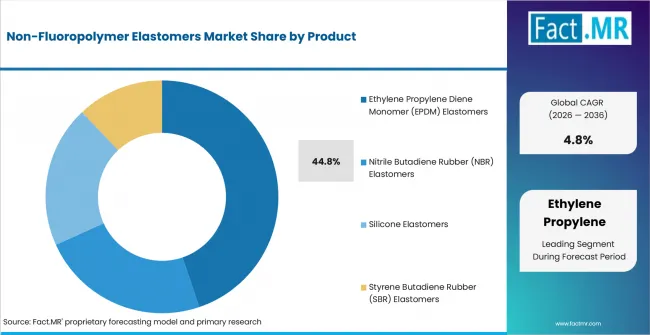
Non Fluoropolymer Elastomers Market Analysis By Product | Source: Fact.MR
EPDM leads where outdoor durability, sealing performance and processing flexibility must work together. Its resistance profile supports demanding automotive, wire and cable, construction and powertrain applications. Dow Inc. positions NORDEL EPDM across weatherseals, sealing systems and cable uses, reinforcing its role in applications requiring dependable long-term elastomer performance.
What leads the Application segment?
Automotive Applications account for 76.20% share in 2026.
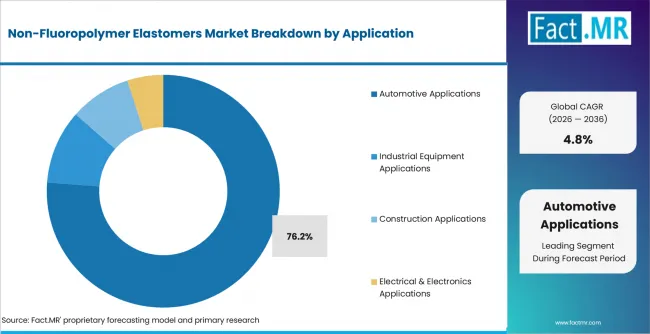
Non Fluoropolymer Elastomers Market Analysis By Application | Source: Fact.MR
Automotive applications lead because weatherseals, hoses and fluid-handling components require materials that maintain sealing performance under heat, vibration and environmental exposure. Approval testing before serial production also favors established elastomer systems, giving automotive programs a strong role in shaping compound selection, qualification cycles and recurring material demand.
How does End Use shape demand?
Automotive Manufacturers represent 58.70% share in 2026.
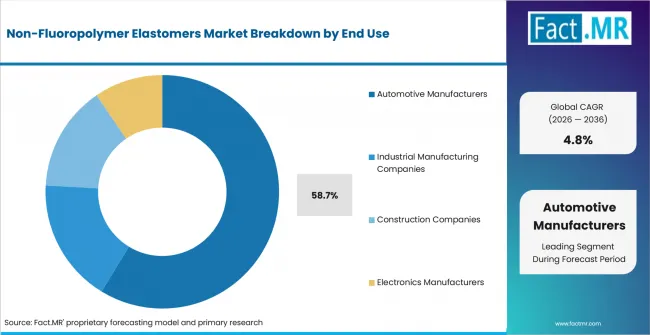
Non Fluoropolymer Elastomers Market Analysis By End Use | Source: Fact.MR
Automotive manufacturers shape demand because engineering drawings, validation protocols and material specifications determine which elastomer compounds enter production. Once a grade is approved, Tier suppliers source qualified materials for weatherseals, hoses and under-hood components, making OEM requirements central to formulation choice, supplier qualification and long-term purchasing decisions.
What supports Technology selection?
Compounding Technology captures 33.60% share in 2026.
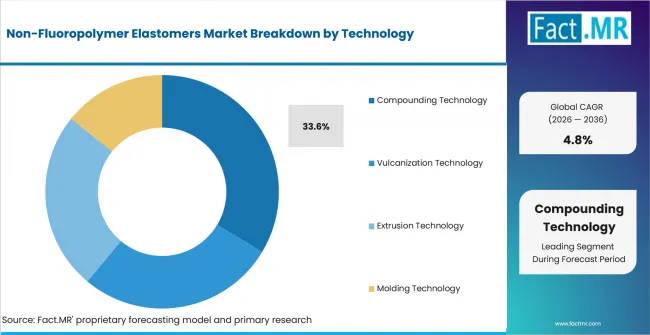
Non Fluoropolymer Elastomers Market Analysis By Technology | Source: Fact.MR
Compounding technology leads because elastomer performance depends on how fillers, additives and curing systems are integrated into the polymer matrix. Effective dispersion and formulation balance help compounds meet required mechanical, thermal and processing windows, making compounding expertise central before a polymer grade can secure approval for demanding applications.
Which Formulation leads?
High Performance Elastomer Formulations hold 69.40% share in 2026.
High-performance elastomer formulations lead where components face prolonged exposure to heat, oils, ozone and demanding warranty conditions. These formulations support applications requiring durable sealing and mechanical stability. Zeon’s HNBR capacity expansion also reflects continued supplier focus on advanced elastomers designed for high-stress automotive and industrial operating environments.
What leads Distribution Channel?
Direct Industrial Sales account for 52.80% share in 2026.
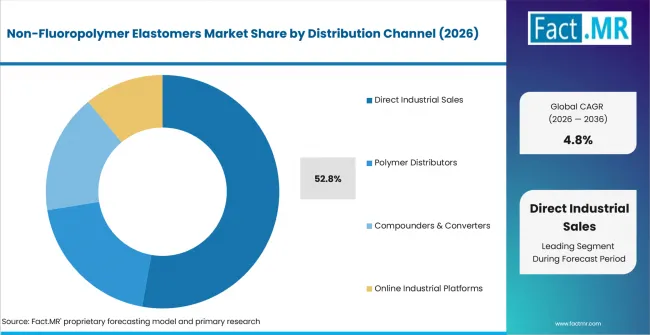
Non Fluoropolymer Elastomers Market Analysis By Distribution Channel | Source: Fact.MR
Direct industrial sales lead because qualified elastomer grades require close technical coordination, detailed performance records and controlled communication when specifications change. OEM and Tier supplier agreements support continuity for safety-related sealing, hose and under-hood applications, while direct supplier relationships help manage qualification requirements and reduce substitution risk.
What is accelerating Non-Fluoropolymer Elastomers Market adoption, and what is holding it back?
Demand is supported by automotive sealing, industrial fluid handling and construction profiles; constraints center on feedstock pricing, qualification time and material substitution.
Drivers Impact Analysis
| Driver | (~) % IMPACT ON CAGR | Geographic Relevance | Impact Timeline |
|---|---|---|---|
| Automotive sealing and hose qualification | +1.1% | North America, Europe, Japan | Short term (<= 2 years) |
| Construction profiles and building envelope parts | +0.7% | USA, UK, France | Medium term (2-4 years) |
| Industrial fluid handling and machinery maintenance | +0.6% | Germany, USA, Japan | Medium term (2-4 years) |
| High-performance compound upgrades | +0.5% | Global | Long term (>= 4 years) |
- Automotive sealing and hose qualification: EPDM and NBR remain tied to applications where approved materials are difficult to replace after production starts.
- Construction profiles and building envelope parts: EPDM and silicone products support weather-resistant profiles, seals and roofing accessories.
- Industrial fluid handling and machinery maintenance: NBR and HNBR compounds support equipment where oil resistance affects downtime.
Opportunity Impact Analysis
| Opportunity | (~) % IMPACT ON CAGR | Geographic Relevance | Impact Timeline |
|---|---|---|---|
| Bio-circular and lower-carbon EPDM grades | +0.5% | Europe, North America | Medium term (2-4 years) |
| EV thermal-management sealing packages | +0.4% | USA, UK, Japan | Long term (>= 4 years) |
| Specialty HNBR and heat-resistant compounds | +0.3% | Japan, Germany, USA | Short term (<= 2 years) |
- Bio-circular and lower-carbon EPDM grades: Buyers are expected to review traceable options where performance remains comparable.
- EV thermal-management sealing packages: Battery cooling loops increase the value of elastomers that hold sealing performance.
- Specialty HNBR and heat-resistant compounds: Higher resistance supports harder industrial and under-hood applications.
Restraints Impact Analysis
| Restraint | (~) % IMPACT ON CAGR | Geographic Relevance | Impact Timeline |
|---|---|---|---|
| Synthetic rubber and energy price movement | -0.4% | Global | Short term (<= 2 years) |
| Long OEM qualification cycles | -0.3% | Automotive regions | Medium term (2-4 years) |
| Substitution by thermoplastic systems | -0.2% | Europe, East Asia | Long term (>= 4 years) |
- Synthetic rubber and energy price movement: Synthetic rubber and energy-cost changes can increase margin pressure for compounders, strengthening the need for cost control, formulation flexibility and efficient material use.
- Long OEM qualification cycles: Material changes require validation and production approval before a new elastomer grade enters safety-related part programs, extending adoption timelines.
- Substitution by thermoplastic systems: Some applications shift toward thermoplastic systems where faster molding, easier processing and shorter production cycles outweigh the performance benefits of cured rubber.
Which countries are scaling the Non-Fluoropolymer Elastomers Market through 2036?
- The country comparison spans 1.4 percentage points and forms two practical growth bands across the forecast period.
- The USA remains ahead of the listed group through automotive scale and construction demand for EPDM building profiles.
- The UK follows as vehicle electrification keeps rubber sealing demand visible.
- Germany remains supported by export-oriented automotive production, while France and Japan post measured expansion.
Comparable CAGRs can create different entry conditions due to automotive output, construction demand, industrial production and qualification cycles. Full report coverage includes North America, Latin America, Western Europe, Eastern Europe, East Asia, South Asia & Pacific, and Middle East & Africa.
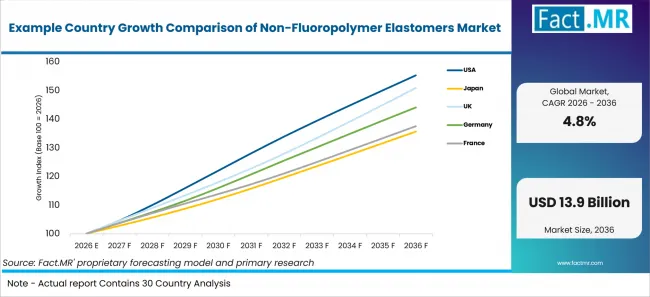
Example Country Growth Comparison Of Non Fluoropolymer Elastomers Market | Source: Fact.MR
| Country | CAGR |
|---|---|
| United States | 4.5% |
| United Kingdom | 4.2% |
| Germany | 3.7% |
| France | 3.2% |
| Japan | 3.1% |
What supports USA adoption?
4.5% CAGR, supported by automotive, construction and industrial sealing demand.
U.S. elastomer demand is tied to construction products and factory output where EPDM and NBR parts move through approved material lists. The U.S. Census Bureau reported in August 2026 that privately owned housing units authorized by building permits were at a seasonally adjusted annual rate of 1.443 million in July 2026.
What supports United Kingdom adoption?
4.2% CAGR, backed by vehicle electrification and repair-oriented construction activity.
UK demand is shaped by vehicle electrification and repair-led building activity, supporting elastomer use across sealing, insulation and related mobility applications. The Department for Transport reported in April 2026 that 528,000 zero-emission vehicles were registered for the first time in 2025, reinforcing vehicle-related material demand.
What supports Germany adoption?
3.7% CAGR, shaped by automotive exports and manufacturing order recovery.
Germany remains an approval-driven elastomer market where automotive drawings and machinery requirements decide compound selection across production programs. Destatis reported in August 2026 that real manufacturing orders increased 3.1% month on month in June, supporting a stronger industrial backdrop for elastomer qualification and manufacturing demand.
What supports France adoption?
3.2% CAGR, supported by transport equipment and construction-related rubber demand.
France is linked to mobility production and construction components that use EPDM, NBR and silicone formulations across sealing and performance applications. INSEE reported in June 2026 that transport equipment output rose 3.3% in April, providing a supportive manufacturing backdrop for elastomer demand across transport-related production programs.
How does Japan perform?
3.1% CAGR, led by vehicle supply chains and measured construction demand.
Japan’s profile reflects mature vehicle supply chains and high qualification discipline in sealing parts, where consistent performance and approved specifications guide material selection. Japan’s Statistics Dashboard showed 417,153 new vehicle sales in July 2026, supporting continued elastomer requirements across automotive sealing, hose and component applications.
Who leads the Non-Fluoropolymer Elastomers Market?
Dow Inc. is active through its NORDEL™ EPDM portfolio for automotive weather seals, powertrain sealing and gasketing, wire and cable, and building and construction applications. Dow Inc. positions NORDEL™ EPDM around durability, sealing performance, flexibility and resistance to demanding operating conditions.
Kraton Corporation supplies styrenic block copolymers, including SBS, SIS, SEBS and SEPS. These materials belong to the thermoplastic elastomer category and therefore represent an adjacent material platform rather than the core EPDM, NBR/HNBR, silicone and SBR product groups considered here.
ENEOS Materials carries the former JSR elastomer business and currently supplies synthetic rubbers, special synthetic rubbers and thermoplastic elastomers, including SBR, NBR and EPDM. In February 2026, JSR stated that, following the 2022 elastomers transfer, it had continued marketing and sales activities for a rubber business serving the electronics industry while receiving product supply from ENEOS Materials; that sales business was subsequently transferred to ENEOS Materials. Zeon Corporation serves higher-performance rubber applications through its Zetpol® HNBR portfolio, including materials used in automotive belts and seals.
Covestro represents an adjacent elastomer supplier through its thermoplastic polyurethane platforms. The company commenced production at the first phase of its new Zhuhai TPU facility in January 2026, with approximately 30,000 tonnes of annual capacity, placing this investment outside the report's core EPDM, NBR/HNBR, silicone and SBR product groups.
Lion Elastomers has direct relevance through its U.S. synthetic rubber portfolio, which includes EPDM, specialty EPDM, SBR and specialty SBR. Goodyear completed the divestiture of the majority of its Chemical business in October 2025, although it retained chemical facilities in Niagara Falls and Bayport and rights to products manufactured at those sites.
Which companies are the key providers?
Key companies include Dow Inc., Kraton Corporation, ENEOS Materials Corporation (reflecting JSR elastomer heritage), Covestro AG, Zeon Corporation, and Lion Elastomers.
- Dow Inc.
- Kraton Corporation
- ENEOS Materials Corporation, reflecting JSR elastomer heritage
- Covestro AG
- Zeon Corporation
- Lion Elastomers
Bibliography
- U.S. Bureau of Labor Statistics. (2026, August 13). Producer price indexes—July 2026.
- Covestro AG. (2026, February 26). Production. Annual Report 2025.
- Department for Transport. (2026, April 29). Vehicle licensing statistics, United Kingdom: 2025.
- Office for National Statistics. (2026, August 13). Construction output in Great Britain: June 2026, new orders and Construction Output Price Indices, April to June 2026.
- Federal Statistical Office (Destatis). (2026, August 6). New orders in manufacturing in June 2026: +3.1% on the previous month.
- Board of Governors of the Federal Reserve System. (2026, August 18). Industrial production: Market and industry group summary [Table 1].
- The Goodyear Tire & Rubber Company. (2025, November 3). Goodyear completes divestiture of chemical business.
- Institut national de la statistique et des études économiques. (2026, June 5). In April 2026, manufacturing output increased by 0.4%.
- Statistics Bureau, Ministry of Internal Affairs and Communications. (2026, August 6). Sales of new vehicles (Non-mini vehicles, mini vehicles) [Statistics Dashboard].
- JSR Corporation. (2026, February 27). Notice regarding transfer of rubber sales business for electronics industry.
- U.S. Census Bureau. (2026, August 18). Monthly new residential construction, July 2026.
This Report Answers
- The report explains where non-fluoropolymer elastomers are used across product, application and end-use segments.
- Segment analysis identifies the leading subsegments and the buyer reasons behind the 2026 share positions.
- Country analysis examines the listed markets and the industrial, automotive and construction mechanisms supporting adoption.
- Competitive analysis reviews current providers across EPDM, NBR, HNBR, silicone, SBR and related elastomer platforms.
- Application analysis reviews sealing, hose, profile, fluid-handling and molded-part requirements that influence supplier selection.
What does the Non-Fluoropolymer Elastomers Market cover?
The Non-Fluoropolymer Elastomers Market covers rubber-like polymer materials outside fluoropolymer chemistry. The assessment includes EPDM elastomers, NBR elastomers, silicone elastomers and SBR elastomers used in sealing and molded-part applications.
Application coverage aligns with automotive hose systems and gaskets and seals where rubber chemistry determines heat resistance, fluid compatibility and compression performance.
What is included in the scope?
The scope includes commercially supplied elastomer polymers, compounds and formulations used in direct industrial sales, distributor channels and converter supply routes. It covers weatherstrip seal systems where EPDM is specified for vehicle and building exposure.
Material comparisons include hydrogenated nitrile rubber, performance silicones and elastomeric sealants when those categories clarify performance-led selection.
What is excluded from the scope?
The scope excludes fluoropolymers, fluoroelastomers and PTFE-based systems. It also excludes raw monomers sold without elastomer conversion and finished products where the elastomer component is outside the assessed material boundary.
Adjacent categories such as thermoplastic vulcanizates, industrial rubber materials and circular elastomers are referenced only when they clarify application boundaries or substitution routes.
How Was the Analysis Built?
The analysis draws on 120+ sources, 35+ company portfolios, 25+ countries, and more than 20 industry interviews.
- Primary Research: Primary research includes discussions with manufacturers, service providers, technology developers, distributors, end users, and subject-matter experts. These conversations examine purchasing priorities, product adoption, operational challenges, approval requirements, competitive positioning, and the factors that influence wider market acceptance.
- Desk Research: Desk research covers government statistics, regulatory publications, company filings, trade data, technical studies, industry associations, standards, public policy, and other authoritative sources. Every source used in the analysis is documented in the bibliography.
- Market Sizing and Forecasting: Market estimates combine historical performance, demand indicators, pricing and volume trends, segment shares, company participation, country-level growth, adoption patterns, investment activity, and barriers to market expansion.
- Data Validation and Update Cycle: Findings are validated by comparing primary interviews with public data, company activity, regulatory changes, trade patterns, and industry developments. Regular updates review new product launches, capacity changes, partnerships, approvals, and shifts in commercial adoption.
What is the report’s scope and coverage?
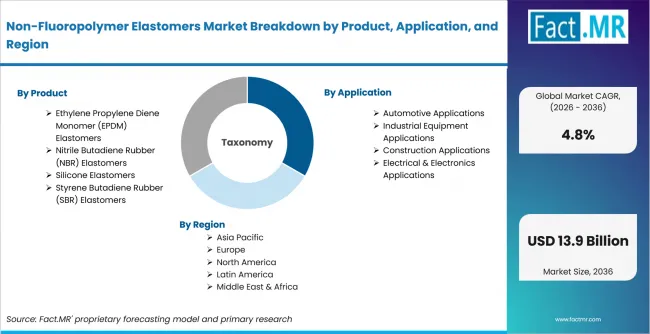
Non Fluoropolymer Elastomers Market Breakdown By Product, Application, And Region | Source: Fact.MR
| Attribute | Details |
|---|---|
| Quantitative Units | USD billion |
| Market Definition | Non-fluoropolymer elastomers in the core product scope include EPDM, NBR/HNBR, silicone and SBR rubber-like materials used in automotive, industrial, construction and electrical applications. |
| Product | EPDM Elastomers; NBR Elastomers; Silicone Elastomers; SBR Elastomers |
| Application | Automotive Applications; Industrial Equipment Applications; Construction Applications; Electrical & Electronics Applications |
| End Use | Automotive Manufacturers; Industrial Manufacturing Companies; Construction Companies; Electronics Manufacturers |
| Technology | Compounding Technology; Vulcanization Technology; Extrusion Technology; Molding Technology |
| Formulation | High Performance Elastomer Formulations; General Purpose Elastomer Formulations; Reinforced Elastomer Formulations; Specialty Elastomer Formulations |
| Distribution Channel | Direct Industrial Sales; Polymer Distributors; Compounders & Converters; Online Industrial Platforms |
| Regions Covered | North America; Latin America; Western Europe; Eastern Europe; East Asia; South Asia & Pacific; Middle East & Africa |
| Countries Covered | United States; United Kingdom; Germany; France; Japan; South Korea |
| Companies Profiled | Dow Inc.; Kraton Corporation; ENEOS Materials Corporation; Covestro AG; Zeon Corporation; Lion Elastomers |
| Forecast Period | 2026 to 2036 |
| Approach | Hybrid top-down and bottom-up approach using product demand, application qualification, end-use concentration, country adoption, channel mix and verified provider portfolios. |
How is the market segmented?
-
By Product:
- Ethylene Propylene Diene Monomer (EPDM) Elastomers
- General Purpose EPDM Compounds
- Specialty EPDM Compounds
- Nitrile Butadiene Rubber (NBR) Elastomers
- Standard NBR Compounds
- Hydrogenated NBR Compounds
- Silicone Elastomers
- Liquid Silicone Rubber Compounds
- High Consistency Silicone Compounds
- Styrene Butadiene Rubber (SBR) Elastomers
- Emulsion SBR Compounds
- Solution SBR Compounds
- Ethylene Propylene Diene Monomer (EPDM) Elastomers
-
By Application:
- Automotive Applications
- Sealing System Applications
- Fluid Handling Applications
- Industrial Equipment Applications
- Machinery Component Applications
- Process Equipment Applications
- Construction Applications
- Building Envelope Applications
- Infrastructure Applications
- Electrical & Electronics Applications
- Cable Protection Applications
- Electronic Device Applications
- Automotive Applications
-
By End Use:
- Automotive Manufacturers
- Passenger Vehicle Manufacturers
- Commercial Vehicle Manufacturers
- Industrial Manufacturing Companies
- Heavy Equipment Manufacturers
- General Industrial Manufacturers
- Construction Companies
- Building Material Producers
- Infrastructure Developers
- Electronics Manufacturers
- Consumer Electronics Producers
- Electrical Equipment Manufacturers
- Automotive Manufacturers
-
By Technology:
- Compounding Technology
- Filler Integration Systems
- Additive Dispersion Systems
- Vulcanization Technology
- Sulfur Curing Systems
- Peroxide Curing Systems
- Extrusion Technology
- Profile Extrusion Systems
- Tube Extrusion Systems
- Molding Technology
- Compression Molding Systems
- Injection Molding Systems
- Compounding Technology
-
By Formulation:
- High Performance Elastomer Formulations
- Heat Resistant Formulations
- Chemical Resistant Formulations
- General Purpose Elastomer Formulations
- Industrial Grade Formulations
- Commercial Grade Formulations
- Reinforced Elastomer Formulations
- Fiber Reinforced Formulations
- Mineral Reinforced Formulations
- Specialty Elastomer Formulations
- Low Compression Set Formulations
- Flame Retardant Formulations
- High Performance Elastomer Formulations
-
By Distribution Channel:
- Direct Industrial Sales
- OEM Supply Agreements
- Strategic Procurement Programs
- Polymer Distributors
- Regional Distributors
- Global Distribution Networks
- Compounders & Converters
- Custom Compound Suppliers
- Processing Service Providers
- Online Industrial Platforms
- Digital Procurement Platforms
- Manufacturer Direct Platforms
- Direct Industrial Sales
-
By Region:
- North America
- Latin America
- Western Europe
- Eastern Europe
- East Asia
- South Asia and Pacific
- Middle East & Africa