- Base Value(2025): 4.7 Bn
- Estimated Value(2025): 4.7 Bn
- Forecast Value (2035): 16.0 Bn
- CAGR (2025 - 2035): 13.0%
Medical Elastomers Market Forecast and Outlook 2025 to 2035
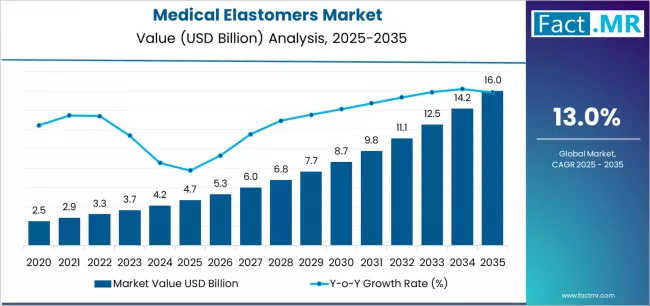
The global medical elastomers market is projected to reach USD 16.0 billion by 2035, recording an absolute increase of USD 11.3 billion over the forecast period. The market is valued at USD 4.7 billion in 2025 and is set to rise at a CAGR of 13.0% during the assessment period.
The market is expected to grow by nearly 3.4 times during the same period, supported by increasing demand for biocompatible medical devices and minimally invasive surgical technologies worldwide, driving demand for specialized elastomeric materials and increasing investments in healthcare infrastructure and medical device manufacturing initiatives globally.
Quick Stats for Medical Elastomers Market
- Medical Elastomers Market Value (2025): USD 4.7 billion
- Medical Elastomers Market Forecast Value (2035): USD 16.0 billion
- Medical Elastomers Market Forecast CAGR: 13.0%
- Leading Material Type in Medical Elastomers Market: Thermoplastic Elastomer
- Key Growth Regions in Medical Elastomers Market: Asia Pacific, North America, and Europe
- Top Players in Medical Elastomers Market: BASF SE, Celanese Corporation, Dow Inc., Solvay, DuPont, DSM, Kraton Corporation, Trelleborg AB, Kuraray Co. Ltd., Teknor Apex
Medical Elastomers Market Market Value Analysis | Source: Fact.MR
The healthcare sector faces mounting pressure to enhance patient safety while meeting stringent regulatory standards, with modern medical elastomers providing documented biocompatibility improvements of 90-95% compared to traditional materials, making elastomer adoption essential for advanced medical device positioning.
Rising prevalence of chronic diseases and expanding healthcare access across emerging economies create substantial opportunities for material suppliers and device manufacturers. However, stringent regulatory approval requirements and technical challenges in material sterilization compatibility may pose obstacles to market expansion.
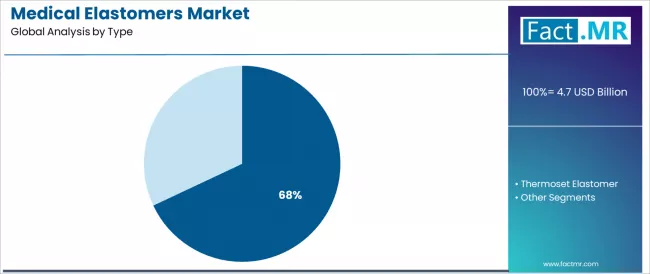
The thermoplastic elastomer segment dominates market activity with approximately 68.0% share in 2022, driven by the extensive adoption of flexible medical-grade polymers requiring advanced processing capabilities and recyclability across medical device manufacturing worldwide. Medical device manufacturers increasingly recognize the performance benefits of thermoplastic elastomers, with typical production cycle times reduced by 30-40% compared to thermoset alternatives through injection molding efficiency.
The silicone-based TPE subsegment demonstrates robust growth potential with a 13.3% CAGR, supported by implantable device requirements and biocompatibility enhancements in modern healthcare applications. Catheters emerge as the fastest-growing application category at a 13.5% CAGR, reflecting industry transition toward minimally invasive procedures combined with enhanced patient comfort benefits. Asia Pacific represents a highly dynamic regional market, driven by expanding medical device manufacturing and healthcare infrastructure development across developing economies.
Regional dynamics show North America maintaining market leadership with 39.0% share in 2022, supported by advanced healthcare infrastructure and medical device innovation centers across USA and Canada. Asia Pacific demonstrates the fastest regional growth driven by manufacturing expansion and healthcare accessibility improvements, while Europe emphasizes medical device quality standards and minimally invasive technology adoption.
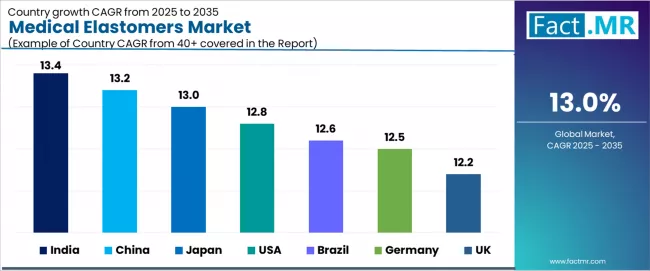
India leads country-level growth at 13.4% CAGR through expanding hospital networks and domestic medical tubing manufacturing, followed by China at 13.2% supported by strong medical disposables production and export capabilities. The competitive landscape features moderate concentration with BASF SE holding a 12.0% market share, while established players including Celanese Corporation, Dow Inc., and Solvay compete through comprehensive material portfolios and advanced biocompatibility capabilities across diverse medical applications.
Medical Elastomers Market Year-over-Year Forecast (2025 to 2035)
Between 2025 and 2030, the medical elastomers market is projected to expand from USD 4.7 billion to USD 8.7 billion, resulting in a value increase of USD 3.9 billion, which represents 34.9% of the total forecast growth for the period.
This phase of development will be shaped by rising demand for disposable medical devices in hospital settings, material innovation in silicone-based thermoplastics and biocompatible polymer formulations, as well as expanding integration with minimally invasive surgical platforms and regulatory compliance protocols.
Companies are establishing competitive positions through investment in specialized polymer synthesis capabilities, advanced biocompatibility testing, and strategic market expansion across medical tubing, catheter manufacturing, and implantable device applications.
From 2030 to 2035, the market is forecast to grow from USD 8.7 billion to USD 16.0 billion, adding another USD 7.3 billion, which constitutes 65.1% of the overall expansion. This period is expected to be characterized by the expansion of specialized material applications, including advanced implantable-grade silicones and next-generation drug delivery elastomers tailored for specific medical requirements.
Growth is further impelled by strategic collaborations between material suppliers and medical device manufacturers, and an enhanced focus on sustainable material development and regulatory harmonization. The growing emphasis on home healthcare devices and wearable medical technology will drive demand for comprehensive medical elastomer solutions across diverse healthcare applications.
Medical Elastomers Market Key Takeaways
| Metric | Value |
|---|---|
| Market Value (2025) | USD 4.7 billion |
| Market Forecast Value (2035) | USD 16.0 billion |
| Forecast CAGR (2025-2035) | 13.0% |
Source: Fact.MR analysis. Updated Nov 13, 2025
Why are Medical Elastomers Becoming Critical for Advanced Healthcare Devices?
The medical elastomers market grows by enabling medical device manufacturers and healthcare providers to access advanced biocompatible materials while benefiting from superior mechanical properties without substantial material development requirements. Device manufacturers and healthcare facilities face mounting pressure to improve patient safety and device performance while managing complex regulatory requirements, with medical-grade elastomers typically providing 90-95% biocompatibility compliance compared to conventional materials, making elastomer adoption essential for advanced medical device positioning. The healthcare industry's need for sterilization compatibility and application-specific material properties creates demand for comprehensive elastomer solutions that can provide superior flexibility, maintain consistent performance standards, and ensure reliable operation without compromising patient safety or device functionality metrics.
Government initiatives promoting healthcare quality standards and medical device innovation drive adoption in hospital supplies, surgical instruments, and implantable device applications, where material performance has a direct impact on patient outcomes and regulatory compliance. However, complex regulatory approval pathways in different markets and the technical requirements for material validation across sterilization methods may limit accessibility among smaller device manufacturers and developing regions with limited resources for comprehensive biocompatibility testing.
Segmental Analysis
The market is segmented by type, application, and region. By type, the market is divided into thermoplastic elastomers and thermoset elastomers. Based on application, the market is categorized into medical tubes, catheters, medical bags & pouches, implants, gloves & surgical instruments, and other applications. Regionally, the market is divided into Asia Pacific, Europe, North America, Latin America, and Middle East & Africa.
How do Thermoplastic Elastomers Maintain Dominance in Medical Device Manufacturing?
Medical Elastomers Market Analysis By Type | Source: Fact.MR
The thermoplastic elastomer segment represents the dominant force in the medical elastomers market, capturing approximately 68.0% of total market share in 2024, projected to expand to approximately 69.0% by 2035.
This category encompasses solutions featuring medical-grade thermoplastic polyurethanes, styrenic block copolymers, and thermoplastic vulcanizates, including advanced silicone-based TPE formulations and specialized biocompatible compounds that enable superior processing efficiency benefits and recyclability across all medical device applications.
The thermoplastic elastomer segment's market leadership stems from its processing versatility advantages, with solutions capable of addressing diverse device manufacturing requirements while maintaining consistent quality standards and sterilization compatibility across all healthcare environments.
Within the thermoplastic elastomer segment, silicone-based TPEs demonstrate the fastest growth with a CAGR of 13.3%, expanding to approximately 52.0% of the type segment by 2035, driven by implantable device requirements and enhanced biocompatibility characteristics.
The thermoset elastomer segment maintains substantial market presence, serving manufacturers who require high-performance silicone rubbers with proven chemical resistance for specialized medical applications and long-term implantable devices. These solutions offer superior thermal stability and biocompatibility while providing sufficient durability to meet demanding medical requirements.
Key technological advantages driving the thermoplastic elastomer segment include:
- Advanced processing flexibility with injection molding compatibility that enhances production efficiency and ensures consistent device quality
- Established recyclability frameworks allowing sustainable manufacturing practices across different device types without extensive material waste
- Enhanced sterilization compatibility features enabling diverse sterilization methods while maintaining material integrity and device performance
- Superior design freedom providing optimal device functionality for various medical application requirements
What Makes Medical Tubes the Leading Application for Medical Elastomers?
Medical Elastomers Market Analysis By Application | Source: Fact.MR
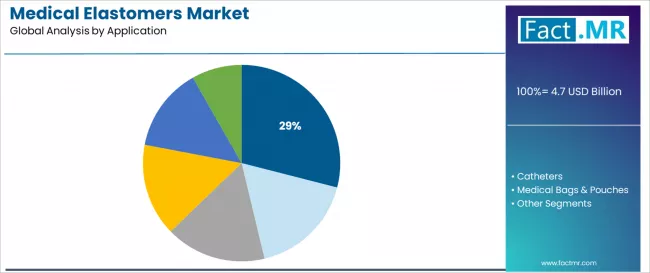
Medical tubes dominate the medical elastomers market with approximately 29.0% market share in 2022, projected to expand to approximately 31.0% by 2035, reflecting the critical role of elastomeric tubing in supporting intravenous therapy, respiratory care, and fluid management systems worldwide. The medical tubes segment's market leadership is reinforced by increasing hospital procedure volumes, disposable device adoption, and rising needs for biocompatible tubing solutions in healthcare facilities across developed and emerging markets.
The catheters segment represents the fastest-growing application category, demonstrating a CAGR of 13.5% from 2025 to 2035, expanding to approximately 19.0% market share by 2035 through specialized requirements for minimally invasive procedures, cardiovascular interventions, and direct integration with advanced diagnostic and therapeutic systems. This segment benefits from growing interventional cardiology demand that requires specific flexibility requirements, kink resistance standards, and biocompatibility protocols in catheterization laboratories and surgical facilities.
The medical bags & pouches segment maintains significant market presence through blood bags, IV bags, and ostomy products requiring flexible, sterile barrier materials. Implants applications encompass orthopedic components, cardiovascular devices, and soft tissue prosthetics with long-term biocompatibility needs. Gloves & surgical instruments represent substantial volume applications with infection control and tactile sensitivity requirements. Other applications include wound care products, pharmaceutical packaging, and diagnostic device components serving diverse healthcare needs.
Key market dynamics supporting application growth include:
- Medical tube expansion driven by rising hospital admissions and home healthcare growth, requiring biocompatible, flexible tubing in diverse therapy applications
- Catheter modernization trends require precision-engineered, kink-resistant materials for cardiovascular intervention and minimally invasive surgery differentiation
- Integration of antimicrobial additives enabling infection prevention capabilities and enhanced patient safety systems
- Growing emphasis on single-use devices driving demand for cost-effective, sterilizable elastomer solutions without traditional reprocessing limitations
What are the Key Drivers, Restraints, and Trends Shaping the Medical Elastomers Market?
The market is driven by three concrete demand factors tied to healthcare outcomes. First, aging population demographics and chronic disease prevalence create increasing demand for medical devices utilizing advanced elastomers, with global healthcare spending representing substantial growth worldwide, requiring comprehensive material innovation. Second, government initiatives promoting healthcare accessibility and medical device safety standards drive increased adoption of biocompatible elastomer technologies, with many countries implementing regulatory frameworks and quality requirements for medical materials by 2030. Third, technological advancements in polymer chemistry and processing methods enable more efficient and higher-performance elastomer solutions that improve device functionality while reducing manufacturing costs and material waste.
Market restraints include stringent regulatory approval requirements and biocompatibility validation costs that can challenge market participants in developing compliant materials, particularly for smaller manufacturers where regulatory pathway complexity remains substantial and affects commercialization timelines. Material sterilization compatibility limitations and processing complexity pose another significant challenge, as medical elastomers demand compatibility across multiple sterilization methods including gamma radiation, ethylene oxide, and steam autoclave, potentially affecting material selection and device design. Raw material price volatility in specialty monomers and additives creates additional cost pressures for elastomer producers, demanding ongoing investment in supply chain optimization and formulation efficiency initiatives.
Key trends indicate accelerated growth in Asia-Pacific markets, particularly China and India, where medical device manufacturing expansion and healthcare infrastructure development drive comprehensive medical elastomer adoption. Material innovation trends toward bio-based elastomers with biodegradable characteristics, antimicrobial-integrated formulations, and advanced drug-eluting capabilities enable efficient therapeutic approaches that optimize patient outcomes and minimize device-related complications. However, the market thesis could face disruption if significant advances in alternative biomaterials or major changes in medical device regulations fundamentally alter elastomer material requirements.
Analysis of the Medical Elastomers Market by Key Country
Medical Elastomers Market Cagr Analysis By Country | Source: Fact.MR
| Country | CAGR (2025-2035) |
|---|---|
| India | 13.4% |
| China | 13.2% |
| Japan | 13.0% |
| USA | 12.8% |
| Brazil | 12.6% |
| Germany | 12.5% |
| UK | 12.2% |
Source: Fact.MR analysis. Updated Nov 13, 2025
The global medical elastomers market is expanding steadily, with India leading at a 13.4% CAGR through 2035, driven by expanding hospital infrastructure, domestic medical tubing manufacturing, and growing medical device production capabilities. China follows at 13.2%, supported by strong medical disposables manufacturing, export-oriented production, and healthcare system modernization.
Japan grows at 13.0%, leveraging rapid biocompatible elastomer adoption in diagnostic devices and advanced medical technology integration. USA advances at 12.8%, anchored by medical tubing demand, catheter innovation, and silicone implant manufacturing. Brazil records 12.6%, reflecting healthcare infrastructure investment and biopolymer production facility development. Germany posts 12.5%, focusing on high-quality medical device standards and minimally invasive technology applications, while UK grows at 12.2%, emphasizing public healthcare investment in disposable medical devices.
How is India Leading Global Medical Elastomers Market Expansion?
India demonstrates the strongest growth potential in the medical elastomers market with a CAGR of 13.4% through 2035, with market value projected to grow from USD 0.36 billion in 2025 to USD 1.30 billion by 2035. The country's leadership position stems from expanding hospital networks, growing medical device manufacturing capabilities, and domestic medical tubing production driving the adoption of biocompatible elastomer solutions.
Growth is concentrated in major healthcare and manufacturing centers, including Maharashtra, Gujarat, Tamil Nadu, and Karnataka, where medical device manufacturers and polymer suppliers are implementing advanced elastomer formulations for enhanced product quality and regulatory compliance. Distribution channels through material distributors and device manufacturing networks expand deployment across disposable medical products and surgical instrument initiatives. The country's Central Drugs Standard Control Organisation provides regulatory support for medical material modernization, including comprehensive biocompatibility standards.
Key market factors:
- Medical device manufacturing expansion concentrated in pharmaceutical corridors and medical technology hubs with comprehensive quality assurance programs
- Government support through Make in India initiatives and medical device manufacturing incentives
- Comprehensive material supply ecosystem, including established polymer distributors with proven technical support capabilities
- Product integration featuring thermoplastic tubing formulations, catheter-grade elastomers, and surgical glove materials
What Makes China an Emerging High-Growth Medical Materials Market?
In major healthcare and manufacturing centers including Shanghai, Guangzhou, Beijing, and Suzhou, the adoption of comprehensive medical elastomer solutions is accelerating across medical disposables factories and device manufacturing facilities, driven by export market growth and domestic healthcare demand.
The market demonstrates strong growth momentum with a CAGR of 13.2% through 2035, with market value projected to grow from USD 0.72 billion in 2025 to USD 2.50 billion by 2035, linked to comprehensive medical device manufacturing expansion and increasing focus on quality medical materials.
Chinese manufacturers are implementing international-standard elastomer formulations and quality control systems to enhance product competitiveness while meeting growing demand in expanding domestic healthcare and export sectors. The country's National Medical Products Administration initiatives create ongoing demand for medical-grade elastomers, while increasing emphasis on healthcare quality drives adoption of certified biocompatible materials.
Key development areas:
- Medical device manufacturing facilities and polymer producers leading elastomer adoption with comprehensive regulatory compliance programs
- Material supply channels providing integrated formulation solutions with expanding technical service rates
- Technology partnerships between international polymer companies and domestic medical device manufacturers are expanding market reach
- Integration of disposable medical device production and comprehensive material testing systems
How does the USA Demonstrate Medical Device Innovation Leadership?
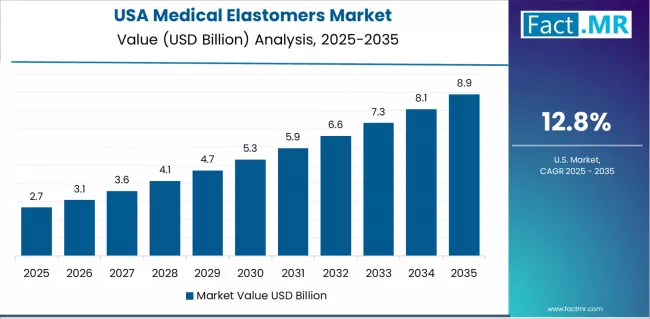
Medical Elastomers Market Country Value Analysis | Source: Fact.MR
The USA market expansion is driven by diverse healthcare demand, including advanced catheter systems in major medical centers and comprehensive medical tubing requirements across multiple healthcare applications.
The country demonstrates strong growth potential with a CAGR of 12.8% through 2035, with market value projected to grow from USD 1.15 billion in 2025 to USD 3.87 billion by 2035, supported by FDA medical device regulations and healthcare innovation initiatives.
American device manufacturers face material challenges related to regulatory validation complexity and sterilization compatibility requirements, requiring strategic material selection approaches and support from specialized polymer suppliers.
Growing minimally invasive procedure volumes and implantable device demand create compelling material utilization cases for medical elastomer adoption, particularly in cardiovascular applications where material biocompatibility has direct impact on patient safety and device performance.
Market characteristics:
- Medical device manufacturers and specialty material suppliers showing robust growth with substantial annual increase in elastomer consumption
- Regional expansion trends focused on silicone implant production and catheter manufacturing in major medical device clusters
- Future projections indicate the need for advanced bio-based elastomer development and antimicrobial material formulations
- Growing emphasis on patient safety and device performance competitiveness in medical technology operations
Why does Japan Exemplify Biocompatible Material Innovation?
The Japan market demonstrates advanced medical elastomer utilization based on integration with diagnostic device manufacturing and precision medical technology development for enhanced healthcare delivery. The country shows strong potential with a CAGR of 13.0% through 2035, with market value projected to grow from USD 0.41 billion in 2025 to USD 1.39 billion by 2035, driven by rapid biocompatible elastomer adoption and the expansion of medical-grade polymer applications in major manufacturing regions, including Kanto, Kansai, Chubu, and Kyushu.
Japanese medical device companies are adopting advanced silicone formulations for implantable devices and diagnostic equipment, particularly in regions with stringent quality requirements and healthcare applications demanding comprehensive material validation. Material distribution channels through established medical supply networks and polymer specialty distributors expand coverage across hospital facilities and device manufacturing operations.
Leading market segments:
- Medical device manufacturers and diagnostic equipment producers implementing comprehensive biocompatible material programs
- Material partnerships with polymer research institutes, achieving high biocompatibility certification rates
- Strategic collaborations between Japanese device companies and international elastomer suppliers are expanding material capabilities
- Focus on silicone-based elastomers and specialized high-purity material requirements
What Drives Germany's High-Quality Medical Device Standards?
In major medical technology centers including Munich, Stuttgart, Hamburg, and Berlin, device manufacturers are implementing comprehensive medical elastomer solutions to meet stringent regulatory requirements and support minimally invasive device innovation, with documented case studies showing substantial improvement in device performance through advanced material integration.
The market shows strong growth potential with a CAGR of 12.5% through 2035, with market value projected to grow from USD 0.49 billion in 2025 to USD 1.58 billion by 2035, linked to the ongoing expansion of medical device manufacturing, surgical instrument production, and implantable device development in major regions.
German manufacturers are adopting EU MDR-compliant elastomer formulations and quality assurance protocols to enhance device reliability while maintaining standards demanded by healthcare providers and regulatory authorities. The country's established medical device infrastructure creates ongoing demand for premium-grade elastomers and material validation solutions that integrate with European quality frameworks.
Market development factors:
- Medical device manufacturers and specialty material suppliers leading elastomer innovation initiatives across Germany
- EU Medical Device Regulation programs providing regulatory framework support for material safety and biocompatibility validation
- Strategic partnerships between German device manufacturers and international polymer companies are expanding technical capabilities
- Emphasis on minimally invasive device materials and comprehensive regulatory documentation across medical applications
What Characterizes UK's Public Healthcare Device Investment?
In major healthcare and manufacturing centers including London, Manchester, Birmingham, and Cambridge, medical device producers are implementing comprehensive elastomer-based solutions to modernize disposable device manufacturing and support NHS procurement requirements, with documented improvements in device availability through domestic production enhancement.
The market shows strong growth potential with a CAGR of 12.2% through 2035, with market value projected to grow from USD 0.31 billion in 2025 to USD 0.96 billion by 2035, linked to the ongoing expansion of public healthcare investment, medical device manufacturing, and disposable medical product production in major regions.
British manufacturers are adopting cost-effective elastomer formulations and efficient processing technologies to enhance manufacturing competitiveness while maintaining standards required by NHS procurement and MHRA regulations. The country's established healthcare system creates ongoing demand for disposable medical devices and material innovation solutions that integrate with national healthcare supply chains.
Market development factors:
- Medical device manufacturers and NHS suppliers leading disposable device production initiatives across UK
- Public healthcare procurement programs providing demand support for cost-effective, high-quality medical devices
- Strategic partnerships between British device companies and European elastomer suppliers are expanding material sourcing capabilities
- Emphasis on disposable device manufacturing and comprehensive material safety standards across healthcare applications
How does Brazil Balance Healthcare Expansion with Material Innovation?
In major healthcare and industrial centers including São Paulo, Rio de Janeiro, Minas Gerais, and Paraná, medical device manufacturers are expanding elastomer utilization to support domestic healthcare infrastructure growth while implementing biopolymer production facilities, driven by public health system expansion and medical device localization initiatives.
The market demonstrates strong growth potential with a CAGR of 12.6% through 2035, with market value projected to grow from USD 0.28 billion in 2025 to USD 0.91 billion by 2035, linked to comprehensive healthcare infrastructure investment and increasing focus on domestic medical device manufacturing.
Brazilian manufacturers are implementing medical-grade elastomer formulations and quality control systems to enhance product reliability while meeting growing demand in expanding public healthcare and private hospital sectors. The country's ANVISA regulatory initiatives create ongoing demand for certified medical elastomers, while increasing emphasis on healthcare accessibility drives adoption of cost-effective device materials.
Key development areas:
- Medical device manufacturers and healthcare suppliers leading elastomer adoption with comprehensive material qualification programs
- Healthcare infrastructure providing integrated device demand through public hospital expansion capabilities
- Industry partnerships between international polymer suppliers and local medical device companies are establishing material supply frameworks
- Integration of biopolymer production facilities and comprehensive sustainable material development systems
Europe Market Split by Country
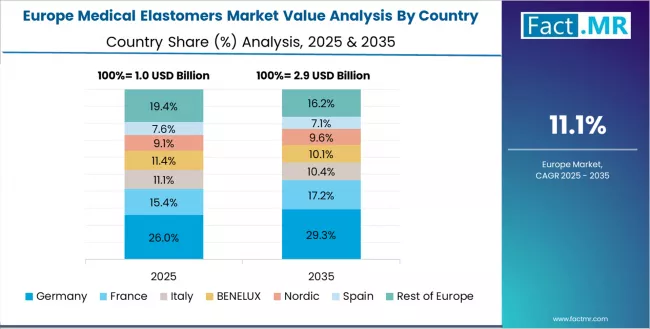
Medical Elastomers Market Europe Country Market Share Analysis, 2025 & 2035 | Source: Fact.MR
The medical elastomers market in Europe is projected to grow from USD 0.99 billion in 2025 to USD 3.21 billion by 2035, registering a CAGR of 12.5% over the forecast period. Germany is expected to maintain its leadership position with a 26.0% market share in 2025, declining slightly to 25.5% by 2035, supported by its extensive medical device manufacturing infrastructure, advanced regulatory compliance frameworks, and comprehensive material testing networks serving major European markets.
The UK follows with a 17.5% share in 2025, projected to reach 17.8% by 2035, driven by comprehensive NHS procurement programs in major healthcare regions implementing disposable medical device solutions. France holds a 15.5% share in 2025, expected to maintain 15.4% by 2035 through the ongoing development of medical technology facilities and pharmaceutical device manufacturing networks.
Italy commands a 12.0% share, while Spain accounts for 10.5% in 2025. The rest of Europe region is anticipated to gain momentum, expanding its collective share from 18.5% to 18.8% by 2035, attributed to increasing medical elastomer adoption in Nordic countries and emerging Eastern European medical device facilities implementing biocompatible material programs.
How does Precision Manufacturing Drive Medical Elastomer Adoption in Japanese Healthcare?
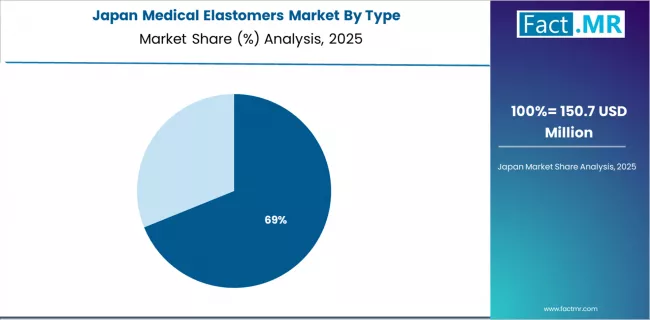
Medical Elastomers Market Japan Market Share Analysis By Type | Source: Fact.MR
The Japanese medical elastomers market demonstrates a mature and quality-focused landscape, characterized by sophisticated integration of biocompatible materials with advanced medical device manufacturing across diagnostic equipment facilities, surgical instrument production, and implantable device operations. Japan's emphasis on material quality and patient safety drives demand for premium medical-grade elastomer solutions that support comprehensive healthcare initiatives and regulatory requirements in medical device operations.
The market benefits from strong partnerships between international polymer providers like BASF SE, Dow Inc., and domestic medical device manufacturers, including established diagnostic equipment companies and surgical product producers, creating comprehensive material supply ecosystems that prioritize biocompatibility validation and technical precision programs. Medical device manufacturing centers in major industrial regions showcase advanced elastomer implementations where silicone-based materials achieve performance improvements through integrated quality assurance programs.
What Characterizes International Material Supply in South Korean Medical Markets?
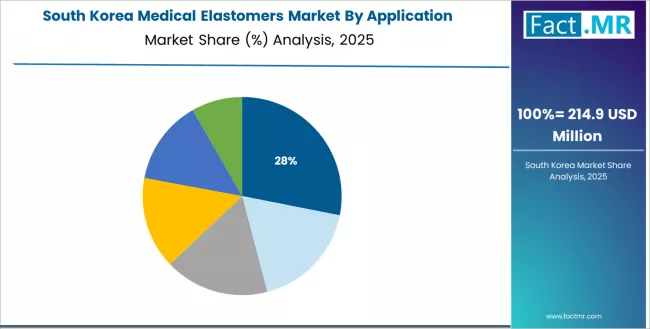
Medical Elastomers Market South Korea Market Share Analysis By Application | Source: Fact.MR
The South Korean medical elastomers market is characterized by strong international polymer supplier presence, with companies like BASF SE, Celanese Corporation, and Dow Inc. maintaining competitive positions through comprehensive material portfolios and technical support capabilities for medical device manufacturing and healthcare product applications.
The market is demonstrating growing emphasis on domestic device manufacturing capacity and import substitution initiatives, as South Korean healthcare providers increasingly demand locally produced devices that integrate with national healthcare systems and medical technology standards deployed across major hospital networks and healthcare facilities.
Local polymer compounders and regional medical material distributors are gaining market share through strategic partnerships with international suppliers, offering specialized services including custom formulation programs and regulatory support services for device manufacturers. The competitive landscape shows increasing collaboration between multinational polymer companies and Korean medical device specialists, creating integrated supply models that combine international material expertise with local regulatory knowledge and healthcare market relationship capabilities.
Competitive Landscape of the Medical Elastomers Market
The medical elastomers market features approximately 15-20 meaningful players with moderate concentration, where the top three compa Medical Elastomers Market Analysis By Company | Source: Fact.MR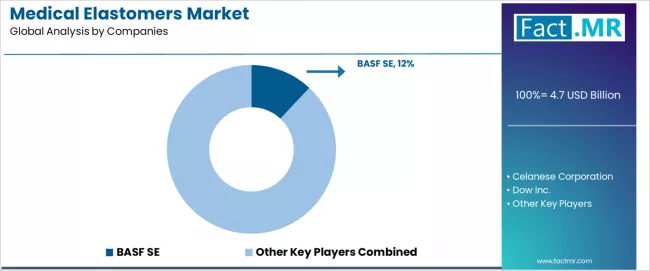
Market leaders include BASF SE, Celanese Corporation, and Dow Inc., which maintain competitive advantages through comprehensive medical elastomer portfolios, advanced polymer synthesis capabilities, and deep expertise in the healthcare materials sector, creating high customer loyalty among medical device manufacturers. These companies leverage established regulatory documentation and ongoing material innovation partnerships to defend market positions while expanding into adjacent implantable device materials and drug delivery system applications.
Challengers encompass Solvay and DuPont, which compete through specialized biocompatible formulations and strong market presence in key medical device segments. Material specialists, including DSM, Kraton Corporation, and Trelleborg AB, focus on specific application categories or material technologies, offering differentiated capabilities in bio-based elastomers, styrenic block copolymers, and precision-engineered medical components.
Regional players and emerging polymer compounders create competitive pressure through cost-effective formulation approaches and rapid local market responsiveness capabilities, particularly in high-growth markets including India and China, where domestic manufacturing provides advantages in supply chain efficiency and technical service proximity.
Market dynamics favor companies that combine advanced polymer chemistry with comprehensive regulatory support services that address the complete device development lifecycle from material selection through regulatory submission and commercial production.
The competitive landscape demonstrates increasing emphasis on sustainability credentials and circular economy principles, with leading suppliers developing bio-based elastomer formulations and recyclable material systems that position medical elastomers as environmentally responsible healthcare materials.
Strategic investments in antimicrobial additive technologies and drug-eluting polymer platforms are creating differentiated material portfolios that address evolving infection prevention and therapeutic delivery requirements, with particular focus on cardiovascular devices and implantable applications.
Vertical integration strategies encompassing monomer production, polymer synthesis, and custom compounding capabilities enable major suppliers to maintain quality control and cost efficiency advantages across the value chain, while strategic partnerships with medical device OEMs are creating co-development programs that secure long-term material supply agreements and enable early access to emerging device technologies.
Global Medical Elastomers Market - Stakeholder Contribution Framework
Medical elastomers represent a critical material category that enables medical device manufacturers, healthcare providers, and surgical facilities to access biocompatible polymer solutions without substantial material development investment, typically providing 90-95% biocompatibility compliance and superior mechanical performance essential for patient safety while ensuring consistent device functionality and sterilization compatibility.
With the market projected to grow from USD 4.7 billion in 2025 to USD 16.0 billion by 2035 at a 13.0% CAGR, these solutions offer compelling advantages - superior flexibility, enhanced biocompatibility, and processing efficiency capabilities - making them essential for medical tube applications (29.0% application share in 2022), thermoplastic elastomer formulations (68.0% type share in 2022), and diverse medical device applications seeking reliable material solutions. Scaling market penetration and material capabilities requires coordinated action across healthcare policy, medical device standards, polymer manufacturers, device producers, and regulatory compliance organizations.
How Could Governments Spur Local Development and Adoption?
- Medical Device Innovation Programs: Include medical material standards in healthcare quality frameworks, providing targeted incentives for medical device manufacturing and supporting local polymer manufacturers through development grants and regulatory guidance.
- Tax Policy & Investment Support: Implement favorable depreciation schedules for medical manufacturing equipment, provide tax incentives for device manufacturers investing in biocompatible materials and sterilization-compatible technologies, and establish capital equipment accounting standards that encourage advanced material adoption over conventional alternatives.
- Regulatory Framework Development: Create streamlined approval processes for medical-grade elastomers across device and pharmaceutical applications, establish clear biocompatibility standards and performance frameworks for medical materials, and develop international harmonization protocols that facilitate cross-border material trade.
- Skills Development & Training: Fund medical device engineering programs for material scientists, biocompatibility specialists, and regulatory affairs professionals. Invest in continuing education initiatives that bridge polymer innovation with medical device applications and quality assurance best practices.
- Market Access & Competition: Establish procurement policies that support domestic medical device manufacturing for public healthcare systems, fund medical material testing facilities through infrastructure programs, and create regulatory environments that encourage innovation in biocompatible polymer technologies.
How Could Industry Bodies Support Market Development?
- Material Standards & Certification: Define standardized performance metrics for medical elastomers across tubing, catheter, and implant applications, establish universal biocompatibility testing and sterilization compatibility protocols, and create certification programs for material quality that device manufacturers can rely on.
- Market Education & Best Practices: Lead messaging that demonstrates medical elastomer advantages, emphasizing improved patient safety, enhanced device performance, and superior processing efficiency compared to alternative material options.
- Technology Integration Standards: Develop interoperability standards for medical materials, device design compatibility guidelines, and sterilization method protocols, ensuring consistent material performance across different healthcare environments and processing requirements.
- Professional Development: Run certification programs for medical material specialists, device engineers, and quality managers on optimizing material selection, biocompatibility validation, and regulatory compliance in competitive medical device markets.
How Could Polymer Manufacturers and Technology Players Strengthen the Ecosystem?
- Advanced Material Development: Develop next-generation medical elastomers with enhanced biocompatibility characteristics, improved sterilization resistance features, and application-specific properties that enhance device reliability while reducing processing complexity.
- Regulatory Support Platforms: Provide comprehensive documentation systems that integrate biocompatibility data, sterilization validation, material safety datasheets, and regulatory filing support, enabling device manufacturers to maximize approval efficiency and compliance effectiveness.
- Technical Service Networks: Offer flexible material selection programs for device manufacturers and healthcare organizations, including formulation customization options, processing optimization consultation, and application development pathways that align material properties with device requirements.
- Research & Development Networks: Build comprehensive R&D capabilities, collaborative material innovation programs, and clinical validation systems that ensure medical elastomers maintain high performance standards and consistent biocompatibility across diverse medical applications.
How Could Medical Device Manufacturers and Healthcare Providers Navigate the Shift?
- Diversified Material Portfolios: Expand elastomer utilization across medical tube applications (29.0% application dominance in 2022), catheter systems (fastest-growing at 13.5% CAGR), and implantable devices, with particular focus on thermoplastic elastomers (68.0% type share in 2022) and specialized silicone-based formulations for biocompatibility requirements.
- Geographic Manufacturing Development: Establish device production operations in high-growth markets like India (13.4% CAGR) and China (13.2% CAGR), while strengthening capabilities in established markets like USA (12.8% CAGR) and Germany (12.5% CAGR) through material sourcing optimization and regulatory compliance.
- Technology-Enabled Manufacturing: Implement advanced processing systems with automated quality control, real-time material monitoring, and predictive maintenance capabilities that differentiate device manufacturing and improve product consistency.
- Flexible Device Design Models: Develop standard, specialty, and custom medical device configurations that accommodate varying healthcare needs, from cost-effective disposables to high-performance implantables for demanding clinical and regulatory requirements.
How Could Investors and Financial Enablers Unlock Value?
- Material Production Expansion Financing: Provide growth capital for established companies like BASF SE, Celanese Corporation, and Dow Inc. to expand medical elastomer production capacity and formulation capabilities, particularly in emerging markets with growing medical device demands.
- Innovation Investment: Back startups developing advanced bio-based elastomers, antimicrobial-integrated materials, and drug-eluting polymer platforms that enhance medical device performance and competitive positioning.
- Regional Manufacturing Development: Finance medical device manufacturing facility establishment and expansion strategies in high-growth regions, supporting infrastructure initiatives that improve material accessibility while maintaining quality standards.
- Consolidation & Scale Opportunities: Support strategic acquisitions and market consolidation that create material portfolio breadth, improve technical service capabilities, and enhance competitive positioning against fragmented regional suppliers across multiple geographic markets.
Key Players in the Medical Elastomers Market
- BASF SE
- Celanese Corporation
- Dow Inc.
- Solvay
- DuPont
- DSM
- Kraton Corporation
- Trelleborg AB
- Kuraray Co., Ltd.
- Teknor Apex
Segmentation
Scope of the Report
| Items | Values |
|---|---|
| Quantitative Units | USD 4.7 Billion |
| Type | Thermoplastic Elastomer, Thermoset Elastomer |
| Application | Medical Tubes, Catheters, Medical Bags & Pouches, Implants, Gloves & Surgical Instruments, Others |
| Regions Covered | Asia Pacific, Europe, North America, Latin America, Middle East & Africa |
| Country Covered | India, China, USA, Germany, UK, Japan, Brazil, and 40+ countries |
| Key Companies Profiled | BASF SE, Celanese Corporation, Dow Inc., Solvay, DuPont, DSM, Kraton Corporation, Trelleborg AB, Kuraray Co. Ltd., Teknor Apex |
| Additional Attributes | Dollar sales by type and application categories, regional consumption trends across Asia Pacific, Europe, and North America, competitive landscape with medical elastomer manufacturers and polymer suppliers, material specifications and biocompatibility requirements, integration with medical device manufacturing initiatives and regulatory compliance platforms, innovations in elastomer chemistry and processing technologies, and development of specialized applications with patient safety and device performance optimization capabilities. |
Source: Fact.MR analysis. Updated Nov 13, 2025
Medical Elastomers Market by Segments
-
Type :
- Thermoplastic Elastomer
- Thermoset Elastomer
-
Application :
- Medical Tubes
- Catheters
- Medical Bags & Pouches
- Implants
- Gloves & Surgical Instruments
- Others
-
Region :
- Asia Pacific
- China
- Japan
- South Korea
- India
- Australia & New Zealand
- ASEAN
- Rest of Asia Pacific
- Europe
- Germany
- UK
- France
- Italy
- Spain
- Nordic
- BENELUX
- Rest of Europe
- North America
- USA
- Canada
- Mexico
- Latin America
- Brazil
- Chile
- Rest of Latin America
- Middle East & Africa
- Kingdom of Saudi Arabia
- Other GCC Countries
- Turkey
- South Africa
- Other African Union
- Rest of Middle East & Africa
- Asia Pacific
Frequently Asked Questions
How big is the medical elastomers market in 2025?
What will be the size of medical elastomers market in 2035?
How much will be the medical elastomers market growth between 2025 and 2035?
What are the key product types in the medical elastomers market?
Which application segment to contribute significant share in the medical elastomers market in 2025?
Who worked on this report


Preview the report firsthand - request a free sample
Free SampleGet the brochure for pricing and purchase details
Download PDF