- Base Value(2025): 0.7 Bn
- Estimated Value(2026): 0.8 Bn
- Forecast Value (2036): 2.6 Bn
- CAGR (2026 - 2036): 12.3%
Low-Odor, Enclosed-Greenhouse Foliar Spray Chemistry Market Forecast and Outlook By FACT.MR
In 2025, the Low-Odor, Enclosed-Greenhouse Foliar Spray Chemistry Market was valued at USD 0.7 billion. Based on Fact.MR analysis, demand for greenhouse foliar spray chemistries is estimated to grow to USD 0.8 billion in 2026 and USD 2.6 billion by 2036. FACT.MR projects a CAGR of 12.3% during the forecast period.
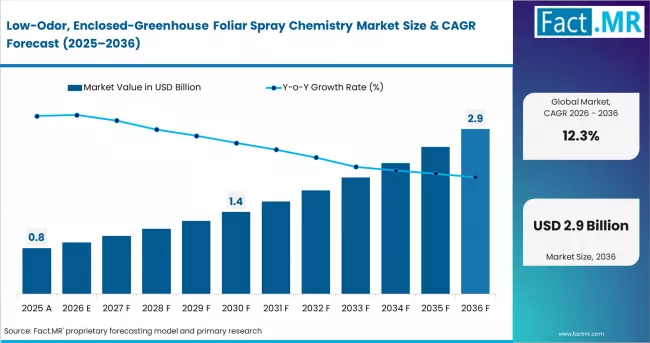
Low Odor Enclosed Greenhouse Foliar Spray Chemistry Market Value Analysis | Source: Fact.MR
Summary of Low-Odor, Enclosed-Greenhouse Foliar Spray Chemistry Market
- Market Definition
- The market covers biofungicides, bioinsecticides, and low-volatility synthetic foliar chemistries formulated for crop protection in protected greenhouse vegetable, ornamental, and herb production globally.
- Demand Drivers
- EU retail chains are mandating zero-residue MRL compliance for greenhouse vegetable imports, accelerating biofungicide procurement across Dutch and Spanish protected horticulture supply chains.
- Netherlands and Japan greenhouse operators are integrating certified biopesticide input programmes to qualify for premium retail and export contracts tied to documented input compliance standards.
- China's greenhouse acreage expansion under national food security programmes is generating large-volume procurement demand for registered foliar spray chemistry inputs.
- Key Segments Analyzed
- By Product Type: Biofungicides lead with 45% share in 2026. Driven by high humidity and fungal pressure.
- By Crop Type: Vegetables lead with 50% share in 2026. Driven by frequent foliar spray cycles.
- By Formulation: Liquid sprays lead with 58% share in 2026. Driven by ease of use and system compatibility.
- By Geography: Netherlands leads at 13.2% CAGR. Driven by advanced greenhouse systems and MRL compliance.
- Analyst Opinion at FACT.MR
- Shambhu Nath Jha, Principal Consultant at Fact.MR, opines, 'CXOs will find that suppliers with EU biopesticide approval and EPA registration hold the strongest positioning. Zero-residue performance is critical. Compliance certification is replacing price as the key procurement factor in premium greenhouse markets.'
- Strategic Implications
- Invest in EU biopesticide approval and EPA registration. This supports entry into preferred supplier programmes. Focus on export-oriented greenhouse growers.
- Develop crop-specific biofungicide protocols. Target tomato and cucumber production. These crops have high humidity and residue risk.
- Build partnerships with Dutch and Spanish cooperatives. Position products within group procurement agreements. This ensures scale and repeat demand.
- Methodology
- Market sizing uses producer revenues and greenhouse acreage data. Validated with 2024–2025 compliance benchmarks.
- Analysis includes EU approval data, EPA registrations, and protected horticulture input spend data.
- Forecasts use acreage growth, adoption trends, and expert interviews.
| Metric | Value |
|---|---|
| Estimated Value in 2026 | USD 0.8 billion |
| Forecast Value in 2036 | USD 2.6 billion |
| Forecast CAGR (2026 to 2036) | 12.3% |
Source: Fact.MR analysis. Updated Apr 28, 2026
The market is projected to generate USD 1.8 billion in absolute opportunity between 2026 and 2036. Growth is structurally driven by greenhouse acreage expansion and mandatory MRL compliance in export vegetable supply chains. Adoption is constrained by biofungicide unit cost premiums and inconsistent biopesticide registration timelines across markets.
Greenhouse produce buyers are restructuring input procurement toward documented residue-free and biopesticide-compliant programmes. Large retail chains and export-focused growers prefer certified and traceable foliar chemistry inputs. BASF, Bayer, and Koppert Biological Systems are embedding compliance documentation into supply agreements. Long-term input contracts indexed to MRL compliance are replacing spot purchasing across Dutch and Spanish protected vegetable supply chains.
Netherlands leads with a projected CAGR of 13.2% through 2036, driven by advanced greenhouse horticulture infrastructure and retailer-mandated input compliance. Japan follows at 12.0%, anchored by controlled environment agriculture technology adoption. Spain records 12.8%, supported by large-scale protected vegetable export to EU retail. China grows at 12.5%, linked to massive greenhouse acreage expansion under food security programmes. The United States records 11.6%, supported by high-value greenhouse crop production and domestic food safety regulations.
Segmental Analysis
Low-Odor, Enclosed-Greenhouse Foliar Spray Chemistry Market Analysis by Product Type
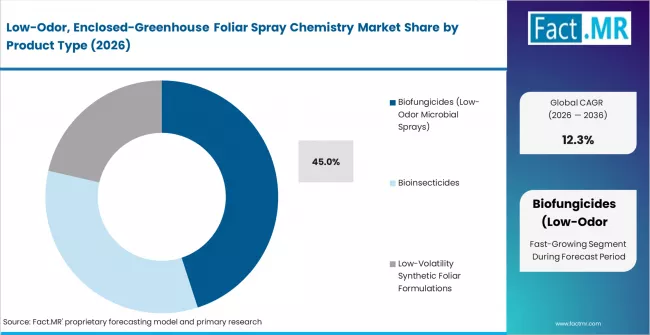
Low Odor Enclosed Greenhouse Foliar Spray Chemistry Market Analysis By Product Type | Source: Fact.MR
Based on FACT.MR's report, biofungicides hold 45% share in 2026. They lead due to high humidity conditions. Fungal pressure is persistent. Botrytis and powdery mildew are key issues. Low-odor microbial formulations meet residue requirements. They are preferred in premium supply chains.
- Koppert Expansion: Koppert Biological Systems expanded its Trichoderma-based range in 2024. Focus was on European greenhouse vegetables. Low-odor formulations were introduced. Target markets include the Netherlands and Germany. Growth was double-digit. [1]
- Valent Launch: Valent BioSciences introduced a Bacillus-based biofungicide in 2025. Focus is on tomato and pepper crops. Target markets include the U.S. and Japan. Efficacy is documented against major fungal diseases. [2]
- Registration Trend: The European Food Safety Authority approved 18 new biopesticide actives in 2024. Biofungicides led approvals. This expanded available products for greenhouse operators. [3]
Low-Odor, Enclosed-Greenhouse Foliar Spray Chemistry Market Analysis by Crop Type
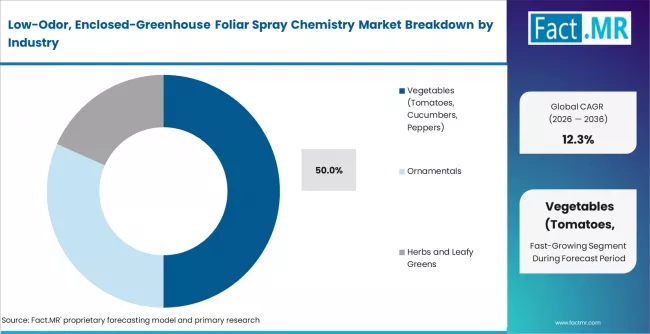
Low Odor Enclosed Greenhouse Foliar Spray Chemistry Market Analysis By Crop Type | Source: Fact.MR
Based on FACT.MR's report, vegetables hold 50% share in 2026. Tomatoes, cucumbers, and peppers dominate. These crops require frequent foliar sprays. Growing cycles are continuous. High density increases pest pressure.
- Syngenta Programme: Syngenta launched a greenhouse vegetable programme in 2024. Products are low-volatility and EU-registered. Focus is on tomatoes and cucumbers. Key markets include the Netherlands and Spain. [4]
- Biobest Development: Biobest Group introduced IPM programmes in 2025. Focus is on ornamentals. Combines sprays with biological agents. Targets thrips and aphids. [5]
- Crop Trend: The Association for Vertical Farming reported strong adoption in 2024. Herbs and leafy greens are growing segments. Demand is driven by zero-residue expectations. [6]
Drivers, Restraints, and Opportunities
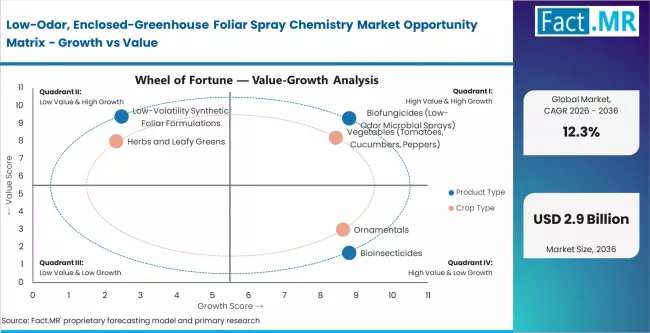
Low Odor Enclosed Greenhouse Foliar Spray Chemistry Market Opportunity Matrix Growth Vs Value | Source: Fact.MR
FACT.MR analysts observe steady market growth. Expansion is linked to greenhouse acreage. Europe, Asia, and North America lead. Demand is shifting toward bio-based chemistries. Compliance and residue limits are key drivers.
Synthetic foliar chemistries are losing share. Biofungicides and bioinsecticides are gaining traction. Price premiums range from 25–40%. Non-compliant products face exclusion. Growth is driven by premium adoption.
- EU MRL Compliance: The European Commission tightened limits in 2024 under EC 396/2005. Residue limits were reduced. This impacted tomatoes, cucumbers, and peppers. BASF and Bayer expanded biofungicide portfolios.
- Netherlands Transition: The Dutch sector recorded EUR 3.2 billion input spend in 2024. Biopesticides were the fastest-growing segment. MRL audits increased in 2024. This pushed growers toward compliant inputs.
- China Expansion: China reported over 3.8 million hectares of greenhouse area in 2024. This is the largest globally. Government programs mandate registered inputs. Demand for compliant foliar chemistries is rising.
Regional Analysis
The Low-Odor, Enclosed-Greenhouse Foliar Spray Chemistry Market is assessed across Europe, Asia Pacific, North America, Latin America, and Middle East and Africa, covering 40+ countries with demand shaped by greenhouse acreage scale, MRL regulatory frameworks, biopesticide registration availability, and retailer input compliance requirements. The full report offers market attractiveness analysis by region and country.
.webp "Top Country Growth Comparison Low Odor, Enclosed Greenhouse Foliar Spray Chemistry Market Cagr (2026 2036)")
Top Country Growth Comparison Low Odor, Enclosed Greenhouse Foliar Spray Chemistry Market Cagr (2026 2036) | Source: Fact.MR
| Country | CAGR (2026 to 2036) |
|---|---|
| Netherlands | 13.2% |
| Spain | 12.8% |
| China | 12.5% |
| Japan | 12.0% |
| United States | 11.6% |
Source: Fact.MR analysis. Updated Apr 28, 2026
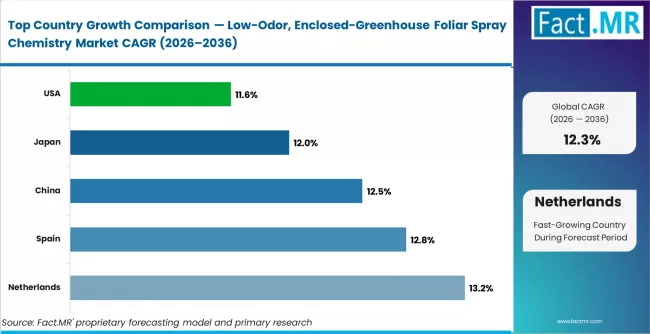
Low Odor Enclosed Greenhouse Foliar Spray Chemistry Market Cagr Analysis By Country | Source: Fact.MR
Source: Fact.MR (FACT.MR) analysis, based on proprietary forecasting model and primary research
Europe Low-Odor, Enclosed-Greenhouse Foliar Spray Chemistry Market Analysis
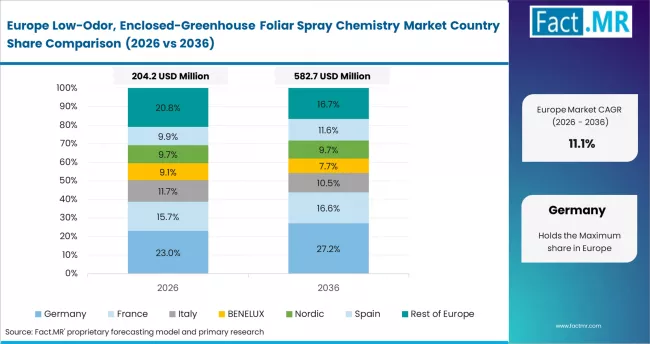
Low Odor Enclosed Greenhouse Foliar Spray Chemistry Market Europe Country Market Share Analysis, 2026 & 2036 | Source: Fact.MR
Europe is the global compliance benchmark. EU MRL rules shape input selection. Biopesticide approvals define market access. Netherlands and Spain drive procurement volumes. BASF, Bayer, and Koppert Biological Systems lead through strong EU registrations.
- Netherlands: Audit-led compliance drives 13.2% CAGR through 2036. NVWA increased MRL inspections in 2024. Growers shifted to certified inputs. Cooperative groups revised approved lists. Synthetic actives were restricted. Koppert Biological Systems expanded biofungicide bundles in 2024. Focus is on tomato and cucumber growers. Growth is compliance-driven and cooperative-led.
- Spain: Export compliance pressure supports 12.8% CAGR through 2036. Ministry guidelines were updated in 2024. Restrictions were applied to key synthetic actives. Almería and Murcia growers updated protocols. Export associations enforced compliance standards. BASF expanded biofungicide availability in 2025. Focus is on tomato and pepper exports. Growth is export-driven and regulation-led.
Fact.MR's analysis of Europe covers the Netherlands, Spain, Germany, France, UK, Italy, Turkey, and Rest of Europe. Includes approval timelines and compliance trends.
Asia Pacific Low-Odor, Enclosed-Greenhouse Foliar Spray Chemistry Market Analysis
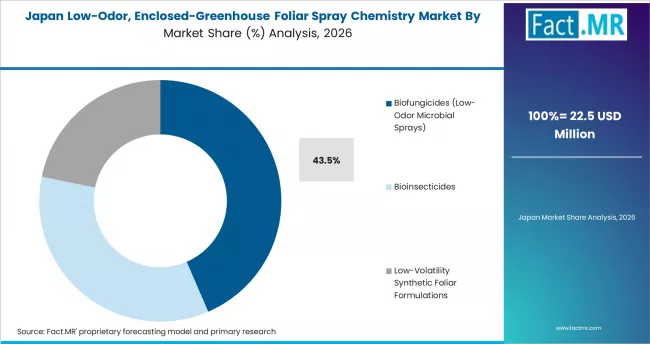
Low Odor Enclosed Greenhouse Foliar Spray Chemistry Market Japan Market Share Analysis By Product Type | Source: Fact.MR
Asia Pacific is the fastest-growing region. China drives volume. Japan drives precision demand. Procurement models differ across markets. Syngenta and Valent BioSciences have strong regional presence.
- China: Policy-driven expansion supports 12.5% CAGR through 2036. Ministry guidelines were updated in 2024. Registered inputs are mandatory in subsidy programmes. Provinces integrated food safety standards. Syngenta expanded product registrations in 2025. Focus is on vegetable greenhouse operators. Growth is driven by scale, regulation, and state procurement.
- Japan: Technology-led demand supports 12.0% CAGR through 2036. MAFF updated approval guidelines in 2025. Registration timelines improved for biopesticides. Operators require tested efficacy data. Prefectures like Aichi lead adoption. Koppert Biological Systems expanded distribution in 2024. Growth is driven by precision and quality requirements.
Fact.MR covers China, Japan, South Korea, India, ASEAN, and Australia and New Zealand. Includes regulatory data and adoption trends.
North America Low-Odor, Enclosed-Greenhouse Foliar Spray Chemistry Market Analysis
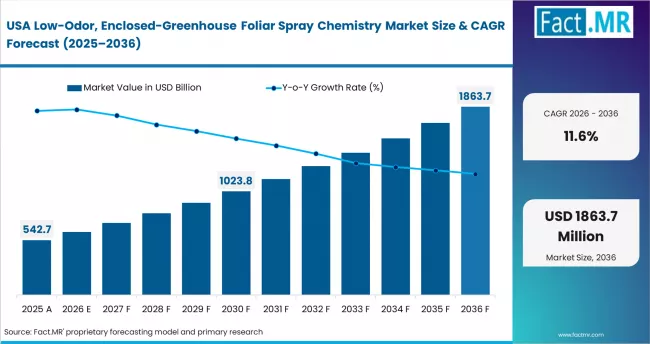
Low Odor Enclosed Greenhouse Foliar Spray Chemistry Market Country Value Analysis | Source: Fact.MR
North America is a certification-led market. Retail standards drive procurement. High-value crops dominate demand. Corteva and Valent BioSciences are key players.
- United States: Retail compliance drives 11.6% CAGR through 2036. EPA registered new products in 2024. Greenhouse-specific biopesticides increased. Retailers updated sourcing standards. Whole Foods and Kroger enforced zero-residue norms. Corteva expanded biofungicide range in 2025. Growth is retailer-driven and certification-led.
Fact.MR covers the U.S., Canada, and Mexico. Includes EPA data and compliance trends.
Competitive Aligners for Market Players
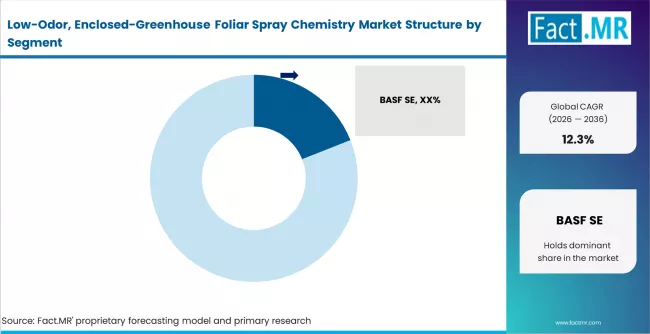
Low Odor Enclosed Greenhouse Foliar Spray Chemistry Market Analysis By Company | Source: Fact.MR
Competition in the Low-Odor, Enclosed-Greenhouse Foliar Spray Chemistry Market is becoming more focused and demanding. Buyers are no longer looking at price alone. They want fewer suppliers, but with stronger credentials. EU biopesticide approvals and clear residue documentation are now essential. The market is still moderately concentrated. Large players like BASF, Bayer, Syngenta, and Koppert Biological Systems continue to lead. Their advantage comes from scale, regulatory strength, and established grower relationships.
These companies have built strong positions over time. They operate extensive registration networks across EU and EPA systems. They also maintain deep distributor reach and long-standing ties with greenhouse cooperatives. This allows them to quickly adapt existing biofungicide and bioinsecticide products for greenhouse-specific use. Their ability to support growers with application guidance and compliance documentation gives them a practical edge. Smaller firms often struggle here due to high registration costs and limited technical capacity.
At the same time, specialist players are gaining ground in premium segments. Companies like Biobest Group and Valent BioSciences are focusing on tailored solutions. They offer crop-specific protocols, IPM programmes, and hands-on agronomy support. This aligns well with how greenhouse operators are changing their buying behaviour. Instead of purchasing individual products, they are choosing complete programmes. These include residue tracking, compliance support, and ongoing crop monitoring. As a result, suppliers that can deliver integrated solutions are gaining stronger, longer-term positions in the market.
Key Players
- BASF SE
- Bayer AG
- Syngenta AG
- Corteva Agriscience
- Koppert Biological Systems
- Biobest Group
- Valent BioSciences LLC
Bibliography
- [1] Koppert Biological Systems. (2024). Annual Report 2024: Trichoderma Biofungicide Range Expansion Including Low-Odor Formulation Launch for European Enclosed Greenhouse Vegetable Markets Covering Netherlands and Germany Cooperative Procurement. koppert.com/investor-relations
- [2] Valent BioSciences LLC. (2025). Product Launch Announcement: Bacillus-Based Biofungicide Formulation for Greenhouse Tomato and Pepper Production Targeting U.S. and Japanese Controlled Environment Agriculture Markets with Botrytis and Powdery Mildew Efficacy Data. valentbiosciences.com/news
- [3] European Food Safety Authority. (2024). Active Substance Approval Summary 2024: Biopesticide Active Substance Approvals for Greenhouse Use Including Biofungicide Category Growth Under EU Regulation 1107/2009 Registration Framework. efsa.europa.eu/en/topics/topic/pesticides
- [4] Syngenta AG. (2024). Product Programme Launch: Greenhouse Vegetable Foliar Spray Programme Including EU-Registered Low-Volatility Fungicide and Insecticide Products for Enclosed Tomato and Cucumber Production in Netherlands, Spain, and Turkey. syngenta.com/en/media-releases
- [5] Biobest Group. (2025). Product Launch: Integrated Biological Control Programme for Ornamental Greenhouse Production Combining Bioinsecticide Sprays and Biological Agents for Thrips and Aphid Management in Dutch Cut Flower and Pot Plant Production. biobestgroup.com/news
- [6] Association for Vertical Farming. (2024). Urban and Protected Crop Production Input Report 2024: Biopesticide Foliar Spray Adoption Trends Among Herb and Leafy Green Producers Including Retail Zero-Residue Sourcing Standard Impact on Input Selection. verticalfarming.net/reports
This Report Addresses
- Strategic intelligence on greenhouse foliar spray chemistry demand across biofungicide adoption, bioinsecticide programme deployment, and low-volatility synthetic foliar chemistry procurement by commercial greenhouse vegetable, ornamental, and herb producers.
- Market forecast from USD 0.8 billion in 2026 to USD 2.6 billion by 2036 at a CAGR of 12.3%.
- Growth opportunity mapping across Netherlands MRL compliance-driven biopesticide procurement, Spain protected vegetable export input transition, China greenhouse acreage expansion, Japan technology-led agriculture adoption, and U.S. retailer zero-residue sourcing mandate adoption.
- Segment analysis by product type (biofungicides, bioinsecticides, low-volatility synthetics), crop type (vegetables, ornamentals, herbs), and formulation (liquid, concentrate, fogging) across global and regional markets.
- Regional outlook covering Europe EU MRL compliance-led procurement, Asia Pacific government programme-driven expansion, and North America food safety certification and zero-residue retail demand.
- Competitive analysis of BASF, Bayer, Syngenta, Corteva, Koppert Biological Systems, Biobest Group, and Valent BioSciences covering EU biopesticide registration, greenhouse IPM programme positioning, and crop-specific foliar chemistry product development.
- Regulatory impact analysis covering EU MRL Regulation EC 396/2005 updates, EU Regulation 1107/2009 biopesticide approval data, EPA biopesticide registration trends, Japan MAFF biopesticide guideline updates, and Netherlands NVWA MRL audit frequency data.
- Report delivered in PDF, Excel datasets, and presentation formats supported by producer revenues, MRL compliance programme benchmarks, greenhouse acreage data, and primary expert interviews.
Low-Odor, Enclosed-Greenhouse Foliar Spray Chemistry Market Definition
The market covers biofungicides, bioinsecticides, and low-volatility synthetic foliar formulations applied to crops grown in protected greenhouse environments. Products address fungal, insect, and pest pressure on vegetables, ornamentals, and herbs without generating residues exceeding regulated MRL thresholds in destination markets.
Low-Odor, Enclosed-Greenhouse Foliar Spray Chemistry Market Inclusions
Covers global and regional forecasts from 2026 to 2036. Includes product type, crop type, and formulation segments. Covers microbial and botanical biofungicides, bioinsecticides, and low-volatility synthetics across liquid, concentrate, and fogging formats.
Low-Odor, Enclosed-Greenhouse Foliar Spray Chemistry Market Exclusions
Excludes broad-spectrum field crop pesticides and soil-applied fumigants. Omits greenhouse equipment and irrigation infrastructure. Excludes foliar nutrition and biostimulant products without registered pesticidal function. Focus remains on crop protection chemistry for protected greenhouse food and ornamental production.
Low-Odor, Enclosed-Greenhouse Foliar Spray Chemistry Market Research Methodology
- Primary Research
- Interviews with greenhouse produce growers, foliar spray formulators, IPM consultants, and retail input procurement managers across the Netherlands, Spain, Japan, China, and the United States.
- Desk Research
- Uses BASF, Bayer, Syngenta, and Koppert annual reports, EU biopesticide approval databases, EPA biopesticide registration data, and 2024-2025 protected horticulture trade statistics.
- Market-Sizing and Forecasting
- Hybrid model combining foliar chemistry producer revenues, greenhouse acreage data by crop and country, average application frequency and rate benchmarks, and MRL compliance premium pricing data.
- Data Validation and Update Cycle
- Validated using biopesticide registration volumes, greenhouse producer input spend data, and retail MRL compliance audit benchmarks. Supported by expert interviews.
Segmentation
Scope of Report
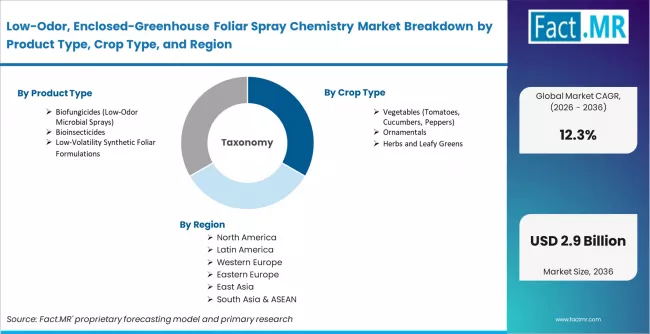
Low Odor Enclosed Greenhouse Foliar Spray Chemistry Market Breakdown By Product Type Crop Type And Region | Source: Fact.MR
| Attribute | Details |
|---|---|
| Quantitative Units | USD 0.8 billion (2026) to USD 2.6 billion (2036), at a CAGR of 12.3% |
| Market Definition | Biofungicides, bioinsecticides, and low-volatility synthetic foliar formulations for crop protection in protected greenhouse vegetable, ornamental, and herb production, supplied with EU biopesticide approval or EPA registration and MRL compliance documentation. |
| Product Type Segmentation | Biofungicides (Low-Odor Microbial Sprays), Bioinsecticides, Low-Volatility Synthetic Foliar Formulations |
| Crop Type Segmentation | Vegetables (Tomatoes, Cucumbers, Peppers), Ornamentals, Herbs and Leafy Greens |
| Formulation Segmentation | Liquid Sprays, Water-Dispersible Concentrates, Aerosol/Fogging Foliar Systems |
| Application Coverage | MRL-compliant biofungicide programmes for export greenhouse vegetable supply, bioinsecticide applications in ornamental and herb production, liquid foliar spray delivery across commercial tomato and cucumber greenhouses, and fogging system chemistry for large-scale enclosed crop protection. |
| Regions Covered | North America, Europe, Asia Pacific, Latin America, Middle East and Africa |
| Countries Covered | USA, Canada, Mexico, Germany, UK, France, Italy, Spain, Netherlands, Turkey, Nordic, BENELUX, China, Japan, South Korea, India, ASEAN, Australia and New Zealand, Brazil, Argentina, Saudi Arabia, GCC, South Africa, Rest of MEA |
| Key Companies Profiled | BASF SE, Bayer AG, Syngenta AG, Corteva Agriscience, Koppert Biological Systems, Biobest Group, Valent BioSciences LLC |
| Forecast Period | 2026 to 2036 |
| Approach | Hybrid top-down and bottom-up model using foliar chemistry producer revenues, greenhouse acreage data by crop and country, average application frequency and rate benchmarks, MRL compliance premium pricing, and primary interviews with greenhouse produce growers and foliar chemistry procurement managers. |
Source: Fact.MR analysis. Updated Apr 28, 2026
Low-Odor, Enclosed-Greenhouse Foliar Spray Chemistry Market by Segments
-
By Product Type:
- Biofungicides (Low-Odor Microbial Sprays)
- Bioinsecticides
- Low-Volatility Synthetic Foliar Formulations
-
By Crop Type:
- Vegetables (Tomatoes, Cucumbers, Peppers)
- Ornamentals
- Herbs and Leafy Greens
-
By Formulation:
- Liquid Sprays
- Water-Dispersible Concentrates
- Aerosol/Fogging Foliar Systems
-
By Region:
- North America
- United States
- Canada
- Mexico
- Latin America
- Brazil
- Mexico
- Argentina
- Rest of Latin America
- Western Europe
- Germany
- United Kingdom
- France
- Italy
- Spain
- Netherlands
- Nordic Countries
- BENELUX
- Rest of Western Europe
- Eastern Europe
- Russia
- Poland
- Turkey
- Rest of Eastern Europe
- East Asia
- China
- Japan
- South Korea
- South Asia and Pacific
- India
- ASEAN
- Australia and New Zealand
- Rest of South Asia and Pacific
- Middle East and Africa
- Kingdom of Saudi Arabia
- Other GCC Countries
- South Africa
- Rest of Middle East and Africa
- North America
Frequently Asked Questions
How large is the global Low-Odor, Enclosed-Greenhouse Foliar Spray Chemistry Market in 2025?
What will the market size be in 2026?
What is the projected market size by 2036?
What is the expected CAGR from 2026 to 2036?
Which product type segment is poised to lead the market?
Which crop type holds the largest share?
Which formulation segment is the most significant?
Which country shows the fastest growth?
What drives demand in this market?
Who are the key players in the market?
Who worked on this report


Preview the report firsthand - request a free sample
Free SampleGet the brochure for pricing and purchase details
Download PDF