Decarbonization-Credited Crop Protection Program Market

Decarbonization-Credited Crop Protection Program Market Size and Share Forecast Outlook 2026 to 2036

Decarbonization-credited crop protection program market is projected to grow from USD 0.7 billion in 2026 to USD 3.1 billion by 2036, at a CAGR of 16.4%. Verified Carbon Credit–Linked Programs will dominate with a 38.0% market share, while reduced-dose chemical programs will lead the crop protection strategy segment with a 34.0% share.

Decarbonization-Credited Crop Protection Program Market Forecast and Outlook 2026 to 2036

The global decarbonization-credited crop protection program market is projected to reach USD 3.14 billion by 2036. The market is valued at USD 0.69 billion in 2026 and is set to rise at a CAGR of 16.4% during the assessment period. By program credit structure, verified carbon credit-linked programs hold a leading 38% share. The reduced-dose chemical programs strategy represents a dominant 34% segment, while row crops account for 48% market share.

Key Takeaways from the Decarbonization-Credited Crop Protection Program Market

  • Market Value for 2026: USD 0.69 Billion
  • Market Value for 2036: USD 3.14 Billion
  • Forecast CAGR (2026-2036): 16.4%
  • Leading Program Credit Structure Share (2026): Verified Carbon Credit-Linked Programs (38%)
  • Leading Crop Protection Strategy Share (2026): Reduced-Dose Chemical Programs (34%)
  • Leading Crop System Share (2026): Row Crops (48%)
  • Key Players in the Market: South Pole (Ag Carbon Programs), Agoro Carbon Alliance, Boomitra, Regrow Ag (MRV Platforms), Soil Capital
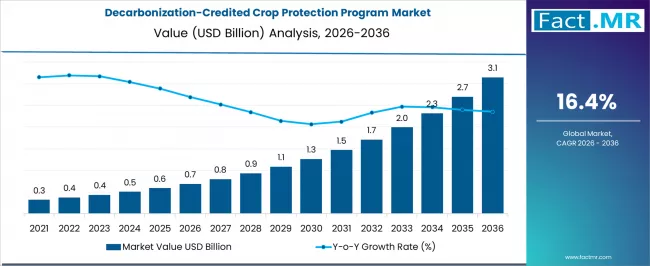
Decarbonization Credited Crop Protection Program Market Market Value Analysis

A pivotal trend is the formal monetization of emission reductions achieved through precision crop protection practices. Programs are evolving beyond simple input reduction to generate verified carbon credits or insetting certificates, creating a new revenue stream for farmers. Innovation centers on robust Measurement, Reporting, and Verification (MRV) platforms that digitally track chemical use, application efficiency, and fuel savings, directly linking agronomic activity to quantifiable carbon units. Integration of these programs with existing carbon market registries and corporate sustainability platforms is accelerating, bridging agriculture with the broader climate economy.

Regulatory and corporate climate commitments are fundamental market drivers. Compliance carbon markets and corporate net-zero pledges generate demand for high-integrity agricultural carbon credits. Policies that assign a carbon price or tax to synthetic inputs make low-emission strategies financially imperative. Supportive government frameworks for agricultural carbon projects, including standardized methodologies for crop protection emission reductions, are lowering barriers to entry and scaling market participation.

Decarbonization-Credited Crop Protection Program Market

Metric Value
Market Value (2026) USD 0.69 Billion
Market Forecast Value (2036) USD 3.14 Billion
Forecast CAGR (2026-2036) 16.4%

Category

Category Segments
Program Credit Structure Verified Carbon Credit–Linked Programs, Scope-3 Emissions Reduction Programs, Insetting-Based Farm Credit Models, Hybrid Offset–Insetting Programs, Others
Crop Protection Strategy Reduced-Dose Chemical Programs, Bio-Chemical Integrated Programs, Precision Application–Optimized Programs, Carbon-Neutral Active Ingredient Programs, Others
Crop System Row Crops (Corn, Soybean, Cotton), Cereals & Grains, Oilseeds & Pulses, Plantation & Specialty Crops, Others
Region North America, Latin America, Western Europe, Eastern Europe, East Asia, South Asia & Pacific, MEA

Segmental Analysis

By Program Credit Structure, Which Model Offers the Greatest Market Liquidity?
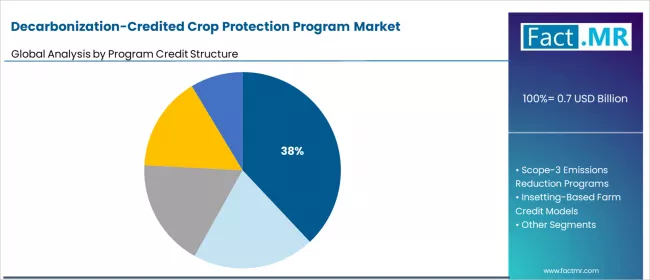
Decarbonization Credited Crop Protection Program Market Analysis By Program Credit Structure

Verified carbon credit-linked programs lead the segment with a 38% share. This dominance stems from their compatibility with regulated and voluntary carbon markets, where credits can be sold to third-party corporations seeking offsets. Farmers receive direct payment for verified tonnes of CO2e reduced through practices like lower herbicide usage or optimized nitrogen management. The transparency and tradability of these credits provide clear financial value, making this structure the most attractive for large-scale adoption and investment.

By Crop Protection Strategy, Which Approach Delivers the Most Direct Emission Cuts?
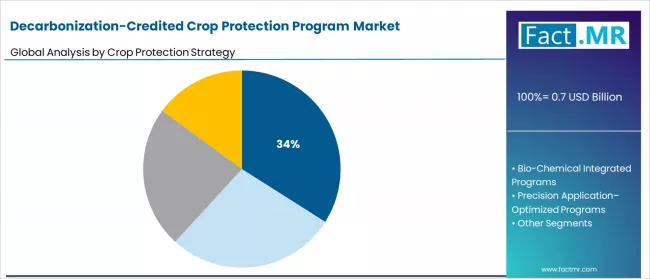
Decarbonization Credited Crop Protection Program Market Analysis By Crop Protection Strategy

Reduced-dose chemical programs hold the largest strategic share at 34%. This strategy tackles decarbonization at its core by minimizing the manufacture and application of synthetic inputs, which are carbon-intensive to produce. Through precision technologies, farmers lower chemical volume per hectare while maintaining efficacy.

The resulting emission reduction is direct, quantifiable, and significant, forming the foundational practice for most credited programs. It offers an immediate path to generating carbon assets while also lowering input costs.

By Crop System, Where is the Scale Conducive to Generating Substantial Credit Volume?
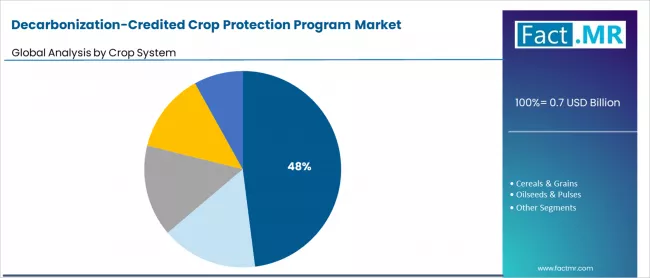
Decarbonization Credited Crop Protection Program Market Analysis By Crop System

Row crops command a dominant 48% share. The vast cultivated area of corn, soybean, and cotton presents an unparalleled opportunity for aggregating large volumes of carbon credits. Even modest per-hectare emission reductions, when multiplied across millions of hectares, yield a substantial carbon asset.

The well-established supply chains and existing adoption of precision agriculture in these systems provide the necessary infrastructure for implementing and verifying credited protection programs at scale.

What are the Drivers, Restraints, and Key Trends of the Decarbonization-Credited Crop Protection Program Market?

Market expansion is driven by aggressive corporate net-zero targets creating unprecedented demand for agricultural carbon credits. Rising input costs incentivize practices that reduce chemical use, aligning economic and environmental goals. Supportive government policy and new carbon accounting methodologies for crop protection provide legitimacy and structure. Consumer preference for low-carbon food products transmits value back through the supply chain, rewarding participants in these programs.

A significant restraint is the complexity and cost of rigorous MRV, which can erode profit margins from credit sales. Farmer skepticism regarding long-term contract lock-ins and data sharing presents an adoption barrier. Market volatility in carbon credit prices introduces financial uncertainty. Proving additionality that emission reductions would not have occurred without the credit program requires careful baseline establishment and ongoing verification.

Key trends include the bundling of carbon credits with premium crop marketing channels. Development of crop-specific decarbonization protocols is gaining traction. Programs are increasingly integrating soil carbon sequestration practices with input reduction for stacked credits. There is a notable shift towards insetting models where food companies directly fund emission reductions within their own supply chains rather than purchasing external offsets.

Analysis of the Decarbonization-Credited Crop Protection Program Market by Key Countries
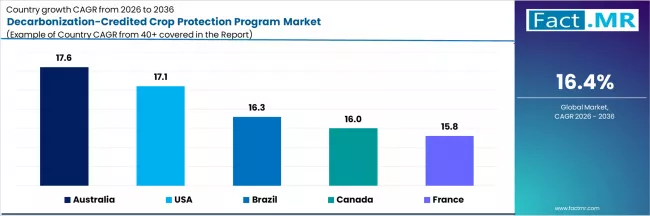
Decarbonization Credited Crop Protection Program Market Cagr Analysis By Country

Country CAGR (2026-2036)
USA 17.10%
Australia 17.60%
Brazil 16.30%
Canada 16.00%
France 15.80%

How does the USA's Compliance Landscape and Agri-Tech Ecosystem Fuel Growth?
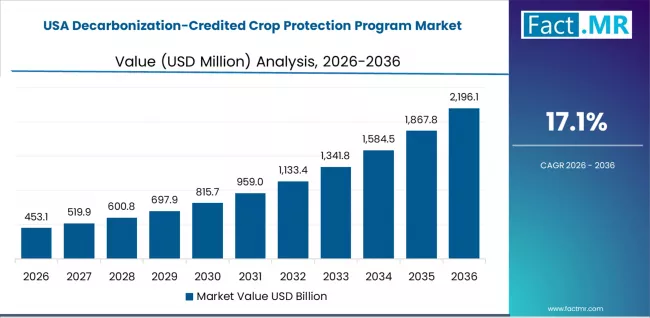
Decarbonization Credited Crop Protection Program Market Country Value Analysis

The USA exhibits a 17.10% CAGR, driven by a maturing voluntary carbon market and a strong agri-tech sector that enables precise input tracking. Major food corporations and grain traders are launching insetting programs, offering premiums for crops grown under credited protection protocols. American farmers are incentivized to join these programs to secure lucrative contracts and future-proof their operations against potential carbon-related input taxes or regulations, leveraging existing precision equipment for verification.

Why does Australia's Established Carbon Framework Position it for Leadership?

Australia leads with a 17.60% growth rate, benefiting from one of the world's most established and government-backed agricultural carbon credit systems. Australian farmers have over a decade of experience with carbon farming initiatives. Decarbonization of crop protection is a logical extension, allowing broadacre grain and cotton growers to generate additional Australian Carbon Credit Units (ACCUs) by verifying reduced herbicide and fertilizer emissions, complementing existing soil carbon projects.

What Role Does Brazil's Scale and Export Market Pressure Play?

The sheer scale of its soybean and corn production and mounting pressure from export markets demanding lower-carbon grain propels Brazil’s 16.30% growth. Brazilian farms, already large and technologically advanced, can aggregate significant credit volumes. Programs here often focus on reducing the carbon footprint of crop protection as part of comprehensive farm-level decarbonization to meet the sustainability requirements of European and Asian buyers, securing market access and price premiums.

How is Canada's Evolving Policy Environment Influencing Program Development?

Canada's 16.00% growth is supported by federal and provincial policies aimed at reducing agricultural emissions. Canadian grower cooperatives and grain handlers are developing hybrid offset-insetting programs. These allow farmers to generate credits from precision pesticide use, which can be sold externally or used to offset the Scope 3 emissions of the cooperative itself, creating a circular model that enhances the sustainability profile of entire grain export supply chains.

What Factors Underpin France's Regulatory Leadership in Agri-Decarbonization?

France's 15.80% growth, though slightly more moderate, reflects its role as a regulated pioneer within the EU. The national low-carbon strategy and stringent EU Farm to Fork targets create a compliance-driven environment. French programs often employ insetting models, where food processors and retailers directly finance input reduction programs among their contracted farmers to lower the corporate carbon footprint of their products, aligning with strict national and EU sustainability regulations.

Competitive Landscape of the Decarbonization-Credited Crop Protection Program Market
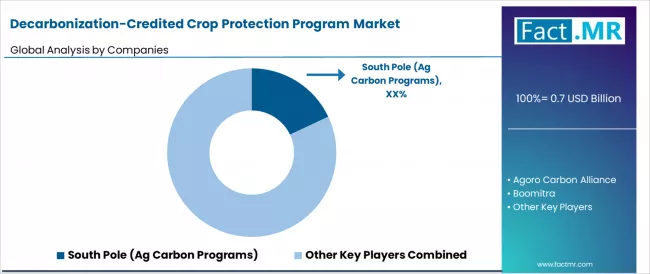
Decarbonization Credited Crop Protection Program Market Analysis By Company

Specialized carbon project developers, MRV technology firms, contest the landscape and agricultural input networks. Established carbon project developers like South Pole and Agoro Carbon Alliance compete by bringing methodological expertise and access to global credit marketplaces. They develop standardized programs for crop protection decarbonization, aggregate projects across thousands of farms, and handle the complex verification and credit issuance process.

Technology-focused MRV platforms like Boomitra, Regrow Ag, and Soil Capital compete through advanced digital tools for monitoring, reporting, and verifying practice changes and emission reductions. Their advantage lies in automated data collection, sophisticated modeling, and providing transparent, audit-ready records. Competition centers on the accuracy and cost-effectiveness of the MRV process, the ability to integrate with farm management software, and forming strategic alliances with large agribusinesses to deploy programs across vast networks of growers.

Key Players in the Decarbonization-Credited Crop Protection Program Market

  • South Pole (Ag Carbon Programs)
  • Agoro Carbon Alliance
  • Boomitra
  • Regrow Ag (MRV Platforms)
  • Soil Capital

Scope of Report

Items Values
Quantitative Units USD Billion
Program Credit Structure Verified Carbon Credit–Linked Programs, Scope-3 Emissions Reduction Programs, Insetting-Based Farm Credit Models, Hybrid Offset–Insetting Programs, Others
Crop Protection Strategy Reduced-Dose Chemical Programs, Bio-Chemical Integrated Programs, Precision Application–Optimized Programs, Carbon-Neutral Active Ingredient Programs, Others
Crop System Row Crops (Corn, Soybean, Cotton), Cereals & Grains, Oilseeds & Pulses, Plantation & Specialty Crops, Others
Key Countries USA, Australia, Brazil, Canada, France
Key Companies South Pole (Ag Carbon Programs), Agoro Carbon Alliance, Boomitra, Regrow Ag (MRV Platforms), Soil Capital
Additional Analysis Analysis of carbon accounting methodologies for crop protection, MRV technology stack comparison, contract structures and risk sharing in credit programs, and integration with Scope 3 corporate reporting standards.

Decarbonization-Credited Crop Protection Program Market by Segments

  • Program Credit Structure :

    • Verified Carbon Credit-Linked Programs
    • Scope-3 Emissions Reduction Programs
    • Insetting-Based Farm Credit Models
    • Hybrid Offset-Insetting Programs
    • Others
  • Crop Protection Strategy :

    • Reduced-Dose Chemical Programs
    • Bio-Chemical Integrated Programs
    • Precision Application-Optimized Programs
    • Carbon-Neutral Active Ingredient Programs
    • Others
  • Crop System :

    • Row Crops (Corn, Soybean, Cotton)
    • Cereals & Grains
    • Oilseeds & Pulses
    • Plantation & Specialty Crops
    • Others
  • Region :

    • North America

      • USA
      • Canada
    • Latin America

      • Brazil
      • Mexico
      • Argentina
      • Rest of Latin America
    • Western Europe

      • Germany
      • UK
      • France
      • Spain
      • Italy
      • BENELUX
      • Rest of Western Europe
    • Eastern Europe

      • Czech Republic
      • Poland
      • Russia
      • Rest of Eastern Europe
    • East Asia

      • China
      • Japan
      • South Korea
      • Rest of East Asia
    • South Asia & Pacific

      • India
      • Indonesia
      • Australia
      • Rest of South Asia & Pacific
    • MEA

      • GCC Countries
      • Turkiye
      • Saudi Arabia
      • Rest of MEA

Table of Content

  1. Executive Summary
    • Global Market Outlook
    • Demand to side Trends
    • Supply to side Trends
    • Technology Roadmap Analysis
    • Analysis and Recommendations
  2. Market Overview
    • Market Coverage / Taxonomy
    • Market Definition / Scope / Limitations
  3. Market Background
    • Market Dynamics
      • Drivers
      • Restraints
      • Opportunity
      • Trends
    • Scenario Forecast
      • Demand in Optimistic Scenario
      • Demand in Likely Scenario
      • Demand in Conservative Scenario
    • Opportunity Map Analysis
    • Product Life Cycle Analysis
    • Supply Chain Analysis
    • Investment Feasibility Matrix
    • Value Chain Analysis
    • PESTLE and Porter’s Analysis
    • Regulatory Landscape
    • Regional Parent Market Outlook
    • Production and Consumption Statistics
    • Import and Export Statistics
  4. Global Market Analysis 2021 to 2025 and Forecast, 2026 to 2036
    • Historical Market Size Value (USD Million) Analysis, 2021 to 2025
    • Current and Future Market Size Value (USD Million) Projections, 2026 to 2036
      • Y to o to Y Growth Trend Analysis
      • Absolute $ Opportunity Analysis
  5. Global Market Pricing Analysis 2021 to 2025 and Forecast 2026 to 2036
  6. Global Market Analysis 2021 to 2025 and Forecast 2026 to 2036, By Program Credit Structure
    • Introduction / Key Findings
    • Historical Market Size Value (USD Million) Analysis By Program Credit Structure, 2021 to 2025
    • Current and Future Market Size Value (USD Million) Analysis and Forecast By Program Credit Structure, 2026 to 2036
      • Verified Carbon Credit–Linked Programs
      • Scope-3 Emissions Reduction Programs
      • Insetting-Based Farm Credit Models
      • Hybrid Offset–Insetting Programs
      • Others
    • Y to o to Y Growth Trend Analysis By Program Credit Structure, 2021 to 2025
    • Absolute $ Opportunity Analysis By Program Credit Structure, 2026 to 2036
  7. Global Market Analysis 2021 to 2025 and Forecast 2026 to 2036, By Crop Protection Strategy
    • Introduction / Key Findings
    • Historical Market Size Value (USD Million) Analysis By Crop Protection Strategy, 2021 to 2025
    • Current and Future Market Size Value (USD Million) Analysis and Forecast By Crop Protection Strategy, 2026 to 2036
      • Reduced-Dose Chemical Programs
      • Bio-Chemical Integrated Programs
      • Precision Application–Optimized Programs
      • Carbon-Neutral Active Ingredient Programs
    • Y to o to Y Growth Trend Analysis By Crop Protection Strategy, 2021 to 2025
    • Absolute $ Opportunity Analysis By Crop Protection Strategy, 2026 to 2036
  8. Global Market Analysis 2021 to 2025 and Forecast 2026 to 2036, By Crop System
    • Introduction / Key Findings
    • Historical Market Size Value (USD Million) Analysis By Crop System, 2021 to 2025
    • Current and Future Market Size Value (USD Million) Analysis and Forecast By Crop System, 2026 to 2036
      • Row Crops (Corn, Soybean, Cotton)
      • Cereals & Grains
      • Oilseeds & Pulses
      • Plantation & Specialty Crops
      • Others
    • Y to o to Y Growth Trend Analysis By Crop System, 2021 to 2025
    • Absolute $ Opportunity Analysis By Crop System, 2026 to 2036
  9. Global Market Analysis 2021 to 2025 and Forecast 2026 to 2036, By Region
    • Introduction
    • Historical Market Size Value (USD Million) Analysis By Region, 2021 to 2025
    • Current Market Size Value (USD Million) Analysis and Forecast By Region, 2026 to 2036
      • North America
      • Latin America
      • Western Europe
      • Eastern Europe
      • East Asia
      • South Asia and Pacific
      • Middle East & Africa
    • Market Attractiveness Analysis By Region
  10. North America Market Analysis 2021 to 2025 and Forecast 2026 to 2036, By Country
    • Historical Market Size Value (USD Million) Trend Analysis By Market Taxonomy, 2021 to 2025
    • Market Size Value (USD Million) Forecast By Market Taxonomy, 2026 to 2036
      • By Country
        • USA
        • Canada
        • Mexico
      • By Program Credit Structure
      • By Crop Protection Strategy
      • By Crop System
    • Market Attractiveness Analysis
      • By Country
      • By Program Credit Structure
      • By Crop Protection Strategy
      • By Crop System
    • Key Takeaways
  11. Latin America Market Analysis 2021 to 2025 and Forecast 2026 to 2036, By Country
    • Historical Market Size Value (USD Million) Trend Analysis By Market Taxonomy, 2021 to 2025
    • Market Size Value (USD Million) Forecast By Market Taxonomy, 2026 to 2036
      • By Country
        • Brazil
        • Chile
        • Rest of Latin America
      • By Program Credit Structure
      • By Crop Protection Strategy
      • By Crop System
    • Market Attractiveness Analysis
      • By Country
      • By Program Credit Structure
      • By Crop Protection Strategy
      • By Crop System
    • Key Takeaways
  12. Western Europe Market Analysis 2021 to 2025 and Forecast 2026 to 2036, By Country
    • Historical Market Size Value (USD Million) Trend Analysis By Market Taxonomy, 2021 to 2025
    • Market Size Value (USD Million) Forecast By Market Taxonomy, 2026 to 2036
      • By Country
        • Germany
        • UK
        • Italy
        • Spain
        • France
        • Nordic
        • BENELUX
        • Rest of Western Europe
      • By Program Credit Structure
      • By Crop Protection Strategy
      • By Crop System
    • Market Attractiveness Analysis
      • By Country
      • By Program Credit Structure
      • By Crop Protection Strategy
      • By Crop System
    • Key Takeaways
  13. Eastern Europe Market Analysis 2021 to 2025 and Forecast 2026 to 2036, By Country
    • Historical Market Size Value (USD Million) Trend Analysis By Market Taxonomy, 2021 to 2025
    • Market Size Value (USD Million) Forecast By Market Taxonomy, 2026 to 2036
      • By Country
        • Russia
        • Poland
        • Hungary
        • Balkan & Baltic
        • Rest of Eastern Europe
      • By Program Credit Structure
      • By Crop Protection Strategy
      • By Crop System
    • Market Attractiveness Analysis
      • By Country
      • By Program Credit Structure
      • By Crop Protection Strategy
      • By Crop System
    • Key Takeaways
  14. East Asia Market Analysis 2021 to 2025 and Forecast 2026 to 2036, By Country
    • Historical Market Size Value (USD Million) Trend Analysis By Market Taxonomy, 2021 to 2025
    • Market Size Value (USD Million) Forecast By Market Taxonomy, 2026 to 2036
      • By Country
        • China
        • Japan
        • South Korea
      • By Program Credit Structure
      • By Crop Protection Strategy
      • By Crop System
    • Market Attractiveness Analysis
      • By Country
      • By Program Credit Structure
      • By Crop Protection Strategy
      • By Crop System
    • Key Takeaways
  15. South Asia and Pacific Market Analysis 2021 to 2025 and Forecast 2026 to 2036, By Country
    • Historical Market Size Value (USD Million) Trend Analysis By Market Taxonomy, 2021 to 2025
    • Market Size Value (USD Million) Forecast By Market Taxonomy, 2026 to 2036
      • By Country
        • India
        • ASEAN
        • Australia & New Zealand
        • Rest of South Asia and Pacific
      • By Program Credit Structure
      • By Crop Protection Strategy
      • By Crop System
    • Market Attractiveness Analysis
      • By Country
      • By Program Credit Structure
      • By Crop Protection Strategy
      • By Crop System
    • Key Takeaways
  16. Middle East & Africa Market Analysis 2021 to 2025 and Forecast 2026 to 2036, By Country
    • Historical Market Size Value (USD Million) Trend Analysis By Market Taxonomy, 2021 to 2025
    • Market Size Value (USD Million) Forecast By Market Taxonomy, 2026 to 2036
      • By Country
        • Kingdom of Saudi Arabia
        • Other GCC Countries
        • Turkiye
        • South Africa
        • Other African Union
        • Rest of Middle East & Africa
      • By Program Credit Structure
      • By Crop Protection Strategy
      • By Crop System
    • Market Attractiveness Analysis
      • By Country
      • By Program Credit Structure
      • By Crop Protection Strategy
      • By Crop System
    • Key Takeaways
  17. Key Countries Market Analysis
    • USA
      • Pricing Analysis
      • Market Share Analysis, 2025
        • By Program Credit Structure
        • By Crop Protection Strategy
        • By Crop System
    • Canada
      • Pricing Analysis
      • Market Share Analysis, 2025
        • By Program Credit Structure
        • By Crop Protection Strategy
        • By Crop System
    • Mexico
      • Pricing Analysis
      • Market Share Analysis, 2025
        • By Program Credit Structure
        • By Crop Protection Strategy
        • By Crop System
    • Brazil
      • Pricing Analysis
      • Market Share Analysis, 2025
        • By Program Credit Structure
        • By Crop Protection Strategy
        • By Crop System
    • Chile
      • Pricing Analysis
      • Market Share Analysis, 2025
        • By Program Credit Structure
        • By Crop Protection Strategy
        • By Crop System
    • Germany
      • Pricing Analysis
      • Market Share Analysis, 2025
        • By Program Credit Structure
        • By Crop Protection Strategy
        • By Crop System
    • UK
      • Pricing Analysis
      • Market Share Analysis, 2025
        • By Program Credit Structure
        • By Crop Protection Strategy
        • By Crop System
    • Italy
      • Pricing Analysis
      • Market Share Analysis, 2025
        • By Program Credit Structure
        • By Crop Protection Strategy
        • By Crop System
    • Spain
      • Pricing Analysis
      • Market Share Analysis, 2025
        • By Program Credit Structure
        • By Crop Protection Strategy
        • By Crop System
    • France
      • Pricing Analysis
      • Market Share Analysis, 2025
        • By Program Credit Structure
        • By Crop Protection Strategy
        • By Crop System
    • India
      • Pricing Analysis
      • Market Share Analysis, 2025
        • By Program Credit Structure
        • By Crop Protection Strategy
        • By Crop System
    • ASEAN
      • Pricing Analysis
      • Market Share Analysis, 2025
        • By Program Credit Structure
        • By Crop Protection Strategy
        • By Crop System
    • Australia & New Zealand
      • Pricing Analysis
      • Market Share Analysis, 2025
        • By Program Credit Structure
        • By Crop Protection Strategy
        • By Crop System
    • China
      • Pricing Analysis
      • Market Share Analysis, 2025
        • By Program Credit Structure
        • By Crop Protection Strategy
        • By Crop System
    • Japan
      • Pricing Analysis
      • Market Share Analysis, 2025
        • By Program Credit Structure
        • By Crop Protection Strategy
        • By Crop System
    • South Korea
      • Pricing Analysis
      • Market Share Analysis, 2025
        • By Program Credit Structure
        • By Crop Protection Strategy
        • By Crop System
    • Russia
      • Pricing Analysis
      • Market Share Analysis, 2025
        • By Program Credit Structure
        • By Crop Protection Strategy
        • By Crop System
    • Poland
      • Pricing Analysis
      • Market Share Analysis, 2025
        • By Program Credit Structure
        • By Crop Protection Strategy
        • By Crop System
    • Hungary
      • Pricing Analysis
      • Market Share Analysis, 2025
        • By Program Credit Structure
        • By Crop Protection Strategy
        • By Crop System
    • Kingdom of Saudi Arabia
      • Pricing Analysis
      • Market Share Analysis, 2025
        • By Program Credit Structure
        • By Crop Protection Strategy
        • By Crop System
    • Turkiye
      • Pricing Analysis
      • Market Share Analysis, 2025
        • By Program Credit Structure
        • By Crop Protection Strategy
        • By Crop System
    • South Africa
      • Pricing Analysis
      • Market Share Analysis, 2025
        • By Program Credit Structure
        • By Crop Protection Strategy
        • By Crop System
  18. Market Structure Analysis
    • Competition Dashboard
    • Competition Benchmarking
    • Market Share Analysis of Top Players
      • By Regional
      • By Program Credit Structure
      • By Crop Protection Strategy
      • By Crop System
  19. Competition Analysis
    • Competition Deep Dive
      • South Pole (Ag Carbon Programs)
        • Overview
        • Product Portfolio
        • Profitability by Market Segments (Product/Age /Sales Channel/Region)
        • Sales Footprint
        • Strategy Overview
          • Marketing Strategy
          • Product Strategy
          • Channel Strategy
      • Agoro Carbon Alliance
      • Boomitra
      • Regrow Ag (MRV Platforms)
      • Soil Capital
      • Others
  20. Assumptions & Acronyms Used
  21. Research Methodology

List Of Table

  • Table 1: Global Market Value (USD Million) Forecast by Region, 2021 to 2036
  • Table 2: Global Market Value (USD Million) Forecast by Program Credit Structure, 2021 to 2036
  • Table 3: Global Market Value (USD Million) Forecast by Crop Protection Strategy, 2021 to 2036
  • Table 4: Global Market Value (USD Million) Forecast by Crop System, 2021 to 2036
  • Table 5: North America Market Value (USD Million) Forecast by Country, 2021 to 2036
  • Table 6: North America Market Value (USD Million) Forecast by Program Credit Structure, 2021 to 2036
  • Table 7: North America Market Value (USD Million) Forecast by Crop Protection Strategy, 2021 to 2036
  • Table 8: North America Market Value (USD Million) Forecast by Crop System, 2021 to 2036
  • Table 9: Latin America Market Value (USD Million) Forecast by Country, 2021 to 2036
  • Table 10: Latin America Market Value (USD Million) Forecast by Program Credit Structure, 2021 to 2036
  • Table 11: Latin America Market Value (USD Million) Forecast by Crop Protection Strategy, 2021 to 2036
  • Table 12: Latin America Market Value (USD Million) Forecast by Crop System, 2021 to 2036
  • Table 13: Western Europe Market Value (USD Million) Forecast by Country, 2021 to 2036
  • Table 14: Western Europe Market Value (USD Million) Forecast by Program Credit Structure, 2021 to 2036
  • Table 15: Western Europe Market Value (USD Million) Forecast by Crop Protection Strategy, 2021 to 2036
  • Table 16: Western Europe Market Value (USD Million) Forecast by Crop System, 2021 to 2036
  • Table 17: Eastern Europe Market Value (USD Million) Forecast by Country, 2021 to 2036
  • Table 18: Eastern Europe Market Value (USD Million) Forecast by Program Credit Structure, 2021 to 2036
  • Table 19: Eastern Europe Market Value (USD Million) Forecast by Crop Protection Strategy, 2021 to 2036
  • Table 20: Eastern Europe Market Value (USD Million) Forecast by Crop System, 2021 to 2036
  • Table 21: East Asia Market Value (USD Million) Forecast by Country, 2021 to 2036
  • Table 22: East Asia Market Value (USD Million) Forecast by Program Credit Structure, 2021 to 2036
  • Table 23: East Asia Market Value (USD Million) Forecast by Crop Protection Strategy, 2021 to 2036
  • Table 24: East Asia Market Value (USD Million) Forecast by Crop System, 2021 to 2036
  • Table 25: South Asia and Pacific Market Value (USD Million) Forecast by Country, 2021 to 2036
  • Table 26: South Asia and Pacific Market Value (USD Million) Forecast by Program Credit Structure, 2021 to 2036
  • Table 27: South Asia and Pacific Market Value (USD Million) Forecast by Crop Protection Strategy, 2021 to 2036
  • Table 28: South Asia and Pacific Market Value (USD Million) Forecast by Crop System, 2021 to 2036
  • Table 29: Middle East & Africa Market Value (USD Million) Forecast by Country, 2021 to 2036
  • Table 30: Middle East & Africa Market Value (USD Million) Forecast by Program Credit Structure, 2021 to 2036
  • Table 31: Middle East & Africa Market Value (USD Million) Forecast by Crop Protection Strategy, 2021 to 2036
  • Table 32: Middle East & Africa Market Value (USD Million) Forecast by Crop System, 2021 to 2036

List Of Figures

  • Figure 1: Global Market Pricing Analysis
  • Figure 2: Global Market Value (USD Million) Forecast 2021 to 2036
  • Figure 3: Global Market Value Share and BPS Analysis by Program Credit Structure, 2026 and 2036
  • Figure 4: Global Market Y to o to Y Growth Comparison by Program Credit Structure, 2026 to 2036
  • Figure 5: Global Market Attractiveness Analysis by Program Credit Structure
  • Figure 6: Global Market Value Share and BPS Analysis by Crop Protection Strategy, 2026 and 2036
  • Figure 7: Global Market Y to o to Y Growth Comparison by Crop Protection Strategy, 2026 to 2036
  • Figure 8: Global Market Attractiveness Analysis by Crop Protection Strategy
  • Figure 9: Global Market Value Share and BPS Analysis by Crop System, 2026 and 2036
  • Figure 10: Global Market Y to o to Y Growth Comparison by Crop System, 2026 to 2036
  • Figure 11: Global Market Attractiveness Analysis by Crop System
  • Figure 12: Global Market Value (USD Million) Share and BPS Analysis by Region, 2026 and 2036
  • Figure 13: Global Market Y to o to Y Growth Comparison by Region, 2026 to 2036
  • Figure 14: Global Market Attractiveness Analysis by Region
  • Figure 15: North America Market Incremental Dollar Opportunity, 2026 to 2036
  • Figure 16: Latin America Market Incremental Dollar Opportunity, 2026 to 2036
  • Figure 17: Western Europe Market Incremental Dollar Opportunity, 2026 to 2036
  • Figure 18: Eastern Europe Market Incremental Dollar Opportunity, 2026 to 2036
  • Figure 19: East Asia Market Incremental Dollar Opportunity, 2026 to 2036
  • Figure 20: South Asia and Pacific Market Incremental Dollar Opportunity, 2026 to 2036
  • Figure 21: Middle East & Africa Market Incremental Dollar Opportunity, 2026 to 2036
  • Figure 22: North America Market Value Share and BPS Analysis by Country, 2026 and 2036
  • Figure 23: North America Market Value Share and BPS Analysis by Program Credit Structure, 2026 and 2036
  • Figure 24: North America Market Y to o to Y Growth Comparison by Program Credit Structure, 2026 to 2036
  • Figure 25: North America Market Attractiveness Analysis by Program Credit Structure
  • Figure 26: North America Market Value Share and BPS Analysis by Crop Protection Strategy, 2026 and 2036
  • Figure 27: North America Market Y to o to Y Growth Comparison by Crop Protection Strategy, 2026 to 2036
  • Figure 28: North America Market Attractiveness Analysis by Crop Protection Strategy
  • Figure 29: North America Market Value Share and BPS Analysis by Crop System, 2026 and 2036
  • Figure 30: North America Market Y to o to Y Growth Comparison by Crop System, 2026 to 2036
  • Figure 31: North America Market Attractiveness Analysis by Crop System
  • Figure 32: Latin America Market Value Share and BPS Analysis by Country, 2026 and 2036
  • Figure 33: Latin America Market Value Share and BPS Analysis by Program Credit Structure, 2026 and 2036
  • Figure 34: Latin America Market Y to o to Y Growth Comparison by Program Credit Structure, 2026 to 2036
  • Figure 35: Latin America Market Attractiveness Analysis by Program Credit Structure
  • Figure 36: Latin America Market Value Share and BPS Analysis by Crop Protection Strategy, 2026 and 2036
  • Figure 37: Latin America Market Y to o to Y Growth Comparison by Crop Protection Strategy, 2026 to 2036
  • Figure 38: Latin America Market Attractiveness Analysis by Crop Protection Strategy
  • Figure 39: Latin America Market Value Share and BPS Analysis by Crop System, 2026 and 2036
  • Figure 40: Latin America Market Y to o to Y Growth Comparison by Crop System, 2026 to 2036
  • Figure 41: Latin America Market Attractiveness Analysis by Crop System
  • Figure 42: Western Europe Market Value Share and BPS Analysis by Country, 2026 and 2036
  • Figure 43: Western Europe Market Value Share and BPS Analysis by Program Credit Structure, 2026 and 2036
  • Figure 44: Western Europe Market Y to o to Y Growth Comparison by Program Credit Structure, 2026 to 2036
  • Figure 45: Western Europe Market Attractiveness Analysis by Program Credit Structure
  • Figure 46: Western Europe Market Value Share and BPS Analysis by Crop Protection Strategy, 2026 and 2036
  • Figure 47: Western Europe Market Y to o to Y Growth Comparison by Crop Protection Strategy, 2026 to 2036
  • Figure 48: Western Europe Market Attractiveness Analysis by Crop Protection Strategy
  • Figure 49: Western Europe Market Value Share and BPS Analysis by Crop System, 2026 and 2036
  • Figure 50: Western Europe Market Y to o to Y Growth Comparison by Crop System, 2026 to 2036
  • Figure 51: Western Europe Market Attractiveness Analysis by Crop System
  • Figure 52: Eastern Europe Market Value Share and BPS Analysis by Country, 2026 and 2036
  • Figure 53: Eastern Europe Market Value Share and BPS Analysis by Program Credit Structure, 2026 and 2036
  • Figure 54: Eastern Europe Market Y to o to Y Growth Comparison by Program Credit Structure, 2026 to 2036
  • Figure 55: Eastern Europe Market Attractiveness Analysis by Program Credit Structure
  • Figure 56: Eastern Europe Market Value Share and BPS Analysis by Crop Protection Strategy, 2026 and 2036
  • Figure 57: Eastern Europe Market Y to o to Y Growth Comparison by Crop Protection Strategy, 2026 to 2036
  • Figure 58: Eastern Europe Market Attractiveness Analysis by Crop Protection Strategy
  • Figure 59: Eastern Europe Market Value Share and BPS Analysis by Crop System, 2026 and 2036
  • Figure 60: Eastern Europe Market Y to o to Y Growth Comparison by Crop System, 2026 to 2036
  • Figure 61: Eastern Europe Market Attractiveness Analysis by Crop System
  • Figure 62: East Asia Market Value Share and BPS Analysis by Country, 2026 and 2036
  • Figure 63: East Asia Market Value Share and BPS Analysis by Program Credit Structure, 2026 and 2036
  • Figure 64: East Asia Market Y to o to Y Growth Comparison by Program Credit Structure, 2026 to 2036
  • Figure 65: East Asia Market Attractiveness Analysis by Program Credit Structure
  • Figure 66: East Asia Market Value Share and BPS Analysis by Crop Protection Strategy, 2026 and 2036
  • Figure 67: East Asia Market Y to o to Y Growth Comparison by Crop Protection Strategy, 2026 to 2036
  • Figure 68: East Asia Market Attractiveness Analysis by Crop Protection Strategy
  • Figure 69: East Asia Market Value Share and BPS Analysis by Crop System, 2026 and 2036
  • Figure 70: East Asia Market Y to o to Y Growth Comparison by Crop System, 2026 to 2036
  • Figure 71: East Asia Market Attractiveness Analysis by Crop System
  • Figure 72: South Asia and Pacific Market Value Share and BPS Analysis by Country, 2026 and 2036
  • Figure 73: South Asia and Pacific Market Value Share and BPS Analysis by Program Credit Structure, 2026 and 2036
  • Figure 74: South Asia and Pacific Market Y to o to Y Growth Comparison by Program Credit Structure, 2026 to 2036
  • Figure 75: South Asia and Pacific Market Attractiveness Analysis by Program Credit Structure
  • Figure 76: South Asia and Pacific Market Value Share and BPS Analysis by Crop Protection Strategy, 2026 and 2036
  • Figure 77: South Asia and Pacific Market Y to o to Y Growth Comparison by Crop Protection Strategy, 2026 to 2036
  • Figure 78: South Asia and Pacific Market Attractiveness Analysis by Crop Protection Strategy
  • Figure 79: South Asia and Pacific Market Value Share and BPS Analysis by Crop System, 2026 and 2036
  • Figure 80: South Asia and Pacific Market Y to o to Y Growth Comparison by Crop System, 2026 to 2036
  • Figure 81: South Asia and Pacific Market Attractiveness Analysis by Crop System
  • Figure 82: Middle East & Africa Market Value Share and BPS Analysis by Country, 2026 and 2036
  • Figure 83: Middle East & Africa Market Value Share and BPS Analysis by Program Credit Structure, 2026 and 2036
  • Figure 84: Middle East & Africa Market Y to o to Y Growth Comparison by Program Credit Structure, 2026 to 2036
  • Figure 85: Middle East & Africa Market Attractiveness Analysis by Program Credit Structure
  • Figure 86: Middle East & Africa Market Value Share and BPS Analysis by Crop Protection Strategy, 2026 and 2036
  • Figure 87: Middle East & Africa Market Y to o to Y Growth Comparison by Crop Protection Strategy, 2026 to 2036
  • Figure 88: Middle East & Africa Market Attractiveness Analysis by Crop Protection Strategy
  • Figure 89: Middle East & Africa Market Value Share and BPS Analysis by Crop System, 2026 and 2036
  • Figure 90: Middle East & Africa Market Y to o to Y Growth Comparison by Crop System, 2026 to 2036
  • Figure 91: Middle East & Africa Market Attractiveness Analysis by Crop System
  • Figure 92: Global Market - Tier Structure Analysis
  • Figure 93: Global Market - Company Share Analysis

- FAQs -

How big is the decarbonization-credited crop protection program market in 2026?

The global decarbonization-credited crop protection program market is estimated to be valued at USD 0.7 billion in 2026.

What will be the size of decarbonization-credited crop protection program market in 2036?

The market size for the decarbonization-credited crop protection program market is projected to reach USD 3.1 billion by 2036.

How much will be the decarbonization-credited crop protection program market growth between 2026 and 2036?

The decarbonization-credited crop protection program market is expected to grow at a 16.4% CAGR between 2026 and 2036.

What are the key product types in the decarbonization-credited crop protection program market?

The key product types in decarbonization-credited crop protection program market are verified carbon credit–linked programs, scope-3 emissions reduction programs, insetting-based farm credit models, hybrid offset–insetting programs and others.

Which crop protection strategy segment to contribute significant share in the decarbonization-credited crop protection program market in 2026?

In terms of crop protection strategy, reduced-dose chemical programs segment to command 34.0% share in the decarbonization-credited crop protection program market in 2026.

Decarbonization-Credited Crop Protection Program Market