Organic Wine Market
Organic Wine Market Size and Share Forecast Outlook 2025 to 2035
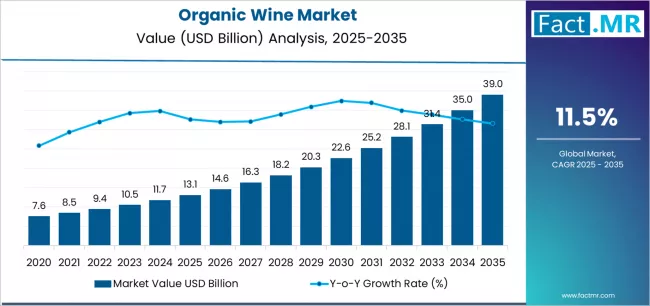
Organic wine market is projected to grow from USD 13.1 billion in 2025 to USD 39.0 billion by 2035, at a CAGR of 11.5%. Organic Red Wine will dominate with a 61.9% market share, while bottles will lead the packaging segment with a 91.1% share.
Organic Wine Market Forecast and Outlook 2025 to 2035
The global organic wine market is projected to reach USD 39.0 billion by 2035, recording an absolute increase of USD 25.9 billion over the forecast period. The market is valued at USD 13.1 billion in 2025 and is set to rise at a CAGR of 11.5% during the assessment period.
Consumption of organic wine is expected to grow by approximately 3.0 times during the same period, supported by increasing consumer preference for sustainable and organic food and beverage products worldwide, driving demand for certified organic wines and increasing investments in organic viticulture practices with environmental benefits across premium wine production and natural winemaking applications globally.
Quick Stats for Organic Wine Market
- Organic Wine Market Value (2025): USD 13.1 billion
- Organic Wine Market Forecast Value (2035): USD 39.0 billion
- Organic Wine Market Forecast CAGR: 11.5%
- Leading Type in Organic Wine Market: Organic Red Wine (61.9%)
- Key Growth Regions in Organic Wine Market: Europe, North America, and Asia Pacific
- Top Players in Organic Wine Market: Bronco Wine Company, Kendall-Jackson Winery, King Estate Winery, Boisset Collection - JCB, Emiliana Organic Vineyards, Societa Agricola Querciabella SpA, Grgich Hills Estate, Avondale, Frey Vineyards, The Organic Wine Company

Wine consumers are seeking out environmentally conscious purchasing decisions while seeking authentic flavor profiles and health-oriented choices, with modern organic wines providing documented benefits including absence of synthetic pesticides, lower sulfite levels, and sustainable vineyard management compared to conventional wine production alone.
Rising awareness about environmental sustainability and expanding organic certification frameworks enabling transparent production verification create substantial opportunities for organic wineries and distribution partners. However, higher production costs and limited vineyard conversion rates may pose obstacles to widespread market expansion.
The organic red wine segment dominates market activity, driven by consumer preference for full-bodied varietals and established organic production methods across traditional wine regions worldwide. Wine enthusiasts increasingly recognize the quality benefits of organic red wines, with typical product offerings providing authentic terroir expression and sustainable production credentials at premium price points through established wine retail networks.
The organic white wine segment demonstrates meaningful presence, supported by growing demand for lighter wine styles and organic production adoption in white grape varietals. Bottles emerge as the dominant packaging format, reflecting traditional wine consumption patterns and premium product positioning across global wine markets.
Regional dynamics show Europe maintaining market leadership, supported by established organic viticulture and stringent certification standards. North America demonstrates strong growth trajectory driven by premium wine consumption and expanding organic vineyard acreage, while Asia Pacific emphasizes emerging wine culture and increasing disposable incomes.
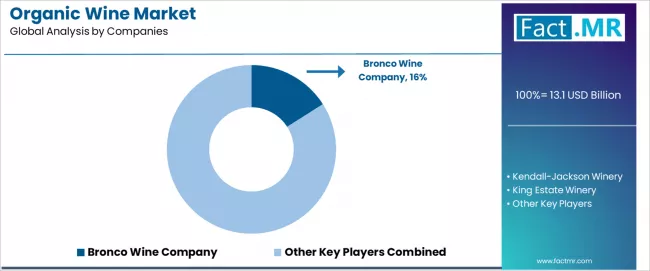
China leads country-level growth through rapidly growing wine consumption and rising interest in organic products, followed by USA supported by premium organic wine demand and expanding certified vineyards. The competitive landscape features moderate concentration with Bronco Wine Company maintaining market leadership position, while established organic wineries including Kendall-Jackson Winery, King Estate Winery, and Emiliana Organic Vineyards compete through premium product portfolios and comprehensive sustainability programs across diverse wine categories.
Organic Wine Market Year-over-Year Forecast 2025 to 2035
Between 2025 and 2029, the organic wine market is projected to expand from USD 13.1 billion to USD 20.0 billion, resulting in a value increase of USD 6.9 billion, which represents 26.6% of the total forecast growth for the period. This phase of development will be shaped by rising demand for premium organic red wines and sustainable viticulture practices addressing environmental concerns, product innovation in organic winemaking techniques with minimal intervention approaches and biodynamic certification adoption, as well as expanding integration with wine tourism experiences and direct-to-consumer sales channels. Companies are establishing competitive positions through investment in organic vineyard conversion, advanced sustainable viticulture technologies, and strategic market expansion across specialty wine retailers, restaurant partnerships, and e-commerce platforms.
From 2029 to 2035, the market is forecast to grow from USD 20.0 billion to USD 39.0 billion, adding another USD 19.0 billion, which constitutes 73.4% of the overall expansion. This period is expected to be characterized by the expansion of specialized wine applications, including single-vineyard organic expressions and regenerative agriculture wine production tailored for conscious consumers, strategic collaborations between organic wineries and sustainable hospitality groups, and an enhanced focus on carbon-neutral production and biodiversity preservation initiatives. The growing emphasis on natural wine movement and rising adoption of alternative packaging formats addressing sustainability concerns will drive demand for comprehensive organic wine solutions across diverse consumer segments.
Organic Wine Market Key Takeaways
| Metric | Value |
|---|---|
| Market Value (2025) | USD 13.1 billion |
| Market Forecast Value (2035) | USD 39.0 billion |
| Forecast CAGR (2025-2035) | 11.5% |
Why is the Organic Wine Market Growing?
The organic wine market grows by enabling environmentally conscious consumers to enjoy premium wine experiences while supporting sustainable agriculture practices and avoiding synthetic chemical exposure without compromising taste quality or varietal authenticity. Wine consumers face mounting pressure to align purchasing decisions with environmental values and health considerations while seeking authentic terroir expression and artisanal production methods, with modern organic wines typically providing certified production standards including prohibition of synthetic pesticides for vineyard health, minimal sulfite additions for consumer wellbeing, and biodiversity preservation for ecosystem protection compared to conventional viticulture alone, making organic certification essential for sustainable wine production. The wine industry's need for differentiated premium products creates demand for organic wine offerings that can provide environmental credibility, support sustainable farming communities, and appeal to health-conscious consumers without compromising wine quality or aging potential.
Retailer adoption and sommelier recommendations drive organic wine placement in specialty wine shops, fine dining establishments, and premium hotel wine programs, where product provenance directly impacts consumer purchasing decisions and brand positioning. The increasing organic food consumption globally, with consumers demonstrating willingness to pay premiums for certified organic products, creates expanding market opportunities for organic wine categories. Rising awareness about conventional viticulture environmental impacts enables informed wine selection and support for sustainable farming practices. However, higher production costs and yield variability may limit price competitiveness and supply consistency among diverse wine producers with varying organic conversion capabilities.
Segmental Analysis
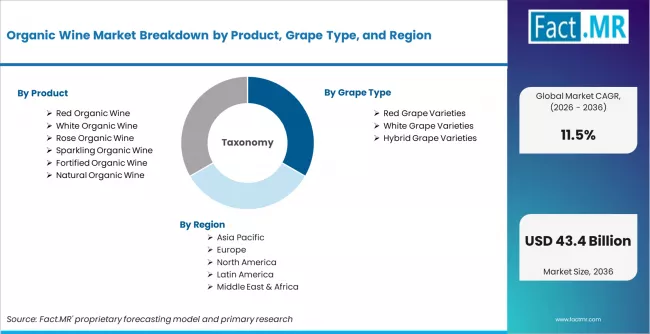
The market is segmented by type, packaging, distribution channel, and region. By type, the market is divided into organic red wine and organic white wine. Based on packaging, the market is categorized into bottles, cans, and others. By distribution channel, the market includes on-trade and off-trade. Regionally, the market is divided into Asia Pacific, Europe, North America, Latin America, and Middle East & Africa.
By Type, Which Segment Accounts for the Dominant Market Share?

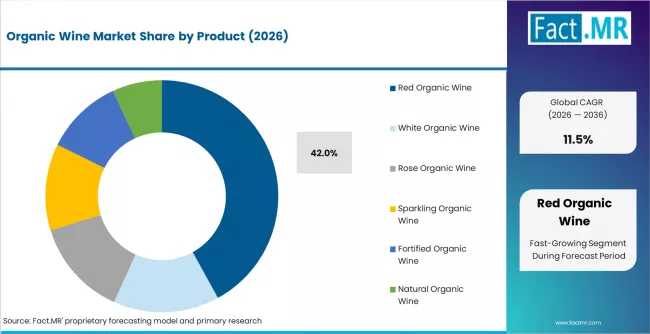
The organic red wine segment represents the dominant force in the organic wine market, capturing 61.9% of the total market share in 2025. This established wine type category encompasses solutions featuring full-bodied varietals and complex flavor profiles, including premium offerings combining Cabernet Sauvignon, Merlot, Pinot Noir, and Syrah grape varieties with traditional winemaking techniques and organic viticulture methods that enable superior taste characteristics and terroir expression across premium wine consumption and fine dining pairing applications worldwide.
The organic red wine segment's market leadership stems from its extensive consumer appeal, with products capable of meeting fundamental wine enthusiast preferences including robust flavor intensity, aging potential, and food pairing versatility while maintaining certified organic production standards and sustainable farming credentials across diverse wine regions.
Within the organic red wine category, Cabernet Sauvignon and Bordeaux-style blends demonstrate dominant market presence, driven by global consumer recognition and premium positioning in wine markets. These full-bodied red wines provide essential offerings for collectors and everyday consumers seeking quality organic options with established varietal characteristics.
The organic white wine segment maintains substantial market share at 38.1%, serving wine consumers requiring lighter styles, seafood pairing options, and refreshing characteristics through Chardonnay, Sauvignon Blanc, and Pinot Grigio varietals. These wines offer versatile consumption occasions and growing adoption among younger demographics prioritizing organic credentials.
Key quality advantages driving the organic red wine segment include:
- Superior terroir expression characteristics with organic viticulture practices enhancing authentic flavor development and vineyard site distinctiveness
- Enhanced aging potential allowing proper cellaring and flavor complexity development without synthetic chemical interference affecting wine evolution
- Premium positioning enabling higher price points and brand differentiation while maintaining wine quality standards and consumer appeal
- Food pairing versatility providing optimal accompaniment for diverse cuisines and dining experiences across casual and fine dining occasions
By Packaging, Which Segment Accounts for the Largest Market Share?

Bottles dominate the organic wine packaging landscape with a 91.1% market share in 2025, reflecting the traditional role of glass bottle packaging in preserving wine quality and maintaining premium product positioning across global wine markets. The bottles segment's market leadership is reinforced by consumer preference for traditional formats, wine aging requirements, and premium product perception that characterize established wine consumption patterns.
Within this segment, standard 750ml glass bottles represent the dominant format, driven by universal acceptance and established supply chain infrastructure. These traditional bottles benefit from consumer familiarity, proper aging capabilities, and premium shelf presence in retail environments.
The cans segment represents an emerging packaging category with 6.0% market share, demonstrating growth through specialized requirements for portable consumption, outdoor activities, and younger consumer appeal. This format benefits from sustainability advantages including lightweight transportation and recyclability while enabling single-serving convenience.
Others packaging including bag-in-box and alternative formats maintains presence at 2.9% through applications requiring cost-effective bulk packaging and casual consumption scenarios. These formats serve specific market niches including value-oriented consumers and high-volume hospitality applications.
Key market dynamics supporting packaging segmentation include:
- Bottle packaging dominance driven by wine preservation requirements and premium product positioning expectations
- Alternative format emergence requiring consumer education and quality perception management
- Integration of sustainable packaging materials addressing environmental concerns without compromising wine quality
- Growing emphasis on lightweight glass and alternative closure systems reducing carbon footprint
By Distribution Channel, Which Segment Accounts for a Significant Market Share?
Off-trade represents a leading distribution channel segment in the organic wine market with a 61.4% market share in 2025, reflecting the fundamental importance of retail wine sales through specialty stores, supermarkets, and online platforms. The off-trade segment demonstrates consistent demand driven by consumer preference for home consumption, retail convenience, and price comparison shopping.
The segment's strength stems from comprehensive retail presence including wine specialty shops providing expert guidance, supermarket wine sections offering convenient access, and e-commerce platforms enabling direct-to-consumer sales. Off-trade channels provide consumers with broader selection, competitive pricing, and convenience advantages supporting regular wine purchasing.
Within distribution applications, on-trade demonstrates meaningful adoption at 38.6% market share through restaurants, bars, and hotels providing experiential wine consumption and sommelier guidance. These establishments drive organic wine discovery and premium positioning through curated wine lists and food pairing recommendations.
Key distribution dynamics include:
- Off-trade dominance accelerating through retail expansion and e-commerce platform growth
- On-trade applications emphasizing experiential consumption and professional wine service
- Specialty retailer importance providing education and curated organic wine selections
- Direct-to-consumer channels enabling winery relationships and membership programs
What is Encouraging Organic White Wine Consumption?
Organic white wine emerges as a significant category in the organic wine market with approximately 38.1% market share in 2025, reflecting growing consumer interest in lighter wine styles and organic viticulture expansion into white grape varieties. The organic white wine segment demonstrates steady demand driven by seafood pairing requirements, warm weather consumption patterns, and varietal diversity across global wine regions.
The segment's market strength stems from versatile consumption occasions including aperitif service, casual dining accompaniment, and outdoor entertainment. Organic white wine production benefits from established organic farming practices adapted to white grape varietals and increasing consumer appreciation for crisp, refreshing wine styles.
Within organic white wine applications, Sauvignon Blanc demonstrates significant adoption through vibrant acidity and aromatic characteristics. Chardonnay maintains strong presence through versatile styles ranging from unoaked mineral expressions to barrel-aged complex wines, while Pinot Grigio serves approachable everyday consumption.
Key segment characteristics include:
- Varietal diversity enabling multiple style preferences from crisp mineral wines to rich barrel-aged expressions
- Seasonal consumption patterns driving summer sales and warm climate market performance
- Food pairing versatility supporting seafood, poultry, and vegetarian cuisine accompaniment
- Growing premium positioning addressing quality-focused consumers seeking organic certification
Why are On-Trade Distribution Channels Gaining Popularity for White Wine Sales?

On-trade represents an important distribution channel in the organic wine market with a 38.6% market share in 2025, reflecting the experiential value of restaurant and hospitality wine service supporting organic wine discovery and premium positioning. The on-trade segment demonstrates consistent presence driven by fine dining emphasis, wine tourism experiences, and sommelier-guided selection processes.
Within on-trade applications, fine dining restaurants demonstrate substantial organic wine adoption through comprehensive wine lists and sustainability commitments. Wine bars and specialty venues maintain presence through focused organic and natural wine programs, while hotels and resorts support organic wine availability through sustainability initiatives.
The segment benefits from professional service enabling wine education, optimal food pairing guidance, and premium consumption experiences. Sommelier advocacy drives organic wine placement and consumer trial supporting subsequent retail purchases.
Key channel dynamics include:
- Restaurant sustainability commitments driving organic wine list expansion
- Wine tourism integration supporting winery direct sales and brand awareness
- Sommelier education emphasizing organic and biodynamic wine knowledge
- Premium positioning enabling higher price points and margin realization
What are the Drivers, Restraints, and Key Trends of the Organic Wine Market?
The market is driven by three concrete demand factors tied to consumer values evolution. First, increasing environmental consciousness and sustainability priorities create expanding consumer bases seeking organic wine options, with certified organic production representing critical differentiation in premium wine segments, requiring widespread retail availability and restaurant placement. Second, growing health awareness and clean label preferences drive organic wine selection, with consumers demonstrating willingness to pay premiums for products free from synthetic pesticides and with lower sulfite levels by 2030. Third, advancing organic viticulture knowledge and certification framework maturation enable improved production quality approaches that deliver superior wine characteristics while maintaining rigorous organic standards and environmental stewardship.
Market restraints include higher production costs and lower vineyard yields that can challenge price competitiveness and profit margins, particularly for small-scale producers where organic conversion investment proves substantial and revenue recovery extends across multiple harvest cycles. Organic certification complexity and regulatory variation pose another significant obstacle, as organic wine production depends on comprehensive documentation, third-party verification, and ongoing compliance monitoring, potentially affecting producer participation and market transparency. Climate vulnerability and pest management limitations create additional barriers for consistent production, demanding innovative organic viticulture solutions and risk management strategies addressing vintage variability and crop protection challenges.
Key trends indicate accelerated biodynamic certification adoption in developed markets, particularly Europe and North America, where premium organic wineries demonstrate increasing implementation of holistic farming practices integrating lunar cycles, compost preparations, and biodiversity enhancement. Natural wine movement trends toward minimal intervention winemaking and indigenous yeast fermentation enable authentic expressions that resonate with adventurous consumers seeking artisanal products. However, the market thesis could face disruption if significant advances in sustainable conventional viticulture or major shifts in consumer preferences toward other beverage alcohol categories substantially reduce organic wine differentiation advantages and premium positioning opportunities.
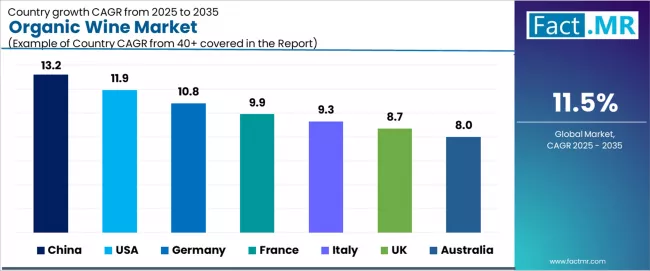
Analysis of the Organic Wine Market by Key Countries

| Country | CAGR (2025-2035) |
|---|---|
| China | 13.2% |
| USA | 11.9% |
| Germany | 10.8% |
| France | 9.9% |
| Italy | 9.3% |
| UK | 8.7% |
| Australia | 8.0% |
The global organic wine market is expanding rapidly, with China leading at a 13.2% CAGR through 2035, driven by growing disposable income, increasing interest in wine culture, and rising demand for premium imported wines. USA follows at 11.9%, supported by premium organic wine demand, expanding certified vineyard acreage, and strong sustainability awareness among consumers.
Germany records 10.8%, reflecting strong wine drinking tradition, high organic consumer awareness, and comprehensive retail presence. France advances at 9.9%, leveraging heritage winemaking expertise and certified organic vineyard expansion. Italy posts 9.3%, focusing on wine tourism growth and organic certification adoption, while UK grows steadily at 8.7%, anchored by retail expansion and consumer preference for sustainable wines. Australia demonstrates 8.0% growth, driven by rising organic vineyard acreage and export market development.
How is China Leading Global Market Expansion?
China demonstrates the strongest growth potential in the organic wine market with a CAGR of 13.2% through 2035. The country's leadership position stems from rapidly expanding middle class with disposable income for premium products, growing wine culture adoption among urban consumers, and increasing awareness about organic food and beverage benefits.
Growth is concentrated in major metropolitan areas and tier-1 cities, including Beijing, Shanghai, Shenzhen, and Guangzhou, where wine consumers are increasingly seeking imported organic wines and premium product offerings through specialty retailers and e-commerce platforms.
Distribution channels through wine importers, upscale supermarkets, and online wine marketplaces expand product accessibility across affluent consumer segments. The country's developing wine appreciation culture provides strong momentum for organic wine adoption, including comprehensive growth across imported wine categories and emerging domestic organic vineyard development.
Key market factors:
- Urban affluent consumers concentrated in first-tier cities with rising wine consumption and organic product interest
- Wine education growth through sommelier training, wine clubs, and tasting events supporting consumer knowledge
- E-commerce dominance enabling direct access to international organic wine brands and convenient home delivery
- Import market expansion featuring European and New World organic wines serving premium positioning and authenticity appeal
Why is USA Emerging as a Premium Market?

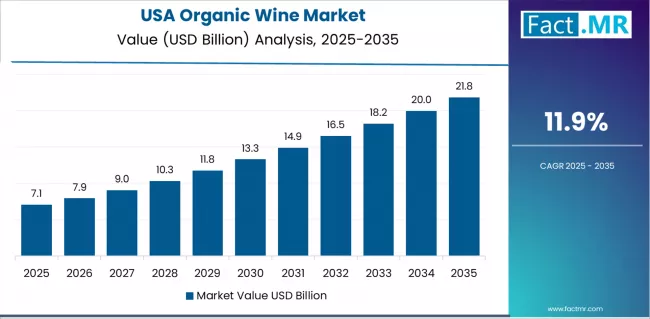
In major wine consumption regions including California, New York, Florida, Texas, and Illinois, the adoption of organic wine is accelerating across specialty wine retailers and upscale dining establishments, driven by sustainability consciousness and premium product preferences. The market demonstrates strong growth momentum with a CAGR of 11.9% through 2035, linked to expanding organic vineyard acreage and increasing consumer demand for certified organic products.
American wine consumers are prioritizing organic certification and sustainable production practices while seeking premium wine experiences and supporting environmentally responsible wineries. The country's established wine culture creates ongoing demand for diverse organic wine offerings, while increasing millennial and Gen Z wine consumption drives emphasis on sustainable and authentic products.
Key development areas:
- Organic vineyard expansion in California, Oregon, and Washington establishing domestic production capacity
- Premium positioning emphasis enabling higher price points and specialty retail distribution
- Wine club membership growth providing direct-to-consumer sales and loyal customer relationships
- Sustainability storytelling supporting brand differentiation and consumer emotional connection
How does Germany Demonstrate Organic Tradition?
The market in Germany demonstrates strong organic wine adoption based on established wine culture and comprehensive organic consumer awareness across beverage and food categories. The country shows meaningful potential with a CAGR of 10.8% through 2035, driven by stringent organic standards and consumer preference for certified products in major wine regions including Rhineland-Palatinate, Baden-Württemberg, and Hesse.
German wine consumers are selecting organic wines through specialty wine merchants and supermarket organic sections, with documented preference for domestic organic Riesling and regional wine varieties supporting local wineries and sustainable viticulture. Retail infrastructure through comprehensive organic product availability and clear certification labeling expands consumer access and purchase confidence.
Leading market segments:
- Organic Riesling dominance reflecting traditional German wine preferences and organic viticulture suitability
- Retail organic sections providing dedicated shelf space and clear organic certification identification
- Regional wine emphasis supporting local organic wineries and sustainable regional development
- Biodynamic certification adoption among premium wineries implementing holistic farming approaches
What positions France for Heritage Leadership?
In major wine regions including Bordeaux, Burgundy, Loire Valley, and Rhône Valley, organic viticulture adoption is expanding across prestigious estates and cooperative wineries, driven by environmental stewardship and quality enhancement objectives. The market shows steady growth potential with a CAGR of 9.9% through 2035, linked to heritage winemaking expertise and increasing organic certification among appellation vineyards.
French winemakers are converting to organic practices while maintaining traditional quality standards and terroir expression supporting premium positioning in domestic and export markets. The country's wine tourism infrastructure creates ongoing opportunities for organic wine promotion through direct sales and authentic wine experiences.
Market development factors:
- Appellation system integration enabling organic certification within traditional quality frameworks
- Heritage winery conversion demonstrating organic viticulture compatibility with premium wine production
- Wine tourism emphasis supporting organic winery visits and direct consumer engagement
- Export market positioning leveraging French wine reputation and organic certification credibility
How does Italy Show Wine Tourism Integration?
Italy's organic wine market demonstrates sophisticated development focused on agritourism integration and regional wine identity preservation, with documented growth in organic certification across traditional wine regions including Tuscany, Piedmont, Veneto, and Sicily.
The country maintains steady growth momentum with a CAGR of 9.3% through 2035, driven by wine tourism popularity and increasing organic vineyard conversion supporting sustainable regional development. Major wine regions showcase organic wineries where traditional winemaking integrates with certified organic viticulture and hospitality offerings including vineyard accommodations and wine tasting experiences.
Key market characteristics:
- Wine tourism integration enabling direct sales and authentic farm-to-table dining experiences
- Regional wine identity preservation through organic certification supporting traditional grape varieties
- Cooperative winery participation expanding organic production among small growers
- Export positioning emphasizing Italian wine heritage and organic sustainability credentials
What Characterizes UK's Retail Development?
In England, Scotland, Wales, and Northern Ireland, organic wine consumption is expanding through supermarket organic sections and specialty wine retailers, driven by consumer preference for sustainable products and convenient retail access. The market demonstrates solid growth potential with a CAGR of 8.7% through 2035, linked to comprehensive retail presence and increasing organic product awareness.
The wine consumers are selecting organic wines through mainstream supermarkets and online retailers prioritizing sustainability credentials and quality assurance. The country's retail infrastructure creates ongoing opportunities for organic wine brands seeking distribution and consumer visibility.
Key development areas:
- Supermarket organic sections providing mainstream consumer access and competitive pricing
- Online wine retail expansion enabling home delivery and subscription services
- Sustainability focus driving retailer commitments to organic and environmentally certified products
- Consumer awareness growth supporting willingness to pay premium prices for certified organic wines
What drives Australia's Export Development?
In major wine regions including Barossa Valley, McLaren Vale, Margaret River, and Yarra Valley, organic vineyard acreage is expanding among established wineries and boutique producers, driven by export market opportunities and domestic premium positioning. The market demonstrates meaningful growth potential with a CAGR of 8.0% through 2035, linked to international demand for Australian organic wines and domestic sustainability awareness.
Australian organic wineries are developing export relationships and establishing brand presence in key markets including China, USA, and UK while serving growing domestic organic wine consumption. The country's wine production expertise creates ongoing opportunities for organic wine quality and market competitiveness.
Key development areas:
- Export market focus leveraging Australian wine reputation and organic certification appeal
- Premium positioning emphasis supporting higher price points in international markets
- Organic vineyard expansion among established wine regions implementing sustainable practices
- Wine tourism development attracting international visitors and supporting direct sales
Europe Market Split by Country

The organic wine market in Europe is projected to grow from USD 6.89 billion in 2025 to USD 20.12 billion by 2035, registering a CAGR of 10.7% over the forecast period. France is expected to maintain its leadership position with a 31.4% market share in 2025, adjusting to 31.1% by 2035, supported by its extensive heritage wine regions, comprehensive organic vineyard conversion, and established organic certification frameworks serving major European markets.
Italy follows with a 26.8% share in 2025, projected to reach 27.2% by 2035, driven by wine tourism integration and regional organic certification growth. Germany holds a 18.7% share in 2025, expected to maintain 19.1% by 2035 through strong consumer organic awareness and retail distribution expansion. Spain commands a 14.3% share, while UK accounts for 6.2% in 2025. The rest of Europe region is anticipated to gain momentum, expanding its collective share from 2.6% to 2.8% by 2035, attributed to increasing organic wine production in Austria, Greece, and Portugal implementing sustainable viticulture practices.
Competitive Landscape of the Organic Wine Market

The organic wine market features approximately 15-20 meaningful players with moderate concentration, where the top three companies control roughly 28-35% of global market share through established organic vineyard holdings, comprehensive distribution networks, and strong brand recognition across premium wine segments. Competition centers on quality differentiation, organic certification credibility, and regional authenticity rather than price competition alone.
Market leaders include Bronco Wine Company, Kendall-Jackson Winery, and King Estate Winery, which maintain competitive advantages through extensive organic vineyard acreage, premium brand portfolios, and deep expertise in organic viticulture and winemaking, creating high consumer confidence among organic wine buyers seeking quality and sustainability. These companies leverage ongoing investment in organic farming practices and strategic distribution partnerships to defend market positions while expanding into natural wine expressions and biodynamic certification.
Challengers encompass established organic wineries including Boisset Collection - JCB, Emiliana Organic Vineyards, and Societa Agricola Querciabella SpA, which compete through specialized organic focus and regional authenticity serving premium wine segments through estate bottling, single-vineyard designations, and comprehensive sustainability credentials. Boutique organic producers, including Grgich Hills Estate, Avondale, and Frey Vineyards, focus on artisanal winemaking or pioneering organic practices, offering differentiated capabilities in biodynamic farming, minimal intervention winemaking, or complete organic estate operations.
Specialty organic wine companies and regional producers create competitive pressure through authentic storytelling and direct consumer relationships, particularly in high-growth markets including USA and China, where premium positioning and sustainability narratives provide advantages in specialty retail and restaurant placement. Market dynamics favor companies that combine proven organic viticulture expertise with compelling brand narratives addressing complete sustainability journey from vineyard to bottle. Strategic emphasis on biodynamic certification, regenerative agriculture adoption, and carbon-neutral operations enables differentiation in increasingly sophisticated organic wine markets across established and emerging regions.
Global Organic Wine Market - Stakeholder Contribution Framework
Organic wine represents a critical premium beverage category that enables environmentally conscious consumers to enjoy quality wine experiences while supporting sustainable agriculture and avoiding synthetic chemical exposure without compromising taste quality, typically providing certified organic production including prohibition of synthetic pesticides, minimal sulfite additions, and biodiversity preservation compared to conventional viticulture alone while ensuring authentic terroir expression and environmental stewardship.
With the market projected to grow from USD 13.1 billion in 2025 to USD 39.0 billion by 2035 at a 11.5% CAGR, these solutions offer compelling advantages for premium wine applications, sustainable hospitality programs, and diverse consumer segments seeking organic certification. Scaling market adoption and production expansion requires coordinated action across agricultural policy, certification standards, organic wineries, wine retailers, and consumer education initiatives.
How Could Governments Spur Local Development and Adoption?
- Organic Viticulture Support: Include organic vineyard conversion in agricultural support programs, providing financial assistance for organic certification costs and supporting research institutions through viticulture development grants and sustainable farming initiatives.
- Certification Framework Development: Implement clear organic wine standards and labeling requirements, provide streamlined certification processes for vineyard conversion, and establish enforcement mechanisms ensuring organic integrity and consumer protection.
- Rural Development Integration: Create programs supporting small-scale organic wineries and family vineyards, provide infrastructure investment for sustainable winemaking facilities, and establish wine tourism frameworks promoting organic vineyard visits.
- Research & Extension Support: Fund organic viticulture research on pest management and soil health, support extension services providing technical assistance to converting vineyards, and create demonstration vineyards showcasing organic farming success.
- Market Development Programs: Support organic wine promotion in export markets, provide trade show participation funding for organic wineries, and establish quality recognition programs celebrating organic winemaking excellence.
How Could Industry Bodies Support Market Development?
- Organic Standards & Certification: Define comprehensive organic viticulture standards across grape growing and winemaking, establish clear certification requirements and audit protocols, and create recognition frameworks supporting consumer confidence and international trade.
- Education & Training: Develop organic viticulture training programs for vineyard managers, establish winemaking workshops on organic and biodynamic practices, and create certification courses for wine professionals on organic wine service.
- Market Development: Lead promotional campaigns demonstrating organic wine quality and sustainability benefits, emphasizing taste characteristics, environmental advantages, and health considerations compared to conventional wines.
- Quality Assurance: Develop sensory evaluation protocols for organic wines, establish best practices for organic winemaking techniques, and create quality benchmarking supporting continuous improvement.
How Could Wineries and Producers Strengthen the Ecosystem?
- Organic Vineyard Conversion: Implement comprehensive organic farming practices eliminating synthetic inputs, develop soil health programs supporting biodiversity and natural pest control, and establish cover cropping systems enhancing vineyard ecosystem resilience.
- Quality Winemaking: Develop minimal intervention winemaking protocols preserving grape quality and terroir expression, optimize sulfite management balancing preservation with minimal addition philosophy, and implement natural fermentation techniques showcasing vineyard character.
- Brand Storytelling: Communicate organic farming journey and sustainability commitments through authentic narratives, provide vineyard transparency enabling consumer connection with production methods, and establish traceability systems documenting organic integrity.
- Direct Consumer Engagement: Build wine club programs connecting organic wine enthusiasts with winery experiences, develop wine tourism offerings showcasing organic viticulture practices, and create educational content supporting consumer organic wine knowledge.
How Could Retailers and Hospitality Partners Navigate the Market?
- Product Curation: Develop comprehensive organic wine selections spanning price points and regional diversity, establish relationships with organic wineries ensuring reliable supply, and create category management strategies highlighting organic wine benefits.
- Staff Education: Implement wine training programs covering organic viticulture and certification standards, develop tasting initiatives familiarizing staff with organic wine characteristics, and create selling tools supporting customer guidance and recommendations.
- Consumer Communication: Design point-of-sale materials explaining organic certification and sustainability advantages, implement shelf organization highlighting organic wines, and develop marketing campaigns promoting organic wine occasions and pairings.
- Sustainability Integration: Align organic wine offerings with broader sustainability commitments, implement responsible serving practices, and establish partnerships with organic wineries supporting shared values and authentic storytelling.
How Could Investors and Financial Enablers Unlock Value?
- Vineyard Conversion Financing: Provide capital for organic vineyard conversion supporting three-year transition periods, finance organic certification costs and sustainable farming infrastructure, and support small-scale producers accessing organic markets.
- Winery Investment: Back organic wine brands developing premium market positions, finance sustainable winemaking facility construction and equipment, and support acquisition of organic vineyard land expanding production capacity.
- Distribution Network Development: Finance specialty wine retailer expansion emphasizing organic selections, support e-commerce platforms connecting organic wineries with consumers, and back wine club platforms serving organic wine enthusiasts.
- Technology Innovation: Support precision viticulture technologies optimizing organic farming practices, finance soil health monitoring systems and pest management tools, and back blockchain traceability platforms ensuring organic certification transparency.
Key Players in the Organic Wine Market
- Bronco Wine Company
- Kendall-Jackson Winery
- King Estate Winery
- Boisset Collection - JCB
- Emiliana Organic Vineyards
- Societa Agricola Querciabella SpA
- Grgich Hills Estate
- Avondale
- Frey Vineyards
- The Organic Wine Company
Scope of the Report
| Items | Values |
|---|---|
| Quantitative Units | USD 13.1 Billion |
| Type | Organic Red Wine, Organic White Wine |
| Packaging | Bottles, Cans, Others |
| Distribution Channel | On-Trade, Off-Trade |
| Regions Covered | Asia Pacific, Europe, North America, Latin America, Middle East & Africa |
| Country Covered | China, USA, Germany, France, Italy, UK, Australia, and 40+ countries |
| Key Companies Profiled | Bronco Wine Company, Kendall-Jackson Winery, King Estate Winery, Boisset Collection - JCB, Emiliana Organic Vineyards, Societa Agricola Querciabella SpA, Grgich Hills Estate, Avondale, Frey Vineyards, The Organic Wine Company |
| Additional Attributes | Dollar sales by type and packaging categories, regional production trends across Europe, North America, and South America, competitive landscape with organic wineries and wine groups, organic certification requirements and viticulture practices, integration with wine tourism experiences and direct-to-consumer sales channels, innovations in biodynamic farming and natural winemaking techniques, and development of specialized applications with single-vineyard designations and regenerative agriculture capabilities. |
Organic Wine Market by Segments
-
Type :
- Organic Red Wine
- Organic White Wine
-
Packaging :
- Bottles
- Cans
- Others
-
Distribution Channel :
- On-Trade
- Off-Trade
-
Region :
- Asia Pacific
- China
- Japan
- South Korea
- India
- Australia
- Thailand
- Rest of Asia Pacific
- Europe
- Germany
- UK
- France
- Italy
- Spain
- Denmark
- Sweden
- Norway
- Rest of Europe
- North America
- USA
- Canada
- Mexico
- Latin America
- Brazil
- Argentina
- Rest of Latin America
- Middle East & Africa
- South Africa
- Saudi Arabia
- UAE
- Kuwait
- Rest of Middle East & Africa
- Asia Pacific
Table of Content
- Executive Summary
- Global Market Outlook
- Demand to side Trends
- Supply to side Trends
- Technology Roadmap Analysis
- Analysis and Recommendations
- Market Overview
- Market Coverage / Taxonomy
- Market Definition / Scope / Limitations
- Market Background
- Market Dynamics
- Drivers
- Restraints
- Opportunity
- Trends
- Scenario Forecast
- Demand in Optimistic Scenario
- Demand in Likely Scenario
- Demand in Conservative Scenario
- Opportunity Map Analysis
- Product Life Cycle Analysis
- Supply Chain Analysis
- Investment Feasibility Matrix
- Value Chain Analysis
- PESTLE and Porter’s Analysis
- Regulatory Landscape
- Regional Parent Market Outlook
- Production and Consumption Statistics
- Import and Export Statistics
- Market Dynamics
- Global Market Analysis 2020 to 2024 and Forecast, 2025 to 2035
- Historical Market Size Value (USD Million) Analysis, 2020 to 2024
- Current and Future Market Size Value (USD Million) Projections, 2025 to 2035
- Y to o to Y Growth Trend Analysis
- Absolute $ Opportunity Analysis
- Global Market Pricing Analysis 2020 to 2024 and Forecast 2025 to 2035
- Global Market Analysis 2020 to 2024 and Forecast 2025 to 2035, By Type
- Introduction / Key Findings
- Historical Market Size Value (USD Million) Analysis By Type, 2020 to 2024
- Current and Future Market Size Value (USD Million) Analysis and Forecast By Type, 2025 to 2035
- Organic Red Wine
- Organic White Wine
- Y to o to Y Growth Trend Analysis By Type, 2020 to 2024
- Absolute $ Opportunity Analysis By Type, 2025 to 2035
- Global Market Analysis 2020 to 2024 and Forecast 2025 to 2035, By Packaging
- Introduction / Key Findings
- Historical Market Size Value (USD Million) Analysis By Packaging, 2020 to 2024
- Current and Future Market Size Value (USD Million) Analysis and Forecast By Packaging, 2025 to 2035
- Bottles
- Cans
- Others
- Y to o to Y Growth Trend Analysis By Packaging, 2020 to 2024
- Absolute $ Opportunity Analysis By Packaging, 2025 to 2035
- Global Market Analysis 2020 to 2024 and Forecast 2025 to 2035, By Distribution Channel
- Introduction / Key Findings
- Historical Market Size Value (USD Million) Analysis By Distribution Channel, 2020 to 2024
- Current and Future Market Size Value (USD Million) Analysis and Forecast By Distribution Channel, 2025 to 2035
- Off-Trade
- On-Trade
- Y to o to Y Growth Trend Analysis By Distribution Channel, 2020 to 2024
- Absolute $ Opportunity Analysis By Distribution Channel, 2025 to 2035
- Global Market Analysis 2020 to 2024 and Forecast 2025 to 2035, By Region
- Introduction
- Historical Market Size Value (USD Million) Analysis By Region, 2020 to 2024
- Current Market Size Value (USD Million) Analysis and Forecast By Region, 2025 to 2035
- North America
- Latin America
- Western Europe
- Eastern Europe
- East Asia
- South Asia and Pacific
- Middle East & Africa
- Market Attractiveness Analysis By Region
- North America Market Analysis 2020 to 2024 and Forecast 2025 to 2035, By Country
- Historical Market Size Value (USD Million) Trend Analysis By Market Taxonomy, 2020 to 2024
- Market Size Value (USD Million) Forecast By Market Taxonomy, 2025 to 2035
- By Country
- USA
- Canada
- Mexico
- By Type
- By Packaging
- By Distribution Channel
- By Country
- Market Attractiveness Analysis
- By Country
- By Type
- By Packaging
- By Distribution Channel
- Key Takeaways
- Latin America Market Analysis 2020 to 2024 and Forecast 2025 to 2035, By Country
- Historical Market Size Value (USD Million) Trend Analysis By Market Taxonomy, 2020 to 2024
- Market Size Value (USD Million) Forecast By Market Taxonomy, 2025 to 2035
- By Country
- Brazil
- Chile
- Rest of Latin America
- By Type
- By Packaging
- By Distribution Channel
- By Country
- Market Attractiveness Analysis
- By Country
- By Type
- By Packaging
- By Distribution Channel
- Key Takeaways
- Western Europe Market Analysis 2020 to 2024 and Forecast 2025 to 2035, By Country
- Historical Market Size Value (USD Million) Trend Analysis By Market Taxonomy, 2020 to 2024
- Market Size Value (USD Million) Forecast By Market Taxonomy, 2025 to 2035
- By Country
- Germany
- UK
- Italy
- Spain
- France
- Nordic
- BENELUX
- Rest of Western Europe
- By Type
- By Packaging
- By Distribution Channel
- By Country
- Market Attractiveness Analysis
- By Country
- By Type
- By Packaging
- By Distribution Channel
- Key Takeaways
- Eastern Europe Market Analysis 2020 to 2024 and Forecast 2025 to 2035, By Country
- Historical Market Size Value (USD Million) Trend Analysis By Market Taxonomy, 2020 to 2024
- Market Size Value (USD Million) Forecast By Market Taxonomy, 2025 to 2035
- By Country
- Russia
- Poland
- Hungary
- Balkan & Baltic
- Rest of Eastern Europe
- By Type
- By Packaging
- By Distribution Channel
- By Country
- Market Attractiveness Analysis
- By Country
- By Type
- By Packaging
- By Distribution Channel
- Key Takeaways
- East Asia Market Analysis 2020 to 2024 and Forecast 2025 to 2035, By Country
- Historical Market Size Value (USD Million) Trend Analysis By Market Taxonomy, 2020 to 2024
- Market Size Value (USD Million) Forecast By Market Taxonomy, 2025 to 2035
- By Country
- China
- Japan
- South Korea
- By Type
- By Packaging
- By Distribution Channel
- By Country
- Market Attractiveness Analysis
- By Country
- By Type
- By Packaging
- By Distribution Channel
- Key Takeaways
- South Asia and Pacific Market Analysis 2020 to 2024 and Forecast 2025 to 2035, By Country
- Historical Market Size Value (USD Million) Trend Analysis By Market Taxonomy, 2020 to 2024
- Market Size Value (USD Million) Forecast By Market Taxonomy, 2025 to 2035
- By Country
- India
- ASEAN
- Australia & New Zealand
- Rest of South Asia and Pacific
- By Type
- By Packaging
- By Distribution Channel
- By Country
- Market Attractiveness Analysis
- By Country
- By Type
- By Packaging
- By Distribution Channel
- Key Takeaways
- Middle East & Africa Market Analysis 2020 to 2024 and Forecast 2025 to 2035, By Country
- Historical Market Size Value (USD Million) Trend Analysis By Market Taxonomy, 2020 to 2024
- Market Size Value (USD Million) Forecast By Market Taxonomy, 2025 to 2035
- By Country
- Kingdom of Saudi Arabia
- Other GCC Countries
- Turkiye
- South Africa
- Other African Union
- Rest of Middle East & Africa
- By Type
- By Packaging
- By Distribution Channel
- By Country
- Market Attractiveness Analysis
- By Country
- By Type
- By Packaging
- By Distribution Channel
- Key Takeaways
- Key Countries Market Analysis
- USA
- Pricing Analysis
- Market Share Analysis, 2024
- By Type
- By Packaging
- By Distribution Channel
- Canada
- Pricing Analysis
- Market Share Analysis, 2024
- By Type
- By Packaging
- By Distribution Channel
- Mexico
- Pricing Analysis
- Market Share Analysis, 2024
- By Type
- By Packaging
- By Distribution Channel
- Brazil
- Pricing Analysis
- Market Share Analysis, 2024
- By Type
- By Packaging
- By Distribution Channel
- Chile
- Pricing Analysis
- Market Share Analysis, 2024
- By Type
- By Packaging
- By Distribution Channel
- Germany
- Pricing Analysis
- Market Share Analysis, 2024
- By Type
- By Packaging
- By Distribution Channel
- UK
- Pricing Analysis
- Market Share Analysis, 2024
- By Type
- By Packaging
- By Distribution Channel
- Italy
- Pricing Analysis
- Market Share Analysis, 2024
- By Type
- By Packaging
- By Distribution Channel
- Spain
- Pricing Analysis
- Market Share Analysis, 2024
- By Type
- By Packaging
- By Distribution Channel
- France
- Pricing Analysis
- Market Share Analysis, 2024
- By Type
- By Packaging
- By Distribution Channel
- India
- Pricing Analysis
- Market Share Analysis, 2024
- By Type
- By Packaging
- By Distribution Channel
- ASEAN
- Pricing Analysis
- Market Share Analysis, 2024
- By Type
- By Packaging
- By Distribution Channel
- Australia & New Zealand
- Pricing Analysis
- Market Share Analysis, 2024
- By Type
- By Packaging
- By Distribution Channel
- China
- Pricing Analysis
- Market Share Analysis, 2024
- By Type
- By Packaging
- By Distribution Channel
- Japan
- Pricing Analysis
- Market Share Analysis, 2024
- By Type
- By Packaging
- By Distribution Channel
- South Korea
- Pricing Analysis
- Market Share Analysis, 2024
- By Type
- By Packaging
- By Distribution Channel
- Russia
- Pricing Analysis
- Market Share Analysis, 2024
- By Type
- By Packaging
- By Distribution Channel
- Poland
- Pricing Analysis
- Market Share Analysis, 2024
- By Type
- By Packaging
- By Distribution Channel
- Hungary
- Pricing Analysis
- Market Share Analysis, 2024
- By Type
- By Packaging
- By Distribution Channel
- Kingdom of Saudi Arabia
- Pricing Analysis
- Market Share Analysis, 2024
- By Type
- By Packaging
- By Distribution Channel
- Turkiye
- Pricing Analysis
- Market Share Analysis, 2024
- By Type
- By Packaging
- By Distribution Channel
- South Africa
- Pricing Analysis
- Market Share Analysis, 2024
- By Type
- By Packaging
- By Distribution Channel
- USA
- Market Structure Analysis
- Competition Dashboard
- Competition Benchmarking
- Market Share Analysis of Top Players
- By Regional
- By Type
- By Packaging
- By Distribution Channel
- Competition Analysis
- Competition Deep Dive
- Bronco Wine Company
- Overview
- Product Portfolio
- Profitability by Market Segments (Product/Age /Sales Channel/Region)
- Sales Footprint
- Strategy Overview
- Marketing Strategy
- Product Strategy
- Channel Strategy
- Kendall-Jackson Winery
- King Estate Winery
- Boisset Collection - JCB
- Emiliana Organic Vineyards
- Societa Agricola Querciabella SpA
- Grgich Hills Estate
- Avondale
- Frey Vineyards
- The Organic Wine Company
- Bronco Wine Company
- Competition Deep Dive
- Assumptions & Acronyms Used
- Research Methodology
List Of Table
- Table 1: Global Market Value (USD Million) Forecast by Region, 2020 to 2035
- Table 2: Global Market Value (USD Million) Forecast by Type, 2020 to 2035
- Table 3: Global Market Value (USD Million) Forecast by Packaging, 2020 to 2035
- Table 4: Global Market Value (USD Million) Forecast by Distribution Channel, 2020 to 2035
- Table 5: North America Market Value (USD Million) Forecast by Country, 2020 to 2035
- Table 6: North America Market Value (USD Million) Forecast by Type, 2020 to 2035
- Table 7: North America Market Value (USD Million) Forecast by Packaging, 2020 to 2035
- Table 8: North America Market Value (USD Million) Forecast by Distribution Channel, 2020 to 2035
- Table 9: Latin America Market Value (USD Million) Forecast by Country, 2020 to 2035
- Table 10: Latin America Market Value (USD Million) Forecast by Type, 2020 to 2035
- Table 11: Latin America Market Value (USD Million) Forecast by Packaging, 2020 to 2035
- Table 12: Latin America Market Value (USD Million) Forecast by Distribution Channel, 2020 to 2035
- Table 13: Western Europe Market Value (USD Million) Forecast by Country, 2020 to 2035
- Table 14: Western Europe Market Value (USD Million) Forecast by Type, 2020 to 2035
- Table 15: Western Europe Market Value (USD Million) Forecast by Packaging, 2020 to 2035
- Table 16: Western Europe Market Value (USD Million) Forecast by Distribution Channel, 2020 to 2035
- Table 17: Eastern Europe Market Value (USD Million) Forecast by Country, 2020 to 2035
- Table 18: Eastern Europe Market Value (USD Million) Forecast by Type, 2020 to 2035
- Table 19: Eastern Europe Market Value (USD Million) Forecast by Packaging, 2020 to 2035
- Table 20: Eastern Europe Market Value (USD Million) Forecast by Distribution Channel, 2020 to 2035
- Table 21: East Asia Market Value (USD Million) Forecast by Country, 2020 to 2035
- Table 22: East Asia Market Value (USD Million) Forecast by Type, 2020 to 2035
- Table 23: East Asia Market Value (USD Million) Forecast by Packaging, 2020 to 2035
- Table 24: East Asia Market Value (USD Million) Forecast by Distribution Channel, 2020 to 2035
- Table 25: South Asia and Pacific Market Value (USD Million) Forecast by Country, 2020 to 2035
- Table 26: South Asia and Pacific Market Value (USD Million) Forecast by Type, 2020 to 2035
- Table 27: South Asia and Pacific Market Value (USD Million) Forecast by Packaging, 2020 to 2035
- Table 28: South Asia and Pacific Market Value (USD Million) Forecast by Distribution Channel, 2020 to 2035
- Table 29: Middle East & Africa Market Value (USD Million) Forecast by Country, 2020 to 2035
- Table 30: Middle East & Africa Market Value (USD Million) Forecast by Type, 2020 to 2035
- Table 31: Middle East & Africa Market Value (USD Million) Forecast by Packaging, 2020 to 2035
- Table 32: Middle East & Africa Market Value (USD Million) Forecast by Distribution Channel, 2020 to 2035
List Of Figures
- Figure 1: Global Market Pricing Analysis
- Figure 2: Global Market Value (USD Million) Forecast 2020 to 2035
- Figure 3: Global Market Value Share and BPS Analysis by Type, 2025 and 2035
- Figure 4: Global Market Y to o to Y Growth Comparison by Type, 2025 to 2035
- Figure 5: Global Market Attractiveness Analysis by Type
- Figure 6: Global Market Value Share and BPS Analysis by Packaging, 2025 and 2035
- Figure 7: Global Market Y to o to Y Growth Comparison by Packaging, 2025 to 2035
- Figure 8: Global Market Attractiveness Analysis by Packaging
- Figure 9: Global Market Value Share and BPS Analysis by Distribution Channel, 2025 and 2035
- Figure 10: Global Market Y to o to Y Growth Comparison by Distribution Channel, 2025 to 2035
- Figure 11: Global Market Attractiveness Analysis by Distribution Channel
- Figure 12: Global Market Value (USD Million) Share and BPS Analysis by Region, 2025 and 2035
- Figure 13: Global Market Y to o to Y Growth Comparison by Region, 2025 to 2035
- Figure 14: Global Market Attractiveness Analysis by Region
- Figure 15: North America Market Incremental Dollar Opportunity, 2025 to 2035
- Figure 16: Latin America Market Incremental Dollar Opportunity, 2025 to 2035
- Figure 17: Western Europe Market Incremental Dollar Opportunity, 2025 to 2035
- Figure 18: Eastern Europe Market Incremental Dollar Opportunity, 2025 to 2035
- Figure 19: East Asia Market Incremental Dollar Opportunity, 2025 to 2035
- Figure 20: South Asia and Pacific Market Incremental Dollar Opportunity, 2025 to 2035
- Figure 21: Middle East & Africa Market Incremental Dollar Opportunity, 2025 to 2035
- Figure 22: North America Market Value Share and BPS Analysis by Country, 2025 and 2035
- Figure 23: North America Market Value Share and BPS Analysis by Type, 2025 and 2035
- Figure 24: North America Market Y to o to Y Growth Comparison by Type, 2025 to 2035
- Figure 25: North America Market Attractiveness Analysis by Type
- Figure 26: North America Market Value Share and BPS Analysis by Packaging, 2025 and 2035
- Figure 27: North America Market Y to o to Y Growth Comparison by Packaging, 2025 to 2035
- Figure 28: North America Market Attractiveness Analysis by Packaging
- Figure 29: North America Market Value Share and BPS Analysis by Distribution Channel, 2025 and 2035
- Figure 30: North America Market Y to o to Y Growth Comparison by Distribution Channel, 2025 to 2035
- Figure 31: North America Market Attractiveness Analysis by Distribution Channel
- Figure 32: Latin America Market Value Share and BPS Analysis by Country, 2025 and 2035
- Figure 33: Latin America Market Value Share and BPS Analysis by Type, 2025 and 2035
- Figure 34: Latin America Market Y to o to Y Growth Comparison by Type, 2025 to 2035
- Figure 35: Latin America Market Attractiveness Analysis by Type
- Figure 36: Latin America Market Value Share and BPS Analysis by Packaging, 2025 and 2035
- Figure 37: Latin America Market Y to o to Y Growth Comparison by Packaging, 2025 to 2035
- Figure 38: Latin America Market Attractiveness Analysis by Packaging
- Figure 39: Latin America Market Value Share and BPS Analysis by Distribution Channel, 2025 and 2035
- Figure 40: Latin America Market Y to o to Y Growth Comparison by Distribution Channel, 2025 to 2035
- Figure 41: Latin America Market Attractiveness Analysis by Distribution Channel
- Figure 42: Western Europe Market Value Share and BPS Analysis by Country, 2025 and 2035
- Figure 43: Western Europe Market Value Share and BPS Analysis by Type, 2025 and 2035
- Figure 44: Western Europe Market Y to o to Y Growth Comparison by Type, 2025 to 2035
- Figure 45: Western Europe Market Attractiveness Analysis by Type
- Figure 46: Western Europe Market Value Share and BPS Analysis by Packaging, 2025 and 2035
- Figure 47: Western Europe Market Y to o to Y Growth Comparison by Packaging, 2025 to 2035
- Figure 48: Western Europe Market Attractiveness Analysis by Packaging
- Figure 49: Western Europe Market Value Share and BPS Analysis by Distribution Channel, 2025 and 2035
- Figure 50: Western Europe Market Y to o to Y Growth Comparison by Distribution Channel, 2025 to 2035
- Figure 51: Western Europe Market Attractiveness Analysis by Distribution Channel
- Figure 52: Eastern Europe Market Value Share and BPS Analysis by Country, 2025 and 2035
- Figure 53: Eastern Europe Market Value Share and BPS Analysis by Type, 2025 and 2035
- Figure 54: Eastern Europe Market Y to o to Y Growth Comparison by Type, 2025 to 2035
- Figure 55: Eastern Europe Market Attractiveness Analysis by Type
- Figure 56: Eastern Europe Market Value Share and BPS Analysis by Packaging, 2025 and 2035
- Figure 57: Eastern Europe Market Y to o to Y Growth Comparison by Packaging, 2025 to 2035
- Figure 58: Eastern Europe Market Attractiveness Analysis by Packaging
- Figure 59: Eastern Europe Market Value Share and BPS Analysis by Distribution Channel, 2025 and 2035
- Figure 60: Eastern Europe Market Y to o to Y Growth Comparison by Distribution Channel, 2025 to 2035
- Figure 61: Eastern Europe Market Attractiveness Analysis by Distribution Channel
- Figure 62: East Asia Market Value Share and BPS Analysis by Country, 2025 and 2035
- Figure 63: East Asia Market Value Share and BPS Analysis by Type, 2025 and 2035
- Figure 64: East Asia Market Y to o to Y Growth Comparison by Type, 2025 to 2035
- Figure 65: East Asia Market Attractiveness Analysis by Type
- Figure 66: East Asia Market Value Share and BPS Analysis by Packaging, 2025 and 2035
- Figure 67: East Asia Market Y to o to Y Growth Comparison by Packaging, 2025 to 2035
- Figure 68: East Asia Market Attractiveness Analysis by Packaging
- Figure 69: East Asia Market Value Share and BPS Analysis by Distribution Channel, 2025 and 2035
- Figure 70: East Asia Market Y to o to Y Growth Comparison by Distribution Channel, 2025 to 2035
- Figure 71: East Asia Market Attractiveness Analysis by Distribution Channel
- Figure 72: South Asia and Pacific Market Value Share and BPS Analysis by Country, 2025 and 2035
- Figure 73: South Asia and Pacific Market Value Share and BPS Analysis by Type, 2025 and 2035
- Figure 74: South Asia and Pacific Market Y to o to Y Growth Comparison by Type, 2025 to 2035
- Figure 75: South Asia and Pacific Market Attractiveness Analysis by Type
- Figure 76: South Asia and Pacific Market Value Share and BPS Analysis by Packaging, 2025 and 2035
- Figure 77: South Asia and Pacific Market Y to o to Y Growth Comparison by Packaging, 2025 to 2035
- Figure 78: South Asia and Pacific Market Attractiveness Analysis by Packaging
- Figure 79: South Asia and Pacific Market Value Share and BPS Analysis by Distribution Channel, 2025 and 2035
- Figure 80: South Asia and Pacific Market Y to o to Y Growth Comparison by Distribution Channel, 2025 to 2035
- Figure 81: South Asia and Pacific Market Attractiveness Analysis by Distribution Channel
- Figure 82: Middle East & Africa Market Value Share and BPS Analysis by Country, 2025 and 2035
- Figure 83: Middle East & Africa Market Value Share and BPS Analysis by Type, 2025 and 2035
- Figure 84: Middle East & Africa Market Y to o to Y Growth Comparison by Type, 2025 to 2035
- Figure 85: Middle East & Africa Market Attractiveness Analysis by Type
- Figure 86: Middle East & Africa Market Value Share and BPS Analysis by Packaging, 2025 and 2035
- Figure 87: Middle East & Africa Market Y to o to Y Growth Comparison by Packaging, 2025 to 2035
- Figure 88: Middle East & Africa Market Attractiveness Analysis by Packaging
- Figure 89: Middle East & Africa Market Value Share and BPS Analysis by Distribution Channel, 2025 and 2035
- Figure 90: Middle East & Africa Market Y to o to Y Growth Comparison by Distribution Channel, 2025 to 2035
- Figure 91: Middle East & Africa Market Attractiveness Analysis by Distribution Channel
- Figure 92: Global Market - Tier Structure Analysis
- Figure 93: Global Market - Company Share Analysis
- FAQs -
How big is the organic wine market in 2025?
The global organic wine market is estimated to be valued at USD 13.1 billion in 2025.
What will be the size of organic wine market in 2035?
The market size for the organic wine market is projected to reach USD 39.0 billion by 2035.
How much will be the organic wine market growth between 2025 and 2035?
The organic wine market is expected to grow at a 11.5% CAGR between 2025 and 2035.
What are the key product types in the organic wine market?
The key product types in organic wine market are organic red wine and organic white wine.
Which packaging segment to contribute significant share in the organic wine market in 2025?
In terms of packaging, bottles segment to command 91.1% share in the organic wine market in 2025.