- Market Value (2025): USD 4.6 Bn
- Estimated Value (2026): USD 4.9 Bn
- Forecast Value (2036): USD 8.8 Bn
- CAGR (2026-2036): 6.0%
What is the OTC Dry Eye Drops Market forecast to be worth by 2036?
USD 4.9 billion in 2026 to USD 8.8 billion by 2036 at 6.0% CAGR.
- The OTC dry eye drops market reached USD 4.6 billion in 2025.
- Demand is projected to increase from USD 4.9 billion in 2026 to USD 8.8 billion by 2036.
- The market is forecast to record 6.0% CAGR from 2026 to 2036.
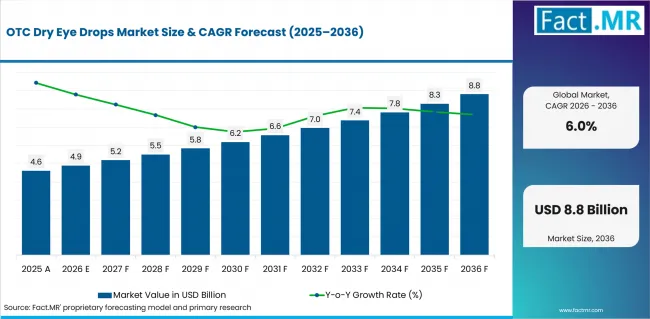
Otc Dry Eye Drops Market Value Analysis | Source: Fact.MR
What are the defining numbers behind OTC Dry Eye Drops Market growth?
USD 3.9 billion absolute opportunity by 2036.
- Demand Drivers in the Market
- Artificial Tears remain the main entry product since shoppers understand the use case quickly.
- Preservative-free formats are expected to gain wider attention where repeat use raises sensitivity concerns. Single-dose vials and preservative-free bottles support comfort-led buying.
- Retail pharmacies are expected to support conversion through immediate shelf access. Pharmacist guidance can turn a broad dry-eye complaint into a clearer product choice.
- Key Segments Analyzed
- By Product Type: Artificial Tears are expected to hold 37.8% share in 2026 since they remain the most familiar OTC option for quick dryness relief.
- By Formulation: Preservative-free Formulations are projected to account for 45.8% share in 2026 as repeat users place more weight on comfort.
- By Distribution Channel: Retail Pharmacies are anticipated to capture 35.5% share in 2026 through visible shelves and pharmacist direction.
- By Application: Evaporative Dry Eye is estimated to represent 40.6% share in 2026 due to tear-film instability and daily irritation.
- By End User: Adults are forecast to hold 40.8% share in 2026 through work routines and device-heavy days.
- Analyst Opinion at Fact.MR
- Shambhu Nath Jha, Sr. Consultant at Fact.MR, opines, “In the OTC dry eye drops market the practical test is whether a product gives clear relief cues without confusing shoppers at the shelf. Buyers are asking brands to support comfort claims with safe packaging and reliable repeat availability.”
- Strategic Implications
- Pharmacy teams can improve conversion by grouping Artificial Tears with clear symptom cues.
- Suppliers need packaging that explains repeat-use suitability in plain language. Preservative-free artificial tears gain stronger consideration when bottle life and dosing steps are clear.
- Investors should compare Canada and Japan through different buying habits. Canada favors broad retail access.
The USA is projected to record 7.8% CAGR from 2026 to 2036. Germany follows at 7.1%, then the UK at 6.3%, France at 5.7%, Japan at 5.0%, and Canada at 4.2%.
How does the OTC Dry Eye Drops Market break down by segment?
Artificial Tears are expected to lead Product Type at 37.8% share. Preservative-free Formulations are projected to lead Formulation at 45.8% share in 2026.
Which product type dominates?
Artificial Tears are projected to account for 37.8% share in 2026.
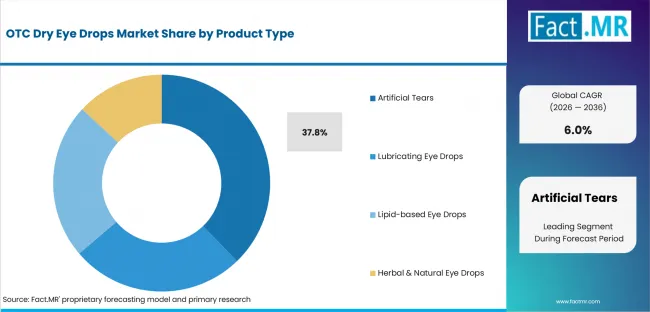
Otc Dry Eye Drops Market Analysis By Product Type | Source: Fact.MR
Artificial tears hold the leading position because shoppers recognize the use case quickly. The format suits daily dryness relief and basic lubrication. Preservative-free Artificial Tears serve sensitive users. Gel-based options remain useful when longer surface comfort matters.
What leads the Formulation segment?
Preservative-free Formulations are expected to hold 45.8% share in 2026.
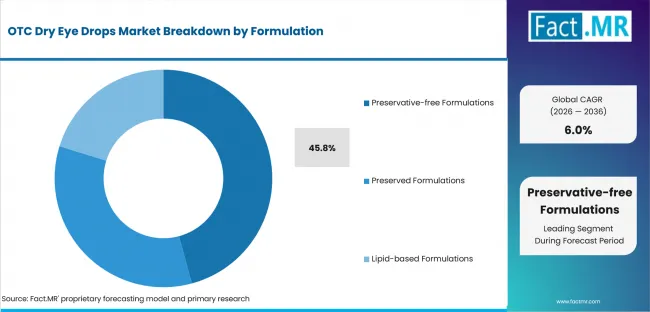
Otc Dry Eye Drops Market Analysis By Formulation | Source: Fact.MR
Preservative-free formulations benefit where repeat users want fewer irritation concerns. Single-dose vials support hygiene-led buying. Multi-dose preservative-free bottles improve convenience for users who dislike frequent vial disposal.
How does Distribution Channel shape demand?
Retail Pharmacies are anticipated to lead with 35.5% share in 2026.
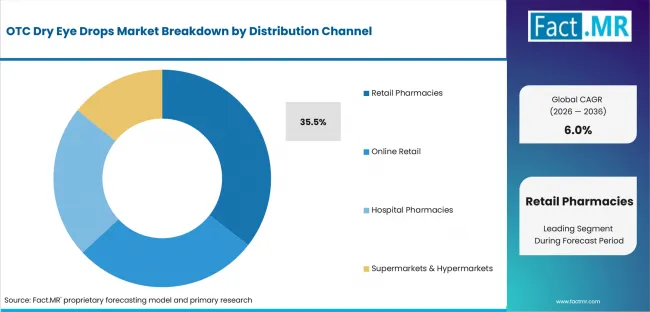
Otc Dry Eye Drops Market Analysis By Distribution Channel | Source: Fact.MR
Retail Pharmacies lead with immediate shelf access. Shoppers can compare comfort claims in person. Chain Pharmacies and Independent Pharmacies add guided selection. Drug Stores support convenience-led replacement purchases.
What supports Evaporative Dry Eye within Application?
Evaporative Dry Eye is estimated to represent 40.6% share in 2026.
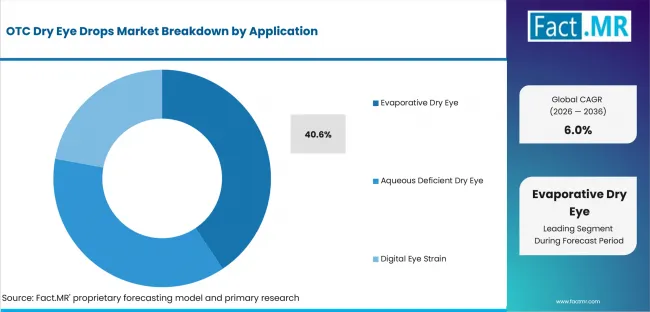
Otc Dry Eye Drops Market Analysis By Application | Source: Fact.MR
Evaporative dry eye leads as tear-film instability produces recurring discomfort. Meibomian Gland Dysfunction creates a related use case. Contact Lens-related Dry Eye and Environmental Dry Eye add repeat occasions.
Why do Adults lead End User?
Adults are forecast to hold 40.8% share in 2026.
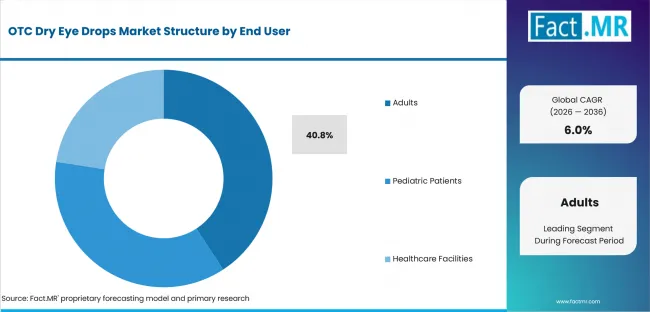
Otc Dry Eye Drops Market Analysis By End User | Source: Fact.MR
Adults represent the largest buyer base due to work routines and device-heavy days. Working Professionals create weekday use cases. Senior Population demand is shaped by age-related irritation. Contact Lens Wearers add targeted lubrication needs.
What is accelerating OTC Dry Eye Drops Market adoption, and what is holding it back?
Demand is expected to grow through familiar artificial tears and rising use of preservative-free products. Adoption may be limited by high prices and confusion between available eye-drop options.
Drivers Impact Analysis
| DRIVER | QUALITATIVE RELEVANCE | GEOGRAPHIC RELEVANCE | IMPACT TIMELINE |
|---|---|---|---|
| Artificial-tear familiarity | High | Canada; USA; UK | Short term (<= 2 years) |
| Preservative-free conversion | High | Japan; Germany; France | Short term (<= 2 years) |
| Retail pharmacy access | Moderate | Canada; UK; USA | Medium term (2-4 years) |
| Digital eye strain use cases | Moderate | USA; Japan; Germany | Medium term (2-4 years) |
| Comfort-led packaging upgrades | Selective | Developed pharmacy markets | Long term (>= 4 years) |
Source: Fact.MR analysis. Updated Jul 29, 2026
- Artificial-tear familiarity: Artificial Tears are expected to remain the first purchase for many dry-eye users.
- Preservative-free conversion: Repeat users are likely to compare preservative-free options when comfort becomes part of daily care.
- Retail pharmacy access: Pharmacy shelves reduce search time for non-prescription relief.
Opportunity Impact Analysis
| OPPORTUNITY | QUALITATIVE RELEVANCE | GEOGRAPHIC RELEVANCE | IMPACT TIMELINE |
|---|---|---|---|
| Preservative-free multipacks | Moderate | Japan and Germany | Medium term (2-4 years) |
| Online pharmacy refill pathways | Moderate | USA and UK | Medium term (2-4 years) |
| Lipid-based dry-eye formats | Selective | Canada and France | Long term (>= 4 years) |
| Clinic-to-retail handoff | Selective | Eye-care networks | Long term (>= 4 years) |
Source: Fact.MR analysis. Updated Jul 29, 2026
- Preservative-free multipacks: Multipack formats can reduce repeat-purchase friction for users who already know the product.
- Online pharmacy refill pathways: Online pharmacy refill pathways can support repeat users who want the same product delivered.
- Lipid-based dry-eye formats: Lipid-based drops can serve evaporative dry-eye users who need tear-film support beyond basic lubrication.
Restraints Impact Analysis
| RESTRAINT | QUALITATIVE RELEVANCE | GEOGRAPHIC RELEVANCE | IMPACT TIMELINE |
|---|---|---|---|
| Preservative-free price premium | Moderate | Global pharmacy channels | Short term (<= 2 years) |
| Recall and contamination concerns | Selective | USA; Canada; UK | Short term (<= 2 years) |
| Label-driven product confusion | Selective | Retail-heavy markets | Medium term (2-4 years) |
| Weak repeat-purchase proof | Selective | Online and private-label channels | Medium term (2-4 years) |
Source: Fact.MR analysis. Updated Jul 29, 2026
- Preservative-free price premium: Some shoppers delay upgrades when single-dose or preservative-free bottles cost more than standard drops. Value packs can reduce this barrier after trial use begins.
- Recall and contamination concerns: Eye-drop safety concerns can slow switching when buyers lack confidence in manufacturing quality. Brands need visible seals and dependable supply discipline.
- Label-driven product confusion: Shoppers may confuse lubrication drops with redness-relief products. Conversion weakens when symptoms are broad and packaging fails to guide the right choice.
Which countries are scaling OTC Dry Eye Drops Market fastest?
The country comparison places the USA first at 7.8% CAGR, followed by Germany at 7.1%. The UK records 6.3%, France 5.7%, Japan 5.0%, and Canada 4.2% from 2026 to 2036.
- Canada leads through broad pharmacy access and dependable availability.
- Japan benefits from quality-focused buying and preservative-free formats.
- The USA gains from strong retail reach but faces private-label pressure.
- The UK relies on pharmacy guidance.
- Germany depends on disciplined product selection.
- France benefits from controlled retail access and repeat-user confidence.
Comparable CAGRs reflect different buying routes. Wider adoption depends on shelf clarity, availability and repeat purchasing.
The full report provides country-level CAGR analysis across North America and Latin America. Europe and East Asia are included. South Asia, Oceania and the Middle East and Africa complete the regional view.
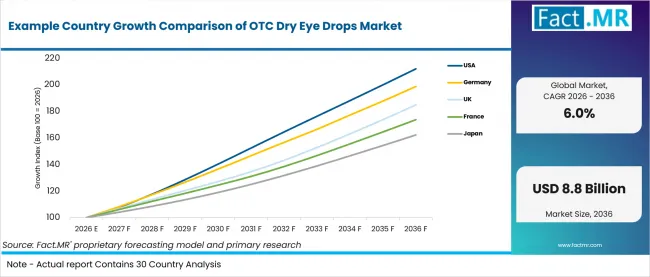
Example Country Growth Comparison Of Otc Dry Eye Drops Market | Source: Fact.MR
| Country | CAGR (2026-2036) |
|---|---|
| Canada | 4.2% |
| Japan | 5.0% |
| USA | 7.8% |
| UK | 6.3% |
| Germany | 7.1% |
| France | 5.7% |
Source: Fact.MR analysis. Updated Jul 29, 2026
What supports Canada adoption?
4.2% CAGR supported by retail pharmacy access and repeat self-care buying.
Canada’s OTC buyers need reliable product availability across wide service areas. Retail Pharmacies can support Artificial Tears selection when shoppers want quick relief and clear label guidance.
How is Japan building demand?
5.0% CAGR driven by preservative-free preference and quality-led product selection.
Quality expectations shape Japan’s OTC dry-eye route. Preservative-free Formulations fit users who apply drops often and want lower irritation risk.
What shapes USA adoption?
7.8% CAGR backed by retail depth and online refill behavior.
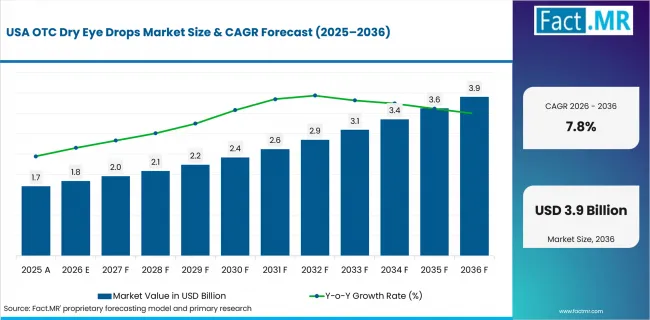
Otc Dry Eye Drops Market Country Value Analysis | Source: Fact.MR
The USA benefits from broad pharmacy coverage and repeat buying through digital channels. Artificial Tears remain easy to trial. Brand loyalty depends on comfort and safety confidence after first use.
How does the UK perform?
6.3% CAGR led by pharmacy-led access and clearer OTC guidance.
UK shoppers often rely on pharmacy advice before choosing eye drops. Retail Pharmacies can convert dry-eye complaints when shelves separate lubrication from redness relief.
What supports Germany’s outlook?
7.1% CAGR supported by pharmacy discipline and formulation review.
Germany’s growth is expected to move through buyers who value clear product positioning and dependable quality cues. Pharmacies help users compare basic Artificial Tears with gel or lipid-based alternatives.
How is France converting demand?
5.7% CAGR driven by controlled retail access and repeat-user confidence.
France’s outlook depends on clear shelf guidance and professional confidence in non-prescription lubrication products. Artificial Tears remain the first comparison point for mild dryness.
Who leads the OTC Dry Eye Drops Market?
Alcon Inc. and Bausch + Lomb show the direct relevance, while AbbVie Inc. strengthens the wider dry-eye treatment and ophthalmic-care landscape.
Alcon supports demand through recognized lubricant eye-care products and strong retail reach. Bausch + Lomb adds ophthalmic depth. AbbVie strengthens dry-eye treatment visibility. Santen, Rohto and Thea broaden the provider landscape through ophthalmology and consumer eye-care products. Competition will depend on comfort claims, preservative-free packaging, safety cues, dosing convenience and easier shelf selection.
Which companies are the key providers?
The provider list includes Alcon Inc., Bausch + Lomb, AbbVie Inc., Santen Pharmaceutical Co., Ltd., Rohto Pharmaceutical Co., Ltd., and Thea Pharmaceuticals.
- Alcon Inc.
- Bausch + Lomb
- AbbVie Inc.
- Santen Pharmaceutical Co., Ltd.
- Rohto Pharmaceutical Co., Ltd.
- Thea Pharmaceuticals
Bibliography
- U.S. Food and Drug Administration. (2024, January 22). Kilitch Healthcare India Limited issues amendments in last voluntary nationwide recall press release.
- Centers for Disease Control and Prevention. (2024, May 15). Taking care of your eyes.
- U.S. Census Bureau. (2025, June). National population by characteristics: 2020–2024 population estimates.
- Bausch + Lomb Corporation. (2024, April 26). Bausch + Lomb receives FDA approval of LUMIFY Preservative Free redness reliever eye drops.
This Report Answers
- The report provides strategic intelligence on the OTC Dry Eye Drops Market across Product Type and Formulation choices that shape consumer self-care and retail buying.
- Segment analysis covers Artificial Tears and Preservative-free Formulations as the share leaders within the 2026 market.
- Country outlook evaluates Canada and Japan alongside the USA and the UK. Germany and France complete the listed growth comparison.
- Competitive analysis profiles Alcon Inc. and Bausch + Lomb alongside AbbVie Inc. Santen Pharmaceutical Co., Ltd. and Rohto Pharmaceutical Co., Ltd. complete the provider set.
- Distribution assessment covers Retail Pharmacies and Online Retail. Hospital Pharmacies and Supermarkets & Hypermarkets complete the channel view.
What does the OTC Dry Eye Drops Market cover?
Non-prescription eye drops are used to relieve dryness and irritation where shoppers select products without a prescription. Contact-lens comfort can create a related use case when lubrication affects daily lens use.
The OTC Dry Eye Drops Market covers commercial buying for Artificial Tears and related lubricating products. Coverage extends to preservative-free bottles and gels. Lipid-based drops and natural eye-drop formats are included where they are sold for non-prescription dryness relief.
What is included in the scope?
OTC dry eye drops are used across adult self-care and pharmacy-led eye-care routines. Contact-lens comfort is included when the product is sold for lubrication support.
The scope includes Product Type and Formulation alongside Distribution Channel and Application. Retail Pharmacies and online pharmacy channels are included where buyers purchase products for non-prescription dryness relief.
What is excluded from the scope?
Prescription-only dry-eye treatments and unrelated ophthalmic procedures remain outside the scope of this market.
The scope excludes prescription drugs and surgical eye-care products. General vision-care spending is excluded unless it leads directly to OTC dry-eye drop purchase. Company revenue without a clear connection to consumer eye-drop products remains outside the scope.
How Was the Analysis Built?
The analysis draws on 120+ sources and 35+ company portfolios. It reviews 25+ countries and more than 20 industry interviews.
- Primary Research: Primary research includes discussions with manufacturers; service providers; technology developers; distributors; end users; procurement teams; and subject-matter experts. These conversations examine purchasing priorities and factors that influence wider market acceptance.
- Desk Research: Desk research covers government statistics; regulatory publications; company filings; trade data; technical studies; industry associations; standards; and public policy. Every retained reference is documented in the bibliography.
- Market Sizing and Forecasting: Market estimates combine historical performance with demand indicators. The analysis then reviews pricing trends and segment shares before testing country-level growth and barriers to market expansion.
- Data Validation and Update Cycle: Findings are validated by comparing primary interviews with public data and company activity. Regular updates review product launches and shifts in commercial adoption.
Segmentation
What is the report’s scope and coverage?
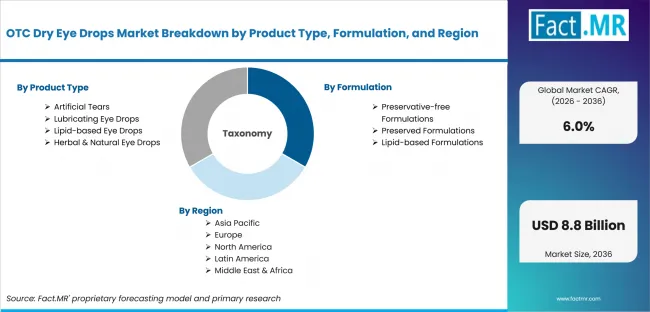
Otc Dry Eye Drops Market Breakdown By Product Type, Formulation, And Region | Source: Fact.MR
| Attribute | Details |
|---|---|
| Quantitative Units | USD billion in 2026 to USD billion by 2036 at CAGR |
| Market Definition | Non-prescription lubricating eye drops used for dry-eye relief and daily comfort. Products are sold through retail pharmacy and online channels for self-care use. |
| Product Type | Artificial Tears; Preservative-free Artificial Tears; Preserved Artificial Tears; Gel-based Artificial Tears; Lubricating Eye Drops; Hyaluronic Acid Drops; Carboxymethylcellulose Drops; Glycerin-based Drops; Lipid-based Eye Drops; Omega Lipid Formulations; Emulsion Eye Drops; Phospholipid Formulations; Herbal & Natural Eye Drops; Herbal Extract Formulations; Plant-based Lubricants; Organic Eye Drops |
| Formulation | Preservative-free Formulations; Single-dose Vials; Multi-dose Preservative-free Bottles; Gel Formulations; Preserved Formulations; Benzalkonium Chloride Formulations; Polyquad Formulations; Oxidative Preservative Formulations; Lipid-based Formulations; Oil-in-water Emulsions; Nanoemulsions; Advanced Lipid Complexes |
| Distribution Channel | Retail Pharmacies; Chain Pharmacies; Independent Pharmacies; Drug Stores; Online Retail; E-commerce Platforms; Brand Websites; Online Pharmacies; Hospital Pharmacies; Outpatient Pharmacies; Hospital Retail Stores; Clinic Pharmacies; Supermarkets & Hypermarkets; Supermarkets; Hypermarkets; Convenience Stores |
| Application | Evaporative Dry Eye; Meibomian Gland Dysfunction; Contact Lens-related Dry Eye; Environmental Dry Eye; Aqueous Deficient Dry Eye; Age-related Dry Eye; Post-surgical Dry Eye; Medication-induced Dry Eye; Digital Eye Strain; Computer Vision Syndrome; Smartphone-related Eye Fatigue; Workplace Eye Fatigue |
| End User | Adults; Working Professionals; Senior Population; Contact Lens Wearers; Pediatric Patients; Children; Adolescents; Specialty Care; Healthcare Facilities; Eye Clinics; Optometry Centers; Hospital Outpatient Departments |
| Regions Covered | North America; Latin America; Europe; East Asia; South Asia and Pacific; Middle East and Africa |
| Countries Covered | Canada; Japan; USA; UK; Germany; France |
| Key Companies Profiled | Alcon Inc.; Bausch + Lomb; AbbVie Inc.; Santen Pharmaceutical Co., Ltd.; Rohto Pharmaceutical Co., Ltd.; Thea Pharmaceuticals |
| Forecast Period | 2026 to 2036 |
| Approach | Hybrid top-down and bottom-up approach using OTC eye-care demand; product-type mix; preservative-free adoption; retail pharmacy reach; online refill behavior; application needs; country adoption patterns and company portfolio review |
Source: Fact.MR analysis. Updated Jul 29, 2026
How is the market segmented?
-
By Product Type:
- Artificial Tears
- Preservative-free Artificial Tears
- Preserved Artificial Tears
- Gel-based Artificial Tears
- Lubricating Eye Drops
- Hyaluronic Acid Drops
- Carboxymethylcellulose Drops
- Glycerin-based Drops
- Lipid-based Eye Drops
- Omega Lipid Formulations
- Emulsion Eye Drops
- Phospholipid Formulations
- Herbal & Natural Eye Drops
- Herbal Extract Formulations
- Plant-based Lubricants
- Organic Eye Drops
-
By Formulation:
- Preservative-free Formulations
- Single-dose Vials
- Multi-dose Preservative-free Bottles
- Gel Formulations
- Preserved Formulations
- Benzalkonium Chloride Formulations
- Polyquad Formulations
- Oxidative Preservative Formulations
- Lipid-based Formulations
- Oil-in-water Emulsions
- Nanoemulsions
- Advanced Lipid Complexes
-
By Distribution Channel:
- Retail Pharmacies
- Chain Pharmacies
- Independent Pharmacies
- Drug Stores
- Online Retail
- E-commerce Platforms
- Brand Websites
- Online Pharmacies
- Hospital Pharmacies
- Outpatient Pharmacies
- Hospital Retail Stores
- Clinic Pharmacies
- Supermarkets & Hypermarkets
- Supermarkets
- Hypermarkets
- Convenience Stores
-
By Application:
- Evaporative Dry Eye
- Meibomian Gland Dysfunction
- Contact Lens-related Dry Eye
- Environmental Dry Eye
- Aqueous Deficient Dry Eye
- Age-related Dry Eye
- Post-surgical Dry Eye
- Medication-induced Dry Eye
- Digital Eye Strain
- Computer Vision Syndrome
- Smartphone-related Eye Fatigue
- Workplace Eye Fatigue
-
By End User:
- Adults
- Working Professionals
- Senior Population
- Contact Lens Wearers
- Pediatric Patients
- Children
- Adolescents
- Specialty Care
- Healthcare Facilities
- Eye Clinics
- Optometry Centers
- Hospital Outpatient Departments
-
By Region:
- North America
- Latin America
- Europe
- East Asia
- South Asia and Oceania
- Middle East and Africa
Frequently Asked Questions
Which Product Type leads the market?
Which Formulation leads the market?
Which Distribution Channel leads the market?
Which Application leads the market?
Which End User leads the market?
Which country records the highest listed CAGR?
What is the primary driver in this market?
What is the main restraint?
Why do adults lead demand?
Who worked on this report


Preview the report firsthand - request a free sample
Free SampleGet the brochure for pricing and purchase details
Download PDF