- Base Value(2025): 4.6 Bn
- Estimated Value(2026): 4.9 Bn
- Forecast Value (2036): 8.3 Bn
- CAGR (2026 - 2036): 6.1%
Passive Entry Door Handles Market Forecast and Outlook 2026 to 2036
In 2025, the passive entry door handles market was valued at USD 4.6 billion. Based on Fact.MR analysis, demand for passive entry door handles is estimated to reach USD 4.9 billion in 2026 and USD 8.3 billion by 2036. Fact.MR projects a CAGR of 6.1% during the forecast period. Growth reflects higher electronic content per vehicle and wider adoption of keyless access systems across mid-range passenger cars, supported by declining sensor and control module costs.
The market adds approximately USD 3.7 billion in value over the decade, indicating steady compounding rather than step-change expansion. Volume growth is strongest where flush and capacitive handles replace mechanical assemblies at the platform level, while pricing remains influenced by integration with body control modules, cybersecurity validation, and durability testing for high-cycle use.
As Swamy Kotagiri, Chief Executive Officer of Magna International, stated, “We closed 2025 with a strong fourth quarter, successfully navigating another dynamic year in our industry. Our disciplined execution and commitment to operational excellence enabled us to deliver financial results that were in line with, or exceeded, our February 2025 Outlook across all key metrics.”[1]
Fact.MR analysis views this performance discipline as directly relevant to passive entry systems, where execution reliability and scale manufacturing capability influence long-term OEM sourcing decisions.
India records the fastest growth at 7.0% CAGR due to rapid penetration of keyless entry in locally produced mid-range vehicles. China follows at 6.5% as domestic OEMs standardize capacitive and flush handle designs. Mexico grows at 6.1% through export-focused assembly programs, while South Korea posts 5.8% driven by technology-dense passenger platforms. Turkey reaches 5.4% through regional vehicle production. Mature markets such as the United States at 5.0%, Germany at 4.6%, and Japan at 3.9% remain replacement-led, constrained by longer model cycles and slower feature refresh rates.
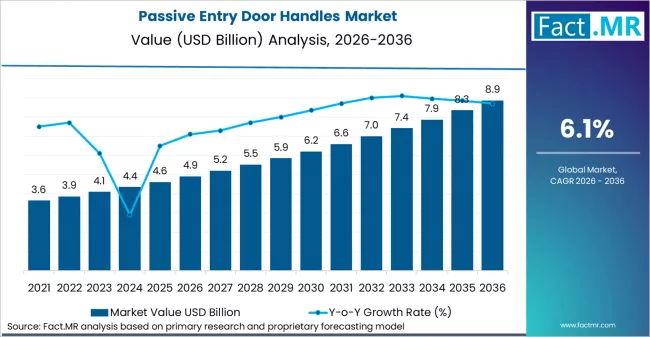
Passive Entry Door Handles Market Market Value Analysis | Source: Fact.MR
Passive Entry Door Handles Market Definition
The passive entry door handles market covers exterior vehicle door handle systems that allow locking and unlocking without physical key insertion. These handles work with proximity sensors and vehicle control units to detect an authorized key fob and enable door access when the user touches or pulls the handle. System operation and vehicle access safety requirements are governed by regulations issued by the US National Highway Traffic Safety Administration and UNECE vehicle construction rules and [2] Passive entry door handles are supplied mainly for passenger cars and light commercial vehicles.
Passive Entry Door Handles Market Inclusions
The report covers global and regional market size estimates in volume and value terms with a forecast period from 2026 to 2036. Segmentation includes handle type such as pull type and flush type, sensor integration level, application by vehicle category, and end use covering original equipment fitment and replacement demand. The scope also includes regional demand patterns, pricing benchmarks, and international trade flows for automotive exterior access components.
Passive Entry Door Handles Market Exclusions
The scope excludes mechanical key operated door handles without electronic sensing capability and interior door release mechanisms. Standalone proximity sensors, key fobs, wiring harnesses, and electronic control modules sold separately are not included. Complete door assemblies and body panels are excluded. Motorsport specific access systems, prototype designs without road certification, laboratory testing equipment, and vehicle software services are also outside the scope.
Passive Entry Door Handles Market Research Methodology
- Primary Research: Primary research involved interviews with door handle manufacturers, automotive OEM sourcing teams, sensor suppliers, and vehicle body engineers.
- Desk Research: Desk research used vehicle access and safety regulations issued by the US National Highway Traffic Safety Administration and UNECE, vehicle production data from national transport authorities, and company annual reports and technical product disclosures filed with securities regulators.
- Market Sizing and Forecasting: Market sizing applied a hybrid top down and bottom up model using vehicle production volumes, passive entry system fitment rates by vehicle segment, and replacement demand patterns.
- Data Validation and Update Cycle: Outputs were cross checked against vehicle registration data, regulatory compliance documentation, trade statistics, and OEM supply disclosures, with updates applied when verified public data sources issue revisions.
Summary of Passive Entry Door Handles Market
- Market Definition
- The passive entry door handles market covers exterior vehicle door handle systems that enable locking and unlocking without mechanical key insertion, using proximity sensors and integration with vehicle body control and immobiliser systems.
- Demand Drivers
- OEMs increasingly standardise passive entry capability across mid-range passenger vehicle platforms to reduce variant complexity and align body electronics architecture at scale.
- Declining costs of proximity sensors and control modules support wider adoption of keyless access systems beyond premium vehicle segments.
- Vehicle security and access system validation requirements influence handle design, durability testing, and electronic integration, as defined under. [3]
- Key Segments Analyzed
- Technology: Keyless or passive entry handles account for the leading share, as they integrate directly with central locking and keyless start systems.
- Vehicle segment: Mid-range passenger cars form the largest demand base due to feature migration from premium models into higher-volume platforms.
- Geography: Asia Pacific leads growth, supported by rising passenger vehicle production and standardisation of electronic access features in India and China under UNECE-aligned frameworks. [4]
- Analyst opinion at FMI
- Shambhu Nath Jha, Principal Consultant at Fact.MR, opines, ‘CXOs will find this report useful for understanding how platform-level standardisation, electronic access validation, and regional regulatory alignment are reshaping sourcing strategies and long-term volume planning for passive entry door handle systems.’
- Strategic Implications / Executive Takeaways
- OEM suppliers should prioritise scalable designs compatible with multiple body control architectures rather than vehicle-specific handle variants.
- Investment focus should shift toward electronic reliability, cybersecurity validation, and high-cycle durability testing.
- Flush and capacitive handle programs should include mechanical fallback provisions to align with evolving safety expectations.
- Methodology
- Based on first-hand interviews with handle manufacturers, OEM sourcing teams, and body electronics engineers.
- Market sizing derived from vehicle production volumes and passive entry fitment rates by segment.
- Findings validated against regulatory documentation, vehicle registration data, and verified public standards.
Segmental Analysis
Passive Entry Door Handles Market Analysis by Technology
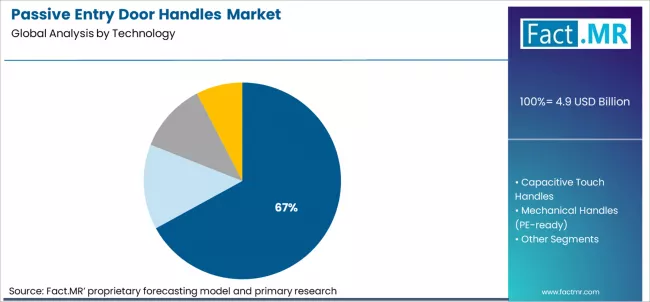
Passive Entry Door Handles Market Analysis By Technology | Source: Fact.MR
Based on Fact.MR analysis, consumption of keyless or passive entry door handles is estimated to hold 67% share of the global market in 2026. Fact.MR analysts note that this technology leads because it enables hands-free vehicle access using proximity authentication, reducing reliance on mechanical key actuation. As per Fact.MR, passive entry handles address OEM requirements for theft deterrence integration, user convenience, and compatibility with vehicle body control modules that manage access authorization and locking functions.
- Regulatory context: Vehicle access and anti-theft system performance requirements influence the design and validation of passive entry technologies used in door handles.
- System architecture: Fact.MR analysts reference vehicle electrical layouts where passive entry handles interface with immobilizers and central locking systems.
- Technology shift: OEMs continue to replace purely mechanical handles with electronically enabled passive entry designs across new vehicle platforms.
Passive Entry Door Handles Market Analysis by Vehicle Segment
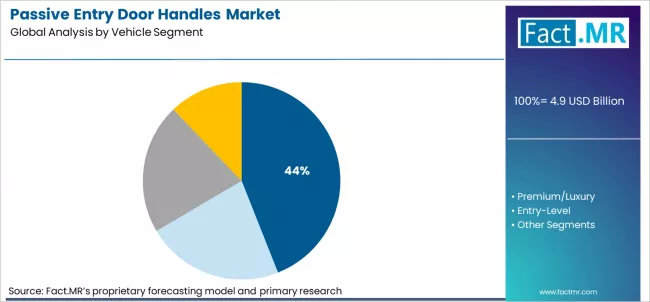
Passive Entry Door Handles Market Analysis By Vehicle Segment | Source: Fact.MR
Based on Fact.MR analysis, consumption of passive entry door handles in mid-range vehicles is estimated to hold 44.0% share of the global market in 2026. Fact.MR opines that this segment leads due to feature migration from premium models into higher-volume mid-range passenger vehicles. As per Fact.MR, mid-range platforms balance cost control with demand for electronic access features, supporting wider installation of passive entry handles without full premium system complexity.
- Regulatory framework: International vehicle regulations governing electronic systems and electromagnetic compatibility apply to passive entry components across passenger vehicle segments.
- Feature diffusion: Fact.MR analysts note that mid-range vehicles increasingly adopt access technologies introduced earlier in luxury segments.
- Volume leverage: Higher production volumes in the mid-range segment accelerate supplier scale for passive entry door handle systems.
Passive Entry Door Handles Market Drivers, Restraints, And Opportunities
Fact.MR analysis indicates that the passive entry door handles market exists as a vehicle access system component segment within the automotive industry, driven by growing demand for convenience and security features across passenger cars and light commercial vehicles. As per Fact.MR assessment, passive entry systems allow vehicle access without using a mechanical key, relying instead on electronic key fob communication and proximity sensors; global safety and anti-theft regulations influence functionality expectations, including standards for electronic immobiliser and access system performance as referenced in UNECE Regulation No. 97, which provides uniform provisions on vehicle immobiliser systems and may inform integrated access feature specifications. Fact.MR analysts observe that the market’s current scale is supported by increasing consumer preference for keyless convenience features, particularly in mid-to-premium vehicle segments where passive access is standard equipment.
Fact.MR is of the opinion that current market dynamics reflect a transition toward greater integration of passive entry door handles with vehicle networked systems and digital security protocols. Based on Fact.MR assessment, traditional mechanical door handles remain prevalent in entry-level vehicles due to cost and simplicity, but demand for passive entry systems expands in segments where security, user convenience, and seamless interaction with keyless start systems are specified. Passive entry door handle assemblies generally carry higher per-unit pricing because of embedded sensors, wireless communication modules, and control logic integration, meaning realised value can grow even where shipment volume expansions remain moderate. Fact.MR analysis suggests this mix of evolving functional requirements and premium value placement shapes near-term market progression.
- Regulated immobiliser and access provisions: Fact.MR analysts note that UNECE Regulation No. 97 on vehicle immobiliser systems informs performance expectations for integrated access solutions like passive entry door handles
- Integration with vehicle electronics: Based on Fact.MR assessment, demand is rising for passive entry door handle systems that integrate with keyless start, remote vehicle access, and networked security protocols.
- Asia Pacific automotive feature adoption: Fact.MR opines that increasing consumer demand for driver convenience and vehicle security features in China, India, and Southeast Asia supports regional uptake of passive entry door handles in both OEM and aftermarket segments.
Regional Analysis
Based on regional assessment, the passive entry door handles sector is analyzed across North America, Europe, East Asia, South Asia, and other major automotive manufacturing regions, spanning more than 40 countries. Regional performance varies according to adoption of keyless entry systems, vehicle electrification trends, and integration of electronic access features across passenger vehicle segments. The report also presents a comparative market attractiveness evaluation grounded in region-specific demand trends.
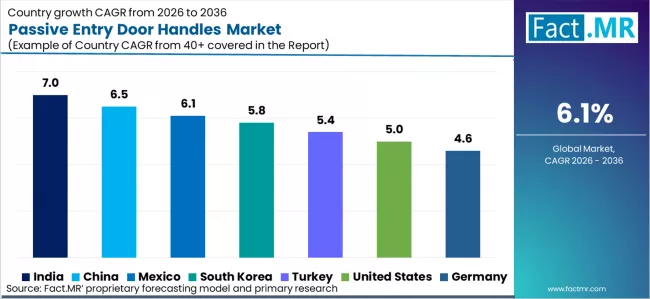
Passive Entry Door Handles Market Cagr Analysis By Country | Source: Fact.MR
| Country | CAGR |
|---|---|
| India | 7.0% |
| China | 6.5% |
| Mexico | 6.1% |
| South Korea | 5.8% |
| Turkey | 5.4% |
| United States | 5.0% |
| Germany | 4.6% |
| Japan | 3.9% |
Source: Fact.MR analysis. Updated Feb 19, 2026
Source: Fact.MR analysis, based on proprietary forecasting models and primary research.
Asia Pacific Passive Entry Door Handles Market Analysis
Asia Pacific operates as a production- and regulation-driven automotive access systems region for passive entry door handles, supported by large passenger vehicle manufacturing volumes and increasing integration of keyless entry systems. Demand is governed by vehicle security standards, electronic access regulations, and OEM homologation requirements. Adoption is enforced through vehicle type approval systems, component certification processes, and compliance with national automotive electronics and theft prevention norms across domestic and export-oriented vehicle production.
- India: Demand for passive entry door handles in India is projected to rise at 7.0% CAGR through 2036. Fitment is governed by Automotive Industry Standards aligned with CMVR safety and security provisions updated during 2021 and reinforced through OEM adoption in passenger vehicles produced during 2022-2023, as per Fact.MR.
- China: Demand for passive entry door handles in China is projected to rise at 6.5% CAGR through 2036. Application follows vehicle electronic security and access provisions under GB automotive standards revised in 2021 and enforced through national type approval systems, according to Fact.MR.
- South Korea: Demand for passive entry door handles in South Korea is projected to rise at 5.8% CAGR through 2036. Use follows vehicle security certification requirements enforced under national safety regulations and reinforced through domestic OEM homologation processes applied during 2021-2022, as per Fact.MR.
Fact.MR’s analysis of the Passive Entry Door Handles Market in Asia Pacific consists of country-wise assessment that includes India, China, and South Korea. Readers can find security regulations, homologation frameworks, and production-linked compliance references.
Latin America Passive Entry Door Handles Market Analysis
Latin America functions as an OEM- and regulation-aligned automotive components region for passive entry door handles. Demand is tied to vehicle assembly activity and adoption of electronic access systems aligned with export and domestic safety requirements. Adoption is governed by homologation rules, vehicle security standards, and OEM certification processes applied to vehicles produced for regional markets and exports.
- Mexico: Demand for passive entry door handles in Mexico is projected to rise at 6.1% CAGR through 2036. Application follows NOM automotive safety and security standards and reinforced through export-oriented OEM production supplying North American markets during 2022-2023, according to Fact.MR.
Fact.MR’s analysis of the Passive Entry Door Handles Market in Latin America consists of country-wise assessment that includes Mexico. Readers can find homologation rules, vehicle security standards, and production-based compliance documentation.
Middle East Passive Entry Door Handles Market Analysis
The Middle East operates as an import-led automotive components market for passive entry door handles, with demand governed by vehicle security compliance and inspection frameworks. Adoption is linked to vehicle import homologation, theft prevention requirements, and fleet safety regulations rather than domestic vehicle manufacturing volume.
- Turkey: Demand for passive entry door handles in Turkey is projected to rise at 5.4% CAGR through 2036. Fitment follows EU-aligned vehicle type approval and electronic security regulations adopted nationally and reinforced through domestic vehicle assembly and inspection systems applied during 2021-2022, as per Fact.MR.
Fact.MR’s analysis of the Passive Entry Door Handles Market in the Middle East consists of country-wise assessment that includes Turkey. Readers can find vehicle approval frameworks and security compliance documentation.
North America Passive Entry Door Handles Market Analysis
North America functions as a standards-led automotive access systems market where passive entry door handles are governed by federal safety regulations, vehicle security requirements, and OEM certification practices. Demand is shaped by compliance with electronic access system standards, vehicle certification processes, and replacement cycles linked to higher trim vehicle adoption.
- United States: Demand for passive entry door handles in the United States is projected to rise at 5.0% CAGR through 2036. Application is governed by FMVSS-related safety and vehicle security provisions and reinforced through OEM compliance in passenger vehicle production and certification programs applied during 2021-2022, as per Fact.MR.
Fact.MR’s analysis of the Passive Entry Door Handles Market in North America consists of country-wise assessment that includes the United States. Readers can find federal safety standards and vehicle security compliance references.
Europe Passive Entry Door Handles Market Analysis
Europe operates as a regulation-led automotive access systems market for passive entry door handles, with adoption governed by UNECE vehicle security regulations and EU type approval frameworks. Demand is enforced through conformity assessments, theft prevention requirements, and OEM compliance with electronic access performance standards across member states.
- Germany: Demand for passive entry door handles in Germany is projected to rise at 4.6% CAGR through 2036. Application follows UNECE vehicle security regulations and EU type approval rules applied in vehicle manufacturing and certification cycles during 2021-2022, according to Fact.MR.
- Japan: Demand for passive entry door handles in Japan is projected to rise at 3.9% CAGR through 2036. Fitment is governed by Road Transport Vehicle Act security provisions and enforced through national vehicle certification systems applied during 2021-2022, as per Fact.MR.
Fact.MR’s analysis of the Passive Entry Door Handles Market in Europe consists of country-wise assessment that includes Germany and Japan. Readers can find regulatory frameworks, type approval processes, and component compliance references.
Competitive Landscape of Passive Entry Door Handles Market
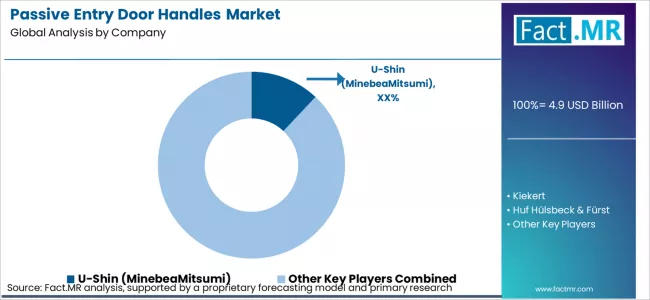
Passive Entry Door Handles Market Analysis By Company | Source: Fact.MR
As per Fact.MR analysis, the 2026 passive entry door handles market is defined by validated actuation reliability, integration with vehicle electronic systems, and OEM alignment, which determine competitive advantage. U-Shin (MinebeaMitsumi) and Kiekert lead with high-precision electronic handles that maintain consistent performance across temperature and humidity ranges, which strengthens adoption in premium and mid-segment vehicles. Huf Hülsbeck & Fürst and Tokai Rika focus on validated sensor and lock communication systems, which reduces failure rates and improves consumer safety. Valeo and Hyundai Mobis emphasize modular, lightweight designs with certified durability, which enhances vehicle fuel efficiency and long-term reliability. Magna International and Alps Alpine provide multi-region compliant assemblies, which supports OEM qualification and supply continuity. Marquardt and Fujikura leverage precision actuation and material resilience, which increases lifespan under repeated use and harsh environmental conditions. Across the market, validated reliability, system-level integration, and robust supply chains form enduring competitive moats that reduce reliance on pricing or isolated component features, ensuring OEM confidence and long-term adoption.
Recent Industry Developments
- China’s 2027 Ban on Fully Hidden Door Handles (January 2026)
- In a landmark regulatory move, China’s Ministry of Industry and Information Technology (MIIT) announced that fully powered flush-fitting door handles will be banned starting January 1, 2027. This follows safety investigations into crashes where occupants were trapped because electronic handles failed to deploy. All vehicles must now incorporate a mechanical release accessible from both the inside and outside, a move expected to reshape global EV design.[5]
- Magna’s "SmartAccess" Power Flush Handle Rollout (February 2026)
- Despite new regulations, Magna International reported record growth in its "Exteriors" segment for 2025, driven by its Power Flush Handle technology. These handles use a specialized actuator that integrates seamless authentication and "SureTouch" capacitive sensors. To comply with emerging safety standards, Magna’s latest iterations include a "failsafe" mechanical override while maintaining the aerodynamic benefits of a flush profile. [6]
- Forvia Hella’s "Slimline" Passive Entry Module (January 2026)
- Forvia Hella has introduced a new Slimline Passive Entry electronic module that fits within the ultra-narrow profiles of modern door handles. The system utilizes UWB (Ultra-Wideband) and Bluetooth Low Energy (BLE) to detect the owner’s approach with centimeter-level precision, preventing "relay attacks" while allowing the handle to deploy and the door to unlock without a physical key press. [7]
Key Players in Passive Entry Door Handles Market
- U-Shin (MinebeaMitsumi)
- Kiekert
- Huf Hülsbeck & Fürst
- Tokai Rika
- Valeo
- Hyundai Mobis
- Magna International
- Alps Alpine
- Marquardt
- Fujikura
Bibliography
- [1] Magna International Inc. (2026). Magna announces fourth quarter 2025 results and provides 2026 outlook. Magna International-News & Press Releases.
- [2] U.S. Department of Transportation, National Highway Traffic Safety Administration. (2023). Road safety and vehicle access regulations. NHTSA; United Nations Economic Commission for Europe. (2023). Vehicle construction and access-related regulations. UNECE.
- [3] U.S. Department of Transportation, National Highway Traffic Safety Administration. (2023). Vehicle security, theft prevention, and access system safety standards. NHTSA.
- [4] United Nations Economic Commission for Europe. (2023). UNECE vehicle construction and electronic access regulatory framework. UNECE.
- [5] Autocar India. (2026). China to ban powered flush-fitting door handles from January 2027. Autocar India.
- [6] Magna International Inc. (2026). Power flush handles: SmartAccess exterior mechatronics solutions. Magna International-Product & Technology Portfolio.
- [7] FORVIA HELLA. (2026). Keyless entry and passive access technologies for automotive door systems. HELLA TechWorld.
Segmentation
Scope of the Report
| Metric | Value |
|---|---|
| Quantitative Units | USD 4.9 billion (2026) to USD 8.3 billion (2036), CAGR 6.1% |
| Market Definition | The passive entry door handles market covers exterior vehicle door handle assemblies that allow keyless or passive access using proximity sensors and vehicle control units. These systems detect authorized key fobs and enable door unlocking without physical key insertion. Safety and access functionality are governed by US NHTSA and UNECE regulations. The market serves passenger cars and light commercial vehicles. |
| Technology Segmentation | Keyless/Passive Entry Handles, Capacitive Touch Handles, Mechanical Handles (PE-ready), Other |
| Vehicle Segment | Mid-Range, Premium/Luxury, Entry-Level, Commercial Vehicles |
| Handle Type | Pull-Type, Flush/E-Handle, Grip-Type, Other |
| Sales Channel | OEM/Tier 1 Supply, Aftermarket Accessories, Service Replacement, Other |
| Regions Covered | Asia Pacific, Europe, North America, Latin America, Middle East & Africa |
| Countries Covered | India, China, South Korea, Mexico, Turkey, United States, Germany, Japan |
| Key Companies Profiled | U-Shin (MinebeaMitsumi), Kiekert, Huf Hülsbeck & Fürst, Tokai Rika, Valeo, Hyundai Mobis, Magna International, Alps Alpine, Marquardt, Fujikura |
| Forecast Period | 2026 to 2036 |
| Approach | Hybrid top-down and bottom-up model using vehicle production data, passive entry fitment rates by segment, OEM adoption trends, and regulatory compliance. Primary research involved interviews with handle manufacturers, OEMs, and sensor suppliers; desk research referenced NHTSA, UNECE, and UN Comtrade data. |
Source: Fact.MR analysis. Updated Feb 19, 2026
Passive Entry Door Handles Market Analysis by Segments
-
By Technology:
- Keyless/Passive Entry Handles
- Capacitive Touch Handles
- Mechanical Handles (PE-ready)
- Other
-
By Vehicle Segment:
- Mid-Range
- Premium/Luxury
- Entry-Level
- Commercial Vehicles
-
By Handle Type:
- Pull-Type
- Flush/E-Handle
- Grip-Type
- Other
-
By Sales Channel:
- OEM/Tier 1 Supply
- Aftermarket Accessories
- Service Replacement
- Other
-
Region
- Asia Pacific
- India
- China
- Japan
- South Korea
- Indonesia
- Australia & New Zealand
- ASEAN
- Rest of Asia Pacific
- Europe
- Germany
- Italy
- France
- United Kingdom
- Spain
- Benelux
- Nordics
- Central & Eastern Europe
- Rest of Europe
- North America
- United States
- Canada
- Mexico
- Latin America
- Brazil
- Argentina
- Chile
- Rest of Latin America
- Middle East & Africa
- Kingdom of Saudi Arabia
- United Arab Emirates
- South Africa
- Turkey
- Rest of Middle East & Africa
- Asia Pacific
Frequently Asked Questions
How large is the passive entry door handles market in 2026?
What will the market size be by 2036?
What CAGR is expected for the market during 2026–2036?
What was the market value in 2025?
How much absolute value will the market add over the forecast period?
What is driving steady growth rather than rapid expansion in this market?
Which technology segment leads the market in 2026?
Why do keyless or passive entry handles dominate technology adoption?
Which vehicle segment accounts for the largest share of demand?
Why is the mid-range segment driving most of the volume?
Which country records the fastest growth rate globally?
What is China’s projected growth rate in the market?
How fast is the passive entry door handles market expected to grow in Mexico?
What is the growth outlook for South Korea?
How does Turkey compare as a regional growth market?
What is the expected growth rate in the United States?
How fast is the German market expected to grow?
What is the projected CAGR for Japan?
Which region leads overall market growth?
What factors most influence OEM sourcing decisions in this market?
Who worked on this report


Preview the report firsthand - request a free sample
Free SampleGet the brochure for pricing and purchase details
Download PDF