- Base Value(2026): 1564.1 Mn
- Estimated Value(2026): 1564.1 Mn
- Forecast Value (2036): 5170.2 Mn
- CAGR (2026 - 2036): 12.7%
Peptide-Rich Firming Creams Market Forecast and Outlook 2026 to 2036
The peptide-rich firming creams market is expected to grow from USD 1,564.1 million in 2026 to USD 5,170.2 million in 2036 at a CAGR of 12.7%.
Key Takeaways from Peptide-Rich Firming Creams Market
- Market Value (2026): USD 1,564.1 million
- Market Forecast Value (2036): USD 5,170.2 million
- Market Forecast CAGR: 12.7%
- Leading Product Type: Serums (44.1%)
- Key Growth Regions: China, India, Brazil, Germany, USA, UK, Japan
- Key Players: Estée Lauder, Olay, StriVectin, L’Oréal, Shiseido, Clinique, Paula’s Choice, Murad, Lancôme, Dr. Dennis Gross
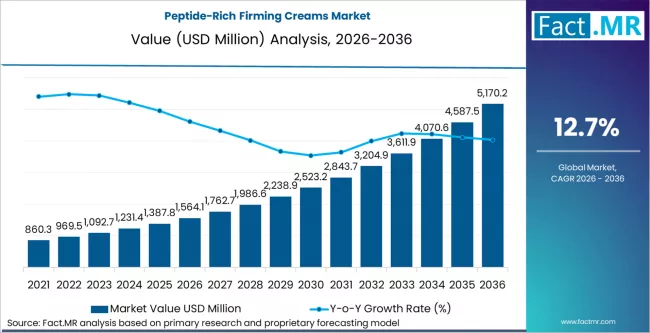
Peptide Rich Firming Creams Market Market Value Analysis | Source: Fact.MR
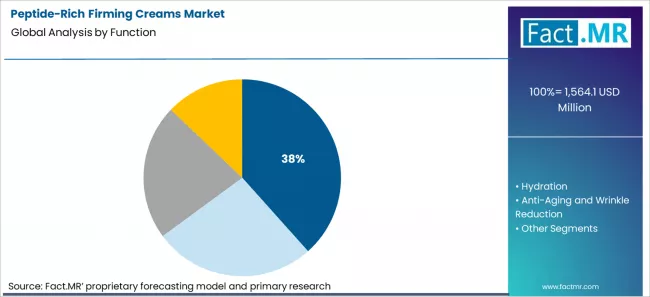
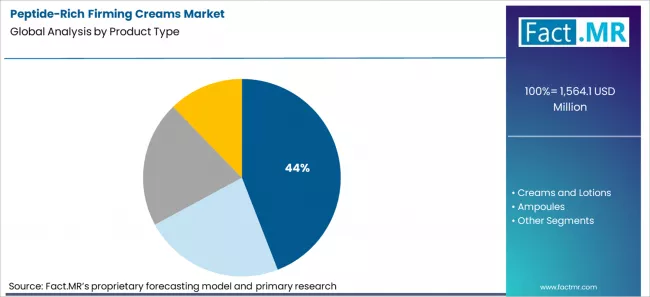
Firming and lifting formulations maintain the leading position in function, complemented by hydration, anti-aging and wrinkle reduction, and skin barrier support applications. Serums dominate product type, followed by creams and lotions, ampoules, and mists, reflecting strong consumer preference for concentrated, high-efficacy formats.
Market expansion is fueled by increasing awareness of peptide-based technology, premiumization of skincare routines, and demand for scientifically validated anti-aging solutions. High-growth regions such as China and India are driving volume adoption, while mature markets including the United States, Germany, and Japan sustain growth through innovation, multi-functional formulations, and established brand loyalty. Companies offering clinically backed products with visible results are likely to capture significant market share over the forecast period.
Peptide-Rich Firming Creams Market
| Metric | Value |
|---|---|
| Market Value 2026 | USD 1,564.1 Million |
| Market Forecast Value 2036 | USD 5,170.2 Million |
| Forecast CAGR 2026 to 2036 | 12.7% |
Source: Fact.MR analysis. Updated Jan 30, 2026
Category
| Category | Segments |
|---|---|
| Function | Firming and Lifting; Hydration; Anti-Aging and Wrinkle Reduction; Skin Barrier Support; Other |
| Product Type | Serums; Creams and Lotions; Ampoules; Mists; Other |
| Application | Anti-Aging; Hydration; Firming; Barrier Support; Other |
| End User | Women; Men; Unisex; Other |
| Region | North America; Europe; Asia Pacific; Latin America; Middle East & Africa |
Source: Fact.MR analysis. Updated Jan 30, 2026
Segmental Analysis
Which Function Holds the Largest Share in the Peptide-Rich Firming Creams Market?
Peptide Rich Firming Creams Market Analysis By Function | Source: Fact.MR
Firming and lifting formulations lead the market with a 38.4% share. These creams and serums are specifically designed to enhance skin elasticity, improve contour definition, and reduce visible sagging, making them a primary choice for consumers seeking targeted anti-aging results. Their multifunctional benefits, including hydration and structural support, drive consistent adoption in both at-home and professional skincare routines.
- Brands continue to integrate advanced peptide complexes to strengthen lifting effects and reinforce product differentiation.
- The focus on visible firmness and contour improvement ensures firming and lifting remains the leading function in the market.
Which Product Type Drives the Highest Adoption in the Peptide-Rich Firming Creams Market?
Peptide Rich Firming Creams Market Analysis By Product Type | Source: Fact.MR
Serums hold the largest share at 44.1%, reflecting their concentrated delivery of bioactive peptides and rapid skin absorption. Serums are favored for their efficacy in targeting specific concerns such as fine lines, sagging, and skin density, complementing creams and lotions in a complete skincare regimen.
- Manufacturers are emphasizing high-potency peptide serums to achieve measurable results and strengthen brand positioning.
- Consumer preference for intensive, targeted treatments ensures serums remain the dominant product type in the peptide-rich firming creams market.
What are the Drivers, Restraints, and Key Trends in the Peptide Rich Firming Creams Market?
- Drivers: Rising consumer demand for firming, lifting, hydration, anti aging, and skin barrier support products is driving adoption of peptide rich firming creams across serums, creams, lotions, ampoules, and mists. Companies such as Estée Lauder, Olay, and L’Oréal are launching high potency formulations with bioactive peptides to enhance skin elasticity, reduce fine lines, and improve hydration. Growth in skincare awareness, premiumization, and digital retail channels is supporting wider adoption in China, India, the U.S., and Europe.
- Restraints: High production costs for peptide-enriched formulations and stability challenges in maintaining active efficacy limit broader participation, particularly among smaller brands. Technical constraints in combining multiple actives without compromising texture or bioavailability can delay product launches and restrict market penetration in emerging regions.
- Trend 1: Development of multifunctional peptide products that combine firming, lifting, hydration, and anti-aging benefits in single formats to simplify skincare routines.
- Trend 2: Expansion of e commerce and omnichannel distribution to enhance accessibility and drive repeat purchases globally.
Analysis of the Peptide-Rich Firming Creams Market by Key Country
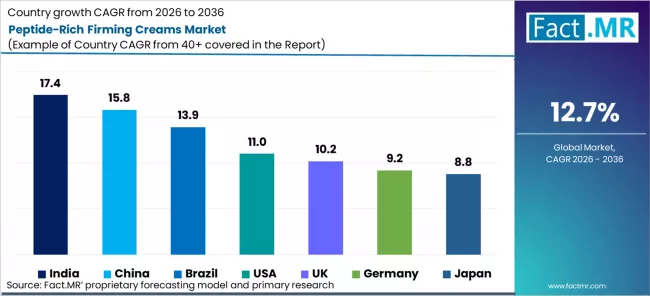
Peptide Rich Firming Creams Market Cagr Analysis By Country | Source: Fact.MR
| Country | CAGR |
|---|---|
| China | 15.8% |
| India | 17.4% |
| Brazil | 13.9% |
| Germany | 9.2% |
| USA | 11.0% |
| UK | 10.2% |
| Japan | 8.8% |
Source: Fact.MR analysis. Updated Jan 30, 2026
How Are Anti-Aging Trends Driving Peptide-Rich Firming Creams Demand in China?
China’s Peptide-Rich Firming Creams market is projected to grow at a CAGR of 15.8% from 2026 to 2036. Urban consumers increasingly adopt serums and creams that target firming, lifting, and hydration. Premium formulations enriched with peptides are gaining traction in specialty stores and e-commerce platforms. Rising awareness of anti-aging benefits and multifunctional skincare routines supports steady adoption among metropolitan consumers seeking visible results and high-performance products.
Why Is India Emerging as a High-Growth Market for Peptide-Rich Firming Creams?
India’s market is expected to expand at a CAGR of 17.4% from 2026 to 2036. Firming and lifting serums dominate adoption, driven by urban consumer focus on anti-aging and skin wellness. E-commerce and specialty retail channels enhance accessibility, while rising disposable income and growing exposure to international premium brands encourage adoption. Consumers increasingly integrate peptide-enriched formulations into daily routines for hydration, lifting, and rejuvenation.
What Factors Are Influencing Peptide-Rich Firming Creams Demand in Brazil?
Brazil’s Peptide-Rich Firming Creams market is projected to grow at a CAGR of 13.9% from 2026 to 2036. Creams and lotions focused on hydration are gaining adoption among urban consumers seeking multifunctional skin benefits. Specialty retailers and online platforms provide product access, while growing awareness of peptide efficacy and anti-aging advantages supports steady uptake. Metropolitan areas lead adoption, with demand driven by premium and multifunctional product offerings.
How Are Anti-Aging Applications Supporting Peptide-Rich Firming Creams Growth in Germany?
Germany’s market is expected to expand at a CAGR of 9.2% from 2026 to 2036. Ampoules and concentrated formulations for anti-aging and wrinkle reduction are increasingly adopted among urban consumers. Specialty stores and online platforms enhance visibility, while consumers prioritize scientifically validated ingredients and multifunctional benefits. Adoption is further reinforced by professional skincare recommendations and premium product positioning.
Why Does the USA Remain a Key Market for Peptide-Rich Firming Creams?
The USA Peptide-Rich Firming Creams market is projected to grow at a CAGR of 11.0% from 2026 to 2036. Mists, creams, and serums targeting skin barrier support, lifting, and hydration are widely adopted. Urban and suburban consumers increasingly prefer premium, multifunctional skincare solutions. E-commerce, specialty retailers, and professional channels enhance accessibility. Rising awareness of peptide efficacy and anti-aging benefits drives consistent adoption in metropolitan areas.
What Is Supporting Peptide-Rich Firming Creams Adoption in the UK?
The UK market is expected to expand at a CAGR of 10.2% from 2026 to 2036. Urban consumers are adopting serums, creams, and ampoules for lifting, hydration, and wrinkle reduction. Specialty stores and online channels provide product availability, while premium positioning and multifunctional benefits support steady uptake. Consumers increasingly value evidence-backed formulations that deliver visible anti-aging and firming results in daily routines.
How Is Market Maturity Affecting Peptide-Rich Firming Creams Demand in Japan?
Japan’s Peptide-Rich Firming Creams market is projected to grow at a CAGR of 8.8% from 2026 to 2036. Urban consumers prioritize multifunctional creams, serums, and ampoules targeting firming, hydration, and wrinkle reduction. Mature retail and specialty channels support product access, while high consumer expectations for efficacy and safety reinforce adoption of premium peptide-enriched formulations. Domestic and international brands compete to provide high-performance skincare solutions in metropolitan areas.
How is Competition Structured in the Peptide-Rich Firming Creams Market?
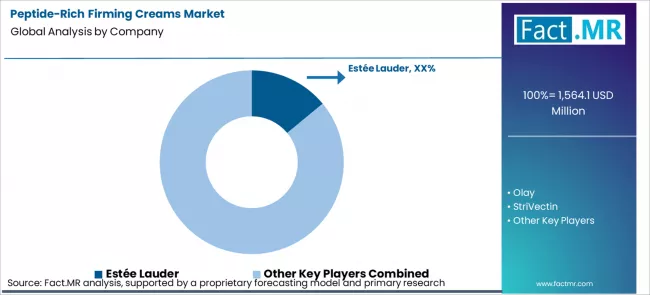
Peptide Rich Firming Creams Market Analysis By Company | Source: Fact.MR
Competition in the Peptide-Rich Firming Creams Market is focused on functional performance, peptide concentration, and multi-application formats. Estée Lauder leads with firming and lifting serums targeting visible skin tightening and elasticity improvement. Olay emphasizes hydration-focused creams and lotions designed for daily skin replenishment, while StriVectin offers anti-aging and wrinkle reduction ampoules formulated with high peptide content for concentrated effects.
L’Oréal focuses on mists for skin barrier support, complementing traditional creams and serums with light-application solutions. Shiseido, Clinique, Paula’s Choice, Murad, Lancôme, and Dr. Dennis Gross differentiate through advanced peptide delivery systems, formulation stability, and multi-functional benefits for diverse skin types. Competitive advantage arises from peptide efficacy, product stability, and visible performance. Buyers evaluate companies based on clinical validation, formulation consistency, and compatibility with consumer or professional skincare routines. From 2026 onward, strategies are expected to emphasize personalized peptide concentrations, modular treatment formats, and digital-assisted usage guidance, reinforcing engagement and results across global markets.
Key Players in the Peptide-Rich Firming Creams Market
- Estée Lauder
- Olay
- StriVectin
- L’Oréal
- Shiseido
- Clinique
- Paula’s Choice
- Murad
- Lancôme
- Dr. Dennis Gross
Bibliography
- National Institutes of Health. (2024). Bioactive peptides in dermatology and skin aging. National Library of Medicine.
- U.S. Food and Drug Administration. (2023). Cosmetic product safety and labeling. U.S. Food and Drug Administration.
- European Commission. (2024). Scientific Committee on Consumer Safety: guidance on safety and stability of cosmetic ingredients. European Commission.
- Organisation for Economic Co-operation and Development. (2023). Consumer trends in health, wellness, and anti-aging products. OECD.
- World Health Organization. (2023). Global consumer health behaviour and self-care. World Health Organization.
Segmentation
Scope of the Report
| Items | Values |
|---|---|
| Quantitative Units (2026) | USD 1,564.1 Million |
| Product Type | Serums, Creams and Lotions, Ampoules, Mists, Other |
| Function | Firming and Lifting, Hydration, AntiAging and Wrinkle Reduction, Skin Barrier Support, Other |
| Regions Covered | Asia Pacific, North America, Europe, Latin America, and Middle East & Africa |
| Countries Covered | China, India, Brazil, Germany, USA, UK, Japan, and other countries |
| Key Companies Profiled | Estée Lauder, Olay, StriVectin, L’Oréal, Shiseido, Clinique, Paula’s Choice, Murad, Lancôme, Dr. Dennis Gross, and other leading skincare companies |
| Additional Attributes | Dollar revenue by product type, function, and region; regional demand trends, competitive landscape, innovations in peptide-rich formulations, firming and lifting efficacy studies, premium anti-aging strategies, and brand positioning analysis |
Source: Fact.MR analysis. Updated Jan 30, 2026
Peptide-Rich Firming Creams Market by Segments
-
Function :
- Firming and Lifting
- Hydration
- Anti‑Aging and Wrinkle Reduction
- Skin Barrier Support
-
Product Type :
- Serums
- Creams and Lotions
- Ampoules
- Mists
-
Region :
- North America
- U.S.
- Canada
- Mexico
- Europe
- Germany
- Italy
- UK
- France
- Spain
- Netherlands
- Switzerland
- Rest of Europe
- Asia Pacific
- Japan
- Australia
- South Korea
- China
- India
- Rest of Asia Pacific
- Latin America
- Brazil
- Argentina
- Rest of Latin America
- Middle East and Africa
- United Arab Emirates
- South Africa
- Rest of Middle East and Africa
- North America
Frequently Asked Questions
How big is the peptide-rich firming creams market in 2026?
What will be the size of peptide-rich firming creams market in 2036?
How much will be the peptide-rich firming creams market growth between 2026 and 2036?
What are the key product types in the peptide-rich firming creams market?
Which product type segment to contribute significant share in the peptide-rich firming creams market in 2026?
Who worked on this report


Preview the report firsthand - request a free sample
Free SampleGet the brochure for pricing and purchase details
Download PDF