- Base Value(2025): 1.3 Bn
- Estimated Value(2026): 1.4 Bn
- Forecast Value (2036): 3.7 Bn
- CAGR (2026 - 2036): 9.9%
Peripheral IV Infiltration Detection Devices Market Forecast and Outlook By FACT.MR
In 2025, the peripheral IV infiltration detection devices market was valued at USD 1.3 billion. Based on Fact.MR analysis, demand for peripheral IV infiltration detection devices is estimated to grow to USD 1.4 billion in 2026 and USD 3.7 billion by 2036. FACT.MR projects a CAGR of 9.9% during the forecast period.
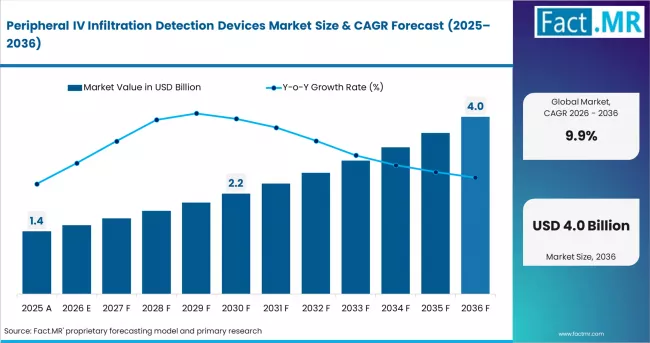
Peripheral Iv Infiltration Detection Devices Market Value Analysis | Source: Fact.MR
Summary of Peripheral IV Infiltration Detection Devices Market
- Market Definition
- Covers wearable infiltration sensors, integrated IV monitoring systems, and standalone detection devices for real-time peripheral IV site surveillance across hospital, ambulatory surgical, and homecare settings globally.
- Demand Drivers
- U.S. hospital quality programmes are mandating infiltration detection as part of IV therapy safety protocols, driving procurement of integrated monitoring systems across infusion and oncology units.
- NHS patient safety initiatives in the United Kingdom are accelerating adoption of automated IV infiltration detection in pediatric and general ward settings through national procurement frameworks.
- Rising chemotherapy infusion volumes globally are increasing demand for continuous infiltration monitoring to prevent extravasation injuries linked to vesicant drug administration.
- Key Segments Analyzed
- By Product Type: Integrated IV monitoring systems lead with approximately 48% share in 2026.
- By Application: General infusion therapy leads at approximately 41% in 2026.
- By End User: Hospitals dominate at approximately 64% in 2026.
- By Geography: India leads at 10.9% CAGR through 2036, driven by hospital infrastructure expansion and growing patient safety investment in tertiary care.
- Analyst Opinion at FACT.MR
- Shambhu Nath Jha, Principal Consultant at Fact.MR, opines, 'CXOs will find that peripheral IV infiltration detection is no longer a bedside accessory decision but a patient safety and liability management investment, and vendors delivering EMR-integrated, clinically validated detection platforms will capture disproportionate share of hospital group purchasing contracts through 2036.'
- Strategic Implications
- Invest in EMR integration and infusion pump connectivity to qualify for group purchasing organisation contracts at U.S. hospital networks replacing manual IV monitoring protocols.
- Build reimbursement evidence and clinical outcome data to support CMS and NHS coverage decisions for wearable infiltration sensors beyond ICU and chemotherapy settings.
- Develop regulatory dossiers for EU MDR certification and FDA 510(k) clearance to access premium European and U.S. hospital procurement without commodity pricing pressure.
- Methodology
- Market sizing based on annual IV procedure volumes, device penetration by product type, and average unit prices by detection technology grade. Validated with 2024 to 2025 procurement and clearance data.
- FDA 510(k) databases, NHS procurement records, EU MDR certification filings, and CMS reimbursement data supported demand and country-level analysis.
- Forecasts incorporate infiltration adverse event reporting trends, hospital quality programme mandates, and infusion therapy protocol standardisation from primary clinical expert interviews.
| Metric | Value |
|---|---|
| Estimated Value in 2026 | USD 1.4 billion |
| Forecast Value in 2036 | USD 3.7 billion |
| Forecast CAGR (2026 to 2036) | 9.9% |
Source: Fact.MR analysis. Updated Apr 21, 2026
Between 2026 and 2036, the market is expected to create USD 2.3 billion in new opportunity. Growth is transformational. Demand is driven by patient safety mandates and rising IV therapy volumes. Infiltration remains a top-five nursing-sensitive adverse event. Growth is constrained by device reimbursement gaps and limited clinical protocol standardization across low-income markets.
Hospitals are shifting procurement toward integrated detection systems. Standalone visual monitoring tools are losing institutional favour. Wireless sensor adoption is rising in chemotherapy and pediatric units. U.S. hospitals are embedding detection into infusion therapy quality programmes. Premium integrated systems command 30 to 50% price premiums over manual-check protocols. Vendors without EMR compatibility and clinical validation data are being excluded from group purchasing organization contracts.
India leads with 10.9% CAGR through 2036, driven by rapid hospital infrastructure expansion and patient safety investment. China follows at 10.7%, supported by ICU modernisation and high-volume infusion therapy demand. The United Kingdom records 10.5%, anchored in NHS-driven patient safety initiatives and procurement frameworks. Germany grows at 10.2%, driven by advanced hospital device adoption and EU MDR compliance requirements. The United States records 9.5%, supported by strong patient safety technology adoption and regulatory pathway depth.
Segmental Analysis
Peripheral IV Infiltration Detection Devices Market Analysis by Product Type
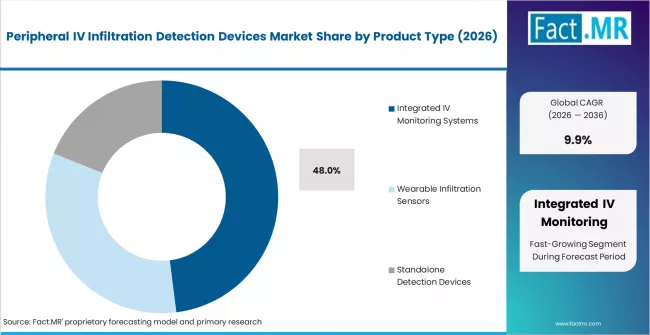
Peripheral Iv Infiltration Detection Devices Market Analysis By Product Type | Source: Fact.MR
Based on FACT.MR, integrated IV monitoring systems hold 48% share in 2026. Hospitals prefer multi-parameter platforms over standalone tools. Integration with infusion pumps and EMR systems improves workflow and enables continuous monitoring.
- ivWatch LLC Expansion: Expanded U.S. hospital network in Q3 2024. Secured multi-site agreements with academic centers. Optical sensor platform is FDA-cleared across patient groups. [1]
- Becton Dickinson Development: Launched updated Alaris system in 2024. Integrated infiltration alert functionality. Connects with EMR systems for real-time monitoring. [2]
- Integrated System Procurement Trend: 61% of U.S. hospitals prioritised infiltration monitoring integration in 2024. Procurement is shifting to multi-function platforms. Group purchasing organisations are updating preferred supplier lists.
Peripheral IV Infiltration Detection Devices Market Analysis by Application
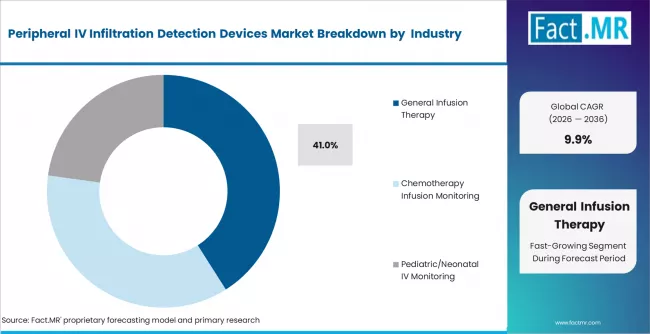
Peripheral Iv Infiltration Detection Devices Market Analysis By Application | Source: Fact.MR
Based on FACT.MR, general infusion therapy holds 41% share in 2026. It is the largest segment by volume. High procedure frequency drives recurring device demand.
- Baxter International Investment: Expanded IV monitoring portfolio in 2024. Focus on sensor-compatible infusion systems. Supports integration with detection platforms. [4]
- Fresenius SE Development: Launched updated infusion system in early 2025. Enables peripheral monitoring compatibility. Integrates with hospital systems for reporting. [6]
Chemotherapy Application Trend: Oncology Nursing Society updated guidelines in 2024. Recommends continuous monitoring for vesicant infusions. Oncology centers are adopting wearable sensors. Pediatric units are leading adoption. [3]
Drivers, Restraints, and Opportunities
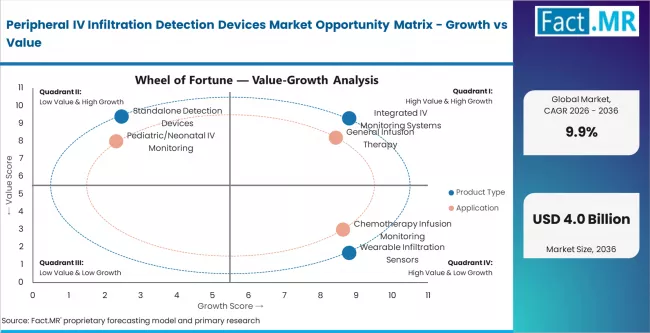
Peripheral Iv Infiltration Detection Devices Market Opportunity Matrix Growth Vs Value | Source: Fact.MR
FACT.MR analysts note that growth is driven by rising IV therapy volumes and patient safety regulations. Peripheral IV infiltration affects 23 to 35% of insertions. It is one of the most common preventable hospital adverse events. This creates strong demand for automated detection across clinical settings.
Procurement is shifting rapidly. Manual visual inspection is losing clinical acceptance. Hospitals prefer integrated sensor-based systems with real-time alerts. FDA and EU MDR-compliant devices command premium pricing. Vendors without interoperability and clinical validation are being excluded from supplier lists.
- FDA Patient Safety Mandate: The FDA updated IV safety guidance in 2024. Hospitals are required to reduce infiltration-related harm. This expanded demand for automated detection systems. Joint Commission standards now include infiltration monitoring in quality scoring. [5]
- NHS Procurement Acceleration: NHS England issued a safety alert in 2024. Hospitals must review detection practices. Procurement of evidence-based monitoring tools is mandated. Pediatric and oncology wards are prioritised.
- India Hospital Infrastructure Expansion: National Health Mission funding in 2024 supports ICU and infusion upgrades. IV monitoring devices are included in procurement schemes. PLI incentives support domestic manufacturing and reduce costs.
Regional Analysis
The peripheral IV infiltration detection devices market is assessed across Asia Pacific, North America, Europe, Latin America, and Middle East and Africa, covering 40+ countries with distinct demand profiles shaped by healthcare infrastructure, hospital quality mandates, reimbursement frameworks, and regulatory certification requirements. The full report provides market attractiveness analysis by region and country.
.webp "Top Country Growth Comparison Peripheral Iv Infiltration Detection Devices Market Cagr (2026 2036)")
Top Country Growth Comparison Peripheral Iv Infiltration Detection Devices Market Cagr (2026 2036) | Source: Fact.MR
| Countrya | CAGR (2026 to 2036) |
|---|---|
| India | 10.9% |
| China | 10.7% |
| United Kingdom | 10.5% |
| Germany | 10.2% |
| United States | 9.5% |
Source: Fact.MR analysis. Updated Apr 21, 2026
Source: Fact.MR (FACT.MR) analysis, based on proprietary forecasting model and primary research
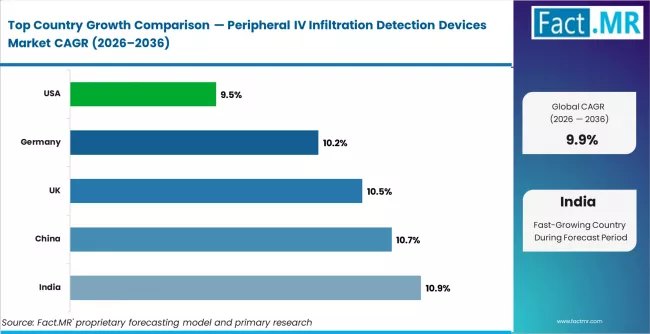
Peripheral Iv Infiltration Detection Devices Market Cagr Analysis By Country | Source: Fact.MR
Asia Pacific Peripheral IV Infiltration Detection Devices Market Analysis
Asia Pacific is the highest-growth region. It is driven by hospital infrastructure expansion and rising IV therapy volumes across India and China. Patient safety investment is increasing across state and provincial health systems. ivWatch LLC and Becton Dickinson are establishing regional presence through distributor partnerships and regulatory registrations.
- India: Infrastructure-led procurement supports 10.9% CAGR through 2036. It is the fastest among all tracked markets. National Health Mission issued procurement guidelines in 2024. These include IV therapy monitoring devices under ICU and infusion upgrades. State hospitals in Maharashtra and Tamil Nadu tendered IV monitoring equipment in Q2 2024. This was under Ayushman Bharat grants. Domestic manufacturers under PLI scheme are expanding IV sensor production. This reduces import costs.
- China: ICU modernisation supports 10.7% CAGR through 2036. National Health Commission updated hospital equipment standards in 2024. These include continuous IV monitoring recommendations. Mindray Medical expanded infusion monitoring products in Q3 2024. This aligns with domestic innovation mandates. Provincial procurement frameworks prioritise local devices. This limits imports. High infusion volumes in oncology and general wards drive demand. Growth is linked to health system modernisation and national quality programmes.
FACT.MR's analysis covers China, India, Japan, South Korea, ASEAN, and ANZ. It includes infrastructure trends, procurement frameworks, and adoption data.
North America Peripheral IV Infiltration Detection Devices Market Analysis
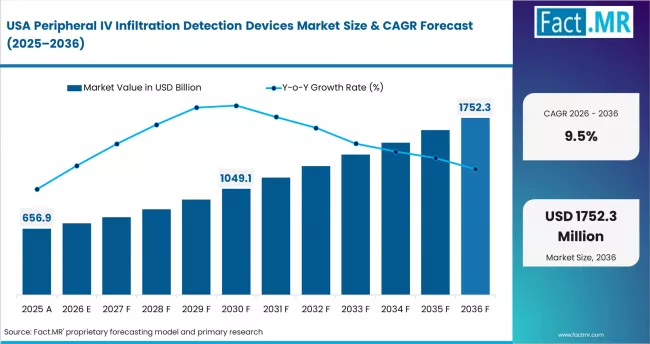
Peripheral Iv Infiltration Detection Devices Market Country Value Analysis | Source: Fact.MR
North America leads in device standards and procurement volume. It has strong clinical validation requirements. Demand is driven by hospital quality mandates and FDA pathways. ivWatch LLC, Becton Dickinson, and Baxter International dominate supply. EMR interoperability and outcome documentation are key requirements.
- United States: Patient safety adoption supports 9.5% CAGR through 2036. It has the largest IV therapy volume globally. FDA cleared three devices under 510(k) in 2024. This expanded available platforms. CMS updated hospital-acquired condition reporting in Q1 2025. Peripheral IV infiltration is now a quality metric. Veterans Health Administration launched procurement in late 2024. It covers 65 VA hospitals. Group purchasing organisations covering 4,500+ hospitals added IV monitoring in 2024. Growth is driven by regulation and quality compliance.
FACT.MR's analysis covers the United States, Canada, and Mexico. It includes FDA trends, CMS updates, and procurement frameworks.
Europe Peripheral IV Infiltration Detection Devices Market Analysis
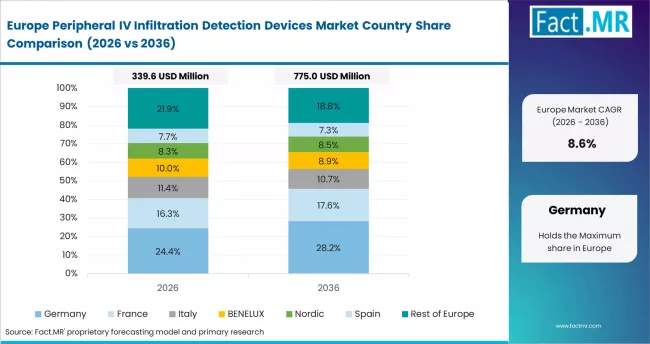
Peripheral Iv Infiltration Detection Devices Market Europe Country Market Share Analysis, 2026 & 2036 | Source: Fact.MR
Europe is a compliance-driven market. Procurement is shaped by EU MDR and national safety mandates. Suppliers must meet CE marking and clinical evidence requirements. Markets are fragmented but high-value.
- Germany: Advanced adoption supports 10.2% CAGR through 2036. B. Braun and Fresenius SE lead domestic supply. German Hospital Association updated standards in 2024. IV complication reporting is now a quality indicator. Bundeswehr expanded procurement in 2024. It includes IV monitoring systems. EU MDR transition accelerated device replacement. Growth is driven by compliance and quality programmes.
- United Kingdom: NHS mandates support 10.5% CAGR through 2036. NHS England issued a safety alert in 2024. It targets IV infiltration detection. Trusts must procure monitoring tools. NICE updated IV therapy guidelines in Q3 2024. Electronic monitoring is recommended for high-risk infusions. Philips Healthcare expanded NHS contracts in 2024. Scotland piloted wearable sensors in neonatal units. Growth is driven by NHS frameworks and safety mandates.
FACT.MR's analysis covers Germany, France, the United Kingdom, Italy, Spain, and Rest of Europe. It includes EU MDR timelines, NHS frameworks, and adoption trends.
Competitive Aligners for Market Players
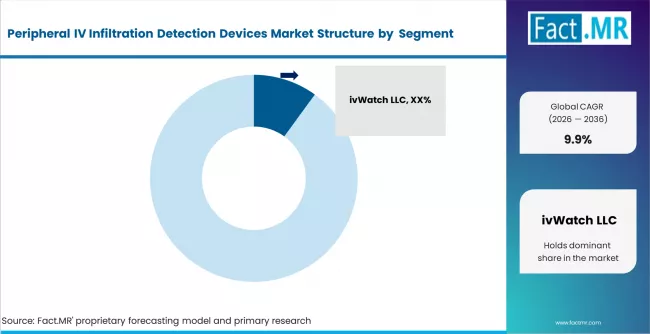
Peripheral Iv Infiltration Detection Devices Market Analysis By Company | Source: Fact.MR
Competition in the peripheral IV infiltration detection devices market is increasingly shaped by regulatory depth, clinical validation, and system integration rather than pricing alone. Market entry is tightly controlled by FDA 510(k) clearance in the United States and EU MDR certification in Europe. Hospitals are prioritizing devices that demonstrate measurable reductions in adverse events and can integrate seamlessly with electronic medical record systems. As a result, only a limited group of compliant manufacturers is securing the majority of large-scale institutional contracts.
ivWatch LLC holds a leading position in continuous optical IV monitoring. Its advantage comes from strong clinical validation across adult, pediatric, and neonatal use cases, making it a preferred choice for hospital safety programs. Established players such as Becton Dickinson and Baxter International compete by embedding infiltration detection into existing infusion systems. This approach reduces switching costs and supports faster adoption within hospitals already using their platforms.
Companies like ICU Medical and B. Braun Melsungen AG leverage their extensive installed base across global hospital networks. They introduce monitoring upgrades within existing infrastructure, avoiding the need for full system replacement. Meanwhile, Fresenius SE focuses on Europe with EU MDR-compliant systems integrated into hospital IT environments. Below the top tier, smaller sensor-focused companies target niche applications such as oncology and neonatal care. However, they rely on partnerships with larger system providers for scale. Hospital procurement trends favor established vendors with proven clinical outcomes, regulatory compliance, and strong integration capabilities, reinforcing their long-term competitive advantage.
Key Players
- ivWatch LLC
- Baxter International Inc.
- Becton Dickinson and Company
- B. Braun Melsungen AG
- Fresenius SE & Co. KGaA
- ICU Medical Inc.
Bibliography
- ivWatch LLC. (Q3 2024). Clinical Validation Update and Hospital Network Expansion: Multi-Site Installation Agreements with U.S. Academic Medical Centre Networks Following FDA-Cleared Optical IV Infiltration Monitoring Platform Validation Across Adult, Pediatric, and Neonatal Patient Populations. Q3 2024. ivwatch.com/news
- Becton Dickinson and Company. (2024). Product Update: Alaris Infusion System Integrated Infiltration Alert Module with EMR Connectivity for Real-Time Peripheral IV Site Status Monitoring at U.S. and European Hospital IV Therapy Units. 2024. bd.com/newsroom
- American Society of Health-System Pharmacists. (2024). IV Therapy Monitoring Technology Survey 2024: 61% of U.S. Hospital Pharmacies Cite Infiltration Detection Integration as Priority Criterion in Infusion System Procurement Decisions. 2024. ashp.org
- Baxter International Inc. (2024). Portfolio Expansion: IV Therapy Patient Monitoring Sensor-Compatible Infusion Sets for Integration with Third-Party Peripheral Infiltration Detection Platforms Across U.S., European, and Asia Pacific Hospital Markets. 2024. baxter.com/newsroom
- U.S. Food and Drug Administration. (2024). Updated IV Device Safety Guidance: Medical Device Safety Action Plan Reinforcement of Hospital Obligations for Infiltration-Reducing Technologies in Peripheral IV Therapy Under Nursing-Sensitive Adverse Event Reduction Frameworks. 2024. fda.gov/medicaldevices
- Fresenius SE & Co. KGaA. (Early 2025). Product Launch: Updated IV Infusion System with Peripheral Site Monitoring Compatibility for EU MDR-Compliant General Ward and Oncology Infusion Centre Applications Across German and European Hospital Networks. January 2025. fresenius.com/press
This Report Addresses
- Strategic intelligence on demand across wearable infiltration sensors, integrated IV monitoring systems, and standalone detection devices for peripheral IV site safety globally.
- Market forecast from USD 1.4 billion in 2026 to USD 3.7 billion by 2036 at a CAGR of 9.9%.
- Growth opportunity mapping across India National Health Mission procurement, China ICU modernisation, U.S. CMS quality metric mandates, UK NHS patient safety alerts, and Germany EU MDR compliance replacement cycles.
- Segment analysis by product type (wearable sensors, integrated systems, standalone devices), application (chemotherapy, pediatric/neonatal, general infusion, contrast media), and end user (hospitals, ASC, homecare).
- Regional outlook covering Asia Pacific infrastructure-led adoption, North America FDA-regulated procurement, and Europe NHS and EU MDR compliance-driven demand cycles.
- Competitive analysis of ivWatch LLC, Baxter International, Becton Dickinson, B. Braun, Fresenius SE, and ICU Medical. Focus on FDA clearance depth, EMR interoperability, and clinical outcome validation.
- Regulatory analysis covering FDA 510(k) clearance requirements, EU MDR certification obligations, CMS quality metric reporting, NHS patient safety alert procurement implications, and national IV therapy guideline updates.
- Report delivered in PDF, Excel, and presentation formats. Supported by primary interviews, hospital procurement records, FDA clearance filings, NHS framework data, and manufacturer revenue disclosures.
Peripheral IV Infiltration Detection Devices Market Definition
The market covers wearable sensors, integrated monitoring systems, and standalone detection devices used to identify peripheral IV infiltration and extravasation in real time. Devices detect fluid leakage from IV sites using impedance, optical, or acoustic-based sensing technologies.
Peripheral IV Infiltration Detection Devices Market Inclusions
Covers global forecasts (2026 to 2036) by product type, application, and end user. Includes wearable sensors, integrated IV systems, and standalone detectors. Covers hospital, ambulatory surgical center, and homecare procurement across infusion therapy, chemotherapy, pediatric, and contrast media delivery settings.
Peripheral IV Infiltration Detection Devices Market Exclusions
Excludes general IV infusion pumps unless equipped with integrated infiltration detection modules. Omits standalone EMR software platforms and IV catheter consumables. Focus remains on active detection devices and their immediate clinical monitoring intermediates used at the peripheral IV site.
Peripheral IV Infiltration Detection Devices Market Research Methodology
- Primary Research
- Interviews with IV therapy nurses, infusion center directors, hospital procurement officers, and device manufacturers across the United States, United Kingdom, Germany, China, and India.
- Desk Research
- Uses FDA 510(k) clearance databases, NHS procurement frameworks, EU MDR certification records, CMS reimbursement data, and company filings from ivWatch LLC, Baxter International, and Becton Dickinson from 2024 to 2025.
- Market-Sizing and Forecasting
- Hybrid model using annual IV procedure volumes, device penetration by product type and end-user segment, and average contract unit prices by detection technology grade across all covered geographies.
- Data Validation and Update Cycle
- Validated through hospital procurement records, FDA clearance volumes, and company revenues. Cross-checked with clinical expert interviews. Updated annually.
Segmentation
Scope of Report
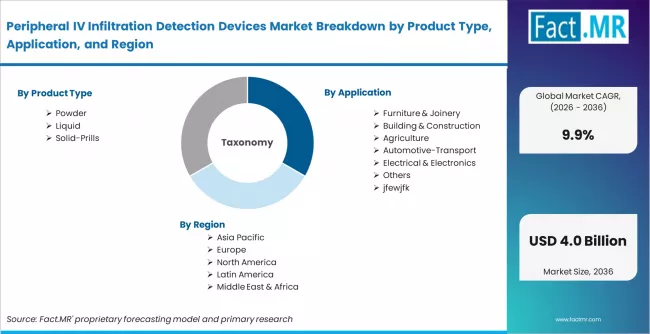
Peripheral Iv Infiltration Detection Devices Market Breakdown By Product Type, Application, And Region | Source: Fact.MR
| Attribute | Details |
|---|---|
| Quantitative Units | USD 1.4 billion (2026) to USD 3.7 billion (2036), at a CAGR of 9.9% |
| Market Definition | Wearable infiltration sensors, integrated IV monitoring systems, and standalone detection devices for real-time peripheral IV site surveillance across hospital, ambulatory surgical, and homecare settings, procured by hospitals, ambulatory surgical centers, and homecare providers globally. |
| Product Type Segmentation | Wearable Infiltration Sensors, Integrated IV Monitoring Systems, Standalone Detection Devices |
| Application Segmentation | Chemotherapy Infusion Monitoring, Pediatric/Neonatal IV Monitoring, General Infusion Therapy, Contrast Media Delivery |
| End User Segmentation | Hospitals, Ambulatory Surgical Centers, Homecare |
| Application Coverage | Hospital IV therapy infiltration surveillance, chemotherapy and vesicant extravasation prevention, pediatric and neonatal IV site monitoring, ambulatory surgical center infusion safety, and homecare IV therapy monitoring. |
| Regions Covered | North America, Europe, Asia Pacific, Latin America, Middle East and Africa |
| Countries Covered | USA, Canada, Mexico, Germany, UK, France, Italy, Spain, Nordic, BENELUX, China, Japan, South Korea, India, ASEAN, Australia and New Zealand, Brazil, Argentina, Chile, Saudi Arabia, GCC, Turkey, South Africa, Rest of MEA |
| Key Companies Profiled | ivWatch LLC, Baxter International Inc., Becton Dickinson and Company, B. Braun Melsungen AG, Fresenius SE & Co. KGaA, ICU Medical Inc. |
| Forecast Period | 2026 to 2036 |
| Approach | Hybrid top-down and bottom-up model using annual IV procedure volume estimates, device penetration by product type and end-user segment, average contract unit prices by detection technology grade, and primary interviews with IV therapy nurses, hospital procurement officers, and device manufacturers. |
Source: Fact.MR analysis. Updated Apr 21, 2026
Peripheral IV Infiltration Detection Devices Market by Segments
-
By Product Type:
- Wearable Infiltration Sensors
- Integrated IV Monitoring Systems
- Standalone Detection Devices
-
By Application:
- Chemotherapy Infusion Monitoring
- Pediatric/Neonatal IV Monitoring
- General Infusion Therapy
- Contrast Media Delivery
-
By End User:
- Hospitals
- Ambulatory Surgical Centers
- Homecare
-
By Region:
- North America
- United States
- Canada
- Mexico
- Latin America
- Brazil
- Mexico
- Argentina
- Chile
- Rest of Latin America
- Western Europe
- Germany
- United Kingdom
- France
- Italy
- Spain
- Nordic Countries
- BENELUX
- Rest of Western Europe
- Eastern Europe
- Russia
- Poland
- Hungary
- Balkan and Baltic
- Rest of Eastern Europe
- East Asia
- China
- Japan
- South Korea
- South Asia and Pacific
- India
- ASEAN
- Australia and New Zealand
- Rest of South Asia and Pacific
- Middle East and Africa
- Kingdom of Saudi Arabia
- Other GCC Countries
- Turkey
- South Africa
- Rest of Middle East and Africa
- North America
Frequently Asked Questions
How large is the peripheral IV infiltration detection devices market in 2025?
What will the market size be by 2036?
What is the expected CAGR from 2026 to 2036?
Which product type segment is poised to lead the market?
Which end-user segment is expected to dominate?
Which application holds the largest share?
Which country shows the fastest growth?
What is driving demand for peripheral IV infiltration detection devices?
What are the major restraints?
What is the main challenge in this market?
Who worked on this report


Preview the report firsthand - request a free sample
Free SampleGet the brochure for pricing and purchase details
Download PDF