- Market Value (2025): USD 89.5 Mn
- Estimated Value (2026): USD 105.0 Mn
- Forecast Value (2036): USD 520.0 Mn
- CAGR (2026-2036): 17.3%
What is the PET delamination additives market forecast to be worth by 2036?
The market climbs from USD 105.0 million in 2026 to USD 520.0 million by 2036, a 17.3% CAGR. Growth concentrates wherever PET thermoforms clear qualification and settle into repeat use.
- The technical case is a balancing act by design: a multilayer construction needs a bond strong enough to survive handling before collection, and the recycling process needs that same bond to let go cleanly, without pushing flake quality, residue, wash water load, or converting costs outside acceptable limits.
- The market had already crossed USD 89.5 million in 2025, a period when label production lines were still working through early approvals for PET recycling additives and plastic recycling chemicals. Getting this right means tying package-handling performance to a separation response that actually holds up at the recycling stage.
- Another USD 415.0 million in demand builds up through 2036 as Thermoforms and Reactive additive chemistry find clearer use cases. Commercial traction hinges on proof that a given construction hits its release point on schedule, without the package losing integrity too early and failing before it ever reaches the recycling stage.
- Label release performance and wash water load are what keep candidates stuck in technical review, and they underpin the 17.3% CAGR forecast. Residue that won't wash out, or a wash load that blows past acceptable limits, is enough to sink an approval.
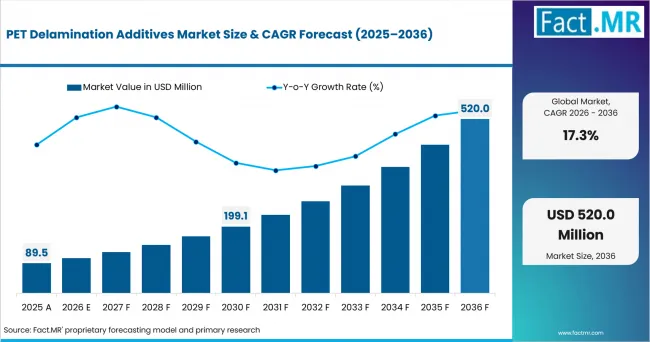
Pet Delamination Additives Market Market Value Analysis | Source: Fact.MR
What are the defining numbers behind PET delamination additives market growth?
The absolute opportunity comes to USD 415.0 million by 2036. PET thermoforms sit at the top of the application list, holding 44% share in 2026 and USD 46.2 million in value.
That puts qualification right at the junction between tray or thermoform construction and the reclaim line. The additive needs to hold a bond through the package's entire service life, then help the target layer separate once recycling conditions kick in. Buyers judge results on label or barrier release, flake purity, contamination reduction, yield, sorting behavior, and how much work it takes to document a result that repeats.
- Demand Drivers in the Market
- Application choice shapes plant outcomes, which is why technical teams keep testing Thermoforms specifically. A thermoform trial has to tie the multilayer construction, the chosen bond, ordinary package handling, and the recycling trigger together in one thread. A release that looks clean in a lab sample still has to deliver acceptable flake and residue numbers once it hits the intended route.
- The same bond has to do two things: hold through filling, distribution, and use, then let go cleanly at the recycling stage so the label does not ride along on the PET flake or throw off the sorter.
- Procurement teams move faster once Hot wash can be tied to real savings or less rework. The route gives them a fixed point to check layer separation, adhesive weakening, wash water load, residue, and recovered yield. That evidence has to hold up lot after lot, not just on the day a sample was pulled for testing.
- Wash facilities provide the sorter evidence needed for final approval. They show firsthand whether labels or barrier layers actually separate and whether the resulting PET meets expected quality. That evidence determines whether a construction earns a place in repeat supply.
- Demand for layer separation grows wherever customers want a sharper answer than a generic mono-material pitch. An additive doesn't get credit for a broad recyclability claim. It gets judged on whether a specific layer releases under the chosen route and whether the PET left behind has better flake purity, less contamination, and workable yield.
- Key Segments Analyzed
- By Application: Thermoforms hold 44% share in 2026. That lead tracks back to the need to manage bonds inside PET thermoform structures while keeping the package intact and still building in an effective release path for labels, barriers, or adjacent layers.
- By Chemistry: Reactive additive holds 31% share in 2026. Selection comes down to whether the chemistry gives a controlled response in the actual construction and stays compatible with production handling, recycling conditions, residue limits, and the paperwork qualification demands.
- By Recycling Route: Hot wash holds 35% share in 2026. Its lead makes wash-stage evidence the centerpiece of approval, covering separation behavior, label release, wash water load, flake condition, and whether the result repeats.
- By End User: Recyclers hold 30% share in 2026. They sit closest to the recovered flake, separated material, residue, sorting response, and yield data that ultimately says whether delamination improved reclaim quality.
- By Function: Layer separation holds 30% share in 2026. Buyers use it to link adhesive weakening to a visible release outcome, while still keeping an eye on Flake purity, Contamination reduction, and Yield improvement.
- Analyst Opinion at Fact.MR
- Fact.MR sees this market as a qualification problem built on requirements that pull in opposite directions. Package designers need a construction that holds together through filling, distribution, storage, and everyday use. At the recycling stage, that same bond needs to give way the moment the chosen route applies its trigger. Neither maximum bond strength nor effortless release wins on its own. What matters is getting the release event to happen at the right stage and then showing what it does to PET flake, separated labels or barriers, residue, sorting, wash water load, and reclaim yield.
- The strongest position comes from making PET thermoforms easy to test and document. A useful record tracks one construction from production review through package handling into recycling, naming the application, chemistry, route, end user, and intended function, then confirming separation repeats under the customer's own conditions. That creates a shared basis for sign-off across packaging production, PET tray manufacturing, product teams, recycling operations, wash facilities, and additive manufacturing.
- Strategic Implications
- Companies need to prove out Thermoforms under real customer conditions, not just in-house trials. Evidence should trace the original multilayer construction through to the chosen recycling route, showing package integrity holding up before collection and controlled layer release once recycling starts. Flake purity, residue, contamination, yield, and sorting response all belong in the same trial record.
- Product teams should run candidate and already-approved grades side by side under matched conditions. Keeping the package format and recycling route constant is what exposes real differences in bond reliability, label or barrier release, wash water load, and reclaim quality.
- Safety files and test notes should be organized before formal review begins. Records need to name the construction, chemistry, route, release function, and the flake outcome observed.
- Packaging policy is pulling recycling design earlier into package development. It backs up flake-quality and label-release evaluation without loosening the package-integrity requirement. Delamination has to stay dormant through use, then activate reliably at whatever recycling stage the construction and route call for.
Country rates run Germany 20.0%, Brazil 18.2%, and United States 16.5%. This country picture through 2036 reflects manufacturing activity, local trials, and how companies respond to them. Local evidence pays off most when it keeps final qualification linked to what the recycling stage actually shows: separation, residue, flake purity, sorting, and yield.
How does the PET delamination additives market break down by segment?
Thermoforms lead Application at 44%, and Reactive additive leads Chemistry at 31%. Hot wash, Recyclers, and Layer separation round out the remaining lead positions. Put together, these segments trace a practical chain: the package construction sets the bond, the chemistry shapes how it responds, the recycling route supplies the separation trigger, the recycling stage shows what comes out the other end, and the function defines what improvement the buyer is actually paying for.
How does Application shape demand?
Thermoforms hold 44% share in 2026, putting multilayer PET trays and related thermoform builds right at the center of the qualification question.
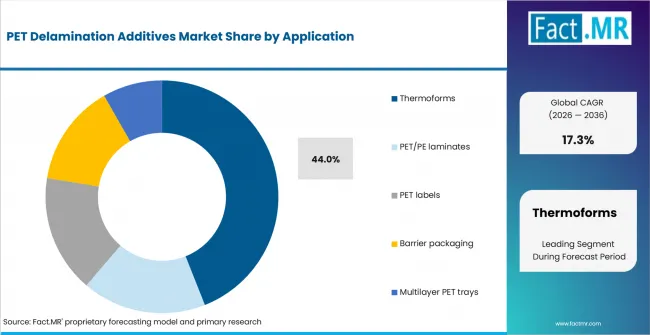
Pet Delamination Additives Market Analysis By Application | Source: Fact.MR
The package has to survive filling, distribution, storage, and use intact, then let the label, barrier, or adjoining layer separate once the chosen recycling route applies its trigger. PET/PE laminates, PET labels, and Barrier packaging stay in the mix because each puts a different bond or interface in the recovery path, and Multilayer PET trays round out the list. Buyers check whether release happens on cue, whether the PET flake stays clean, whether residue or contamination lingers, and whether yield and sorting support repeat business. A thermoform grade moves forward when production data and recycling data describe the same construction, not two disconnected samples.
Where is Chemistry demand strongest?
Reactive additive holds 31% share in 2026, giving companies a clear opening, though the chemistry still needs testing inside the real package and recycling route.
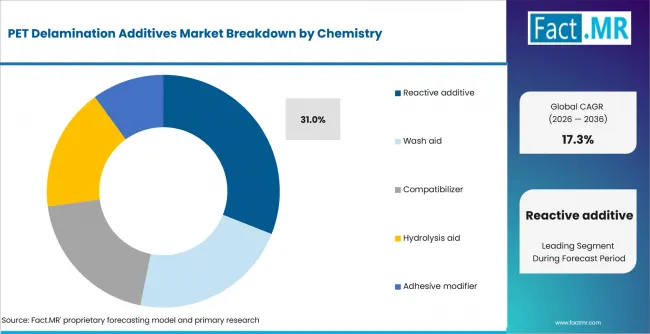
Pet Delamination Additives Market Analysis By Chemistry | Source: Fact.MR
Wash aid, Compatibilizer, Hydrolysis aid, and Adhesive modifier remain valid alternatives depending on the role a buyer is actually purchasing, whether that's kicking off or supporting layer separation, weakening an adhesive at the recycling stage, or lifting the quality of the recovered PET. Qualification needs to separate a controlled release response from premature bond failure during package use, and it has to look past the release event to flake purity, contamination, residue, wash water load, and yield. Results that hold up after routine storage and plant handling are the real gate to wider adoption, since a chemistry that only works in an isolated sample settles nothing for production or recycling operations.
What supports Recycling Route adoption?
Hot wash holds 35% share in 2026. It leads because it gives buyers one defined setting where label release, adhesive weakening, layer separation, wash water load, and flake condition can all be checked together.
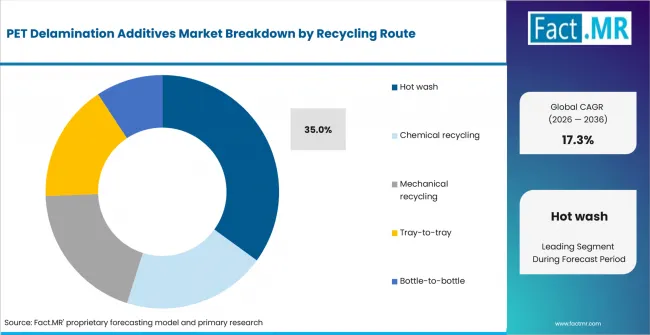
Pet Delamination Additives Market Analysis By Recycling Route | Source: Fact.MR
Chemical recycling, Mechanical recycling, Tray-to-tray, and Bottle-to-bottle stay part of the taxonomy, and each shifts where a customer looks for proof. Adoption of Hot wash still rests on how the package performs before it even reaches the wash stage, since the bond has to protect the filled and distributed package first, then respond once recycling conditions apply. Buyers won't assume visible separation is proof enough. They check whether detached material leaves residue, whether the PET sorts and reclaims the way it should, and whether the route delivers acceptable yield without generating rework. Final sign-off follows evidence from the actual construction and process, not a proxy.
Which End User dominates?
Recyclers hold 30% share in 2026, a lead that comes down to access.
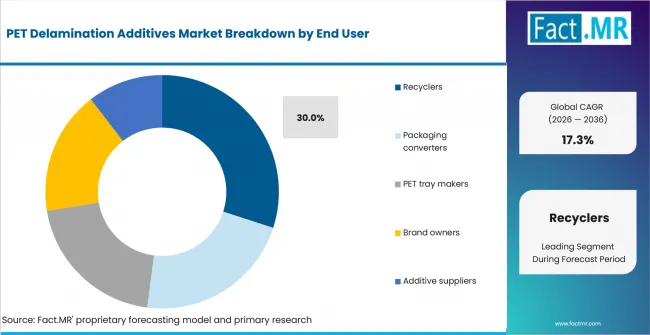
Pet Delamination Additives Market Analysis By End User | Source: Fact.MR
They provide the decisive post-use evidence on incoming structures, sorter reading, label or barrier separation, wash behavior, PET flake, residue, contamination, and recovered yield. Packaging manufacturers and PET tray manufacturers still carry responsibility for building and qualifying bonds that survive normal handling. Product companies connect those results to the approved package, while additive manufacturers support chemistry selection and documentation. The market moves forward when all these end-use groups work from one shared material history. A production-only trial can confirm the package holds together, but it cannot prove reclaim quality on its own. A recycling-only trial might show release happening, but it still needs the original construction record behind it. Recyclers drive purchasing because their flake-quality findings move a grade from sample to repeat orders.
What leads the Function segment?
Layer separation holds 30% share in 2026, leading because it's the visible moment where a multilayer structure should split into more useful recovery fractions.
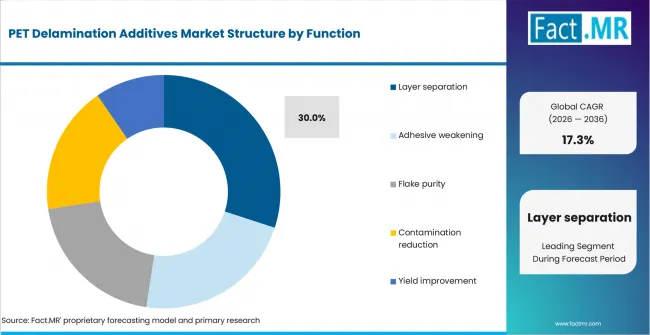
Pet Delamination Additives Market Analysis By Function | Source: Fact.MR
Adhesive weakening is one path to that outcome. Flake purity, Contamination reduction, and Yield improvement describe what the customer expects to see afterward. These functions overlap but aren't interchangeable: a bond can weaken without giving a clean separation, and separation can happen while residue still clings to the PET. Qualification has to follow both the event and its aftermath. The package needs to hold together through filling, distribution, storage, and use, then release the target layer predictably once the recycling trigger hits. From there, the recycling review checks whether the separated material helps sorting, cuts unwanted carryover, protects flake quality, and delivers the yield the approved route is supposed to produce.
What is accelerating PET delamination additives market adoption and what is holding it back?
Better flake quality is what pulls adoption forward. Qualification cost and process fit are what hold it back. Approval moves faster once a package proves it can keep its bond before collection and still release the target layer during recycling. Poor trigger fit, leftover residue, or results that don't repeat at plant scale are enough to stall an approval.
Drivers Impact Analysis
| DRIVER | (~) % IMPACT ON CAGR | GEOGRAPHIC RELEVANCE | IMPACT TIMELINE |
|---|---|---|---|
| Flake quality control in Thermoforms | +0.8% | China and export markets | Medium term (2-4 years) |
| Label release testing | +0.6% | Europe and North America | Short term (<= 2 years) |
| PET thermoforms approval programs | +0.5% | Asia Pacific | Medium term (2-4 years) |
| Local support near label production sites | +0.4% | Global | Long term (>= 4 years) |
Source: Fact.MR analysis. Updated Jul 15, 2026
- Flake quality control in Thermoforms turns a vague recyclability goal into something you can actually measure at the package and reclaim stage. Following the same construction through delamination lets teams tie residue, contamination, sorting behavior, and yield back to the specific additive and release condition being tested.
- Label release testing gives technical teams a straightforward way to weigh bond integrity against recycling-stage separation. It matters because the label needs to stay put during package use, then come off the PET cleanly under the intended route without dragging down flake quality.
- PET thermoforms approval programs build a repeatable path from package construction through recycling review. Shared test records make it much easier to tell whether a result comes down to the additive, the adhesive or coating bond, the trigger chosen, or simply a different package build.
- Local support near label production sites cuts down investigation time when sample results and production results don't match. Technical teams can look at the original construction, release behavior, residue, wash water load, and reclaim outcome while the relevant production evidence is still on hand.
Opportunity Impact Analysis
| OPPORTUNITY | (~) % IMPACT ON CAGR | GEOGRAPHIC RELEVANCE | IMPACT TIMELINE |
|---|---|---|---|
| Grades tuned for PET thermoforms | +0.5% | Global | Medium term (2-4 years) |
| Application labs for Reactive additive | +0.4% | Asia Pacific and Europe | Short term (<= 2 years) |
| Rule-ready documentation | +0.4% | Europe and United Kingdom | Medium term (2-4 years) |
| Local trials with wash facilities | +0.3% | India and Brazil | Long term (>= 4 years) |
Source: Fact.MR analysis. Updated Jul 15, 2026
- Grades tuned for PET thermoforms can tighten the qualification brief around a construction that's already well understood. The opportunity improves once customers can repeat package-integrity and recycling-release checks without special handling that ordinary production or reclaim operations can't sustain day to day.
- Application labs for Reactive additive can establish how chemistry, bond response, and the intended separation trigger relate to each other before any customer plant time gets used. Useful records follow the same package all the way into flake, residue, contamination, and yield review.
- Rule-ready documentation can tie the package specification, additive identity, recycling route, release result, and recovered-material findings together in one place. That gives customers a checkable basis for approval and helps stop a changed label, barrier, or adhesive construction from quietly inheriting evidence that no longer applies to it.
- Local trials with wash facilities put label release and wash water load under the same review. That opening gets stronger once washed PET can be checked for attached material, residue, flake purity, sorting response, and yield before a grade moves into repeat supply.
Restraints Impact Analysis
| RESTRAINT | (~) % IMPACT ON CAGR | GEOGRAPHIC RELEVANCE | IMPACT TIMELINE |
|---|---|---|---|
| Qualification cost | -0.4% | Global production | Medium term (2-4 years) |
| Fit limits in Reactive additive | -0.3% | Global | Short term (<= 2 years) |
| Documentation burden | -0.3% | Europe and North America | Medium term (2-4 years) |
| Scale-up risk | -0.2% | High-volume plants | Long term (>= 4 years) |
Source: Fact.MR analysis. Updated Jul 15, 2026
- Qualification cost covers package samples, production time, recycling trials, flake inspection, and the review work needed to protect an already-approved construction. Buyers hold back when the expected drop in rejection or rework doesn't justify all that effort combined.
- Fit limits in Reactive additive slow adoption whenever the chemistry and the construction don't add up to the intended release response. A candidate has to avoid letting go of the bond too early while still delivering useful separation once the recycling route kicks in.
- Documentation burden grows because approval touches more than one operating stage. Customers need an unbroken thread from multilayer construction and ordinary package handling through trigger conditions, separated material, wash water load, residue, flake purity, sorting, and yield.
- Scale-up risk concentrates in High-volume plants, where a release result has to repeat under everyday operating practice, not just under careful lab conditions. Customers stay cautious when a lab outcome needs special handling or when normal production variation shifts separation, residue, or reclaim quality.
Which countries are scaling PET delamination additives market fastest?
Germany at 20.0%, Brazil at 18.2%, and the United States at 16.5%. Country performance tracks manufacturing activity, customer testing, and company response through 2036. The commercial path runs from package construction and local qualification through to recycling evidence and, eventually, repeat supply.
.webp "Top Country Growth Comparison Pet Delamination Additives Market Cagr (2026 2036)")
Top Country Growth Comparison Pet Delamination Additives Market Cagr (2026 2036) | Source: Fact.MR
| COUNTRY | CAGR |
|---|---|
| Germany | 20.0% |
| Brazil | 18.2% |
| United States | 16.5% |
Source: Fact.MR analysis. Updated Jul 15, 2026
What underpins Germany's growth?
Germany is set to advance at a 20.0% CAGR, with local manufacturing activity and customer testing around PET recycling additives and plastic recycling chemicals behind the demand.
Customer trials can run close to the main production base, which helps keep package-construction data linked to reclaim-line findings. Documentation burden stays relevant across Europe and North America, so a candidate needs more than a convincing delamination event on paper. The record should show whether normal package integrity holds, what trigger actually produces release, whether labels or barriers detach as intended, and what residue is left on the PET. Flake purity, contamination reduction, sorting response, and yield then give scale approval an operational footing instead of a general recyclability claim.
What is driving Brazil's growth through 2036?
Brazil is expected to log an 18.2% CAGR, with local manufacturing activity and customer testing around PET recycling additives and plastic recycling chemicals behind the rate.
The opportunity view includes local trials with wash facilities, making label release and wash-stage performance a meaningful part of field feedback ahead of scale orders. A useful trial keeps the package construction's identity intact from production review through to recycling, which helps teams tell an additive-fit problem apart from a change in the label, barrier, adhesive, or thermoform build. From there, the recycling review can judge separated material, residue, PET flake, sorting, and yield. Repeat purchasing gets easier to justify once routine operating teams can reproduce the result without special handling.
How is United States scaling demand?
The United States is on pace for a 16.5% CAGR, supported by local manufacturing activity and customer testing around PET recycling additives and plastic recycling chemicals.
Label release testing and documentation burden both carry weight in North America. Nearby technical teams can speed up approval by keeping package-production records tied to wash-facility and recycling findings. Timing remains the central test: adhesive and coating bonds must hold the package together before collection, while delamination needs to happen once the intended recycling condition applies. Approval gets stronger when detached labels or barriers, leftover residue, flake purity, contamination, sorting response, wash water load, and yield all get reviewed as one package. That's what lets scale orders rest on the actual recovery route rather than a proxy for it.
Who leads the PET delamination additives market?
Sukano and Avient lead the named provider set, with BASF, Eastman, and Indorama Ventures rounding out the group. Competition comes down to consistent results, clear documentation, and support through production and recycling qualification. The evidence that decides things follows one package construction from bond performance in normal use through to controlled release and recovered-flake review.
Companies gain ground by answering process questions before buyers even think about switching grades: which application, chemistry, route, and function were tested, whether the package held its integrity, when separation actually happened, and what the recycling review found once release occurred. Turning a sample success into plant-level approval takes continuity across all of that, plus reliable service when a result needs a second look.
Which companies are the key providers?
Sukano and Avient are key providers. BASF, Eastman, and Indorama Ventures complete the named set. Buyer evaluation focuses on proof in PET thermoforms and adjacent structures, repeatable layer release, flake-quality evidence, documentation, and support through formal approval.
- Sukano
- Avient
- BASF
- Eastman
- Indorama Ventures
Bibliography
- Cerbone, A., Palazzo, I., Ceriello, A., Castaldo, R., Stanzione, M., Lavorgna, M., Buonocore, G. G., and Gentile, G. (2025). “Delamination of Multilayer Flexible Packaging: A Promising Approach towards the Recycling of Their Components-A Review.” Resources, Conservation and Recycling. doi:10.1016/j.resconrec.2025.108493.
- Ügdüler, S., De Somer, T., Collier, N., Roosen, M., and De Meester, S. (2025). “Delamination and Deinking of Colored Multilayer Flexible Plastic Packaging via Selective Aminolysis of Polyurethane and Acrylate-Based Adhesives.” Green Chemistry, 27, 15485–15501. doi:10.1039/D5GC02667A.
- Loukodimou, A., Lovell, C., Theodosopoulos, G., Maniam, K. K., and Paul, S. (2024). “Delamination and Evaluation of Multilayer PE/Al/PET Packaging Waste Separated Using a Hydrophobic Deep Eutectic Solvent.” Polymers, 16(19), 2718. doi:10.3390/polym16192718.
- Loukodimou, A., Lovell, C., Li, T., Theodosopoulos, G., Maniam, K. K., and Paul, S. (2024). “Formulation and Characterization of Deep Eutectic Solvents and Potential Application in Recycling Packaging Laminates.” Polymers, 16(19), 2781. doi:10.3390/polym16192781.
- Mastroddi, R., Samorì, C., Vagnoni, M., Gualandi, C., Galletti, P., and Tagliavini, E. (2025). “Recycling of Multilayer Flexible Packaging Waste Through Delamination with Recoverable Switchable Hydrophilicity Solvents.” Separations, 12(2), 45. doi:10.3390/separations12020045.
- Walker, T. W., Frelka, N., Shen, Z., Chew, A. K., Banick, J., Grey, S., Kim, M. S., Dumesic, J. A., Van Lehn, R. C., and Huber, G. W. (2020). “Recycling of Multilayer Plastic Packaging Materials by Solvent-Targeted Recovery and Precipitation.” Science Advances, 6(47), eaba7599. doi:10.1126/sciadv.aba7599.
- Association of Plastic Recyclers. “APR Design Guide for Plastics Recyclability: PET Rigid Packaging.” APR Design Hub. Accessed July 15, 2026.
- RecyClass. “Design for Recycling Guidelines: Transparent Clear and Light-Blue PET Bottles.” RecyClass Design for Recycling Guidelines. Accessed July 15, 2026.
- India Plastics Pact. (2022). Design Guidance Recommendations for Food Contact Grade PET Bottles. Confederation of Indian Industry and WWF India.
- Thermoform Circularity Evaluation Platform. “Design for Recycling Guidelines for PET Trays in Contact with Food and Non-Food Trays.” TCEP Europe. Accessed July 15, 2026.
- European Food Safety Authority Panel on Food Contact Materials, Enzymes and Processing Aids. (2024). “Scientific Guidance on the Criteria for the Evaluation and on the Preparation of Applications for the Safety Assessment of Post-Consumer Mechanical PET Recycling Processes Intended to Be Used for Manufacture of Materials and Articles in Contact with Food.” EFSA Journal. doi:10.2903/j.efsa.2024.8879.
- European Commission. (2022). Commission Regulation (EU) 2022/1616 of 15 September 2022 on Recycled Plastic Materials and Articles Intended to Come into Contact with Foods and Repealing Regulation (EC) No 282/2008. Official Journal of the European Union.
- European Parliament and Council of the European Union. (2025). Regulation (EU) 2025/40 of 19 December 2024 on Packaging and Packaging Waste. Official Journal of the European Union.
This Report Addresses
- This report lays out strategic intelligence on the PET delamination additives market across Application and Chemistry choices. The analysis starts with a PET-based multilayer construction, tracks the adhesive or coating bond through normal package use, then follows release through the chosen recycling route.
- Segment analysis centers on Thermoforms and Reactive additive as the 2026 share leaders, while still covering every Application, Chemistry, Recycling Route, End User, and Function option in the taxonomy.
- Country analysis opens with China and India, then covers Germany, Brazil, and the United States to round out the growth set, while the segmentation section keeps the full geographic taxonomy intact.
- Competitive analysis profiles Sukano and Avient first, then BASF, Eastman, and Indorama Ventures. Provider assessment sticks to this named set and focuses on qualification evidence and process support.
- Use-case assessment covers PET thermoforms and adjacent applications within PET recycling additives and plastic recycling chemicals, examining label or barrier separation, adhesive weakening, wash water load, residue, flake purity, contamination reduction, sorting response, and yield.
What does the PET delamination additives market cover?
Coverage spans Thermoforms, Reactive additive, PET thermoforms, and every listed application where customers buy the defined delamination or recyclability function. To be included, a product has to be sold specifically to support layer separation, delamination, or improved recyclability in a PET-based multilayer structure.
Value sits between package design and recycling operations. The construction has to hold together during production and use. In the intended recovery route, the target label, barrier, or adjoining layer has to separate in a controlled way. The recovered PET is then checked for contamination, residue, sorting response, and yield.
This boundary keeps the market distinct from general additives and broad packaging chemistry. Simply being present in a PET package or recycling plant doesn't qualify a product. Purchase and qualification have to rest on the named function.
What is included in the scope?
- Scope covers additives and chemical aids that support layer separation, delamination, and improved recyclability of PET-based multilayer structures, spanning Thermoforms and the other listed applications, Reactive additive and the rest of the chemistry choices, every recycling route, the named end users, and the full functional set where customers are buying the same role.
- Revenue counts toward this market once reviewed grades move to repeat purchase. Qualification can involve bond assessment, package handling, release testing, recycling observation, and review of separated material, residue, flake purity, contamination, sorting, wash water load, and yield.
What is excluded from the scope?
- Parent products that lack the stated delamination role sit outside the PET delamination additives market. Equipment-only offerings are excluded too, even where filling, converting, sorting, washing, or reclaim equipment shapes the outcome.
- Commodity materials only qualify when sold for a named application within this market. General packaging additives, unrelated recycling chemicals, and broad PET materials stay outside the scope just by sitting near a multilayer package or reclaim operation.
How was the analysis built?
The analysis draws on public evidence, country signals, segment logic, company mapping, and sizing checks. Technical interpretation follows the package from multilayer construction into the chosen separation route, then ties release back to residue, flake purity, contamination, sorting, wash water load, yield, and approval.
- Primary Research:
- Primary research draws on conversations across supply, formulation, purchasing, distribution, and application teams working with PET recycling additives and plastic recycling chemicals, covering construction, bond integrity, chemistry, trigger conditions, release, flake quality, and qualification risk.
- Desk Research:
- Desk research works through policy documents, technical publications, official statistics, standards guidance, and non-commercial references on safety and recycling, framing the packaging, recycling, manufacturing, and chemical context behind customer tests.
- Market-Sizing and Forecasting:
- Forecasting ties value movement to segment weight, company presence, and country signals, preserving the values, CAGRs, shares, providers, boundaries, options, countries, and forecast period while working through qualification timing.
- Data Validation and Update Cycle:
- Validation checks company coverage against policy direction, country activity, and adoption barriers. Updates ask whether the evidence still holds after changes to construction, grade, customer process, or reclaim result, including residue, flake quality, sorting, wash water load, and yield.
Segmentation
What is the report's scope and coverage?
The market covers additives and chemical aids that support layer separation, delamination, and improved recyclability of PET-based multilayer structures. The boundary follows that purchased material role through the applications and end users that qualify it. It does not expand to every material or item of equipment involved in packaging or recycling. The operating scope joins the package bond, the intended release function, and the recovered-PET result.
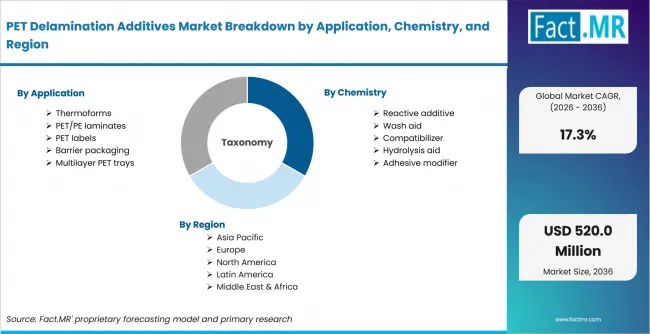
Pet Delamination Additives Market Breakdown By Application, Chemistry, And Region | Source: Fact.MR
| Attribute | Details |
|---|---|
| Quantitative Units | USD Million in 2026 to USD Million by 2036 at CAGR |
| Market Definition | Additives and chemical aids that support layer separation, delamination, and improved recyclability of PET-based multilayer structures. |
| Application | Multilayer PET trays, PET/PE laminates, PET labels, Barrier packaging, Thermoforms |
| Chemistry | Reactive additive, Wash aid, Compatibilizer, Hydrolysis aid, Adhesive modifier |
| Recycling Route | Hot wash, Chemical recycling, Mechanical recycling, Tray-to-tray, Bottle-to-bottle |
| End User | Recyclers, Packaging manufacturers, PET tray manufacturers, Product companies, Additive manufacturers |
| Function | Layer separation, Adhesive weakening, Flake purity, Contamination reduction, Yield improvement |
| Regions Covered | North America, Europe, Asia Pacific, Central and South America, Middle East and Africa |
| Countries Covered | China, India, Germany, Brazil, United States |
| Key Companies Profiled | Sukano, Avient, BASF, Eastman, Indorama Ventures |
| Forecast Period | 2026 to 2036 |
| Approach | Hybrid top-down and bottom-up approach using PET Recycling Additives / Plastic Recycling Chemicals, segment shares, country growth, company mapping, and technical validation |
Source: Fact.MR analysis. Updated Jul 15, 2026
How is the market segmented?
The market breaks down along six axes: Application, Chemistry, Recycling Route, End User, Function, and Region. This taxonomy follows the path from package testing through approval to purchasing, while still covering the full geographic scope.
-
By Application:
- Multilayer PET trays
- PET/PE laminates
- PET labels
- Barrier packaging
- Thermoforms
-
By Chemistry:
- Reactive additive
- Wash aid
- Compatibilizer
- Hydrolysis aid
- Adhesive modifier
-
By Recycling Route:
- Hot wash
- Chemical recycling
- Mechanical recycling
- Tray-to-tray
- Bottle-to-bottle
-
By End User:
- Recyclers
- Packaging manufacturers
- PET tray manufacturers
- Product companies
- Additive manufacturers
-
By Function:
- Layer separation
- Adhesive weakening
- Flake purity
- Contamination reduction
- Yield improvement
-
By Region:
- North America
- United States
- Canada
- Europe
- Germany
- United Kingdom
- France
- Italy
- Spain
- Asia Pacific
- China
- India
- Japan
- South Korea
- Australia
- Central & South America
- Brazil
- Argentina
- Mexico
- Chile
- Middle East & Africa
- UAE
- Saudi Arabia
- South Africa
- North America
Frequently Asked Questions
Which Application leads the PET delamination additives market?
Which Chemistry leads the PET delamination additives market?
Which Recycling Route leads the PET delamination additives market?
Which End User leads the PET delamination additives market?
Which Function leads the PET delamination additives market?
What is the primary driver in the PET delamination additives market?
What is the main restraint in the PET delamination additives market?
Why is Thermoforms important?
Why do buyers continue testing PET delamination additives market?
Who worked on this report


Preview the report firsthand - request a free sample
Free SampleGet the brochure for pricing and purchase details
Download PDF