- Market Value (2025): USD 309.7 Mn
- Estimated Value (2026): USD 340.0 Mn
- Forecast Value (2036): USD 866.0 Mn
- CAGR (2026-2036): 9.8%
What is the Plant Protein Off-Note Masking Systems Market forecast to be worth by 2036?
USD 340 million to USD 866 million by 2036 at a 9.8% CAGR.
- The plant protein off-note masking systems market reached USD 309.7 million in 2025.
- Demand is projected to increase from USD 340.0 million in 2026 to USD 866.0 million by 2036.
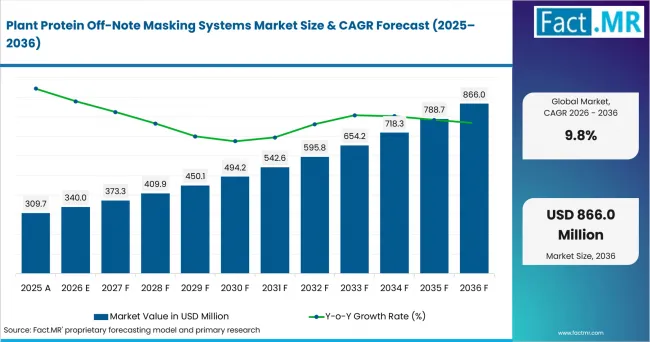
Plant Protein Off Note Masking Systems Market Value Analysis | Source: Fact.MR
What are the defining numbers behind Plant Protein Off-Note Masking Systems Market growth?
An absolute opportunity of USD 526 million is expected between 2026 and 2036.
- Demand Drivers in the Market
- Plant protein ingredients carry volatile and non-volatile compounds that can produce beany, grassy, bitter or astringent sensory notes. Research summarized in Critical Reviews in Food Science and Nutrition identifies aldehydes, alcohols, ketones and furans among the volatile contributors, while phenolics and saponins can contribute to bitterness and astringency. As formulators increase the use of plant proteins, these sensory defects create direct demand for masking systems that make the base acceptable before the finished flavor is built.
- Pea protein is creating a particularly strong formulation need because its off-notes can remain noticeable across meat alternatives, dairy alternatives and protein-fortified foods. Peer-reviewed studies have linked pea protein sensory challenges to compounds including hexanal and 2-pentylfuran, while sensory work repeatedly identifies beany, green and bitter attributes. Masking systems are purchased when processing alone cannot deliver the required flavor profile at commercial protein loadings.
- Meat analogue development increases masking demand because extrusion and other high-temperature processes can change the volatile profile of a plant protein base. The finished product still needs enough neutral sensory space for grilled, roasted or other savory notes to perform as intended. This makes off-note control part of the formulation workflow rather than a finishing step added after the flavor system is selected.
- Dairy alternatives and high-protein beverages broaden the requirement beyond savory applications. Givaudan notes that plant proteins used in dairy alternatives can introduce beany, grainy, bitter or astringent notes, while Kerry describes protein beverages as systems where bitterness and astringency shift with protein source, processing method and format. Suppliers therefore need masking systems that remain effective in liquid matrices and under different serving conditions.
- Sensory and analytical methods are making masking more targeted. Givaudan uses analytical chemistry and sensory mapping to identify compounds associated with off-notes, while IFF has partnered with Unilever and Wageningen University & Research to study protein-flavor interactions. More precise diagnosis reduces trial-and-error flavor overdosing and supports repeat purchases of application-specific masking systems.
- Key Segments Analyzed
- Flavour-based maskers account for 38.0% of Masking Technology in 2026 because they can be integrated directly into the finished flavor system while targeting beany, bitter or earthy notes.
- Pea protein represents 41.0% of Protein Source Handled in 2026, supported by its use across meat alternatives, dairy alternatives and protein-fortified foods where beany and bitter notes require correction.
- Meat analogues hold 33.0% of Application in 2026 because concentrated plant proteins and extrusion create a demanding sensory base that must be neutralized before the intended savory profile is built.
- Liquid systems account for 52.0% of Form in 2026 because they support rapid dosing and dispersion during beverage, dairy-alternative and wet-formulation development.
- Analyst Opinion at Fact.MR
- Shambhu Nath Jha, Principal Consultant at Fact.MR, states, “Plant Protein Off-Note Masking Systems demand will be shaped by how precisely suppliers match the masker to the protein source, processing conditions and application. Pea, soy and faba proteins do not present the same sensory profile, and heat or extrusion can change which notes dominate. Suppliers that combine sensory analysis with application testing can reduce reformulation cycles and become involved earlier in customer product development.”
- Strategic Implications
- Flavour houses should organize masking portfolios around protein source and application matrix, so formulators can begin with a smaller set of technically relevant options.
- Suppliers serving pea-protein customers should combine sensory screening with volatile and non-volatile analysis where practical, because the perceived defect can shift between aroma, bitterness and astringency.
- Liquid and powdered systems should be qualified against processing conditions such as heat treatment, extrusion and high-protein loading rather than sold on flavor description alone.
- Commercial teams should treat meat analogues and dairy alternatives as distinct formulation environments. The buyer is purchasing a route to a neutral base that can carry the target flavor profile consistently at scale.
How does the Plant Protein Off-Note Masking Systems Market break down by segment?
The market is segmented by Masking Technology, Protein Source Handled, Application and Form.
Why do Flavour-based maskers lead Masking Technology?
Flavour-based maskers are projected to account for a 38.0% share in 2026.
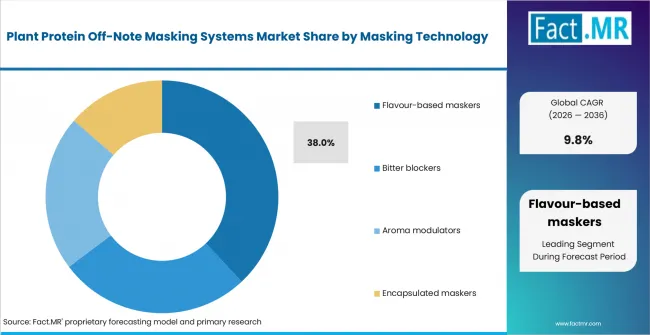
Plant Protein Off Note Masking Systems Market Analysis By Masking Technology | Source: Fact.MR
Flavour-based systems lead because they can be built directly into the flavor architecture of the finished product. The formulator can reduce an unwanted beany or earthy note while simultaneously shaping the positive profile that remains. This is useful when the same protein base is used across several product concepts that require different top notes.
Givaudan describes masking as the creation of a neutral sensory base before the intended taste is added, while Symrise similarly positions masking as the step that follows identification of the protein-specific off-note. This workflow supports buyer preference for solutions that can be adjusted to a specific protein, process and finished-food profile.
Why does Pea protein lead Protein Source Handled?
Pea protein is projected to account for a 41.0% share in 2026.
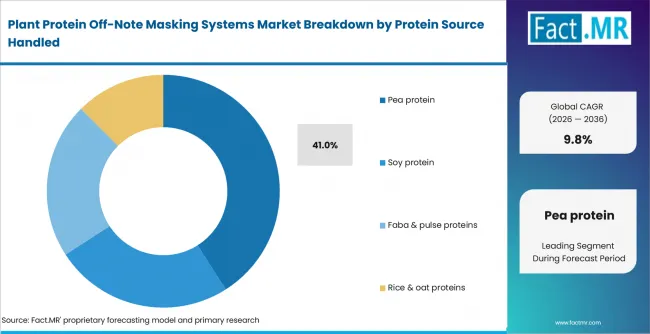
Plant Protein Off Note Masking Systems Market Analysis By Protein Source Handled | Source: Fact.MR
Pea protein leads because it is used in several high-protein food formats while presenting a recognizable combination of beany, green, bitter and astringent notes. Its flavor profile can also change with extraction conditions and ingredient origin, making a single universal masking approach unreliable.
Research on pea protein has identified aldehydes, alcohols, ketones and furans in its volatile profile. Fermentation studies show that reducing compounds such as hexanal can improve sensory perception, but processing can also change solubility or other functional properties. Masking therefore remains useful when manufacturers need flavor correction without redesigning the protein ingredient itself.
Why do Meat analogues lead Application?
Meat analogues are projected to account for a 33.0% share in 2026.
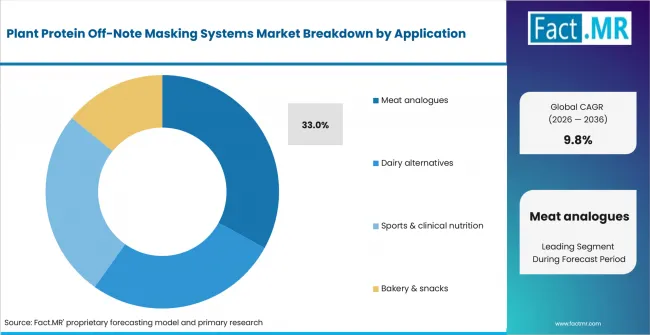
Plant Protein Off Note Masking Systems Market Analysis By Application | Source: Fact.MR
Meat analogues lead because their formulations often contain concentrated pea, soy or pulse proteins and undergo processing designed to create fibrous texture. These steps can leave beany, bitter or cereal-like notes in a product that is expected to carry a savory meat-style flavor.
IFF notes that plant proteins can create beany off-notes and lingering bitterness in meat alternatives, while Kerry identifies protein source and processing method as major causes of off-taste variation. Masking systems help developers establish a cleaner base before adding grilled, roasted or seasoning profiles, reducing the risk that the base competes with the intended taste.
Why do Liquid systems lead Form?
Liquid systems are projected to account for a 52.0% share in 2026.
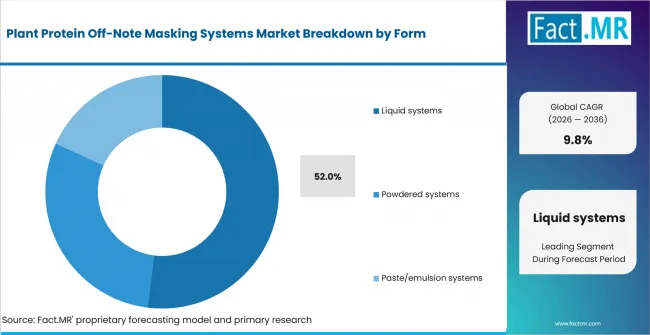
Plant Protein Off Note Masking Systems Market Analysis By Form | Source: Fact.MR
Liquid systems lead because they can be dosed accurately during benchtop development and dispersed through beverages, dairy alternatives and wet meat-analogue formulations. Formulators can adjust the level in small increments during sensory trials, which is useful when an off-note becomes noticeable only after the final protein concentration is set.
Liquid delivery also fits flavor-house workflows in which a masker is combined with characterizing flavors and other taste-modulation components. Powdered and paste systems remain relevant where dry blending, process stability or manufacturing format makes a liquid addition less practical.
What is accelerating Plant Protein Off-Note Masking Systems Market adoption, and what is holding it back?
Drivers Impact Analysis
| Driver | (~) % Impact on CAGR | Geographic Relevance | Impact Timeline |
|---|---|---|---|
| Protein off-note correction in high-protein formulations | +1.6% | Global | Short term (≤ 2 years) |
| Plant-based meat and dairy formulation demand | +1.4% | USA, Germany and UK | Short term (≤ 2 years) |
| Pea and pulse protein diversification | +1.1% | Global | Medium term (2–4 years) |
| Sensory-led masker selection | +0.9% | USA, UK and Canada | Medium term (2–4 years) |
| Liquid-system formulation efficiency | +0.6% | Global | Long term (≥ 4 years) |
Opportunity Impact Analysis
| Opportunity | (~) % Impact on CAGR | Geographic Relevance | Impact Timeline |
|---|---|---|---|
| New pulse and protein-source applications | +1.0% | Global | Medium term (2–4 years) |
| Application-specific masking systems | +0.8% | USA, UK and Germany | Medium term (2–4 years) |
| Flavor-house co-development | +0.7% | Global | Long term (≥ 4 years) |
| Natural and clean-label masking alignment | +0.5% | USA, Canada and Singapore | Long term (≥ 4 years) |
Restraints Impact Analysis
| Restraint | (~) % Impact on CAGR | Geographic Relevance | Impact Timeline |
|---|---|---|---|
| Formulation complexity and dose sensitivity | -1.1% | Global | Short term (≤ 2 years) |
| Label and specification constraints | -0.9% | USA, UK and Germany | Short term (≤ 2 years) |
| Processing-based de-flavoring alternatives | -0.7% | Import-dependent markets | Medium term (2–4 years) |
| Raw-material variability and pricing pressure | -0.5% | Global | Long term (≥ 4 years) |
Which countries are scaling the Plant Protein Off-Note Masking Systems Market?
- United States: USDA Agricultural Research Service work on soybean seed composition directly targets off-flavors that limit wider use of soy protein in foods. This research focus, together with a broad protein-formulation sector, supports demand for masking systems used in high-protein beverages and meat-alternative development.
- Germany: Germany’s federal protein strategy supports the cultivation and utilization of legumes as domestic protein sources. The Max Rubner-Institut is also studying protein-enriched fractions from faba bean, pea and lentil for bakery and pasta applications, creating more formulation settings in which off-note control can be required.
- Italy: CREA’s PROLEGU project is developing protein-rich legume varieties across chickpea, bean and soy germplasm. As research moves plant proteins into more processed foods, flavor correction becomes relevant when traditional legume taste has to be adapted to new product formats.
- United Kingdom: The UK Food Standards Agency reported in 2026 that taste and texture were the most frequently cited purchase factor for foods made using innovative technologies. This places sensory performance close to the commercial decision and supports demand for masking when plant proteins introduce bitterness or astringency.
- Japan: Japan’s Ministry of Agriculture, Forestry and Fisheries reported that 55.6% of respondents in a food-tech survey wanted to eat meat alternatives such as soy meat made from plant protein. Product developers serving this demand need flavor systems that can manage soy-derived and other plant-protein notes without obscuring the intended finished-food profile.
- Spain: Spain’s agriculture ministry has called for greater strategic autonomy in vegetable protein and has emphasized research, crop diversification and wider consumption of legumes. A broader domestic protein base can increase development of processed legume foods, creating demand for application-specific flavor correction and masking.
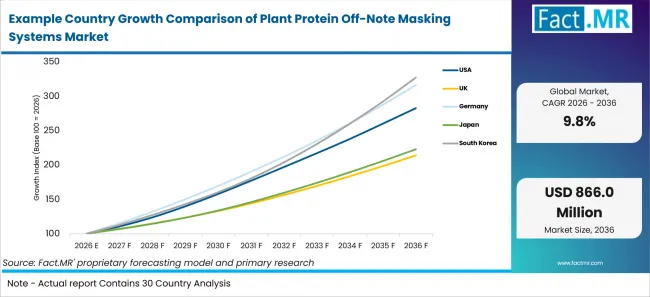
Example Country Growth Comparison Of Plant Protein Off Note Masking Systems Market | Source: Fact.MR
| Country | CAGR (2026-2036) |
|---|---|
| United States | 11.00% |
| Germany | 9.49% |
| Italy | 9.53% |
| United Kingdom | 10.49% |
| Japan | 9.62% |
| Spain | 11.49% |
What is driving United States’s growth through 2036?
United States is forecast to expand at a 11.00% CAGR from 2026 to 2036.
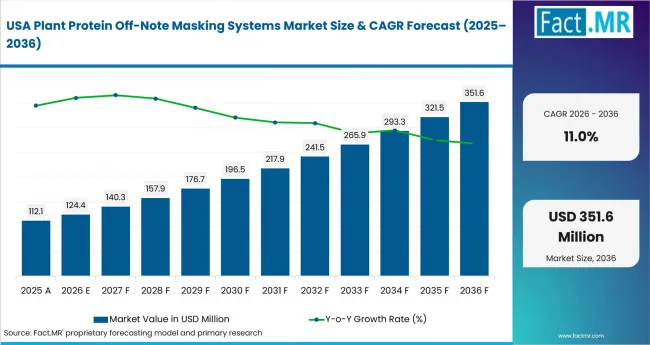
Plant Protein Off Note Masking Systems Market Country Value Analysis | Source: Fact.MR
Growth is supported by continued work to improve the sensory performance of plant proteins used in formulated foods. USDA Agricultural Research Service research has examined soybean seed composition changes that reduce off-flavor formation, reflecting the commercial importance of flavor as a barrier to broader protein use. Masking suppliers can complement ingredient-level improvement when manufacturers need a solution that works across several protein suppliers, processing conditions or finished flavors.
What is driving Germany’s growth through 2036?
Germany is forecast to expand at a 9.49% CAGR from 2026 to 2036.
Germany’s protein strategy is widening the cultivation and utilization base for legumes and other alternative proteins. The Max Rubner-Institut’s LeguDryProt project evaluates protein-enriched fractions from faba bean, pea and lentil for bakery and pasta applications. As these ingredients move into processed foods, manufacturers need tools to correct legume-derived aroma and taste without compromising the target product profile.
What is driving Italy’s growth through 2036?
Italy is forecast to expand at a 9.53% CAGR from 2026 to 2036.
Italy is strengthening research around legume varieties and food use. CREA’s PROLEGU project is assessing more than 1,100 genotypes and focuses on crops including chickpea, bean and soy, with the aim of improving protein quality and supporting domestic value chains. Increased ingredient diversity creates a wider set of sensory profiles for flavor houses to characterize and mask.
What is driving United Kingdom’s growth through 2036?
United Kingdom is forecast to expand at a 10.49% CAGR from 2026 to 2036.
UK demand is supported by a food-innovation environment in which sensory quality has direct commercial weight. The Food Standards Agency found that taste and texture were selected by 36% of surveyed consumers as an important factor when considering foods made using innovative technologies. Masking systems can help developers improve acceptance when plant-protein bases create bitterness, astringency or lingering vegetal notes.
What is driving Japan’s growth through 2036?
Japan is forecast to expand at a 9.62% CAGR from 2026 to 2036.
Japan’s food-tech policy environment supports development of plant-protein foods, including soy-based meat alternatives. MAFF reported that 55.6% of surveyed respondents expressed interest in eating meat alternatives made from plant protein. Soy has a long role in Japanese foods, but new meat-style and convenience applications require flavor profiles different from traditional soy foods, creating a use case for targeted masking.
What is driving Spain’s growth through 2036?
Spain is forecast to expand at an 11.49% CAGR from 2026 to 2036.
Spain is expanding policy support for protein crops while emphasizing innovation and greater use of vegetable protein for human food. The Ministry of Agriculture has linked this agenda to research and crop diversification, which can support a broader supply of legumes for processed applications. As product developers move these proteins into meat analogues, dairy alternatives and fortified foods, sensory correction becomes part of commercialization.
Who leads the Plant Protein Off-Note Masking Systems Market?
Givaudan is positioned as a leading supplier because its plant-protein masking work combines sensory mapping, analytical chemistry and application development. The company has developed masking approaches across protein sources including soy, pea, faba, rice and oat, allowing formulators to match the solution to the base instead of treating every vegetal off-note as the same problem.
dsm-firmenich competes through ModulaSENSE masking technology, including systems integrated into textured vegetable protein processing. IFF combines taste-modulation products with research on protein-flavor interactions, while Symrise uses ProtiScan and related analytical tools to characterize off-notes before selecting a masking approach.
Kerry Group competes through Tastesense masking and protein-specific sensory work. Sensient Technologies offers taste-modulation approaches for beany, bitter, earthy and astringent notes across plant-based formulations. These portfolios show that competition is moving toward source-specific diagnosis and application validation rather than broad flavor coverage alone.
Supplier selection depends on whether the masking system remains effective at the target protein loading and through the customer’s process. Clean-label requirements, heat stability and compatibility with the intended top-note flavor can all change the formulation outcome. Flavor houses that can test the customer’s actual protein base and finished application reduce development risk for buyers.
Which companies are the key providers?
Key companies include Givaudan; dsm-firmenich; IFF; Symrise; Kerry Group; and Sensient Technologies.
- Givaudan
- dsm-firmenich
- IFF
- Symrise
- Kerry Group
- Sensient Technologies
Bibliography
- Leonard, W., Zhang, P., Ying, D., & Fang, Z. (2023). Surmounting the off-flavor challenge in plant-based foods. Critical Reviews in Food Science and Nutrition.
- Fischer, E. et al. (2022). Potential of Microorganisms to Decrease the “Beany” Off-Flavor: A Review. Journal of Agricultural and Food Chemistry.
- El Youssef, C. et al. (2020). Sensory Improvement of a Pea Protein-Based Product Using Microbial Co-Cultures of Lactic Acid Bacteria and Yeasts. Foods.
- Zipori, D. et al. (2024). Rapid Acidification and Off-Flavor Reduction of Pea Protein by Fermentation with Lactic Acid Bacteria and Yeasts. Foods.
- U.S. Department of Agriculture, Agricultural Research Service. (2025). Research on soybean seed composition and off-flavor reduction in food protein applications.
- Federal Office for Agriculture and Food, Germany. (2026). Protein Crop Strategy and Proteins of the Future.
- Max Rubner-Institut. (2026). LeguDryProt: Protein-enriched flours from domestic grain legumes for bakery and pasta applications.
- Food Standards Agency, United Kingdom. (2026). Consumer Insights on Innovative Food Technologies.
- Council for Agricultural Research and Economics, Italy. (2025). Legumi: le proteine alternative da rilanciare.
- Ministry of Agriculture, Fisheries and Food, Spain. (2024). Strategic autonomy and development of vegetable protein production.
- Ministry of Agriculture, Forestry and Fisheries, Japan. (2021). Policies for the Promotion of Shokuiku: Food Tech and Consumer Attitudes.
- Givaudan. (2019). Givaudan Unveils Breakthrough Masking Solutions for Seven Proteins.
- dsm-firmenich. (2026). Next-generation Vertis TVPs with Integrated ModulaSENSE Taste Modulation Technology.
- IFF. (2024). IFF Partners with Unilever and Wageningen University & Research to Address Flavor Challenges in Plant-Based Meat Alternatives.
- Symrise. (n.d.). Masking for Plant Protein Products.
- Kerry Group. (2026). Protein Masking Has a Precision Problem.
- Sensient Technologies. (2023). The Future of Plant-Based Foods and Taste Solutions.
This Report Answers
- The report explains where off-note masking is used across plant-protein formulations and how demand differs by protein source and application.
- Segment analysis examines masking technology, protein source handled, application and form.
- Country analysis explains the formulation and protein-innovation factors supporting demand in the listed markets.
- Competitive analysis reviews the supplied flavor and taste-modulation companies and the technical factors that influence buyer selection.
- Application analysis covers meat analogues, dairy alternatives, sports and clinical nutrition, and bakery and snack formulations.
What does the Plant Protein Off-Note Masking Systems Market cover?
The Plant Protein Off-Note Masking Systems Market covers flavor and taste-modulation systems used to reduce undesirable sensory notes created by plant protein ingredients. The assessment includes systems applied to pea, soy, faba and pulse proteins, as well as rice and oat proteins, across food and beverage formulations.
What is included in the scope?
The scope includes flavour-based maskers, bitter blockers, aroma modulators and encapsulated maskers used specifically for plant-protein off-note correction. Applications include meat analogues, dairy alternatives, sports and clinical nutrition products, and bakery and snacks. Liquid, powdered and paste or emulsion systems are included.
Buyers include food and beverage manufacturers, protein formulators and product-development teams purchasing masking systems as part of a finished formulation. Regional coverage spans North America, Latin America, Europe, East Asia, South Asia and Pacific, and the Middle East and Africa.
What is excluded from the scope?
The scope excludes plant protein concentrates and isolates sold without an off-note masking function. Protein extraction, deodorization and fermentation equipment are outside the market unless the commercial offering is sold as part of a masking or taste-modulation system.
General characterizing flavors are excluded when they are sold only to create the target flavor and are not intended to reduce an undesirable plant-protein note. Sweeteners, texturants and mouthfeel agents are also outside the market unless they form an integrated masking solution.
How Was the Analysis Built?
The analysis draws on more than 120 sources, over 35 company portfolios and more than 20 industry interviews across at least 25 countries.
- Primary Research: Interviews with flavor houses, plant-protein ingredient suppliers, food manufacturers and product-development specialists examine off-note profiles, formulation priorities and purchasing criteria.
- Desk Research: The review covers peer-reviewed flavor chemistry, public protein-strategy programs, food-innovation research and official company product information. Sources used in the analysis are recorded in the bibliography.
- Market Sizing and Forecasting: Estimates combine plant-protein formulation volumes, protein-source mix, application demand and masking-system usage across liquid and dry formats. Country growth reflects local food innovation and plant-protein utilization.
- Data Validation and Update Cycle: Findings are cross-checked against company activity, public research and industry interviews. Updates account for new protein sources, masking technologies, processing methods and application launches.
What is the report's scope and coverage?
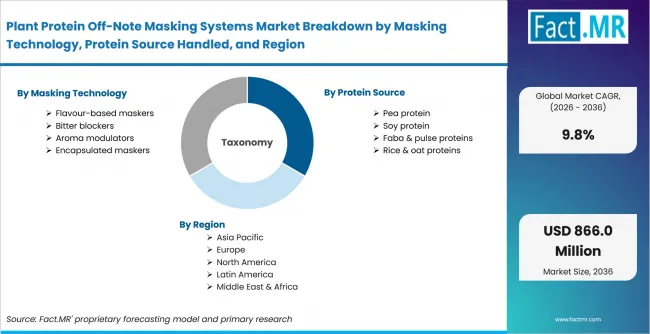
Plant Protein Off Note Masking Systems Market Breakdown By Masking Technology, Protein Source Handled, And Region | Source: Fact.MR
| Attribute | Details |
|---|---|
| Quantitative Units | USD million |
| Market Definition | Plant Protein Off-Note Masking Systems used to reduce undesirable taste and aroma notes in plant-protein food and beverage formulations |
| Segments Covered | Masking Technology; Protein Source Handled; Application; Form |
| Regions Covered | North America; Latin America; Europe; East Asia; South Asia and Pacific; Middle East and Africa |
| Countries Covered | United States; Germany; Italy; United Kingdom; Japan; Spain |
| Key Companies Profiled | Givaudan; dsm-firmenich; IFF; Symrise; Kerry Group; Sensient Technologies |
| Forecast Period | 2026 to 2036 |
| Approach | Hybrid top-down and bottom-up approach using plant-protein formulation demand, application mix, country growth, product format and company portfolio review |
How is the market segmented?
-
By Masking Technology:
- Flavour-based maskers
- Bitter blockers
- Aroma modulators
- Encapsulated maskers
-
By Protein Source Handled:
- Pea protein
- Soy protein
- Faba & pulse proteins
- Rice & oat proteins
-
By Application:
- Meat analogues
- Dairy alternatives
- Sports & clinical nutrition
- Bakery & snacks
-
By Form:
- Liquid systems
- Powdered systems
- Paste/emulsion systems