- Base Value(2025): 3.1 Bn
- Estimated Value(2026): 3.4 Bn
- Forecast Value (2036): 8.7 Bn
- CAGR (2026 - 2036): 9.9%
Port Electrification Load Orchestration Software Market Forecast and Outlook By FACT.MR
In 2025, the port electrification load orchestration software market was valued at USD 3.1 billion. Based on Fact.MR analysis, demand for port electrification load orchestration software is estimated to grow to USD 3.4 billion in 2026 and USD 8.7 billion by 2036. FACT.MR projects a CAGR of 9.9% during the forecast period.
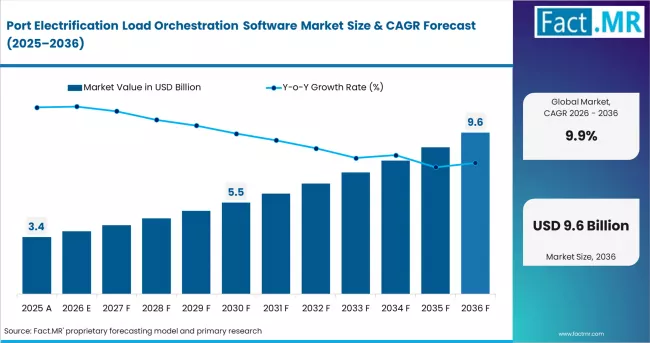
Port Electrification Load Orchestration Software Market Market Value Analysis | Source: Fact.MR
| Metric | Value |
|---|---|
| Estimated Value in 2026 | USD 3.4 billion |
| Forecast Value in 2036 | USD 8.7 billion |
| Forecast CAGR (2026 to 2036) | 9.9% |
Source: Fact.MR analysis. Updated Apr 24, 2026
Summary of the Port Electrification Load Orchestration Software Market
- Market Definition
- The market covers AI-enabled software platforms for real-time load orchestration, energy management, and grid coordination across shore power, cargo handling equipment, and EV charging assets at electrified port facilities globally.
- Demand Drivers
- EU Fit for 55 mandates require major European ports to provide shore power for specified vessel types by 2030, creating non-discretionary software procurement demand across container terminals and cruise berths.
- China's Ministry of Transport electrification programme is driving adoption of energy management platforms at over 100 major ports, with state-linked terminal operators mandated to deploy load orchestration systems by 2025.
- U.S. federal infrastructure funding under the Bipartisan Infrastructure Law includes port electrification grants requiring digital energy management capability, directly expanding software procurement pipelines at American terminals.
- Key Segments Analyzed
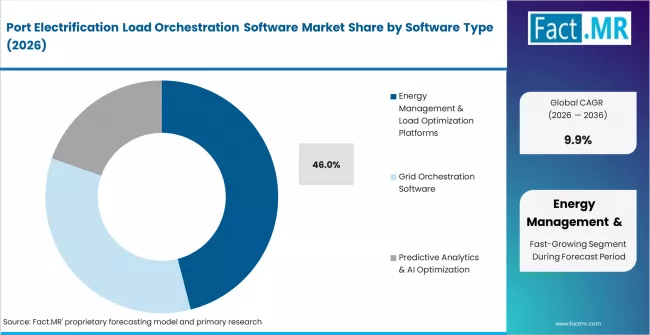
- By Software Type: Energy Management & Load Optimization Platforms lead with 46% share in 2026. Dominance driven by need for real-time power balancing across port assets.
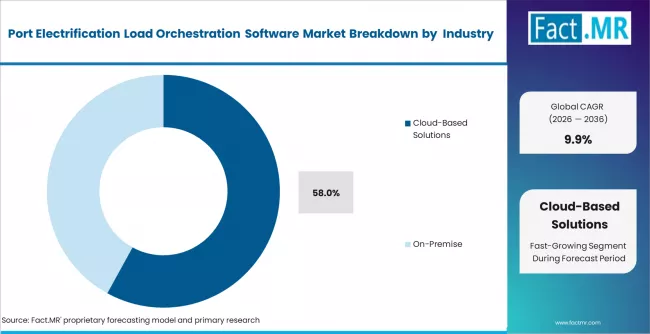
- By Deployment: Cloud-Based Solutions hold 58% share in 2026. Cloud dominates due to scalability and integration with smart port ecosystems.
- By Application: Shore Power (Cold Ironing) Management leads with 39% share in 2026 as the largest single electrification load in ports.
- By Geography: China leads at 11.5% CAGR through 2036, driven by state-funded electrification mandates across major port clusters.
- Analyst Opinion at FACT.MR
- Shambhu Nath Jha, Principal Consultant at Fact.MR, opines, ‘CXOs will find that port electrification load orchestration software has moved from a supporting tool to a compliance requirement. It is now essential for meeting regulatory mandates. Vendors offering integrated AI-driven load management with grid connectivity will secure a larger share of future software investments through 2036.
- Strategic Implications
- Develop compliance reporting modules to meet EU shore power mandates before 2030 deadlines.
- Expand deployment teams in China and South Korea to capture high-growth markets early.
- Build open API systems for integration with port and grid platforms to secure long-term contracts.
- Methodology
- Market sizing is based on software revenues by deployment and region. Validated with vendor data and port procurement records.
- Analysis includes EU, IMO, U.S., and China electrification regulations.
- Forecasts consider investment trends, regulatory filings, and smart port digitalization insights.
The market is expected to generate USD 5.6 billion in incremental revenue during the forecast period. Growth is strong and structurally anchored. Demand is driven by decarburization mandates and smart port digitization. Expansion is moderated by legacy grid infrastructure constraints and high integration costs at smaller terminals.
Port operators are consolidating electrification software procurement around platforms that unify shore power, cargo handling, and EV charging loads. Point solutions are being displaced. Buyers at major container terminals in Europe and Asia prioritise interoperability with grid operators. This is reshaping vendor qualification criteria and contracting terms.
China leads with a projected CAGR of 11.5% through 2036, driven by state-mandated port electrification programmes and massive infrastructure investment. The United States follows at 10.6%, supported by smart port initiatives and federal grid modernisation funding. Germany records 10.2%, underpinned by port decarburization mandates under the EU Fit for 55 package. The Netherlands grows at 10.0%, anchored by Rotterdam's position as a digital port benchmark. South Korea records 9.8%, driven by rapid smart port development and government digitalization funding. Japan follows at 9.6%, supported by high automation adoption and national electrification programmes.
Segmental Analysis
Port Electrification Load Orchestration Software Market Analysis by Software Type
Port Electrification Load Orchestration Software Market Analysis By Software Type | Source: Fact.MR
Based on FACT.MR, energy management and load optimization platforms hold 46% share in 2026. This segment leads due to real-time power balancing needs. Ports handle multiple high-load assets simultaneously. These platforms prevent grid overloads. They also optimize energy costs. Buyers prefer integration with national grid systems.
- Siemens Deployment: Siemens partnered with Port of Rotterdam in June 2025. The project includes a digital twin platform. It integrates IoT, AI, and energy management. Load orchestration is a core feature [1].
- ABB Investment: ABB secured a contract in February 2025. It supports the Port of Los Angeles terminal project. The scope includes energy management and load control software [2].
- Adoption Trend: IAPH reported in 2024 that AI-based systems reduce downtime by up to 30%. This is driving adoption among major ports [3].
Port Electrification Load Orchestration Software Market Analysis by Deployment
Port Electrification Load Orchestration Software Market Analysis By Deployment | Source: Fact.MR
Based on FACT.MR, cloud-based solutions hold 58% share in 2026. This segment leads due to scalability benefits. Cloud systems support real-time data integration. They connect with grid operators and port systems. Subscription models reduce upfront costs. Multi-site operators gain centralised visibility.
- Schneider Electric Platform: Schneider Electric’s EcoStruxure platform was highlighted in 2025. It enables cloud-based energy orchestration. It supports automation and distributed energy integration [4].
- Hitachi Energy Development: Hitachi Energy expanded its software portfolio in 2024. It targets port electrification needs. Solutions support grid API integration and real-time analytics [5].
- Regulatory Driver: EU Fit for 55 mandates shore power by 2030. Ports must adopt digital systems. Cloud-based reporting and load management are required [6].
Drivers, Restraints, and Opportunities
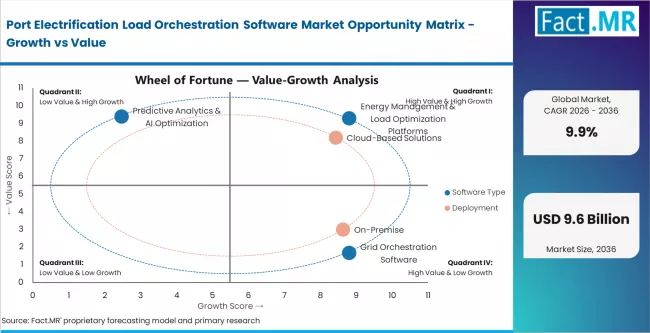
Port Electrification Load Orchestration Software Market Opportunity Matrix Growth Vs Value | Source: Fact.MR
FACT.MR analysts observe that growth is driven by regulation. Compliance demand is non-cyclical. Smart port investments add further growth. Market expansion remains stable across cycles.
Platform providers are gaining share over point solutions. Buyers prefer unified systems. These manage shore power, cargo, and EV loads together. Compliance reporting is now mandatory. Grid connectivity is also required. Integrated platforms command 25–45% price premiums.
- EU Fit for 55 Mandate: The EU requires shore power by 2030. This creates mandatory software demand. HAROPA PORT partnered with European organisations in 2025. The focus is compliance readiness.
- China Electrification Programme: China is expanding port electrification. Government mandates require energy software adoption. Major ports are implementing systems. Asia-Pacific led over 40% of investment in 2024.
- U.S. Infrastructure Funding: U.S. grants require digital energy systems. Ports must include load monitoring tools. Los Angeles and Long Beach secured funding in 2024. Projects include orchestration software.
Regional Analysis
The port electrification load orchestration software market is assessed across North America, Europe, Asia Pacific, Latin America, and Middle East and Africa, covering 40+ countries with distinct demand profiles shaped by port electrification maturity, regulatory frameworks, smart port investment levels, and grid integration capability. The full report provides market attractiveness analysis by region and country.
.webp "Top Country Growth Comparison Port Electrification Load Orchestration Software Market Cagr (2026 2036)")
Top Country Growth Comparison Port Electrification Load Orchestration Software Market Cagr (2026 2036) | Source: Fact.MR
| Country | CAGR (2026 to 2036) |
|---|---|
| China | 11.5% |
| United States | 10.6% |
| Germany | 10.2% |
| Netherlands | 10.0% |
| South Korea | 9.8% |
| Japan | 9.6% |
Source: Fact.MR analysis. Updated Apr 24, 2026
Source: Fact.MR (FACT.MR) analysis, based on proprietary forecasting model and primary research
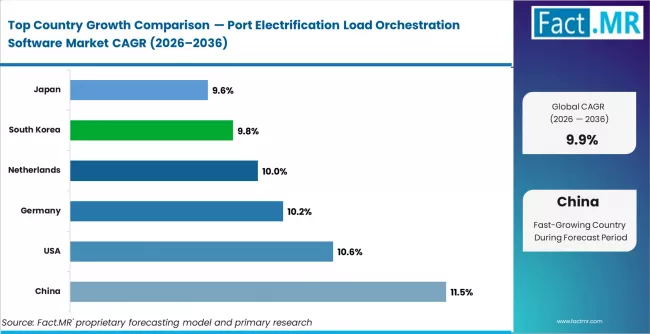
Port Electrification Load Orchestration Software Market Cagr Analysis By Country | Source: Fact.MR
Asia Pacific Port Electrification Load Orchestration Software Market Analysis
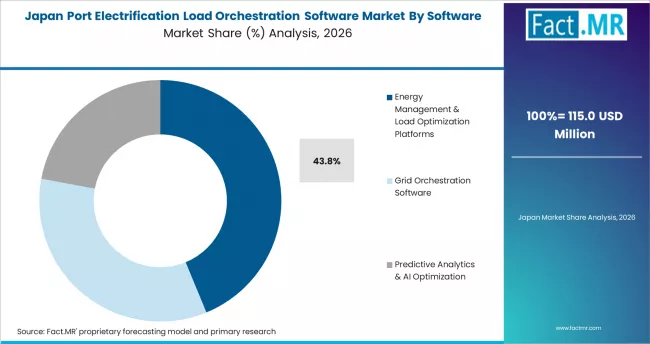
Port Electrification Load Orchestration Software Market Japan Market Share Analysis By Software Type | Source: Fact.MR
Asia Pacific is the fastest-growing and largest regional market. Growth is propelled by state-led electrification mandates and rapid smart port construction. China, Japan, South Korea, and Singapore anchor demand expansion. Hitachi Energy, Siemens, and ABB lead regional supply through established electrification project delivery and software integration capabilities.
- China: State-mandated programmes underpin an 11.5% CAGR through 2036. China's Ministry of Transport Green Port Action Plan requires energy management system deployment across major coastal terminals by 2025. State-linked operators at Yangshan Deep Water Port and Tianjin Port began tendering load orchestration software contracts in 2024. Growth is driven by compliance timelines and new terminal construction volume.
- Japan: High automation integration drives a 9.6% CAGR through 2036. Japan's Ministry of Land, Infrastructure, Transport and Tourism published its Green Port Policy in 2024, mandating shore power equipment at designated international ports. Port of Yokohama and Port of Kobe expanded electrification software procurement in 2024 as part of the national decarbonisation strategy. Growth reflects structured regulatory implementation and industrial automation depth.
- South Korea: Government-funded digitalisation supports a 9.8% CAGR through 2036. South Korea's Ministry of Oceans and Fisheries allocated KRW 500 billion toward smart port infrastructure in its 2024 budget, covering energy management and load monitoring software for Busan, Incheon, and Gwangyang terminals. Growth is driven by procurement-linked funding and Korea's Smart Port development roadmap.
Fact.MR's analysis covers China, Japan, South Korea, India, ASEAN, and Australia and New Zealand. It includes electrification mandate timelines, smart port software adoption, and load orchestration investment trends.
North America Port Electrification Load Orchestration Software Market Analysis
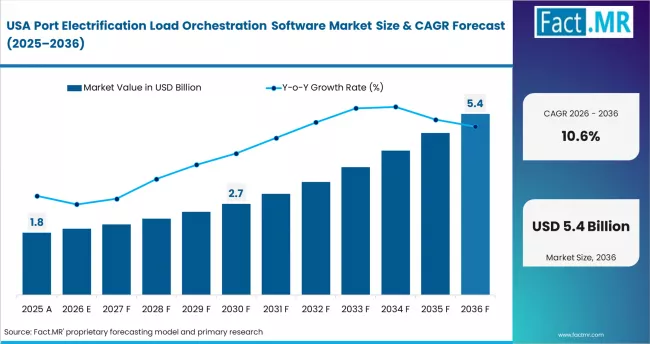
Port Electrification Load Orchestration Software Market Country Value Analysis | Source: Fact.MR
North America is a high-investment market driven by federal infrastructure programmes and port authority sustainability commitments. Growth is concentrated at West Coast container terminals and East Coast cruise ports. ABB, Siemens Energy, and Schneider Electric dominate platform supply through established utility and industrial grid integration capability.
- United States: Federal grant eligibility requirements drive a 10.6% CAGR through 2036. The Port of Seattle Commission mandated shore power for all home-ported cruise vessels from 2027, passed in June 2024, accelerating load orchestration software timelines. ABB secured the Port of Los Angeles electrification contract in February 2025 incorporating software-based load control. Growth is led by regulatory advance procurement and federal funding leverage
Fact.MR's analysis covers the United States, Canada, and Mexico. It includes federal grant programme requirements, port authority electrification commitments, and digital energy management adoption trends.
Europe Port Electrification Load Orchestration Software Market Analysis
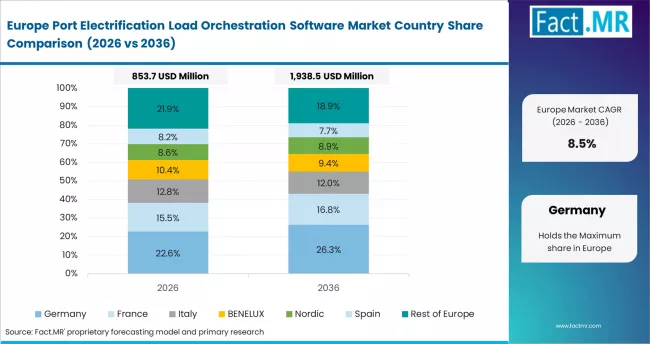
Port Electrification Load Orchestration Software Market Europe Country Market Share Analysis, 2026 & 2036 | Source: Fact.MR
Europe is the most compliance-intensive regional market. EU Fit for 55 shore power deadlines define mandatory procurement cycles. Rotterdam, Hamburg, and Antwerp are the benchmark deployment environments. Siemens, Schneider Electric, and Wärtsilä lead through deep EU port authority relationships and certified shore power software integration capability.
- Germany: Decarbonisation regulation drives a 10.2% CAGR through 2036. Hamburg Port Authority's smartPORT initiative mandated energy management software integration across berth electrification assets in 2024. The EU Fit for 55 compliance deadline creates a multi-year mandatory procurement cycle for load orchestration platforms at German container and ferry terminals. Growth is driven by regulatory depth and industrial automation leadership.
- Netherlands: Rotterdam's smart port benchmark status underpins a 10.0% CAGR through 2036. In June 2025, Siemens announced a strategic collaboration with the Port of Rotterdam Authority to deploy a digital twin-based platform integrating energy management and AI analytics. The updated Rotterdam Shore Power Plan, presented in November 2025, mandated accelerated electrification software deployment across all major berths. Growth is driven by benchmark port investment and EU compliance leadership.
Fact.MR's analysis covers Germany, France, the United Kingdom, Netherlands, Italy, Spain, and Rest of Europe. It includes EU Fit for 55 timelines, shore power compliance investment, and smart port software adoption trends.
Competitive Aligners for Market Players
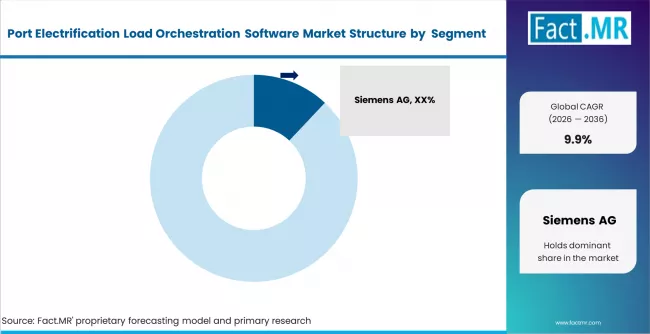
Port Electrification Load Orchestration Software Market Analysis By Company | Source: Fact.MR
The port electrification load orchestration software market is shaped by a concentrated group of global industrial and energy technology players, supported by a growing layer of specialised software providers. Companies such as Siemens AG, ABB Ltd., Schneider Electric SE, and Hitachi Energy Ltd. dominate the competitive landscape through integrated electrification and digital grid platforms. These firms benefit from strong capabilities across hardware, automation, and software, allowing them to deliver end-to-end port energy management solutions.
Competition is increasingly centred on software intelligence rather than physical infrastructure. Vendors are differentiating through AI-driven load balancing, real-time analytics, and seamless integration with grid operators and port systems. Platforms that combine electrification control with compliance reporting are gaining preference, as ports move toward unified systems instead of standalone tools.
Large incumbents hold an advantage due to their ability to bundle software with electrification hardware and long-term service contracts. Their global presence and established relationships with port authorities enable them to secure large-scale deployments. At the same time, emerging software-focused firms and niche energy tech providers are entering the market with cloud-native orchestration platforms, targeting flexibility and interoperability. Buyer behaviour is shifting toward platform consolidation. Port operators increasingly prefer single vendors capable of managing shore power, terminal equipment, and grid interaction within one system. This is raising entry barriers for smaller vendors offering limited functionality.
Key Players
- Siemens AG
- ABB Ltd.
- Schneider Electric SE
- Hitachi Energy Ltd.
- Wärtsilä Corporation
- Enel X
- Cavotec SA
Bibliography
- [1] Siemens AG. (June 2025). Strategic Collaboration Announcement: Digital Twin-Based Port Optimization Platform with Port of Rotterdam Authority Integrating IoT, AI Analytics, and Energy Management for Shore Power and Terminal Electrification. June 2025. siemens.com/newsroom
- [2] ABB Ltd. (February 2025). Contract Announcement: Electrification and Automation Solutions Including Software-Based Load Management for New Automated Container Terminal at the Port of Los Angeles. February 2025. abb.com/newsroom
- [3] International Association of Ports and Harbors. (2024). Port Technology and Sustainability Report 2024: AI-Powered Predictive Maintenance and Load Management Reducing Unplanned Downtime by up to 30% at Electrified Terminals. 2024. iaphworldports.org
- [4] IoT Analytics. (December 2025). SPS 2025: Positioning for Industrial Automation's Future — Schneider Electric EcoStruxure Suite and Open Interoperable Orchestration Layer for Energy Management and Automation Deployment. December 2025. iot-analytics.com
- [5] Hitachi Energy Ltd. (2024). Annual Report and Portfolio Update: Grid Software and Digital Energy Management Expansion Targeting Maritime and Port Electrification Customers with Cloud-Native Orchestration Tools. 2024. hitachienergy.com
- [6] European Commission. (2025). FuelEU Maritime Regulation and Fit for 55 Shore Power Requirements: Mandate for Major EU Ports to Supply Shore Power to Container Ships and Cruise Vessels by 2030. May 2025. ec. europa.eu
This Report Addresses
- Strategic intelligence on port electrification load orchestration software demand across energy management, grid orchestration, and AI predictive analytics segments globally.
- Market forecast from USD 3.4 billion in 2026 to USD 8.7 billion by 2036 at a CAGR of 9.9%.
- Growth opportunity mapping across China state-mandated electrification programmes, U.S. federal grant-driven procurement, EU Fit for 55 shore power compliance mandates, Netherlands Rotterdam benchmark deployments, and South Korea smart port development funding.
- Segment analysis by software type (energy management, grid orchestration, AI analytics), deployment mode (cloud, on-premise), and application (shore power, cargo handling, EV charging).
- Regional outlook covering Asia Pacific electrification mandate adoption, North America federal funding-driven demand, and European Fit for 55 compliance software investment cycles.
- Competitive landscape of Siemens AG, ABB Ltd., Schneider Electric SE, Hitachi Energy Ltd., Wärtsilä Corporation, Enel X, and Cavotec SA. Focus on grid integration depth, compliance reporting capability, and platform interoperability positioning.
- Regulatory impact analysis covering EU Fit for 55 shore power timelines, IMO GHG strategy implications, U.S. Bipartisan Infrastructure Law port electrification grant requirements, China Ministry of Transport Green Port Action Plan mandates, and Port of Seattle universal shore power regulation.
- Report delivered in PDF, Excel datasets, and presentation formats. Supported by primary interviews, vendor revenue disclosures, EU regulatory publications, IMO strategy documents, and port authority procurement records.
Port Electrification Load Orchestration Software Market Definition
The market covers software platforms enabling real-time energy monitoring, load balancing, and grid orchestration across electrified port assets. It serves port authorities, terminal operators, and energy utilities managing shore power, cargo equipment, and EV charging infrastructure.
Port Electrification Load Orchestration Software Market Inclusions
Includes global and regional forecasts from 2026 to 2036. Covers software type, deployment mode, and application. Encompasses energy management platforms, grid orchestration tools, and AI-based predictive analytics. Covers shore power, cargo handling, and EV charging applications. Delivered via cloud and on-premise models.
Port Electrification Load Orchestration Software Market Exclusions
Excludes shore power hardware, cables, and physical switchgear. Omits general port management software not specific to electrification load control. Excludes vessel-side onboard power systems and marine fuel management platforms.
Port Electrification Load Orchestration Software MarketResearch Methodology
- Primary Research: Interviews with port energy managers, terminal operations directors, grid integration engineers, and procurement heads at container terminals, port authorities, and energy utilities across China, the United States, Germany, the Netherlands, Japan, and South Korea.
- Desk Research: Uses EU Fit for 55 shore power directives, U.S. Department of Transportation port decarburization grants, IMO greenhouse gas strategy documents, and software revenue disclosures from Siemens, ABB, Schneider Electric, and Hitachi Energy from 2024–2025.
- Market-Sizing and Forecasting: Hybrid model integrating top-down software revenue estimates from vendor financial disclosures with bottom-up deployment volume forecasts by software type and application across each covered geography.
- Data Validation and Update Cycle: Validated through vendor revenue data, port authority procurement records, and regulatory filing volumes. Cross-checked with expert interviews. Updated on a rolling annual basis.
Segmentation
Scope of Report
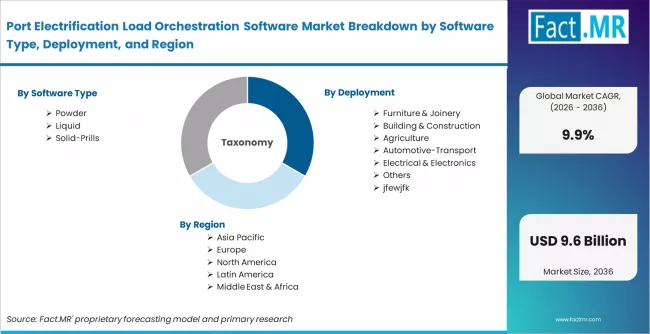
Port Electrification Load Orchestration Software Market Breakdown By Software Type, Deployment, And Region | Source: Fact.MR
| Attribute | Details |
|---|---|
| Quantitative Units | USD 3.4 billion (2026) to USD 8.7 billion (2036), at a CAGR of 9.9% |
| Market Definition | Software platforms for real-time load orchestration, energy management, grid coordination, and compliance reporting across shore power, cargo handling, and EV charging assets at electrified ports globally. |
| Software Type Segmentation | Energy Management & Load Optimization Platforms, Grid Orchestration Software, Predictive Analytics & AI Optimization |
| Deployment Segmentation | Cloud-Based Solutions, On-Premise |
| Application Segmentation | Shore Power (Cold Ironing) Management, Electric Cargo Handling Equipment, EV Charging Infrastructure, Others |
| Application Coverage | Shore power compliance management, multi-load balancing, predictive maintenance scheduling, grid peak demand optimization, EV fleet charging coordination, and real-time energy cost analytics for terminal operators. |
| Regions Covered | North America, Europe, Asia Pacific, Latin America, Middle East and Africa |
| Countries Covered | USA, Canada, Mexico, Germany, UK, France, Italy, Netherlands, Spain, Nordic, BENELUX, China, Japan, South Korea, India, ASEAN, Australia and New Zealand, Brazil, Saudi Arabia, GCC, South Africa, Rest of MEA |
| Key Companies Profiled | Siemens AG, ABB Ltd., Schneider Electric SE, Hitachi Energy Ltd., Wärtsilä Corporation, Enel X, Cavotec SA |
| Forecast Period | 2026 to 2036 |
| Approach | Hybrid top-down and bottom-up model using vendor electrification software revenue disclosures, port authority deployment volume estimates by application, average software contract value benchmarks, and primary interviews with terminal operators and energy managers. |
Source: Fact.MR analysis. Updated Apr 24, 2026
Port Electrification Load Orchestration Software Market by Segments
-
By Software Type:
- Energy Management & Load Optimization Platforms
- Grid Orchestration Software
- Predictive Analytics & AI Optimization
-
By Deployment:
- Cloud-Based Solutions
- On-Premise
-
By Application:
- Shore Power (Cold Ironing) Management
- Electric Cargo Handling Equipment
- EV Charging Infrastructure
- Others
-
By Region:
-
North America
- United States
- Canada
- Mexico
-
Latin America
- Brazil
- Chile
- Rest of Latin America
-
Western Europe
- Germany
- United Kingdom
- France
- Italy
- Spain
- Nordic Countries
- BENELUX
- Rest of Western Europe
-
Eastern Europe
- Russia
- Poland
- Hungary
- Balkan and Baltic
- Rest of Eastern Europe
-
East Asia
- China
- Japan
- South Korea
-
South Asia and Pacific
- India
- ASEAN
- Australia and New Zealand
- Rest of South Asia and Pacific
-
Middle East and Africa
- Kingdom of Saudi Arabia
- Other GCC Countries
- Turkey
- South Africa
- Rest of Middle East and Africa
-
Frequently Asked Questions
How large is the global port electrification load orchestration software market in 2025?
What will the market size be in 2026?
What is the projected market size by 2036?
What is the expected CAGR from 2026 to 2036?
Which software type segment is poised to lead the market?
Which deployment mode holds the largest share?
Which application segment dominates?
Which country shows the fastest growth?
What is driving demand for port electrification load orchestration software?
What are the major restraints?
Which application is most significant?
Who worked on this report


Preview the report firsthand - request a free sample
Free SampleGet the brochure for pricing and purchase details
Download PDF