- Market Value (2025): USD 655.2 Mn
- Estimated Value (2026): USD 760.0 Mn
- Forecast Value (2036): USD 3353.0 Mn
- CAGR (2026-2036): 16.0%
What is the Postbiotic Food Additives Market forecast to be worth by 2036?
USD 760.0 million in 2026 to USD 3353.0 million by 2036, at 16.0% CAGR.
- The Postbiotic Food Additives Market reached USD 655.2 million in 2025.
- Demand is projected to increase from USD 760.0 million in 2026 to USD 3353.0 million by 2036.
- The market is forecast to record 16.0% CAGR from 2026 to 2036 as food brands use non-viable microbial ingredients to support nutrition, texture and clean-label positioning.
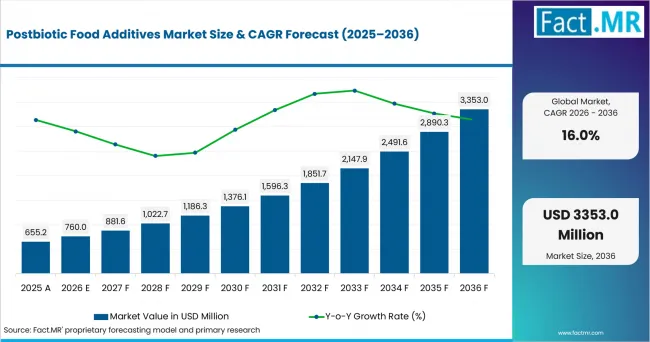
Postbiotic Food Additives Market Value Analysis | Source: Fact.MR
What are the defining numbers behind Postbiotic Food Additives Market growth?
USD 2593.0 million absolute opportunity by 2036, led by isolates, precision fermentation and powder forms.
- Demand Drivers in the Market
- Food formulators need stable microbiome ingredients where heat treatment, acidity or storage time would reduce live-culture count.
- U.S. food spending reached USD 2.51 trillion in 2025 in inflation-adjusted 2025 dollars, according to USDA Economic Research Service data updated in June 2026.
- Nutrition teams use postbiotic isolates to add gut-health positioning while keeping ingredient performance measurable after processing and storage.
- Food brands developing health and wellness foods are expected to use postbiotic additives where familiar product formats need a functional claim story.
- Contract manufacturers favor powder formats since premix handling supports repeatable dosing across meat alternatives, dairy alternatives and fortified bakery systems.
- Key Segments Analyzed
- By Ingredient Type: Isolates are expected to hold 42.0% share in 2026 due to cleaner specification control and easier dosage documentation.
- By Production Route: Precision fermentation is projected to account for 46.0% share in 2026 owing to batch consistency and targeted microbial output.
- By Function: Nutrition is anticipated to capture 32.0% share in 2026 supported by gut-health and immune-support positioning.
- By Application: Meat alternatives are estimated to represent 30.0% share in 2026 because formulators need flavor and texture support in protein systems.
- By Form: Powder is forecast to hold 46.0% share in 2026 as dry blending simplifies transport, storage and plant-scale dosing.
- Analyst Opinion at Fact.MR
- Shambhu Nath Jha, Principal Consultant at Fact.MR, states, “Postbiotics draw attention because the ingredient remains useful after controlled inactivation. Food brands are expected to place them first in formats where live organisms create processing limits. Suppliers that combine strain documentation, application testing and clear claim guidance are better placed for repeat commercial orders.”
- Strategic Implications
- Ingredient suppliers should document strain identity, inactivation method and stability across pH and heat exposure.
- Food brands should connect postbiotic dosage to the processing step where functional loss usually occurs.
- Application teams should test postbiotic blends beside food processing ingredients so dosing, texture and flavor changes are evaluated in one trial.
- Regulatory teams should separate structure-function language from drug-style claims when reviewing packaging, launch documents and brand websites.
The UK is projected to post 19.6% CAGR through 2036 supported by food manufacturing depth and functional reformulation. South Korea is expected to record 18.3% CAGR as processed food output and K-food manufacturing widen ingredient trials. Japan is anticipated to reach 17.8% CAGR with export-oriented food development. The USA is forecast to hold 16.1% CAGR through broad retail and foodservice formulation cycles. Germany is estimated to record 12.7% CAGR as specification review and cost control shape adoption.
How does the Postbiotic Food Additives Market break down by segment?
Precision fermentation leads at 46.0%; powder forms lead at 46.0%.
Which Ingredient Type dominates?
Isolates hold 42.0% share in 2026.
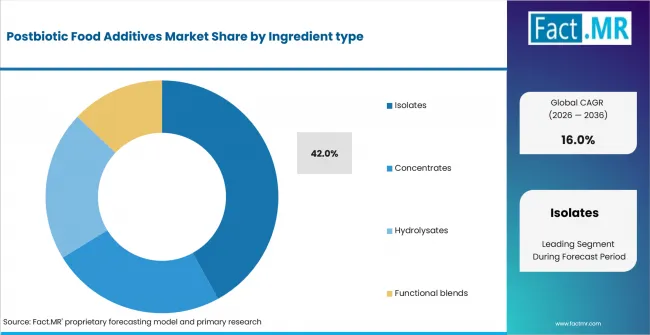
Postbiotic Food Additives Market Analysis By Ingredient Type | Source: Fact.MR
Isolates lead because they give formulators a defined ingredient input. A narrower specification helps brands control dosage, sensory impact and label language. Adjacent fermented ingredients coverage shows why fermentation-derived functionality is becoming part of broader ingredient planning.
What leads the Production Route segment?
Precision fermentation accounts for 46.0% share in 2026.
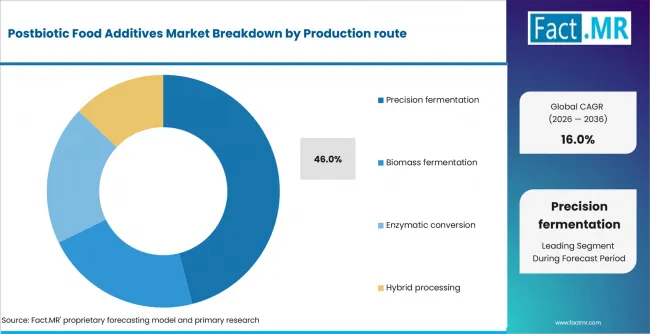
Postbiotic Food Additives Market Analysis By Production Route | Source: Fact.MR
Precision fermentation leads because it improves strain control and repeatability. Ingredient manufacturers manage culture conditions before inactivation, which makes customer qualification easier. The same specification reasoning appears in food additive systems where production discipline shapes supplier selection.
How does Function shape demand?
Nutrition represents 32.0% share in 2026.
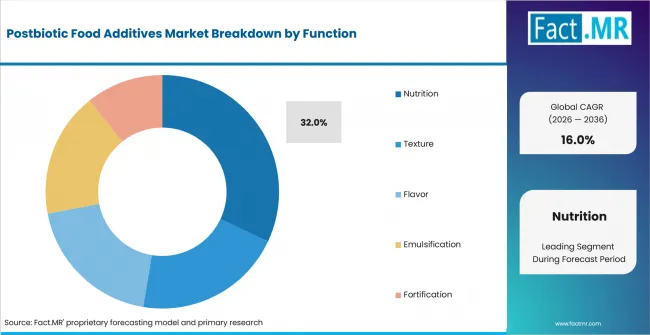
Postbiotic Food Additives Market Analysis By Function | Source: Fact.MR
Nutrition leads because postbiotic additives let food brands connect microbiome positioning with stable shelf formats. The ingredient can support a functional story in bars, beverages and prepared foods. Functional foods analysis shows why nutrition claims remain central to premium food development.
What supports Meat alternatives within Application?
Meat alternatives lead with 30.0% share in 2026.
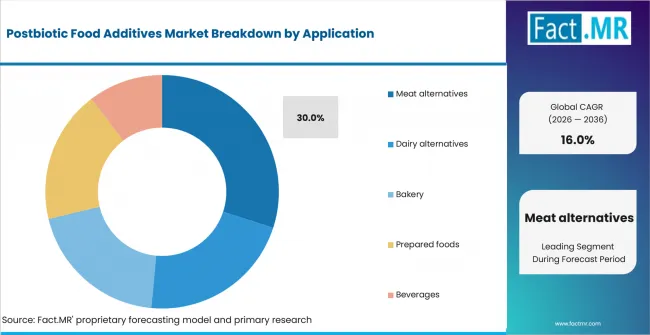
Postbiotic Food Additives Market Analysis By Application | Source: Fact.MR
Meat alternatives lead among applications because formulators often adjust nutrition, taste and mouthfeel in one development cycle. Postbiotic additives help support a health-positioned label while producers solve flavor and texture gaps. Functional beverages provide a second route where postbiotic additives can move into everyday routines.
What supports Powder within Form?
Powder holds 46.0% share in 2026.
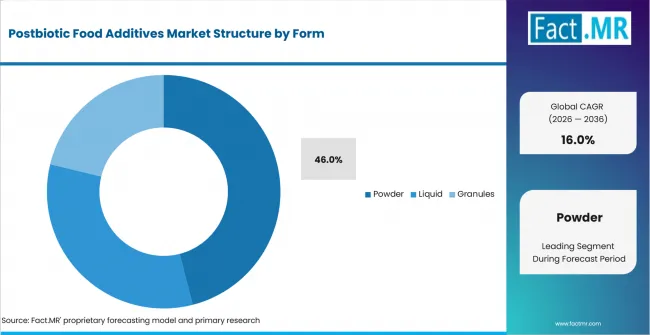
Postbiotic Food Additives Market Analysis By Form | Source: Fact.MR
Powder leads because dry formats travel well and blend into premixes with fewer handling changes. Food plants dose powder through existing ingredient systems. Heat-stable beverage ingredients is relevant where stability and processing tolerance influence formulation choices.
What is accelerating Postbiotic Food Additives Market adoption, and what is holding it back?
Demand is rising through heat-stable functionality, while adoption is constrained by claims review and price-sensitive reformulation.
Drivers Impact Analysis
| DRIVER | (~) % IMPACT ON CAGR | GEOGRAPHIC RELEVANCE | IMPACT TIMELINE |
|---|---|---|---|
| Heat-stable microbiome functionality | +1.8% | Global | Short term (<= 2 years) |
| Precision fermentation and strain control | +1.5% | USA, UK, South Korea | Medium term (2-4 years) |
| Functional food and beverage reformulation | +1.3% | USA, UK, Japan | Short term (<= 2 years) |
| Meat and dairy alternative formulation needs | +1.0% | Germany, Japan, South Korea | Medium term (2-4 years) |
Source: Fact.MR analysis. Updated Aug 26, 2026
- Heat-stable microbiome functionality: Food brands place postbiotic additives in processes that would damage live cultures. This supports use in baked goods, beverages and retorted foods.
- Precision fermentation and strain control: Controlled production routes help suppliers deliver repeatable ingredient specifications. Approval confidence improves when brands compare several microbial inputs.
- Functional food and beverage reformulation: Brands use postbiotics when nutrition positioning needs a stable additive format. Clean-label preservatives and stabilizing systems remain part of the same formulation review.
- Meat and dairy alternative formulation needs: Alternative-protein developers are expected to use postbiotic additives where nutrition claims and sensory correction must be solved together.
Opportunity Impact Analysis
| OPPORTUNITY | (~) % IMPACT ON CAGR | GEOGRAPHIC RELEVANCE | IMPACT TIMELINE |
|---|---|---|---|
| Powder premix platforms for contract manufacturing | +1.2% | Global | Short term (<= 2 years) |
| Beverage and bakery fortification systems | +0.9% | North America, Europe, East Asia | Medium term (2-4 years) |
| Co-development with functional food brands | +0.8% | Global | Medium term (2-4 years)= |
Source: Fact.MR analysis. Updated Aug 26, 2026
- Powder premix platforms: Suppliers reduce adoption friction by offering validated blends for common production lines. Premix documentation also helps contract manufacturers repeat dosage between batches.
- Beverage and bakery fortification systems: Functional bakery ingredients create a practical test area where heat-stable additives must survive processing and still support a label benefit.
- Co-development with functional food brands: Application support helps translate strain science into commercial product formats. Brands gain faster approval when suppliers provide prototypes and sensory data.
Restraints Impact Analysis
| RESTRAINT | (~) % IMPACT ON CAGR | GEOGRAPHIC RELEVANCE | IMPACT TIMELINE |
|---|---|---|---|
| Claim substantiation and consumer communication | -0.8% | Global | Short term (<= 2 years) |
| Price-sensitive food reformulation | -0.5% | USA, UK, Germany | Medium term (2-4 years) |
| Limited familiarity with postbiotic additives | -0.3% | Japan, South Korea | Long term (>= 4 years) |
Source: Fact.MR analysis. Updated Aug 26, 2026
- Claim substantiation and consumer communication: Brands need evidence that matches the exact postbiotic ingredient and final food format. Food stabilizers often face the same proof burden where functionality depends on dosage and processing.
- Price-sensitive food reformulation: Premium microbiome ingredients must compete with established fibers, cultures and flavor systems. Adoption is faster when suppliers prove shelf-life or formulation savings.
- Limited familiarity with postbiotic additives: Some food teams still treat postbiotics as supplement inputs. Pilot launches are expected to educate formulators before wider mainstream use.
Which countries are scaling the Postbiotic Food Additives Market through 2036?
- The country comparison spans 6.9 percentage points from the UK to Germany across the forecast period.
- The UK remains 1.3 percentage points above South Korea through food manufacturing depth and functional product reformulation.
- South Korea remains 0.5 percentage point above Japan as processed food output and K-food manufacturing support ingredient trials.
- Japan remains 1.7 percentage points above the USA with export-oriented food development and heat-stable nutrition formats.
- The USA remains 3.4 percentage points above Germany through a larger retail and foodservice formulation base.
- Germany closes the displayed range as specification review and price discipline shape approval speed.
Comparable CAGRs create different entry conditions due to food manufacturing scale, claim-review routines, ingredient-cost pressure and brand readiness. Full report coverage includes North America, Latin America, Western Europe, Eastern Europe, East Asia, South Asia & Pacific, Middle East & Africa.
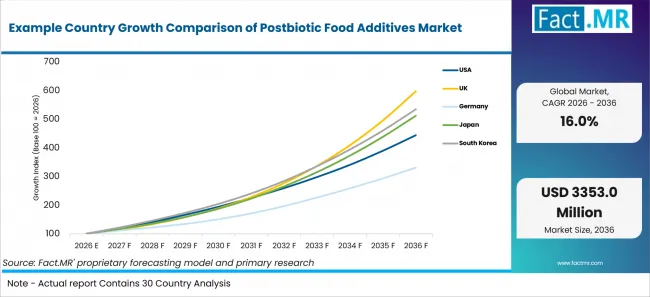
Example Country Growth Comparison Of Postbiotic Food Additives Market | Source: Fact.MR
| Country | CAGR (2026-2036) |
|---|---|
| UK | 19.6% |
| South Korea | 18.3% |
| Japan | 17.8% |
| USA | 16.1% |
| Germany | 12.7% |
Source: Fact.MR analysis. Updated Aug 26, 2026
What supports the United Kingdom’s growth?
19.6% CAGR, backed by food expenditure scale and food manufacturing depth.
The United Kingdom’s product development teams evaluate postbiotic additives in mainstream grocery formats where shelf stability and clear benefit language are both required. Defra reported in July 2026 that UK consumer expenditure on food and alcoholic drinks reached GBP 303.3 billion in 2025 in real terms, measured at constant 2023 prices. ONS reported in July 2026 that the manufacture of food represented 22.9% of total UK manufacturers’ product sales in 2025. That manufacturing base gives postbiotic suppliers a direct path into fortified foods, dairy alternatives and private-label reformulation.
How is South Korea developing demand?
18.3% CAGR, driven by processed food scale and K-food manufacturing growth.
South Korea’s ingredient trials are supported by export-ready food plants and fast product cycles across sauces, beverages and prepared meals. MFDS reported in May 2026 that South Korea’s food-industry production reached KRW 119.7372 trillion in 2025, up 4.3% from the previous year. MAFRA and the Korean Food Promotion Institute reported in July 2025 that the number of Korean food and beverage manufacturing businesses increased 3.5% year over year in the 2024 Survey on the Korean Food Industry. Powder postbiotics are expected to fit export-oriented production where brands need nutrition positioning with easier storage and handling.
How is Japan scaling demand?
17.8% CAGR, led by export-oriented food development and heat-stable nutrition formats.
Japan’s food brands are expected to use postbiotic additives where premium nutrition formats require stable ingredients and careful consumer explanation. MAFF’s 2025 Basic Plan set a JPY 5 trillion target for exports of agricultural, forestry and fishery products and food by 2030. The Bank of Japan stated in May 2026 that rice prices doubled from 2024 to 2025, highlighting continued food-cost pressures that can reinforce cost-management considerations across premium food formulations. Postbiotic suppliers therefore need strong stability data and clear application economics.
What supports USA adoption?
16.1% CAGR, supported by food spending scale and functional food reformulation.
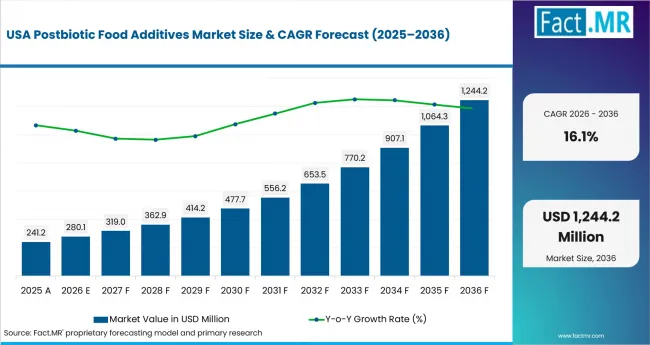
Postbiotic Food Additives Market Country Value Analysis | Source: Fact.MR
U.S. food brands have a broad testing base for postbiotic additives across snacks, beverages and prepared foods. The U.S. Census Bureau reported in August 2026 that U.S. retail and food services sales reached USD 763.6 billion in July 2026. The U.S. Bureau of Labor Statistics reported in January 2026 that the food index increased 3.1% over the 12 months ending December 2025. The scale of consumer spending and continued food-price movement provide a broad commercial backdrop for food manufacturers evaluating formulation, cost and product-positioning decisions.
What is supporting Germany’s adoption?
12.7% CAGR, shaped by food manufacturing capacity and technical qualification routines.
Germany’s food technologists are expected to approve postbiotic additives only after strain files, heat-inactivation details and batch controls are complete. Destatis GENESIS data for 2025 listed 618 establishments in Germany’s manufacture of other food products (WZ08-108). Destatis reported in June 2025 that consumer food prices in Germany were 2.8% higher year over year in May 2025. Ingredient suppliers therefore need a clear cost case when pitching premium postbiotic systems to meat and dairy alternative developers.
Who leads the Postbiotic Food Additives Market?
ADM is active through a postbiotic portfolio for foods, beverages and dietary supplements. In February 2025, ADM signed an exclusive agreement with Asahi Group Foods to market and distribute the lactic-acid-based postbiotic Lactobacillus gasseri CP2305, with distribution across North America, Europe and Asia beginning in March 2025.
dsm-firmenich participates through Humiome® Postbiotics within its broader Health from the Gut platform. Kerry Group supplies Wellmune®, a baker’s yeast beta-glucan postbiotic, and Plenibiotic™, a rice-derived postbiotic for digestive and skin-health applications. IFF Health Sciences includes CalceoBiotic® in its postbiotic portfolio for joint and bone health.
Lallemand Health Solutions expanded its postbiotic offering through a May 2025 distribution partnership with Kirin Holdings for IMMUSE®, a heat-inactivated Lactococcus lactis strain Plasma. In February 2025, Sabinsa listed PoZibio® among its Expo West featured products and described it as a patent-protected postbiotic composition derived from a heat-treated Lactobacillus paracasei strain. Across these portfolios, clinical substantiation, formulation stability, regulatory support and application expertise are relevant competitive considerations.
Which companies are the key providers?
Key companies include ADM; DSM-Firmenich; Kerry Group plc; IFF; Lallemand Inc.; and Sabinsa Corporation.
- ADM
- DSM-Firmenich
- Kerry Group plc
- IFF
- Lallemand Inc.
- Sabinsa Corporation
Bibliography
- ADM. (2025, February 25). ADM and Asahi Group sign exclusive distribution agreement for innovative postbiotic designed to support stress, mood and sleep.
- Lallemand Health Solutions. (2025, May 15). Lallemand Health Solutions and Kirin Holdings announce distribution agreement for scientifically proven postbiotic IMMUSE®.
- Sabinsa Corporation. (2025, February 19). Sabinsa to feature portfolio of science-supported ingredients at Expo West, showcase Ayurvedic brand Nature’s Formulary products.
- U.S. Census Bureau. (2026, August 14). Advance monthly sales for retail and food services [July 2026 release].
- U.S. Bureau of Labor Statistics. (2026, January 13). Consumer Price Index – December 2025.
- Department for Environment, Food & Rural Affairs. (2026, July 29). Food statistics in your pocket.
- Office for National Statistics. (2026, July 24). UK manufacturers' sales by product: 2025. Federal Statistical Office (Destatis). (2025, June 13). Inflation rate at +2.1% in May 2025.
- Ministry of Agriculture, Forestry and Fisheries. (2025, April 11). Key points of the new Basic Plan for Food, Agriculture, and Rural Areas.
- Ministry of Agriculture, Food and Rural Affairs. (2025, July 31). The Result of the Survey on the Korean Food Industry for the Year 2024.
- U.S. Food and Drug Administration. (2026, August 10). Generally Recognized as Safe (GRAS).
- dsm-firmenich. (2025, April 14). From cellular aging to gut microbiome: dsm-firmenich highlights solutions to advance nutrition at Vitafoods 2025.
- Kerry Group plc. (2026, March 19). Kerry Group Annual Report 2025.
- IFF Health Sciences. (2025, August 25). IFF Health Sciences Healthy Aging for Women Q&A.
This Report Answers
- The report explains where postbiotic food additives are used across ingredient type and production route. It also covers function, application and form.
- Segment analysis identifies the leading subsegments and the operational reasons food brands prioritize them.
- Country analysis examines the listed markets and the food manufacturing or policy mechanisms supporting formulation activity.
- Competitive analysis reviews current providers across postbiotic portfolios, microbiome ingredients, fermentation know-how and application support.
- Application analysis assesses how heat stability, powder handling and claim review influence purchase decisions.
What does the Postbiotic Food Additives Market cover?
The Postbiotic Food Additives Market covers inanimate microorganisms, microbial fractions, cell components and fermentation-derived preparations used in food and beverage products. The assessment includes ingredients added for nutrition, texture, flavor support and emulsification where the final product requires a stable additive format.
The assessment covers ingredient types and production routes across meat alternatives and dairy alternatives. It also covers bakery, prepared foods, fortified foods and beverages. Related food processing ingredients are considered where they influence qualification decisions for additive systems.
What is included in the scope?
The scope includes commercial postbiotic additives supplied as isolates, concentrates, hydrolysates or functional blends. It includes precision fermentation, biomass fermentation, enzymatic conversion and hybrid processing routes used to create food-grade postbiotic inputs.
It includes powder, liquid and granular forms used by food brands, contract manufacturers and product development teams. Adjacent food stabilizers are considered only where they are part of the same formulation decision for texture or stability.
What is excluded from the scope?
The scope excludes live probiotic cultures sold mainly for colony-forming activity, dietary supplements sold as finished capsules and pharmaceutical microbiome products. Animal feed additives and cosmetic postbiotic ingredients are outside the food additive boundary.
Raw fermentation media, basic cultures used only for fermentation and processing aids removed before final sale are outside the scope. Finished consumer foods are included only when they help assess application demand for postbiotic additive inputs. The wider functional foods and health and wellness foods categories are used as adjacent references, separate from market totals.
How Was the Analysis Built?
The analysis draws on 120+ sources, 35+ company portfolios, 25+ countries and more than 20 industry interviews.
- Primary Research: Primary research includes discussions with ingredient manufacturers, food formulators, contract manufacturers, distributors, brand owners, procurement teams and subject-matter experts. These conversations examine purchasing priorities and adoption barriers. They also cover approval requirements, competitive positioning and factors that influence wider market acceptance.
- Desk Research: Desk research covers government statistics and regulatory publications. It also reviews company filings, technical studies, industry associations, standards, public policy and authoritative company materials. Every evidence point used in the analysis is documented in the bibliography.
- Market Sizing and Forecasting: Market estimates combine historical performance and demand indicators. The model also reviews pricing trends, segment shares, company participation, country-level growth, adoption patterns, investment activity and barriers to expansion.
- Data Validation and Update Cycle: Findings are validated by comparing primary interviews with public data. Company activity, regulatory changes, trade patterns and industry developments are reviewed in the same cycle. Regular updates review new product launches and capacity changes. They also cover partnerships, approvals, procurement trends and shifts in commercial adoption.
Segmentation
What is the report’s scope and coverage?
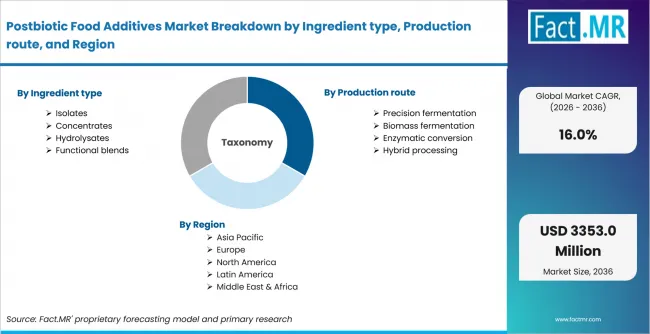
Postbiotic Food Additives Market Breakdown By Ingredient Type, Production Route, And Region | Source: Fact.MR
| Attribute | Details |
|---|---|
| Quantitative Units | USD million |
| Market Definition | Postbiotic food additives are inanimate microorganisms, microbial fragments or fermentation-derived preparations used to add nutrition, texture, flavor or formulation support in food and beverage products. |
| Ingredient Type | Isolates; Concentrates; Hydrolysates; Functional blends |
| Production Route | Precision fermentation; Biomass fermentation; Enzymatic conversion; Hybrid processing |
| Function | Nutrition; Texture; Flavor; Emulsification |
| Application | Meat alternatives; Dairy alternatives; Bakery; Prepared foods; Fortification; Beverages |
| Form | Powder; Liquid; Granules |
| Regions Covered | North America; Latin America; Western Europe; Eastern Europe; East Asia; South Asia & Pacific; Middle East & Africa |
| Countries Covered | United States; United Kingdom; Germany; Japan; South Korea |
| Key Companies Profiled | ADM; DSM-Firmenich; Kerry Group plc; IFF; Lallemand Inc.; Sabinsa Corporation |
| Forecast Period | 2026 to 2036 |
| Approach | Hybrid top-down and bottom-up approach using food additive demand; postbiotic ingredient qualification; application mix; country adoption; and provider portfolio review. |
Source: Fact.MR analysis. Updated Aug 26, 2026
How is the market segmented?
-
By Ingredient Type:
- Isolates
- Concentrates
- Hydrolysates
- Functional blends
-
By Production Route:
- Precision fermentation
- Biomass fermentation
- Enzymatic conversion
- Hybrid processing
-
By Function:
- Nutrition
- Texture
- Flavor
- Emulsification
-
By Application:
- Meat alternatives
- Dairy alternatives
- Bakery
- Prepared foods
- Fortification
- Beverages
-
By Form:
- Powder
- Liquid
- Granules
-
By Region:
- North America
- Latin America
- Western Europe
- Eastern Europe
- East Asia
- South Asia & Pacific
- Middle East & Africa
Frequently Asked Questions
How big is the postbiotic food additives market in 2026?
What is the CAGR of the postbiotic food additives market from 2026 to 2036?
Which ingredient type leads the postbiotic food additives market?
Which production route leads the postbiotic food additives market?
Who are the leading companies in the postbiotic food additives market?
Who worked on this report


Preview the report firsthand - request a free sample
Free SampleGet the brochure for pricing and purchase details
Download PDF