- Base Value(2025): 41.3 Bn
- Forecast Value (2036): 77.5 Bn
- CAGR (2036): 5.8%
Power Sports Market Forecast and Outlook 2026 to 2036
In 2025, the power sports market was valued at approximately USD 41.3 billion. Based on Fact.MR analysis, demand for power sports vehicles is estimated to reach around USD 44.2 billion in 2026 and expand to nearly USD 77.5 billion by 2036, registering a CAGR of 5.8% during the forecast period. Electrification is gradually entering segments historically dominated by internal combustion platforms. Reflecting this transition, Scott Wine, Chairman and Chief Executive Officer of Polaris Inc., stated,
“Zero Motorcycles’ pioneering electrification experience, proven leadership and mastery of the electric powertrain for power sports are unmatched in the market. We believe this transformative partnership will enable us to leapfrog technological hurdles around range and cost while providing a tremendous speed-to-market advantage.” [1]
Fact.MR analysis interprets this as evidence of strategic alliances aimed at accelerating electric drivetrain deployment in motorcycles and off-road vehicles.
The market is projected to add nearly USD 36.2 billion in incremental value over the forecast window, reflecting steady compounding supported by both recreational and utility demand. Early-period growth is supported by side-by-side vehicle sales and personal watercraft upgrades in North America. Mid-period performance aligns with broader penetration of adventure and utility motorcycles in Europe and Asia Pacific. In later years, value realization increasingly reflects electric variants, compliance with emission regulations for two-stroke engines, and premium feature integration.
The United States leads growth at 6.2% CAGR, supported by strong dealer networks and high recreational vehicle ownership. Canada follows at 5.9%, driven by snowmobile and ATV demand. Germany records 5.7%, reflecting motorcycle uptake and leisure mobility trends. Australia posts 5.4%, supported by rural off-road usage, while Japan at 5.1% remains influenced by domestic motorcycle demand and gradual electrification initiatives.
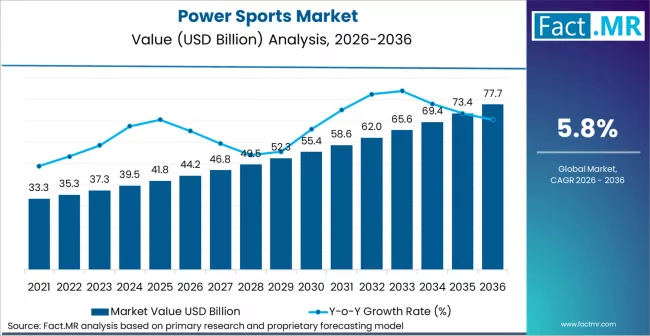
Power Sports Market Market Value Analysis | Source: Fact.MR
Power Sports Market
| Metric | Value |
|---|---|
| Market Value (2026) | USD 44.2 billion |
| Forecast Value (2036) | USD 77.5 billion |
| Forecast CAGR (2026-2036) | 5.8% |
Source: Fact.MR analysis. Updated Feb 27, 2026
Summary of Automotive Tappet Market
- Market Definition
- The power sports market comprises motorized recreational vehicles including all-terrain vehicles, side-by-side vehicles, motorcycles, personal watercraft, and snowmobiles used for leisure, sport, and light utility purposes across land, water, and snow environments.
- Demand Drivers
- Rising discretionary spending and outdoor recreation participation support steady replacement cycles for ATVs, side-by-side vehicles, and motorcycles.
- Dealer financing availability and structured retail networks in North America and Europe sustain unit sales across seasonal demand peaks.
- Gradual electrification and emission compliance requirements influence product development strategies and long-term platform investment.
- Key Segments Analyzed
- Product Type: All-terrain vehicles account for the largest share, supported by versatility across recreational riding and light utility applications.
- Engine Type: Two-stroke engines retain a meaningful share in performance-focused and lightweight segments despite tightening emission frameworks.
- Geography: North America leads overall demand, while Asia Pacific reflects incremental growth linked to leisure adoption and tourism expansion.
- Analyst Opinion at Fact.MR
- Shambhu Nath Jha, Principal Consultant at Fact.MR, opines, ‘CXOs will find that long-term competitiveness in power sports depends on propulsion transition readiness, dealer financing resilience, and regulatory alignment rather than incremental model refresh cycles alone.’
- Strategic Implications / Executive Takeaways
- Manufacturers should balance internal combustion platforms with phased electrification to address evolving emission standards.
- Investment in dealer network strength and after-sales service infrastructure remains critical for retention and replacement demand.
- Portfolio diversification across recreation and utility segments can mitigate seasonality and regional demand volatility.
- Methodology
- Market estimates were developed using vehicle production volumes, registration data, and seasonal replacement patterns across key segments.
- Safety and regulatory frameworks were referenced from. [2]
- Marine and recreational vehicle oversight assumptions were validated.
Power Sports Market Definition
The power sports market covers motorized recreational vehicles designed for off road, on road, water, and snow based leisure use. These vehicles include motorcycles, all-terrain vehicles, side by side vehicles, personal watercraft, and snowmobiles. They are used for recreation, sport competition, and outdoor travel. Vehicle registration, safety standards, and operational rules are regulated by transportation and safety authorities such as the US National Highway Traffic Safety Administration and marine and recreational safety programs administered by the US Coast Guard.[3]
Power Sports Market Inclusions
The report covers global and regional market size estimates in volume and value with a forecast from 2026 to 2036. Segmentation includes vehicle type, engine capacity class, fuel type, and end use across recreational consumers and organized sport participants. Regional demand patterns, pricing benchmarks, and international trade flows for power sports vehicles are included.
Power Sports Market Exclusions
The scope excludes conventional passenger cars, heavy commercial vehicles, and agricultural machinery. Electric bicycles and non-motorized recreational equipment are not included. Aftermarket accessories, safety gear, apparel, and spare parts sold separately are excluded. Rental services, racing event operations, maintenance services, and prototype vehicles without regulatory approval are also outside the scope.
Power Sports Market Research Methodology
- Primary Research: Interviews were conducted with vehicle manufacturers, dealerships, recreational vehicle distributors, and industry association representatives.
- Desk Research: Desk research used vehicle safety regulations issued by the US National Highway Traffic Safety Administration and boating safety frameworks from the US Coast Guard, along with vehicle registration data and company annual reports.
- Market Sizing and Forecasting: Estimates were developed using vehicle production volumes, registration statistics, seasonal demand patterns, and replacement cycles by vehicle category.
- Data Validation and Update Cycle: Data was cross checked against registration records, trade statistics, regulatory documentation, and manufacturer disclosures before updates were finalized.
Segmental Analysis
Power Sports Market Analysis by Product Type
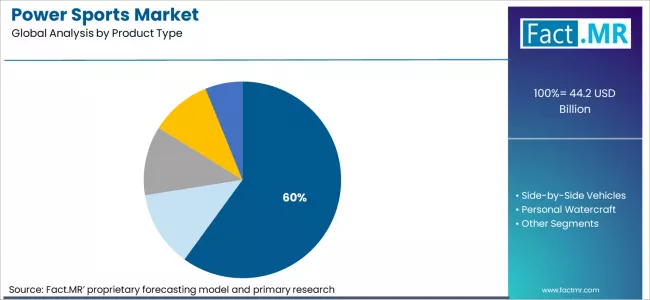
Power Sports Market Analysis By Product Type | Source: Fact.MR
Based on Fact.MR analysis, consumption of all-terrain vehicles is estimated to hold 60% share of the global power sports market. Fact.MR analysts note all-terrain vehicles lead due to versatility across recreation, utility tasks, and trail access. As per Fact.MR, this product type addresses rider demand for off road mobility, payload capability, and seasonal usability, supporting widespread adoption among rural users, outdoor enthusiasts, and worksite operators worldwide today, where multi-purpose vehicles fit mixed recreational and functional requirements across diverse terrains during varied climates and regulated riding environments globally.
- Safety oversight: Off road vehicle use is subject to consumer safety guidance and operational recommendations.[4]
- Utility adoption: Fact.MR analysts note ATVs are widely used for both recreation and light utility work.
- Terrain flexibility: ATVs operate across trails, farms, and undeveloped land.
Power Sports Market Analysis by Engine Type
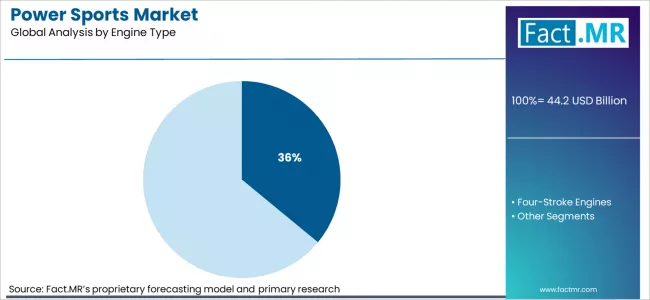
Power Sports Market Analysis By Engine Type | Source: Fact.MR
Based on Fact.MR analysis, consumption of two stroke engines is estimated to hold 36% share of the global power sports market. Fact.MR analysts note two stroke engines remain preferred in select segments due to high power to weight ratios and simpler mechanical design. As per Fact.MR, this engine type addresses rider priorities for acceleration, ease of maintenance, and compact packaging, supporting use in lightweight vehicles, racing applications, and legacy platforms worldwide today within defined regulatory operating categories for recreational and utility usage across permitted environments and regions globally today widely.
- Emissions framework: Small engine emissions are regulated under national air quality standards.
- Performance focus: Fact.MR analysts note two stroke engines deliver rapid throttle response.
- Segment fit: Two stroke designs remain common in racing and lightweight platforms.
Power Sports Market Drivers, Restraints, And Opportunities
Fact.MR analysis indicates that the power sports market exists as a broadly defined recreational and utility vehicle segment that includes all-terrain vehicles (ATVs), utility terrain vehicles (UTVs), snowmobiles, personal watercraft (PWC), and sport motorcycles used in off-road, on-water, and snow environments. As per Fact.MR assessment, vehicle safety, emissions, and noise regulations influence product specifications and type-approval requirements across major markets, including frameworks such as the U.S. Environmental Protection Agency (EPA) emissions standards for off-road vehicles, which set limits on exhaust emissions and evaporative losses for categories of off-highway engines and vehicles. Fact.MR analysts observe that the current market size is supported by growing participation in outdoor recreational activities, rising discretionary spending on leisure vehicles, and expanding utility use cases for UTVs in agriculture, mining, and land management.
Fact.MR is of the opinion that current market dynamics reflect a transition in consumer and commercial demand patterns as power sports vehicles evolve toward enhanced performance, greater fuel efficiency, and integration with digital technologies. Based on Fact.MR assessment, traditional internal combustion engine power sports vehicles continue to dominate unit volumes due to established production and service networks, but growth is occurring in segments where electrified powertrains and enhanced connectivity are specified to meet evolving user preferences and regulatory criteria. Electrified power sports vehicles often carry higher per-unit pricing because of battery system costs and advanced control electronics, meaning realised market value can grow even where shipment volumes grow at a measured pace. Fact.MR analysis suggests that this blend of evolving propulsion trends and differentiated product value will shape near-term market progression.
- Regulated emissions frameworks: Fact.MR analysts note that compliance with U.S. EPA emissions standards for off-road vehicles influences design, testing, and market introduction considerations for power sports vehicles and their engines.
- Shift toward electrification and connectivity: Based on Fact.MR assessment, demand is rising for electric and digital-integrated power sports models that offer lower operating emissions, enhanced control features, and connectivity with mobile platforms.
- Asia Pacific recreational adoption: Fact.MR opines that increasing leisure spending, outdoor activity participation, and growth in tourism-related experiences in China, India, and Southeast Asia support regional demand for a diverse portfolio of power sports vehicles in both OEM and aftermarket channels.
Regional Analysis
Based on regional assessment, the power sports sector is analyzed across North America, Europe, Asia Pacific, and other major recreational vehicle markets, spanning more than 40 countries. Regional performance varies according to participation in outdoor recreational activities, disposable income levels, seasonal usage patterns, and expansion of organized power sports events and dealership networks.
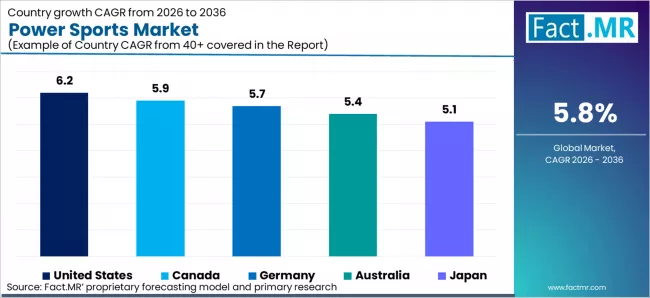
Power Sports Market Cagr Analysis By Country | Source: Fact.MR
Power Sports Market CAGR Analysis by Country (2026-2036)
| Country | CAGR |
|---|---|
| United States | 6.2% |
| Canada | 5.9% |
| Germany | 5.7% |
| Australia | 5.4% |
| Japan | 5.1% |
Source: Fact.MR analysis. Updated Feb 27, 2026
Source: Fact.MR analysis, based on proprietary forecasting models and primary research.
Demand for Power Sports Vehicles in North America
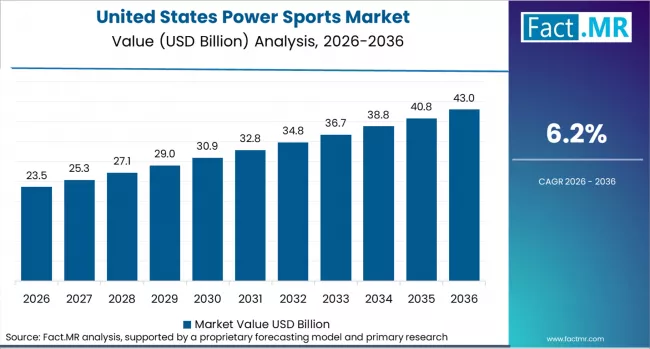
Power Sports Market Country Value Analysis | Source: Fact.MR
North America shows active demand for power sports vehicles supported by recreational riding culture trail infrastructure and discretionary spending. Sales are driven by off road motorcycles ATVs side by side vehicles and personal watercraft. The United States and Canada anchor volumes through dealer networks organized events and financing availability. Procurement favors performance reliability and aftermarket support. Market growth reflects replacement cycles accessory sales and participation in outdoor recreation across rural and suburban markets nationwide during peak seasons annually for consumers.
- United States: Demand for power sports vehicles in the United States is projected to rise at 6.2% CAGR through 2036. Sales are supported by strong dealer networks organized riding events and steady replacement demand, as per Fact.MR.
- Canada: Demand for power sports vehicles in Canada is projected to rise at 5.9% CAGR through 2036. Usage reflects trail based recreation seasonal riding and outdoor tourism participation, according to Fact.MR.
Fact.MR’s analysis of the Power Sports Market in North America consists of country-wise assessment that includes the United States and Canada. Readers can find participation trends and dealer network insights.
Analysis On Power Sports Vehicle Sales in Europe
Europe reflects steady power sports demand shaped by regulation trail access and mature ownership patterns. Sales emphasize motorcycles off road segments and touring vehicles supported by dealer networks. Germany anchors regional volumes with strong engineering preference and club participation. Procurement prioritizes compliance noise emissions and safety standards. Market expansion remains incremental reflecting replacement purchases accessory upgrades and organized recreational riding across managed environments and seasonal usage patterns within Western markets serving enthusiasts dealers events annually regionwide across multiple countries today.
- Germany: Demand for power sports vehicles in Germany is projected to rise at 5.7% CAGR through 2036. Sales reflect touring culture organized riding clubs and steady replacement purchasing, as per Fact.MR.
Fact.MR’s analysis of the Power Sports Market in Europe consists of country-wise assessment that includes Germany. Readers can find regulatory alignment and club participation insights.
Outlook On Power Sports Demand in Asia Pacific
Asia Pacific demonstrates rising power sports demand supported by expanding middle class urban leisure and tourism development. Sales growth follows motorcycles and recreational vehicles used for trail riding touring and water sports. Japan anchors regional sophistication while emerging markets add volume. Procurement favors affordability fuel efficiency and dealer coverage. Market growth reflects participation growth financing access and gradual infrastructure development across coastal and inland recreation destinations regionwide supporting events club’s rentals safety programs and seasonal demand patterns for riders locally.
- Japan: Demand for power sports vehicles in Japan is projected to rise at 5.1% CAGR through 2036. Usage reflects touring culture organized events and steady replacement demand across motorcycle segments, as per Fact.MR.
Fact.MR’s analysis of the Power Sports Market in Asia Pacific consists of country-wise assessment that includes Japan. Readers can find participation and infrastructure development references.
Outlook On Power Sports Adoption in Oceania
Oceania shows consistent power sports demand linked to outdoor lifestyles trail networks and coastal recreation. Sales center on motorcycles ATVs and watercraft supported by specialty dealers. Australia anchors regional consumption through touring culture and event participation. Procurement emphasizes durability service access and parts availability. Market growth remains steady reflecting replacement demand accessory sales and organized recreational use across dispersed populations and seasonal conditions including rental fleets club rides tourism operator’s festivals safety programs maintenance cycles annually nationwide broadly today regionwide.
- Australia: Demand for power sports vehicles in Australia is projected to rise at 5.4% CAGR through 2036. Sales reflect touring demand outdoor recreation and organized riding events, according to Fact.MR.
Fact.MR’s analysis of the Power Sports Market in Oceania consists of country-wise assessment that includes Australia. Readers can find tourism participation and dealer coverage insights.
Competitive Landscape for Market Players
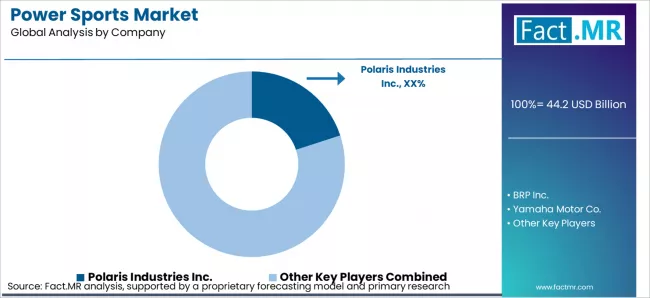
Power Sports Market Analysis By Company | Source: Fact.MR
As per Fact.MR analysis, the 2026 power sports market is defined by validated vehicle performance, reliability, and multi-region regulatory compliance, which determine competitive advantage. Polaris Industries Inc. and BRP Inc. lead with high-performance all-terrain vehicles and snowmobiles with documented durability, which strengthens adoption across recreational and competitive segments. Yamaha Motor Co. and Honda Motor Co. focus on motorcycles, ATVs, and watercraft with validated engine efficiency and ride stability, which improves consumer confidence and reduces warranty claims. Kawasaki Heavy Industries and KTM AG provide high-performance, race-ready vehicles with certified safety and validated handling characteristics, which supports adoption among professional and enthusiast riders. Arctic Cat Inc. and Suzuki Motor Corporation emphasize multi-terrain adaptability and reliable drivetrain systems, which enhances versatility and repeat purchase. Can-Am (BRP) and Textron Inc. deliver validated, regionally compliant recreational vehicles with proven reliability, which expands penetration in North American and European markets. Across the market, validated performance, durability, and regulatory compliance form enduring competitive moats, reducing reliance on pricing or isolated product claims.
Recent Industry Developments
- In March 2025, Yamaha Motor Co., Ltd. signed an agreement with German automotive parts manufacturer Brose to acquire its bicycle drive unit (e-Kit) business subsidiary. [5]
- In April 2024, Synchrony, a premier consumer financial services company, announced a new partnership with BRP US Inc., a global leader in powersports and marine products. Synchrony will now provide BRP's USA dealers with installment financing options on its line of powersports products. [6]
Key Players in Power Sports Market
- Polaris Industries Inc.
- BRP Inc.
- Yamaha Motor Co.
- Honda Motor Co.
- Kawasaki Heavy Industries
- KTM AG
- Arctic Cat Inc.
- Suzuki Motor Corporation
- Can-Am (BRP)
- Textron Inc.
Bibliography
- [1] Interface, Inc. (2023). Design, sustainability, and human-centered flooring innovation: Interview with Mandy Leeming, Design Director UK. Interface, Inc.
- [2] U.S. Consumer Product Safety Commission. (2024). Regulations, laws, and standards for consumer products. U.S. Consumer Product Safety Commission; U.S. Department of Housing and Urban Development. (2024). Healthy homes and indoor environment standards. U.S. Department of Housing and Urban Development.
- [3] U.S. Consumer Product Safety Commission. (2024). Product safety regulations and material compliance for building products. U.S. Consumer Product Safety Commission; U.S. Department of Housing and Urban Development. (2024). Indoor air quality and housing health guidance. U.S. Department of Housing and Urban Development.
- [4] U.S. Occupational Safety and Health Administration. (2024). Walking-working surfaces and flooring standards (29 CFR 1910.22). U.S. Department of Labor.
- [5] Mohawk Industries, Inc. (2024). Mohawk Industries announces expansion of LVT manufacturing capacity in Tennessee [Company press release]. Mohawk Industries, Inc.
- [6] Interface, Inc. (2024). Interface launches CQuest™ Bio backing technology using algae-based materials [Product and sustainability announcement]. Interface, Inc.
This Report Addresses
- Market intelligence to support strategic decision-making in the global power sports industry, where discretionary spending patterns, dealer financing strength, and replacement cycles influence demand more than baseline mobility needs
- Global market size assessment and 10-year revenue forecasts from 2026 to 2036, derived from vehicle production volumes, registration trends, seasonal demand cycles, and replacement behavior across major power sports categories
- Growth opportunity mapping across power sports product types including all-terrain vehicles, side-by-side vehicles, motorcycles, personal watercraft, and snowmobiles, highlighting differentiated adoption drivers across recreation and utility use cases
- Engine-type analysis covering two-stroke and four-stroke platforms, assessing performance trade-offs, regulatory pressure, and the pace of transition toward compliant and alternative propulsion systems
- Competitive landscape assessment benchmarking OEMs on product performance, dealer network depth, financing partnerships, regulatory compliance, and readiness for electrification and digital feature integration
- Technology and propulsion roadmap tracking, including electrification initiatives, emission-compliant engine platforms, connectivity features, and premium performance enhancements shaping future product portfolios
- Regulatory and safety framework review covering emissions standards, vehicle safety rules, and marine and off-road operational oversight influencing product approval and market access
- Regional and country-level growth analysis across North America, Europe, Asia Pacific, and Oceania, highlighting differentiated demand trajectories in the United States, Canada, Germany, Australia, and Japan
- Strategic implications for manufacturers, dealers, and investors focused on balancing internal combustion platforms with electrified offerings, strengthening retail financing structures, and managing seasonality-driven demand
- Multi-format market report delivery in PDF, Excel datasets, PPT presentations, and interactive dashboards for executives, product strategists, dealer networks, and investment stakeholders
Segmentation
Scope of the Report
| Metric | Value |
|---|---|
| Quantitative Units | USD 44.2 billion (2026) to USD 77.5 billion (2036), CAGR 5.8% |
| Market Definition | The power sports market covers motorized recreational and utility vehicles for off-road, on-road, water, and snow use. Products include motorcycles, all-terrain vehicles (ATVs), side-by-side vehicles (UTVs), personal watercraft, and snowmobiles. Vehicles are used for recreation, sport, touring, and utility purposes. Regulatory compliance involves registration, emissions, and safety standards overseen by authorities such as the US National Highway Traffic Safety Administration (NHTSA) and the US Coast Guard. |
| Product Type Segmentation | All-Terrain Vehicles, Side-by-Side Vehicles, Personal Watercraft, Snowmobiles, Motorcycles |
| Engine Type Segmentation | Two-Stroke Engines, Four-Stroke Engines |
| Application Segmentation | Recreational (trail riding, water sports, winter recreation), Utility (agriculture, commercial, public safety), Others (racing, tourism, rental operations) |
| Distribution Channel Segmentation | Authorized Dealerships, Online Retailers, Specialty Stores, Direct Sales |
| Regions Covered | Asia Pacific, Europe, North America, Latin America, Middle East & Africa |
| Countries Covered | India, China, Japan, South Korea, Indonesia, Australia & New Zealand, Germany, Italy, France, United Kingdom, Spain, Benelux, Nordics, Central & Eastern Europe, United States, Canada, Mexico, Brazil, Argentina, Chile, Kingdom of Saudi Arabia, United Arab Emirates, South Africa, Turkey |
| Key Companies Profiled | Polaris Industries Inc., BRP Inc., Yamaha Motor Co., Honda Motor Co., Kawasaki Heavy Industries, KTM AG, Arctic Cat Inc., Suzuki Motor Corporation, Can-Am (BRP), Textron Inc. |
| Forecast Period | 2026 to 2036 |
| Approach | Market sizing and forecasting based on production volumes, registration statistics, seasonal demand, and replacement cycles, validated through primary interviews with manufacturers, dealerships, distributors, and regulatory data from NHTSA and US Coast Guard. |
Source: Fact.MR analysis. Updated Feb 27, 2026
Power Sports Market Analysis by Segments
-
Product Type :
- All-Terrain Vehicles
- Side-by-Side Vehicles
- Personal Watercraft
- Snowmobiles
- Motorcycles
-
Engine Type :
- Two-Stroke Engines
- Four-Stroke Engines
-
Application :
- Recreational (trail riding, water sports, winter recreation)
- Utility (agricultural, commercial, public safety)
- Others (racing, tourism, rental operations)
-
Distribution Channel :
- Authorized Dealerships
- Online Retailers
- Specialty Stores
- Direct Sales
-
Region :
- Asia Pacific
- India
- China
- Japan
- South Korea
- Indonesia
- Australia & New Zealand
- ASEAN
- Rest of Asia Pacific
- Europe
- Germany
- Italy
- France
- United Kingdom
- Spain
- Benelux
- Nordics
- Central & Eastern Europe
- Rest of Europe
- North America
- United States
- Canada
- Mexico
- Latin America
- Brazil
- Argentina
- Chile
- Rest of Latin America
- Middle East & Africa
- Kingdom of Saudi Arabia
- United Arab Emirates
- South Africa
- Turkey
- Rest of Middle East & Africa
- Asia Pacific
Frequently Asked Questions
How large is the power sports market in 2026?
What will the power sports market size be by 2036?
What is the expected CAGR for the power sports market during the forecast period?
How much incremental value will the power sports market add over the forecast window?
What are the primary structural drivers of demand in the power sports market?
Which product type leads the power sports market?
Why do all-terrain vehicles dominate power sports demand?
Which engine type holds a significant share of the power sports market?
Why do two-stroke engines remain relevant despite emission regulations?
What is supporting early-period growth in the power sports market?
What factors contribute to mid-period market expansion?
What trends shape value realization in the later years of the forecast?
Which country is expected to grow the fastest in the power sports market?
What is the growth outlook for Canada in the power sports market?
How fast is the power sports market expected to grow in Germany?
What is the projected growth rate for Australia in power sports vehicles?
How does Japan perform in terms of power sports market growth?
What role does electrification play in the power sports market outlook?
How important are dealer financing and retail networks to market stability?
What is the long-term outlook for the power sports market?
Who worked on this report


Preview the report firsthand - request a free sample
Free SampleGet the brochure for pricing and purchase details
Download PDF