- Market Value (2025): USD 1.2 Bn
- Estimated Value (2026): USD 1.3 Bn
- Forecast Value (2036): USD 3.8 Bn
- CAGR (2026-2036): 11.2%
What is the Prebiotic Fiber Pectin Bases Market forecast to be worth by 2036?
USD 1.3 billion in 2026 to USD 3.8 billion by 2036 at an 11.2% CAGR.
- The Prebiotic Fiber Pectin Bases Market reached USD 1.2 billion in 2025.
- Demand is projected to increase from USD 1.3 billion in 2026 to USD 3.8 billion by 2036.
- The market is forecast to record an 11.2% CAGR from 2026 to 2036 as supplement brands and beverage formulators combine fiber positioning with texture control.
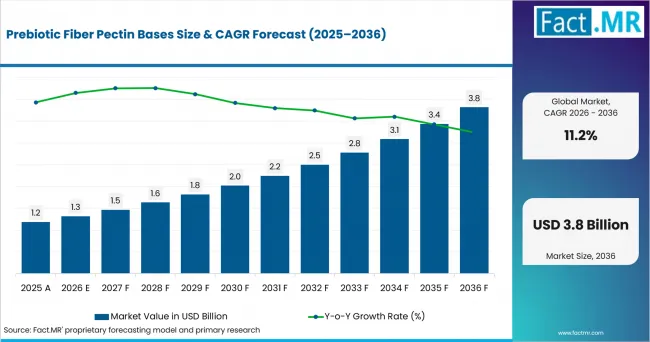
Prebiotic Fiber Pectin Bases Value Analysis | Source: Fact.MR
What are the defining numbers behind Prebiotic Fiber Pectin Bases Market growth?
An absolute opportunity of USD 2.5 billion is expected between 2026 and 2036.
- Demand Drivers in the Market
- Supplement brands need pectin bases that help fiber claims fit into gummies without relying on animal-derived gelatin.
- Food brands need fiber systems for large commercial channels. USDA ERS reported in June 2026 that total U.S. food spending reached USD 2.51 trillion in 2025.
- Dairy alternative teams need stabilizing pectin to manage protein protection and mouthfeel in low-pH formulations.
- Contract manufacturers need repeatable pectin blends when gummy and beverage customers ask for clean-label texture with digestive-positioned benefits.
- Key Segments Analyzed
- By Pectin Base: Citrus pectin is expected to hold 37.0% share in 2026 due to citrus peel availability and broad use in acidified drinks and gummies.
- By Fiber Blend: Inulin enriched systems are projected to account for 33.0% share in 2026 owing to their fit with digestive-positioned formulations.
- By Function: Prebiotic support is anticipated to capture 34.0% share in 2026 as brands use soluble fiber language in supplements and fortified foods.
- By Application: Supplements are estimated to represent 31.0% share in 2026 since pectin helps gummy formats combine fiber delivery with texture.
- Analyst Opinion at Fact.MR
- Shambhu Nath Jha, Principal Consultant at Fact.MR, states, "Pectin bases draw attention by solving fiber positioning and texture together. Demand is expected to stay tied to clean-label gummies, drinks and dairy alternatives. Suppliers should combine raw-material control with application testing and clear nutrition documentation."
- Strategic Implications
- Ingredient makers should publish guidance for gummy bloom, acid stability and fiber-label calculations.
- Supplement brands should test pectin blends under real storage temperatures before committing to national launches.
- Beverage developers should compare citrus and apple pectin by pH range, viscosity and protein-stabilizing behavior.
- Distributors should support customers with food additive files, allergen statements and nutrition-claim documentation.
China is forecast to record 12.5% CAGR through 2036 due to packaged-food retail growth. The USA is projected to advance at 12.0% CAGR as supplement gummies and beverage formats keep fiber claims visible. Germany is expected to post 11.8% CAGR owing to established food spending. Japan is anticipated to hold 10.9% CAGR through health-food labeling and convenience formats. France is estimated to record 10.5% CAGR as fruit processing supports pectin use.
How does the Prebiotic Fiber Pectin Bases Market break down by segment?
Citrus pectin leads Pectin Base at 37.0% share in 2026; Prebiotic support leads Function at 34.0% share.
Which Pectin Base dominates?
Citrus pectin is expected to hold 37.0% share in 2026.
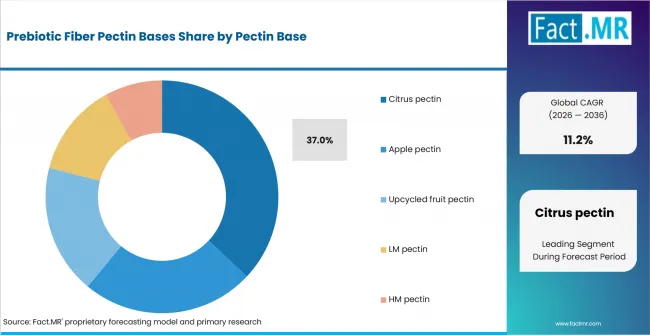
Prebiotic Fiber Pectin Bases Analysis By Pectin Base | Source: Fact.MR
Citrus pectin leads due to its fit across acidic beverages, gummies and fruit-based systems. Apple pectin remains relevant where brands want a recognizable fruit-origin story. Upcycled fruit pectin supports peel and pomace use where processors need to recover more value from fruit streams. CP Kelco, now part of Tate & Lyle, adds formulation capabilities through its portfolio of pectin, specialty gums and other nature-based ingredients. In July 2025, Tate & Lyle showcased its expanded portfolio and mouthfeel capabilities at IFT FIRST 2025 following the combination with CP Kelco.
What leads the Fiber Blend segment?
Inulin enriched systems are projected to account for 33.0% share in 2026.
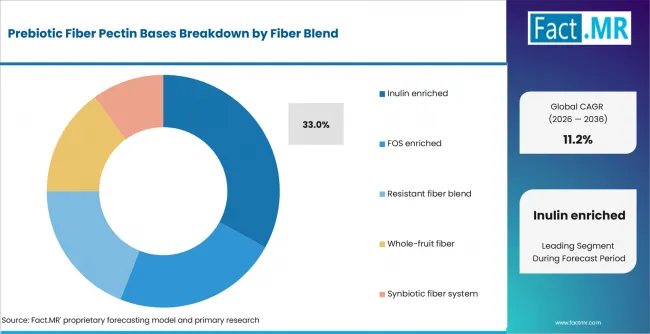
Prebiotic Fiber Pectin Bases Analysis By Fiber Blend | Source: Fact.MR
Inulin enriched systems lead by pairing soluble fiber language with pectin texture control. FOS enriched blends serve smaller dosage formats where brands need mild sweetness and digestive positioning. Resistant fiber blends support bakery and snack formats that need better heat tolerance. USDA and HHS released the Dietary Guidelines for Americans, 2025–2030 in January 2026.
How does Function shape demand?
Prebiotic support is anticipated to capture 34.0% share in 2026.
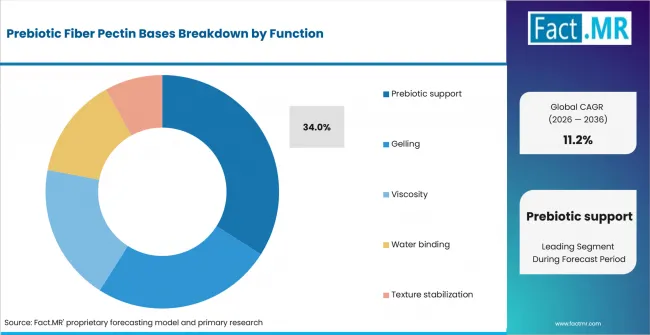
Prebiotic Fiber Pectin Bases Analysis By Function | Source: Fact.MR
Prebiotic support leads where brands need fiber benefits that consumers understand quickly. Gelling remains central in gummies and fruit spreads. Viscosity and water binding support beverages and dairy alternatives where texture problems appear after fiber addition. Herbstreith & Fox published a November 2025 application update combining H&F apple and citrus pectins with functional fruit fibers for savory applications, illustrating the use of tailored pectin-fiber systems for specific formulation requirements.
What supports Supplements within Application?
Supplements are estimated to represent 31.0% share in 2026.
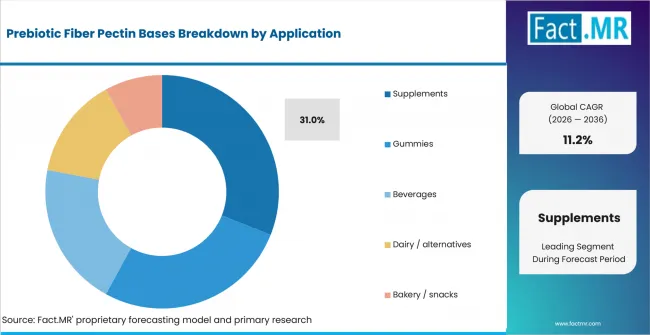
Prebiotic Fiber Pectin Bases Analysis By Application | Source: Fact.MR
Supplements lead as gummies give consumers a familiar daily fiber format. Beverages use pectin when fiber addition must avoid heavy texture. Dairy alternatives need pectin when acid stability affects shelf performance. CEAMSA lists supplement gummies, pectin jellies and chewy gummies within its confectionery application coverage, supporting the fit between pectin and supplement-style dosage formats.
What is accelerating Prebiotic Fiber Pectin Bases Market adoption, and what is holding it back?
Fiber-positioned gummies drive it; raw-material and claim-control pressure restrain it.
Drivers Impact Analysis
| Driver | (~) % Impact on CAGR | Geographic Relevance | Impact Timeline |
|---|---|---|---|
| Supplement gummy reformulation toward pectin fiber bases | +1.6% | North America, East Asia, Western Europe | Short term (<= 2 years) |
| Beverage and dairy alternative texture control | +1.2% | USA, Germany, France, Japan | Medium term (2-4 years) |
| Citrus and apple peel valorization | +0.9% | China, France, Germany | Medium term (2-4 years) |
| Label-led interest in dietary fiber | +0.8% | USA, Japan, Western Europe | Long term (>= 4 years) |
Source: Fact.MR analysis. Updated Sep 17, 2026
Opportunity Impact Analysis
| Opportunity | (~) % Impact on CAGR | Geographic Relevance | Impact Timeline |
|---|---|---|---|
| Synbiotic fiber systems for gummies and powders | +1.0% | Global | Medium term (2-4 years) |
| Whole-fruit fiber positioning in beverages | +0.7% | USA, France, Japan | Short term (<= 2 years) |
| Supplier application labs for clean-label reformulation | +0.6% | Europe, China, North America | Long term (>= 4 years) |
Source: Fact.MR analysis. Updated Sep 17, 2026
Restraints Impact Analysis
| Restraint | (~) % Impact on CAGR | Geographic Relevance | Impact Timeline |
|---|---|---|---|
| Citrus peel and apple pomace supply variability | -0.8% | China, Europe, North America | Short term (<= 2 years) |
| Claim documentation and functional-food review | -0.6% | USA, China, Japan, Europe | Medium term (2-4 years) |
| Formulation trade-offs in sugar-reduced systems | -0.4% | Global | Long term (>= 4 years) |
Source: Fact.MR analysis. Updated Sep 17, 2026
Which countries are scaling the Prebiotic Fiber Pectin Bases Market through 2036?
- The country comparison spans 2.0 percentage points across the forecast period.
- China remains 0.5 percentage point above the USA through packaged-food retail growth and health-food compliance.
- The USA remains 0.2 percentage point above Germany as supplement gummies and beverage formats keep fiber claims visible.
- Germany remains 0.9 percentage point above Japan through stable food spending and established pectin-processing knowledge.
- Japan remains 0.4 percentage point above France as convenience formats and health-food labeling support daily-use supplements.
Comparable CAGRs create different entry conditions due to fruit raw-material access, food-label rules, health-claim review and application testing. Full report coverage includes North America, Latin America, Western Europe, Eastern Europe, East Asia, South Asia & Pacific, Middle East & Africa.
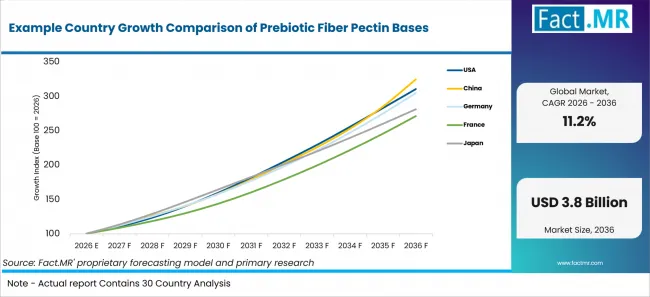
Example Country Growth Comparison Of Prebiotic Fiber Pectin Bases | Source: Fact.MR
| Country | CAGR |
|---|---|
| China | 12.5% |
| USA | 12.0% |
| Germany | 11.8% |
| Japan | 10.9% |
| France | 10.5% |
Source: Fact.MR analysis. Updated Sep 17, 2026
What supports China adoption?
12.5% CAGR through 2036, supported by packaged-food retail growth and health-food compliance.
China gives pectin formulators a large packaged-food base for gummies and drinks. In February 2026, the National Bureau of Statistics of China reported that grain, oil and food retail sales by enterprises above designated size rose 9.3% in 2025. China is forecast to record 12.5% CAGR through 2036 as health-food filing work and texture testing shape supplier selection.
What supports USA adoption?
12.0% CAGR through 2036, driven by supplement gummies and dietary-fiber positioning.
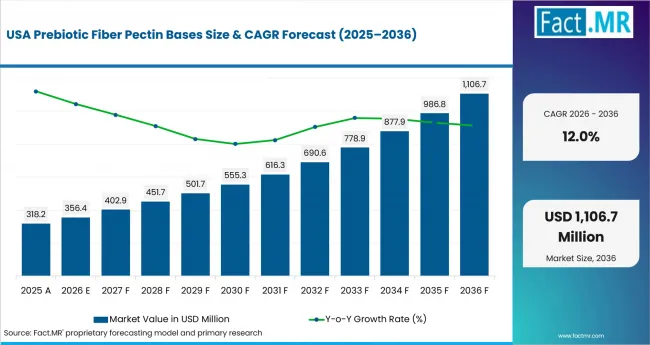
Prebiotic Fiber Pectin Bases Country Value Analysis | Source: Fact.MR
USA demand is shaped by supplement gummies and beverage reformulation. In February 2026, the U.S. Bureau of Labor Statistics reported that nonalcoholic beverage prices were 4.5% higher year over year in January 2026. The USA is projected to post 12.0% CAGR through 2036 as brands balance fiber claims with dosage cost and texture.
What supports Germany adoption?
11.8% CAGR through 2036, supported by food spending and ingredient-processing discipline.
Germany’s food and beverage base supports testing of apple and citrus pectin grades. Destatis reported that German private-household consumption expenditure on food, beverages and tobacco reached EUR 250.39 billion in 2025. Germany is expected to record 11.8% CAGR through 2036 as brands use pectin for fruit systems, dairy alternatives and sugar-reduced textures.
How does Japan perform?
10.9% CAGR through 2036, led by health-food labeling and convenience formats.
Japan’s demand profile is linked to convenience supplements and processed foods. USDA Foreign Agricultural Service Japan reported in April 2026 that Japan’s food processing sector reached USD 174 billion in 2025. Japan is anticipated to hold 10.9% CAGR through 2036 as soft drinks, health foods and shelf-stable products keep texture control relevant.
What underpins France growth?
10.5% CAGR through 2036, shaped by fruit-processing supply and nutrition-label scrutiny.
France gives pectin suppliers a fruit-processing base that fits apple and citrus pectin use. INSEE reported in July 2026 that the production value of food, beverage and tobacco manufacturing in France reached EUR 207 billion in 2025, based on provisional data. France is estimated to record 10.5% CAGR through 2036 as bakery fillings, dairy alternatives and beverage systems use pectin for texture control.
Who leads the Prebiotic Fiber Pectin Bases Market?
CP Kelco, Cargill, Herbstreith & Fox and JRS Silvateam Ingredients have publicly documented pectin portfolios and application capabilities relevant to food and beverage formulation.
CP Kelco, now part of Tate & Lyle, is active in pectin and specialty gums for food and beverage texture and mouthfeel applications. Cargill provides UniPECTINE® pectin solutions across dairy, bakery, beverage and confectionery applications. Across these suppliers, application support and formulation testing are important capabilities because pectin performance depends on factors such as gelation, viscosity, stabilization and finished-product requirements.
Herbstreith & Fox adds pectin expertise across food applications requiring gelling, thickening and stabilizing functionality. JRS Silvateam Ingredients supplies Aglupectin® grades produced from citrus peel and supports applications across beverages, confectionery and fruit preparations. Dsm-firmenich (Yantai DSM Andre Pectin) strengthens dsm-firmenich’s position in Chinese pectin production after dsm-firmenich increased its shareholding in Yantai DSM Dsm-firmenich (Yantai DSM Andre Pectin) to 90.5% in April 2025. CEAMSA adds pectin and citrus-fiber capabilities across confectionery and other food applications.
Which companies are the key providers?
Companies profiled for relevant pectin capabilities include CP Kelco, Cargill, Herbstreith & Fox, JRS Silvateam Ingredients, Dsm-firmenich (Yantai DSM Andre Pectin) and Ceamsa.
- CP Kelco
- Cargill
- Herbstreith & Fox
- JRS Silvateam Ingredients
- Dsm-firmenich (Yantai DSM Andre Pectin)
- Ceamsa
Bibliography
- Aoki, S. (2026, April 1). Food processing ingredients annual (GAIN Report No. JA2026-0012). U.S. Department of Agriculture, Foreign Agricultural Service.
- Cargill. (2025, March 4). Cargill showcases full range of innovative food solutions at AAHAR 2025.
- dsm-firmenich. (2025, April 3). dsm-firmenich completes shareholding increase in Andre Pectin to 90.5%.
- Herbstreith & Fox. (2025, November 20). Spicy savory applications – Combination of H&F Pectin with functional fruit fibers.
- Institut national de la statistique et des études économiques. (2026, July 21). Indicateurs macroéconomiques de l’industrie manufacturière : Données annuelles de 2010 à 2025.
- National Bureau of Statistics of China. (2026, February 28). Statistical communiqué of the People’s Republic of China on the 2025 national economic and social development.
- Tate & Lyle. (2025, July 7). Tate & Lyle debuts expanded portfolio and mouthfeel leadership at IFT FIRST 2025.
- U.S. Bureau of Labor Statistics. (2026, February 13). Consumer Price Index – January 2026 [News release].
- U.S. Department of Health and Human Services. (2026, January 7). Kennedy, Rollins unveil historic reset of U.S. nutrition policy, put real food back at center of health.
- Zeballos, E., & Sinclair, W. (2026, June 11). Total U.S. food spending reached $2.51 trillion in 2025. U.S. Department of Agriculture, Economic Research Service.
This Report Answers
- The report explains where prebiotic fiber pectin bases are used across pectin base and fiber blend. It covers function and application.
- Segment analysis identifies citrus pectin and prebiotic support as the main share leaders in 2026.
- Country analysis examines China, the USA, Germany, Japan and France through official food and beverage indicators.
- Competitive analysis reviews CP Kelco, Cargill, Herbstreith & Fox, JRS Silvateam Ingredients, Dsm-firmenich (Yantai DSM Andre Pectin) and Ceamsa.
- Application analysis assesses supplements, gummies, beverages, dairy / alternatives and bakery / snacks.
- Evidence review combines official statistics, company portfolio checks and 2025 or later development screening.
What does the Prebiotic Fiber Pectin Bases Market cover?
Citrus pectin, apple pectin, LM pectin and HM pectin bases used for fiber-positioned texture systems.
The Prebiotic Fiber Pectin Bases Market covers pectin-based ingredients used for fiber positioning and texture control. It includes citrus, apple, upcycled fruit, LM and HM pectin across supplements, beverages, dairy alternatives and snacks.
The assessment differs from general hydrocolloids by requiring a pectin base and a prebiotic or dietary-fiber link. Other gums stay outside the scope unless blended into a pectin-led fiber base.
What is included in the scope?
Pectin fiber systems used in supplements, gummies, beverages, dairy alternatives and bakery snacks.
The scope includes citrus and apple pectin bases used for prebiotic support, gelling, viscosity and texture stabilization. It covers inulin enriched, FOS enriched, resistant fiber, whole-fruit fiber and synbiotic systems when pectin remains central to the formulation. Adjacent ingredient mapping includes citrus pectin and prebiotic fiber where peel-derived systems influence formulation choices. Functional food coverage connects with dietary fibers and food stabilizers when brands evaluate fiber enrichment and texture together.
What is excluded from the scope?
Standalone hydrocolloids and non-pectin digestive fibers are outside the scope.
The scope excludes isolated inulin, FOS, resistant dextrin and other fibers sold without pectin. It excludes gelatin, starch and other gums outside pectin-defined systems.
Finished supplements, beverages and bakery snacks are outside the scope unless the analysis is limited to the pectin fiber base inside the formulation.
How was the analysis built?
120+ sources, 35+ company portfolios, 25+ countries and more than 20 interviews.
- Primary Research: Primary research includes discussions with ingredient makers, supplement brands, beverage formulators, distributors and contract manufacturers about pectin grade selection and launch barriers.
- Desk Research: Desk research covers government food data, food-label rules, company product pages, portfolios and official development announcements documented in the bibliography.
- Market Sizing and Forecasting: Market estimates combine ingredient demand, fiber blend use, application shares, country growth and supplier participation.
- Data Validation and Update Cycle: Findings are validated through provider checks, official-data review, application mapping and comparison of country statistics with supplier portfolios.
Segmentation
What is the report's scope and coverage?
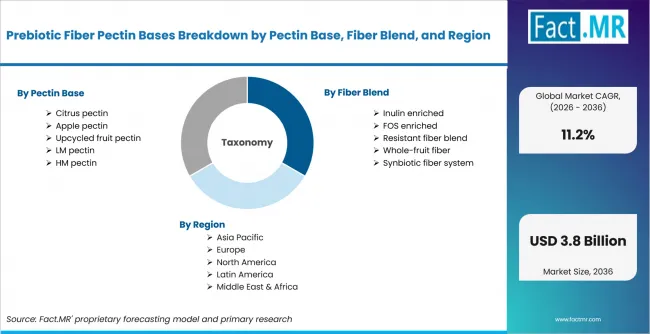
Prebiotic Fiber Pectin Bases Breakdown By Pectin Base, Fiber Blend, And Region | Source: Fact.MR
| Attribute | Details |
|---|---|
| Quantitative Units | USD billion |
| Market Definition | Pectin-based soluble fiber systems used to support prebiotic positioning, gelling, viscosity, water binding and texture stabilization in food, beverage and supplement formulations. |
| Pectin Base | Citrus pectin; Apple pectin; Upcycled fruit pectin; LM pectin; HM pectin |
| Fiber Blend | Inulin enriched; FOS enriched; Resistant fiber blend; Whole-fruit fiber; Synbiotic fiber system |
| Function | Prebiotic support; Gelling; Viscosity; Water binding; Texture stabilization |
| Application | Supplements; Gummies; Beverages; Dairy / alternatives; Bakery / snacks |
| Regions Covered | North America; Latin America; Western Europe; Eastern Europe; East Asia; South Asia & Pacific; Middle East & Africa |
| Countries Covered | China; USA; Germany; Japan; France |
| Key Companies Profiled | CP Kelco; Cargill; Herbstreith & Fox; JRS Silvateam Ingredients; Dsm-firmenich (Yantai DSM Andre Pectin); Ceamsa |
| Forecast Period | 2026 to 2036 |
| Approach | Hybrid top-down and bottom-up approach using pectin base demand; fiber blend fit; application mix; country indicators; and provider portfolio review. |
Source: Fact.MR analysis. Updated Sep 17, 2026
How is the market segmented?
-
By Pectin Base
- Citrus pectin
- Apple pectin
- Upcycled fruit pectin
- LM pectin
- HM pectin
-
By Fiber Blend
- Inulin enriched
- FOS enriched
- Resistant fiber blend
- Whole-fruit fiber
- Synbiotic fiber system
-
By Function
- Prebiotic support
- Gelling
- Viscosity
- Water binding
- Texture stabilization
-
By Application
- Supplements
- Gummies
- Beverages
- Dairy / alternatives
- Bakery / snacks
-
By Region
- North America
- Latin America
- Western Europe
- Eastern Europe
- East Asia
- South Asia & Pacific
- Middle East & Africa
Frequently Asked Questions
How big is the Prebiotic Fiber Pectin Bases Market in 2026?
What is the CAGR of the Prebiotic Fiber Pectin Bases Market from 2026 to 2036?
Which pectin base leads the Prebiotic Fiber Pectin Bases Market?
Which fiber blend leads the Prebiotic Fiber Pectin Bases Market?
Who are the leading companies in the Prebiotic Fiber Pectin Bases Market?
Who worked on this report


Preview the report firsthand - request a free sample
Free SampleGet the brochure for pricing and purchase details
Download PDF