- Market Value (2025): USD 283.5 Bn
- Estimated Value (2026): USD 297.7 Bn
- Forecast Value (2036): USD 483.5 Bn
- CAGR (2026-2036): 5.0%
What is the Pressure Thermoforming Packaging Machines Market forecast to be worth by 2036?
USD 297.7 million in 2026 to USD 483.5 million by 2036, at a 5.0% CAGR.
- The pressure thermoforming packaging market was valued at USD 283.5 million in 2025.
- Sales are forecast to increase from USD 297.7 million in 2026 to USD 483.5 million by 2036.
- As per Fact.MR analysis, the market is forecast to record a 5.0% CAGR during 2026 to 2036 as converters assess machine capacity and production flexibility.
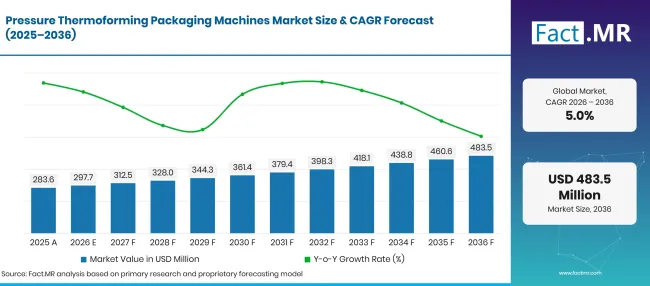
Factmr Pressure Thermoforming Packaging Machines Market Forecast Global | Source: Fact.MR
| Year | Basis | Market Value (USD million) |
|---|---|---|
| 2025 | Estimate | 283.5 |
| 2026 | Estimate | 297.7 |
| 2036 | Forecast | 483.5 |
| CAGR 2026 to 2036 | Forecast period | 5.0% |
Source: Fact.MR analysis. Updated Oct 19, 2026
What are the defining numbers behind Pressure Thermoforming Packaging Machines Market growth?
USD 185.8 million absolute opportunity from 2026 to 2036.
- Demand Drivers in the Market
- Packaging plant managers value repeated forming accuracy because poorly controlled heating and pressure create waste and require more manual inspection. For high-volume converters, fewer interruptions also protect delivery schedules.
- Electronics packaging teams use shaped cavities to hold components in a defined position during handling. Pressure forming offers a route to detailed contours where tooling and sheet selection meet the product specification.
- Food-packaging producers assess the full packaging line when choosing a thermoformer.
- Factories that make packs in several sizes also need to account for changeover time. Machines with accessible tools and clear controls make it easier to plan shorter runs without disrupting other orders.
- Key Segments Analyzed
- By Machine Type: Automatic machines account for 48.3% share in 2026 because large converters rely on repeated cycles and integrated handling.
- By Application: Electronics represent 55.0% share in 2026 as formed inserts protect small parts during movement between production steps.
- By Material Type: Plastic holds 64.2% share in 2026 because polymer sheets suit a wide range of formed pack designs.
- By End-User: Manufacturing captures 55.0% share in 2026 as converters and factory packaging lines purchase production equipment.
- Analyst Opinion at Fact.MR
- Shambhu Nath Jha, Principal Consultant at Fact.MR, states, “Packaging converters judge a pressure thermoformer by the finished packs it can produce, rather than its stated cycle speed alone. Heating, trimming and tooling changes must remain consistent during regular operation. Suppliers that provide practical installation help and reliable machine settings may be better placed to secure replacement orders.”
- Strategic Implications
- Equipment manufacturers should demonstrate actual cycle performance with customer tooling and the required sheet material, so production engineers can judge pack quality alongside rated capacity.
- Converters need to budget for moulds and trimming tools before approving machine investment. The full line cost is more informative than the thermoformer purchase price alone.
- Material suppliers should provide consistent sheet thickness and forming guidance to reduce rejected parts during trials. Stable input material improves the value of machine automation.
Germany is forecast to record 6.0% CAGR during 2026 to 2036, influenced by equipment manufacturing and technical converter requirements. The USA follows at 5.6% as manufacturers review packaging line investment. Brazil is estimated at 4.6%, the UK at 4.2%, and Japan at 3.5% as local pack producers balance output requirements against capital spending.
How does the Pressure Thermoforming Packaging Machines Market break down by segment?
Automatic 48.3%; Electronics 55.0%; Plastic 64.2%; Manufacturing 55.0% in 2026.
Which Machine Type dominates?
Automatic holds 48.3% share in 2026.
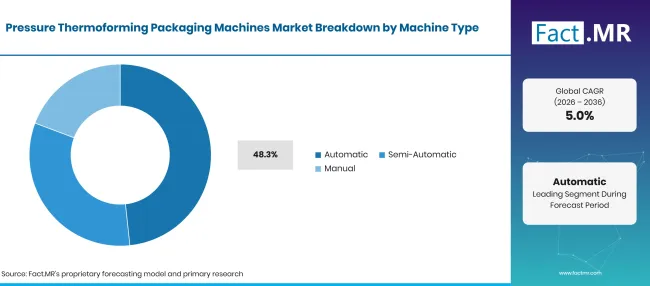
Factmr Pressure Thermoforming Packaging Machines Market Breakdown Machine Type | Source: Fact.MR
| Machine Type | Share (2026) |
|---|---|
| Automatic (Leading segment) | 48.3% |
| Other segments combined | 51.7% |
| Total | 100.0% |
Source: Fact.MR analysis. Updated Oct 19, 2026
Automatic machines account for 48.3% share in 2026. Semi-automatic equipment remains useful where operators need closer control during smaller batches or frequent tool changes. Manual machines suit testing and limited production where a fully automated line would be difficult to justify.
Automation carries particular value when moulded cavities and trimming steps must stay aligned over longer runs. Production engineers still assess loading equipment and the downstream packing line before selecting a machine.
What leads the Application segment?
Electronics account for 55.0% share in 2026.
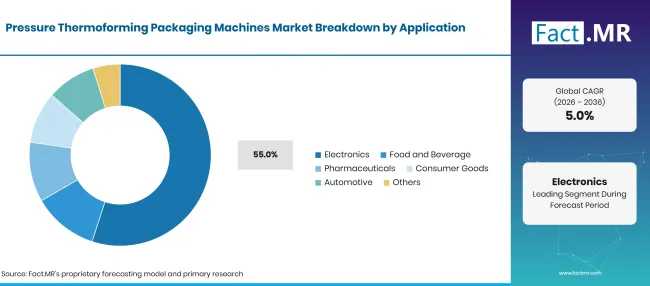
Factmr Pressure Thermoforming Packaging Machines Market Breakdown Application | Source: Fact.MR
| Application | Share (2026) |
|---|---|
| Electronics (Leading segment) | 55.0% |
| Other segments combined | 45.0% |
| Total | 100.0% |
Source: Fact.MR analysis. Updated Oct 19, 2026
Electronics lead the application segment. Protective inserts must fit components closely enough to limit movement during transport. Packaging teams therefore check cavity depth and wall thickness, since both influence how the finished pack protects its contents.
Food and beverage machines serve trays and other rigid packs. Pharmaceutical users may require documented process control and suitable material handling, while consumer goods and automotive applications use formed pieces where tailored product protection is useful.
How does Material Type shape equipment purchases?
Plastic leads with 64.2% share in 2026.
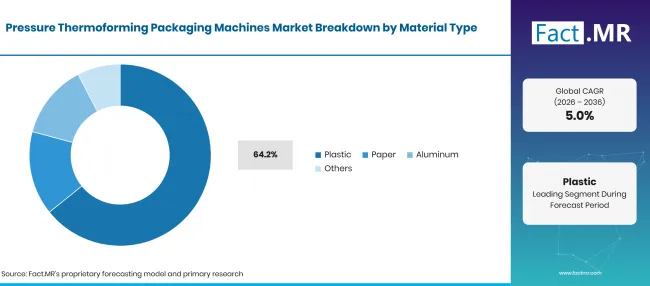
Factmr Pressure Thermoforming Packaging Machines Market Breakdown Material Type | Source: Fact.MR
| Material Type | Share (2026) |
|---|---|
| Plastic (Leading segment) | 64.2% |
| Other segments combined | 35.8% |
| Total | 100.0% |
Source: Fact.MR analysis. Updated Oct 19, 2026
Plastic is leading the material type segment with 64.2% share in 2026. Polymer sheets work well in pressure forming because factories can adjust heat and pressure to suit each grade. Sheet thickness affects heating time and the detail of the finished part, so material changes still require production trials.
Paper and aluminium appear in the wider material classification, although the selected material must be compatible with the specific forming process. Other materials are used only where forming conditions and available tooling meet the finished pack requirement.
Which End-User accounts for the main share?
Manufacturing captures 55.0% share in 2026.
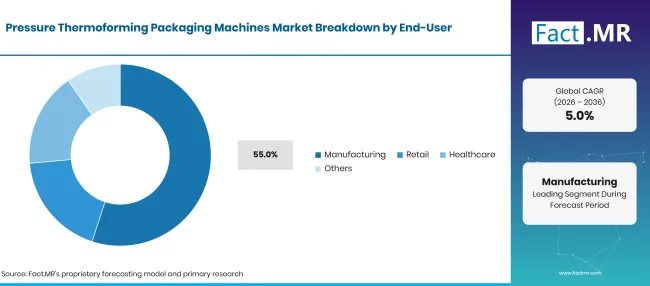
Factmr Pressure Thermoforming Packaging Machines Market Breakdown End User | Source: Fact.MR
| End-User | Share (2026) |
|---|---|
| Manufacturing (Leading segment) | 55.0% |
| Other segments combined | 45.0% |
| Total | 100.0% |
Source: Fact.MR analysis. Updated Oct 19, 2026
Manufacturing holds 55.0% share. Buyers compare the number of usable packs made each hour with the cost of producing them. The surrounding line also matters, particularly when loading and trimming must keep pace with the forming cycle.
Retail and healthcare users influence the specification of the finished package, while specialist packaging manufacturers often purchase and operate the equipment. Service access and changeover effort remain practical concerns across these end uses.
What is accelerating Pressure Thermoforming Packaging Machines Market adoption, and what is holding it back?
Repeatable forming and line integration support purchases; tooling expense and plant investment limits constrain orders.
Drivers Impact Analysis
| DRIVER | (~) % IMPACT ON CAGR | GEOGRAPHIC RELEVANCE | IMPACT TIMELINE |
|---|---|---|---|
| Factory line automation | +0.9% | Global | Medium term (2–4 years) |
| Electronics pack protection | +0.7% | East Asia, Europe | Medium term (2–4 years) |
| Consistent trim quality | +0.6% | Global | Short term (up to 2 years) |
| Pack format flexibility | +0.5% | Global | Medium term (2–4 years) |
| Integrated material handling | +0.4% | North America, Europe | Long term (4+ years) |
Source: Fact.MR analysis. Updated Oct 19, 2026
Opportunity Impact Analysis
| OPPORTUNITY | (~) % IMPACT ON CAGR | GEOGRAPHIC RELEVANCE | IMPACT TIMELINE |
|---|---|---|---|
| Replacement machine orders | +0.7% | Europe, North America | Medium term (2–4 years) |
| Shorter tool changeovers | +0.5% | Global | Short term (up to 2 years) |
| Sheet material trials | +0.4% | Global | Medium term (2–4 years) |
| Service and retrofit packages | +0.3% | Global | Long term (4+ years) |
Source: Fact.MR analysis. Updated Oct 19, 2026
Restraints Impact Analysis
| RESTRAINT | (~) % IMPACT ON CAGR | GEOGRAPHIC RELEVANCE | IMPACT TIMELINE |
|---|---|---|---|
| Equipment investment cost | -0.7% | Global | Short term (up to 2 years) |
| Tooling qualification | -0.5% | Global | Medium term (2–4 years) |
| Sheet cost variation | -0.4% | Global | Medium term (2–4 years) |
| Operator training time | -0.3% | Global | Short term (up to 2 years) |
Source: Fact.MR analysis. Updated Oct 19, 2026
Which countries are scaling Pressure Thermoforming Packaging Machines Market through 2036?
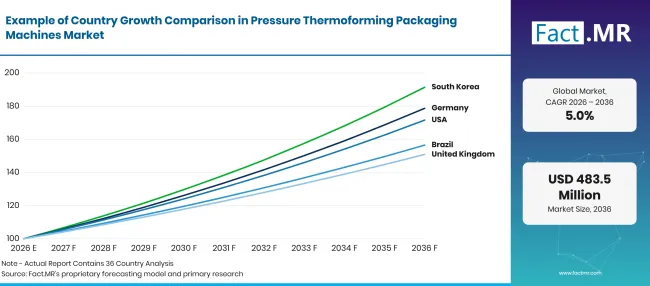
Factmr Pressure Thermoforming Packaging Machines Market Growth Index | Source: Fact.MR
| Country | CAGR (2026–2036) |
|---|---|
| Germany | 6.0% |
| United States | 5.6% |
| Brazil | 4.6% |
| United Kingdom | 4.2% |
| Japan | 3.5% |
Source: Fact.MR analysis. Updated Oct 19, 2026
What supports pressure thermoforming machine sales in Germany?
6.0% CAGR, linked to local packaging production and equipment renewal.
Germany's packaging converters assess forming accuracy alongside access to local tooling and machine maintenance. An industry account published by Messe Frankfurt in 2026 discussed production conditions for Germany’s food processing and packaging machinery sector [2]. Machine builders serving this sector therefore have a home market where factory teams already understand production-line integration.
How is the United States developing pressure thermoforming capacity?
5.6% CAGR, shaped by packaging-line investment and factory upgrades.
Packaging manufacturers in the United States purchase thermoforming systems for food containers and protective industrial inserts, with automatic equipment suited to repeated production runs. In September 2026, PMMI reported estimated U.S. packaging machinery shipments of USD 11.7 billion during 2025. Food represented approximately 44% of those shipments, reflecting the wider importance of food-packaging production [1].
Packaging plants assess the forming station alongside product loading and end-of-line inspection because reliable output depends on how the complete line operates. Machine selection also reflects access to trained technicians and spare parts.
Why is Brazil assessing new thermoforming equipment?
4.6% CAGR, shaped by converter spending and imported machinery costs.
Brazilian packaging converters compare the output of automatic pressure thermoformers with the flexibility offered by smaller installations. Consumer packaging provides a varied base of potential equipment applications, including formed plastic trays and protective inserts. Factory managers also consider access to plastic sheet and technical assistance when evaluating a new line.
What shapes the United Kingdom outlook?
4.2% CAGR, reflecting production flexibility and machine replacement decisions.
United Kingdom converters tend to assess machine flexibility because packaging orders can involve several tray shapes and material specifications. In July 2026, the Office for National Statistics reported that food manufacturing accounted for 22.9% of the value of UK manufacturers' product sales in 2025 [4].
Food producers form a substantial customer base for packaging operations, and their production schedules influence machinery selection. Manufacturers evaluate practical access to technical support and the time required to change forming tools.
How does Japan approach pressure thermoforming investment?
3.5% CAGR, shaped by equipment precision and compact factory layouts.
Japanese machine purchasers focus on consistent part dimensions and efficient use of production space, particularly for protective packaging around electronics. The Japan Packaging Institute estimated Japan’s packaging machinery production value at JPY 531 billion in 2025 [7].
Factories assess machine footprint and access to maintenance points before selecting a new forming line. Accurate heat control helps operators maintain consistent pack shapes, and existing tools can influence whether a line is upgraded or replaced.
Who leads the Pressure Thermoforming Packaging Machines Market?
ILLIG, MULTIVAC, Kiefel and WM Thermoforming Machines supply relevant forming and packaging machinery.
Equipment offerings differ by pack design and factory layout. Kiefel describes SPEEDFORMER equipment for polymer trays and cups, while MULTIVAC supplies thermoforming packaging lines with integration options [3][5].
WM Thermoforming Machines lists pressure-forming and integrated sheet-to-pack systems suitable for rigid packaging production [6]. The equipment specifications are therefore more useful in a supplier comparison than broad claims about global leadership.
ILLIG and Brown Machine Group are also associated with thermoforming equipment. GN Thermoforming Equipment and GEISS serve forming requirements through their machine portfolios, while ZED Industries is associated with specialist thermoforming systems.
Product-level selection depends on the precise pack geometry and on a manufacturer’s service support. Thermoforming Systems LLC is included in the supplier landscape for customer due diligence.
Which companies are the key providers?
Key companies include ILLIG packaging solutions GmbH; MULTIVAC Sepp Haggenmüller SE & Co. KG; Kiefel GmbH; Brown Machine Group; GN Thermoforming Equipment; WM Thermoforming Machines; GEISS AG; ZED Industries; Thermoforming Systems LLC.
- ILLIG packaging solutions GmbH
- MULTIVAC Sepp Haggenmüller SE & Co. KG
- Kiefel GmbH
- Brown Machine Group
- GN Thermoforming Equipment
- WM Thermoforming Machines
- GEISS AG
- ZED Industries
- Thermoforming Systems LLC
Bibliography
- [1] PMMI. (2026, September 14). PMMI’s 2026 State of the Industry Report reveals a packaging machinery market driven by flexibility, automation, and new North American opportunities.
- [2] Messe Frankfurt. (2026, May 8). German mechanical engineering sector in good shape.
- [3] Kiefel GmbH. (n.d.). Sustainable & innovative packaging solutions.
- [4] Office for National Statistics. (2026, July 24). UK manufacturers’ sales by product: 2025.
- [5] MULTIVAC. (n.d.). Thermoforming packaging machines for the high-output segment.
- [6] WM Thermoforming Machines. (n.d.). Thermoforming machines and solutions.
- [7] Japan Packaging Institute. (n.d.). Statistics on the scale of Japanese packaging industry in 2025.
This Report Answers
- The report compares automatic and lower-automation pressure forming machines for packaging use.
- Application analysis reviews electronics inserts and the requirements of other formed-pack users.
- Material analysis considers plastic sheet while preserving paper and aluminium as separate classification options.
- Country coverage compares Germany, Brazil, the United States, the United Kingdom and Japan.
- Supplier analysis describes machine portfolios and the practical basis for equipment selection.
What does the Pressure Thermoforming Packaging Machines Market cover?
The market covers equipment used to heat and pressure-form packaging sheets into shaped containers and protective parts. Machinery investment includes forming and associated trimming functions where they are integral to the machine offer. Applications cover electronics packs alongside food packaging and selected industrial products. Related products include plastic trays.
What is included in the scope?
The analysis includes automatic, semi-automatic and manual machines sold for pressure thermoforming in packaging-related production.
It examines manufacturing operators and other downstream users who specify the packs. Machine functionality is considered alongside sheet selection and tool changes, because the finished product must remain consistent across repeated cycles. Forming equipment is also discussed alongside thermoform packaging.
What is excluded from the scope?
The market excludes stand-alone packaging films and finished trays sold without production machinery.
It also excludes separate printing presses and unrelated filling lines unless they form part of an integrated thermoforming-equipment package. Machinery intended only for non-packaging products sits outside the main comparison. Related product markets include transparent plastic packaging.
How Was the Analysis Built?
The analysis draws on 120+ sources, 35+ company portfolios, 25+ countries, and more than 20 industry interviews.
- Primary Research: Primary research includes discussions with manufacturers, service providers, technology developers, distributors, end users, and subject-matter experts. These conversations examine purchasing priorities, product adoption, operational challenges, approval requirements, competitive positioning, and the factors that influence wider market acceptance.
- Desk Research: Desk research covers government statistics, regulatory publications, company filings, trade data, technical studies, industry associations, standards, public policy, and other authoritative sources. Every source used in the analysis is documented in the bibliography.
- Market Sizing and Forecasting: Market estimates combine historical performance, demand indicators, pricing and volume trends, segment shares, company participation, country-level growth, adoption patterns, investment activity, and barriers to market expansion.
- Data Validation and Update Cycle: Findings are validated by comparing primary interviews with public data, company activity, regulatory changes, trade patterns, and industry developments. Regular updates review new product launches, capacity changes, partnerships, approvals, and shifts in commercial adoption.
Segmentation
What is the report’s scope and coverage?
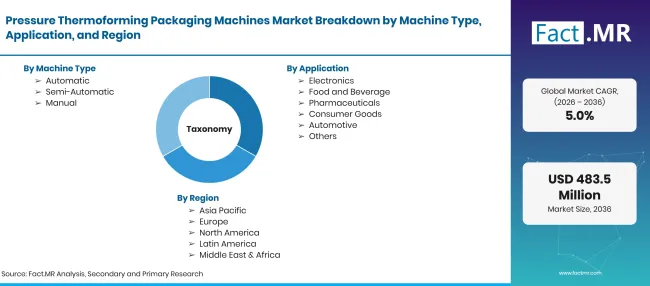
Factmr Pressure Thermoforming Packaging Machines Market Taxonomy | Source: Fact.MR
| Attribute | Details |
|---|---|
| Quantitative Units | USD million |
| Market Definition | Machines that apply pressure while thermoforming packaging materials into shaped packs or protective inserts |
| Machine Type | Automatic; Semi-Automatic; Manual |
| Application | Electronics; Food and Beverage; Pharmaceuticals; Consumer Goods; Automotive; Others |
| Material Type | Plastic; Paper; Aluminum; Others |
| End-User | Manufacturing; Retail; Healthcare; Others |
| Regions Covered | North America; Latin America; Western Europe; Eastern Europe; East Asia; South Asia & Pacific; Middle East & Africa |
| Countries Covered | Germany; Brazil; United States; United Kingdom; Japan |
| Companies Profiled | ILLIG packaging solutions GmbH; MULTIVAC Sepp Haggenmüller SE & Co. KG; Kiefel GmbH; Brown Machine Group; GN Thermoforming Equipment; WM Thermoforming Machines; GEISS AG; ZED Industries; Thermoforming Systems LLC. |
| Forecast Period | 2026 to 2036 |
| Approach | Equipment capabilities, published packaging activity, supplier portfolios and country industrial conditions |
Source: Fact.MR analysis. Updated Oct 19, 2026
How is the market segmented?
-
By Machine Type:
- Automatic
- Semi-Automatic
- Manual
-
By Application:
- Electronics
- Food and Beverage
- Pharmaceuticals
- Consumer Goods
- Automotive
- Others
-
By Material Type:
- Plastic
- Paper
- Aluminum
- Others
-
By End-User:
- Manufacturing
- Retail
- Healthcare
- Others
-
By Region
- North America
- Latin America
- Western Europe
- Eastern Europe
- East Asia
- South Asia & Pacific
- Middle East & Africa
Who worked on this report


Preview the report firsthand - request a free sample
Free SampleGet the brochure for pricing and purchase details
Download PDF