- Base Value(2025): 15.9 Bn
- Estimated Value(2026): 16.5 Bn
- Forecast Value (2036): 24.0 Bn
- CAGR (2026 - 2036): 3.8%
Pressure Treated Structural Timber Market Forecast and Outlook 2026 to 2036
In 2025, the pressure treated structural timber market was valued at USD 15.9 billion. Based on Fact.MR analysis, demand for pressure treated structural timber is estimated to grow to USD 16.5 billion in 2026 and USD 24.0 billion by 2036. Fact.MR projects a CAGR of 3.8% during the forecast period.
The absolute dollar increase of USD 8.1 billion over the decade reflects steady, regulation anchored expansion rather than cyclical acceleration. Market value growth is sustained by building codes and infrastructure specifications that mandate preservative treated wood in load bearing and ground contact applications. As per Fact.MR assessment, untreated timber continues to dominate bulk volume on cost grounds, but treated structural timber secures consistent demand where service life and biological durability are explicitly specified, supporting predictable replacement and new build consumption.
Pricing behavior in this market is shaped by preservative chemistry costs, inspection protocols, and treatment capacity rather than downstream construction cycles alone. Fact.MR analysts note that integrated treatment operators with captive sawmill access maintain margin stability through scale efficiencies and long term supply contracts, even as housing starts and infrastructure spending fluctuate across regions.
From a country level perspective, India leads growth at 6.0% CAGR due to expanding housing and rural infrastructure programs that mandate treated timber in moisture exposed structures. Vietnam at 5.6% and Indonesia at 5.4% follow, supported by public housing and education construction in high humidity zones. China records 4.8% CAGR, driven by regulatory adoption in public buildings and landscaping structures. Mature markets including the United States at 3.3%, Canada at 3.1%, Germany at 2.2%, and the UK at 2.0% generate replacement driven demand, with volume growth constrained by mature housing stock and alternative material competition in non-mandated applications.
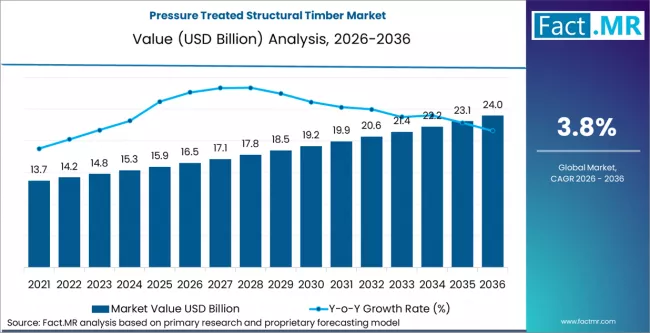
Pressure Treated Structural Timber Market Market Value Analysis | Source: Fact.MR
Pressure Treated Structural Timber Market Definition
The pressure treated structural timber market covers solid wood products impregnated with preservative chemicals under pressure to improve resistance to decay, insects, and moisture. The treatment process forces preservatives deep into the wood structure, which extends service life when timber is used in load bearing and exposed conditions. Product performance and use classes follow durability guidance under EN 335 and EN 351 published by CEN [1]. Pressure treated structural timber is sold as beams, posts, and boards for use in buildings, bridges, outdoor frameworks, and utility structures.
Pressure Treated Structural Timber Market Inclusions
The report covers global and regional market size estimates in volume and value terms with a forecast period from 2026 to 2036. Segmentation includes preservative type, water based and oil based systems defined under EN, product form such as beams and posts, application areas including construction and infrastructure, and end use sectors covering residential, commercial, and utility projects. The scope also includes regional demand patterns and trade flows reported through UN Comtrade [2].
Pressure Treated Structural Timber Market Exclusions
The scope excludes untreated structural timber, thermally modified wood, and chemically modified products such as acetylated wood. Engineered wood products including glulam, cross laminated timber, plywood, and LVL are not included. Downstream finished structures such as installed decks, fencing systems, utility poles in service, and prefabricated building assemblies are excluded. Decorative wood products, consumer grade treated lumber, laboratory scale treatments, and pilot trials without commercial structural use are also outside the scope.
Pressure Treated Structural Timber Market Research Methodology
- Primary Research: Primary research involved interviews with sawmills, pressure treatment operators, preservative suppliers, building contractors, and utility infrastructure managers.
- Desk Research: Desk research used treatment and durability standards from CEN, preservative regulations from the European Chemicals Agency [3], forestry production data from FAO, and company annual reports and technical datasheets filed with securities regulators.
- Market Sizing and Forecasting: Market sizing applied a hybrid top down and bottom up model using reported treated timber output, housing and infrastructure construction data from national statistical offices, and preservative usage norms.
Data Validation and Update Cycle
Outputs were cross checked against trade statistics, treatment capacity disclosures, and government construction data, with updates applied when verified public sources release revisions.
Summary of Pressure Treated Structural Timber Market
Market Definition
- The pressure treated structural timber market includes solid wood beams, boards, and posts impregnated with preservatives under pressure to meet decay, insect, and moisture resistance requirements for load bearing and exposed uses, in line with EN 335 and EN 351 durability classes published by CEN.
Demand Drivers
- Building codes require preservative treated timber for ground contact and moisture exposed structural members, anchoring baseline demand through provisions in the International Residential Code.
- Public housing, rural infrastructure, and utility projects in high humidity regions specify treated timber to meet service life criteria, sustaining demand in Asia Pacific housing and infrastructure programs.
- Replacement of untreated or failed structural members in decks, framing interfaces, and outdoor structures supports recurring consumption in mature housing markets where durability compliance is enforced by inspection regimes.
Key Segments Analyzed
- Treatment chemistry: Copper azole treated timber leads with about 39% share in 2026 due to regulatory acceptance after CCA restrictions and defined retention levels under AWPA U1 standards.
- Application: Residential framing accounts for roughly 35% of demand, driven by mandatory use in sill plates, posts, and members in contact with concrete or soil under model building codes.
- Geography: Asia Pacific records the highest growth, led by India, Vietnam, and Indonesia, where climate exposure and public construction standards mandate treated structural timber in housing and infrastructure.
Analyst opinion at Fact.MR
- Shambhu Nath Jha, Principal Consultant at Fact.MR, opines, “CXOs will find that long-term demand for pressure treated structural timber is secured by code-mandated durability requirements, with value stability tied to treatment validation, certification compliance, and integrated sawmill-treatment operations rather than construction cycle volatility.”
Strategic Implications / Executive Takeaways
- Align product portfolios with nationally adopted building codes and AWPA or EN treatment classes to secure specification driven demand.
- Invest in integrated sawmill and treatment capacity to control preservative costs, inspection compliance, and delivery reliability.
- Prioritize certification, documented retention data, and audit readiness to maintain inclusion in public housing and infrastructure procurement frameworks.
Methodology
- Market sizing is based on treated timber output, housing and infrastructure construction data, and preservative usage norms validated against national statistics and trade flows reported by UN Comtrade.
- Durability and treatment assumptions reference EN 335, EN 351, and AWPA U1 standards governing penetration and retention performance.
- Findings are cross checked through primary interviews with sawmills, treatment operators, and contractors, and through review of regulatory guidance from bodies such as ECHA.
Segmental Analysis
Pressure Treated Structural Timber Market Analysis by Treatment Chemistry
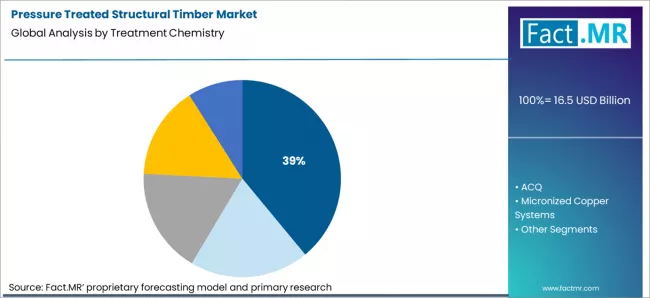
Pressure Treated Structural Timber Market Analysis By Treatment Chemistry | Source: Fact.MR
Based on Fact.MR analysis, consumption of copper azole treated structural timber is estimated to hold 39% share in 2026. Fact.MR analysts note that copper azole systems are widely adopted because they provide decay and termite resistance without the use of arsenic or chromium compounds. As per Fact.MR, this chemistry addresses buyer requirements for structural durability while meeting residential and commercial regulatory acceptance across multiple regions.
- Regulatory Acceptance: The United States Environmental Protection Agency recognizes copper azole as an approved preservative for structural lumber used in residential and commercial construction following the phase-out of CCA for most consumer uses.
- Commercial Production: Koppers manufactures copper azole treated lumber for structural framing and outdoor construction, as detailed in its product and treatment disclosures.
- Specification Guidance: Fact.MR analysts reference American Wood Protection Association standards that list copper azole retention levels and use categories for structural applications exposed to moisture and insects.
Pressure Treated Structural Timber Market Analysis by Application
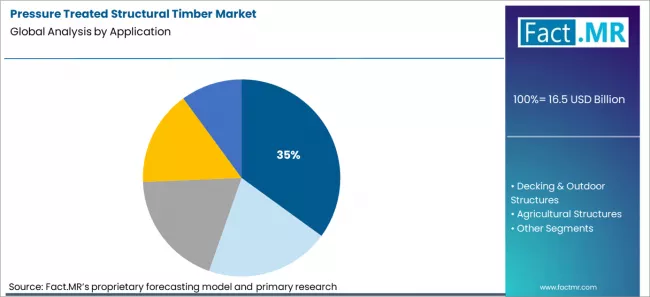
Pressure Treated Structural Timber Market Analysis By Application | Source: Fact.MR
Based on Fact.MR analysis, consumption in residential framing applications is estimated to hold 35% share in 2026. Fact.MR opines that this segment leads due to recurring housing construction and refurbishment activity that requires treated lumber for sill plates, ground-contact members, and load-bearing elements. As per Fact.MR, pressure treated timber addresses decay risk at moisture-prone interfaces where untreated structural wood shows early deterioration.
- Building Code Reference: International Code Council International Residential Code provisions require preservative treated wood in framing components exposed to concrete or ground contact.
- Housing Program Linkage: Fact.MR analysts reference government housing construction and rehabilitation programs that sustain baseline demand for treated framing lumber in residential structures. [4]
- Material Guidance: US Department of Agriculture Forest Service technical publications document service life and performance expectations for pressure treated structural timber in residential construction environments.
Pressure Treated Structural Timber Market Drivers, Restraints, And Opportunities
Fact.MR analysis indicates that the pressure treated structural timber market exists as a protective wood products segment within construction, infrastructure, and outdoor structural applications where durability against biological degradation is specified. As per Fact.MR assessment, pressure treated timber is produced by forcing preservative chemicals into timber substrates under controlled pressure conditions, which improves resistance to decay fungi, termites, and other wood-destroying organisms, consistent with performance criteria outlined by American Wood Protection Association (AWPA) U1 standards for treated wood. Fact.MR analysts observe that the market’s current size is shaped by building codes and procurement requirements in residential, commercial, and civil construction where treated timber is a mandated protective material rather than an optional product.
Fact.MR is of the opinion that current market dynamics reflect a transition in end-use demand from generic untreated timber to grade-specified pressure treated structural timber as specifications tighten around durability and service life expectations. Based on Fact.MR assessment, standard lumber continues to dominate overall volume because of its lower upfront cost, but pressure treated structural timber grows where project specifications mandate biological durability and moisture-related performance under model building code provisions such as the International Residential Code (IRC) sections for wood preservatives. Pressure treated timber variants typically carry higher per-unit pricing because of preservative application and inspection protocols, meaning realised market value can increase even where total shipment volumes grow at moderate rates. Fact.MR analysis suggests that this combination of moderate tonnage uptake and higher unit economics defines near-term market expansion.
- Preservative treatment standards: Fact.MR analysts note that AWPA U1 standards inform manufacturer and project specifications by defining performance expectations for preservative penetration, retention levels, and end-use utilities, encouraging use of treated structural timber in construction where service life criteria are documented
- Building code mandates: Based on Fact.MR assessment, model codes such as the International Residential Code (IRC) influence demand by specifying preservative treatment for structural timber in exterior and ground-contact applications to reduce decay risk over expected service intervals
- Asia Pacific construction growth: Fact.MR opines that expanding residential and infrastructure activity in China, India, and Southeast Asia supports regional use of pressure treated structural timber because treated products align with durability expectations where biological and moisture exposure risks are high.
Regional Analysis
Based on regional assessment, the pressure treated structural timber sector is analyzed across North America, Latin America, Europe, East Asia, South Asia, Oceania, and the Middle East & Africa, spanning more than 40 countries. Regional performance varies according to construction activity, adoption of treated timber in structural applications, and regulatory standards governing wood preservation. The report also presents a comparative market attractiveness evaluation grounded in region-specific demand trends.
Pressure Treated Structural Timber Market CAGR Analysis by Country (2026-2036)
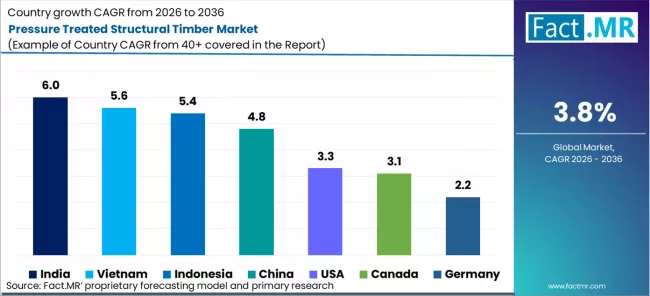
Pressure Treated Structural Timber Market Cagr Analysis By Country | Source: Fact.MR
| Country | CAGR |
|---|---|
| India | 6.0% |
| Vietnam | 5.6% |
| Indonesia | 5.4% |
| China | 4.8% |
| United States | 3.3% |
| Canada | 3.1% |
| Germany | 2.2% |
| UK | 2.0% |
Source: Fact.MR analysis. Updated Feb 18, 2026
Source: Fact.MR analysis, based on proprietary forecasting models and primary research.
Asia Pacific Pressure Treated Structural Timber Market Analysis
Asia Pacific operates as a specification-led construction region for pressure treated structural timber due to climatic exposure, termite risk, and moisture-driven durability requirements. Adoption is governed by national building codes, timber preservation standards, and public works specifications. Usage is common in housing, rural infrastructure, utilities, and transport structures where durability classes and preservative treatment methods are mandated in government-issued construction norms and tender documents.
- India: Demand for pressure treated structural timber in India is projected to rise at 6.0% CAGR through 2036. Use is specified under BIS timber preservation standards updated in July 2021 and reinforced through public housing and rural infrastructure works tendered under government programs during September 2022, as per Fact.MR.
- Vietnam: Demand for pressure treated structural timber in Vietnam is projected to rise at 5.6% CAGR through 2036. Application is referenced in construction timber durability standards issued by the Ministry of Construction in June 2020 and applied in public housing and school projects approved in October 2022, according to Fact.MR.
- Indonesia: Demand for pressure treated structural timber in Indonesia is projected to rise at 5.4% CAGR through 2036. Usage is documented under timber protection requirements in SNI revisions released in August 2021 and reinforced through government-funded housing construction tenders issued in February 2023, based on Fact.MR.
- China: Demand for pressure treated structural timber in China is projected to rise at 4.8% CAGR through 2036. Application follows timber preservation provisions under GB standards revised in October 2020 and reinforced through public building and landscaping projects tendered during May 2022, according to Fact.MR.
Fact.MR’s analysis of the pressure treated structural timber market in Asia Pacific consists of country-wise assessment that includes India, Vietnam, Indonesia, and China. Readers can find timber preservation standards, public procurement activity, and application-level compliance references.
North America Pressure Treated Structural Timber Market Analysis
North America functions as a standards-driven structural timber market where pressure treated wood adoption is regulated through model building codes, preservative treatment standards, and procurement rules for public infrastructure. Structural timber selection is guided by compliance with nationally recognized standards adopted at state and municipal levels, particularly for residential construction, bridges, decks, and utility-related infrastructure projects.
- United States: Demand for pressure treated structural timber in the United States is projected to rise at 3.3% CAGR through 2036. Use is referenced under AWPA treatment standards and IBC requirements adopted by states in 2021 and reinforced through federally funded infrastructure and housing projects during 2022, as per Fact.MR.
- Canada: Demand for pressure treated structural timber in Canada is projected to rise at 3.1% CAGR through 2036. Application is governed by CSA wood preservation standards updated in 2020 and reinforced through public housing and municipal infrastructure procurement issued during 2022, according to Fact.MR.
Fact.MR’s analysis of the pressure treated structural timber market in North America consists of country-wise assessment that includes the United States and Canada. Readers can find code adoption references, treatment standards, and public procurement documentation.
Europe Pressure Treated Structural Timber Market Analysis
Europe operates as a regulation-led adoption market for pressure treated structural timber, with use governed by harmonized construction product regulations, national building laws, and durability classification systems. Structural timber applications require documented conformity with performance standards and treatment specifications, particularly in load-bearing elements used in public buildings, transport infrastructure, and refurbishment of existing structures.
- Germany: Demand for pressure treated structural timber in Germany is projected to rise at 2.2% CAGR through 2036. Application is specified under DIN timber protection standards revised in June 2020 and reinforced through public building and transport infrastructure refurbishment tenders issued in February 2022, as per Fact.MR.
- United Kingdom: Demand for pressure treated structural timber in the UK is projected to rise at 2.0% CAGR through 2036. Use is governed by BS timber durability standards and Building Regulations updated in 2021 and applied in public sector housing and infrastructure projects during 2022, according to Fact.MR.
Fact.MR’s analysis of the pressure treated structural timber market in Europe consists of country-wise assessment that includes Germany and the UK. Readers can find regulatory standards, refurbishment activity, and application-level references.
How Are Certification Compliance, Treatment Validation, and Supply Chain Integration Creating Competitive Moats in the Pressure Treated Structural Timber Market?
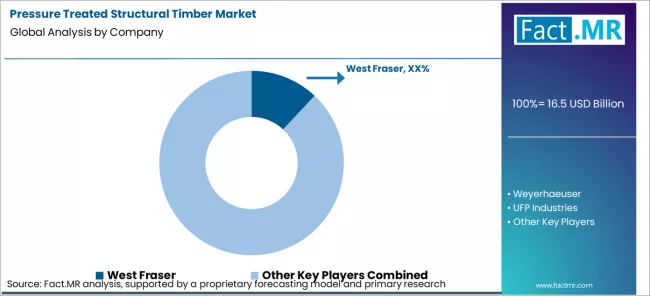
Pressure Treated Structural Timber Market Analysis By Company | Source: Fact.MR
As per Fact.MR analysis, the pressure treated structural timber market in 2026 is defined by a shift from basic timber preservation to performance‑validated, code‑compliant structural solutions where certification, durability evidence, and integrated supply networks determine competitive advantage. West Fraser and Weyerhaeuser leverage broad, vertically integrated feedstock access and validated treatment systems, which strengthens adoption in commercial and infrastructure construction that demands consistent decay and insect resistance. UFP Industries and Stella‑Jones focus on engineered treated members with documented load‑bearing and retention data, which increases specification in building programs governed by stringent codes. Koppers and Boise Cascade provide treated timbers with multi‑region certification and extended service‑life warranties, which improves buyer confidence in long‑term performance. Culpeper Wood Preservers and Arch Timber Protection optimise preservative process control and delivery logistics, which enhances project scheduling reliability. Interfor and Canfor reinforce regional supply responsiveness and inventory availability, which supports just‑in‑time construction timelines. Across the market, multi‑region certification compliance, validated treatment performance, and supply chain integration form enduring competitive moats that reduce reliance on price or basic product claims.
Recent Industry Development
- In February 2026, Koppers announced a 12.5% increase in its quarterly dividend, signaling strong confidence in its "utility and railroad" infrastructure segments. The company is currently focusing on its Zero Harm culture and expanding its capacity for copper-based preservatives, which are replacing older, more toxic chemical treatments in structural residential framing. [5]
- Stella-Jones completed the strategic acquisition of Brooks Manufacturing Co. in late 2025 to dominate the wood distribution crossarm market. For the 2026-2028 period, the company has committed to a massive capital allocation plan aimed at "infrastructure renewal," focusing on the replacement of aging utility poles and railway ties across North America. [6]
Key Players in Pressure Treated Structural Timber Market
- West Fraser
- Weyerhaeuser
- UFP Industries
- Stella-Jones
- Koppers
- Boise Cascade
- Culpeper Wood Preservers
- Arch Timber Protection
- Interfor
- Canfor
Bibliography
- [1] European Committee for Standardization. (2013). EN 335: Durability of wood and wood-based products - Use classes: Definitions, application to solid wood and wood-based products. CEN.
- [2] United Nations Statistics Division. (2024). UN Comtrade database. United Nations.
- [3] European Chemicals Agency. (2024). Biocidal products and wood preservatives. ECHA.
- [4] U.S. Department of Housing and Urban Development. (2024). Housing and community development programs. HUD.
- [5] Koppers Holdings Inc. (2026). Koppers Holdings Inc. announces increase in quarterly cash dividend. Koppers Holdings Inc.
- [6] Stella-Jones Inc. (2025). Investor relations press releases. Stella-Jones Inc.
Segmentation
Scope of the Report
| Metric | Value |
|---|---|
| Quantitative Units | USD 16.5 billion (2026) to USD 24.0 billion (2036), CAGR 3.8% |
| Market Definition | The pressure treated structural timber market covers solid wood beams, boards, posts, and load-bearing timber impregnated with preservative chemicals under pressure to improve resistance to decay, insects, and moisture. Treated timber is used in residential framing, decking, infrastructure, and outdoor structures where durability compliance is mandated under EN 335 and EN 351 standards. |
| Treatment Chemistry Segmentation | Copper Azole (CA), ACQ, Micronized Copper Systems, Borate Treatments, Creosote/Industrial |
| Application Segmentation | Residential Framing, Decking & Outdoor Structures, Agricultural Structures, Industrial & Marine, Landscaping |
| Product Form Segmentation | Sawn Lumber, Posts & Poles, Engineered Wood (Treated), Glulam/CLT (Treated), Other |
| Regions Covered | Asia Pacific, Europe, North America, Latin America, Middle East & Africa |
| Countries Covered | India, Vietnam, Indonesia, China, United States, Canada, Germany, United Kingdom |
| Key Companies Profiled | West Fraser, Weyerhaeuser, UFP Industries, Stella-Jones, Koppers, Boise Cascade, Culpeper Wood Preservers, Arch Timber Protection, Interfor, Canfor |
| Forecast Period | 2026 to 2036 |
| Approach | Hybrid top-down and bottom-up modeling validated through primary interviews with sawmills, treatment operators, distributors, contractors, and regulators. Desk research leveraged EN standards, AWPA U1 guidance, ECHA biocidal regulations, FAO forestry statistics, and UN Comtrade trade flows. |
Source: Fact.MR analysis. Updated Feb 18, 2026
Pressure Treated Structural Timber Market Analysis by Segments
-
By Treatment Chemistry :
- Copper Azole (CA)
- ACQ
- Micronized Copper Systems
- Borate Treatments
- Creosote/Industrial
-
By Application :
- Residential Framing
- Decking & Outdoor Structures
- Agricultural Structures
- Industrial & Marine
- Landscaping
-
By Product Form :
- Sawn Lumber
- Posts & Poles
- Engineered Wood (Treated)
- Glulam/CLT (Treated)
- Other
-
Region :
- Asia Pacific
- India
- China
- Japan
- South Korea
- Indonesia
- Australia & New Zealand
- ASEAN
- Rest of Asia Pacific
- Europe
- Germany
- Italy
- France
- United Kingdom
- Spain
- Benelux
- Nordics
- Central & Eastern Europe
- Rest of Europe
- North America
- United States
- Canada
- Mexico
- Latin America
- Brazil
- Argentina
- Chile
- Rest of Latin America
- Middle East & Africa
- Kingdom of Saudi Arabia
- United Arab Emirates
- South Africa
- Turkey
- Rest of Middle East & Africa
- Asia Pacific
Frequently Asked Questions
How large is the pressure treated structural timber market in 2026?
What will the market size be by 2036?
What CAGR is expected for the pressure treated structural timber market from 2026 to 2036?
What was the market value in 2025?
How much absolute value will the market add over the decade?
What primarily governs demand for pressure treated structural timber new construction cycles or compliance needs?
Which treatment chemistry leads the market in 2026?
Which application segment accounts for the largest share of demand in 2026?
Which country is forecast to grow the fastest in this market?
What is the growth outlook for Vietnam?
How fast is the market expected to grow in Indonesia?
What is China’s projected CAGR in the pressure treated structural timber market?
How does the United States market grow compared with emerging Asia?
What is the projected growth rate for Canada?
What is the projected growth rate for Germany?
What is the projected growth rate for the UK?
What is the market value trajectory from 2026 to 2036?
Is market expansion described as cyclical acceleration or regulation-anchored growth?
What factors shape pricing behavior in pressure treated structural timber?
What should executives prioritize to win repeat specification in this market?
Who worked on this report


Preview the report firsthand - request a free sample
Free SampleGet the brochure for pricing and purchase details
Download PDF