- Market Value (2025): USD 1.3 Bn
- Estimated Value (2026): USD 1.5 Bn
- Forecast Value (2036): USD 5.7 Bn
- CAGR (2026-2036): 14.3%
What is the Psychiatric Digital Biomarkers Market forecast to be worth by 2036?
USD 1.5 billion in 2026 to USD 5.7 billion by 2036, at 14.3% CAGR.
- The psychiatric digital biomarkers market reached USD 1.3 billion in 2025 as pharmaceutical sponsors and care providers expanded longitudinal measurement programs.
- Demand is projected to increase from USD 1.5 billion in 2026 to USD 5.7 billion by 2036.
- The market is forecast to record a 14.3% CAGR from 2026 to 2036 as validated digital measures move into clinical investigations and governed care workflows.
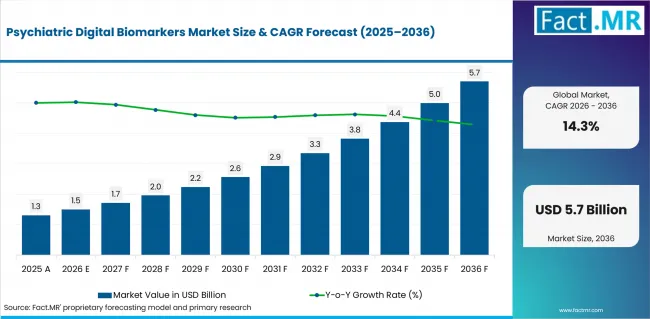
Psychiatric Digital Biomarkers Market Value Analysis | Source: Fact.MR
What are the defining numbers behind Psychiatric Digital Biomarkers Market growth?
Wearable-Based Digital Biomarkers lead Product Type at 31.0%, Depression Monitoring leads Application at 32.0%, and Hospitals lead End User at 34.0% in 2026.
- Demand Drivers in the Market
- Pharmaceutical sponsors need longitudinal measures because clinically important changes can occur between scheduled study visits.
- Hospitals need objective signals around sleep, activity, autonomic response; speech; cognition; and device interaction when self-report is sparse.
- Mental health providers need earlier indications of worsening or recovery relative to a patient-specific baseline.
- Enterprise buyers need governed data capture and escalation because false reassurance can delay care and false positives can overload clinical teams.
- Key Segments Analyzed
- By Product Type: Wearable-Based Digital Biomarkers are projected to hold 31.0% share in 2026 because passive physiological and activity streams can be collected repeatedly with limited daily effort.
- By Application: Depression Monitoring is projected to account for 32.0% share in 2026 because symptom fluctuation and relapse risk make longitudinal measurement commercially useful.
- By End User: Hospitals are projected to capture 34.0% share in 2026 because clinical-risk outputs require governance, escalation, and documentation.
- By Distribution Channel: Direct Enterprise Sales and Healthcare Provider Contracts place validation and integration at the center of procurement, while Payer Agreements and Cloud-Based Subscription depend on a defined care pathway and recurring value.
- By Technology: Artificial Intelligence, Machine Learning, Deep Learning; and Mobile Health Technologies are evaluated through intended use; validation; model performance; and workflow fit. Clinical workflow constraints remain relevant to the mental health software and mental health sleep overlap markets.
- Analyst Opinion at Fact.MR
- Shambhu Nath Jha, Principal Consultant at Fact.MR, states: “Psychiatric digital biomarkers will earn budget only when they change a clinical or development decision. A device that collects more data is not enough. Buyers need validated endpoints; clear performance limits; demographic generalizability; and ownership of escalation. The strongest suppliers will connect multimodal measurement to a governed workflow and an operating model that hospitals or sponsors can sustain.”
- Strategic Implications
- Pharmaceutical sponsors should define the endpoint or development decision each digital signal is expected to inform before adding devices to a protocol.
- Hospitals should assign alert ownership, escalation thresholds, documentation; and integration responsibilities before deployment.
- Platform vendors should report performance limits, missing-data handling, demographic generalizability; and model-drift controls alongside accuracy claims.
- Enterprise buyers should compare implementation burden, data governance, device support; and renewal economics rather than feature breadth alone.
How does the Psychiatric Digital Biomarkers Market break down by segment?
Wearable-Based Digital Biomarkers lead at 31.0%, Depression Monitoring at 32.0%, and Hospitals at 34.0% in 2026. Distribution and technology choices remain tied to enterprise governance and intended clinical use.
Why do Wearable-Based Digital Biomarkers lead Product Type?
Wearable-Based Digital Biomarkers hold 31.0% share in 2026.
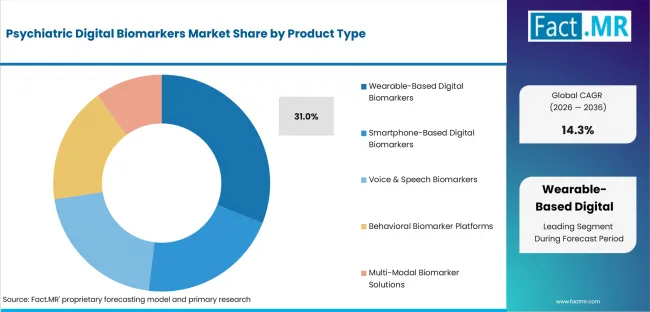
Psychiatric Digital Biomarkers Market Analysis By Product Type | Source: Fact.MR
Wearables occupy a central position because psychiatric states often change gradually and outside the clinic. Wrist-worn devices can collect repeated activity, sleep, skin conductance; temperature; pulse-derived measures; and contextual signals with less recall bias than periodic questionnaires. Their commercial value comes from continuity and validated interpretation; not from the device alone.
Why does Depression Monitoring lead Application?
Depression Monitoring holds 32.0% share in 2026.
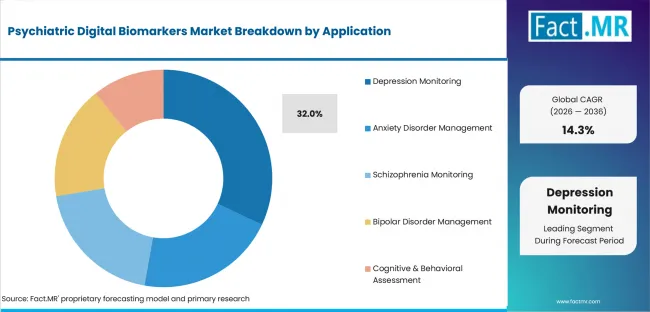
Psychiatric Digital Biomarkers Market Analysis By Application | Source: Fact.MR
Depression monitoring leads because severity, functioning, sleep; speech; movement; and social behavior can change between scheduled visits. Treatment response is often judged from sparse self-report and clinician ratings. Digital biomarkers can add temporal resolution by identifying deviations from a person's baseline and patterns associated with symptom worsening or recovery.
Why do Hospitals lead End User?
Hospitals hold 34.0% share in 2026.
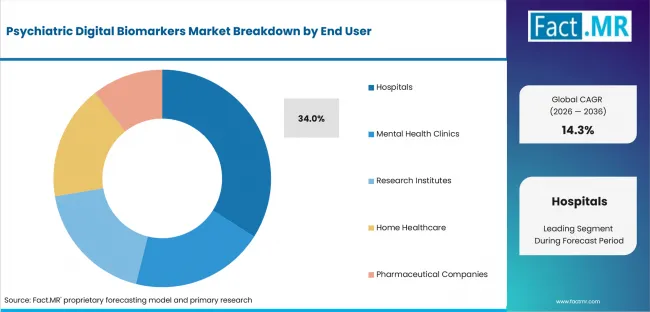
Psychiatric Digital Biomarkers Market Analysis By End User | Source: Fact.MR
Hospitals lead because psychiatric biomarker outputs can imply clinical risk and therefore require governance, escalation, and documentation. Psychiatric hospitals can use longitudinal measures to support observation of severe mental illness. General hospitals can integrate monitoring into behavioral health; neurology; emergency; and post-discharge workflows.
How do Distribution Channel and Technology choices shape commercialization?
Direct Enterprise Sales and Healthcare Provider Contracts place validation, integration, and service responsibility at the center of procurement.
Payer Agreements require a clear care and economic pathway; while Cloud-Based Subscription supports recurring deployment only when governance and renewal value are established. Artificial Intelligence; Machine Learning; Deep Learning; and Mobile Health Technologies function as enabling tools. The intended clinical use determines the evidence; quality controls; and post-market obligations attached to the offer. Data governance connects this demand with the remote patient monitoring device and remote patient monitoring systems markets.
What is accelerating Psychiatric Digital Biomarkers Market adoption, and what is holding it back?
Objective longitudinal measurement supports adoption, validation and workflow accountability restrain it, and multimodal enterprise programs provide the clearest commercial opportunity.
Drivers Impact Analysis
| DRIVER | QUALITATIVE RELEVANCE | GEOGRAPHIC RELEVANCE | IMPACT TIMELINE |
|---|---|---|---|
| Objective longitudinal measurement between scheduled encounters | High | Germany | Current forecast period |
- Objective longitudinal measurement: Clinical investigators and mental health providers face the same measurement problem: the most informative changes often occur outside scheduled encounters. The U.S. Food and Drug Administration's December 2023 final guidance recognizes remote digital health technologies as tools for acquiring data in clinical investigations, giving sponsors a clearer basis for protocol design, participant access; verification; and data handling.
Opportunity Impact Analysis
| OPPORTUNITY | QUALITATIVE RELEVANCE | GEOGRAPHIC RELEVANCE | IMPACT TIMELINE |
|---|---|---|---|
| Multimodal enterprise programs | High | Brazil | Current forecast period |
- Multimodal enterprise programs: The most credible opportunity is a measurement service tied to a defined psychiatric pathway. Wearable physiology can identify autonomic and sleep changes, smartphone data can add context, voice can capture psychomotor and affective features; and active tasks can measure cognition. Combining signals can improve resilience when a single stream is missing or noisy; but only when the platform controls versioning; missingness; and model drift.
Restraints Impact Analysis
| RESTRAINT | QUALITATIVE RELEVANCE | GEOGRAPHIC RELEVANCE | IMPACT TIMELINE |
|---|---|---|---|
| Validation and workflow accountability | High | USA | Current forecast period |
- Validation and workflow accountability: A model may correlate with depression or relapse in a study but still fail a buyer's test for target-population validity, calibration, interpretability; alert burden; privacy; or integration. Psychiatric signals are especially sensitive because false reassurance can delay care and false positives can overwhelm clinicians or distress patients.
Which countries are scaling Psychiatric Digital Biomarkers Market fastest?
Germany 16.4%, Brazil 15.0%, USA 13.6%; UK 12.2%; Japan 10.7%; Australia 13.2%; and Canada 12.8% from 2026 to 2036.
Regional analysis covers North America, Latin America, Western Europe; Eastern Europe; East Asia; South Asia and Pacific; and the Middle East and Africa.
| COUNTRY | CAGR, 2026 to 2036 |
|---|---|
| Germany | 16.4% |
| Brazil | 15.0% |
| USA | 13.6% |
| UK | 12.2% |
| Japan | 10.7% |
| Australia | 13.2% |
| Canada | 12.8% |
What is shaping Germany's outlook through 2036?
16.4% CAGR from 2026 to 2036, supported by a formal route from digital evidence to paid use.
German providers can prescribe qualifying digital health applications and obtain statutory insurance coverage. This creates a formal route from digital evidence to paid use, but it also raises the threshold for effectiveness, data protection; and medical-purpose documentation. Demand for Psychiatric Digital Biomarkers in Germany is forecast to expand at 16.4% CAGR from 2026 to 2036.
What is shaping Brazil's outlook through 2036?
15.0% CAGR from 2026 to 2036, shaped by software classification and locally supported enterprise deployment.
Brazilian enterprise buyers must distinguish regulated medical-purpose software from wellness and administrative tools before procurement. ANVISA's software-as-a-medical-device framework makes classification and local compliance part of enterprise evaluation. Demand for Psychiatric Digital Biomarkers in Brazil is forecast to rise at 15.0% CAGR from 2026 to 2036.
What is shaping USA's outlook through 2036?
13.6% CAGR from 2026 to 2036, driven by pharmaceutical development and health-system purchasing.
U.S. pharmaceutical sponsors and health systems buy digital biomarker programs through clinical-development, innovation, and service-line budgets rather than relying on consumer app distribution. The route to scale therefore depends on protocol fit; enterprise integration; and a defined clinical or development decision. Demand in the USA is forecast to expand at 13.6% CAGR from 2026 to 2036. Provider adoption conditions also affect the wearable healthcare devices and digital patient engagement markets.
What is shaping the UK's outlook through 2036?
12.2% CAGR from 2026 to 2036, influenced by early separation of wellness and medical-device functions.
UK purchasers separate wellness software from medical-device functions early because classification determines the evidence, quality, and post-market obligations attached to the product. Adoption of Psychiatric Digital Biomarkers in the UK is forecast to rise at 12.2% CAGR from 2026 to 2036.
What is shaping Japan's outlook through 2036?
10.7% CAGR from 2026 to 2036, supported by clearly defined clinical purpose and specialist engagement.
Japanese buyers favor technology that enters through a well-defined clinical purpose and a development plan discussed early with regulators and specialist institutions. Demand for Psychiatric Digital Biomarkers in Japan is forecast to expand at 10.7% CAGR from 2026 to 2036.
Who leads the Psychiatric Digital Biomarkers Market?
Koneksa, Biofourmis, Empatica; and Rune Labs anchor enterprise measurement infrastructure; while specialist providers focus on behavior; voice; emotional physiology; speech; and cognition.
Competition separates into enterprise measurement infrastructure, psychiatric signal specialists, and focused cognitive assessment suppliers. Koneksa; Biofourmis; Empatica; and Rune Labs compete on governed data capture; device integration; and clinical-study execution. Their commercial position depends on supporting repeatable deployment across sponsors; institutions; and regulated workflows.
Mindstrong Health, Sonde Health, Feel Therapeutics; and Winterlight Labs concentrate on behavior; voice; emotional physiology; or speech-based measures. Altoida and BeCare Link bring cognitive and remote assessment capabilities that can extend into psychiatric monitoring when validation supports the intended use.
In June 2024, Feel Therapeutics launched the Feel Monitor, a wearable paired with an AI platform for emotional and mental health. The device includes five sensors; including electrodermal activity and photoplethysmography; to capture passive indicators associated with mood; stress; sleep; and psychomotor activity. Procurement scrutiny appears in the digital therapeutics and biomarkers markets.
In November 2023, Empatica received FDA 510(k) clearance for pulse and respiratory rate biomarkers on its health monitoring platform. The clearance expanded a stack that combines the EmbracePlus wearable, Care software; secure cloud infrastructure; raw sensor access; and clinically validated digital measures.
In November 2023, Sonde Health partnered with Together to power the Mental Vitals feature in an AI-based health assistant. Sonde's API and SDK analyze approximately 30 seconds of smartphone voice for vocal features associated with depression and anxiety, with escalation to a digital screening checklist and telehealth option.
Which companies are the key providers?
Koneksa and Biofourmis are leading companies in the market.
- Koneksa
- Biofourmis
- Mindstrong Health
- Empatica
- Altoida
- Rune Labs
- BeCare Link
- Sonde Health
- Feel Therapeutics
- Winterlight Labs
Bibliography
- U.S. Food and Drug Administration. (2023, December 22). Digital Health Technologies for Remote Data Acquisition in Clinical Investigations.
- Vairavan et al. (2023, October 30). Personalized relapse prediction in patients with major depressive disorder using digital biomarkers.
- German Federal Ministry of Health. (2024, December 3). Digital health applications (DiGA): apps on prescription.
- Brazilian Health Regulatory Agency (ANVISA). (2022, March 24). Collegiate Board Resolution - RDC No. 657 of 24 March 2022.
- Medicines and Healthcare products Regulatory Agency. (2025, February 3). Software and artificial intelligence (AI) as a medical device.
This Report Addresses
- What is the Psychiatric Digital Biomarkers Market worth in 2026, and what value is forecast for 2036?
- Which demand, validation, purchasing; and operating pressures shape the market?
- Why do Wearable-Based Digital Biomarkers, Depression Monitoring, and Hospitals lead their respective segments?
- How do country growth rates differ across Germany, Brazil, USA; UK; Japan; Australia; and Canada?
- Which companies are profiled and what determines competitive credibility?
- What scope boundary, evidence base, segmentation; and methodology support the market assessment?
What does the Psychiatric Digital Biomarkers Market cover?
Psychiatric digital biomarker platforms and associated enterprise services that measure mental-health-related signals across wearable, smartphone, voice; speech; behavioral; cognitive; and multimodal workflows.
The Psychiatric Digital Biomarkers Market covers software licenses and subscriptions, enterprise deployments, wearable and sensor-enabled measurement solutions; voice and speech analysis; behavioral phenotyping; multimodal analytics; and associated productized implementation services. Commercial value comes from the measurement and governed interpretation of psychiatric signals rather than from general digital engagement alone.
The market boundary focuses on tools used for psychiatric measurement in clinical investigations or care pathways. A technology is included when the purchased function is digital biomarker capture, analysis, or implementation for a defined psychiatric use.
What is included in the scope?
The scope includes Wearable-Based Digital Biomarkers and Smartphone-Based Digital Biomarkers used across Depression Monitoring, Major Depressive Disorder, Persistent Depressive Disorder; and Anxiety Disorder Management.
It covers hospital and mental-health-clinic buyers; direct enterprise and provider contracting; payer agreements; cloud subscriptions; and enabling Artificial Intelligence; Machine Learning; Deep Learning; and Mobile Health Technologies.
What is excluded from the scope?
The scope excludes downstream drug or therapy revenue, general telepsychiatry revenue without biomarker measurement, wellness-only apps; and non-psychiatric biomarker revenue.
Stand-alone consumer engagement without a defined psychiatric measurement function remains outside the market boundary. Patient-monitoring needs also shape the smartphone and software as a medical device markets.
How was the analysis built?
- Primary Research
- Fact.MR engages psychiatric care providers, hospital digital health and procurement teams, pharmaceutical sponsors; contract research organizations; platform vendors; device suppliers; payers; and subject-matter experts.
- Desk Research
- The analysis reviews regulator and ministry guidance, peer-reviewed literature, public health programs; company filings and official product documentation; clinical-trial and standards material; and dated first-party company announcements.
- Market-Sizing and Forecasting
- The model combines bottom-up estimates of enterprise contracts, subscriptions, platform deployments; device-enabled programs; implementation services; and renewal behavior with top-down checks on eligible buyers; psychiatric use cases; trial activity; and country adoption conditions.
- Data Validation and Update Cycle
- Findings are triangulated across source types and checked for consistency of intended use, buyer, geography; date; and revenue boundary. Forecast assumptions are reviewed against deployment; renewal; validation; regulatory; and company evidence.
What is the report’s scope and coverage?
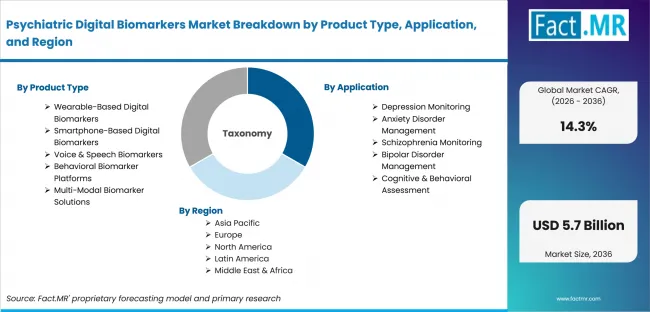
Psychiatric Digital Biomarkers Market Breakdown By Product Type, Application, And Region | Source: Fact.MR
| Attribute | Details |
|---|---|
| Quantitative Units | USD Billion in 2026 to USD Billion by 2036 at CAGR |
| Market Definition | Revenue includes psychiatric digital biomarker platforms, software licenses and subscriptions, enterprise deployments; wearable and sensor-enabled measurement solutions; voice and speech analysis; behavioral phenotyping; multimodal analytics; and associated productized implementation services sold within the stated segmentation. It excludes downstream drug or therapy revenue; general telepsychiatry revenue without biomarker measurement; wellness-only apps; and non-psychiatric biomarker revenue. |
| Product Type | Wearable-Based Digital Biomarkers; Smartwatches; Wristbands; Smartphone-Based Digital Biomarkers |
| Application | Depression Monitoring; Major Depressive Disorder; Persistent Depressive Disorder; Anxiety Disorder Management |
| End User | Hospitals; Psychiatric Hospitals; General Hospitals; Mental Health Clinics |
| Distribution Channel | Direct Enterprise Sales; Healthcare Provider Contracts; Payer Agreements; Cloud-Based Subscription |
| Technology | Artificial Intelligence; Machine Learning; Deep Learning; Mobile Health Technologies |
| Regions Covered | North America; Latin America; Western Europe; Eastern Europe; East Asia; South Asia and Pacific; Middle East and Africa |
| Countries Covered | Germany; Brazil; USA; UK; Japan; Australia; Canada; and more than twenty-five additional countries in the full report |
| Key Companies Profiled | Koneksa; Biofourmis; Mindstrong Health; Empatica; Altoida; Rune Labs; BeCare Link; Sonde Health; Feel Therapeutics; Winterlight Labs |
| Forecast Period | 2026 to 2036 |
| Approach | Fact.MR applies a hybrid bottom-up and top-down sizing approach using product and contract revenue, buyer adoption, deployment and renewal patterns; addressable institutions; segment mix; country conditions; and triangulation against primary and secondary evidence. |
How is the market segmented?
-
By Product Type:
- Wearable-Based Digital Biomarkers
- Smartwatches
- Wristbands
- Smartphone-Based Digital Biomarkers
- Passive Monitoring Apps
- Active Assessment Apps
- Voice & Speech Biomarkers
- Speech Pattern Analysis
- Voice Feature Analytics
- Behavioral Biomarker Platforms
- Cognitive Assessment Tools
- Digital Phenotyping Platforms
- Multi-Modal Biomarker Solutions
- AI-Based Analytics
- Integrated Sensor Platforms
- Wearable-Based Digital Biomarkers
-
By Application:
- Depression Monitoring
- Major Depressive Disorder
- Persistent Depressive Disorder
- Anxiety Disorder Management
- Generalized Anxiety Disorder
- Panic Disorder
- Schizophrenia Monitoring
- Psychosis Detection
- Relapse Prediction
- Bipolar Disorder Management
- Mood Episode Monitoring
- Mania Detection
- Cognitive & Behavioral Assessment
- Attention Monitoring
- Cognitive Impairment Analysis
- Depression Monitoring
-
By End User:
- Hospitals
- Psychiatric Hospitals
- General Hospitals
- Mental Health Clinics
- Outpatient Clinics
- Behavioral Health Centers
- Research Institutes
- Academic Research Centers
- Clinical Research Organizations
- Home Healthcare
- Remote Patient Monitoring
- Telepsychiatry Programs
- Pharmaceutical Companies
- Clinical Trial Sponsors
- Digital Therapeutics Developers
- Hospitals
-
By Technology:
- Artificial Intelligence
- Machine Learning
- Deep Learning
- Mobile Health Technologies
- Smartphone Sensors
- Mobile Applications
- Wearable Sensor Technology
- Physiological Sensors
- Activity Trackers
- Cloud Analytics
- Real-Time Analytics
- Predictive Analytics
- Natural Language Processing
- Text Analytics
- Speech Analytics
- Artificial Intelligence
-
By Region:
- North America
- Latin America
- Western Europe
- Eastern Europe
- East Asia
- South Asia and Pacific
- Middle East and Africa
- Germany
- Brazil
- USA
- UK
- Japan
- Australia
- Canada
- North America