- Market Value (2025): USD 13.4 Bn
- Estimated Value (2026): USD 14.8 Bn
- Forecast Value (2036): USD 41.3 Bn
- CAGR (2026-2036): 10.8%
What is the Public Safety LTE Market forecast to be worth by 2036?
USD 14.8 billion in 2026 to USD 41.3 billion by 2036 at 10.8% CAGR.
- The public safety LTE market reached USD 13.4 billion in 2025.
- Demand is projected to increase from USD 14.8 billion in 2026 to USD 41.3 billion by 2036.
- The market is forecast to record 10.8% CAGR from 2026 to 2036 due to private LTE deployment and mission-critical data use.
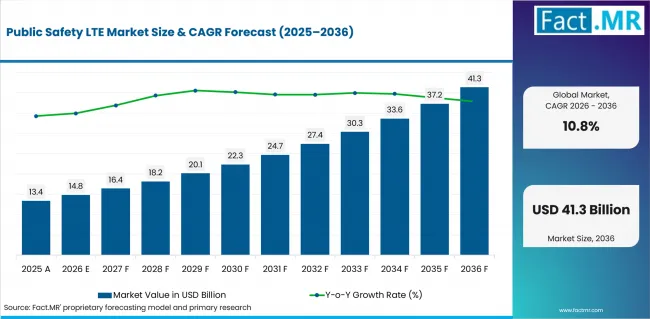
Public Safety Lte Market Value Analysis | Source: Fact.MR
What are the defining numbers behind Public Safety LTE Market growth?
USD 26.5 billion absolute opportunity by 2036.
- Demand Drivers in the Market
- Dedicated LTE networks are expected to gain approval where agencies need direct control over coverage and traffic priority.
- Emergency medical services are expected to require steadier mobile broadband as patient data becomes part of ambulance response.
- System integrators can win demand when LTE radios and dispatch platforms work without extra workflow steps.
- Key Segments Analyzed
- By Component: Infrastructure is expected to hold 39.2% share in 2026 because agencies need core network assets before devices and services can perform reliably.
- By Technology: Private LTE is projected to account for 51.1% share in 2026 as controlled networks help agencies manage priority access during response operations.
- By Application: Emergency Medical Services is anticipated to capture 33.9% share in 2026 since ambulance communication and patient-data exchange need stable mobile broadband.
- By End User: Public Safety Agencies are estimated to represent 42.5% share in 2026 due to direct responsibility for network approval and response coordination.
- By Deployment: On-premise is forecast to hold 51.4% share in 2026 as agencies prefer local control for sensitive traffic and backup operations.
- Analyst Opinion at Fact.MR
- Shambhu Nath Jha, Sr. Consultant at Fact.MR, opines, “Public safety LTE suppliers must prove that network priority, device security and service support work under emergency conditions. Procurement teams are expected to compare integration proof and operational continuity before moving from pilot sites to wider deployment.”
- Strategic Implications
- Agency technology teams should define coverage and interoperability needs before comparing infrastructure proposals.
- Suppliers can improve proposals by showing how private LTE fits current radio and security environments.
- Investors should separate direct public-safety LTE exposure from general telecom equipment demand.
The USA leads with a 14.0% CAGR, supported by public safety broadband experience and integration demand. Canada follows at 12.7% through coverage reach and maintenance planning. The UK records 11.4% as service support and network control shape demand. Germany reaches 10.1%, while Japan records 8.9% and France records 7.6% through validation, agency modernization and reliability-focused deployment across public safety networks.
How does the Public Safety LTE Market break down by segment?
Infrastructure is expected to lead Component at 39.2% share in 2026. Private LTE is projected to lead Technology at 51.1% share in 2026.
Why does Infrastructure lead Component?
Infrastructure is projected to account for 39.2% share in 2026.
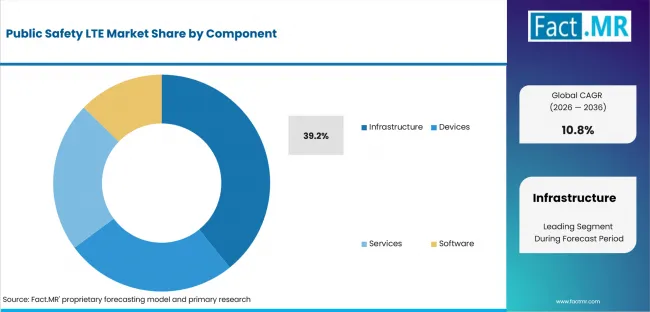
Public Safety Lte Market Analysis By Component | Source: Fact.MR
Infrastructure leads component when agencies must secure the network layer before devices and applications can perform. Evolved Packet Core and eNodeB Base Stations remain relevant where buyers need stronger control over routing and radio access.
Why does Private LTE lead Technology?
Private LTE is expected to hold 51.1% share in 2026.
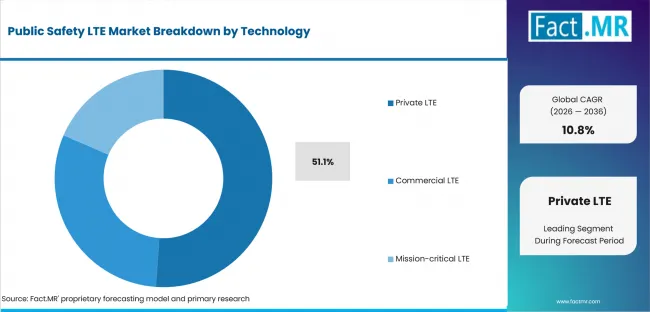
Public Safety Lte Market Analysis By Technology | Source: Fact.MR
Private LTE leads technology when agencies need controlled coverage and priority access for critical traffic. Dedicated public safety LTE and municipal LTE networks remain useful for agencies that want separation from commercial network load. Utility LTE Networks support adjacent emergency and infrastructure-response use cases.
Why does Emergency Medical Services lead Application?
Emergency Medical Services is anticipated to lead with 33.9% share in 2026.
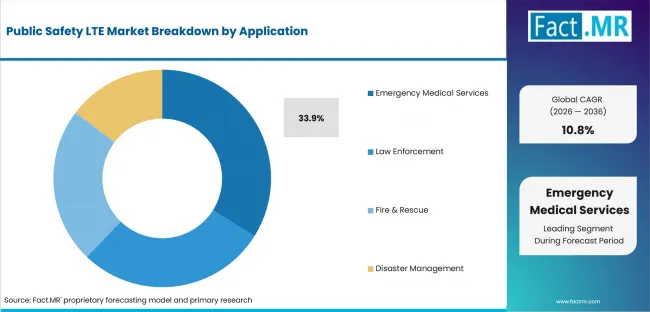
Public Safety Lte Market Analysis By Application | Source: Fact.MR
Emergency medical services leads application because ambulance communication and patient-data transfer need stable mobile broadband during response. Ambulance communication and telemedicine support strengthen the same use case when hospitals need earlier visibility into patient status.
Why does Public Safety Agencies lead End User?
Public Safety Agencies are estimated to represent 42.5% share in 2026.
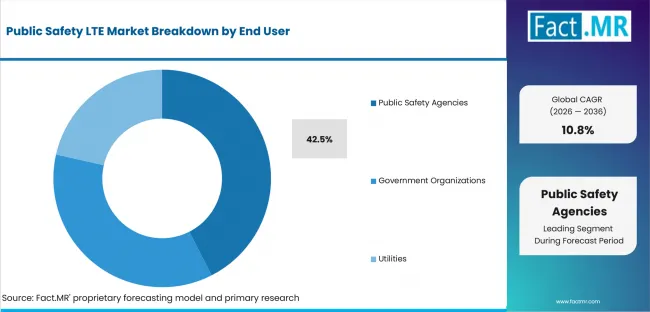
Public Safety Lte Market Analysis By End User | Source: Fact.MR
Public safety agencies lead end user since they control network approval and emergency communication budgets. Police Departments and Fire Departments create separate device and application requirements.
Why does On-premise lead Deployment?
On-premise is forecast to hold 51.4% share in 2026.
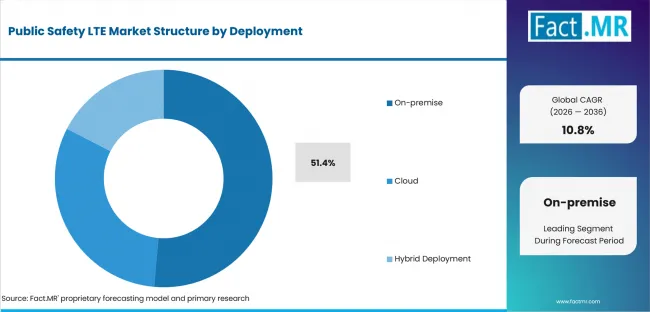
Public Safety Lte Market Analysis By Deployment | Source: Fact.MR
On-premise leads Deployment where agencies want local control over sensitive traffic and continuity planning. Dedicated Network Infrastructure and Local Data Centers remain relevant when procurement teams need a clear ownership model.
What is accelerating Public Safety LTE Market adoption, and what is holding it back?
Demand is expected to grow through LTE upgrades and private network deployment. Adoption may be limited by high integration costs and complex interoperability testing.
Drivers Impact Analysis
| DRIVER | (~) % IMPACT ON CAGR | GEOGRAPHIC RELEVANCE | IMPACT TIMELINE |
|---|---|---|---|
| Dedicated public-safety LTE modernization | +2.8% | France, UK, USA | Short term (<= 2 years) |
| Private LTE and controlled-network deployment | +2.4% | France and UK | Short term (<= 2 years) |
| Emergency medical communication workloads | +1.9% | USA and Germany | Medium term (2-4 years) |
| Mission-critical data and video use | +1.6% | Public safety agency clusters | Medium term (2-4 years) |
| On-premise security and control requirements | +1.3% | Canada and Japan | Long term (>= 4 years) |
Source: Fact.MR analysis. Updated Jul 30, 2026
- Dedicated public-safety LTE modernization: Network upgrades are expected to raise demand where agencies want mission-critical voice and data on the same platform.
- Emergency medical communication workloads: Ambulance teams need mobile broadband that can support routing and patient-data exchange.
- Mission-critical data and video use: Field video and incident records are expected to increase bandwidth needs during response.
Opportunity Impact Analysis
| OPPORTUNITY | (~) % IMPACT ON CAGR | GEOGRAPHIC RELEVANCE | IMPACT TIMELINE |
|---|---|---|---|
| Managed private LTE and integration services | +1.4% | France and UK | Medium term (2-4 years) |
| Mission-critical push-to-talk and data upgrades | +1.1% | USA and Germany | Medium term (2-4 years) |
| Edge-connected incident command support | +0.9% | Canada and Japan | Long term (>= 4 years) |
| Public safety agency interoperability programs | +0.7% | Multi-agency response markets | Long term (>= 4 years) |
Source: Fact.MR analysis. Updated Jul 30, 2026
- Managed private LTE and integration services: Suppliers can gain demand when deployment support is packaged with testing and maintenance.
- Mission-critical push-to-talk and data upgrades: Agencies are expected to upgrade when voice and data services share one dependable operating model.
- Edge-connected incident command support: Edge nodes can support command teams that need local processing and faster data access.
Restraints Impact Analysis
| RESTRAINT | (~) % IMPACT ON CAGR | GEOGRAPHIC RELEVANCE | IMPACT TIMELINE |
|---|---|---|---|
| Integration complexity and switching cost | -1.5% | Global public safety buyers | Short term (<= 2 years) |
| Spectrum planning and approval delays | -1.0% | France, UK, USA | Short term (<= 2 years) |
| Device and lifecycle cost pressure | -0.8% | Municipal and regional agencies | Medium term (2-4 years) |
| Interoperability testing burden | -0.6% | Multi-agency response networks | Long term (>= 4 years) |
Source: Fact.MR analysis. Updated Jul 30, 2026
- Integration complexity and switching cost: Existing radio systems and dispatch tools can slow deployment when buyers cannot see a clean migration path.
- Spectrum planning and approval delays: Deployment can slow when agencies must align network plans with local spectrum rules.
- Device and lifecycle cost pressure: Public agencies may delay orders when devices and training raise the ownership case.
Which countries are scaling Public Safety LTE Market fastest?
The USA clearly leads the country comparison at 14.0% CAGR, followed by Canada at 12.7% and the UK at 11.4%. Germany, Japan and France grow at lower listed rates.
- The USA benefits from public-safety broadband experience and integration knowledge.
- Canada depends on coverage reach and maintenance planning.
- The UK stays near the global rate as buyers assess private LTE value.
- Germany requires stronger validation before wider deployment.
- Japan follows a reliability-focused path shaped by supplier support and careful rollout decisions across emergency networks.
- France remains important through agency modernization and service-support readiness.
Comparable CAGRs can therefore produce different market entry conditions across these countries. Deployment timing depends on integration evidence and local service depth. Commercial readiness also reflects device support and system ownership.
The full report provides country-level CAGR analysis across North America, Latin America, Europe, East Asia, South Asia, Oceania and the Middle East and Africa.
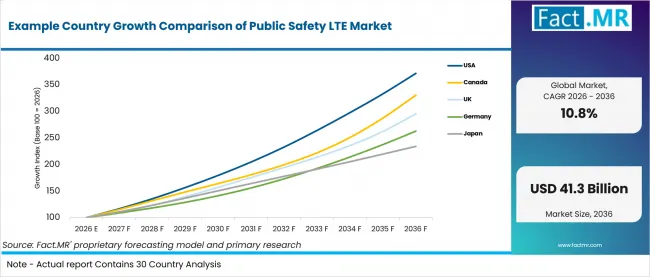
Example Country Growth Comparison Of Public Safety Lte Market | Source: Fact.MR
| Country | CAGR (2026-2036) |
|---|---|
| France | 7.6% |
| UK | 11.4% |
| USA | 14.0% |
| Germany | 10.1% |
| Canada | 12.7% |
| Japan | 8.9% |
Source: Fact.MR analysis. Updated Jul 30, 2026
What supports France adoption?
7.6% CAGR, supported by agency modernization and channel readiness.
France’s growth reflects a market where public agencies are expected to demand clear links between LTE infrastructure and operating needs. Suppliers with local support and integration proof are likely to move faster through procurement.
How is UK demand developing?
11.4% CAGR, driven by private LTE review and service accountability.
UK growth is shaped by buyers that compare lifecycle value before expanding network orders. Private LTE is expected to gain preference when agencies can see how coverage and data security fit existing response operations.
What supports USA adoption?
14.0% CAGR, backed by public safety broadband experience and integration demand.
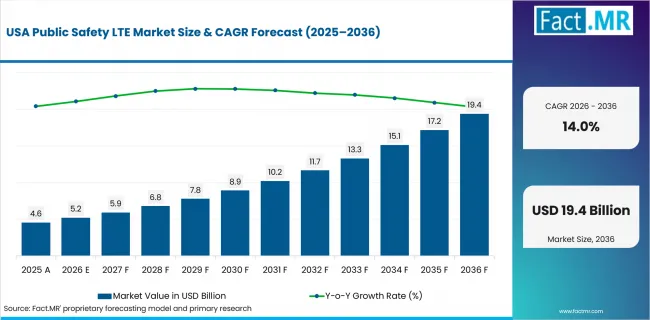
Public Safety Lte Market Country Value Analysis | Source: Fact.MR
USA growth reflects a market where agencies already understand the value of mobile broadband for incident response. Buyers are expected to place weight on interoperability and device readiness before approving wider deployment.
How is Germany converting demand?
10.1% CAGR, supported by institutional validation and emergency-service coordination.
Germany’s growth is expected to move through careful technical review before procurement expands. Public safety agencies are likely to ask for proof that LTE systems work with existing command routines and security rules.
What shapes Canada’s route to adoption?
12.7% CAGR, led by coverage needs and service planning across large operating areas.
Canada’s growth reflects the need for reliable communication across wide response zones. Agencies are expected to value network reach and maintenance support before ordering larger deployments.
How does Japan perform?
8.9% CAGR, supported by reliability-focused procurement and compact deployment needs.
Japan’s growth is shaped by buyers that place high value on dependable operation and disciplined supplier support. Agencies are likely to favor systems that can be validated within compact deployment footprints.
Who leads the Public Safety LTE Market?
Motorola Solutions, Ericsson and Nokia Corporation show direct relevance. Samsung Electronics and Huawei Technologies broaden the network equipment field.
Motorola Solutions supports mission-critical communication and command-center operations. Ericsson and Nokia add LTE infrastructure and private-network expertise. Samsung, Huawei and ZTE broaden the telecom equipment field, while Airbus adds secure emergency-network capabilities. Competition will depend on network priority, service continuity, device support and maintenance. Providers with reliable performance across police and medical workflows may gain stronger agency demand.
Which companies are the key providers?
Key companies include Motorola Solutions, Inc., Ericsson, Nokia Corporation, Samsung Electronics, Huawei Technologies, ZTE Corporation, and Airbus Public Safety and Security.
- Motorola Solutions, Inc.
- Ericsson
- Nokia Corporation
- Samsung Electronics
- Huawei Technologies
- ZTE Corporation
- Airbus Public Safety and Security
Bibliography
- National Telecommunications and Information Administration. (2024, January 3). NTIA announces recruitment of new FirstNet Authority Board members.
- National Telecommunications and Information Administration. (2025, January). Technology in service of human progress: NTIA’s accomplishments in the Biden-Harris administration.
- Ericsson. (2024, February 13). MSB strengthens Sweden’s national critical network with 5G from Ericsson.
- Motorola Solutions, Inc., & Nokia Corporation. (2024, December 12). Nokia and Motorola Solutions announce drone technology integration for public safety and mission-critical industries.
This Report Answers
- The report provides strategic intelligence on the public safety LTE market across Component and Technology choices that shape emergency communication programs.
- Segment analysis covers Infrastructure and private LTE as the share leaders within the 2026 market.
- Country outlook evaluates the USA and Canada alongside the UK and Germany. Japan and France complete the growth comparison across the profiled markets.
- Competitive analysis profiles Motorola Solutions and Ericsson alongside Nokia Corporation and Samsung Electronics. Huawei Technologies, ZTE Corporation and Airbus Public Safety and Security complete the provider set.
- Deployment assessment covers On-premise and Cloud choices. Hybrid Deployment and Edge Computing complete the deployment view alongside dedicated and local data-center options.
What does the Public Safety LTE Market cover?
Public Safety LTE systems are used by public agencies for mission-critical voice and data communication during emergency response.
The Public Safety LTE Market covers infrastructure and devices used to support agency communication. Coverage extends to handheld LTE radios and vehicle-mounted terminals. Managed services and system integration are included where they support live public-safety operations. The market also includes network management software and mission-critical applications where they are tied to LTE deployment.
What is included in the scope?
Public Safety LTE includes infrastructure and devices used by public safety agencies and related government buyers.
The scope includes Component and Technology alongside Application, End User and Deployment. Coverage spans private LTE and dedicated public safety LTE. Emergency Medical Services, Law Enforcement and Fire & Rescue complete the main application view. The scope includes on-premise and cloud deployments where they support secure public-safety communication.
What is excluded from the scope?
General telecom services and unrelated corporate network spending remain outside the scope of this market.
The scope excludes networks that do not support public safety communication requirements. Consumer LTE subscriptions and general enterprise broadband are excluded. Hardware sales are excluded when they are not tied to public-safety LTE operation.
How Was the Analysis Built?
The analysis draws on 120+ sources, 35+ company portfolios, 25+ countries, and more than 20 industry interviews.
- Primary Research: Primary research includes discussions with manufacturers, service providers, technology developers, distributors, end users, procurement teams, and subject-matter experts. These conversations examine purchasing priorities, product adoption, operational challenges, approval requirements, competitive positioning, and the factors that influence wider market acceptance.
- Desk Research: Desk research covers government statistics, regulatory publications, company filings, trade data, technical studies, industry associations, standards, public policy, and other authoritative sources. Every source used in the analysis is documented in the bibliography.
- Market Sizing and Forecasting: Market estimates combine historical performance, demand indicators, pricing and volume trends, segment shares, company participation, country-level growth, adoption patterns, investment activity, and barriers to market expansion.
- Data Validation and Update Cycle: Findings are validated by comparing primary interviews with public data, company activity, regulatory changes, trade patterns, and industry developments. Regular updates review new product launches, capacity changes, partnerships, approvals, procurement trends, and shifts in commercial adoption.
Segmentation
What is the report’s scope and coverage?
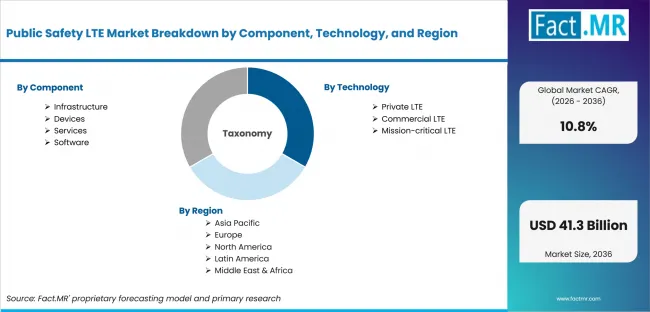
Public Safety Lte Market Breakdown By Component, Technology, And Region | Source: Fact.MR
| Attribute | Details |
|---|---|
| Quantitative Units | USD 14.8 billion in 2026 to USD 41.3 billion by 2036, at a 10.8% CAGR. |
| Market Definition | LTE network infrastructure, devices, software and services used by public agencies for mission-critical voice and data communication where coverage, priority access, security and service continuity determine approval |
| Component | Infrastructure; Evolved Packet Core; eNodeB Base Stations; Backhaul Equipment; Devices; Handheld LTE Radios; Vehicle-mounted Terminals; Wearable Communication Devices; Services; Managed Services; System Integration; Maintenance & Support; Software; Network Management Software; Mission-critical Applications; Security & Analytics Software |
| Technology | Private LTE; Dedicated Public Safety LTE; Municipal LTE Networks; Utility LTE Networks; Commercial LTE; Sharing Agreements; Hybrid Commercial LTE; Roaming-enabled Networks; Mission-critical LTE; Mission Critical Push-to-Talk; Mission Critical Data; Mission Critical Video |
| Application | Emergency Medical Services; Ambulance Communication; Telemedicine Support; Disaster Medical Response; Law Enforcement; Police Communication; Crime Scene Management; Patrol Operations; Fire & Rescue; Firefighter Communication; Incident Command; Search & Rescue; Disaster Management; Emergency Operations Centers; Public Warning Systems; Crisis Response |
| End User | Public Safety Agencies; Police Departments; Fire Departments; Emergency Medical Services; Government Organizations; Homeland Security; Defense Agencies; Municipal Authorities; Utilities; Electric Utilities; Oil & Gas Companies; Transportation Authorities |
| Deployment | On-premise; Dedicated Network Infrastructure; Local Data Centers; Private Core Networks; Cloud; Public Cloud; Private Cloud; Hybrid Cloud; Hybrid Deployment; Edge Computing; Multi-site Deployment; Cloud-integrated Networks |
| Regions Covered | North America; Latin America; Europe; East Asia; South Asia and Pacific; Middle East and Africa |
| Countries Covered | France; UK; USA; Germany; Canada; Japan |
| Key Companies Profiled | Motorola Solutions, Inc.; Ericsson; Nokia Corporation; Samsung Electronics; Huawei Technologies; ZTE Corporation; Airbus Public Safety and Security |
| Forecast Period | 2026 to 2036 |
| Approach | Hybrid top-down and bottom-up approach using public safety communication demand; LTE infrastructure requirements; private network deployment; emergency medical communication use; agency procurement patterns; integration burden; device and service support; country adoption patterns and company portfolio review |
Source: Fact.MR analysis. Updated Jul 30, 2026
How is the market segmented?
-
By Component:
- Infrastructure
- Evolved Packet Core
- eNodeB Base Stations
- Backhaul Equipment
- Devices
- Handheld LTE Radios
- Vehicle-mounted Terminals
- Wearable Communication Devices
- Services
- Managed Services
- System Integration
- Maintenance & Support
- Software
- Network Management Software
- Mission-critical Applications
- Security & Analytics Software
- Infrastructure
-
By Technology:
- Private LTE
- Dedicated Public Safety LTE
- Municipal LTE Networks
- Utility LTE Networks
- Commercial LTE
- Sharing Agreements
- Hybrid Commercial LTE
- Roaming-enabled Networks
- Mission-critical LTE
- Mission Critical Push-to-Talk
- Mission Critical Data
- Mission Critical Video
- Private LTE
-
By Application:
- Emergency Medical Services
- Ambulance Communication
- Telemedicine Support
- Disaster Medical Response
- Law Enforcement
- Police Communication
- Crime Scene Management
- Patrol Operations
- Fire & Rescue
- Firefighter Communication
- Incident Command
- Search & Rescue
- Disaster Management
- Emergency Operations Centers
- Public Warning Systems
- Crisis Response
- Emergency Medical Services
-
By End User:
- Public Safety Agencies
- Police Departments
- Fire Departments
- Emergency Medical Services
- Government Organizations
- Homeland Security
- Defense Agencies
- Municipal Authorities
- Utilities
- Electric Utilities
- Oil & Gas Companies
- Transportation Authorities
- Public Safety Agencies
-
By Deployment:
- On-premise
- Dedicated Network Infrastructure
- Local Data Centers
- Private Core Networks
- Cloud
- Public Cloud
- Private Cloud
- Hybrid Cloud
- Hybrid Deployment
- Edge Computing
- Multi-site Deployment
- Cloud-integrated Networks
- On-premise
-
By Region:
- North America
- Latin America
- Europe
- East Asia
- South Asia and Oceania
- Middle East and Africa
Frequently Asked Questions
Which Component leads the market?
Which Technology leads the market?
Which Application leads the market?
Which End User leads the market?
Which Deployment leads the market?
Which country records the highest listed CAGR?
What is the primary driver in this market?
What is the main restraint?
Why do Public Safety Agencies lead demand?
Who worked on this report


Preview the report firsthand - request a free sample
Free SampleGet the brochure for pricing and purchase details
Download PDF