The Pulmonary Embolectomy System Market is analyzed across its key product, application and end-use segments, with the study covering market dynamics, regional trends and demand outlook, forecast 2026 to 2036.
By Fact.MR Healthcare DeskLead analyst:
S.N. JhaPublished :
Updated :
9 min read
Fact-checked under the Fact.MR editorial process
Pulmonary Embolectomy System Market Forecast and Outlook 2026 to 2036
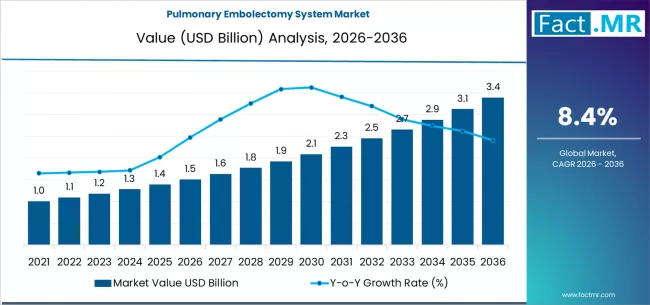
The global pulmonary embolectomy system market is projected to total USD 1.51 billion in 2026, advancing to USD 3.39 billion by 2036, achieving a CAGR of 8.4%. This expansion is driven by the rising global incidence of pulmonary embolism, particularly massive and submassive cases, alongside significant technological advancements that favor minimally invasive interventions.
Pulmonary Embolectomy System Market Market Value Analysis | Source: Fact.MR
Summary of PulmonaryEmbolectomySystem Market
Market Snapshot
Global pulmonaryembolectomysystem market revenue stood at USD 1.51 billion in 2026 and is forecast to reach USD 3.39 billion by 2036.
Ata8.4%CAGRfrom 2026 to 2036, this market is set to expand ~2.2x in value, adding USD 1.88 billion in absolute opportunity.
This marketrepresentsa high-growth interventional cardiology and vascular device segment, driven by increasing incidence of pulmonary embolism (PE), particularly acute and life-threatening cases.
Pulmonaryembolectomysystems are evolving toward minimally invasive catheter-based technologies, reducing procedural risk, recovery time, and dependence on open surgery.
Demand and Growth Drivers
Rising global incidence of pulmonary embolism (massive andsubmassivePE) is the primary growth driver.
Increasing adoption of minimally invasive catheter-based interventions is accelerating market expansion.
Growing demand for rapid clot removal solutions in emergency and critical care settings is supporting adoption.
Advancements in interventional cardiology and vascular technologies are improving safety, precision, and procedural outcomes.
Expansion of hospital-based interventional infrastructure (cathlabs, hybridORs) is enabling wider adoption of advancedembolectomysystems.
Product and Segment View
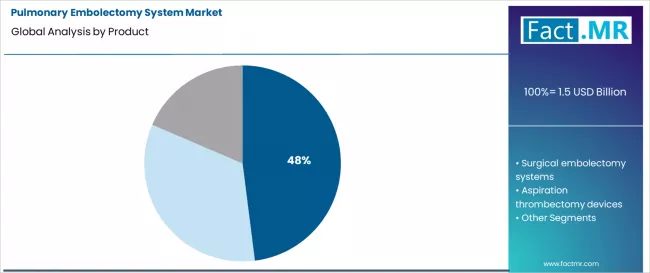
Catheter-basedembolectomysystems hold 48.0% of product share in 2026,emergingas the dominant segment due to reduced invasiveness and faster recovery.
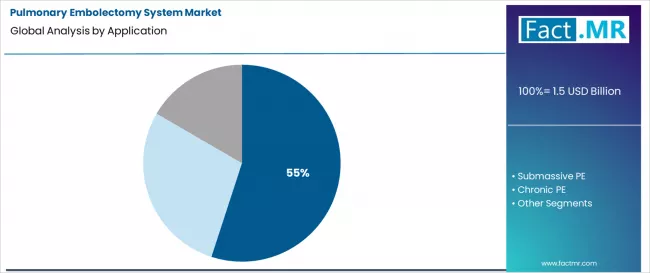
Massive pulmonary embolism (PE) accounts for 55.0% of application share in 2026, positioning it as the leading segment due to urgent intervention requirements.
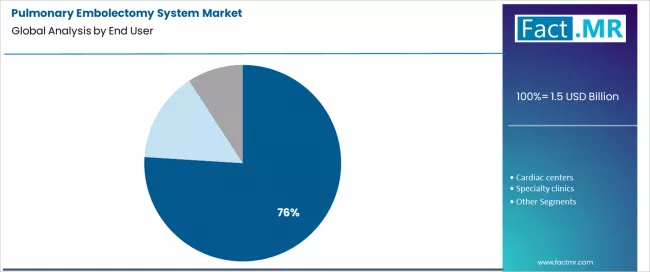
Hospitalsrepresent76.0% of end-user share in 2026, reflecting the need for specialized infrastructure and multidisciplinary care teams.
Key product categories include:
Catheter-basedembolectomysystems
Surgicalembolectomysystems
Aspirationthrombectomydevices
Geography and Competitive Outlook
Growth is supported across North America, Europe, and Asia Pacific, driven by healthcare infrastructure, disease prevalence, and technological adoption.
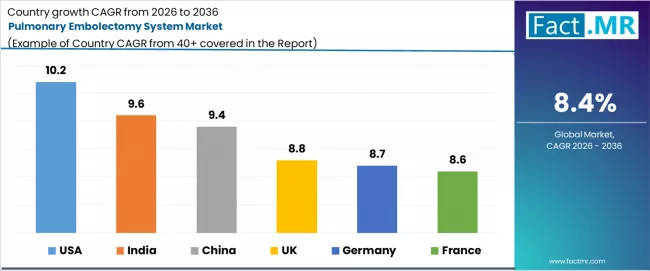
United States (10.2%CAGR), India (9.6%), China (9.4%), United Kingdom (8.8%), Germany (8.7%), and France (8.6%) are key growth markets.
Market expansion is closely tied to:
Increasing cardiovascular disease burden
Expansion of interventional cardiology procedures
Adoption of minimally invasive surgical techniques
Competitive landscape includes companies focused on:
Catheter-based clot removal systems
Aspiration andthrombectomytechnologies
Advanced interventional device platforms
PulmonaryEmbolectomySystem Market — At a Glance
Attribute
Details
Market Value 2026
USD 1.51 billion
Market Value 2036
USD 3.39 billion
Absolute Dollar Opportunity 2026–2036
USD 1.88 billion
Total Growth 2026–2036
124.5%
CAGR2026–2036
8.4%
Growth Multiple
~2.2x
Key Demand Theme
Shift toward minimally invasive catheter-based clot removal systems for acute pulmonary embolism management
Leading Segment by Product (2026)
Catheter-BasedEmbolectomySystems
Segment Share (2026)
48.0%
Leading Segment by Application (2026)
Massive Pulmonary Embolism
Segment Share (2026)
55.0%
Leading Segment by End User (2026)
Hospitals
Segment Share (2026)
76.0%
Key Growth Regions
North America, Europe, Asia Pacific
CountryCAGRs
USA 10.2%, India 9.6%, China 9.4%, UK 8.8%, Germany 8.7%, France 8.6%
North America, Europe, Asia Pacific, Latin America, MEA
Source: Fact.MR analysis. Updated Apr 20, 2026
The market is dominated by catheter-based embolectomy systems, reflecting a clinical shift away from open surgery towards percutaneous techniques that reduce patient trauma and improve recovery times. Growth is further concentrated in hospital settings, which house the necessary multidisciplinary teams and advanced imaging infrastructure. USA leads in growth rate due to its advanced healthcare infrastructure and high procedural volume, while emerging economies like India and China present significant opportunities due to improving access to interventional care. The competitive landscape features specialized device innovators competing with large, diversified medtech corporations, with success hinging on demonstrating superior clinical outcomes, procedural efficiency, and robust training support.
North America, Latin America, Western Europe, Eastern Europe, East Asia, South Asia & Pacific, MEA
Source: Fact.MR analysis. Updated Apr 20, 2026
Segmental Analysis
By Product, Which Technology is Redefining First-Line Intervention?
Pulmonary Embolectomy System Market Analysis By Product | Source: Fact.MR
Catheter-based embolectomy systems command a leading 48.0% share. This dominance is due to their minimally invasive profile, which allows for rapid thrombus removal in critically ill patients who are poor candidates for open surgery or thrombolytic drugs. Their ability to restore pulmonary blood flow quickly, reducing right heart strain, has established them as a cornerstone of modern PE response.
By Application, Which Condition Represents the Most Critical Procedural Demand?
Pulmonary Embolectomy System Market Analysis By Application | Source: Fact.MR
Massive PE constitutes the dominant application with a 55.0% share. This life-threatening condition, characterized by hypotension and cardiogenic shock, creates an urgent need for immediate thrombus removal to prevent mortality. The high mortality risk associated with massive PE drives the adoption of advanced embolectomy systems as essential, time-critical tools in emergency and cardiac care units.
By End User, Where is Complex Acute Care Centralized?
Pulmonary Embolectomy System Market Analysis By End User | Source: Fact.MR
Hospitals are the primary end-user segment, holding a 76.0% share. Tertiary care hospitals and academic medical centers possess the hybrid operating rooms, advanced interventional radiology/cardiology suites, and multidisciplinary teams including intensivists, interventionalists, and cardiac surgeons required to diagnose and perform emergent embolectomy procedures around the clock.
What are the Principal Drivers, Constraints, and Evolving Dynamics of this Market?
Factor
Impact
Driver
Rising global incidence of venous thromboembolism and aging populations increasing the patient pool for acute PE interventions.
Restraint
High procedural costs, requirement for specialized operator expertise, and associated risks of vascular injury or distal embolism.
Opportunity
Development of next-generation devices with improved safety profiles, better clot engagement, and compatibility with smaller access sites.
Threat
Strong competition from pharmacological thrombolysis and improving efficacy of anticoagulation protocols for lower-risk PE.
Source: Fact.MR analysis. Updated Apr 20, 2026
Analysis of the Pulmonary Embolectomy System Market by Key Countries
Pulmonary Embolectomy System Market Cagr Analysis By Country | Source: Fact.MR
Country
CAGR 2026 to 2036
USA
10.2%
India
9.6%
China
9.4%
UK
8.8%
Germany
8.7%
France
8.6%
Source: Fact.MR analysis. Updated Apr 20, 2026
What Distinguishes Germany's Integration of Research and Standardized Care Pathways?
Germany's 8.7% CAGR is propelled by its robust network of university hospitals that serve as both high-volume treatment centers and research hubs for clinical trials. Adoption of advanced embolectomy systems is accelerated through standardized national care pathways (DMPs) and a reimbursement system that recognizes the value of innovative, evidence-based interventions. Growth is further driven by the country’s strong medical device sector, fostering close collaboration between clinicians and domestic engineers on device refinement.
How Does France's Centralized Health System Streamline Technology Adoption?
France's 8.6% CAGR is underpinned by its highly centralized public health system, which facilitates the rapid dissemination of new clinical guidelines from agencies like the HAS (Haute Autorité de Santé). This structure allows for coordinated adoption of proven technologies across regional university hospitals (CHUs).
Government-led tenders and a focus on health technology assessment, ensuring that new embolectomy systems demonstrate clear clinical and economic benefit before widespread integration into publicly funded care pathways, characterize market growth.
What Drives the USA's Advanced Interventional Capability and Procedural Volume?
The USA's 10.2% CAGR is propelled by its high prevalence of risk factors for PE, a well-established network of comprehensive stroke and cardiac centers, and favorable reimbursement for complex interventional procedures. Early adoption of innovative catheter-based technologies and a strong clinical research ecosystem further solidify its position as the largest and most advanced market.
How is India's Healthcare Modernization Expanding Access to Acute Interventions?
India's 9.6% CAGR is linked to rapid expansion in private hospital chains equipped with advanced cath labs and a growing cadre of trained interventional cardiologists and radiologists. Increasing awareness and diagnosis of PE, coupled with rising healthcare investments, are making advanced embolectomy procedures accessible beyond major metropolitan centers.
What Strategic Healthcare Investments Underpin China's Market Growth?
China's 9.4% CAGR is driven by massive government investment in upgrading county-level hospital infrastructure and building regional cardiovascular centers. The rising burden of cardiovascular disease and a focus on improving acute care standards are generating significant demand for advanced medical devices, including embolectomy systems, with growing domestic manufacturing playing a supportive role.
What Role Does the UK's National Health Service and Research Play?
The National Health Service’s (NHS) procurement pathways influence the UK’s 8.8% CAGR and the influence of national guidelines from bodies like NICE. Growth is tied to clinical evidence generation from UK-based research and the systematic adoption of cost-effective technologies that demonstrate improved patient outcomes and reduced overall hospitalization costs.
Competitive Landscape of the Pulmonary Embolectomy System Market
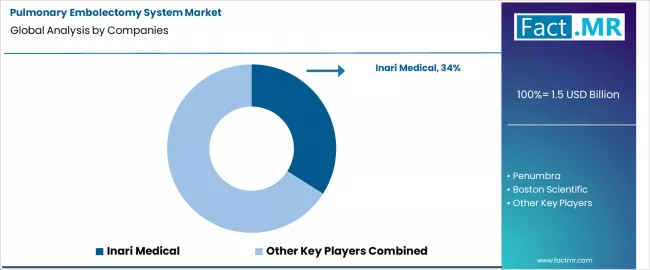
Pulmonary Embolectomy System Market Analysis By Company | Source: Fact.MR
The competitive landscape features intense rivalry between specialized thrombectomy companies and large cardiovascular device corporations. Competition centers on clinical data demonstrating superiority in complete clot removal, procedure speed, and safety outcomes.
Key Strategic Pillars for Market Players
Strategy
Details
Investment in Robust Clinical Evidence
Generating high-quality real-world and comparative data to support guideline inclusion and hospital formulary acceptance.
Tailoring training and market access strategies for growing healthcare systems in Asia-Pacific and Latin America.
Strategic Partnerships with Healthcare Institutions
Collaborating with leading hospitals on training fellowships and procedural technique development.
Source: Fact.MR analysis. Updated Apr 20, 2026
Key Players in the Pulmonary Embolectomy System Market
Inari Medical
Penumbra
Boston Scientific
Medtronic plc.
Cook Medical
Others
References
American Heart Association. (2025). Guidelines for the management of massive and submassive pulmonary embolism. Circulation.
Konstantinides, S. V., & Meyer, G. (2024). The 2024 ESC Guidelines on the diagnosis and management of acute pulmonary embolism. European Heart Journal.
Society of Interventional Radiology. (2024). Quality improvement guidelines for percutaneous management of acute pulmonary embolism. Journal of Vascular and Interventional Radiology.
Tapson, V. F., & Sterling, K. (2025). Advances in catheter-directed therapy for pulmonary embolism. Chest.
U.S. Food and Drug Administration. (2025). Premarket approval data for mechanical thrombectomy devices.
Inari Medical, Penumbra, Boston Scientific, Medtronic, Cook Medical, Others
Additional Analysis
Comparative analysis of technical success rates and complication profiles; health-economic impact studies; analysis of learning curves for new devices; review of ongoing clinical trials and pipeline products.
Source: Fact.MR analysis. Updated Apr 20, 2026
Market by Segments
Product :
Catheter-based embolectomy systems
Surgical embolectomy systems
Aspiration thrombectomy devices
Application :
Massive PE
Submassive PE
Chronic PE
End User :
Hospitals
Cardiac centers
Specialty Clinics
Region :
North America
USA
Canada
Latin America
Brazil
Mexico
Argentina
Rest of Latin America
Western Europe
Germany
France
Italy
Spain
UK
BENELUX
Rest of Western Europe
Eastern Europe
Russia
Poland
Czech Republic
Rest of Eastern Europe
East Asia
China
Japan
South Korea
Rest of East Asia
South Asia & Pacific
India
ASEAN
Australia
Rest of South Asia & Pacific
MEA
GCC Countries
South Africa
Turkiye
Rest of MEA
Questions Answered
Frequently Asked Questions
How big is the pulmonary embolectomy system market in 2026?
The global pulmonary embolectomy system market is estimated to be valued at USD 1.5 billion in 2026.
What will be the size of pulmonary embolectomy system market in 2036?
The market size for the pulmonary embolectomy system market is projected to reach USD 3.4 billion by 2036.
How much will be the pulmonary embolectomy system market growth between 2026 and 2036?
The pulmonary embolectomy system market is expected to grow at a 8.4% CAGR between 2026 and 2036.
What are the key product types in the pulmonary embolectomy system market?
The key product types in pulmonary embolectomy system market are catheter-based embolectomy systems, surgical embolectomy systems and aspiration thrombectomy devices.
Which application segment to contribute significant share in the pulmonary embolectomy system market in 2026?
In terms of application, massive pe segment to command 55.0% share in the pulmonary embolectomy system market in 2026.