Puncture Resistance Tester Market (2026 - 2036)
Puncture Resistance Tester Market Size and Share Forecast Outlook 2026 to 2036
Core Findings
Puncture Resistance Tester Market Forecast Outlook 2026 to 2036
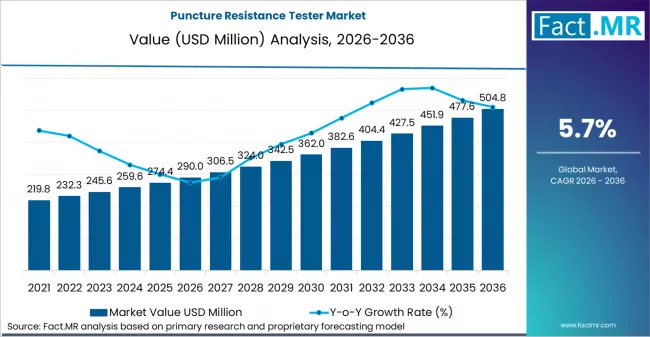
The puncture resistance tester market is projected to reach USD 290 million in 2026, growing to USD 505 million by 2036, with a CAGR of 5.7%.
Key Takeaways from Puncture Resistance Tester Market
- Puncture Resistance Tester Market Value (2026): USD 290 million
- Puncture Resistance Tester Market Forecast Value (2036): USD 505 million
- Puncture Resistance Tester Market Forecast CAGR (2026 to 2036): 5.7%
- Leading Segment in Puncture Resistance Tester Market: Digital Benchtop (47%)
- Key Growth Region in Puncture Resistance Tester Market: Asia Pacific
- Key Players in Puncture Resistance Tester Market: Thwing-Albert Instrument Company, Tinius Olsen Testing Machine Company, ZwickRoell GmbH & Co. KG, SDL Atlas, Labthink International Technology Co., Ltd., Presto Stantest Ltd., Qualitest Group plc, James Heal Ltd., Testex AG, Instron
Regulatory oversight will continue to shape market dynamics, as stringent industry standards across sectors like packaging and automotive require compliance with safety and quality norms. Compliance costs, driven by frequent updates to testing protocols and certifications, can present significant barriers for smaller vendors, influencing their ability to enter or scale in the market.
Certification complexity adds another layer, with businesses needing to navigate both local and international standards, which may delay product launch or increase time to market. These factors create a competitive advantage for vendors with robust compliance frameworks, positioning them as preferred partners for large-scale operations. Vendors focusing on streamlining certification processes or offering cost-effective compliance solutions will likely capture a larger share of the market, balancing quality with efficiency.
Puncture Resistance Tester Market
| Metric | Value |
|---|---|
| Estimated Value in (2026E) | USD 290 million |
| Forecast Value in (2036F) | USD 505 million |
| Forecast CAGR (2026 to 2036) | 5.7% |
Category
| Category | Segments |
|---|---|
| Method | ASTM D4833 or Geomembranes; ASTM F1342 or Protective Clothing; ISO 3036 or Paperboard; EN or ISO Packaging Methods; Other |
| End Use | Packaging and Corrugated; Geotextiles and Geomembranes; Protective Apparel; Medical Packaging; Labs and Certification |
| Automation Level | Manual or Basic; Digital Benchtop; Automated Data Logging Systems; Other |
| Region | North America; Europe; Asia Pacific; Latin America; Middle East & Africa |
Segmental Analysis
What Is the Impact of Method on the Puncture Resistance Tester Market?
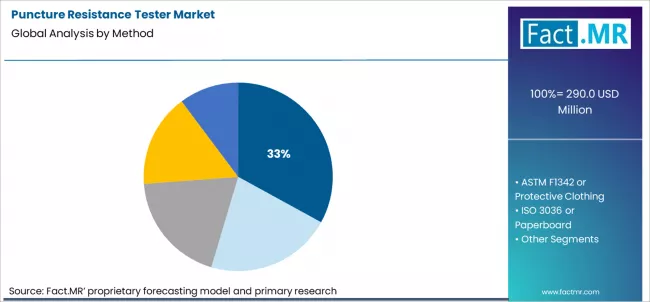
In the puncture resistance tester market, the method used significantly influences the testing requirements and market demand. The ASTM D4833 method for geomembranes leads the market with a 33% share, as it is widely used for evaluating the puncture resistance of materials used in environmental protection, such as liners and barriers in landfills and water containment systems. This method is critical for ensuring the durability and safety of geomembranes under pressure. As industries continue to focus on material integrity and safety, the demand for puncture resistance testers based on ASTM D4833 and other testing standards will remain strong, particularly in sectors like construction, packaging, and protective clothing.
What Is the Impact of Automation Level on the Puncture Resistance Tester Market?
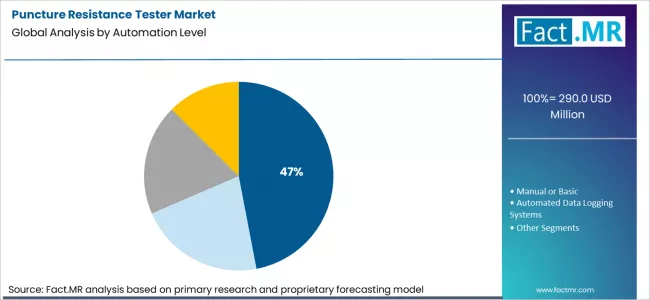
Automation level plays a key role in enhancing testing efficiency and data accuracy, with digital benchtop systems holding a 47% share. Digital benchtop testers offer high precision, ease of use, and data integration capabilities, making them ideal for laboratory and quality control environments. These systems provide automated testing processes, improving consistency and reducing human error, while enabling seamless data logging and analysis. As industries increasingly prioritize automation and data-driven decision-making, the adoption of digital benchtop testers will continue to drive growth in the market, supporting efficient puncture resistance testing across a range of materials like geomembranes, protective clothing, and paperboard.
What are the Drivers, Restraints, and Key Trends in the Puncture Resistance Tester Market?
- Drivers: Demand for puncture resistance testers is shaped by requirements to assess material robustness in packaging, protective gear, medical devices, and industrial products. Quality engineers and test labs specify these systems to measure force needed to penetrate films, textiles, coatings, and composites. Procurement decisions emphasize accuracy, repeatability, and adherence to industry standards to support material selection, specification compliance, and product safety validation across consumer goods, medical, and industrial segments.
- Restraints: High acquisition and calibration costs limit adoption by smaller manufacturers and contract test facilities with constrained budgets. Some laboratories face challenges integrating testers with automated data systems, increasing manual handling and test cycle time. Variability in product formats and test protocols across applications requires flexible configurations, adding complexity to equipment specification and delivery timelines.
- Trend 1: Integration of enhanced data logging and reporting features to support traceability and quality documentation.
- Trend 2: Development of modular designs that accommodate diverse sample sizes and evolving industry standards.
Analysis of the Puncture Resistance Tester Market by Key Country
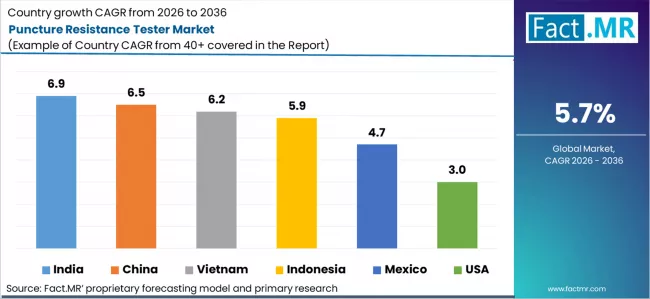
| Country | CAGR 2026 to 2036 |
|---|---|
| India | 6.9% |
| China | 6.5% |
| Vietnam | 6.2% |
| Mexico | 4.7% |
| Indonesia | 5.9% |
| USA | 3% |
The report covers an in-depth analysis of 40+ countries; top-performing countries are highlighted below.
What is the Outlook on the Puncture Resistance Tester Market in India?
India market in puncture resistance testers is projected to grow at a CAGR of 6.9% from 2026 to 2036. The demand for these testing devices is rising as industries such as packaging, automotive, and textiles focus on enhancing material performance and safety. Puncture resistance testers are crucial for evaluating the durability and strength of materials, particularly in applications that require high resistance to mechanical damage. With India’s growing industrial base and increasing focus on product quality, the market for puncture resistance testers is expected to experience steady growth.
What is the Demand for Puncture Resistance Testers in China?
China sales of puncture resistance testers are expected to grow at a CAGR of 6.5% from 2026 to 2036. As one of the largest manufacturing hubs in the world, China’s demand for puncture resistance testers is increasing, driven by the need for high-quality materials in packaging, textiles, and automotive industries. These testers are vital for ensuring the performance and reliability of materials under stress, helping manufacturers meet quality standards and improve product durability. The market for puncture resistance testers in China is expected to grow steadily, supported by ongoing industrial expansion and quality control requirements.
What is the Sales Outlook on Puncture Resistance Testers in Vietnam?
Vietnam demand for puncture resistance testers is projected to grow at a CAGR of 6.2% from 2026 to 2036. As Vietnam’s manufacturing sector continues to expand, particularly in textiles, packaging, and automotive industries, the need for puncture resistance testing solutions is increasing. These testers are essential for ensuring the durability of materials used in various products, particularly in those requiring high mechanical strength. With Vietnam’s growing role in the global manufacturing supply chain, the market for puncture resistance testers is expected to experience steady growth.
What is the Demand for Puncture Resistance Testers in Mexico?
Mexico market in puncture resistance testers is forecast to grow at a CAGR of 4.7% from 2026 to 2036. Mexico’s growing manufacturing sector, particularly in automotive and packaging, is driving the demand for reliable testing equipment. Puncture resistance testers are crucial for evaluating the durability of materials used in packaging and other industrial applications. As the country continues to expand its manufacturing capabilities and improve its quality standards, the market for puncture resistance testers is expected to grow steadily, supported by both local demand and export opportunities.
What is the Sales Outlook on Puncture Resistance Testers in Indonesia?
Indonesia demand for puncture resistance testers is set to grow at a CAGR of 5.9% from 2026 to 2036. As Indonesia’s manufacturing sectors expand, particularly in packaging, textiles, and automotive, the need for reliable and efficient puncture resistance testing solutions is rising. These testers are essential for ensuring that materials meet the necessary strength and durability requirements. With Indonesia’s growing industrial base and increasing focus on product quality, the market for puncture resistance testers is expected to continue growing steadily.
What is the Market Expansion Outlook for Puncture Resistance Testers in the USA?
USA sales of puncture resistance testers are projected to grow at a CAGR of 3% from 2026 to 2036. While the market in the USA is more mature, the demand for puncture resistance testers remains steady, driven by the need for high-quality testing solutions in industries like packaging, automotive, and manufacturing. These devices are essential for ensuring the durability and performance of materials used in critical applications. The market for puncture resistance testers in the USA is expected to grow at a moderate pace, supported by ongoing demand for quality control and regulatory compliance.
How Are Key Players Competing in the Puncture Resistance Tester Market?
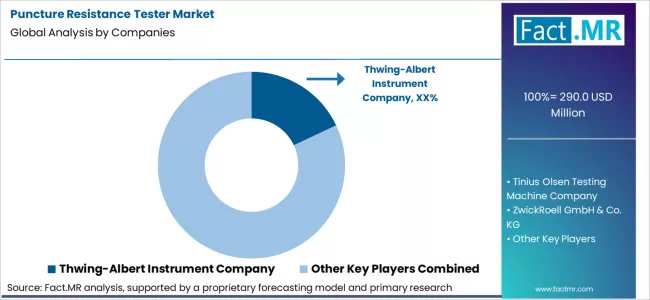
Competition in the puncture resistance tester market is driven by measurement accuracy, compliance with material testing standards, and equipment reliability. Thwing Albert Instrument Company and Tinius Olsen Testing Machine Company supply testers engineered for consistent force application and precise puncture threshold detection. ZwickRoell GmbH & Co. KG and SDL Atlas focus on systems with robust frames and detailed data recording suited to plastics, films, and packaging materials. Labthink International Technology Co., Ltd. and Presto Stantest Ltd. provide testers with configurable test parameters and clear result reporting. Qualitest Group plc and James Heal Ltd. offer solutions with user oriented interfaces and broad specimen compatibility. Testex AG and Instron supply high resolution testers with verified repeatability under varied test conditions. Competitive positioning is defined by adherence to ASTM and ISO test methods, instrument durability, and clarity of measurement output.
Key Players of the Puncture Resistance Tester Market
- Thwing-Albert Instrument Company
- Tinius Olsen Testing Machine Company
- ZwickRoell GmbH & Co. KG
- SDL Atlas
- Labthink International Technology Co., Ltd.
- Presto Stantest Ltd.
- Qualitest Group plc
- James Heal Ltd.
- Testex AG
- Instron
Scope of the Report
| Items | Values |
|---|---|
| Quantitative Units (2026) | USD Million |
| Method | ASTM D4833 or Geomembranes, ASTM F1342 or Protective Clothing, ISO 3036 or Paperboard, EN or ISO Packaging Methods, Other |
| End Use | Packaging and Corrugated, Geotextiles and Geomembranes, Protective Apparel, Medical Packaging, Labs and Certification |
| Automation Level | Manual or Basic, Digital Benchtop, Automated Data Logging Systems, Other |
| Regions Covered | North America, Europe, Asia Pacific, Latin America, Middle East & Africa |
| Countries Covered | United States, Canada, Mexico, Germany, United Kingdom, France, Japan, South Korea, China, India, Brazil, and other countries |
| Key Companies Profiled | Thwing-Albert Instrument Company, Tinius Olsen Testing Machine Company, ZwickRoell GmbH & Co. KG, SDL Atlas, Labthink International Technology Co., Ltd., Presto Stantest Ltd., Qualitest Group plc, James Heal Ltd., Testex AG, Instron |
| Additional Attributes | Dollar revenue by method, end use, automation level, and region; regional demand trends, competitive landscape, technological advancements in puncture resistance testing, operational performance optimization initiatives, and product development strategies |
Puncture Resistance Tester Market Key Segments
-
Method :
- ASTM D4833 or Geomembranes
- ASTM F1342 or Protective Clothing
- ISO 3036 or Paperboard
- EN or ISO Packaging Methods
- Other
-
End Use :
- Packaging and Corrugated
- Geotextiles and Geomembranes
- Protective Apparel
- Medical Packaging
- Labs and Certification
- Other
-
Automation Level :
- Manual or Basic
- Digital Benchtop
- Automated Data Logging Systems
- Other
-
Region :
- North America
- USA
- Canada
- Mexico
- Europe
- Germany
- UK
- France
- Italy
- Spain
- Rest of Europe
- Asia Pacific
- China
- Japan
- South Korea
- India
- Australia
- Rest of Asia Pacific
- Latin America
- Brazil
- Argentina
- Rest of Latin America
- Middle East and Africa
- Kingdom of Saudi Arabia
- United Arab Emirates
- South Africa
- Rest of Middle East and Africa
- Other Regions
- Oceania
- Central Asia
- Other Markets
- North America
Bibliographies
- ASTM International. (2023). ASTM D781-23: Standard test method for puncture resistance of paperboard and corrugated board.
- International Organization for Standardization. (2023). ISO 6603-2: Plastics - Determination of puncture impact behaviour - Instrumented methods.
- Technical Association of the Pulp and Paper Industry. (2023). TAPPI T 803: Puncture test of containerboard.
- European Committee for Standardization. (2022). EN ISO 3036: Board - Determination of puncture resistance.
- ASM International. (2023). ASM Handbook, Volume 8: Mechanical testing and evaluation.
Table of Content
- Executive Summary
- Global Market Outlook
- Demand to side Trends
- Supply to side Trends
- Technology Roadmap Analysis
- Analysis and Recommendations
- Market Overview
- Market Coverage / Taxonomy
- Market Definition / Scope / Limitations
- Market Background
- Market Dynamics
- Drivers
- Restraints
- Opportunity
- Trends
- Scenario Forecast
- Demand in Optimistic Scenario
- Demand in Likely Scenario
- Demand in Conservative Scenario
- Opportunity Map Analysis
- Product Life Cycle Analysis
- Supply Chain Analysis
- Investment Feasibility Matrix
- Value Chain Analysis
- PESTLE and Porter’s Analysis
- Regulatory Landscape
- Regional Parent Market Outlook
- Production and Consumption Statistics
- Import and Export Statistics
- Market Dynamics
- Global Market Analysis 2021 to 2025 and Forecast, 2026 to 2036
- Historical Market Size Value (USD Million) Analysis, 2021 to 2025
- Current and Future Market Size Value (USD Million) Projections, 2026 to 2036
- Y to o to Y Growth Trend Analysis
- Absolute $ Opportunity Analysis
- Global Market Pricing Analysis 2021 to 2025 and Forecast 2026 to 2036
- Global Market Analysis 2021 to 2025 and Forecast 2026 to 2036, By Method
- Introduction / Key Findings
- Historical Market Size Value (USD Million) Analysis By Method, 2021 to 2025
- Current and Future Market Size Value (USD Million) Analysis and Forecast By Method, 2026 to 2036
- ASTM D4833 or Geomembranes
- ASTM F1342 or Protective Clothing
- ISO 3036 or Paperboard
- EN or ISO Packaging Methods
- Other
- ASTM D4833 or Geomembranes
- Y to o to Y Growth Trend Analysis By Method, 2021 to 2025
- Absolute $ Opportunity Analysis By Method, 2026 to 2036
- Global Market Analysis 2021 to 2025 and Forecast 2026 to 2036, By End Use
- Introduction / Key Findings
- Historical Market Size Value (USD Million) Analysis By End Use, 2021 to 2025
- Current and Future Market Size Value (USD Million) Analysis and Forecast By End Use, 2026 to 2036
- Packaging and Corrugated
- Geotextiles and Geomembranes
- Protective Apparel
- Medical Packaging
- Labs and Certification
- Packaging and Corrugated
- Y to o to Y Growth Trend Analysis By End Use, 2021 to 2025
- Absolute $ Opportunity Analysis By End Use, 2026 to 2036
- Global Market Analysis 2021 to 2025 and Forecast 2026 to 2036, By Automation Level
- Introduction / Key Findings
- Historical Market Size Value (USD Million) Analysis By Automation Level, 2021 to 2025
- Current and Future Market Size Value (USD Million) Analysis and Forecast By Automation Level, 2026 to 2036
- Digital Benchtop
- Manual or Basic
- Automated Data Logging Systems
- Other
- Digital Benchtop
- Y to o to Y Growth Trend Analysis By Automation Level, 2021 to 2025
- Absolute $ Opportunity Analysis By Automation Level, 2026 to 2036
- Global Market Analysis 2021 to 2025 and Forecast 2026 to 2036, By Region
- Introduction
- Historical Market Size Value (USD Million) Analysis By Region, 2021 to 2025
- Current Market Size Value (USD Million) Analysis and Forecast By Region, 2026 to 2036
- North America
- Latin America
- Western Europe
- Eastern Europe
- East Asia
- South Asia and Pacific
- Middle East & Africa
- Market Attractiveness Analysis By Region
- North America Market Analysis 2021 to 2025 and Forecast 2026 to 2036, By Country
- Historical Market Size Value (USD Million) Trend Analysis By Market Taxonomy, 2021 to 2025
- Market Size Value (USD Million) Forecast By Market Taxonomy, 2026 to 2036
- By Country
- USA
- Canada
- Mexico
- By Method
- By End Use
- By Automation Level
- By Country
- Market Attractiveness Analysis
- By Country
- By Method
- By End Use
- By Automation Level
- Key Takeaways
- Latin America Market Analysis 2021 to 2025 and Forecast 2026 to 2036, By Country
- Historical Market Size Value (USD Million) Trend Analysis By Market Taxonomy, 2021 to 2025
- Market Size Value (USD Million) Forecast By Market Taxonomy, 2026 to 2036
- By Country
- Brazil
- Chile
- Rest of Latin America
- By Method
- By End Use
- By Automation Level
- By Country
- Market Attractiveness Analysis
- By Country
- By Method
- By End Use
- By Automation Level
- Key Takeaways
- Western Europe Market Analysis 2021 to 2025 and Forecast 2026 to 2036, By Country
- Historical Market Size Value (USD Million) Trend Analysis By Market Taxonomy, 2021 to 2025
- Market Size Value (USD Million) Forecast By Market Taxonomy, 2026 to 2036
- By Country
- Germany
- UK
- Italy
- Spain
- France
- Nordic
- BENELUX
- Rest of Western Europe
- By Method
- By End Use
- By Automation Level
- By Country
- Market Attractiveness Analysis
- By Country
- By Method
- By End Use
- By Automation Level
- Key Takeaways
- Eastern Europe Market Analysis 2021 to 2025 and Forecast 2026 to 2036, By Country
- Historical Market Size Value (USD Million) Trend Analysis By Market Taxonomy, 2021 to 2025
- Market Size Value (USD Million) Forecast By Market Taxonomy, 2026 to 2036
- By Country
- Russia
- Poland
- Hungary
- Balkan & Baltic
- Rest of Eastern Europe
- By Method
- By End Use
- By Automation Level
- By Country
- Market Attractiveness Analysis
- By Country
- By Method
- By End Use
- By Automation Level
- Key Takeaways
- East Asia Market Analysis 2021 to 2025 and Forecast 2026 to 2036, By Country
- Historical Market Size Value (USD Million) Trend Analysis By Market Taxonomy, 2021 to 2025
- Market Size Value (USD Million) Forecast By Market Taxonomy, 2026 to 2036
- By Country
- China
- Japan
- South Korea
- By Method
- By End Use
- By Automation Level
- By Country
- Market Attractiveness Analysis
- By Country
- By Method
- By End Use
- By Automation Level
- Key Takeaways
- South Asia and Pacific Market Analysis 2021 to 2025 and Forecast 2026 to 2036, By Country
- Historical Market Size Value (USD Million) Trend Analysis By Market Taxonomy, 2021 to 2025
- Market Size Value (USD Million) Forecast By Market Taxonomy, 2026 to 2036
- By Country
- India
- ASEAN
- Australia & New Zealand
- Rest of South Asia and Pacific
- By Method
- By End Use
- By Automation Level
- By Country
- Market Attractiveness Analysis
- By Country
- By Method
- By End Use
- By Automation Level
- Key Takeaways
- Middle East & Africa Market Analysis 2021 to 2025 and Forecast 2026 to 2036, By Country
- Historical Market Size Value (USD Million) Trend Analysis By Market Taxonomy, 2021 to 2025
- Market Size Value (USD Million) Forecast By Market Taxonomy, 2026 to 2036
- By Country
- Kingdom of Saudi Arabia
- Other GCC Countries
- Turkiye
- South Africa
- Other African Union
- Rest of Middle East & Africa
- By Method
- By End Use
- By Automation Level
- By Country
- Market Attractiveness Analysis
- By Country
- By Method
- By End Use
- By Automation Level
- Key Takeaways
- Key Countries Market Analysis
- USA
- Pricing Analysis
- Market Share Analysis, 2025
- By Method
- By End Use
- By Automation Level
- Canada
- Pricing Analysis
- Market Share Analysis, 2025
- By Method
- By End Use
- By Automation Level
- Mexico
- Pricing Analysis
- Market Share Analysis, 2025
- By Method
- By End Use
- By Automation Level
- Brazil
- Pricing Analysis
- Market Share Analysis, 2025
- By Method
- By End Use
- By Automation Level
- Chile
- Pricing Analysis
- Market Share Analysis, 2025
- By Method
- By End Use
- By Automation Level
- Germany
- Pricing Analysis
- Market Share Analysis, 2025
- By Method
- By End Use
- By Automation Level
- UK
- Pricing Analysis
- Market Share Analysis, 2025
- By Method
- By End Use
- By Automation Level
- Italy
- Pricing Analysis
- Market Share Analysis, 2025
- By Method
- By End Use
- By Automation Level
- Spain
- Pricing Analysis
- Market Share Analysis, 2025
- By Method
- By End Use
- By Automation Level
- France
- Pricing Analysis
- Market Share Analysis, 2025
- By Method
- By End Use
- By Automation Level
- India
- Pricing Analysis
- Market Share Analysis, 2025
- By Method
- By End Use
- By Automation Level
- ASEAN
- Pricing Analysis
- Market Share Analysis, 2025
- By Method
- By End Use
- By Automation Level
- Australia & New Zealand
- Pricing Analysis
- Market Share Analysis, 2025
- By Method
- By End Use
- By Automation Level
- China
- Pricing Analysis
- Market Share Analysis, 2025
- By Method
- By End Use
- By Automation Level
- Japan
- Pricing Analysis
- Market Share Analysis, 2025
- By Method
- By End Use
- By Automation Level
- South Korea
- Pricing Analysis
- Market Share Analysis, 2025
- By Method
- By End Use
- By Automation Level
- Russia
- Pricing Analysis
- Market Share Analysis, 2025
- By Method
- By End Use
- By Automation Level
- Poland
- Pricing Analysis
- Market Share Analysis, 2025
- By Method
- By End Use
- By Automation Level
- Hungary
- Pricing Analysis
- Market Share Analysis, 2025
- By Method
- By End Use
- By Automation Level
- Kingdom of Saudi Arabia
- Pricing Analysis
- Market Share Analysis, 2025
- By Method
- By End Use
- By Automation Level
- Turkiye
- Pricing Analysis
- Market Share Analysis, 2025
- By Method
- By End Use
- By Automation Level
- South Africa
- Pricing Analysis
- Market Share Analysis, 2025
- By Method
- By End Use
- By Automation Level
- USA
- Market Structure Analysis
- Competition Dashboard
- Competition Benchmarking
- Market Share Analysis of Top Players
- By Regional
- By Method
- By End Use
- By Automation Level
- Competition Analysis
- Competition Deep Dive
- Thwing-Albert Instrument Company
- Overview
- Product Portfolio
- Profitability by Market Segments (Product/Age /Sales Channel/Region)
- Sales Footprint
- Strategy Overview
- Marketing Strategy
- Product Strategy
- Channel Strategy
- Tinius Olsen Testing Machine Company
- ZwickRoell GmbH & Co. KG
- SDL Atlas
- Labthink International Technology Co., Ltd.
- Presto Stantest Ltd.
- Qualitest Group plc
- James Heal Ltd.
- Testex AG
- Instron
- Thwing-Albert Instrument Company
- Competition Deep Dive
- Assumptions & Acronyms Used
- Research Methodology
List Of Table
- Table 1: Global Market Value (USD Million) Forecast by Region, 2021 to 2036
- Table 2: Global Market Value (USD Million) Forecast by Method, 2021 to 2036
- Table 3: Global Market Value (USD Million) Forecast by End Use, 2021 to 2036
- Table 4: Global Market Value (USD Million) Forecast by Automation Level, 2021 to 2036
- Table 5: North America Market Value (USD Million) Forecast by Country, 2021 to 2036
- Table 6: North America Market Value (USD Million) Forecast by Method, 2021 to 2036
- Table 7: North America Market Value (USD Million) Forecast by End Use, 2021 to 2036
- Table 8: North America Market Value (USD Million) Forecast by Automation Level, 2021 to 2036
- Table 9: Latin America Market Value (USD Million) Forecast by Country, 2021 to 2036
- Table 10: Latin America Market Value (USD Million) Forecast by Method, 2021 to 2036
- Table 11: Latin America Market Value (USD Million) Forecast by End Use, 2021 to 2036
- Table 12: Latin America Market Value (USD Million) Forecast by Automation Level, 2021 to 2036
- Table 13: Western Europe Market Value (USD Million) Forecast by Country, 2021 to 2036
- Table 14: Western Europe Market Value (USD Million) Forecast by Method, 2021 to 2036
- Table 15: Western Europe Market Value (USD Million) Forecast by End Use, 2021 to 2036
- Table 16: Western Europe Market Value (USD Million) Forecast by Automation Level, 2021 to 2036
- Table 17: Eastern Europe Market Value (USD Million) Forecast by Country, 2021 to 2036
- Table 18: Eastern Europe Market Value (USD Million) Forecast by Method, 2021 to 2036
- Table 19: Eastern Europe Market Value (USD Million) Forecast by End Use, 2021 to 2036
- Table 20: Eastern Europe Market Value (USD Million) Forecast by Automation Level, 2021 to 2036
- Table 21: East Asia Market Value (USD Million) Forecast by Country, 2021 to 2036
- Table 22: East Asia Market Value (USD Million) Forecast by Method, 2021 to 2036
- Table 23: East Asia Market Value (USD Million) Forecast by End Use, 2021 to 2036
- Table 24: East Asia Market Value (USD Million) Forecast by Automation Level, 2021 to 2036
- Table 25: South Asia and Pacific Market Value (USD Million) Forecast by Country, 2021 to 2036
- Table 26: South Asia and Pacific Market Value (USD Million) Forecast by Method, 2021 to 2036
- Table 27: South Asia and Pacific Market Value (USD Million) Forecast by End Use, 2021 to 2036
- Table 28: South Asia and Pacific Market Value (USD Million) Forecast by Automation Level, 2021 to 2036
- Table 29: Middle East & Africa Market Value (USD Million) Forecast by Country, 2021 to 2036
- Table 30: Middle East & Africa Market Value (USD Million) Forecast by Method, 2021 to 2036
- Table 31: Middle East & Africa Market Value (USD Million) Forecast by End Use, 2021 to 2036
- Table 32: Middle East & Africa Market Value (USD Million) Forecast by Automation Level, 2021 to 2036
List Of Figures
- Figure 1: Global Market Pricing Analysis
- Figure 2: Global Market Value (USD Million) Forecast 2021 to 2036
- Figure 3: Global Market Value Share and BPS Analysis by Method, 2026 and 2036
- Figure 4: Global Market Y to o to Y Growth Comparison by Method, 2026 to 2036
- Figure 5: Global Market Attractiveness Analysis by Method
- Figure 6: Global Market Value Share and BPS Analysis by End Use, 2026 and 2036
- Figure 7: Global Market Y to o to Y Growth Comparison by End Use, 2026 to 2036
- Figure 8: Global Market Attractiveness Analysis by End Use
- Figure 9: Global Market Value Share and BPS Analysis by Automation Level, 2026 and 2036
- Figure 10: Global Market Y to o to Y Growth Comparison by Automation Level, 2026 to 2036
- Figure 11: Global Market Attractiveness Analysis by Automation Level
- Figure 12: Global Market Value (USD Million) Share and BPS Analysis by Region, 2026 and 2036
- Figure 13: Global Market Y to o to Y Growth Comparison by Region, 2026 to 2036
- Figure 14: Global Market Attractiveness Analysis by Region
- Figure 15: North America Market Incremental Dollar Opportunity, 2026 to 2036
- Figure 16: Latin America Market Incremental Dollar Opportunity, 2026 to 2036
- Figure 17: Western Europe Market Incremental Dollar Opportunity, 2026 to 2036
- Figure 18: Eastern Europe Market Incremental Dollar Opportunity, 2026 to 2036
- Figure 19: East Asia Market Incremental Dollar Opportunity, 2026 to 2036
- Figure 20: South Asia and Pacific Market Incremental Dollar Opportunity, 2026 to 2036
- Figure 21: Middle East & Africa Market Incremental Dollar Opportunity, 2026 to 2036
- Figure 22: North America Market Value Share and BPS Analysis by Country, 2026 and 2036
- Figure 23: North America Market Value Share and BPS Analysis by Method, 2026 and 2036
- Figure 24: North America Market Y to o to Y Growth Comparison by Method, 2026 to 2036
- Figure 25: North America Market Attractiveness Analysis by Method
- Figure 26: North America Market Value Share and BPS Analysis by End Use, 2026 and 2036
- Figure 27: North America Market Y to o to Y Growth Comparison by End Use, 2026 to 2036
- Figure 28: North America Market Attractiveness Analysis by End Use
- Figure 29: North America Market Value Share and BPS Analysis by Automation Level, 2026 and 2036
- Figure 30: North America Market Y to o to Y Growth Comparison by Automation Level, 2026 to 2036
- Figure 31: North America Market Attractiveness Analysis by Automation Level
- Figure 32: Latin America Market Value Share and BPS Analysis by Country, 2026 and 2036
- Figure 33: Latin America Market Value Share and BPS Analysis by Method, 2026 and 2036
- Figure 34: Latin America Market Y to o to Y Growth Comparison by Method, 2026 to 2036
- Figure 35: Latin America Market Attractiveness Analysis by Method
- Figure 36: Latin America Market Value Share and BPS Analysis by End Use, 2026 and 2036
- Figure 37: Latin America Market Y to o to Y Growth Comparison by End Use, 2026 to 2036
- Figure 38: Latin America Market Attractiveness Analysis by End Use
- Figure 39: Latin America Market Value Share and BPS Analysis by Automation Level, 2026 and 2036
- Figure 40: Latin America Market Y to o to Y Growth Comparison by Automation Level, 2026 to 2036
- Figure 41: Latin America Market Attractiveness Analysis by Automation Level
- Figure 42: Western Europe Market Value Share and BPS Analysis by Country, 2026 and 2036
- Figure 43: Western Europe Market Value Share and BPS Analysis by Method, 2026 and 2036
- Figure 44: Western Europe Market Y to o to Y Growth Comparison by Method, 2026 to 2036
- Figure 45: Western Europe Market Attractiveness Analysis by Method
- Figure 46: Western Europe Market Value Share and BPS Analysis by End Use, 2026 and 2036
- Figure 47: Western Europe Market Y to o to Y Growth Comparison by End Use, 2026 to 2036
- Figure 48: Western Europe Market Attractiveness Analysis by End Use
- Figure 49: Western Europe Market Value Share and BPS Analysis by Automation Level, 2026 and 2036
- Figure 50: Western Europe Market Y to o to Y Growth Comparison by Automation Level, 2026 to 2036
- Figure 51: Western Europe Market Attractiveness Analysis by Automation Level
- Figure 52: Eastern Europe Market Value Share and BPS Analysis by Country, 2026 and 2036
- Figure 53: Eastern Europe Market Value Share and BPS Analysis by Method, 2026 and 2036
- Figure 54: Eastern Europe Market Y to o to Y Growth Comparison by Method, 2026 to 2036
- Figure 55: Eastern Europe Market Attractiveness Analysis by Method
- Figure 56: Eastern Europe Market Value Share and BPS Analysis by End Use, 2026 and 2036
- Figure 57: Eastern Europe Market Y to o to Y Growth Comparison by End Use, 2026 to 2036
- Figure 58: Eastern Europe Market Attractiveness Analysis by End Use
- Figure 59: Eastern Europe Market Value Share and BPS Analysis by Automation Level, 2026 and 2036
- Figure 60: Eastern Europe Market Y to o to Y Growth Comparison by Automation Level, 2026 to 2036
- Figure 61: Eastern Europe Market Attractiveness Analysis by Automation Level
- Figure 62: East Asia Market Value Share and BPS Analysis by Country, 2026 and 2036
- Figure 63: East Asia Market Value Share and BPS Analysis by Method, 2026 and 2036
- Figure 64: East Asia Market Y to o to Y Growth Comparison by Method, 2026 to 2036
- Figure 65: East Asia Market Attractiveness Analysis by Method
- Figure 66: East Asia Market Value Share and BPS Analysis by End Use, 2026 and 2036
- Figure 67: East Asia Market Y to o to Y Growth Comparison by End Use, 2026 to 2036
- Figure 68: East Asia Market Attractiveness Analysis by End Use
- Figure 69: East Asia Market Value Share and BPS Analysis by Automation Level, 2026 and 2036
- Figure 70: East Asia Market Y to o to Y Growth Comparison by Automation Level, 2026 to 2036
- Figure 71: East Asia Market Attractiveness Analysis by Automation Level
- Figure 72: South Asia and Pacific Market Value Share and BPS Analysis by Country, 2026 and 2036
- Figure 73: South Asia and Pacific Market Value Share and BPS Analysis by Method, 2026 and 2036
- Figure 74: South Asia and Pacific Market Y to o to Y Growth Comparison by Method, 2026 to 2036
- Figure 75: South Asia and Pacific Market Attractiveness Analysis by Method
- Figure 76: South Asia and Pacific Market Value Share and BPS Analysis by End Use, 2026 and 2036
- Figure 77: South Asia and Pacific Market Y to o to Y Growth Comparison by End Use, 2026 to 2036
- Figure 78: South Asia and Pacific Market Attractiveness Analysis by End Use
- Figure 79: South Asia and Pacific Market Value Share and BPS Analysis by Automation Level, 2026 and 2036
- Figure 80: South Asia and Pacific Market Y to o to Y Growth Comparison by Automation Level, 2026 to 2036
- Figure 81: South Asia and Pacific Market Attractiveness Analysis by Automation Level
- Figure 82: Middle East & Africa Market Value Share and BPS Analysis by Country, 2026 and 2036
- Figure 83: Middle East & Africa Market Value Share and BPS Analysis by Method, 2026 and 2036
- Figure 84: Middle East & Africa Market Y to o to Y Growth Comparison by Method, 2026 to 2036
- Figure 85: Middle East & Africa Market Attractiveness Analysis by Method
- Figure 86: Middle East & Africa Market Value Share and BPS Analysis by End Use, 2026 and 2036
- Figure 87: Middle East & Africa Market Y to o to Y Growth Comparison by End Use, 2026 to 2036
- Figure 88: Middle East & Africa Market Attractiveness Analysis by End Use
- Figure 89: Middle East & Africa Market Value Share and BPS Analysis by Automation Level, 2026 and 2036
- Figure 90: Middle East & Africa Market Y to o to Y Growth Comparison by Automation Level, 2026 to 2036
- Figure 91: Middle East & Africa Market Attractiveness Analysis by Automation Level
- Figure 92: Global Market - Tier Structure Analysis
- Figure 93: Global Market - Company Share Analysis
- FAQs -
How big is the puncture resistance tester market in 2026?
The global puncture resistance tester market is estimated to be valued at USD 290.0 million in 2026.
What will be the size of puncture resistance tester market in 2036?
The market size for the puncture resistance tester market is projected to reach USD 504.8 million by 2036.
How much will be the puncture resistance tester market growth between 2026 and 2036?
The puncture resistance tester market is expected to grow at a 5.7% CAGR between 2026 and 2036.
What are the key product types in the puncture resistance tester market?
The key product types in puncture resistance tester market are astm d4833 or geomembranes, astm f1342 or protective clothing, iso 3036 or paperboard, en or iso packaging methods and other.
Which end use segment to contribute significant share in the puncture resistance tester market in 2026?
In terms of end use, packaging and corrugated segment to command 31.0% share in the puncture resistance tester market in 2026.