- Base Value(2026): 0.46 Bn
- Estimated Value(2026): 0.5 Bn
- Forecast Value (2036): 1.7 Bn
- CAGR (2026 - 2036): 13.9%
Rainfastness-Boosting Spray-Film Former Market Forecast and Outlook 2026 to 2036
The global rainfastness-boosting spray film-former market is projected to reach USD 1.68 billion by 2036. The market is valued at USD 0.46 billion in 2026 and is set to rise at a CAGR of 13.9% during the assessment period.
By film-former chemistry, latex & acrylic polymer films hold a leading 35% share. Compatibility with systemic pesticides represents a dominant 41% segment, while the fruits & vegetables crop type accounts for 39% market share.
Key Takeaways from the Rainfastness-Boosting Spray-Film Former Market
- Market Value for 2026: USD 0.46 Billion
- Market Value for 2036: USD 1.68 Billion
- Forecast CAGR (2026-2036): 13.9%
- Leading Film-Former Chemistry Share (2026): Latex & Acrylic Polymer Films (35%)
- Leading Compatibility Type Share (2026): Systemic Pesticides (41%)
- Leading Crop Type Share (2026): Fruits & Vegetables (39%)
- Key Players in the Market: AkzoNobel Surface Chemistry, Evonik Industries (Agro Additives), Arkema (Agro Polymers Division), Wacker Chemie AG, Elementis PLC
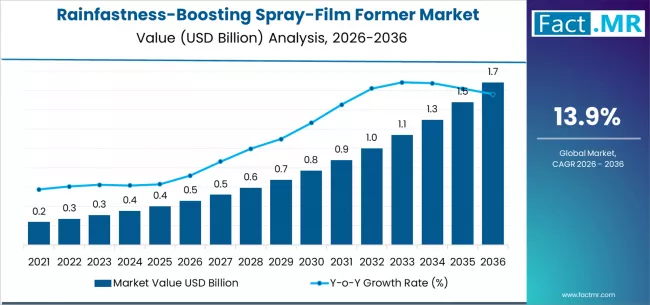
Rainfastness Boosting Spray Film Former Market Market Value Analysis | Source: Fact.MR
Critical trends involve the development of multifunctional film formers that enhance adhesion, reduce evaporation, and improve pesticide uptake alongside rainfastness. Innovation is progressing towards environmentally benign, bio-based resins that degrade after fulfilling their protective role. Integration of these additives into tank-mix recommendation engines and precision spraying systems is becoming standard to optimize performance across diverse weather scenarios.
Regulatory pressures to improve pesticide application efficiency and reduce environmental runoff are significant market drivers. Policies that mandate or incentivize best management practices for spray application indirectly promote the adoption of high-quality adjuvants. Regulatory acceptance of novel, biodegradable polymer chemistries is also accelerating, supporting the shift away from traditional, persistent materials.
Rainfastness-Boosting Spray-Film Former Market
| Metric | Value |
|---|---|
| Market Value (2026) | USD 0.46 Billion |
| Market Forecast Value (2036) | USD 1.68 Billion |
| Forecast CAGR (2026-2036) | 13.9% |
Source: Fact.MR analysis. Updated Dec 22, 2025
Category
| Category | Segments |
|---|---|
| Film-Former Chemistry | Latex & Acrylic Polymer Films, Silicone-Modified Film Formers, Bio-Based Resin & Terpene Films, Wax & Paraffin Emulsion Systems, Others |
| Compatibility Type | Systemic Pesticides, Contact Fungicides, Insecticides, Foliar Nutrients & Biostimulants, Others |
| Crop Type | Fruits & Vegetables, Cereals & Grains, Plantation & Export Crops, Vineyards, Others |
| Region | North America, Latin America, Western Europe, Eastern Europe, East Asia, South Asia & Pacific, MEA |
Source: Fact.MR analysis. Updated Dec 22, 2025
Segmental Analysis
By Film-Former Chemistry, Which System Delivers Durable Adhesion?
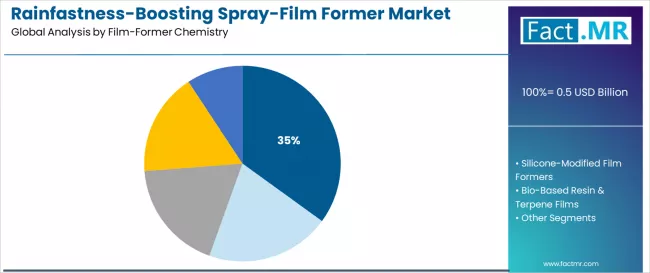
Rainfastness Boosting Spray Film Former Market Analysis By Film Former Chemistry | Source: Fact.MR
Latex and acrylic polymer films lead the segment with a 35% share. This dominance is rooted in their ability to form a tough, flexible, and transparent film that strongly binds spray droplets to leaf surfaces. These polymers resist cracking and weathering, maintaining a protective shield over the active ingredient. Their proven performance across a wide range of temperatures and humidity levels makes them a reliable, mainstream choice for growers.
By Compatibility Type, Which Application Demands the Highest Protection?
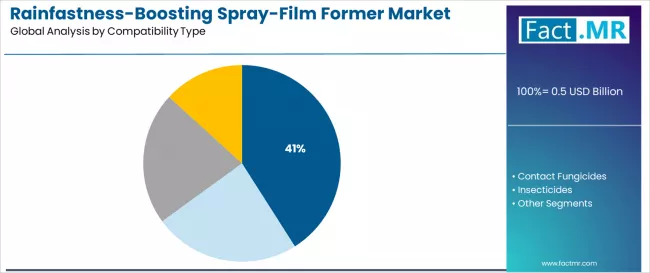
Rainfastness Boosting Spray Film Former Market Analysis By Compatibility Type | Source: Fact.MR
Systemic pesticides hold the largest compatibility share at 41%. These chemicals require time to be absorbed into plant tissues to be effective. A wash-off event shortly after application represents a total loss of product and control. Film formers are essential for safeguarding this critical absorption window, ensuring the chemical remains in place long enough to translocate, directly protecting the farmer's investment and the crop's health.
By Crop Type, Where is Produce Quality Most Vulnerable to Application Gaps?
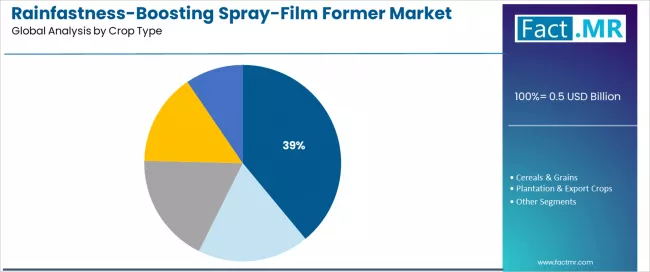
Rainfastness Boosting Spray Film Former Market Analysis By Crop Type | Source: Fact.MR
Fruits and vegetables command a 39% share. The high economic value and sensitivity to cosmetic defects in this sector make consistent pest and disease control imperative. Unplanned rain after spraying can lead to immediate control failure and crop loss. Growers of these high-value crops prioritize film-forming adjuvants as a non-negotiable insurance policy to guarantee application success and protect yield quality.
What are the Drivers, Restraints, and Key Trends of the Rainfastness-Boosting Spray-Film Former Market?
Market growth is driven by increasing climate volatility and unpredictable rainfall patterns that disrupt carefully timed spray schedules. The rising cost of advanced pesticide actives makes protecting that investment from wash-off economically critical. A growing global focus on improving pesticide application efficiency and reducing environmental contamination through drift and runoff further supports adjuvant adoption.
A primary restraint is the potential for phytotoxicity if film formers are used incorrectly or under certain environmental conditions, creating a need for careful user education. Compatibility issues with certain tank-mix partners can limit flexibility. The perception of adjuvants as an optional extra cost, rather than a core component of the application, can also hinder uptake in some markets.
Key trends include the formulation of multi-polymer blends that balance adhesion with elasticity. The rise of precision digital tools recommends specific film formers based on real-time weather forecasts and the pesticide's mode of action. Sustainable chemistry trends are pushing development towards high-performance, fully biodegradable film-forming agents.
Analysis of the Rainfastness-Boosting Spray-Film Former Market by Key Countries
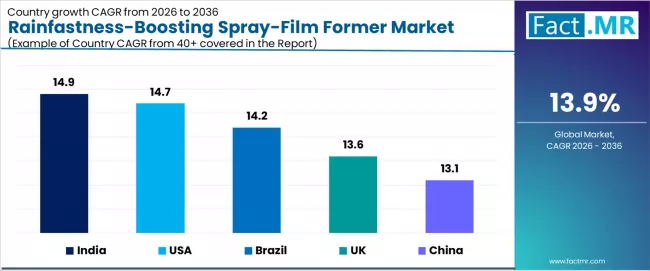
Rainfastness Boosting Spray Film Former Market Cagr Analysis By Country | Source: Fact.MR
| Country | CAGR (2026-2036) |
|---|---|
| USA | 14.70% |
| India | 14.90% |
| Brazil | 14.20% |
| UK | 13.60% |
| China | 13.10% |
Source: Fact.MR analysis. Updated Dec 22, 2025
How does the USA's Professional Crop Management Culture Fuel Demand?
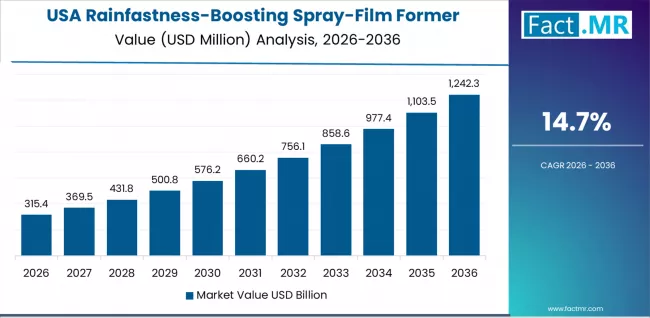
Rainfastness Boosting Spray Film Former Market Country Value Analysis | Source: Fact.MR
The USA exhibits a 14.70% CAGR, driven by a professional farming approach that meticulously manages risk and input efficiency. With high-value specialty crops and large-scale row crop operations, American growers cannot afford spray failures. The widespread use of custom applicators and contract spraying services, which guarantee results, makes premium rainfastness adjuvants a standard tool for ensuring application reliability and maintaining service quality across diverse geographies.
Why does India's Monsoon-Dependent Agriculture Create a Critical Need?
India leads with a 14.90% CAGR, directly linked to the challenge of scheduling pesticide applications around the unpredictable monsoon rains. A sudden downpour can wipe out a smallholder's entire investment in crop protection. The growing adoption of film formers is seen as a vital risk-mitigation strategy, especially for high-value vegetable and fruit growers. Cost-effective, easy-to-use products are gaining rapid traction as awareness of their protective benefits spreads.
What drives Brazil's Adoption in High-Rainfall Crop Systems?
Brazil's 14.20% growth is fueled by the frequency of convective rainfall events in its tropical and subtropical cropping regions. Farmers spraying vast areas of soybeans, cotton, or citrus have a narrow window for optimal application. Film formers extend this window significantly, providing peace of mind and operational flexibility. The practice is becoming embedded in spray programs as a necessary step to combat high humidity and frequent rain showers.
How does the UK's Changeable Maritime Climate Influence Adjuvant Use?
The UK's 13.60% growth is shaped by its notoriously unpredictable weather, where rain is possible at any time. Cereal and potato growers, in particular, rely on precisely timed fungicide applications. The use of effective film formers is considered a standard best practice to protect these crucial inputs. The strong influence of agricultural advisors and integrated crop management schemes promotes the adoption of these adjuvant technologies as part of responsible stewardship.
What Factors Underpin Steady Growth in China's Intensive Production?
China's 13.10% growth is supported by the intensification and professionalization of its agriculture. As farm sizes grow and production becomes more market-oriented, the cost of crop failure rises. The government's push to reduce pesticide waste and increase utilization efficiency aligns with the function of film-forming adjuvants. Adoption is growing in protected horticulture and high-value field crops where every spray application must yield a guaranteed result.
Competitive Landscape of the Rainfastness-Boosting Spray-Film Former Market
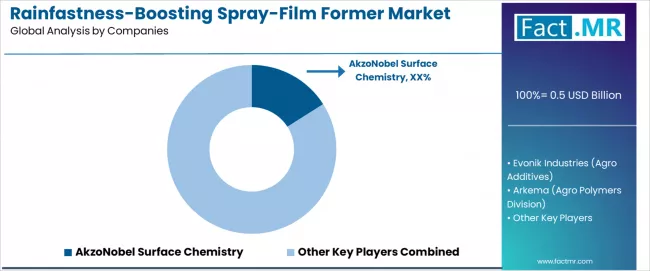
Rainfastness Boosting Spray Film Former Market Analysis By Company | Source: Fact.MR
Global specialty chemical companies with deep expertise in polymer and surface science dominate the market. Leaders like AkzoNobel Surface Chemistry, Evonik Industries, and Arkema compete based on extensive R&D portfolios, offering a range of synthetic and bio-based film-forming chemistries tailored to different pesticide chemistries and crop types. Their strength lies in technical support and providing validated tank-mix compatibility data.
Firms like Wacker Chemie AG and Elementis PLC compete through specialized silicone and rheology modifier technologies that enhance film performance. Competition centers on product differentiation through superior rainfastness ratings, low phytotoxicity risk, and ease of tank-mixing. Success requires building strong relationships with both pesticide formulators, who may incorporate film formers into pre-mixed products, and with adjuvant distributors who serve the end-user grower market.
Key Players in the Rainfastness-Boosting Spray-Film Former Market
- AkzoNobel Surface Chemistry
- Evonik Industries (Agro Additives)
- Arkema (Agro Polymers Division)
- Wacker Chemie AG
- Elementis PLC
Segmentation
Scope of Report
| Items | Values |
|---|---|
| Quantitative Units | USD Billion |
| Film-Former Chemistry | Latex & Acrylic Polymer Films, Silicone-Modified Film Formers, Bio-Based Resin & Terpene Films, Wax & Paraffin Emulsion Systems, Others |
| Compatibility Type | Systemic Pesticides, Contact Fungicides, Insecticides, Foliar Nutrients & Biostimulants, Others |
| Crop Type | Fruits & Vegetables, Cereals & Grains, Plantation & Export Crops, Vineyards, Others |
| Key Countries | USA, India, Brazil, UK, China |
| Key Companies | AkzoNobel Surface Chemistry, Evonik Industries (Agro Additives), Arkema (Agro Polymers Division), Wacker Chemie AG, Elementis PLC |
| Additional Analysis | Analysis of film formation dynamics on different leaf surfaces, rain simulation efficacy testing protocols, long-term phytotoxicity studies, and environmental degradation profiles of polymer films. |
Source: Fact.MR analysis. Updated Dec 22, 2025
Rainfastness-Boosting Spray-Film Former Market by Segments
-
Film-Former Chemistry :
- Latex & Acrylic Polymer Films
- Silicone-Modified Film Formers
- Bio-Based Resin & Terpene Films
- Wax & Paraffin Emulsion Systems
- Others
-
Compatibility Type :
- Systemic Pesticides
- Contact Fungicides
- Insecticides
- Foliar Nutrients & Biostimulants
- Others
-
Crop Type :
- Fruits & Vegetables
- Cereals & Grains
- Plantation & Export Crops
- Vineyards
- Others
-
Region :
-
North America
- USA
- Canada
-
Latin America
- Brazil
- Mexico
- Argentina
- Rest of Latin America
-
Western Europe
- Germany
- UK
- France
- Spain
- Italy
- BENELUX
- Rest of Western Europe
-
Eastern Europe
- Czech Republic
- Poland
- Russia
- Rest of Eastern Europe
-
East Asia
- China
- Japan
- South Korea
- Rest of East Asia
-
South Asia & Pacific
- India
- Indonesia
- Australia
- Rest of South Asia & Pacific
-
MEA
- GCC Countries
- Turkiye
- Saudi Arabia
- Rest of MEA
-
Frequently Asked Questions
How big is the rainfastness-boosting spray-film former market in 2026?
What will be the size of rainfastness-boosting spray-film former market in 2036?
How much will be the rainfastness-boosting spray-film former market growth between 2026 and 2036?
What are the key product types in the rainfastness-boosting spray-film former market?
Which compatibility type segment to contribute significant share in the rainfastness-boosting spray-film former market in 2026?
Who worked on this report


Preview the report firsthand - request a free sample
Free SampleGet the brochure for pricing and purchase details
Download PDF