Regenerable Acid Gas Removal Chemicals Market
Regenerable Acid Gas Removal Chemicals Market Size and Share Forecast Outlook 2026 to 2036
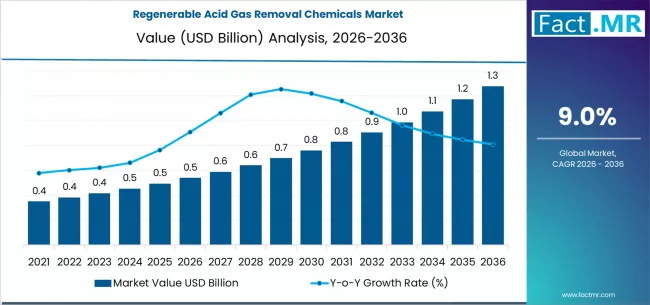
Regenerable acid gas removal chemicals market is projected to grow from USD 0.5 billion in 2026 to USD 1.3 billion by 2036, at a CAGR of 9.0%. Amino Acid Salt-Based Solvents will dominate with a 30.0% market share, while co₂ will lead the target gas segment with a 38.0% share.
Regenerable Acid Gas Removal Chemicals Market Forecast and Outlook 2026 to 2036
The global market for regenerable acid gas removal chemicals is poised for significant growth, driven by the expanding need for efficient and sustainable gas purification across energy and industrial sectors. Projected to rise from USD 0.54 billion in 2026 to USD 1.28 billion by 2036, the market is forecast to advance at a 9.0% CAGR.
Key Takeaways from the Regenerable Acid Gas Removal Chemicals Market
- Market Value for 2026: USD 0.54 Billion
- Market Value for 2036: USD 1.28 Billion
- Forecast CAGR (2026-2036): 9.0%
- Leading Chemical Type Share (2026): Amino Acid Salt-Based Solvents (30%)
- Leading Target Gas Share (2026): CO₂ (38%)
- Leading End-Use Industry Share (2026): Oil & Gas Processing (28%)
- Key Players in the Market: BASF SE, Shell Catalysts & Technologies, Huntsman Corporation, Fluor Corporation (Econamine), MHI Engineering/KM-CDR
Amino acid salt-based solvents represent the leading chemical type, capturing a 30% market share. Carbon dioxide (CO₂) is the primary target gas for removal, accounting for 38% of demand. The oil and gas processing industry stands as the dominant end-use sector, holding a 28% share, due to its extensive requirements for gas sweetening and conditioning.
This growth trajectory is anchored in the global push for cleaner energy and industrial processes, alongside stricter environmental regulations governing acid gas emissions. Regenerable chemicals, which can be reused over multiple absorption-desorption cycles, offer a more economical and environmentally favorable alternative to single-use sorbents for large-volume gas streams. Their ability to purify natural gas, treat flue gases, and capture CO₂ for utilization or storage makes them indispensable in the transition to lower-carbon operations.
Continuous innovation focuses on enhancing solvent capacity, reducing regeneration energy, and improving resistance to degradation. These advancements are critical for lowering the operational costs of gas treatment plants and enabling compliance with increasingly stringent emission and product specifications across diverse industries.
Metric
| Metric | Value |
|---|---|
| Market Value (2026) | USD 0.54 Billion |
| Market Forecast Value (2036) | USD 1.28 Billion |
| Forecast CAGR (2026-2036) | 9.0% |
Category
| Category | Segments |
|---|---|
| Chemical Type | Amino Acid Salt-Based Solvents, Advanced Aqueous Amine Blends, Ionic Liquid-Based Absorbents, Activated Carbon & Adsorbent Systems, Other Regenerable Acid Gas Removal Chemicals |
| Target Gas | CO₂, H₂S, SO₂/SOx, NOx, Other Acid Gas Mixtures |
| End-Use Industry | Oil & Gas Processing, Power Generation & Utilities, Petrochemical & Refining, Cement & Steel Manufacturing, Waste-to-Energy & Industrial Emissions |
| Region | North America, Latin America, Western Europe, Eastern Europe, East Asia, South Asia & Pacific, MEA |
Segmental Analysis
By Chemical Type, Which Formulation is Gaining Prominence?
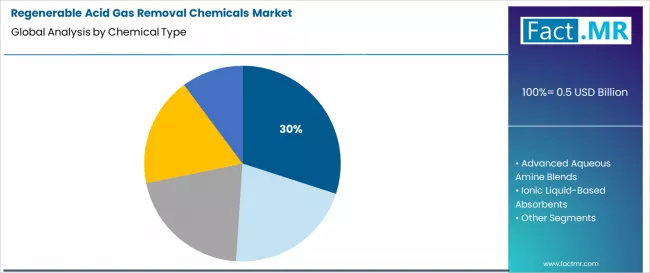
Amino acid salt-based solvents lead this segment with a 30% share. Their growing preference is attributed to a superior environmental and operational profile compared to traditional amines. These solvents exhibit lower volatility, reducing solvent loss and fugitive emissions.
They often demonstrate higher oxidative stability and lower corrosion potential, extending equipment life. Their effectiveness in capturing CO₂ and H₂S, coupled with a favorable toxicity profile, positions them as a key technology for sustainable gas treatment, particularly in projects with stringent safety and emission requirements.
By Target Gas, Which Contaminant Represents the Largest Volume?
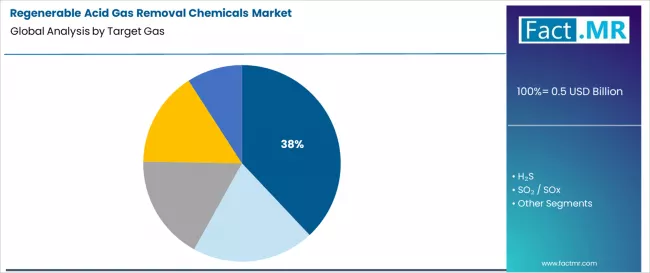
CO₂ is the dominant target gas, holding a 38% share. This predominance is driven by dual applications: natural gas sweetening to meet pipeline specifications and post-combustion CO₂ capture for sequestration or utilization.
The sheer volume of CO₂ emissions from power and industrial sources, combined with evolving carbon pricing and CCS initiatives, creates sustained, large-scale demand for efficient, regenerable capture technologies. This focus makes CO₂ capture the primary engine for solvent development and sales.
By End-Use Industry, Which Sector Relies Heavily on These Chemicals?
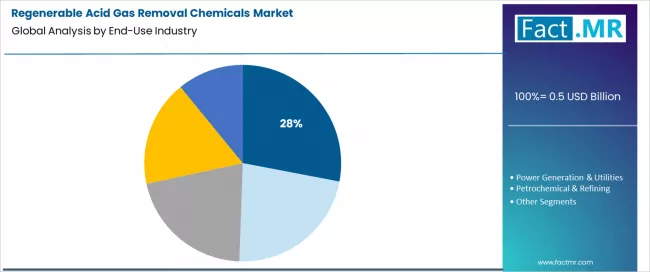
The oil and gas processing industry is the largest end-use sector, accounting for a 28% share. This sector's operations are fundamentally dependent on acid gas removal to purify raw natural gas (sweetening) and to meet LNG feedstock specifications.
The continuous, high-pressure nature of gas processing facilities necessitates reliable, regenerable solvent systems capable of handling large and variable gas flows. This non-discretionary need for product quality and pipeline compliance ensures consistent and foundational demand.
What are the Drivers, Restraints, and Key Trends of the Regenerable Acid Gas Removal Chemicals Market?
Stringent global regulations governing sulfur content in fuels and emissions of CO₂ and SOx are the primary market drivers. The expansion of natural gas production and processing, especially from sour gas fields, directly increases demand for H₂S removal technologies. The growth of CCUS projects worldwide is creating a major new demand stream for high-performance CO₂ capture solvents. The economic imperative to reduce solvent consumption and waste disposal costs further incentivizes investment in efficient, long-life regenerable systems.
A significant market restraint is the high energy penalty associated with solvent regeneration, particularly for CO₂ capture, which impacts plant efficiency and operating costs. Solvent degradation from oxygen, heat, and contaminants like SOx can lead to increased makeup chemical costs, corrosion, and formation of harmful degradation products. The capital intensity of installing or retrofitting absorption-stripper units with advanced solvent systems can be a barrier, especially in commodity-driven industries during periods of low prices.
Key trends include the active development of hybrid and phase-change solvents designed to significantly lower regeneration energy through unique desorption mechanisms. There is accelerating research into water-lean solvents and ionic liquids that promise higher CO₂ loading capacity and reduced water evaporation losses. The market is also progressing toward integrated digital process optimization tools that use AI and real-time analytics to monitor solvent health, predict degradation, and optimize regeneration parameters for maximum efficiency and minimal emissions.
Analysis of the Regenerable Acid Gas Removal Chemicals Market by Key Countries
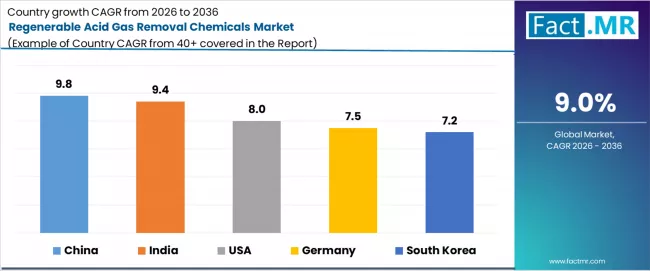
| Country | CAGR (2026-2036) |
|---|---|
| China | 9.80% |
| India | 9.40% |
| USA | 8.00% |
| Germany | 7.50% |
| South Korea | 7.20% |
How do China’s Energy Transition and Emission Goals Drive the Market?
China’s leading CAGR of 9.80% is fueled by its dual focus on cleaning up its industrial emissions and developing its vast natural gas infrastructure. National CCUS demonstration projects and ultra-low emission standards for power and steel plants drive demand for advanced CO₂ and SOx capture solvents.
The growing imports and domestic production of natural gas, including sour gas, necessitate substantial investment in gas sweetening capacity, creating a robust market for regenerable acid gas removal technologies.
What is the Impact of India’s Growing Gas Economy and Industrial Compliance?
India’s 9.40% growth is propelled by its national drive to increase the share of natural gas in its energy mix and tighten industrial emission norms. The expansion of LNG import terminals, city gas distribution networks, and domestic gas processing creates steady demand for gas treating chemicals.
Parallelly, environmental regulations pushing coal-fired power plants and refineries to control SOx and NOx emissions are opening new applications for regenerable scrubbing technologies beyond traditional oil and gas.
How does the USA’s Mature Energy Sector and Policy Support Influence Demand?
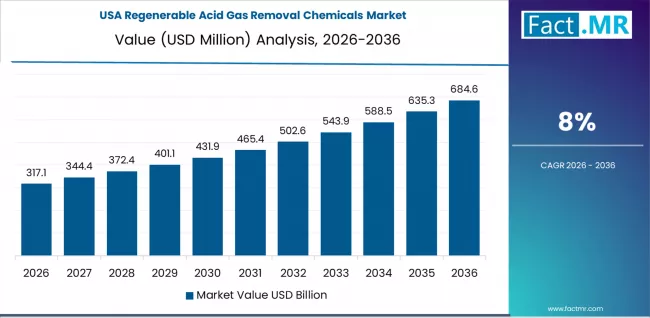
The USA’s 8.00% CAGR is supported by its extensive and active oil & gas processing sector, particularly in shale regions, which requires continuous gas treating. Strong policy support for CCUS through the 45Q tax credit is catalyzing investments in point-source CO₂ capture projects, many of which will employ advanced regenerable solvents.
The market is characterized by the deployment of next-generation solvents aimed at improving the economics of both enhanced oil recovery (EOR) and dedicated geological storage.
Why is Germany a Hub for High-Performance and Sustainable Solvent Development?
Germany’s 7.50% growth reflects its leadership in chemical engineering and its commitment to industrial decarbonization. German research institutions and companies are at the forefront of developing novel, energy-efficient solvents like advanced amino acid salts and ionic liquids.
The stringent EU industrial emissions directive and focus on energy efficiency create a demanding market for solvents that offer lower regeneration energy and higher stability, driving innovation for applications in biomass/waste incineration and chemical production.
What Role does South Korea’s Industrial Complex and Carbon Neutrality Plan Play?
South Korea’s 7.20% growth is anchored in its large petrochemical and refining sector, which requires extensive acid gas removal. The country’s ambitious 2050 carbon neutrality roadmap is spurring investments in CO₂ capture from power plants and industrial sites.
This strategic focus, combined with the need to treat emissions from its advanced manufacturing base, drives demand for high-efficiency, regenerable chemical systems suitable for integration into complex industrial processes.
Competitive Landscape of the Regenerable Acid Gas Removal Chemicals Market
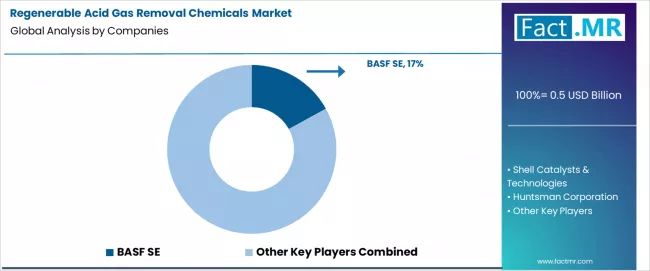
Large multinational chemical and energy companies possessing deep process technology expertise define the competitive landscape. Leaders like BASF and Shell Catalysts & Technologies compete based on their proprietary solvent portfolios, comprehensive licensable process designs, and global technical service networks.
Competition centers on demonstrating quantifiable reductions in energy consumption and total cost of ownership, providing extensive piloting data, and offering integrated solutions that include solvent management and reclamation services. A key differentiator is the ability to tailor solvent formulations and process designs for specific gas compositions and client economic criteria.
Key Players in the Regenerable Acid Gas Removal Chemicals Market
- BASF SE
- Shell Catalysts & Technologies
- Huntsman Corporation
- Fluor Corporation (Econamine)
- MHI Engineering/KM-CDR
Scope of Report
| Items | Values |
|---|---|
| Quantitative Units | USD Billion |
| Chemical Type | Amino Acid Salts, Advanced Amine Blends, Ionic Liquids, Adsorbent Systems, Other Regenerable Chemicals |
| Target Gas | CO₂, H₂S, SOx, NOx, Mixed Gases |
| End-Use Industry | Oil & Gas Processing, Power Generation, Petrochemicals, Cement & Steel, Waste-to-Energy |
| Key Countries | China, India, USA, Germany, South Korea |
| Key Companies | BASF SE, Shell Catalysts & Technologies, Huntsman Corporation, Fluor Corporation (Econamine), MHI Engineering/KM-CDR |
| Additional Analysis | Analysis of solvent absorption capacity and kinetics; regeneration energy benchmarking; degradation pathways and mitigation; corrosion performance; techno-economic analysis for different gas streams; environmental fate and biodegradability of solvents and degradation products. |
Market by Segments
-
Chemical Type :
- Amino Acid Salt-Based Solvents
- Advanced Aqueous Amine Blends
- Ionic Liquid-Based Absorbents
- Activated Carbon & Adsorbent Systems
- Other Regenerable Acid Gas Removal Chemicals
-
Target Gas :
- CO₂
- H₂S
- SO₂/SOx
- NOx
- Other Acid Gas Mixtures
-
End-Use Industry :
- Oil & Gas Processing
- Power Generation & Utilities
- Petrochemical & Refining
- Cement & Steel Manufacturing
- Waste-to-Energy & Industrial Emissions
-
Region :
-
North America
- USA
- Canada
-
Latin America
- Brazil
- Mexico
- Argentina
- Rest of Latin America
-
Western Europe
- Germany
- UK
- France
- Spain
- Italy
- BENELUX
- Rest of Western Europe
-
Eastern Europe
- Russia
- Poland
- Czech Republic
- Rest of Eastern Europe
-
East Asia
- China
- Japan
- South Korea
- Rest of East Asia
-
South Asia & Pacific
- India
- ASEAN
- Australia
- Rest of South Asia & Pacific
-
MEA
- Saudi Arabia
- UAE
- Turkiye
- Rest of MEA
-
Table of Content
- Executive Summary
- Global Market Outlook
- Demand to side Trends
- Supply to side Trends
- Technology Roadmap Analysis
- Analysis and Recommendations
- Market Overview
- Market Coverage / Taxonomy
- Market Definition / Scope / Limitations
- Market Background
- Market Dynamics
- Drivers
- Restraints
- Opportunity
- Trends
- Scenario Forecast
- Demand in Optimistic Scenario
- Demand in Likely Scenario
- Demand in Conservative Scenario
- Opportunity Map Analysis
- Product Life Cycle Analysis
- Supply Chain Analysis
- Investment Feasibility Matrix
- Value Chain Analysis
- PESTLE and Porter’s Analysis
- Regulatory Landscape
- Regional Parent Market Outlook
- Production and Consumption Statistics
- Import and Export Statistics
- Market Dynamics
- Global Market Analysis 2021 to 2025 and Forecast, 2026 to 2036
- Historical Market Size Value (USD Million) Analysis, 2021 to 2025
- Current and Future Market Size Value (USD Million) Projections, 2026 to 2036
- Y to o to Y Growth Trend Analysis
- Absolute $ Opportunity Analysis
- Global Market Pricing Analysis 2021 to 2025 and Forecast 2026 to 2036
- Global Market Analysis 2021 to 2025 and Forecast 2026 to 2036, By Chemical Type
- Introduction / Key Findings
- Historical Market Size Value (USD Million) Analysis By Chemical Type, 2021 to 2025
- Current and Future Market Size Value (USD Million) Analysis and Forecast By Chemical Type, 2026 to 2036
- Amino Acid Salt-Based Solvents
- Advanced Aqueous Amine Blends
- Ionic Liquid-Based Absorbents
- Activated Carbon & Adsorbent Systems
- Other Regenerable Acid Gas Removal Chemicals
- Amino Acid Salt-Based Solvents
- Y to o to Y Growth Trend Analysis By Chemical Type, 2021 to 2025
- Absolute $ Opportunity Analysis By Chemical Type, 2026 to 2036
- Global Market Analysis 2021 to 2025 and Forecast 2026 to 2036, By Target Gas
- Introduction / Key Findings
- Historical Market Size Value (USD Million) Analysis By Target Gas, 2021 to 2025
- Current and Future Market Size Value (USD Million) Analysis and Forecast By Target Gas, 2026 to 2036
- CO₂
- H₂S
- SO₂ / SOx
- NOx
- Other Acid Gas Mixtures
- CO₂
- Y to o to Y Growth Trend Analysis By Target Gas, 2021 to 2025
- Absolute $ Opportunity Analysis By Target Gas, 2026 to 2036
- Global Market Analysis 2021 to 2025 and Forecast 2026 to 2036, By End-Use Industry
- Introduction / Key Findings
- Historical Market Size Value (USD Million) Analysis By End-Use Industry, 2021 to 2025
- Current and Future Market Size Value (USD Million) Analysis and Forecast By End-Use Industry, 2026 to 2036
- Oil & Gas Processing
- Power Generation & Utilities
- Petrochemical & Refining
- Cement & Steel Manufacturing
- Waste-to-Energy & Industrial Emissions
- Oil & Gas Processing
- Y to o to Y Growth Trend Analysis By End-Use Industry, 2021 to 2025
- Absolute $ Opportunity Analysis By End-Use Industry, 2026 to 2036
- Global Market Analysis 2021 to 2025 and Forecast 2026 to 2036, By Region
- Introduction
- Historical Market Size Value (USD Million) Analysis By Region, 2021 to 2025
- Current Market Size Value (USD Million) Analysis and Forecast By Region, 2026 to 2036
- North America
- Latin America
- Western Europe
- Eastern Europe
- East Asia
- South Asia and Pacific
- Middle East & Africa
- Market Attractiveness Analysis By Region
- North America Market Analysis 2021 to 2025 and Forecast 2026 to 2036, By Country
- Historical Market Size Value (USD Million) Trend Analysis By Market Taxonomy, 2021 to 2025
- Market Size Value (USD Million) Forecast By Market Taxonomy, 2026 to 2036
- By Country
- USA
- Canada
- Mexico
- By Chemical Type
- By Target Gas
- By End-Use Industry
- By Country
- Market Attractiveness Analysis
- By Country
- By Chemical Type
- By Target Gas
- By End-Use Industry
- Key Takeaways
- Latin America Market Analysis 2021 to 2025 and Forecast 2026 to 2036, By Country
- Historical Market Size Value (USD Million) Trend Analysis By Market Taxonomy, 2021 to 2025
- Market Size Value (USD Million) Forecast By Market Taxonomy, 2026 to 2036
- By Country
- Brazil
- Chile
- Rest of Latin America
- By Chemical Type
- By Target Gas
- By End-Use Industry
- By Country
- Market Attractiveness Analysis
- By Country
- By Chemical Type
- By Target Gas
- By End-Use Industry
- Key Takeaways
- Western Europe Market Analysis 2021 to 2025 and Forecast 2026 to 2036, By Country
- Historical Market Size Value (USD Million) Trend Analysis By Market Taxonomy, 2021 to 2025
- Market Size Value (USD Million) Forecast By Market Taxonomy, 2026 to 2036
- By Country
- Germany
- UK
- Italy
- Spain
- France
- Nordic
- BENELUX
- Rest of Western Europe
- By Chemical Type
- By Target Gas
- By End-Use Industry
- By Country
- Market Attractiveness Analysis
- By Country
- By Chemical Type
- By Target Gas
- By End-Use Industry
- Key Takeaways
- Eastern Europe Market Analysis 2021 to 2025 and Forecast 2026 to 2036, By Country
- Historical Market Size Value (USD Million) Trend Analysis By Market Taxonomy, 2021 to 2025
- Market Size Value (USD Million) Forecast By Market Taxonomy, 2026 to 2036
- By Country
- Russia
- Poland
- Hungary
- Balkan & Baltic
- Rest of Eastern Europe
- By Chemical Type
- By Target Gas
- By End-Use Industry
- By Country
- Market Attractiveness Analysis
- By Country
- By Chemical Type
- By Target Gas
- By End-Use Industry
- Key Takeaways
- East Asia Market Analysis 2021 to 2025 and Forecast 2026 to 2036, By Country
- Historical Market Size Value (USD Million) Trend Analysis By Market Taxonomy, 2021 to 2025
- Market Size Value (USD Million) Forecast By Market Taxonomy, 2026 to 2036
- By Country
- China
- Japan
- South Korea
- By Chemical Type
- By Target Gas
- By End-Use Industry
- By Country
- Market Attractiveness Analysis
- By Country
- By Chemical Type
- By Target Gas
- By End-Use Industry
- Key Takeaways
- South Asia and Pacific Market Analysis 2021 to 2025 and Forecast 2026 to 2036, By Country
- Historical Market Size Value (USD Million) Trend Analysis By Market Taxonomy, 2021 to 2025
- Market Size Value (USD Million) Forecast By Market Taxonomy, 2026 to 2036
- By Country
- India
- ASEAN
- Australia & New Zealand
- Rest of South Asia and Pacific
- By Chemical Type
- By Target Gas
- By End-Use Industry
- By Country
- Market Attractiveness Analysis
- By Country
- By Chemical Type
- By Target Gas
- By End-Use Industry
- Key Takeaways
- Middle East & Africa Market Analysis 2021 to 2025 and Forecast 2026 to 2036, By Country
- Historical Market Size Value (USD Million) Trend Analysis By Market Taxonomy, 2021 to 2025
- Market Size Value (USD Million) Forecast By Market Taxonomy, 2026 to 2036
- By Country
- Kingdom of Saudi Arabia
- Other GCC Countries
- Turkiye
- South Africa
- Other African Union
- Rest of Middle East & Africa
- By Chemical Type
- By Target Gas
- By End-Use Industry
- By Country
- Market Attractiveness Analysis
- By Country
- By Chemical Type
- By Target Gas
- By End-Use Industry
- Key Takeaways
- Key Countries Market Analysis
- USA
- Pricing Analysis
- Market Share Analysis, 2025
- By Chemical Type
- By Target Gas
- By End-Use Industry
- Canada
- Pricing Analysis
- Market Share Analysis, 2025
- By Chemical Type
- By Target Gas
- By End-Use Industry
- Mexico
- Pricing Analysis
- Market Share Analysis, 2025
- By Chemical Type
- By Target Gas
- By End-Use Industry
- Brazil
- Pricing Analysis
- Market Share Analysis, 2025
- By Chemical Type
- By Target Gas
- By End-Use Industry
- Chile
- Pricing Analysis
- Market Share Analysis, 2025
- By Chemical Type
- By Target Gas
- By End-Use Industry
- Germany
- Pricing Analysis
- Market Share Analysis, 2025
- By Chemical Type
- By Target Gas
- By End-Use Industry
- UK
- Pricing Analysis
- Market Share Analysis, 2025
- By Chemical Type
- By Target Gas
- By End-Use Industry
- Italy
- Pricing Analysis
- Market Share Analysis, 2025
- By Chemical Type
- By Target Gas
- By End-Use Industry
- Spain
- Pricing Analysis
- Market Share Analysis, 2025
- By Chemical Type
- By Target Gas
- By End-Use Industry
- France
- Pricing Analysis
- Market Share Analysis, 2025
- By Chemical Type
- By Target Gas
- By End-Use Industry
- India
- Pricing Analysis
- Market Share Analysis, 2025
- By Chemical Type
- By Target Gas
- By End-Use Industry
- ASEAN
- Pricing Analysis
- Market Share Analysis, 2025
- By Chemical Type
- By Target Gas
- By End-Use Industry
- Australia & New Zealand
- Pricing Analysis
- Market Share Analysis, 2025
- By Chemical Type
- By Target Gas
- By End-Use Industry
- China
- Pricing Analysis
- Market Share Analysis, 2025
- By Chemical Type
- By Target Gas
- By End-Use Industry
- Japan
- Pricing Analysis
- Market Share Analysis, 2025
- By Chemical Type
- By Target Gas
- By End-Use Industry
- South Korea
- Pricing Analysis
- Market Share Analysis, 2025
- By Chemical Type
- By Target Gas
- By End-Use Industry
- Russia
- Pricing Analysis
- Market Share Analysis, 2025
- By Chemical Type
- By Target Gas
- By End-Use Industry
- Poland
- Pricing Analysis
- Market Share Analysis, 2025
- By Chemical Type
- By Target Gas
- By End-Use Industry
- Hungary
- Pricing Analysis
- Market Share Analysis, 2025
- By Chemical Type
- By Target Gas
- By End-Use Industry
- Kingdom of Saudi Arabia
- Pricing Analysis
- Market Share Analysis, 2025
- By Chemical Type
- By Target Gas
- By End-Use Industry
- Turkiye
- Pricing Analysis
- Market Share Analysis, 2025
- By Chemical Type
- By Target Gas
- By End-Use Industry
- South Africa
- Pricing Analysis
- Market Share Analysis, 2025
- By Chemical Type
- By Target Gas
- By End-Use Industry
- USA
- Market Structure Analysis
- Competition Dashboard
- Competition Benchmarking
- Market Share Analysis of Top Players
- By Regional
- By Chemical Type
- By Target Gas
- By End-Use Industry
- Competition Analysis
- Competition Deep Dive
- BASF SE
- Overview
- Product Portfolio
- Profitability by Market Segments (Product/Age /Sales Channel/Region)
- Sales Footprint
- Strategy Overview
- Marketing Strategy
- Product Strategy
- Channel Strategy
- Shell Catalysts & Technologies
- Huntsman Corporation
- Fluor Corporation (Econamine)
- MHI Engineering / KM-CDR
- BASF SE
- Competition Deep Dive
- Assumptions & Acronyms Used
- Research Methodology
List Of Table
- Table 1: Global Market Value (USD Million) Forecast by Region, 2021 to 2036
- Table 2: Global Market Value (USD Million) Forecast by Chemical Type, 2021 to 2036
- Table 3: Global Market Value (USD Million) Forecast by Target Gas, 2021 to 2036
- Table 4: Global Market Value (USD Million) Forecast by End-Use Industry, 2021 to 2036
- Table 5: North America Market Value (USD Million) Forecast by Country, 2021 to 2036
- Table 6: North America Market Value (USD Million) Forecast by Chemical Type, 2021 to 2036
- Table 7: North America Market Value (USD Million) Forecast by Target Gas, 2021 to 2036
- Table 8: North America Market Value (USD Million) Forecast by End-Use Industry, 2021 to 2036
- Table 9: Latin America Market Value (USD Million) Forecast by Country, 2021 to 2036
- Table 10: Latin America Market Value (USD Million) Forecast by Chemical Type, 2021 to 2036
- Table 11: Latin America Market Value (USD Million) Forecast by Target Gas, 2021 to 2036
- Table 12: Latin America Market Value (USD Million) Forecast by End-Use Industry, 2021 to 2036
- Table 13: Western Europe Market Value (USD Million) Forecast by Country, 2021 to 2036
- Table 14: Western Europe Market Value (USD Million) Forecast by Chemical Type, 2021 to 2036
- Table 15: Western Europe Market Value (USD Million) Forecast by Target Gas, 2021 to 2036
- Table 16: Western Europe Market Value (USD Million) Forecast by End-Use Industry, 2021 to 2036
- Table 17: Eastern Europe Market Value (USD Million) Forecast by Country, 2021 to 2036
- Table 18: Eastern Europe Market Value (USD Million) Forecast by Chemical Type, 2021 to 2036
- Table 19: Eastern Europe Market Value (USD Million) Forecast by Target Gas, 2021 to 2036
- Table 20: Eastern Europe Market Value (USD Million) Forecast by End-Use Industry, 2021 to 2036
- Table 21: East Asia Market Value (USD Million) Forecast by Country, 2021 to 2036
- Table 22: East Asia Market Value (USD Million) Forecast by Chemical Type, 2021 to 2036
- Table 23: East Asia Market Value (USD Million) Forecast by Target Gas, 2021 to 2036
- Table 24: East Asia Market Value (USD Million) Forecast by End-Use Industry, 2021 to 2036
- Table 25: South Asia and Pacific Market Value (USD Million) Forecast by Country, 2021 to 2036
- Table 26: South Asia and Pacific Market Value (USD Million) Forecast by Chemical Type, 2021 to 2036
- Table 27: South Asia and Pacific Market Value (USD Million) Forecast by Target Gas, 2021 to 2036
- Table 28: South Asia and Pacific Market Value (USD Million) Forecast by End-Use Industry, 2021 to 2036
- Table 29: Middle East & Africa Market Value (USD Million) Forecast by Country, 2021 to 2036
- Table 30: Middle East & Africa Market Value (USD Million) Forecast by Chemical Type, 2021 to 2036
- Table 31: Middle East & Africa Market Value (USD Million) Forecast by Target Gas, 2021 to 2036
- Table 32: Middle East & Africa Market Value (USD Million) Forecast by End-Use Industry, 2021 to 2036
List Of Figures
- Figure 1: Global Market Pricing Analysis
- Figure 2: Global Market Value (USD Million) Forecast 2021 to 2036
- Figure 3: Global Market Value Share and BPS Analysis by Chemical Type, 2026 and 2036
- Figure 4: Global Market Y to o to Y Growth Comparison by Chemical Type, 2026 to 2036
- Figure 5: Global Market Attractiveness Analysis by Chemical Type
- Figure 6: Global Market Value Share and BPS Analysis by Target Gas, 2026 and 2036
- Figure 7: Global Market Y to o to Y Growth Comparison by Target Gas, 2026 to 2036
- Figure 8: Global Market Attractiveness Analysis by Target Gas
- Figure 9: Global Market Value Share and BPS Analysis by End-Use Industry, 2026 and 2036
- Figure 10: Global Market Y to o to Y Growth Comparison by End-Use Industry, 2026 to 2036
- Figure 11: Global Market Attractiveness Analysis by End-Use Industry
- Figure 12: Global Market Value (USD Million) Share and BPS Analysis by Region, 2026 and 2036
- Figure 13: Global Market Y to o to Y Growth Comparison by Region, 2026 to 2036
- Figure 14: Global Market Attractiveness Analysis by Region
- Figure 15: North America Market Incremental Dollar Opportunity, 2026 to 2036
- Figure 16: Latin America Market Incremental Dollar Opportunity, 2026 to 2036
- Figure 17: Western Europe Market Incremental Dollar Opportunity, 2026 to 2036
- Figure 18: Eastern Europe Market Incremental Dollar Opportunity, 2026 to 2036
- Figure 19: East Asia Market Incremental Dollar Opportunity, 2026 to 2036
- Figure 20: South Asia and Pacific Market Incremental Dollar Opportunity, 2026 to 2036
- Figure 21: Middle East & Africa Market Incremental Dollar Opportunity, 2026 to 2036
- Figure 22: North America Market Value Share and BPS Analysis by Country, 2026 and 2036
- Figure 23: North America Market Value Share and BPS Analysis by Chemical Type, 2026 and 2036
- Figure 24: North America Market Y to o to Y Growth Comparison by Chemical Type, 2026 to 2036
- Figure 25: North America Market Attractiveness Analysis by Chemical Type
- Figure 26: North America Market Value Share and BPS Analysis by Target Gas, 2026 and 2036
- Figure 27: North America Market Y to o to Y Growth Comparison by Target Gas, 2026 to 2036
- Figure 28: North America Market Attractiveness Analysis by Target Gas
- Figure 29: North America Market Value Share and BPS Analysis by End-Use Industry, 2026 and 2036
- Figure 30: North America Market Y to o to Y Growth Comparison by End-Use Industry, 2026 to 2036
- Figure 31: North America Market Attractiveness Analysis by End-Use Industry
- Figure 32: Latin America Market Value Share and BPS Analysis by Country, 2026 and 2036
- Figure 33: Latin America Market Value Share and BPS Analysis by Chemical Type, 2026 and 2036
- Figure 34: Latin America Market Y to o to Y Growth Comparison by Chemical Type, 2026 to 2036
- Figure 35: Latin America Market Attractiveness Analysis by Chemical Type
- Figure 36: Latin America Market Value Share and BPS Analysis by Target Gas, 2026 and 2036
- Figure 37: Latin America Market Y to o to Y Growth Comparison by Target Gas, 2026 to 2036
- Figure 38: Latin America Market Attractiveness Analysis by Target Gas
- Figure 39: Latin America Market Value Share and BPS Analysis by End-Use Industry, 2026 and 2036
- Figure 40: Latin America Market Y to o to Y Growth Comparison by End-Use Industry, 2026 to 2036
- Figure 41: Latin America Market Attractiveness Analysis by End-Use Industry
- Figure 42: Western Europe Market Value Share and BPS Analysis by Country, 2026 and 2036
- Figure 43: Western Europe Market Value Share and BPS Analysis by Chemical Type, 2026 and 2036
- Figure 44: Western Europe Market Y to o to Y Growth Comparison by Chemical Type, 2026 to 2036
- Figure 45: Western Europe Market Attractiveness Analysis by Chemical Type
- Figure 46: Western Europe Market Value Share and BPS Analysis by Target Gas, 2026 and 2036
- Figure 47: Western Europe Market Y to o to Y Growth Comparison by Target Gas, 2026 to 2036
- Figure 48: Western Europe Market Attractiveness Analysis by Target Gas
- Figure 49: Western Europe Market Value Share and BPS Analysis by End-Use Industry, 2026 and 2036
- Figure 50: Western Europe Market Y to o to Y Growth Comparison by End-Use Industry, 2026 to 2036
- Figure 51: Western Europe Market Attractiveness Analysis by End-Use Industry
- Figure 52: Eastern Europe Market Value Share and BPS Analysis by Country, 2026 and 2036
- Figure 53: Eastern Europe Market Value Share and BPS Analysis by Chemical Type, 2026 and 2036
- Figure 54: Eastern Europe Market Y to o to Y Growth Comparison by Chemical Type, 2026 to 2036
- Figure 55: Eastern Europe Market Attractiveness Analysis by Chemical Type
- Figure 56: Eastern Europe Market Value Share and BPS Analysis by Target Gas, 2026 and 2036
- Figure 57: Eastern Europe Market Y to o to Y Growth Comparison by Target Gas, 2026 to 2036
- Figure 58: Eastern Europe Market Attractiveness Analysis by Target Gas
- Figure 59: Eastern Europe Market Value Share and BPS Analysis by End-Use Industry, 2026 and 2036
- Figure 60: Eastern Europe Market Y to o to Y Growth Comparison by End-Use Industry, 2026 to 2036
- Figure 61: Eastern Europe Market Attractiveness Analysis by End-Use Industry
- Figure 62: East Asia Market Value Share and BPS Analysis by Country, 2026 and 2036
- Figure 63: East Asia Market Value Share and BPS Analysis by Chemical Type, 2026 and 2036
- Figure 64: East Asia Market Y to o to Y Growth Comparison by Chemical Type, 2026 to 2036
- Figure 65: East Asia Market Attractiveness Analysis by Chemical Type
- Figure 66: East Asia Market Value Share and BPS Analysis by Target Gas, 2026 and 2036
- Figure 67: East Asia Market Y to o to Y Growth Comparison by Target Gas, 2026 to 2036
- Figure 68: East Asia Market Attractiveness Analysis by Target Gas
- Figure 69: East Asia Market Value Share and BPS Analysis by End-Use Industry, 2026 and 2036
- Figure 70: East Asia Market Y to o to Y Growth Comparison by End-Use Industry, 2026 to 2036
- Figure 71: East Asia Market Attractiveness Analysis by End-Use Industry
- Figure 72: South Asia and Pacific Market Value Share and BPS Analysis by Country, 2026 and 2036
- Figure 73: South Asia and Pacific Market Value Share and BPS Analysis by Chemical Type, 2026 and 2036
- Figure 74: South Asia and Pacific Market Y to o to Y Growth Comparison by Chemical Type, 2026 to 2036
- Figure 75: South Asia and Pacific Market Attractiveness Analysis by Chemical Type
- Figure 76: South Asia and Pacific Market Value Share and BPS Analysis by Target Gas, 2026 and 2036
- Figure 77: South Asia and Pacific Market Y to o to Y Growth Comparison by Target Gas, 2026 to 2036
- Figure 78: South Asia and Pacific Market Attractiveness Analysis by Target Gas
- Figure 79: South Asia and Pacific Market Value Share and BPS Analysis by End-Use Industry, 2026 and 2036
- Figure 80: South Asia and Pacific Market Y to o to Y Growth Comparison by End-Use Industry, 2026 to 2036
- Figure 81: South Asia and Pacific Market Attractiveness Analysis by End-Use Industry
- Figure 82: Middle East & Africa Market Value Share and BPS Analysis by Country, 2026 and 2036
- Figure 83: Middle East & Africa Market Value Share and BPS Analysis by Chemical Type, 2026 and 2036
- Figure 84: Middle East & Africa Market Y to o to Y Growth Comparison by Chemical Type, 2026 to 2036
- Figure 85: Middle East & Africa Market Attractiveness Analysis by Chemical Type
- Figure 86: Middle East & Africa Market Value Share and BPS Analysis by Target Gas, 2026 and 2036
- Figure 87: Middle East & Africa Market Y to o to Y Growth Comparison by Target Gas, 2026 to 2036
- Figure 88: Middle East & Africa Market Attractiveness Analysis by Target Gas
- Figure 89: Middle East & Africa Market Value Share and BPS Analysis by End-Use Industry, 2026 and 2036
- Figure 90: Middle East & Africa Market Y to o to Y Growth Comparison by End-Use Industry, 2026 to 2036
- Figure 91: Middle East & Africa Market Attractiveness Analysis by End-Use Industry
- Figure 92: Global Market - Tier Structure Analysis
- Figure 93: Global Market - Company Share Analysis
- FAQs -
How big is the regenerable acid gas removal chemicals market in 2026?
The global regenerable acid gas removal chemicals market is estimated to be valued at USD 0.5 billion in 2026.
What will be the size of regenerable acid gas removal chemicals market in 2036?
The market size for the regenerable acid gas removal chemicals market is projected to reach USD 1.3 billion by 2036.
How much will be the regenerable acid gas removal chemicals market growth between 2026 and 2036?
The regenerable acid gas removal chemicals market is expected to grow at a 9.0% CAGR between 2026 and 2036.
What are the key product types in the regenerable acid gas removal chemicals market?
The key product types in regenerable acid gas removal chemicals market are amino acid salt-based solvents, advanced aqueous amine blends, ionic liquid-based absorbents, activated carbon & adsorbent systems and other regenerable acid gas removal chemicals.
Which target gas segment to contribute significant share in the regenerable acid gas removal chemicals market in 2026?
In terms of target gas, co₂ segment to command 38.0% share in the regenerable acid gas removal chemicals market in 2026.