- Base Value(2026): 4.9 Bn
- Estimated Value(2026): 4.9 Bn
- Forecast Value (2036): 11.6 Bn
- CAGR (2026 - 2036): 9%
Regenerative Brake Control Module Market Forecast Outlook 2026 to 2036
The regenerative brake control module market is likely to be valued at USD 4.9 billion in 2026 and is projected to reach USD 11.6 billion by 2036, expanding at a 9% compound annual growth rate (CAGR).
Key Takeaways from Regenerative Brake Control Module Market
- Regenerative Brake Control Module Market Value (2026): USD 4.9 billion
- Regenerative Brake Control Module Market Forecast Value (2036): USD 11.6 billion
- Regenerative Brake Control Module Market Forecast CAGR (2026-2036): 9%
- Leading Segment in Regenerative Brake Control Module Market: First Fit (OEM) Sales Channel (86%)
- Key Growth Region in Regenerative Brake Control Module Market: Asia Pacific
- Key Players in Regenerative Brake Control Module Market: Robert Bosch GmbH (Bosch), Continental AG, ZF Friedrichshafen AG (ZF), Hitachi Astemo Ltd., Denso Corporation, Aptiv PLC, Brembo S.p.A., Mando Corporation, Nidec Corporation, Valeo SA
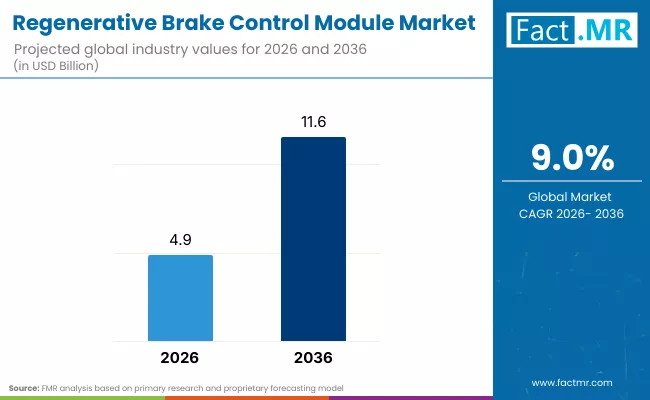
Regenerative Brake Control Module Market Industry | Source: Fact.MR
Over the next decade, market dominance is shifting from those who supply hardware to the "system architects" who command the software-defined braking (SDB) ecosystem. As Dr. Markus Heyn, Chairman of Bosch Mobility, observed in late 2025 regarding this pivot toward software-integrated chassis control, "with brake-by-wire, we expect to achieve cumulative sales revenue of more than 7 billion euros by 2032... software-driven vehicles are user-centered and are constantly learning through updates."
This transition reflects a deeper industry trend where cost structures are being re-weighted toward silicon and functional safety R&D rather than traditional casting. Pricing control is increasingly localized within the hands of Tier 1s who offer "One-Box" integrated units, which capture higher margins by reducing OEM assembly complexity. Ultimately, value is no longer captured through friction-component volume but through the proprietary algorithms that optimize energy recuperation and vehicle stability in real-time.
Regenerative Brake Control Module Market
| Metric | Value |
|---|---|
| Estimated Value in (2026E) | USD 4.9 billion |
| Forecast Value in (2036F) | USD 11.6 billion |
| Forecast CAGR (2026 to 2036) | 9% |
Source: Fact.MR analysis. Updated Feb 4, 2026
Category
| Category | Segments |
|---|---|
| Sales Channel | First Fit (OEM); Aftermarket |
| Electrification | BEV; PHEV; HEV |
| Architecture | Brake-by-wire Integrated; Regen Blending (Conventional) |
| Voltage | 400V; 800V |
| Module Type | Integrated with ESC/ABS; Standalone |
| Vehicle Type | Passenger Cars; LCV; HCV |
| Region | North America; Europe; Asia Pacific; Latin America; Middle East & Africa |
Source: Fact.MR analysis. Updated Feb 4, 2026
Segmental Analysis
What is Driving the Dominance of 400V Voltage in the Regenerative Brake Control Module Market?
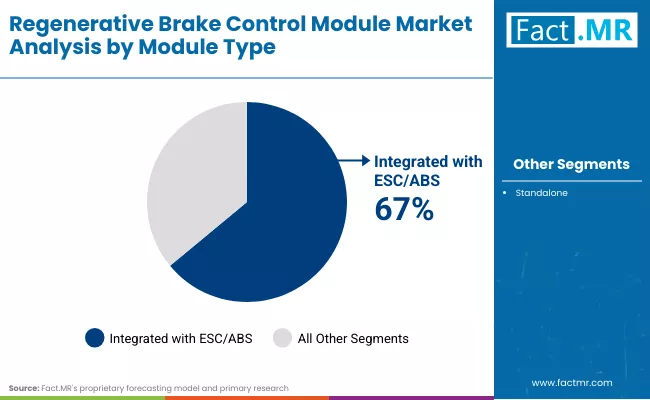
Regenerative Brake Control Module Market | Source: Fact.MR
The 400V voltage architecture holds 67% of the market share in 2026. This dominance is primarily driven by its widespread use in Electric Vehicles (EVs) and Hybrid Electric Vehicles (HEVs), which typically utilize 400V systems for efficient energy regeneration during braking. This voltage level strikes a balance between performance and cost-effectiveness, making it the standard for most passenger EVs and light commercial vehicles. The 400V system is also supported by existing infrastructure, allowing for seamless integration into modern vehicle platforms.
What is the Market Share of Integrated and Standalone Regenerative Brake Control Modules?
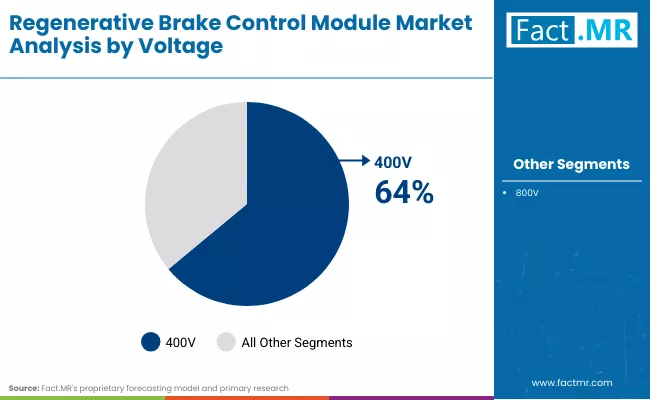
Regenerative Brake Control Module Market Voltage | Source: Fact.MR
The Integrated with ESC/ABS module type leads the market with 64% of the share in 2026. This integration enables better coordination between regenerative braking and the vehicle's electronic stability control (ESC) and anti-lock braking system (ABS), providing enhanced safety and efficiency. On the other hand, Standalone regenerative brake control modules, while growing in popularity, represent a smaller portion of the market. These modules are primarily used in high-performance or specialized applications, offering greater customization but at higher costs.
Regenerative Brake Control Module Market — Drivers, Restraints & Trends
| Country | Drivers | Restraints | Trends |
|---|---|---|---|
| USA | Strong EV/HEV adoption and regulatory fuel economy targets increase RBCM demand. | Higher component cost and integration complexity limit uptake in lower segments. | Integration with vehicle stability and energy recovery systems. |
| China | Largest EV market globally drives massive RBCM requirement. | Cost sensitivity in entry EV/HEV segments limits premium modules. | Local manufacturing to reduce costs and lead time. |
| India | Growing EV policy support and rising hybrid interest fuel RBCM adoption. | Lower EV penetration and price‑sensitive market restrain near‑term growth. | Aftermarket and retrofit RB systems in commercial fleets. |
| Germany | Strong BEV/PHEV production and emission targets boost demand. | Electrification shifts may consolidate module suppliers. | High‑performance RBCM optimized for safety and efficiency. |
| Japan | OEM leadership in hybrid systems sustains RBCM volumes. | Slower full EV uptake limits long‑term demand. | Compact, energy‑efficient control units integrated with hybrid powertrains. |
| South Korea | Rapid EV diffusion and advanced automotive electronics demand RBCMs. | Competitive component pricing pressure. | Adoption of intelligent brake energy recovery strategies. |
| Mexico | Expanding EV/HEV assembly for export drives RBCM use. | Cost constraints and slower local EV adoption. | Aftermarket growth as hybrid/electric fleets age. |
Source: Fact.MR analysis. Updated Feb 4, 2026
Analysis of the Regenerative Brake Control Module Market by Key Country
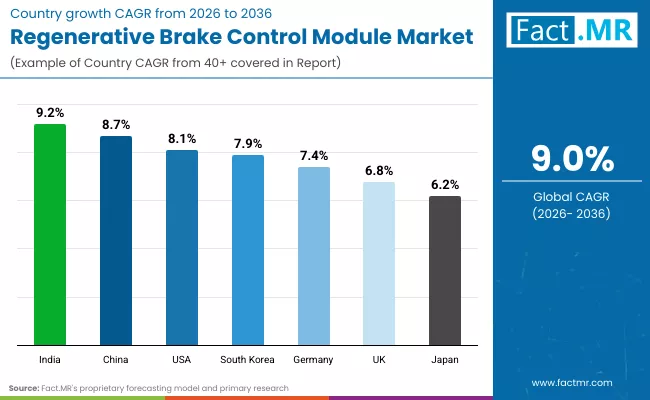
Regenerative Brake Control Module Market Country | Source: Fact.MR
| Country | CAGR (Forecast Period) |
|---|---|
| USA | 8.1% |
| China | 8.7% |
| India | 9.2% |
| Germany | 7.4% |
| Japan | 6.2% |
| South Korea | 7.9% |
| UK | 6.8% |
Source: Fact.MR analysis. Updated Feb 4, 2026
What Drives the 8.1% Growth in the USA Regenerative Brake Control Module Market?
The USA regenerative brake control module market is growing at 8.1%, driven by the increasing adoption of electric vehicles (EVs) and hybrids that require advanced regenerative braking systems to improve battery efficiency. Under the NHTSA’s 2026 safety standards, the integration of regenerative braking systems is becoming more common in both electric trucks and luxury SUVs, where maximizing energy recovery during braking is critical. The EV production incentives under the Inflation Reduction Act (IRA) are also accelerating the development of next-gen braking modules in domestic manufacturing, further increasing market demand. The growing focus on fuel efficiency and low-emission standards is pushing the need for regenerative braking technologies that help meet CAFE fuel economy targets while providing enhanced vehicle safety.
Why is the China Regenerative Brake Control Module Market Projected to Expand at 8.7%?
China’s 8.7% growth in the regenerative brake control module market is largely influenced by the country’s dominance in electric vehicle production. With NEV sales growing rapidly, the Chinese government is pushing for increased vehicle electrification, where regenerative braking systems play a key role in battery optimization. The MIIT’s 2025-2026 Automotive Industry Growth Plan places emphasis on the integration of regenerative braking in mid-range EVs and PHEVs, making the market highly competitive for local manufacturers like BYD and NIO. Additionally, China's commitment to reducing carbon emissions aligns with the growing need for regenerative braking control modules that maximize energy recovery, contributing to the market's expansion in the country.
How Does the 9.2% Growth Reflect the India Regenerative Brake Control Module Market Expansion?
India leads the market with a 9.2% growth, driven by the Production Linked Incentive (PLI) Scheme and the rapid shift to electric vehicles. India’s growing EV adoption, particularly in urban areas, is spurring demand for high-efficiency regenerative braking systems that can enhance the driving range of electric cars. In 2026, the enforcement of BS6 Phase 2 norms is pushing manufacturers to integrate regenerative braking into mid-range and premium EVs and commercial vehicles. The rise of EV infrastructure across India also encourages Tier 1 suppliers to localize production, driving down costs and enhancing the competitiveness of regenerative brake control modules.
What Factors Drive the 7.4% Growth for the Germany Regenerative Brake Control Module Market?
In Germany, the 7.4% growth is driven by Euro 7 regulations, which place a strong emphasis on reducing non-exhaust emissions like tire and brake dust. Regenerative braking control modules are critical in optimizing vehicle efficiency and reducing particulate matter, aligning with Germany’s commitment to sustainable mobility. German luxury carmakers like Mercedes-Benz, BMW, and Audi are incorporating regenerative braking in their premium hybrids and electric vehicles. Furthermore, the rise of level 3 autonomous vehicles in Germany necessitates regenerative braking control systems that are highly integrated with advanced driver-assistance systems (ADAS) for enhanced safety and efficiency.
How Does Japan Achieve 6.2% Growth in the Regenerative Brake Control Module Market?
Japan’s 6.2% growth in the regenerative brake control module market is shaped by the Green Transformation (GX) 2040 Vision and the country’s leadership in hybrid vehicle production. Japan's focus on energy-efficient hybrid vehicles like Toyota’s Prius has made regenerative braking a standard feature in most Japanese vehicles. The integration of AI-driven regenerative braking systems is allowing manufacturers like Hitachi Astemo to improve energy efficiency and vehicle stability. With Japan's aging population, there is also an increased emphasis on smooth, comfortable driving experiences, which regenerative braking technologies facilitate, further driving demand in the local market.
Why Does South Korea Exhibit 7.9% Growth in Regenerative Brake Control Modules?
South Korea’s 7.9% growth is bolstered by the K-Mobility Global Leadership Strategy, which focuses on electric vehicle development and smart braking technologies. South Korean manufacturers like Hyundai and Kia are integrating regenerative braking systems into their hybrid and EV lineups, aligning with government incentives for clean energy vehicles. Additionally, South Korea is at the forefront of AI-powered chassis control systems, where regenerative braking is a key component. The development of autonomous vehicles in South Korea also drives the need for regenerative braking systems that ensure seamless, energy-efficient driving experiences.
How is the UK Regenerative Brake Control Module Market Maintaining a 6.8% Rate?
The 6.8% growth in the UK regenerative brake control module market is driven by the country's strong push for low-emission vehicles as part of its Carbon Neutrality goals. The UK government’s incentives for electric and hybrid vehicles are prompting automakers to include regenerative braking systems as standard, especially in premium EVs. The Advanced Propulsion Centre (APC) in the UK is funding research into next-gen regenerative braking technologies, which are designed to improve both efficiency and safety. Additionally, urban mobility initiatives in the UK, including the push for autonomous shuttles, are driving demand for advanced braking systems that integrate seamlessly with AI-driven technologies.
How Are Participants Competing in the Regenerative Brake Control Module Market?
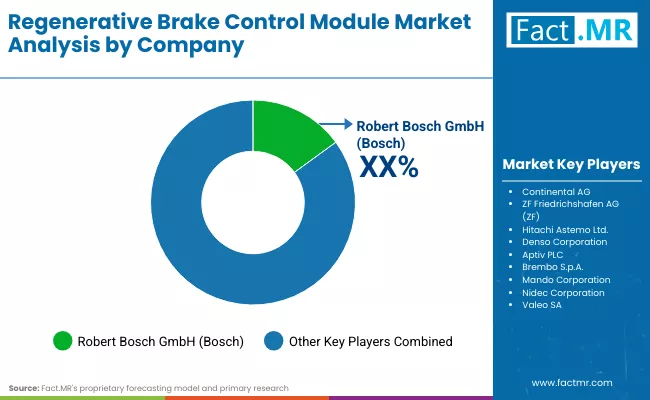
Regenerative Brake Control Module Market Company | Source: Fact.MR
Competition in the regenerative brake control module market centers on advanced braking technologies and integration with electric powertrains. Bosch and Continental lead by offering sophisticated brake control modules with AI-powered energy recovery. ZF Friedrichshafen and Hitachi Astemo focus on hybrid and electric vehicle integration, optimizing braking efficiency. Denso Corporation and Aptiv emphasize software-driven regenerative braking systems for seamless integration with autonomous vehicle platforms. Brembo targets high-performance braking solutions, while Mando Corporation and Nidec deliver cost-effective, scalable systems for mainstream EVs. Differentiation is driven by energy efficiency, system integration, and scalability for electric mobility.
Recent Industry Developments
- Patent Publication (Sept 27, 2023): A regenerative braking control module that generates regenerative braking commands based on interpreted torque limits was published as part of a vehicle brake system controller. This directly relates to control logic and hardware modules used in regenerative braking systems.
- Patent Filing (2024): A regenerative braking control system for electric vehicles that optimizes energy recuperation while coordinating friction and regenerative braking using control circuitry and actuator coordination was detailed in an international patent (EP4308425A4) entering the European phase in Dec 2023.
- Academic Research (2024): A model for optimizing regenerative brake control in electric vehicles was published, introducing an energy-efficient strategy that dynamically distributes braking forces to enhance regeneration efficiency - demonstrating systemic control advancements relevant to control modules.
Key Players of the Regenerative Brake Control Module Market
- Robert Bosch GmbH (Bosch)
- Continental AG
- ZF Friedrichshafen AG (ZF)
- Hitachi Astemo Ltd.
- Denso Corporation
- Aptiv PLC
- Brembo S.p.A.
- Mando Corporation
- Nidec Corporation
- Valeo SA
Bibliographies
- United Nations Economic Commission for Europe (UNECE). (2024). UN Regulation No. 13 and 13-H - Braking performance and electronic control requirements for passenger vehicles. UNECE Transport Division.
- National Highway Traffic Safety Administration (NHTSA). (2023). Federal Motor Vehicle Safety Standards: Hydraulic and electric brake systems performance. U.S. Department of Transportation.
- International Organization for Standardization. (2023). ISO 26262: Road vehicles - Functional safety of electrical and electronic systems. ISO.
- Institute of Electrical and Electronics Engineers (IEEE). (2024). Regenerative braking energy management and motor control algorithms in EV powertrains. IEEE Xplore Digital Library.
- European Commission Joint Research Centre. (2024). Energy recovery and braking control technologies in electrified vehicles. JRC Technical Report.
Segmentation
Scope of the Report
| Items | Values |
|---|---|
| Quantitative Units (2026) | USD Billion |
| Sales Channel | First Fit (OEM), Aftermarket |
| Electrification | BEV, PHEV, HEV |
| Architecture | Brake-by-wire Integrated, Regen Blending (Conventional) |
| Voltage | 400V, 800V |
| Module Type | Integrated with ESC/ABS, Standalone |
| Vehicle Type | Passenger Cars, LCV, HCV |
| Regions Covered | North America, Europe, Asia Pacific, Latin America, Middle East & Africa |
| Countries Covered | United States, Canada, Mexico, Germany, United Kingdom, France, Japan, South Korea, China, India, Brazil, and other countries |
| Key Companies Profiled | Robert Bosch GmbH (Bosch), Continental AG, ZF Friedrichshafen AG (ZF), Hitachi Astemo Ltd., Denso Corporation, Aptiv PLC, Brembo S.p.A., Mando Corporation, Nidec Corporation, Valeo SA |
| Additional Attributes | Dollar revenue by sales channel, electrification, architecture, voltage, module type, vehicle type, and region; regional demand trends, competitive landscape, technological advancements in regenerative brake control modules, operational performance optimization initiatives, and product development strategies |
Source: Fact.MR analysis. Updated Feb 4, 2026
Regenerative Brake Control Module Market Key Segments
-
Sales Channel :
- First Fit (OEM)
- Aftermarket
-
Electrification :
- BEV
- PHEV
- HEV
-
Architecture :
- Brake-by-wire Integrated
- Regen Blending (Conventional)
-
Voltage :
- 400V
- 800V
-
Module Type :
- Integrated with ESC/ABS
- Standalone
-
Vehicle Type :
- Passenger Cars
- LCV (Light Commercial Vehicle)
- HCV (Heavy Commercial Vehicle)
-
Region :
- North America
- USA
- Canada
- Mexico
- Europe
- Germany
- UK
- France
- Italy
- Spain
- Nordic Countries
- BENELUX
- Rest of Europe
- Asia Pacific
- China
- Japan
- South Korea
- India
- Australia
- Rest of Asia Pacific
- Latin America
- Brazil
- Argentina
- Rest of Latin America
- Middle East and Africa
- Kingdom of Saudi Arabia
- United Arab Emirates
- South Africa
- Rest of Middle East and Africa
- Other Regions
- Oceania
- Central Asia
- Other Markets
- North America
Frequently Asked Questions
What is the projected market size for regenerative brake control modules in 2026?
What value is expected for regenerative brake control modules in 2036?
At what rate will the regenerative brake control module market progress from 2026 to 2036?
Which sales channel dominates demand and what share does it hold?
Which region is expected to experience the fastest growth and what rate is it projected at?
Who are the major players in the regenerative brake control module market?
Who worked on this report


Preview the report firsthand - request a free sample
Free SampleGet the brochure for pricing and purchase details
Download PDF