- Market Value (2025): USD 221.7 Mn
- Estimated Value (2026): USD 236.1 Mn
- Forecast Value (2036): USD 442.3 Mn
- CAGR (2026-2036): 6.5%
What is the Resealable Anti-fog Lidding Films Market forecast to be worth by 2036?
USD 236.1 million in 2026 to USD 442.3 million by 2036, at a 6.5% CAGR.
- As per Fact.MR analysis, the anti-fog lidding films market reached USD 221.7 million in 2025.
- Sales are projected to increase from USD 236.1 million in 2026 to USD 442.3 million by 2036.
- The market is forecast to record a 6.5% CAGR from 2026 to 2036, as chilled-food packers assess clear lids with resealing features.
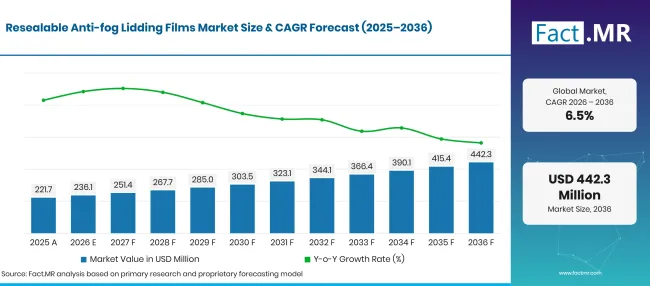
Factmr Resealable Anti Fog Lidding Films Market Forecast Global | Source: Fact.MR
| Year | Basis | Market Value (USD million) |
|---|---|---|
| 2025 | Historical | 221.7 |
| 2026 | Estimate | 236.1 |
| 2036 | Forecast | 442.3 |
| CAGR 2026 to 2036 | Forecast period | 6.5% |
Source: Fact.MR analysis. Updated Oct 16, 2026
What are the defining numbers behind Resealable Anti-fog Lidding Films Market growth?
USD 206.2 million absolute opportunity between 2026 and 2036, with polypropylene and food packaging at the center of product choice.
- Demand Drivers in the Market
- Fresh-food packers need a clear view of chilled trays when moisture collects under the lid. Anti-fog treatment spreads condensed water into a thin film so customers can inspect the product without opening the seal. Film manufacturers checking moisture control also assess anti-fogging masterbatches for packaging films.
- Retail-ready food brands seek a reclosure feature for partially used packs. A resealable top web must still attach reliably to its matching tray after the first peel, especially when consumers return food to refrigeration.
- Tray-sealing operators prefer lidding structures tested at their existing machine speed. A film that reduces sealing interruptions and behaves consistently across batches is easier to qualify for recurring orders.
- Packaging designers have to compare material choices against collection and recycling rules. Eurostat reported 35.3 kg of plastic packaging waste per EU resident in 2023, published in October 2025 [1]. Film design decisions face closer scrutiny as a result.
- Key Segments Analyzed
- By Material Type: Polypropylene is forecast to hold 35.2% share in 2026, reflecting its use in heat-sealable packaging structures.
- By Application: Food Packaging is forecast to account for 42.3% share in 2026, where moisture control helps preserve visibility in chilled displays.
- By End-User: Food and Beverage Industry is estimated to account for 44.6% share in 2026, linked to repeat purchases from tray packers.
- By Distribution Channel: Online Retail is forecast to hold 54.7% share in 2026, making up the stated route to market for film orders.
- Analyst Opinion at Fact.MR
- Shambhu Nath Jha, Principal Consultant at Fact.MR, states, “Film converters first need to make sure the anti-fog layer works with the tray and its sealing surface. Even when a film looks clear in an early test, it must continue to perform after filling, chilled storage and repeated opening and closing.”
- Strategic Implications
- film converters should test anti-fog clarity after chilling alongside opening and reclosure performance, since each function places other requirements on the lid surface.
- Food processors should approve lid and tray combinations together. Seal temperature and opening force become difficult to compare when the tray substrate changes between suppliers.
- Material suppliers should document film construction and food-contact suitability for the intended use, so packers can complete their product approval checks more efficiently.
- Sellers should retain accurate specification records for repeat orders. Online product descriptions need to distinguish anti-fog films from films that also offer a working reclosure feature.
Germany is forecast to grow at 8.3% CAGR through 2036, followed by the United Kingdom at 7.7%. Japan is projected to reach 6.5%, while Brazil carries 6.1% and the United States 5.3%.
How does the Resealable Anti-fog Lidding Films Market break down by segment?
Polypropylene 35.2%; Food Packaging 42.3%; Food and Beverage Industry 44.6%; Online Retail 54.7% in 2026.
Which Material Type leads sales?
Polypropylene accounts for 35.2% share in 2026.
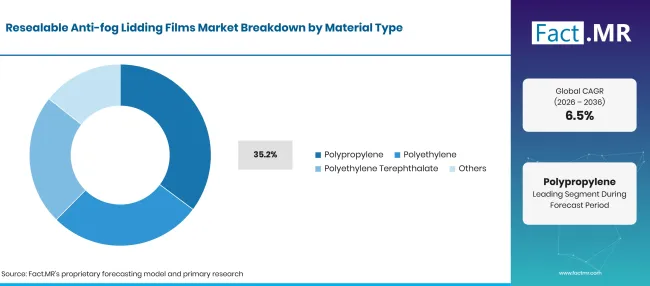
Factmr Resealable Anti Fog Lidding Films Market Breakdown Material Type | Source: Fact.MR
| Which Material Type leads sales | Share (2026) |
|---|---|
| Polypropylene (Leading segment) | 35.2% |
| Other segments combined | 64.8% |
| Total | 100.0% |
Source: Fact.MR analysis. Updated Oct 16, 2026
Polypropylene offers a familiar base for food-contact film construction when its sealing layer matches the tray. Polyethylene remains useful in flexible seal layers and package structures where softness or sealing behavior guides choice. Polyethylene terephthalate is useful when dimensional stability and a clear top web are required. Each material still needs specific testing for reclosure and anti-fog performance, as these functions depend on the entire film design.
What leads the Application?
Food Packaging accounts for 42.3% share in 2026.
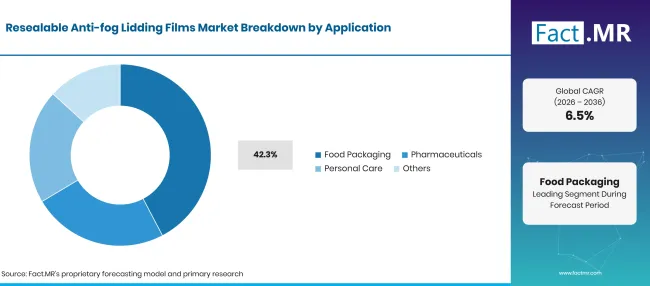
Factmr Resealable Anti Fog Lidding Films Market Breakdown Application | Source: Fact.MR
| What leads the Application | Share (2026) |
|---|---|
| Food Packaging (Leading segment) | 42.3% |
| Other segments combined | 57.7% |
| Total | 100.0% |
Source: Fact.MR analysis. Updated Oct 16, 2026
Food packaging brings together the clearest technical reasons for choosing this type of lid. Chilled prepared foods and fresh items can produce condensation as temperatures change during handling. Buyers also weigh how a consumer closes the pack after serving part of its contents. Pharmaceutical and personal care applications need other closure checks and should be assessed separately from food trays.
How does End-User purchasing shape sales?
Food and Beverage Industry accounts for 44.6% share in 2026.
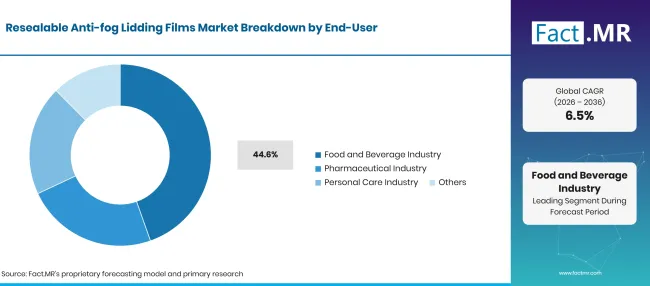
Factmr Resealable Anti Fog Lidding Films Market Breakdown End User | Source: Fact.MR
| How does End-User purchasing shape sales | Share (2026) |
|---|---|
| Food and Beverage Industry (Leading segment) | 44.6% |
| Other segments combined | 55.4% |
| Total | 100.0% |
Source: Fact.MR analysis. Updated Oct 16, 2026
Food and beverage producers buy lidding to match their own tray lines and shelf presentation standards. Stable visual clarity helps shoppers see contents without breaking the pack seal. Trial runs also check whether the lid peels as intended and closes again after first opening. Pharmaceutical and personal care manufacturers use flexible packaging in selected formats, although their requirements can place more weight on barrier properties and controlled access.
Which Distribution Channel captures the largest share?
Online Retail accounts for 54.7% share in 2026.
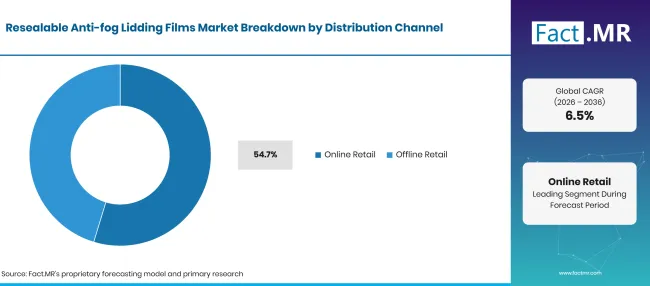
Factmr Resealable Anti Fog Lidding Films Market Breakdown Distribution Channel | Source: Fact.MR
| Which Distribution Channel captures the largest share | Share (2026) |
|---|---|
| Online Retail (Leading segment) | 54.7% |
| Other segments combined | 45.3% |
| Total | 100.0% |
Source: Fact.MR analysis. Updated Oct 16, 2026
Online retail is estimated to account for a 54.7% share of the stated distribution channel split in 2026. Digital ordering can simplify repeat purchases where packers already know the required film specification. For unfamiliar grades, buyers still require samples and trial results before ordering production volumes. Offline retail and direct technical sales remain useful where customers need hands-on advice about tray fit or specific filling-line conditions.
What is accelerating Resealable Anti-fog Lidding Films adoption, and what is holding it back?
Chilled-pack visibility and reclosure support purchases, while material costs and trial requirements can slow adoption.
Drivers Impact Analysis
| DRIVER | (~) % IMPACT ON CAGR | GEOGRAPHIC RELEVANCE | IMPACT TIMELINE |
|---|---|---|---|
| Visibility in chilled displays | +1.0% | Germany, United Kingdom | Short term (≤ 2 years) |
| Convenient reclosure | +0.9% | United States, Japan | Medium term (2–4 years) |
| Tray-line compatibility | +0.7% | Global | Medium term (2–4 years) |
| Food-contact documentation | +0.5% | Europe, Japan | Medium term (2–4 years) |
| Specification-based repeat orders | +0.4% | Global | Long term (≥ 4 years) |
Source: Fact.MR analysis. Updated Oct 16, 2026
Opportunity Impact Analysis
| OPPORTUNITY | (~) % IMPACT ON CAGR | GEOGRAPHIC RELEVANCE | IMPACT TIMELINE |
|---|---|---|---|
| Dual-function film qualification | +0.8% | Global | Medium term (2–4 years) |
| Fresh protein tray applications | +0.6% | Brazil, Germany | Medium term (2–4 years) |
| Mono-material structure development | +0.5% | Europe, United Kingdom | Long term (≥ 4 years) |
| Reorder services for converters | +0.4% | Global | Short term (≤ 2 years) |
Source: Fact.MR analysis. Updated Oct 16, 2026
Restraints Impact Analysis
| RESTRAINT | (~) % IMPACT ON CAGR | GEOGRAPHIC RELEVANCE | IMPACT TIMELINE |
|---|---|---|---|
| Film qualification costs | -0.8% | Global | Short term (≤ 2 years) |
| Conflicting design requirements | -0.6% | Europe, Japan | Medium term (2–4 years) |
| Variable surface performance | -0.5% | Global | Medium term (2–4 years) |
| Packaging waste obligations | -0.4% | Europe, United Kingdom | Long term (≥ 4 years) |
Source: Fact.MR analysis. Updated Oct 16, 2026
Which countries are scaling the Resealable Anti-fog Lidding Films Market through 2036?
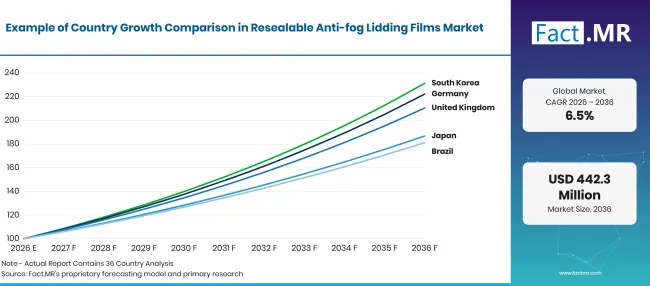
Factmr Resealable Anti Fog Lidding Films Market Growth Index | Source: Fact.MR
| Country | CAGR (2026–2036) |
|---|---|
| Germany | 8.3% |
| United Kingdom | 7.7% |
| Japan | 6.5% |
| Brazil | 6.1% |
| United States | 5.3% |
Source: Fact.MR analysis. Updated Oct 16, 2026
Why is Germany increasing its use of functional lidding?
8.3% CAGR, driven by chilled-food tray production, clear product presentation, and film performance requirements.
German food processors use clear lidding films to make chilled meat and prepared-food products easier to see on store shelves. reported that slaughterhouses produced nearly 3.4 million tonnes of meat in the first half of 2026 [4]. This creates steady demand for packaging films used on meat trays and ready-meal packs. Film suppliers must ensure their products work reliably on existing tray-sealing lines and meet material recovery requirements.
What supports the United Kingdom outlook?
7.7% CAGR, supported by chilled-food spending, retail presentation, and consistent seal performance.
Product presentation plays an important role in the UK chilled-food market, making clear tray lids a common choice across many packaged foods. reported that consumers spent GBP 303.3 billion on food and alcoholic drinks in 2025 [5]. Some brands use resealable packs to add convenience for repeat use after opening. Packaging teams generally review peelability, reclosure performance, and suitability with existing tray materials before making changes.
How is Japan approaching clearer reclosable packs?
6.5% CAGR, shaped by portion packaging, moisture control, and reliable refrigerated performance.
Japanese food packers often prefer compact tray formats that make products easy to see and open during refrigerated storage. The <Ministry of Agriculture, Forestry and Fisheries> estimated business-related food loss at 2.37 million tonnes in fiscal 2024 [6]. Smaller portions and resealable lids can suit products that are consumed over several occasions. Packaging companies also pay close attention to moisture buildup, opening ease, and compatibility with existing plastic collection systems.
What shapes Brazil’s prospects for resealable anti-fog lids?
6.1% CAGR, linked to meat processing, prepared foods, and packaging-line compatibility.
Brazil’s poultry industry creates strong demand for clear packaging used on refrigerated meat products. reported that 6.69 billion chickens were slaughtered in 2025 [3]. Clear lids can help shoppers easily see the product before purchase, which is important for fresh poultry displays. Anti-fog and resealable features are also used in some applications. Packaging suppliers must ensure their films work properly with the tray materials and equipment already used by food processors.
How are United States packers evaluating these films?
5.3% CAGR, influenced by ready-to-eat foods, product visibility, and dependable film supply.
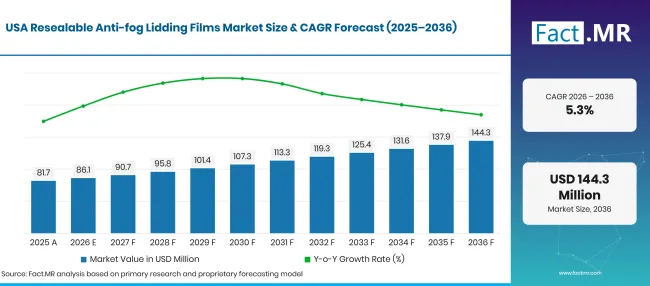
Factmr Resealable Anti Fog Lidding Films Market Forecast Usa | Source: Fact.MR
Refrigerated foods in the United States are often displayed in clear packaging so shoppers can easily see the product before purchase. The reported inflation-adjusted total U.S. food expenditure of USD 2.51 trillion in 2025 [7]. Resealable anti-fog films can help maintain product visibility after packaging and throughout retail display. Food companies also prefer materials that run smoothly on existing production lines. Suppliers need to provide clear guidance on tray compatibility when customers reorder packaging materials.
Who participates in the Resealable Anti-fog Lidding Films Market?
Amcor, Sealed Air, Mondi, Toray Plastics, Uflex, Winpak, Constantia Flexibles, Coveris and ProAmpac are useful packaging businesses.
This market covers documents EVOH barrier film options used in lidding applications and identifies anti-fog additives and reclose options among available functions. Its published film information offers a direct product-level link to the technical scope of this market. Other flexible packaging suppliers compete through sealing layers and converting knowledge, but each individual grade still requires technical confirmation for combined anti-fog and resealable use.
Amcor includes the former Berry Global business after the April 2025 transaction [2]. Sealed Air serves protein and food protection applications, while Mondi and Constantia Flexibles supply flexible packaging solutions. Toray Plastics and Uflex operate in packaging film materials. Winpak and ProAmpac also work with food packaging customers; customers should match each supplier’s actual product specification to the required use rather than assume all lidding grades have identical functions.
Which companies are the key providers?
Key companies include Amcor Plc (including Berry Global); Sealed Air Corporation; Mondi Group; Toray Plastics; Uflex Ltd.; Winpak Ltd.; Constantia Flexibles Group GmbH; Coveris; ProAmpac LLC.
- Amcor Plc (including Berry Global)
- Sealed Air Corporation
- Mondi Group
- Toray Plastics
- Uflex Ltd.
- Winpak Ltd.
- Constantia Flexibles Group GmbH
- Coveris
- ProAmpac LLC
Bibliography
- [1] Eurostat. (2025, October 22). Plastic packaging waste in the EU: 35.3 kg per person.
- [2] Amcor. (2025, April 30). Amcor completes combination with Berry Global; positioned to significantly enhance value for customers and shareholders.
- [3] Instituto Brasileiro de Geografia e Estatística. (2026, March 18). Em 2025, Brasil registra a maior produção de leite, couro e ovos da história; abate de bovinos, frangos e suínos também é recorde.
- [4] Statistisches Bundesamt (Destatis). (2026, August 7). Fleischproduktion im 1. Halbjahr 2026 um 0,7 % gesunken.
- [5] Department for Environment, Food & Rural Affairs. (2026, July 29). Food statistics in your pocket.
- [6] Ministry of Agriculture, Forestry and Fisheries. (2026, June 30). 事業系食品ロス量(2024年度推計値)を公表 [Business-sector food loss volume: FY2024 estimates].
- [7] U.S. Department of Agriculture, Economic Research Service. (2026, June 11). Total U.S. food spending reached $2.51 trillion in 2025.
This Report Answers
- The report compares polymer choices for film manufacturers qualifying clear and reclosable tray lids.
- Segment analysis explains the commercial use of polypropylene and food packaging formats.
- Country outlooks assess film buying conditions in Germany, the United Kingdom, Japan, Brazil and the United States.
- Packaging performance analysis identifies the checks that matter in chilled storage and initial reclosure.
- competitive coverage distinguishes broad flexible-film businesses from recorded products with the exact required properties.
What does the Resealable Anti-fog Lidding Films Market cover?
Resealable lidding films with anti-fog functionality used on compatible food trays and selected specialty packs.
The market covers flexible film lids designed to limit visible misting from condensation while allowing a package to close again after opening. Useful materials include polypropylene and polyethylene, along with polyester-based top webs and other compatible structures.
Adjacent categories covered by Fact.MR include plastic lidding films, where sealing performance is examined across food applications.
What is included in the scope?
Finished film constructions for sealed containers that combine visibility control with repeat closing.
The analysis includes qualifying film materials used with the stated application and end-user groups. Food-contact suitability and tray fit are evaluated within the intended end use. Purchases are classified under online or offline routes according to the channel used for the finished lidding product.
Related film conversion options appear in Fact.MR research on resealable films, covering closure functionality across several packaging types.
What is excluded from the scope?
Standard lids lacking an anti-fog function or working reclosure fall outside the combined-function boundary.
Generic cling wraps and ordinary single-use top films are excluded unless they offer both specified features. Films that carry only an anti-fog additive, without reclosure, remain distinct.
Further product context is available in Fact.MR analysis of anti-fogging masterbatches for packaging films, which concerns an upstream additive category rather than the finished reclosable lid.
For adjacent opening designs, Fact.MR also examines clean-peel lidding films, where first-opening behavior is the product focus.
How Was the Analysis Built?
The analysis draws on 120+ sources, 35+ company portfolios, 25+ countries, and more than 20 industry interviews.
- Primary Research: Primary research includes discussions with manufacturers, service providers, technology developers, distributors, end users, and subject-matter experts. These conversations examine purchasing priorities, product adoption, operational challenges, approval requirements, competitive positioning, and the factors that influence wider market acceptance.
- Desk Research: Desk research covers government statistics, regulatory publications, company filings, trade data, technical studies, industry associations, standards, public policy, and other authoritative sources. Every source used in the analysis is documented in the bibliography.
- Market Sizing and Forecasting: Market estimates combine historical performance, demand indicators, pricing and volume trends, segment shares, company participation, country-level growth, adoption patterns, investment activity, and barriers to market expansion.
- Data Validation and Update Cycle: Findings are validated by comparing primary interviews with public data, company activity, regulatory changes, trade patterns, and industry developments. Regular updates review new product launches, capacity changes, partnerships, approvals, and shifts in commercial adoption.
Segmentation
What is the report’s scope and coverage?
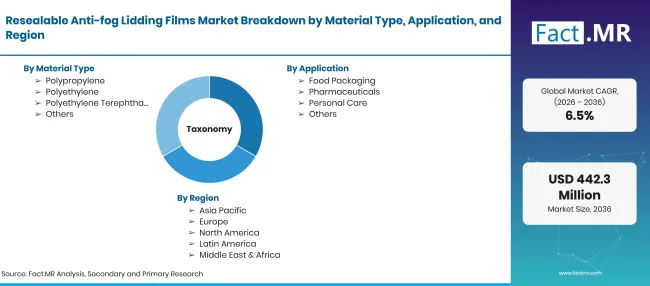
Factmr Resealable Anti Fog Lidding Films Market Taxonomy | Source: Fact.MR
| Attribute | Details |
|---|---|
| Quantitative Units | USD 236.1 million in 2026 to USD 442.3 million by 2036 at a 6.5% CAGR |
| Market Definition | Resealable lidding films with anti-fog functionality used on compatible food trays and selected specialty packs. These films reduce visible condensation while allowing the package to close again after opening. |
| Material Type | Polypropylene; Polyethylene; Polyethylene Terephthalate; Others |
| Application | Food Packaging; Pharmaceuticals; Personal Care; Others |
| End-User | Food and Beverage Industry; Pharmaceutical Industry; Personal Care Industry; Others |
| Distribution Channel | Online Retail; Offline Retail |
| Regions Covered | North America; Latin America; Western Europe; Eastern Europe; East Asia; South Asia & Pacific; Middle East & Africa |
| Countries Covered | Germany; United Kingdom; Japan; Brazil; United States |
| Companies Profiled | Amcor Plc (including Berry Global); Sealed Air Corporation; Mondi Group; Toray Plastics; Uflex Ltd.; Winpak Ltd.; Constantia Flexibles Group GmbH; Coveris; ProAmpac LLC. |
| Forecast Period | 2026 to 2036 |
| Approach | Assessment of film materials, chilled-food applications, end-user requirements, distribution channels, tray compatibility, anti-fog and reclosure performance, country outlook, and documented supplier activity. |
Source: Fact.MR analysis. Updated Oct 16, 2026
How is the market segmented?
-
By Material Type
- Polypropylene
- Polyethylene
- Polyethylene Terephthalate
- Others
-
By Application
- Food Packaging
- Pharmaceuticals
- Personal Care
- Others
-
By End-User
- Food and Beverage Industry
- Pharmaceutical Industry
- Personal Care Industry
- Others
-
By Distribution Channel
- Online Retail
- Offline Retail
-
By Region
- North America
- Latin America
- Western Europe
- Eastern Europe
- East Asia
- South Asia & Pacific
- Middle East & Africa
Frequently Asked Questions
How big is the resealable anti-fog lidding films market in 2026?
What is the stated CAGR for 2026 to 2036?
Which material type holds the leading specified share?
Which application accounts for the leading specified share?
Who are the main companies in the resealable anti-fog lidding films market?
Who worked on this report


Preview the report firsthand - request a free sample
Free SampleGet the brochure for pricing and purchase details
Download PDF