- Base Value(2025): 0.8 Bn
- Estimated Value(2026): 0.9 Bn
- Forecast Value (2036): 2.9 Bn
- CAGR (2026 - 2036): 12.8%
Retort-Stable Plant Protein Sauces Market Forecast and Outlook By FACT.MR
In 2025, the retort-stable plant protein sauces market was valued at USD 0.8 billion. Based on Fact.MR analysis, demand for retort-stable plant protein sauces is estimated to grow to USD 0.9 billion in 2026 and USD 2.9 billion by 2036. FACT.MR projects a CAGR of 12.8% during the forecast period.
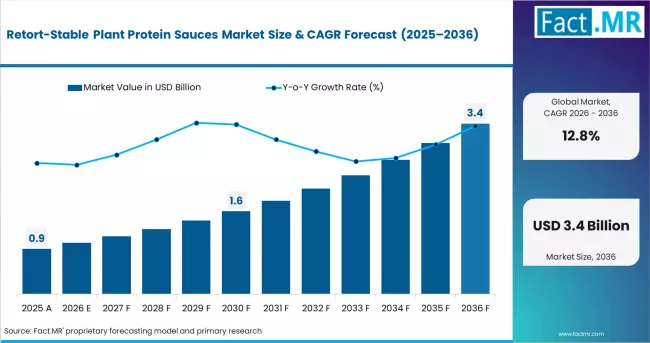
Retort Stable Plant Protein Sauces Market Value Analysis | Source: Fact.MR
Summary Of Retort-Stable Plant Protein Sauces Market
- Market Definition
- The market covers soy, pea, and wheat-based plant protein sauces formulated for retort sterilisation and ambient shelf stability across packaged food, foodservice, and retail cooking applications globally.
- Demand Drivers
- Global packaged food expansion is increasing demand for shelf-stable protein sauces. QSR chains and retail brands are reformulating with plant-based, retort-verified ingredients.
- Clean-label mandates across EU and North American retail are shifting procurement toward low-additive, plant-protein-functional sauce formats with verified ingredient transparency.
- Rising vegetarian and flexitarian dietary adoption in India, Southeast Asia, and China is increasing volume demand for plant-protein sauces in ambient meal formats.
- Key Segments Analyzed
- By Product Type: Soy protein-based sauces lead 48% share in 2026 due to cost efficiency, established supply chains, and strong emulsification stability in retort processing.
- By Application: Ready meals & packaged foods dominate 52% share in 2026 driven by demand for shelf-stable, protein-fortified convenience meals.
- By Geography: India leads 15.8% CAGR supported by packaged food expansion, vegetarian protein demand, and rapid growth in retort food consumption.
- Analyst Opinion at FACT.MR
- Shambhu Nath Jha, Senior Analyst at Fact.MR, opines, 'CXOs will find this report maps the protein-grade divide between commodity soy formats and premium retort-stable pea protein systems, with actionable data on which formulation platforms capture margin and which face substitution risk.'
- Strategic Implications
- Invest in pea protein formulation capabilities with validated retort stability to access premium retail and QSR procurement contracts.
- Develop clean-label sauce lines targeting EU and North American retail channels where ingredient transparency is a procurement requirement.
- Separate product lines for high-volume ambient ready meals and premium retail cooking sauces to optimise margin and qualification investment.
- Methodology
- Market sizing based on sauce shipment volumes and pricing by protein type and formulation grade. Validated with 2024-2025 data.
- Supported by plant protein trade data, retail launch tracking, and packaged food industry procurement benchmarks.
- Forecasts include packaged food output growth, QSR sauce procurement trends, and clean-label regulatory impact analysis.
| Metric | Value |
|---|---|
| Estimated Value in 2026 | USD 0.9 billion |
| Forecast Value in 2036 | USD 2.9 billion |
| Forecast CAGR (2026 to 2036) | 12.8% |
Source: Fact.MR analysis. Updated Apr 21, 2026
The market is expected to generate USD 2.1 billion in incremental revenue during the forecast period. Growth is transformational and structurally driven. Demand is supported by shelf-stable meal expansion and plant-based dietary shifts. Retail and foodservice procurement cycles are accelerating. Growth is partly constrained by protein destabilization under retort temperatures and limited standardisation across formulation platforms.
Demand is shifting toward acid-stable, heat-resistant protein matrices. Ready-meal manufacturers and QSR chains are increasing shelf-stable sauce procurement. Buyers require emulsification stability and clean-label compliance. Retort-verified, low-additive formulations are becoming procurement prerequisites. Suppliers lacking validated thermal processing protocols are being excluded from large-volume contracts.
India leads with 15.8% CAGR through 2036. Growth is driven by packaged food expansion and vegetarian protein demand. China follows at 15.2%, supported by rapid ready-meal and plant-based sauce capacity growth. The United States records 14.5%, driven by functional food adoption and protein-fortified convenience demand. Germany records 14.2%, led by clean-label and plant-based product innovation. The United Kingdom grows at 13.8%, supported by premium convenience and vegan sauce retail expansion. Mature Western European markets face constraints from formulation compliance costs and long food safety certification cycles.
Segmental Analysis
Retort-Stable Plant Protein Sauces Market Analysis by Product Type
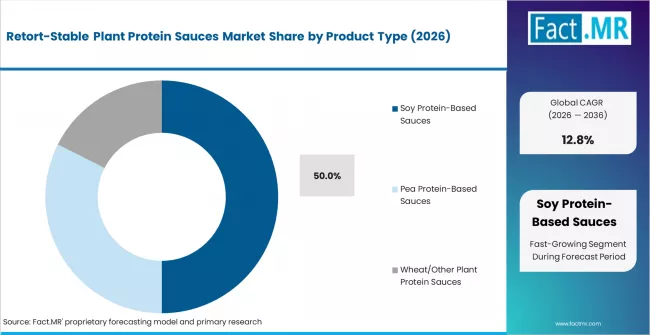
Retort Stable Plant Protein Sauces Market Analysis By Product Type | Source: Fact.MR
Based on FACT.MR's retort-stable plant protein sauces market report, consumption of soy protein-based sauces is estimated to hold 50% share in 2026. They dominate due to cost-competitive supply chains and proven thermal stability in industrial retort systems. Emulsification performance and ingredient availability support continued leadership.
- Cargill Investment: Cargill expanded its plant protein ingredient portfolio in 2024, introducing acid-stable soy protein concentrates targeting retort sauce manufacturers in North America and Asia. Products are validated for high-temperature processing without protein aggregation. [4]
- Roquette Frères Development: Roquette Frères launched a new pea protein isolate series in early 2025, specifically engineered for retort sauce formulations. The range includes low-bitterness variants with documented emulsification stability at 121°C sterilisation temperatures. [5
- Protein Diversification Trend: Pea protein sauce launches increased 22% in global retail in 2024 per Mintel food launch database. Clean-label demand and allergen-free positioning are supporting transition away from soy in premium retail and QSR channels. [6]
Retort-Stable Plant Protein Sauces Market Analysis by Formulation Type
Based on FACT.MR's retort-stable plant protein sauces market report, liquid sauces are estimated to hold 55% share in 2026. Liquid formulations dominate due to versatility across ready meal gravies, QSR cooking bases, and packaged food manufacturing. Pumpability, portion control, and blending consistency drive industrial preference.
- Kerry Group Innovation: Kerry Group launched a retort-stable liquid plant protein sauce range in mid-2024, targeting European ready meal manufacturers. Formulations are clean-label certified and validated for 12-month ambient shelf life without preservative additives. [7]
- ADM Technology Development: ADM introduced semi-solid plant protein paste concentrates in Q1 2025 for foodservice applications. Products include soy and pea protein blends with standardised Brix and viscosity profiles for QSR sauce preparation. [8]
- Foodservice Adoption Trend: Global QSR chains increased plant protein sauce procurement by 17% in 2024, driven by menu protein claims and sustainability commitments. Ambient-stable liquid formats are preferred for centralised sauce preparation and distribution logistics. [6]
Drivers, Restraints, and Opportunities
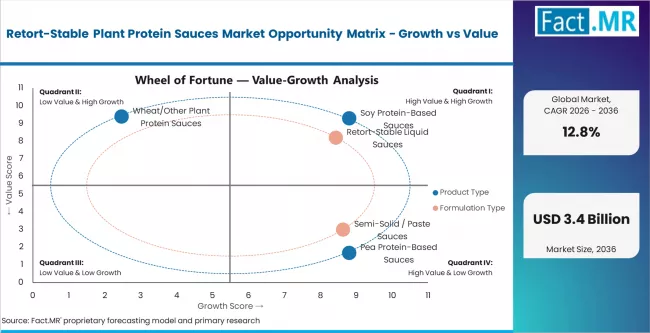
Retort Stable Plant Protein Sauces Market Opportunity Matrix Growth Vs Value | Source: Fact.MR
FACT.MR analysts observe the retort-stable plant protein sauces market as a structurally transitional segment. Historically dominated by soy-based liquid sauces serving industrial food manufacturing, demand is now bifurcating. Premium-specification pea protein and multi-protein formulations are capturing retail and QSR contract growth. This shift is tied to clean-label regulatory pressure, shelf-life compliance standards, and rising consumer protein awareness.
Commodity soy sauce volumes remain stable in industrial channels but yield lower margins. Buyers in retail and premium foodservice require retort-verified, low-additive protein sauces with documented nutritional profiles. Pea protein formats command 18-25% price premiums over soy equivalents.
- Clean-Label Retail Compliance: EU food labelling regulation updates in 2024 increased ingredient transparency requirements for ambient sauces. Retail buyers are eliminating emulsifier-heavy soy sauce formats. Kerry Group reported increased demand for clean-label plant protein sauce systems in European retail in 2024. [1]
- Asia Pacific Packaged Meal Expansion: India's packaged food sector grew 9.4% in FY2024, supported by FSSAI regulatory alignment with global shelf-stable product standards. Ambient ready-meal demand is increasing plant protein sauce procurement from domestic and export-oriented manufacturers. [2]
- Retort Technology Investment: Ingredion launched retort-optimised pea protein concentrate formulations in Q3 2024. These address protein aggregation challenges in high-temperature processing. Demand for validated thermal-stable protein sauce solutions is increasing across North American and European food manufacturers. [3]
Regional Analysis
The retort-stable plant protein sauces market is assessed across Asia Pacific, North America, Europe, Latin America, and Middle East and Africa, covering 40+ countries with distinct demand profiles shaped by packaged food output, plant protein infrastructure, retail regulatory requirements, and ready-meal consumption patterns. The full report offers market attractiveness analysis by region and country.
.webp "Top Country Growth Comparison Retort Stable Plant Protein Sauces Market Cagr (2026 2036)")
Top Country Growth Comparison Retort Stable Plant Protein Sauces Market Cagr (2026 2036) | Source: Fact.MR
| Country | CAGR (2026 to 2036) |
|---|---|
| India | 15.8% |
| China | 15.2% |
| United States | 14.5% |
| Germany | 14.2% |
| United Kingdom | 13.8% |
Source: Fact.MR analysis. Updated Apr 21, 2026
Source: Fact.MR (FACT.MR) analysis, based on proprietary forecasting model and primary research
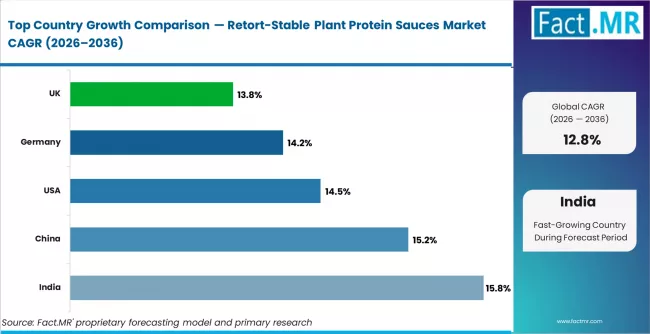
Retort Stable Plant Protein Sauces Market Cagr Analysis By Country | Source: Fact.MR
Asia Pacific Retort-Stable Plant Protein Sauces Market Analysis
Asia Pacific is the fastest-growing region. It is emerging as a high-volume consumption hub for shelf-stable, protein-fortified sauces. India leads with strong packaged food growth and vegetarian protein demand. China drives scale through ready meal expansion and domestic manufacturing. Cargill and ADM support regional ingredient supply. The region is shifting from traditional condiments to functional, protein-enriched sauces.
- India: India leads with a projected CAGR of 15.8% through 2036. Growth is driven by rapid expansion of packaged and retort food consumption. Rising vegetarian population and protein awareness support demand. Food processing investments and retail expansion are accelerating adoption. Domestic brands are introducing protein-fortified ready meals and sauces targeting urban consumers.
- China: China is projected to grow at 15.2% CAGR through 2036. Ready meal consumption is expanding across urban markets. Local manufacturers are scaling retort-compatible sauces with plant protein integration. Growth is supported by strong manufacturing infrastructure and increasing demand for convenience foods. The market is scale-driven with high domestic production capacity.
Fact.MR’s analysis covers China, India, Japan, South Korea, ASEAN, and ANZ. It includes packaged food trends, protein adoption, and demand forecasts.
North America Retort-Stable Plant Protein Sauces Market Analysis
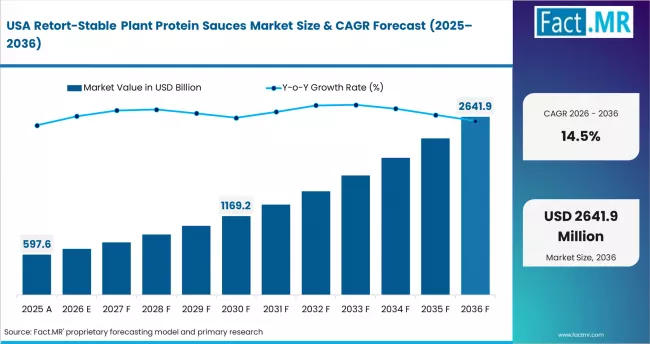
Retort Stable Plant Protein Sauces Market Country Value Analysis | Source: Fact.MR
North America is a mature and innovation-driven market. It leads in functional food development and clean-label product adoption. Ingredion Incorporated and Kerry Group support formulation innovation. Demand is driven by premium convenience foods and plant-based diets.
- United States: The United States grows at 14.5% CAGR through 2036. It is the largest market for functional packaged foods. Plant-based diet trends and protein fortification are driving demand. Retail and foodservice channels are expanding protein-enriched sauces. Growth is driven by innovation and premiumisation rather than volume alone.
Fact.MR’s analysis covers the United States, Canada, and Mexico. It includes clean-label trends, packaged food innovation, and demand forecasts.
Europe Retort-Stable Plant Protein Sauces Market Analysis
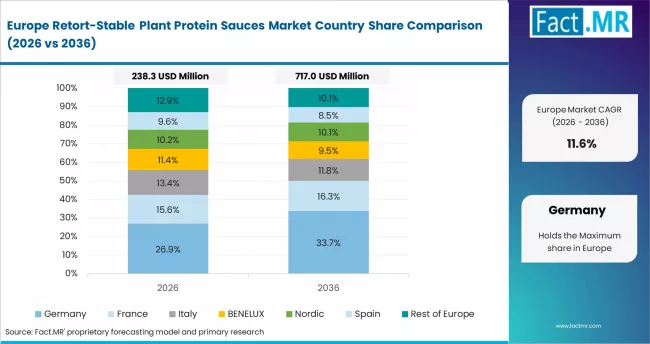
Retort Stable Plant Protein Sauces Market Europe Country Market Share Analysis, 2026 & 2036 | Source: Fact.MR
Europe is a clean-label and sustainability-focused market. It is a key region for plant-based product innovation. Roquette Frères and Cosucra Groupe Warcoing support ingredient supply. Demand is driven by regulatory alignment and consumer preference for natural products.
- Germany: Germany grows at 14.2% CAGR through 2036. Clean-label demand and plant-based adoption are strong. Food manufacturers are investing in protein-enriched sauces for retail and ready meals. Growth is supported by strong retail infrastructure and sustainability-driven consumption.
- United Kingdom: The United Kingdom grows at 13.8% CAGR through 2036. Premium convenience food demand is increasing. Retailers and brands are introducing functional sauces with protein fortification. Growth is driven by innovation and evolving consumer preferences.
Fact.MR’s analysis covers Germany, France, the UK, Italy, Spain, and Rest of Europe. It includes regulatory trends, plant-based adoption, and demand forecasts.
Competitive Aligners for Market Players
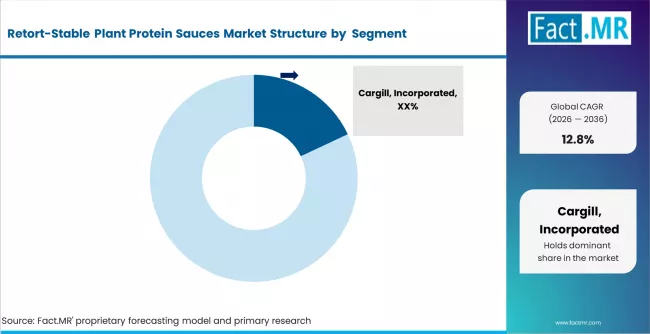
Retort Stable Plant Protein Sauces Market Analysis By Company | Source: Fact.MR
Competition in the retort-stable plant protein sauces market is not decided by scale alone. It is shaped by how deeply ingredient suppliers and sauce producers are embedded in clean-label procurement ecosystems. Premium retort-stable sauce suppliers operate closer to retail buyers and QSR chain specification teams, aligning protein formulation with nutritional claim requirements rather than selling standardised sauce bases. This creates long product validation timelines but establishes multi-year supply relationships once approved by retail buyers or foodservice operators
Cargill and Ingredion position themselves around broad plant protein ingredient portfolios and application development capability. Their advantage lies in offering validated retort-stable protein matrices across soy, pea, and wheat platforms. These companies compete through formulation flexibility and regulatory documentation rather than price. Kerry Group and ADM operate in a hybrid space, bridging branded ingredient supply and OEM sauce production. Their competitive strength comes from application engineering support and the ability to co-develop sauce systems for specific retail or QSR nutritional requirements.
Roquette Frères focuses on pea protein specialisation. By offering high-purity, retort-verified pea protein isolates with documented thermal stability, it captures premium sauce formulation contracts. Glanbia plc leverages retail channel relationships to position plant protein sauce solutions directly with branded food manufacturers. Smaller regional suppliers remain active in industrial sauce volumes. They compete on cost but face limitations in meeting clean-label documentation and thermal validation requirements for premium retail access.
Key Players
- Cargill, Incorporated
- Ingredion Incorporated
- Archer Daniels Midland Company (ADM)
- Kerry Group plc
- Roquette Frères S.A.
- Glanbia plc
Scope of Report
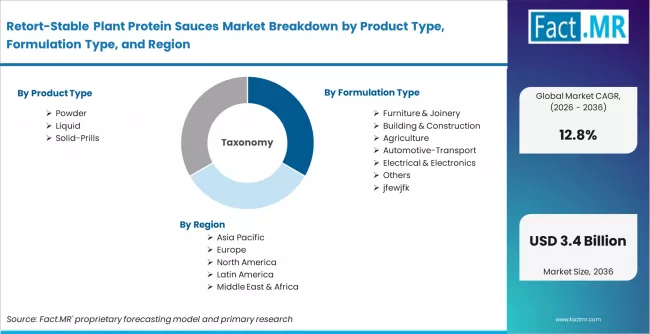
Retort Stable Plant Protein Sauces Market Breakdown By Product Type, Formulation Type, And Region | Source: Fact.MR
| Attribute | Details |
|---|---|
| Quantitative Units | USD 0.9 billion (2026) to USD 2.9 billion (2036), at a CAGR of 12.8% |
| Market Definition | Soy, pea, and wheat-based plant protein sauces engineered for retort sterilisation and ambient shelf-stable distribution across packaged food, foodservice, and retail cooking sauce applications globally. |
| Product Type Segmentation | Soy Protein-Based Sauces, Pea Protein-Based Sauces, Wheat/Other Plant Protein Sauces |
| Formulation Type Segmentation | Retort-Stable Liquid Sauces, Semi-Solid/Paste Sauces |
| Application Segmentation | Ready Meals & Packaged Foods, Foodservice/QSR, Retail Cooking Sauces |
| Application Coverage | Ambient ready meal sauce production, QSR centralised sauce supply, retail plant protein cooking sauce, packaged meal kit sauce systems, and export-oriented shelf-stable sauce manufacturing. |
| Regions Covered | North America, Europe, Asia Pacific, Latin America, Middle East and Africa |
| Countries Covered | USA, Canada, Mexico, Germany, UK, France, Italy, Spain, Nordic, BENELUX, China, Japan, South Korea, India, ASEAN, Australia and New Zealand, Brazil, Argentina, Chile, Saudi Arabia, GCC, Turkey, South Africa, Rest of MEA |
| Key Companies Profiled | Cargill, Incorporated; Ingredion Incorporated; ADM; Kerry Group plc; Roquette Frères S.A.; Glanbia plc |
| Forecast Period | 2026 to 2036 |
| Approach | Hybrid top-down and bottom-up model using plant protein ingredient producer revenues, packaged food output volumes, average selling prices by protein type and formulation grade, application-level procurement benchmarks, and primary interviews with food manufacturers and QSR sauce procurement managers. |
Source: Fact.MR analysis. Updated Apr 21, 2026
Retort-Stable Plant Protein Sauces Market by Segments
-
By Product Type:
- Soy Protein-Based Sauces
- Pea Protein-Based Sauces
- Wheat/Other Plant Protein Sauces
-
By Formulation Type:
- Retort-Stable Liquid Sauces
- Semi-Solid / Paste Sauces
-
By Application:
- Ready Meals & Packaged Foods
- Foodservice/QSR
- Retail Cooking Sauces
-
By Region:
- North America
- United States
- Canada
- Mexico
- Latin America
- Brazil
- Mexico
- Argentina
- Chile
- Rest of Latin America
- Western Europe
- Germany
- United Kingdom
- France
- Italy
- Spain
- Nordic Countries
- BENELUX
- Rest of Western Europe
- Eastern Europe
- Russia
- Poland
- Hungary
- Balkan and Baltic
- Rest of Eastern Europe
- East Asia
- China
- Japan
- South Korea
- South Asia and Pacific
- India
- ASEAN
- Australia and New Zealand
- Rest of South Asia and Pacific
- Middle East and Africa
- Kingdom of Saudi Arabia
- Other GCC Countries
- Turkey
- South Africa
- Rest of Middle East and Africa
- North America
This Report Addresses
- Strategic intelligence on demand across ready meals, QSR sauce procurement, retail cooking sauce channels, and packaged food plant protein integration globally.
- Market forecast from USD 0.9 billion in 2026 to USD 2.9 billion by 2036 at a CAGR of 12.8%.
- Growth opportunity mapping across India packaged food expansion, China ready-meal manufacturing, U.S. functional food demand, Germany clean-label innovation, and UK vegan retail growth.
- Segment analysis by product type (soy, pea, wheat protein sauces), formulation type (liquid, paste), and application (ready meals, foodservice, retail cooking sauces).
- Regional outlook covering Asia Pacific volume-led growth, North America premium functional demand, and Europe regulation-driven clean-label sauce adoption.
- Competitive analysis of Cargill, Ingredion, ADM, Kerry Group, Roquette Frères, and Glanbia. Focus on retort validation, formulation capability, and retail channel alignment.
- Regulatory analysis covering EU food labelling updates, FSSAI ambient food standards, USDA dietary guidelines, and UK FSA plant protein shelf-stability requirements.
- Report delivered in PDF, Excel, and presentation formats. Supported by primary interviews, plant protein industry data, and food manufacturer procurement benchmarks.
Bibliography
- [1] Kerry Group plc. (2024). Sustainability and Innovation Report: Clean-Label Plant Protein Ingredient Demand Growth in European Retail and Foodservice Channels Including Retort-Stable Sauce Applications. 2024. kerrygroup.com/sustainability
- [2] Food Safety and Standards Authority of India (FSSAI). (2024). Revision of Standards for Ambient and Shelf-Stable Plant Protein Food Products Including Sauce and Gravy Formulations. July 2024. fssai.gov.in
- [3] Ingredion Incorporated. (Q3 2024). Innovation Update: Retort-Optimised Pea Protein Concentrate Launch for Ambient Sauce and Gravy Applications in North America and Asia Pacific. September 2024. ingredion.com/investor-relations
- [4] Cargill, Incorporated. (Q4 2024). Plant Protein Portfolio Expansion: Acid-Stable Soy Protein Concentrate Range for Retort Sauce Manufacturing in North America and Asia. October 2024. cargill.com/news
- [5] Roquette Frères S.A. (January 2025). Product Launch: NUTRALYS Pea Protein Isolate Series for Retort-Stable Sauce Formulations with Validated Thermal Stability at 121°C. January 2025. roquette.com/innovation
- [6] Mintel Group Ltd. (2024). Global Plant Protein Food and Sauce Launch Data 2024: Retail and Foodservice Channel Tracking Including QSR Plant Protein Sauce Procurement Volumes. 2024. mintel.com
- [7] Kerry Group plc. (Q2 2024). Taste & Nutrition Division Update: Retort-Stable Plant Protein Liquid Sauce Range Launch for European Ready Meal Manufacturers. June 2024. kerrygroup.com/media
- [8] Archer Daniels Midland Company. (Q1 2025). Human Nutrition Product Launch: Plant Protein Paste Concentrate Range Including Soy-Pea Blends for QSR Sauce Applications. March 2025. adm.com/news
Retort-Stable Plant Protein Sauces Market Definition
The retort-stable plant protein sauces market covers soy, pea, and wheat-based protein sauces engineered to withstand high-temperature retort sterilisation. These sauces serve as shelf-stable flavour and protein delivery systems in packaged meals and foodservice applications.
Retort-Stable Plant Protein Sauces Market Inclusions
Covers global and regional forecasts from 2026 to 2036. Includes product type and formulation type segments. Covers ready meals, foodservice, and retail cooking sauce channels. Includes both liquid and semi-solid paste sauce formats across OEM and branded supply chains.
Retort-Stable Plant Protein Sauces Market Exclusions
Excludes animal-protein-blended sauces unless classified as plant-primary hybrids. Omits finished ready meal SKUs. Also excludes general condiment sauces without verified plant protein content. Focus remains on retort-processed, plant-protein-functional sauce intermediates and branded formats.
Retort-Stable Plant Protein Sauces Market Research Methodology
- Primary Research
- Interviews with sauce manufacturers and plant protein ingredient suppliers. Covers retail, foodservice, and packaged food procurement buyers across key markets.
- Desk Research
- Uses Cargill, Kerry Group, and Ingredion public data. Includes plant protein trade statistics and retail launch data from 2024-2025.
- Market-Sizing and Forecasting
- Uses a hybrid top-down and bottom-up model. Based on producer revenues and application-level volumes. Segmented by product type, formulation, and end application.
- Data Validation and Update Cycle
- Validated using revenue data and industry procurement statistics. Cross-checked with retail audit volumes and expert interviews. Updated regularly.
Frequently Asked Questions
How large is the retort-stable plant protein sauces market in 2025?
What will the market size be in 2026?
What is the projected market size by 2036?
What is the expected CAGR of the retort-stable plant protein sauces market?
What is the absolute dollar opportunity in this market?
Which product type segment leads the market?
Which application segment is poised to lead?
Which country shows the fastest growth?
Who worked on this report


Preview the report firsthand - request a free sample
Free SampleGet the brochure for pricing and purchase details
Download PDF