- Market Value (2025): USD 267.6 Bn
- Estimated Value (2026): USD 298.6 Bn
- Forecast Value (2036): USD 894.8 Bn
- CAGR (2026-2036): 11.6%
What is the Ride Hailing Taxi Market forecast to be worth by 2036?
USD 298.6 billion in 2026 to USD 894.8 billion by 2036 at 11.6% CAGR.
- The ride hailing taxi market reached USD 267.6 billion in 2025.
- Demand is projected to increase from USD 298.6 billion in 2026 to USD 894.8 billion by 2036.
- The market is forecast to record 11.6% CAGR from 2026 to 2036 owing to easier booking, wider passenger-car supply and simple digital payment use.
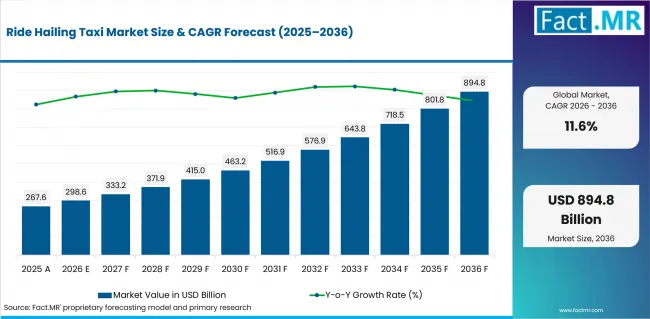
Ride Hailing Taxi Market Value Analysis | Source: Fact.MR
What are the defining numbers behind Ride Hailing Taxi Market growth?
USD 596.2 billion absolute opportunity by 2036.
- Demand Drivers in the Market
- Ride hailing platforms depend on quick trip matching. Demand improves when riders can see the wait time, fare estimate and driver details before they confirm a trip.
- Passenger cars remain the main vehicle base for daily travel and airport movement. Operators prefer vehicles that are easy to maintain and accepted under city transport rules.
- Mobile applications concentrate booking activity in one user flow. Riders can search and confirm in the same app. They can pay and ask for support without moving between separate service channels.
- Key Segments Analyzed
- By Service Type: Ride Hailing is expected to hold 39.3% share in 2026 because app-based matching remains the clearest route for repeat urban trips.
- By Vehicle Type: Passenger Cars are projected to account for 38.1% share in 2026 as they fit commuting and airport transfers.
- By Booking Mode: Mobile Application is anticipated to capture 42.8% share in 2026 since trip search and payment work inside one flow.
- By Payment Mode: Digital Payments are estimated to represent 39.6% share in 2026 due to wallet and card convenience.
- By End User: Individual Consumers are forecast to hold 42.4% share in 2026 as daily travel creates most booking frequency.
- Analyst Opinion at Fact.MR
- Shambhu Nath Jha, Sr. Consultant at Fact.MR, opines, "Ride hailing taxi platforms have to balance rider convenience with driver availability and local compliance. Market acceptance is expected to depend on reliable trip completion, clear fares and payment confidence."
- Strategic Implications
- Platform teams should align driver supply with busy commute corridors before promotion spending is increased.
- Fleet partners need to show vehicle uptime and insurance readiness before new city expansion.
- Investors should separate app scale from profitable trip density before comparing countries.
The USA is estimated at 15.1% CAGR from 2026 to 2036 where platform economics affect city expansion. Canada is projected to reach 13.7% through demand across large urban corridors. The UK is expected to post 12.3% through mature app booking and service checks. Germany is forecast at 10.9% as transport rules shape rollout. France is anticipated to record 9.5% through app-led urban travel, while Brazil is projected to reach 8.1% as passenger-car availability supports platform use.
How does the Ride Hailing Taxi Market break down by segment?
Ride Hailing is expected to lead Service Type at 39.3% share. Passenger Cars are projected to lead Vehicle Type at 38.1% share in 2026.
Which service type dominates?
Ride Hailing is projected to account for 39.3% share in 2026.
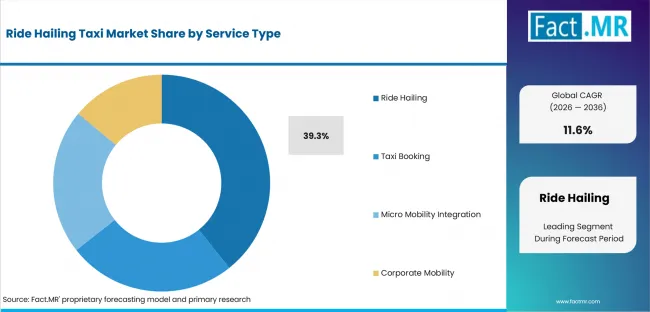
Ride Hailing Taxi Market Analysis By Service Type | Source: Fact.MR
Ride hailing leads service type when passengers want a direct app route to a driver and a visible fare before the ride starts. Standard Ride Hailing supports basic city trips. Premium Ride Hailing serves riders who pay for comfort or a more predictable experience.
What leads the Vehicle Type segment?
Passenger Cars are expected to hold 38.1% share in 2026.
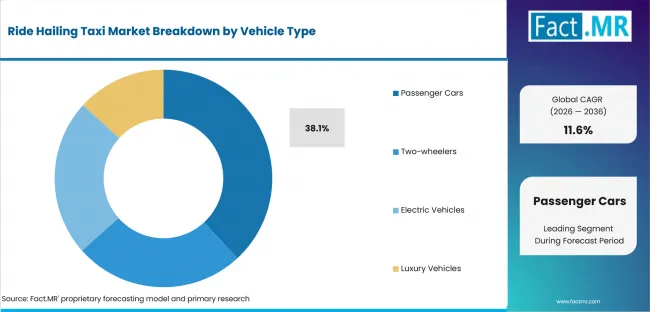
Ride Hailing Taxi Market Analysis By Vehicle Type | Source: Fact.MR
Passenger cars form the widest operating base for daily travel. Sedans and hatchbacks support affordable city rides. SUVs remain useful when riders need more luggage space or travel in groups.
How does Booking Mode shape demand?
Mobile Application is anticipated to lead with 42.8% share in 2026.
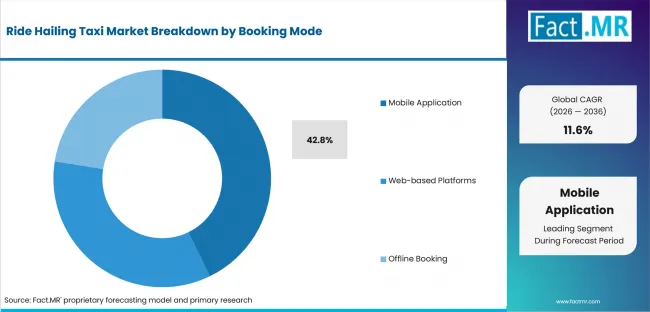
Ride Hailing Taxi Market Analysis By Booking Mode | Source: Fact.MR
Mobile applications give riders fare estimates and trip tracking before a ride begins. Android applications and iOS applications support the largest smartphone groups. Super Apps help in markets where riders prefer one account for several services.
What supports Digital Payments within Payment Mode?
Digital Payments are estimated to represent 39.6% share in 2026.
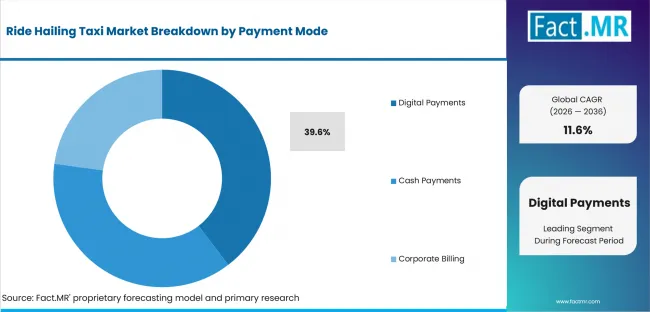
Ride Hailing Taxi Market Analysis By Payment Mode | Source: Fact.MR
Digital payments reduce cash handling and make receipts easier to manage. Mobile Wallets and Credit & Debit Cards support quick trip completion. UPI & Instant Payments remain useful where riders expect real-time settlement.
What supports Individual Consumers within End User?
Individual Consumers are forecast to hold 42.4% share in 2026.
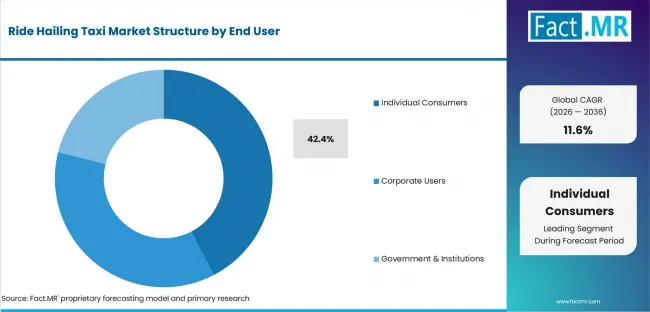
Ride Hailing Taxi Market Analysis By End User | Source: Fact.MR
Individual consumers lead end user because ride hailing solves frequent travel needs without advance planning. Daily Commuters create repeat demand during peak hours. Leisure Travelers and Tourists add demand when local transport choices are less familiar.
What is accelerating Ride Hailing Taxi Market adoption, and what is holding it back?
Demand is expected to grow through app-based ride matching and digital payments. Adoption may be limited by low driver earnings and local licensing rules.
Drivers Impact Analysis
| DRIVER | (~) % IMPACT ON CAGR | GEOGRAPHIC RELEVANCE | IMPACT TIMELINE |
|---|---|---|---|
| App-led trip matching | +2.8% | France, UK, USA | Short term (<= 2 years) |
| Passenger-car supply availability | +2.4% | Brazil, Germany, Canada | Short term (<= 2 years) |
| Digital payment convenience | +2.1% | France and USA | Medium term (2-4 years) |
| Corporate and airport use cases | +1.7% | UK and Germany | Medium term (2-4 years) |
| Platform safety and service accountability | +1.2% | Large urban markets | Long term (>= 4 years) |
Source: Fact.MR analysis. Updated Jul 30, 2026
- App-led trip matching: Real-time driver allocation is expected to improve booking conversion in dense urban zones. Platforms gain more value when pickup time and fare estimate are visible before confirmation.
- Passenger-car supply availability: Passenger cars give operators the most flexible vehicle base for commuter trips and airport use. Availability becomes an onboarding issue when driver churn weakens service coverage.
- Digital payment convenience: Wallets and cards are expected to reduce cash handling and make receipts easier. Corporate riders benefit when payments can be reconciled after the trip.
Opportunity Impact Analysis
| OPPORTUNITY | (~) % IMPACT ON CAGR | GEOGRAPHIC RELEVANCE | IMPACT TIMELINE |
|---|---|---|---|
| EV and hybrid ride options | +1.4% | France, Germany, Canada | Medium term (2-4 years) |
| Super-app and wallet integration | +1.1% | Brazil and UK | Medium term (2-4 years) |
| Corporate mobility programs | +0.9% | USA and Germany | Long term (>= 4 years) |
| Airport and tourism corridors | +0.6% | France, UK, Brazil | Long term (>= 4 years) |
Source: Fact.MR analysis. Updated Jul 30, 2026
- EV and hybrid ride options: Fleet partners can serve riders and corporate accounts with lower-emission vehicle choices. The opening depends on charging access and uptime evidence from vehicle electrification planning.
- Super-app and wallet integration: Platforms that connect ride booking with wallet balances are expected to improve repeat use. Integration must stay simple or booking friction returns.
- Corporate mobility programs: Employers can use ride hailing for late-night trips and client travel. Providers need clear billing controls before procurement teams approve wider use.
Restraints Impact Analysis
| RESTRAINT | (~) % IMPACT ON CAGR | GEOGRAPHIC RELEVANCE | IMPACT TIMELINE |
|---|---|---|---|
| Driver earnings pressure | -1.3% | Global | Short term (<= 2 years) |
| Local licensing and taxi rules | -1.0% | France, Germany, UK | Short term (<= 2 years) |
| Surge-price sensitivity | -0.8% | Brazil and Canada | Medium term (2-4 years) |
| Safety and insurance review | -0.5% | USA and Europe | Long term (>= 4 years) |
Source: Fact.MR analysis. Updated Jul 30, 2026
- Driver earnings pressure: Platforms can lose vehicle supply when driver incentives do not cover waiting time and fuel cost. This weakens pickup reliability during peak periods.
- Local licensing and taxi rules: City rules can slow platform launches when driver checks or fare policies differ by market. Operators need local compliance work before wider rollout.
- Surge-price sensitivity: Riders may return to public transport or street taxis when peak fares rise sharply. Price communication has to be clear before confirmation.
Which countries are scaling Ride Hailing Taxi Market fastest?
The country comparison is led by the USA at 15.1% CAGR, followed by Canada at 13.7% and the UK at 12.3%. Germany, France and Brazil grow at lower listed rates.
- The USA leads through platform scale, digital payment behavior and city-level expansion economics.
- Canada relies on major-city demand and driver coverage.
- The United Kingdom depends on service quality, rider trust and reliable support.
- Germany grows carefully under transport regulations.
- France remains tied to app-based booking and dense urban travel.
- Brazil follows through passenger-car availability and payment habits.
Market entry depends on driver supply, local rules, payment behavior and dependable coverage.
The full report provides country-level CAGR analysis across North America and Latin America. Coverage extends to Europe; East Asia; South Asia and Oceania; and the Middle East and Africa.
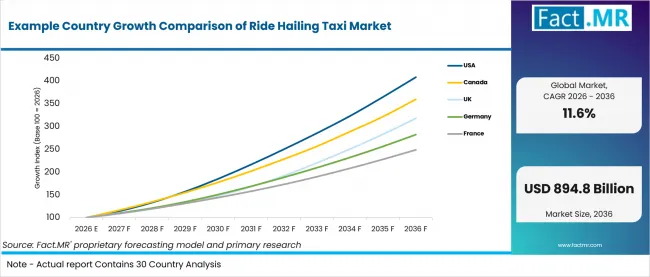
Example Country Growth Comparison Of Ride Hailing Taxi Market | Source: Fact.MR
| Country | CAGR (2026-2036) |
|---|---|
| France | 9.5% |
| Brazil | 8.1% |
| UK | 12.3% |
| USA | 15.1% |
| Germany | 10.9% |
| Canada | 13.7% |
Source: Fact.MR analysis. Updated Jul 30, 2026
What supports France adoption?
9.5% CAGR, supported by app-led urban mobility and regulated taxi integration.
France growth reflects a market where ride hailing must fit dense city travel and formal transport expectations. Platforms are expected to gain stronger acceptance when pickup reliability and fare clarity are visible to riders. Ride Hailing remains the main service reference because it gives passengers a direct booking path without relying on street availability.
How is Brazil scaling demand?
8.1% CAGR, driven by passenger-car availability and local payment adoption.
Brazil demand is tied to passenger-car supply across large urban areas and the need for flexible booking options. Operators are likely to benefit when drivers can use common vehicles.
What is driving UK growth from 2026 to 2036?
12.3% CAGR, backed by mature app usage and service-accountability needs.
UK growth is shaped by riders who understand app booking but still expect clear service standards. Platforms must manage licensing checks and support response before riders trust wider use.
How is USA developing demand?
15.1% CAGR, driven by platform economics and digital payment behavior.
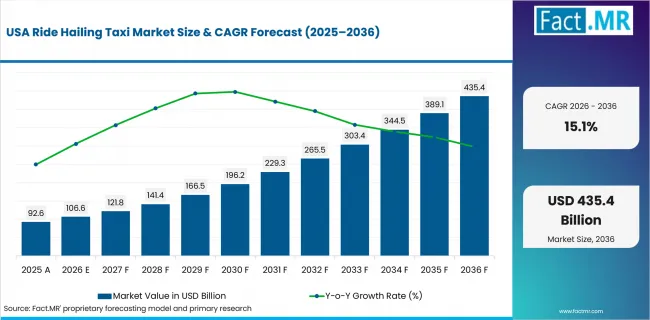
Ride Hailing Taxi Market Country Value Analysis | Source: Fact.MR
USA demand reflects a large ride hailing base where profitability and driver supply now matter as much as app reach. Operators are expected to focus on trip density and insurance coverage.
How does Germany perform?
10.9% CAGR, led by regulated mobility planning and safety expectations.
Germany growth is expected to move through cities where platforms can satisfy transport rules and passenger protection requirements. Operators need strong documentation for driver checks and fare transparency.
What supports Canada growth?
13.7% CAGR, backed by urban corridors and service-coverage requirements.
Canada growth reflects demand across large cities where app-based rides support commuting and airport movement. Smaller markets require enough driver coverage before platform use becomes dependable.
Who leads the Ride Hailing Taxi Market?
Uber Technologies, Inc. and DiDi Global are directly relevant ride-hailing platform operators. Lyft, Inc. strengthens the North American platform view, while Grab Holdings adds Southeast Asian mobility depth.
Uber supports demand through broad ride-hailing coverage and digital payments. DiDi adds large-scale mobility experience, while Lyft strengthens North American reach. Grab expands super-app mobility across Southeast Asia. Bolt, Ola and Cabify broaden regional coverage. Competition will depend on driver supply, app reliability, fare transparency and safety tools. Providers with dependable peak-time service may attract more individual and corporate users.
Which companies are the key providers?
Key companies include the Uber Technologies, Inc., DiDi Global, Lyft, Inc., Grab Holdings, Bolt Technology, ANI Technologies Private Limited, and Cabify.
- Uber Technologies, Inc.
- DiDi Global
- Lyft, Inc.
- Grab Holdings
- Bolt Technology
- ANI Technologies Private Limited
- Cabify
Bibliography
- Department for Transport. (2024, July 31). Taxi and private hire vehicle statistics, England: 2024. GOV.UK.
- European Parliament. (2024, April 24). Parliament adopts Platform Work Directive.
- Council of the European Union. (2024, October 14). Platform workers: Council adopts new rules to improve their working conditions.
- Uber Technologies, Inc. (2024, September 17). Only on Uber: Helping to make driving and delivering safer, fairer, and easier.
- Grab Holdings Limited. (2025, February 20). Grab reports fourth quarter and full year 2024 results.
This Report Answers
- The report provides strategic intelligence on the Ride Hailing Taxi Market across Service Type and Vehicle Type choices that shape platform adoption. Automotive telematics market coverage helps compare how connected trip data supports dispatch and safety functions.
- Segment analysis covers Ride Hailing and Passenger Cars as the share leaders within the 2026 market structure.
- Country outlook evaluates the USA and Canada alongside the UK and Germany. France and Brazil complete the growth comparison across the profiled markets.
- Competitive analysis profiles Uber Technologies, Inc. and DiDi Global alongside Lyft, Inc. and Grab Holdings. Bolt Technology, ANI Technologies Private Limited and Cabify complete the provider set.
- Booking and payment assessment covers Mobile Application and Digital Payments. Corporate billing and offline booking complete the service view.
What does the Ride Hailing Taxi Market cover?
Ride hailing taxi services connect riders with drivers through app-based or digitally supported booking systems.
The Ride Hailing Taxi Market covers platform-led passenger transport services used for daily commuting and airport movement. Coverage extends to taxi booking and shared ride formats. Premium trips are included when the service is sold through a ride hailing or taxi booking platform.
What is included in the scope?
Ride hailing taxi services are used by individual consumers, corporate users and public or institutional buyers.
The scope includes Service Type and Vehicle Type alongside Booking Mode, Payment Mode and End User. Coverage spans Ride Hailing and Taxi Booking. Corporate Mobility and Micro Mobility Integration are included where they are sold through platform or taxi booking models. Passenger Cars remain central. Two-wheelers, electric vehicles and luxury vehicles follow the same service-use rule.
What is excluded from the scope?
General vehicle sales and unrelated transport infrastructure remain outside the scope of this market.
The scope excludes vehicle manufacturing revenue that is not tied to ride hailing taxi services. Public bus, metro and rail operations are excluded. General software spending is excluded unless it directly supports booking or dispatch. Payment and rider support software must directly serve the ride hailing taxi model. Advertising revenue and unrelated delivery platforms are outside the scope unless they are reported within a ride hailing taxi service model.
How Was the Analysis Built?
The analysis draws on 120+ sources, 35+ company portfolios, 25+ countries, and more than 20 industry interviews.
- Primary Research: Primary research includes discussions with manufacturers, service providers, technology developers, distributors, end users, procurement teams, and subject-matter experts. These conversations examine purchasing priorities, product adoption, operational challenges, approval requirements, competitive positioning, and the factors that influence wider market acceptance.
- Desk Research: Desk research covers government statistics, regulatory publications, company filings, trade data, technical studies, industry associations, standards, public policy, and other authoritative sources. Every source used in the analysis is documented in the bibliography.
- Market Sizing and Forecasting: Market estimates combine historical performance, demand indicators, pricing and volume trends, segment shares, company participation, country-level growth, adoption patterns, investment activity, and barriers to market expansion.
- Data Validation and Update Cycle: Findings are validated by comparing primary interviews with public data, company activity, regulatory changes, trade patterns, and industry developments. Regular updates review new product launches, capacity changes, partnerships, approvals, procurement trends, and shifts in commercial adoption.
Segmentation
What is the report's scope and coverage?
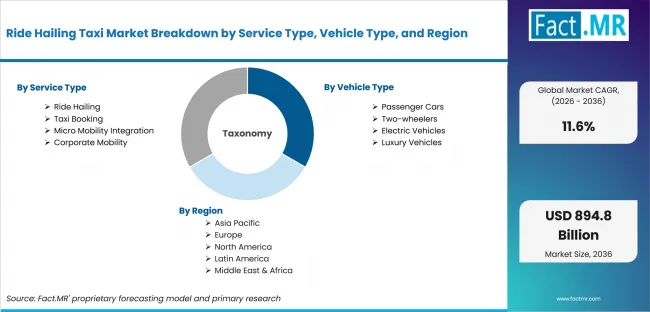
Ride Hailing Taxi Market Breakdown By Service Type, Vehicle Type, And Region | Source: Fact.MR
| Attribute | Details |
|---|---|
| Quantitative Units | USD 298.6 billion in 2026 to USD 894.8 billion by 2036, at an 11.6% CAGR. |
| Market Definition | App-based taxi services that match riders with drivers for paid point-to-point trips. Coverage includes ride booking, taxi dispatch, payment-enabled trip management, fleet participation and passenger support across individual and corporate use cases |
| Service Type | Ride Hailing; Standard Ride Hailing; Premium Ride Hailing; Shared Ride Hailing; Taxi Booking; Street Taxi Booking; Executive Taxi Services; Airport Taxi Services; Micro Mobility Integration; Bike Taxi Services; E-scooter Integration; Last-mile Mobility; Corporate Mobility; Business Travel; Employee Transportation; Fleet Mobility Services |
| Vehicle Type | Passenger Cars; Sedan; Hatchback; SUV; Two-wheelers; Motorcycle Taxi; Electric Scooter Taxi; Bike Taxi; Electric Vehicles; Battery Electric Vehicles; Hybrid Vehicles; Plug-in Hybrid Vehicles; Luxury Vehicles; Premium Sedans; Luxury SUVs; Chauffeur-driven Vehicles |
| Booking Mode | Mobile Application; Android Applications; iOS Applications; Super Apps; Web-based Platforms; Desktop Booking; Mobile Web; Corporate Portals; Offline Booking; Call Centers; Street Hailing; Hotel Concierge Booking |
| Payment Mode | Digital Payments; Mobile Wallets; Credit & Debit Cards; UPI & Instant Payments; Cash Payments; Cash on Ride; Prepaid Cash Vouchers; Local Currency Payments; Corporate Billing; Monthly Invoicing; Business Accounts; Fleet Payment Solutions |
| End User | Individual Consumers; Daily Commuters; Leisure Travelers; Tourists; Corporate Users; Business Travelers; Employee Commute Programs; Corporate Accounts; Government & Institutions; Public Agencies; Educational Institutions; Healthcare Organizations |
| Regions Covered | North America; Latin America; Europe; East Asia; South Asia and Oceania; Middle East and Africa |
| Countries Covered | France; Brazil; UK; USA; Germany; Canada |
| Key Companies Profiled | Uber Technologies, Inc.; DiDi Global; Lyft, Inc.; Grab Holdings; Bolt Technology; ANI Technologies Private Limited; Cabify |
| Forecast Period | 2026 to 2036 |
| Approach | Hybrid top-down and bottom-up approach using app booking demand; passenger-car supply; digital payment behavior; country-level adoption; taxi regulation; driver availability; corporate travel use; airport movement; platform reliability; user support requirements; regional service coverage and company portfolio review |
Source: Fact.MR analysis. Updated Jul 30, 2026
How is the market segmented?
-
By Service Type:
- Ride Hailing
- Taxi Booking
- Micro Mobility Integration
- Corporate Mobility
-
By Vehicle Type:
- Passenger Cars
- Two-wheelers
- Electric Vehicles
- Luxury Vehicles
-
By Booking Mode:
- Mobile Application
- Web-based Platforms
- Offline Booking
-
By Payment Mode:
- Digital Payments
- Cash Payments
- Corporate Billing
-
By End User:
- Individual Consumers
- Corporate Users
- Government & Institutions
-
By Region:
- North America
- Latin America
- Europe
- East Asia
- South Asia and Oceania
- Middle East and Africa
Frequently Asked Questions
Which Service Type leads the market?
Which Vehicle Type leads the market?
Which Booking Mode category leads the market?
Which Payment Mode leads the market?
Which End User leads the market?
Which country records the highest listed CAGR?
What is the primary driver in this market?
What is the main restraint?
Why do individual consumers lead demand?
Who worked on this report


Preview the report firsthand - request a free sample
Free SampleGet the brochure for pricing and purchase details
Download PDF