- Base Value(2025): 1.8 Bn
- Estimated Value(2026): 1.9 Bn
- Forecast Value (2036): 3.7 Bn
- CAGR (2026 - 2036): 6.8%
Root-Zone pH Micro-Buffering Fertilizer Additive Market Forecast and Outlook By Fact.MR
- The root-zone pH micro-buffering fertilizer additive market was valued at USD 1.8 billion in 2025.
- According to Fact.MR, demand is projected to reach USD 1.9 billion in 2026 and expand to USD 3.7 billion by 2036, reflecting a CAGR of 6.8% during the forecast period.

Root Zone Ph Micro Buffering Fertilizer Additive Market Market Value Analysis | Source: Fact.MR
Summary of Root-Zone pH Micro-Buffering Fertilizer Additive Market
- Market Definition
- The market includes fertilizer-compatible additives used to stabilize root-zone pH and reduce nutrient-availability losses caused by abrupt acidity or alkalinity shifts in substrates and irrigated crop systems.
- Demand Drivers
- Greenhouse and nursery production systems are supporting demand because substrate pH directly influences micronutrient availability and crop response.
- Irrigation water and fertilizer programs can shift pH quickly in low-buffer substrates, increasing the value of additives that stabilize the root environment.
- Soilless media and controlled-environment agriculture are creating stronger demand for materials that buffer pH without repeated corrective treatment.
- Key Segments Analyzed
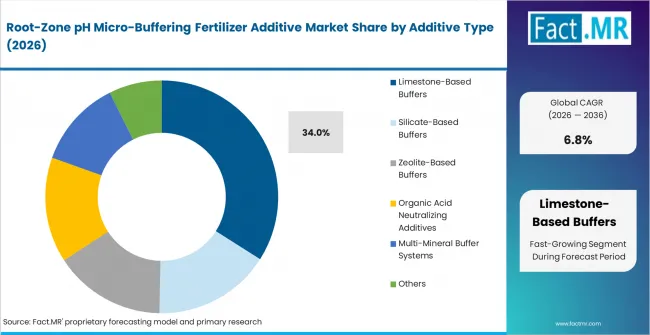
- By Additive Type: Limestone-based buffers are estimated to lead with approximately 34% share in 2026, supported by their established role in media pH adjustment and residual buffering in greenhouse and nursery substrates.
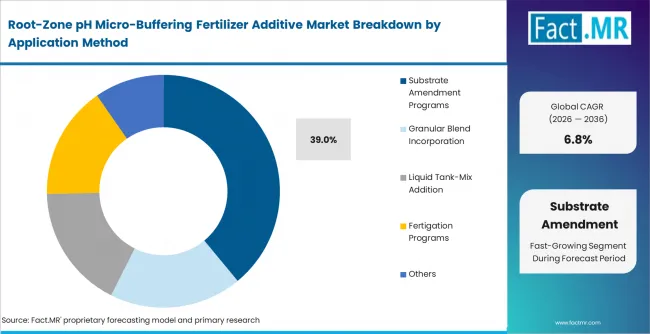
- By Application Method: Substrate amendment programs are expected to hold approximately 39% share in 2026, driven by pre-plant integration and longer buffering effect in container and greenhouse systems.
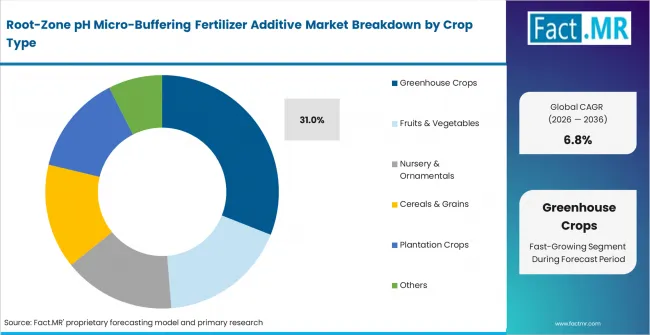
- By Crop Type: Greenhouse crops are projected to account for approximately 31% share in 2026, supported by greater substrate sensitivity and tighter nutrient-management discipline.
- By Geography: India leads growth at 8.1% CAGR through 2036, supported by expanding protected cultivation and greater technical management in horticulture.
- Analyst Opinion at Fact.MR
- Shambhu Nath Jha, Senior Analyst at Fact.MR, notes, “CXOs should read this market as a nutrient-protection category rather than a simple correction-input category. Buyers are not only trying to raise or lower pH. They are trying to avoid instability in the root environment that undermines fertilizer efficiency and crop uniformity.”
- Strategic Implications
- Invest in buffering formulations that fit both substrate incorporation and liquid feeding systems.
- Build technical sales capability around irrigation-water quality, fertilizer acidity, and crop-specific pH targets.
- Position multi-mineral and longer-residual buffering systems in greenhouse, nursery, and substrate-intensive horticulture programs where repeat stability matters more than one-time correction.
- Methodology
- Market sizing uses substrate intensity, crop sensitivity to pH drift, and adoption potential across greenhouse, nursery, and irrigated specialty crop systems.
- Analysis includes pH-management guidance from extension systems and substrate-buffering studies from horticulture and USDA sources.
- Forecasts account for protected cultivation growth, fertilizer-program complexity, and rising commercial importance of root-zone nutrient stability.
The market is expected to generate an absolute opportunity of USD 1.8 billion between 2026 and 2036, supported by increasing adoption in precision agriculture and controlled growing systems. Growth is being driven by the expansion of high-value horticulture, greater use of soilless and peat-based substrates, and rising emphasis on stable nutrient delivery in fertigation and controlled-environment agriculture. Root-zone pH management is becoming more critical because even small imbalances in substrate conditions can reduce micronutrient availability, disrupt fertilizer efficiency, and require corrective interventions. Micro-buffering additives help maintain consistent pH levels, reducing the need for repeated adjustments and lowering both input costs and crop risk, particularly in intensive cultivation systems where consistency and yield quality are closely linked.
India is projected to lead with a CAGR of 8.1% through 2036, driven by protected cultivation growth, horticulture intensification, and wider use of soluble fertilizer programs. Spain follows at 7.5%, supported by greenhouse and irrigated horticulture. The United States is expected to grow at 7.0%, underpinned by nursery, greenhouse, and specialty crop substrate management. Canada records 6.6%, supported by container production and greenhouse vegetable systems. Mexico grows at 6.1%, backed by export horticulture and irrigation-driven crop management. This variation reflects differences in protected cultivation intensity, substrate use, irrigation quality challenges, and the technical maturity of growers managing root-zone chemistry.
Segmental Analysis
Root-Zone pH Micro-Buffering Fertilizer Additive Market Analysis by Additive Type
Root Zone Ph Micro Buffering Fertilizer Additive Market Analysis By Additive Type | Source: Fact.MR
Based on Fact.MR’s root-zone pH micro-buffering fertilizer additive market analysis, limestone-based buffers are estimated to hold 34% share in 2026. They lead because limestone remains the most established substrate amendment used to adjust initial pH and provide residual basicity in greenhouse and nursery production. Greenhouse pH management guidance identifies limestone as the primary means of adjusting media pH before planting, while residual lime research and pH-buffering studies indicate that buffering behavior in substrates remains a core determinant of root-zone stability. Zeolite-based buffers continue to gain relevance because their slightly alkaline nature and cation-exchange behavior can help moderate pH and nutrient retention. Silicate-based systems are also expanding where growers want both pH-supportive behavior and added plant-strengthening benefits. Product leadership in this segment depends on how long the additive can stabilize the root zone without creating overcorrection or compatibility problems in fertilizer programs.
- Limestone Residual Effect: Residual limestone is identified in horticulture literature as an important substrate property for pH management during crop production.
- Zeolite Buffering Role: Peer-reviewed work notes that zeolite use with fertilizers can help buffer soil pH and reduce the need for additional liming.
- Substrate Component Influence: USDA research shows substrate components buffer acids and bases differently, reinforcing the commercial role of specific buffer chemistries.
Root-Zone pH Micro-Buffering Fertilizer Additive Market Analysis by Application Method
Root Zone Ph Micro Buffering Fertilizer Additive Market Analysis By Application Method | Source: Fact.MR
Substrate amendment programs are expected to hold approximately 39% share in 2026, because pre-plant incorporation allows the buffering material to be distributed through the media profile and provide a more sustained effect than emergency liquid correction. Greenhouse guidance repeatedly emphasizes that the substrate should ideally be modified before plants are established, and media testing programs similarly frame pH adjustment as most effective before crop placement. Liquid tank-mix and fertigation-linked buffering programs remain important where growers need more responsive control, especially in hydroponics and drip systems where the root zone can shift quickly. Their role is growing, though long-residual media incorporation still holds the strongest commercial base because it reduces repeated intervention and supports more stable nutrient management across the crop cycle.
- Pre-Plant Preference: Missouri greenhouse media testing guidance states it is best to modify greenhouse media before establishing plants.
- Rapid Shift Risk: Ohio hydroponic guidance notes that growers adjust solution pH when the root zone moves above target range, underscoring the need for buffer-supportive systems.
- Low-Buffer Systems: Hydroponic and soilless systems often have minimal buffering capacity, which raises the value of additive programs designed for stability.
Root-Zone pH Micro-Buffering Fertilizer Additive Market Analysis by Crop Type
Root Zone Ph Micro Buffering Fertilizer Additive Market Analysis By Crop Type | Source: Fact.MR
Greenhouse crops are projected to account for approximately 31% share in 2026. They lead because greenhouse systems rely heavily on substrates, irrigation precision, and soluble fertilizer programs, all of which make pH movement in the root zone more commercially visible than in broad field cropping. Greenhouse pH management publications note that plants experience pH through their roots and that root-zone conditions determine how nutrients remain available to the crop. Nursery and ornamental crops also create strong demand because container substrates can react quickly to irrigation-water alkalinity and fertilizer acidity. Fruits and vegetables remain important in protected and irrigated systems where nutrient imbalance can affect quality and marketability. Crop leadership in this market is therefore tied to sensitivity to pH drift rather than acreage alone.
- Root-Zone Sensitivity: University of Georgia notes that plants experience pH through their roots and that pH changes in the substrate directly affect nutrient behavior.
- Irrigation Interaction: Tennessee nursery irrigation guidance states changes in pH can make nutrients unavailable and that inert substrates are more susceptible to fluctuations.
- Protected Cultivation Pull: FAO’s greenhouse production guidance supports the wider expansion of greenhouse crop systems globally, strengthening the commercial base for pH-stable root management.
Drivers, Restraints, and Opportunities
Root Zone Ph Micro Buffering Fertilizer Additive Market Opportunity Matrix Growth Vs Value | Source: Fact.MR
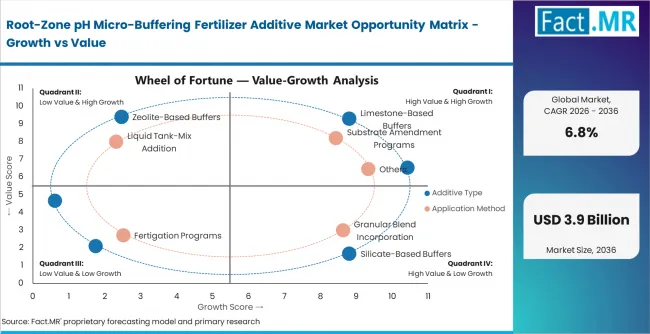
Fact.MR analysts observe that the root-zone pH micro-buffering fertilizer additive market is being shaped by the growing need to stabilize nutrient availability in substrate-based and irrigated production systems. Structural demand is anchored in the fact that pH directly changes nutrient solubility and root uptake conditions. Greenhouse, nursery, and hydroponic systems expose this problem more sharply because the crop root zone has less natural buffering than many field soils, and irrigation or fertilizer choices can move the chemistry quickly. That makes preventive buffering commercially more attractive than waiting for visible deficiency symptoms or repeated corrective intervention.
The main restraint is complexity of application fit. Buffering additives have to work with substrate composition, irrigation-water alkalinity, fertilizer acidity, and crop tolerance ranges. Not every grower has the testing discipline or technical support required to use these materials efficiently. Overcorrection is another risk, especially where highly reactive liming or alkalizing materials are applied without careful calibration. Extension guidance explicitly notes that some amendments used to change pH can burn plants and should be tested carefully in root media applications.
- Protected Cultivation Expansion: Wider greenhouse and container production remains the clearest growth opportunity because these systems are more sensitive to pH drift.
- Water Quality Management: Growers facing high-alkalinity or unstable irrigation water create strong demand for additives that stabilize the root zone rather than only correcting feed solutions.
- Multi-Function Inputs: Additives that combine buffering, nutrient retention, and fertilizer compatibility offer higher-value opportunity than simple pH correction tools.
Regional Analysis
The root-zone pH micro-buffering fertilizer additive market is assessed across North America, Europe, Asia Pacific, Latin America, and Middle East and Africa, covering 40+ countries with demand profiles shaped by protected cultivation intensity, substrate use, irrigation-water quality management, and nutrient-program sophistication. The full report provides market attractiveness analysis by region and country.
.webp "Top Country Growth Comparison Root Zone Ph Micro Buffering Fertilizer Additive Market Cagr (2026 2036)")
Top Country Growth Comparison Root Zone Ph Micro Buffering Fertilizer Additive Market Cagr (2026 2036) | Source: Fact.MR
| Country | CAGR (2026 to 2036) |
|---|---|
| India | 8.1% |
| Spain | 7.5% |
| United States | 7.0% |
| Canada | 6.6% |
| Mexico | 6.1% |
Source: Fact.MR analysis. Updated Jun 15, 2026
Source: Fact.MR analysis, based on proprietary forecasting model and primary research
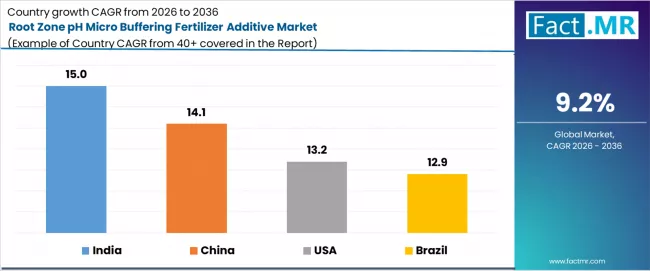
Root Zone Ph Micro Buffering Fertilizer Additive Market Cagr Analysis By Country | Source: Fact.MR
North America Root-Zone pH Micro-Buffering Fertilizer Additive Market Analysis

Root Zone Ph Micro Buffering Fertilizer Additive Market Country Value Analysis | Source: Fact.MR
North America remains a core commercial region because it combines nursery production, greenhouse vegetables, ornamentals, and specialty crops with relatively mature substrate-management practices. The region also has a strong testing culture around greenhouse media and irrigation-water effects, which increases awareness of pH drift as an operational issue rather than a sporadic crop problem. Demand here is strongest where soluble fertilizer programs and container production create faster movement in the root-zone chemistry than growers can tolerate without preventive buffering.
- United States: Greenhouse crops, nursery production, and specialty crop substrates support U.S. demand. The market in the United States is projected to expand at a CAGR of 7.0% through 2036, supported by media-testing discipline and wider use of soluble fertilizer programs.
- Canada: Greenhouse vegetables, bedding plants, and container crops support Canadian demand. Root-zone pH micro-buffering fertilizer additive demand in Canada is expected to grow at 6.6% CAGR through 2036, backed by substrate-intensive production systems.
- Mexico: Export horticulture and irrigated protected cultivation create a practical fit for pH-stable root management. Sales of root-zone pH micro-buffering fertilizer additives in Mexico are likely to rise at 6.1% CAGR during the forecast period.
Fact.MR’s analysis of North America covers the United States, Canada, and Mexico. Includes container production, greenhouse substrate management, and irrigation-quality related buffering demand.
Europe Root-Zone pH Micro-Buffering Fertilizer Additive Market Analysis
Root Zone Ph Micro Buffering Fertilizer Additive Market Europe Country Market Share Analysis, 2026 & 2036 | Source: Fact.MR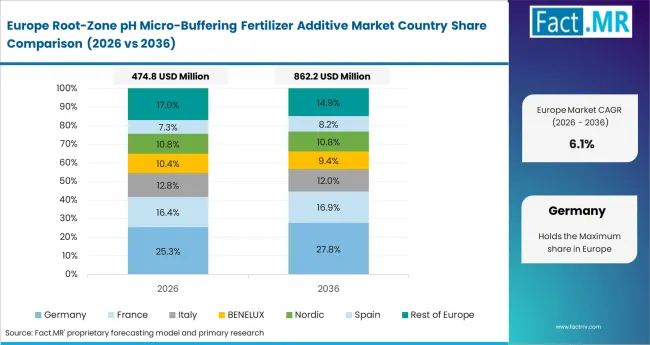
- Spain: Intensive horticulture, greenhouse vegetable production, and irrigated root-zone management support stronger adoption in Spain. Demand for root-zone pH micro-buffering fertilizer additives in Spain is estimated to expand at a CAGR of 7.5% through 2036.
Fact.MR’s analysis covers Spain, the Netherlands, Germany, France, Italy, and Rest of Europe. Includes greenhouse nutrition, substrate chemistry management, and buffering demand conditions in intensive crop systems.
Asia Pacific and Latin America Root-Zone pH Micro-Buffering Fertilizer Additive Market Analysis
Asia Pacific and Latin America offer the strongest long-term expansion potential because protected cultivation, irrigated horticulture, and higher-value crop systems are increasing across multiple regions. Demand is likely to strengthen where growers shift from generalized fertilizer practice toward more technically managed substrate and fertigation programs. Adoption depends on access to greenhouse inputs, testing discipline, and the ability of suppliers to explain how buffering additives protect nutrient-use efficiency rather than simply altering pH.
- India: Protected cultivation growth, substrate-intensive nursery systems, and greater technical management in horticulture support Indian demand. The market in India is projected to grow at 8.1% CAGR through 2036.
Fact.MR’s analysis covers India, China, Japan, ASEAN, Australia, Brazil, Argentina, and Rest of Latin America. Includes protected cultivation, horticulture intensification, and irrigation-linked root-zone management across major agricultural systems.
Competitive Aligners for Market Players
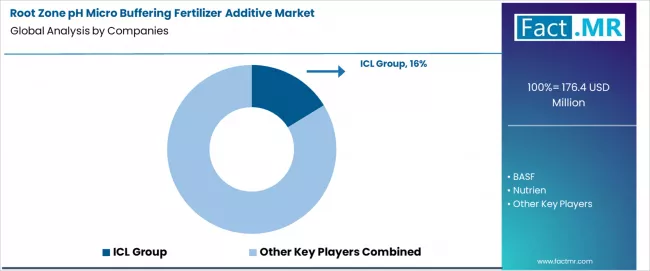
Root Zone Ph Micro Buffering Fertilizer Additive Market Analysis By Company | Source: Fact.MR
The root-zone pH micro-buffering fertilizer additive market is moderately concentrated at the formulation level, while distribution and technical support remain fragmented. Competitive strength comes from the ability to connect substrate chemistry, irrigation-water conditions, and fertilizer behavior into a product story grower can apply with confidence. Suppliers competing in this space need more than a corrective chemistry claim. They need a credible explanation of residual effect, buffering behavior, and crop compatibility.
Competitive advantage is defined by buffering consistency, ease of incorporation into fertilizer or substrate programs, and the ability to avoid overcorrection. Limestone-based leaders benefit from familiarity and broad grower acceptance. Zeolite and silicate-linked systems gain attention where suppliers can show added benefits around nutrient retention or system stability. Buyers in this market usually choose on predictability and technical support rather than on input cost alone, because failure in pH control can quickly trigger visible crop losses or repeated remediation. Buyer dynamics vary by crop intensity and substrate use. Greenhouse and nursery buyers are less willing to compromise on chemistry stability because small pH errors can affect micronutrient uptake and crop quality rapidly. Broader field buyers remain more selective and often adopt only where fertigation, specialty crop value, or irrigation quality issues justify the extra technical layer. Competitive intensity is therefore rising fastest in substrate-driven horticulture rather than in broad-acre agriculture.
Key Players
- ICL Group Ltd.
- Yara International ASA
- Nutrien Ltd.
- The Mosaic Company
- Haifa Group
- EuroChem Group AG
- UPL Ltd.
- Coromandel International Ltd.
- SQM S.A.
Bibliography
- Zhang, M., Wang, W., Zhong, L., Ji, F., & He, D. (2024). Bicarbonate used as a buffer for controling nutrient solution pH value during the growth of hydroponic lettuce. International Journal of Agricultural and Biological Engineering, 17(3), 59–67. doi: 10.25165/j.ijabe.20241703.8692.
- Bosman, R. C., Van Rooyen, I. L., Brancken, J., Brink, H. G., & Nicol, W. (2024). Simultaneous pH and EC control in hydroponics through real-time manipulation of the ammonium-to-nitrate ratio in the nutrient solution. Scientia Horticulturae, 332, 113185. doi: 10.1016/j.scienta.2024.113185.
- Langenfeld, N. J., Skabelund, H. A., Heins, R., & Bugbee, B. G. (2024). Advantages of a novel in situ pH measurement for soilless media. Frontiers in Plant Science, 15, 1334328. doi: 10.3389/fpls.2024.1334328.
- Langenfeld, N. J., & Bugbee, B. G. (2025). Adding ammonium through automated pH control in zero-discharge liquid hydroponics to maintain low, steady-state concentrations. HortScience, 60(9), 1555–1560. doi: 10.21273/HORTSCI18771-25.
- Chowdhury, M. S. N., Hossain, M. S., Sagervanshi, A., Pitann, B., & Mühling, K. H. (2024). pH stabilized NH4+-fed nutrition promotes higher B uptake and plant growth in rapeseed (Brassica napus L.) by the upregulation of B transporters. Journal of Plant Growth Regulation, 43, 3594–3608. doi: 10.1007/s00344-024-11330-x.
This Report Addresses
- Strategic intelligence on root-zone pH micro-buffering additive demand across greenhouse, nursery, substrate-based, and irrigated crop systems.
- Market forecast from USD 1.9 billion in 2026 to USD 3.7 billion by 2036 at a CAGR of 6.8%.
- Growth opportunity mapping across limestone-based, silicate-based, zeolite-based, and multi-mineral buffering systems.
- Segment analysis by additive type, application, crop type, and end use.
- Regional outlook covering North America, Europe, Asia Pacific, Latin America, and Middle East and Africa.
- Competitive analysis of ICL Group, Yara International, Nutrien, Mosaic, Haifa Group, EuroChem, and other participants.
- Root-zone nutrient stability analysis covering substrate buffering, irrigation-water effects, fertilizer acidity, and micronutrient availability.
- Report delivered in PDF, Excel datasets, and presentation formats. Supported by primary interviews, extension guidance, and substrate chemistry research.
Root-Zone pH Micro-Buffering Fertilizer Additive Market Definition
The market covers fertilizer-compatible additives designed to stabilize or gradually adjust pH conditions in the crop root zone. It includes materials incorporated into substrates, fertilizer blends, tank mixes, or fertigation programs to reduce abrupt pH drift, preserve nutrient availability, and improve the operating stability of root media and rhizosphere chemistry in professional crop production systems.
Root-Zone pH Micro-Buffering Fertilizer Additive Market Inclusions
Covers global and regional forecasts from 2026 to 2036. Includes limestone-based buffering additives, silicate-based inputs, zeolite-based buffering materials, organic-neutralizing systems, and multi-mineral products used to stabilize root-zone chemistry in greenhouse media, nursery substrates, hydroponic root environments, and irrigated soil systems. Covers products positioned for controlled pH response, nutrient protection, and better fertilizer efficiency in technically managed crops.
Root-Zone pH Micro-Buffering Fertilizer Additive Market Exclusions
Excludes standard bulk lime used only for general field liming without root-zone management intent. Omits standalone pH-up and pH-down chemicals used only as immediate solution correction tools. Excludes general soil conditioners, irrigation hardware, and fertilizer products that do not claim or function as pH micro-buffering systems within the root environment. It also excludes ordinary nutrient products unless buffering capacity is part of their commercial positioning.
Root-Zone pH Micro-Buffering Fertilizer Additive Market Research Methodology
- Primary Research
- Interviews with greenhouse growers, nursery substrate managers, fertigation consultants, horticulture distributors, root-media formulators, and specialty crop agronomy teams across major agricultural regions.
- Desk Research
- Uses greenhouse and nursery pH management guidance from extension systems, USDA substrate-buffering research, horticultural pH-management publications, and technical product positioning around buffering substrates and nutrient availability.
- Market-Sizing and Forecasting
- Hybrid model using protected cultivation relevance, substrate-use intensity, irrigation-driven pH management need, crop sensitivity to pH drift, and adoption potential across fertilizer-compatible buffering systems.
- Data Validation and Update Cycle
- Validated using extension recommendations, grower practice references, substrate chemistry studies, and recurring checks on commercial need in greenhouse, nursery, and intensive horticulture systems.
Segmentation
Scope of Report
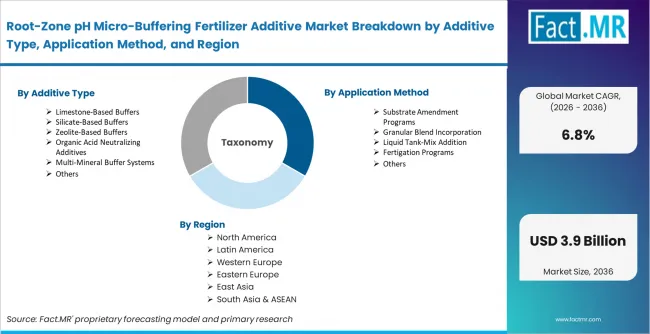
Root Zone Ph Micro Buffering Fertilizer Additive Market Breakdown By Additive Type, Application Method, And Region | Source: Fact.MR
| Attribute | Details |
|---|---|
| Quantitative Units | USD billion (2026) to USD billion (2036), at a CAGR |
| Market Definition | Fertilizer-compatible additives designed to stabilize or gradually adjust pH in the crop root zone, improving nutrient availability and reducing abrupt acidity or alkalinity shifts across substrate-based and irrigated crop systems. |
| Additive Type Segmentation | Limestone-Based Buffers, Silicate-Based Buffers, Zeolite-Based Buffers, Organic Acid Neutralizing Additives, Multi-Mineral Buffer Systems, Others |
| Application Segmentation | Granular Blend Incorporation, Liquid Tank-Mix Addition, Fertigation Programs, Substrate Amendment Programs, Others |
| Crop Type Segmentation | Fruits & Vegetables, Nursery & Ornamentals, Greenhouse Crops, Cereals & Grains, Plantation Crops, Others |
| Regions Covered | North America, Europe, Asia Pacific, Latin America, Middle East and Africa |
| Countries Covered | United States, Canada, Mexico, Spain, Netherlands, Germany, France, India, China, Australia, Brazil, Argentina, and 40+ countries |
| Key Companies Profiled | ICL Group Ltd., Yara International ASA, Nutrien Ltd., The Mosaic Company, Haifa Group, EuroChem Group AG, UPL Ltd., Coromandel International Ltd., SQM S.A. |
| Forecast Period | 2026 to 2036 |
| Approach | Hybrid top-down and bottom-up model using substrate intensity, greenhouse and nursery relevance, irrigation-water chemistry risk, crop sensitivity to pH drift, and primary interviews with growers, distributors, and agronomy teams. |
Source: Fact.MR analysis. Updated Jun 15, 2026
Root-Zone pH Micro-Buffering Fertilizer Additive Market by Segments
-
By Additive Type:
- Limestone-Based Buffers
- Silicate-Based Buffers
- Zeolite-Based Buffers
- Organic Acid Neutralizing Additives
- Multi-Mineral Buffer Systems
- Others
-
By Application:
- Granular Blend Incorporation
- Liquid Tank-Mix Addition
- Fertigation Programs
- Substrate Amendment Programs
- Others
-
By Crop Type:
- Fruits & Vegetables
- Nursery & Ornamentals
- Greenhouse Crops
- Cereals & Grains
- Plantation Crops
- Others
-
By Region:
- North America
- United States
- Canada
- Latin America
- Brazil
- Mexico
- Argentina
- Chile
- Rest of Latin America
- Western Europe
- Germany
- France
- United Kingdom
- Italy
- Spain
- Nordic Countries
- BENELUX
- Rest of Western Europe
- Eastern Europe
- Russia
- Poland
- Hungary
- Balkan and Baltic
- Rest of Eastern Europe
- East Asia
- China
- Japan
- South Korea
- South Asia and Pacific
- India
- ASEAN
- Australia and New Zealand
- Rest of South Asia and Pacific
- Middle East and Africa
- Kingdom of Saudi Arabia
- Other GCC Countries
- Turkey
- South Africa
- Rest of Middle East and Africa
- North America
Root-Zone pH Micro-Buffering Fertilizer Additive Market Definition
-
By Additive Type:
- Limestone-Based Buffers
- Silicate-Based Buffers
- Zeolite-Based Buffers
- Organic Acid Neutralizing Additives
- Multi-Mineral Buffer Systems
- Others
-
By Application:
- Granular Blend Incorporation
- Liquid Tank-Mix Addition
- Fertigation Programs
- Substrate Amendment Programs
- Others
-
By Crop Type:
- Fruits & Vegetables
- Nursery & Ornamentals
- Greenhouse Crops
- Cereals & Grains
- Plantation Crops
- Others
-
By Region:
- North America
- United States
- Canada
- Latin America
- Brazil
- Mexico
- Argentina
- Chile
- Rest of Latin America
- Western Europe
- Germany
- France
- United Kingdom
- Italy
- Spain
- Nordic Countries
- BENELUX
- Rest of Western Europe
- Eastern Europe
- Russia
- Poland
- Hungary
- Balkan and Baltic
- Rest of Eastern Europe
- East Asia
- China
- Japan
- South Korea
- South Asia and Pacific
- India
- ASEAN
- Australia and New Zealand
- Rest of South Asia and Pacific
- Middle East and Africa
- Kingdom of Saudi Arabia
- Other GCC Countries
- Turkey
- South Africa
- Rest of Middle East and Africa
- North America
Frequently Asked Questions
What is the expected CAGR from 2026 to 2036?
Which additive type is poised to lead the market?
Which application segment holds the largest share?
Which crop segment is expected to remain strongest?
Which end-use segment is likely to remain commercially important?
Which country shows the fastest growth?
What is driving demand for root-zone pH micro-buffering additives?
What is the key challenge in this market?
What makes this market different from conventional liming demand?
Who worked on this report


Preview the report firsthand - request a free sample
Free SampleGet the brochure for pricing and purchase details
Download PDF