- Market Value (2025): USD 1.1 Bn
- Estimated Value (2026): USD 1.1 Bn
- Forecast Value (2036): USD 2.0 Bn
- CAGR (2026-2036): 5.8%
What is the Rotary Chamber Vacuumizers Market forecast to be worth by 2036?
USD 1.1 Billion in 2026 to USD 2.0 Billion by 2036, at 5.8% CAGR.
- The Rotary Chamber Vacuumizers Market crossed a valuation of USD 1.1 Billion in 2025.
- Demand is projected to increase from USD 1.1 Billion in 2026 to USD 2.0 Billion by 2036.
- The market is forecast to record a 5.8% CAGR from 2026 to 2036 as meat plants, dairy packers and prepared-food processors use chamber vacuumizing to improve pouch sealing and shelf-life control.
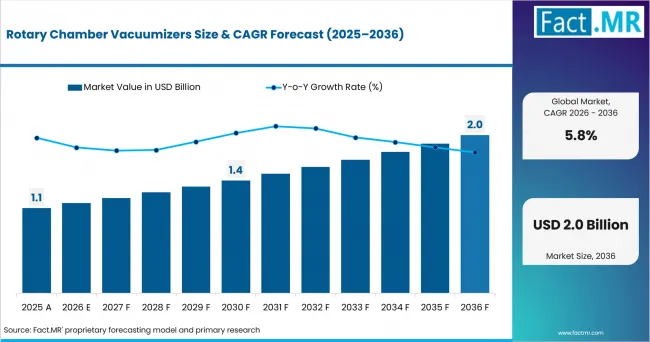
Rotary Chamber Vacuumizers Value Analysis | Source: Fact.MR
What are the defining numbers behind Rotary Chamber Vacuumizers Market growth?
USD 0.8 Billion absolute opportunity by 2036, led by single-chamber rotary systems, 6-10 cycles/min equipment and fresh & processed meat applications.
- Demand Drivers in the Market
- Meat processors need steady oxygen removal and seal repeatability to pack chilled cuts, marinated meat and portioned products with fewer rejected pouches.
- Dairy processors need compact chamber systems to protect cheese blocks and portions where pouch packs move into cold storage before distribution.
- Prepared-meal producers require equipment that handles mixed pack sizes while maintaining clean changeovers between recipes and short batch runs.
- Maintenance teams value stainless-steel chambers and service access because pump downtime can interrupt chilled-food packing schedules.
- Large meat plants sustain recurring pouch volume. USDA NASS reported in April 2026 that U.S. red meat production reached 53.8 billion pounds in 2025, giving chamber equipment a sizeable application base.
- Key Segments Analyzed
- By Machine Configuration: Single-chamber rotary is projected to hold 31.0% share in 2026 owing to its smaller footprint and fit with mid-sized packing rooms.
- By Throughput Class: 6-10 cycles/min equipment is anticipated to account for 29.0% share in 2026 because it balances labor input with practical daily output.
- By Package Application: Fresh & processed meat is estimated to capture 39.0% share in 2026 supported by high pouch volumes in chilled meat operations.
- By Automation Level: Semi-automatic loading is forecast to represent 34.0% share in 2026 due to its lower integration burden for processors that retain manual handling.
- Analyst Opinion at Fact.MR
- Shambhu Nath Jha, Principal Consultant at Fact.MR, states, "Rotary chamber vacuumizers draw attention because they bridge bench-top vacuum sealers and larger form-fill-seal lines. The market is expected to expand as food plants seek cycle control before investing in larger packaging halls. Suppliers that combine chamber reliability, hygienic design and responsive service coverage are likely to win repeat equipment orders."
- Strategic Implications
- Equipment manufacturers should document cycle rates by pouch size and product type so plant engineers can match machines to realistic line output.
- Distributors should pair sales with spare parts availability since processors treat pump service and seal-bar replacement as uptime safeguards.
- Food processors should evaluate chamber dimensions, pump capacity and cleaning access before choosing between single and double-chamber formats.
- Packaging material vendors should test pouch structures on chamber systems to reduce sealing defects across meat, cheese and seafood applications.
Japan is projected to post 7.0% CAGR through 2036 supported by export-oriented food packaging and labor-saving equipment demand. Italy is anticipated to advance at 6.6% CAGR owing to livestock, dairy and regional prepared-food processing. The USA is estimated to record 5.5% CAGR as meat and poultry plants keep pouch vacuum systems active. Germany is forecast to hold 4.8% CAGR supported by hygienic machinery replacement in meat processing. The UK is expected to register 4.3% CAGR as meat products and prepared meals sustain chamber packaging use.
How does the Rotary Chamber Vacuumizers Market break down by segment?
Single-chamber rotary leads at 31.0%; fresh & processed meat leads at 39.0%.
Which Machine Configuration dominates?
Single-chamber rotary holds 31.0% share in 2026.
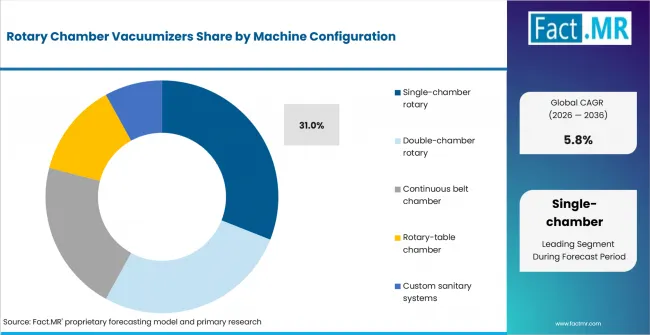
Rotary Chamber Vacuumizers Analysis By Machine Configuration | Source: Fact.MR
Single-chamber rotary systems lead because they give mid-sized processors a practical step above static chamber machines. The format suits butcheries, central kitchens and regional meat plants that need repeatable vacuum cycles in compact packing rooms. It keeps cleaning and operator training manageable for plants with mixed daily production.
What leads the Throughput Class segment?
6-10 cycles/min equipment leads with 18.0% share in 2026.
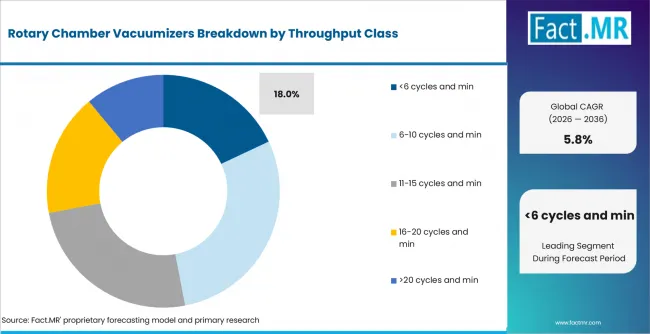
Rotary Chamber Vacuumizers Analysis By Throughput Class | Source: Fact.MR
The 6-10 cycles/min band fits plants that pack chilled foods in batches and still rely on operators for loading. It gives enough speed for regular commercial use while avoiding the cost and floor-space needs of higher-throughput lines. Cycle consistency carries weight where pouch loading remains manual.
How does Package Application shape demand?
Fresh & processed meat captures 39.0% share in 2026.
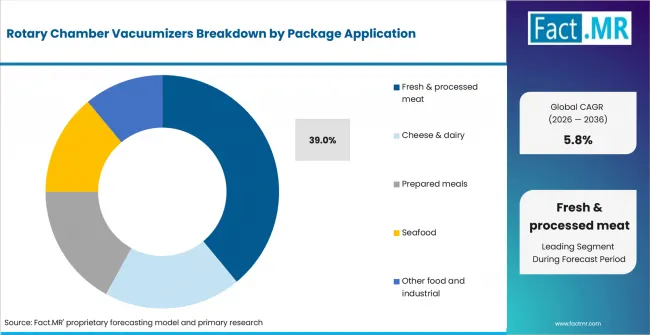
Rotary Chamber Vacuumizers Analysis By Package Application | Source: Fact.MR
Fresh and processed meat applications lead because vacuum pouches are common in chilled cuts, sausage portions and marinated products. Eurostat reported in August 2026 that EU food products recorded 3.8% growth in sold production value in constant prices in 2025. Chamber vacuumizers serve these operations when oxygen removal and strong seals are required before cold-chain distribution.
What supports Semi-automatic loading within Automation Level?
Semi-automatic loading represents 34.0% share in 2026.
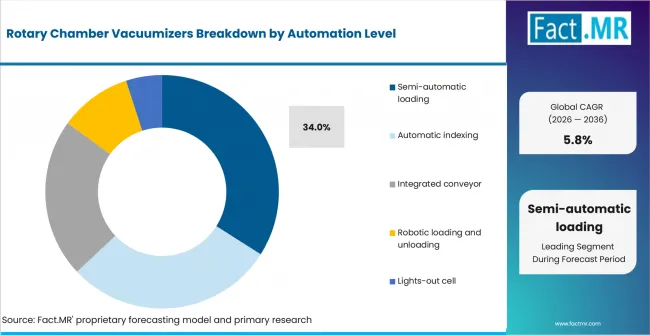
Rotary Chamber Vacuumizers Analysis By Automation Level | Source: Fact.MR
Semi-automatic loading leads because many processors want output gains while keeping workers close to product inspection and pouch placement. The format reduces repetitive chamber handling before a full robotic cell becomes practical. It is easier to install inside older rooms where utilities and drainage were built around manual workstations.
What is accelerating Rotary Chamber Vacuumizers Market adoption, and what is holding it back?
Demand rises through chilled-food pouching, semi-automatic labor relief and hygienic replacement. Growth is constrained by capital cost, service needs and format competition.
Drivers Impact Analysis
| DRIVER | (~) % IMPACT ON CAGR | GEOGRAPHIC RELEVANCE | IMPACT TIMELINE |
|---|---|---|---|
| Fresh and processed meat pouching | +1.1% | Global | Short term (<= 2 years) |
| Semi-automatic labor relief | +0.8% | North America, Western Europe | Medium term (2-4 years) |
| Export-grade vacuum packaging for chilled foods | +0.6% | East Asia, Europe | Medium term (2-4 years) |
| Hygienic stainless-steel equipment replacement | +0.5% | Global | Long term (>= 4 years) |
- Fresh and processed meat pouching: Meat plants need vacuum chambers that remove oxygen consistently and protect sealed products during chilled distribution.
- Semi-automatic labor relief: Semi-automatic chamber formats help plants raise output while keeping operators involved in product placement and quality checks.
- Export-grade vacuum packaging: Food exporters need packaging that protects product quality during longer transit and helps maintain appearance at destination.
- Hygienic equipment replacement: Stainless-steel chambers, cleanable surfaces and serviceable pumps influence repeat orders in wet and chilled food rooms.
Opportunity Impact Analysis
| OPPORTUNITY | (~) % IMPACT ON CAGR | GEOGRAPHIC RELEVANCE | IMPACT TIMELINE |
|---|---|---|---|
| Conveyor-linked chamber lines | +0.7% | Global | Medium term (2-4 years) |
| Compact rotary chambers for SMEs | +0.5% | Europe, North America | Short term (<= 2 years) |
| Service and retrofit packages | +0.4% | Global | Medium term (2-4 years) |
- Conveyor-linked chamber lines: Processors can add controlled infeed and outfeed handling around chamber systems when thermoforming lines are too large.
- Compact rotary chambers for SMEs: Smaller food companies need machines that raise pouch output while preserving floor space and simple operator routines.
- Service and retrofit packages: Pump maintenance, seal-bar upgrades and training packages can extend machine life and create recurring service revenue.
Restraints Impact Analysis
| RESTRAINT | (~) % IMPACT ON CAGR | GEOGRAPHIC RELEVANCE | IMPACT TIMELINE |
|---|---|---|---|
| Capital spending delays in small plants | -0.5% | Global | Short term (<= 2 years) |
| Specialized maintenance requirements | -0.3% | Global | Medium term (2-4 years) |
| Competition from tray and thermoforming formats | -0.2% | Europe, North America | Long term (>= 4 years) |
- Capital spending delays: Small processors often delay chamber upgrades when packaging demand varies by season and cash flow favors basic sealers.
- Specialized maintenance requirements: Pumps, seals and chambers require service discipline, so weak local support can slow equipment decisions.
- Format competition: Tray sealers and thermoforming lines can take some prepared-meal and retail-ready formats away from pouch-based vacuum systems.
Which countries are scaling the Rotary Chamber Vacuumizers Market through 2036?
- The country comparison spans 2.69 percentage points and forms three practical growth bands across the forecast period.
- Japan remains 0.45 percentage point above Italy as packaged food exports and compact machinery investment support chamber equipment adoption.
- Italy remains 1.08 percentage points above the USA through livestock, dairy and prepared-food production where pouch vacuumizing remains practical.
- The USA remains 0.69 percentage point above Germany as large meat and poultry plants sustain demand for productive chamber systems.
- Germany remains 0.47 percentage point above the UK through hygienic equipment replacement and a strong food-machinery base.
- The UK closes the displayed range as prepared meals and chilled meat sales sustain steady replacement demand.
Comparable CAGRs create different entry conditions because chamber equipment is tied to plant layout, labor cost, service reach and food-format mix. Full report coverage includes North America, Latin America, Western Europe, Eastern Europe, East Asia, South Asia & Pacific, Middle East & Africa.
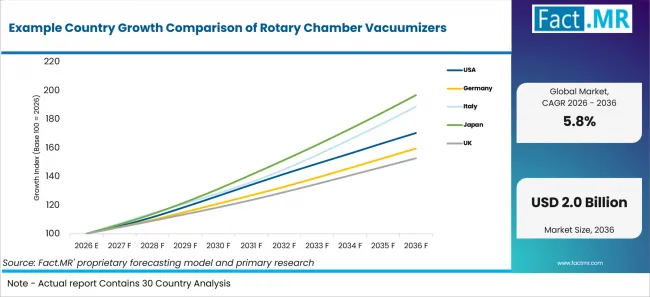
Example Country Growth Comparison Of Rotary Chamber Vacuumizers | Source: Fact.MR
| Country | CAGR |
|---|---|
| Japan | 7.0% |
| Italy | 6.6% |
| United States | 5.5% |
| Germany | 4.8% |
| United Kingdom | 4.3% |
How does Japan perform?
7.0% CAGR, led by export-oriented food packing and compact equipment replacement.
Japan starts from export-led food processing and compact machinery needs. MAFF's April 2025 Basic Plan set a 2030 target of 5 trillion yen for exports of agricultural, forestry, and fishery products and food. The International Trade Administration reported in May 2026 that Japan food processing machinery reached USD 4.2 Billion in 2024. The country is projected to record 7.0% CAGR as seafood, prepared-food and meat processors use chamber systems for sealed pouches before cold-chain shipment. Semi-automatic formats fit older rooms where operators still inspect pouch position and product appearance.
What supports Italy adoption?
6.6% CAGR, supported by livestock value, cheese output and regional chilled-food production.
Italy benefits from livestock, cheese and cured-meat processing that relies on pouch protection. Istat reported in June 2026 that livestock output exceeded EUR 25 Billion in 2025. Istat also reported in June 2026 that industrial producer prices rose 7.3% year over year in May 2026. The country is anticipated to advance at 6.6% CAGR as regional processors use rotary chambers for varied meat, dairy and prepared-food pack sizes. Sanitary design, drainage fit and seal repeatability shape replacement timing in smaller plants.
What supports USA adoption?
5.5% CAGR, driven by meat throughput, poultry volumes and semi-automatic packaging upgrades.
The USA market is shaped by high-volume meat and poultry packing. USDA NASS reported in April 2026 that broiler live-weight production reached 62.2 billion pounds in 2025. BLS reported a 12-month increase of 11.5% in July 2026 for the producer price index for machinery and equipment parts and supplies wholesaling. The USA is estimated to record 5.5% CAGR as processors balance chamber uptime with service cost control. Semi-automatic loading remains useful where operators inspect product orientation and seal cleanliness before vacuumizing.
What is supporting Germany adoption?
4.8% CAGR, supported by meat production, food manufacturing and hygienic machine replacement.
Germany retains a clear base in meat processing and food machinery. Destatis reported in August 2026 that German commercial slaughter companies produced nearly 3.4 million tonnes of meat in the first half of 2026. Germany is forecast to hold 4.8% CAGR as sausage, pork and specialty-food plants replace older chamber systems. Wet-room cleaning, stainless-steel design and local service depth remain central to equipment selection.
What supports the United Kingdom growth?
4.3% CAGR, backed by food manufacturing sales, trade activity and chilled prepared meals.
The UK advances through chilled meat, cheese and prepared-meal packaging. ONS reported in July 2026 that food manufacturing represented 22.9% of total UK manufacturers' sales in 2025. Defra reported in April 2026 that food, feed and drink exports reached GBP 25.7 Billion in 2025. The UK is expected to register 4.3% CAGR as processors use rotary chamber vacuumizers for compact pouch sealing. Replacement orders depend on service response, spare parts access and fit with existing chilled rooms.
Who leads the Rotary Chamber Vacuumizers Market?
SEALED AIR – CRYOVAC® is profiled among the key providers in the Rotary Chamber Vacuumizers Market. Its competitive relevance sits within a market where food processors prioritize reliable oxygen removal, pouch sealing, hygienic chamber design, and equipment suited to chilled-food packaging operations.
Furukawa Mfg. Co., Ltd. and Rollstock, Inc. are also included among the principal providers. Their competitive positioning aligns with demand for chamber-based packaging systems that combine dependable cycle control with practical loading, cleaning, and integration requirements across meat, cheese, seafood, and prepared-food applications.
Wuhu Elemotion Technology Co., Ltd. completes the profiled supplier group. Across the market, providers participate through chamber machines, chamber belt systems, double-chamber formats, and compact vacuum equipment, giving processors alternatives according to plant layout, throughput requirements, and automation preferences.
Competition therefore centers on chamber reliability, hygienic design, cycle consistency, service access, and equipment integration. Suppliers that combine dependable machinery with spare-parts availability, pump maintenance, seal-bar support, and responsive technical service are better positioned to secure repeat equipment orders.
Which companies are the key providers?
Key companies include SEALED AIR – CRYOVAC®, Furukawa Mfg. Co., Ltd., Rollstock, Inc., and Wuhu Elemotion Technology Co., Ltd.
- SEALED AIR – CRYOVAC®
- Furukawa Mfg. Co., Ltd.
- Rollstock, Inc.
- Wuhu Elemotion Technology Co., Ltd.
Bibliography
- U.S. Department of Agriculture, National Agricultural Statistics Service. (2026, April 22). Livestock slaughter 2025 summary.
- U.S. Department of Agriculture, National Agricultural Statistics Service. (2026, April 30). Poultry - production and value 2025 summary.
- U.S. Bureau of Labor Statistics. (2026, August 13). Producer Price Indexes - July 2026.
- Eurostat. (2026, August 24). EU industrial production rebounds in 2025.
- Statistisches Bundesamt (Destatis). (2026, August 7). Fleischproduktion im 1. Halbjahr 2026 um 0,7 % gesunken.
- Istat. (2026, June 12). Economic accounts for agriculture - Year 2025.
- Istat. (2026, June 30). Industrial and construction producer prices - May 2026.
- Office for National Statistics. (2026, July 24). UK manufacturers' sales by product: 2025.
- Department for Environment, Food & Rural Affairs. (2026, April 30). UK trade in food, feed and drink, 2025 provisional. GOV.UK.
- Ministry of Agriculture, Forestry and Fisheries. (2025). Key points of the new Basic Plan for Food, Agriculture, and Rural Areas.
- International Trade Administration. (2026, May 7). Japan food packaging equipment.
This Report Answers
- The report explains where rotary chamber vacuumizers are used across machine configuration, throughput class, package application and automation level.
- Segment analysis identifies the leading subsegments and the operating reasons food processors prioritize them.
- Country analysis examines the listed markets and the food-production mechanisms that support chamber vacuumizer demand.
- Competitive analysis reviews active providers across chamber machines, chamber belt systems, double-chamber formats and compact vacuum equipment.
- Application analysis assesses how pouch sealing, chamber size, cycle rate and service access influence equipment selection.
What does the Rotary Chamber Vacuumizers Market cover?
The Rotary Chamber Vacuumizers Market covers chamber-based equipment used to remove air from pouches or bags before sealing. The category borders vacuum sealers when smaller users move from external sealing units toward chamber equipment.
Meat applications connect directly with fresh meat packaging where oxygen removal, seal strength and chilled storage life shape pack performance.
Processed meats are included where sausage, marinated cuts and deli products use pouch sealing. Those applications align with processed meat packaging where distribution stability influences equipment choice.
What is included in the scope?
The scope includes single-chamber rotary, double-chamber rotary, continuous belt chamber and rotary-table chamber systems used in pouch packaging. It connects with food processing and handling equipment where packaging machines support processing rooms.
Equipment linked with semi-automatic loading, automatic indexing and integrated conveyor movement is included. These systems align with packaging automation solutions where processors seek labor relief.
Form fill and sealing equipment is reviewed as an adjacent category when continuous bagging or rollstock formats compete with chamber packaging.
The scope includes pouch-based meat, cheese, prepared-meal and seafood applications. It also references meatainers packaging where meat distribution needs shape packaging choices outside chamber systems.
What is excluded from the scope?
The scope excludes basic household vacuum sealers, loose packaging consumables and standalone pumps sold apart from chamber packaging systems. Tray sealing machines remain outside the core boundary when the equipment seals rigid trays.
Modified-atmosphere tray equipment is outside the core boundary unless paired with chamber vacuumizing in a mixed packaging room. MAP sealing equipment remains adjacent because it uses gas composition control.
Fully robotic cells are outside the scope when handling automation carries most of the equipment value. Packaging robots are treated as adjacent automation hardware.
How Was the Analysis Built?
The analysis draws on 120+ sources, 35+ company portfolios, 25+ countries, and more than 20 industry interviews.
- Primary Research: Primary research includes discussions with manufacturers, service providers, technology developers, distributors, end users, and subject-matter experts. These conversations examine purchasing priorities, product adoption, operational challenges, approval requirements, competitive positioning, and the factors that influence wider market acceptance.
- Desk Research: Desk research covers government statistics, regulatory publications, company filings, trade data, technical studies, industry associations, standards, public policy, and other authoritative sources. Every source used in the analysis is documented in the bibliography.
- Market Sizing and Forecasting: Market estimates combine historical performance, demand indicators, pricing and volume trends, segment shares, company participation, country-level growth, adoption patterns, investment activity, and barriers to market expansion.
- Data Validation and Update Cycle: Findings are validated by comparing primary interviews with public data, company activity, regulatory changes, trade patterns, and industry developments. Regular updates review new product launches, capacity changes, partnerships, approvals, and shifts in commercial adoption.
What is the report's scope and coverage?
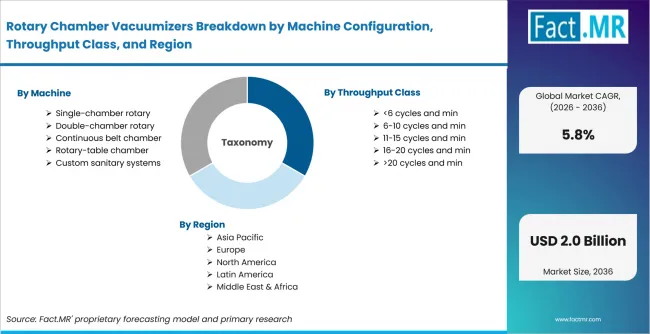
Rotary Chamber Vacuumizers Breakdown By Machine Configuration, Throughput Class, And Region | Source: Fact.MR
| Attribute | Details |
|---|---|
| Quantitative Units | USD Billion |
| Market Definition | Chamber-based vacuum packaging equipment that removes air from pouches or bags before sealing, including rotary chamber, double-chamber and chamber belt formats used in food and industrial packaging. |
| Machine Configuration | Single-chamber rotary; Double-chamber rotary; Continuous belt chamber; Rotary-table chamber; Custom sanitary systems |
| Throughput Class | <6 cycles/min; 6-10 cycles/min; 11-15 cycles/min; 16-20 cycles/min; >20 cycles/min |
| Package Application | Fresh & processed meat; Cheese & dairy; Prepared meals; Seafood; Other food and industrial |
| Automation Level | Semi-automatic loading; Automatic indexing; Integrated conveyor; Robotic loading and unloading; Lights-out cell |
| Regions Covered | North America; Latin America; Western Europe; Eastern Europe; East Asia; South Asia & Pacific; Middle East & Africa |
| Countries Covered | United States; Germany; Italy; Japan; United Kingdom |
| Key Companies Profiled | SEALED AIR – CRYOVAC®, Furukawa Mfg. Co., Ltd., Rollstock, Inc., and Wuhu Elemotion Technology Co., Ltd. |
| Forecast Period | 2026 to 2036 |
| Approach | Hybrid top-down and bottom-up approach using food-processing output, installed equipment base, package application mix, country demand indicators and verified provider portfolios. |
How is the market segmented?
-
By Machine Configuration
- Single-chamber rotary
- Double-chamber rotary
- Continuous belt chamber
- Rotary-table chamber
- Custom sanitary systems
-
By Throughput Class
- <6 cycles/min
- 6-10 cycles/min
- 11-15 cycles/min
- 16-20 cycles/min
- >20 cycles/min
-
By Package Application
- Fresh & processed meat
- Cheese & dairy
- Prepared meals
- Seafood
- Other food and industrial
-
By Automation Level
- Semi-automatic loading
- Automatic indexing
- Integrated conveyor
- Robotic loading and unloading
- Lights-out cell
-
By Region
- North America
- Latin America
- Western Europe
- Eastern Europe
- East Asia
- South Asia & Pacific
- Middle East & Africa