- Market size in 2025:USD 178.5 Million
- Estimated market size in 2026:USD 186.0 Million
- Projected market size by 2036:USD 349.1 Million
- CAGR (2026-2036):6.5%
What is the scalp massage combs market forecast to be worth by 2036?
USD 186.0 million in 2026 to USD 349.1 million by 2036, at 6.5% CAGR.
- The scalp massage combs market crossed USD 178.5 million in 2025 as scalp routines became more visible.
- The market is estimated at USD 186.0 million in 2026. It is projected to reach USD 349.1 million by 2036.
- The market is forecast to record 6.5% CAGR during the forecast period across branded and marketplace channels.
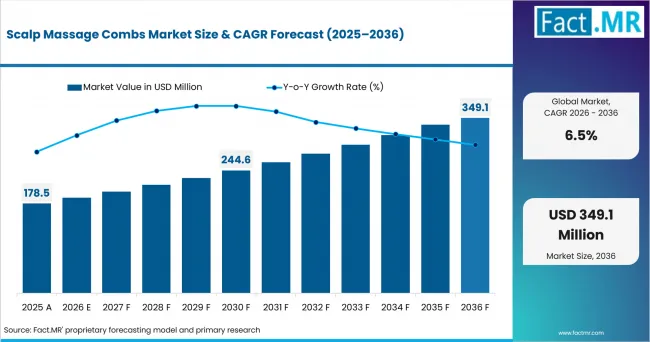
Scalp Massage Combs Market Market Value Analysis | Source: Fact.MR
What are the defining numbers behind scalp massage combs growth?
USD 163.1 million absolute opportunity by 2036, led by scalp-first routines and manual combs.
- Demand Drivers in the Market
- Beauty buyers use massage combs to make scalp scrubs and oils easier to apply during weekly wash routines.
- Retailers add low-ticket tools beside scalp serums because the accessory improves basket value without changing the formulation.
- Marketplaces support trial because manual silicone combs are easy to ship and compare by rating.
- Salons use scalp combs as add-on retail products after exfoliation and treatment services.
- Key Segments Analyzed
- By Device Mechanism: Manual combs are expected to hold 34.0% share in 2026 because low price and shower compatibility support broad trial.
- By Paired Active Base: Niacinamide-linked routines are projected to hold 24.0% share in 2026 as sebum and barrier claims fit scalp-care messaging.
- By Hair Concern: Barrier repair is likely to account for 27.0% share in 2026 as consumers connect scalp comfort with hair appearance.
- By Channel: Marketplaces are estimated to hold 33.0% share in 2026 because buyers compare price, bristle softness and user reviews before purchase.
- By Positioning: Scalp-first routines are forecast to hold 37.0% share in 2026 as brands place tools beside scrubs, oils and leave-on treatments.
- By Geography: India is projected to record 8.0% CAGR through 2036 because urban beauty retail and marketplace trial support low-priced tools.
- Analyst Opinion at Fact.MR
- Shambhu Nath Jha, Senior Analyst at Fact.MR, states, “Scalp massage combs are not winning because they look new. They are winning because they make a scalp routine easier for buyers to repeat weekly. Brands that connect the comb to a clear treatment step have a better path than sellers that only compete on bristle color or handle shape.”
- Strategic Implications
- Brands should design combs around treatment steps because routine fit gives the tool a clearer reason to buy.
- Retailers need clear bristle-softness and cleaning instructions because hygiene concerns can slow repeat purchase.
- Marketplace sellers should separate manual combs from powered devices because price expectations differ by mechanism.
- Salon chains can use scalp combs as small add-on products after treatment services.
Scalp massage combs sit inside the wider scalp health care space because buyers now treat the scalp as part of hair performance. The product remains small in ticket size but repeat purchase comes from routines that pair tools with scrubs and leave-on serums.
India is projected to record 8.0% CAGR through 2036 because urban beauty retail and marketplace trial support low-priced tools. China is expected to expand at 7.4% CAGR through 2036 as social commerce and scalp-care product bundles scale. South Korea is forecast to grow at 7.2% CAGR through 2036 because K-beauty brands keep scalp routines visible. The United States is expected to advance at 6.8% CAGR through 2036 as online beauty sales and at-home treatment routines support device trial. The United Kingdom is projected to rise at 6.3% CAGR through 2036 because specialty beauty retailers keep scalp tools within premium care shelves.
How does the scalp massage combs market break down by segment?
Scalp-first routines lead at 37.0%; manual combs lead at 34.0%.
Which device mechanism leads?
Manual combs hold 34.0% share in the 2026.
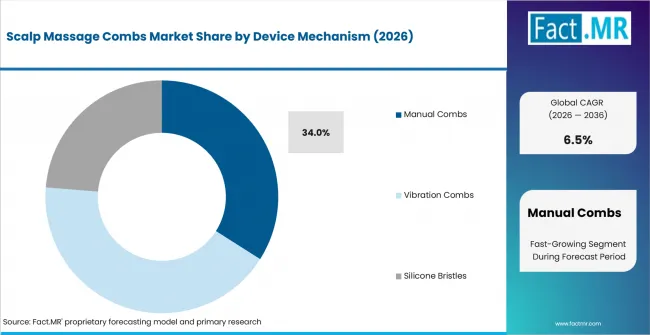
Scalp Massage Combs Market Analysis By Device Mechanism | Source: Fact.MR
Manual combs are expected to hold 34.0% share in 2026 because buyers can add them to shampoo and oil routines without charging or app setup. Their position is supported by low replacement risk and simple shelf display for retailers. Powered beauty devices keep a higher price band but manual formats remain the first trial product for most households.
Which paired active base leads?
Niacinamide-linked routines account for 24.0% share in the 2026.
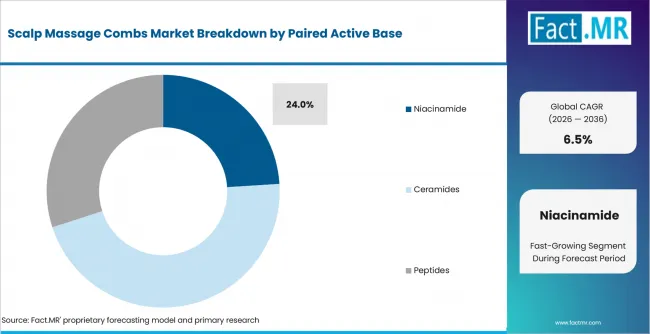
Scalp Massage Combs Market Analysis By Paired Active Base | Source: Fact.MR
Niacinamide-linked routines are projected to hold 24.0% share in 2026 as sebum control and barrier messaging are easy for consumers to understand. The comb does not contain the active in most cases but it supports application in kits. The commercial link comes from kits where scalp serums, tonics or scrubs are sold with an application tool.
Which hair concern leads?
Barrier repair lead with 27.0% share in the 2026.
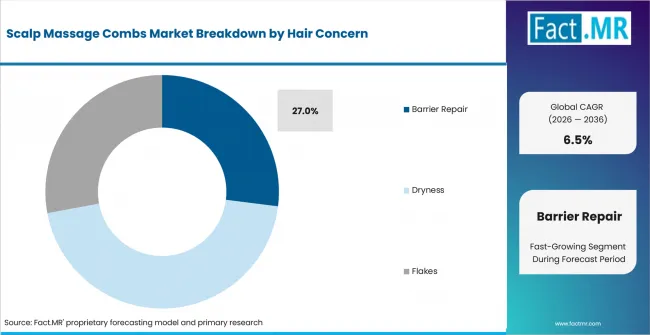
Scalp Massage Combs Market Analysis By Hair Concern | Source: Fact.MR
Barrier repair is likely to account for 27.0% share in 2026 because buyers connect scalp tightness and flakes with weak hair appearance. This concern creates demand for gentle bristles and softer massage claims in home routines. Adjacent hair care appliances show that at-home hair tools perform best when they solve a repeated care step.
Which channel leads?
Marketplaces hold 33.0% share in the 2026.
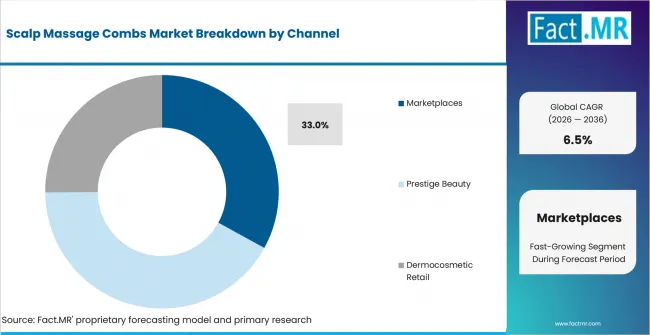
Scalp Massage Combs Market Analysis By Channel | Source: Fact.MR
Marketplaces are estimated to hold 33.0% share in 2026 as scalp combs are small, lightweight and easy to compare by image. Buyers often choose based on bristle feel and waterproof claims before trusting review volume. DTC brands keep higher pricing when the tool sits inside a full scalp-care routine.
Which positioning route leads?
Scalp-first routines account for 37.0% share in the 2026.
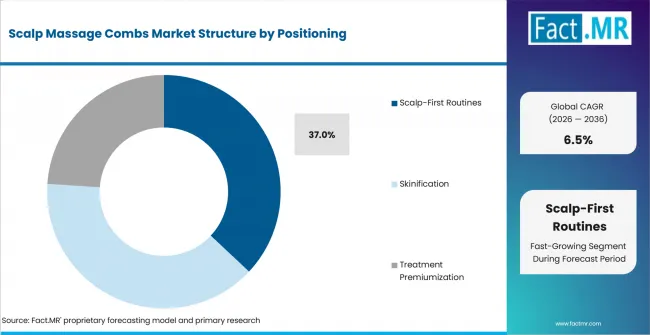
Scalp Massage Combs Market Analysis By Positioning | Source: Fact.MR
Scalp-first routines are forecast to hold 37.0% share in 2026 because brands now explain why scalp condition affects hair appearance. This positioning gives a low-cost comb a treatment role instead of a grooming role. The result is better shelf logic beside exfoliating shampoos and soothing leave-on products.
What is accelerating scalp massage combs adoption, and what is holding it back?
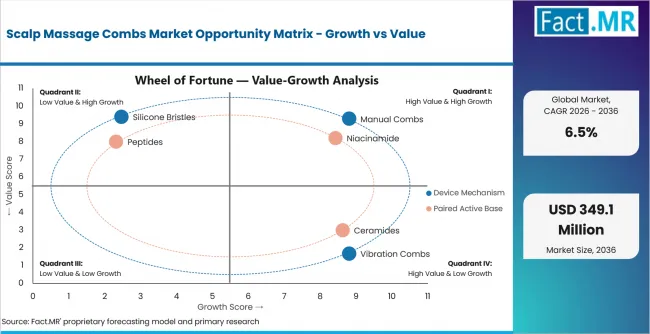
Scalp Massage Combs Market Opportunity Matrix Growth Vs Value | Source: Fact.MR
Scalp-care routine formation and marketplace reviews drive it, while manual comb copying and hygiene concerns restrain it.
Drivers Impact Analysis
| DRIVER | (~) % IMPACT ON CAGR | GEOGRAPHIC RELEVANCE | IMPACT TIMELINE |
|---|---|---|---|
| Scalp-care routine formation | +1.5% | Global; strongest in India and China | Short term (2 years) |
| Marketplace discovery and reviews | +1.3% | USA; China; India; United Kingdom | Short term (2 years) |
| Treatment bundle merchandising | +1.1% | North America; Europe; South Korea | Medium term (2 to 4 years) |
| Salon add-on retailing | +0.8% | USA; United Kingdom; Japan; Germany | Medium term (2 to 4 years) |
| Powered-device premiumization | +0.7% | USA; South Korea; Japan | Long term (4 years or more) |
Source: Fact.MR analysis. Updated Jun 30, 2026
- Scalp Routine Formation: Scalp massage combs gain shelf space when brands teach buyers a repeatable step. The step is simple because buyers apply product and massage the scalp before rinsing at home. Fact.MR analysis of premium beauty care indicates that haircare carries premium positioning when treatment logic is easy to explain. Manual combs benefit first because they do not require charging or skin-contact electronics.
- Marketplace Review Signals: Marketplace selling changes how scalp combs compete. Buyers compare bristle shape and waterproof claims before they compare brand heritage and cleaning guidance. U.S. retail e-commerce reached USD 326.7 billion in the first quarter of 2026 according to the U.S. Census Bureau. That channel scale supports small beauty tools that can be bought without in-store demonstration.
- Treatment Bundle Merchandising: Brands can raise attachment rates by placing combs beside scrubs and serum applicators. The bundle tells buyers why the tool belongs in the routine after product application. Lower-priced mass beauty care also supports manual formats because shoppers can add the comb without crossing a high price threshold.
Opportunity Impact Analysis
| OPPORTUNITY | (~) % IMPACT ON CAGR | GEOGRAPHIC RELEVANCE | IMPACT TIMELINE |
|---|---|---|---|
| Scalp serum applicator kits | +1.2% | USA; United Kingdom; South Korea | Short term (2 years) |
| Dermocosmetic retail education | +1.0% | Germany; Japan; United Kingdom | Medium term (2 to 4 years) |
| Salon scalp service retail | +0.9% | USA; Japan; Germany | Medium term (2 to 4 years) |
| Powered portable devices | +0.8% | South Korea; China; USA | Long term (4 years or more) |
| Marketplace private label packs | +0.7% | India; China; USA | Short term (2 years) |
Source: Fact.MR analysis. Updated Jun 30, 2026
- Serum Applicator Kits: Serum applicator kits offer a clear margin path because the comb supports the treatment story. Buyers understand the role of a comb when the bottle claims dryness relief or scalp comfort. Related nourishing hair care patterns show that oil and treatment products give tool sellers a natural pairing point.
- Dermocosmetic Retail Education: Dermocosmetic retailers can position scalp combs as hygiene tools rather than impulse accessories. This matters for sensitive scalps because buyers want reassurance before using bristles directly on skin. Germany’s personal care association reported that hair care products rose 8.1% in 2025. This category movement gives retailers more room to explain scalp-comfort routines at shelf level.
- Salon Scalp Service Retail: Salons can convert service traffic into product sales when the comb supports an aftercare instruction. The tool is easy to demonstrate during shampoo and oiling services before retail sale. Demand for professional hair care supports this channel because trained staff can explain use cases more clearly than a product page.
Restraints Impact Analysis
| RESTRAINT | (~) % IMPACT ON CAGR | GEOGRAPHIC RELEVANCE | IMPACT TIMELINE |
|---|---|---|---|
| Low differentiation in manual combs | -0.9% | Global; strongest in marketplaces | Short term (2 years) |
| Hygiene and cleaning concerns | -0.7% | USA; Europe; Japan | Short term (2 years) |
| Powered-device price resistance | -0.6% | India; China; United Kingdom | Medium term (2 to 4 years) |
| Weak proof for stimulation claims | -0.5% | Global | Medium term (2 to 4 years) |
| Copycat listings and rating noise | -0.4% | Marketplaces | Short term (2 years) |
Source: Fact.MR analysis. Updated Jun 30, 2026
- Manual Comb Copying: Manual combs are easy to copy because material, bristle shape and handle design are visible. This keeps pricing under pressure on marketplaces where listings compete on images and ratings. Brands that cannot defend softness and grip may lose repeat purchase after first trial. The restraint is strongest where shoppers sort listings by price before brand name and material claims.
- Hygiene Instruction Gap: A scalp comb touches skin and shampoo residue during repeated wash and treatment routines. Poor cleaning instructions can turn a simple tool into a hygiene concern after repeated use. Buyers of anti-dandruff shampoos are especially sensitive to flakes and irritation claims during product selection. That raises the need for clear guidance on drying and storage after every use.
- Powered Price Resistance: Powered combs must justify a higher price through vibration quality, battery life and waterproof design. The product may lose buyers when claims feel close to a manual comb after comparison. This slows conversion in value-focused channels where manual formats remain easier to justify. Sellers need clear use instructions and warranty coverage to reduce the price objection for powered formats.
Which countries are scaling scalp massage combs fastest?
India 8.0%. China 7.4%. South Korea 7.2%. United States 6.8%. United Kingdom 6.3%.
Based on regional analysis, the scalp massage combs market covers North America and East Asia. It also covers South Asia and Pacific. Western Europe and Latin America are included alongside Middle East and Africa.
.webp "Top Country Growth Comparison Scalp Massage Combs Market Cagr (2026 2036)")
Top Country Growth Comparison Scalp Massage Combs Market Cagr (2026 2036) | Source: Fact.MR
| Country | CAGR |
|---|---|
| India | 8.0% |
| China | 7.4% |
| South Korea | 7.2% |
| United States | 6.8% |
| United Kingdom | 6.3% |
| Germany | 5.9% |
| Japan | 5.6% |
Source: Fact.MR analysis. Updated Jun 30, 2026
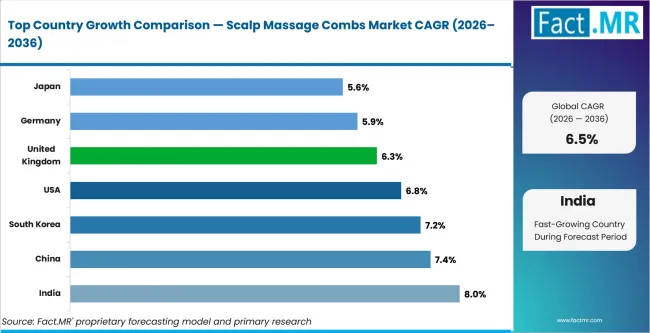
Scalp Massage Combs Market Cagr Analysis By Country | Source: Fact.MR
What is powering India’s lead?
8.0% CAGR, supported by low-ticket beauty tools and online trial.
India is projected to record 8.0% CAGR through 2036 as scalp-care trial moves into marketplaces and specialty beauty retail. Low-priced tools fit shampoo and oiling routines because buyers can add them without changing their core haircare spend. The UK government stated that the trade agreement lowers cosmetics and personal care tariffs to 10%. Lower import friction can support more branded tools and treatment accessories over time.
How is China scaling scalp tool demand?
7.4% CAGR, backed by social commerce and routine bundles.
China is expected to expand at 7.4% CAGR through 2036 as online beauty retail supports scalp product bundles. Chinese buyers respond well to short usage videos that show how combs work with serums and scrubs. China’s online retail sales reached CNY 15,972.2 billion in 2025 according to the National Bureau of Statistics. The channel base favors small tools that can be demonstrated through short-video merchandising.
Why does South Korea remain important?
7.2% CAGR, driven by K-beauty routines and product testing.
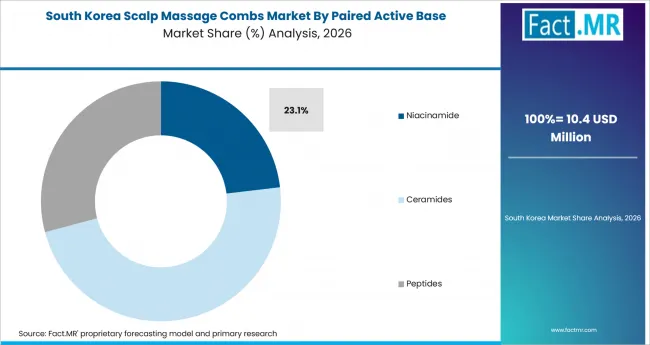
Scalp Massage Combs Market South Korea Market Share Analysis By Paired Active Base | Source: Fact.MR
South Korea is forecast to grow at 7.2% CAGR through 2036 as K-beauty brands keep scalp routines visible. The country turns ingredient routines into exportable product stories for global retailers. The Ministry of Trade, Industry and Resources stated that cosmetics exports totaled USD 9.42 billion as of October 2025. Suppliers can use Korea as a test market for finer bristles and compact powered combs.
What supports the United States outlook?
6.8% CAGR, supported by e-commerce and at-home treatment habits.
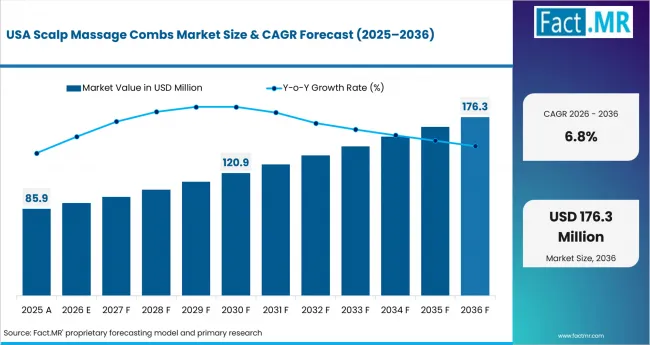
Scalp Massage Combs Market Country Value Analysis | Source: Fact.MR
The United States is expected to advance at 6.8% CAGR through 2036 as buyers keep purchasing beauty tools online. Product pages that explain usage and cleaning make small scalp tools easier to trial at home. The U.S. Census Bureau reported retail e-commerce sales of USD 326.7 billion in the first quarter of 2026. That channel base helps scalp tools move beyond impulse purchase into repeat routines.
What explains the United Kingdom’s steady role?
6.3% CAGR, supported by specialty beauty retail and online share.
The United Kingdom is projected to rise at 6.3% CAGR through 2036 as specialty beauty retail supports scalp-tool trial. The country has a dense prestige and mass beauty retail base across online stores. The Office for National Statistics reported that online sales accounted for 28.1% of retail spending in April 2026. That online share helps grooming accessories reach buyers outside salon channels and specialty stores.
Why is Germany a careful but valuable market?
5.9% CAGR, backed by hair-care spending and evidence-led retail.
Germany is forecast at 5.9% CAGR through 2036 as consumers compare quality and skin comfort before buying scalp tools. Buyers also check cleaning guidance because the product touches skin during repeated wash routines. Cosmetics Europe reported Germany at EUR 18.0 billion in cosmetics and personal care retail sales in 2025. Suppliers with clear material claims and compliant product files have a better route into dermocosmetic retail.
How does Japan fit the forecast?
5.6% CAGR, supported by routine discipline and careful product selection.
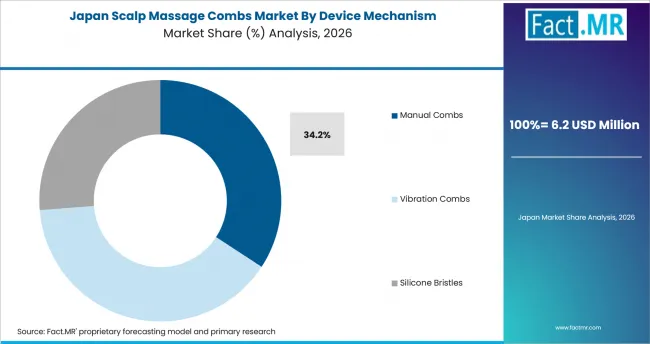
Scalp Massage Combs Market Japan Market Share Analysis By Device Mechanism | Source: Fact.MR
Japan is expected to post 5.6% CAGR through 2036 as buyers favor tools that fit established wash and treatment habits. Brands need to explain bristle softness and storage hygiene before broader online conversion. The Ministry of Economy, Trade and Industry reported Japan’s domestic business-to-consumer e-commerce scale at JPY 26.1 trillion in 2024. That channel supports product education when brands present scalp tools as routine aids.
Who leads the scalp massage combs landscape?
Briogeo, Tangle Teezer and HairMax lead through scalp routines, treatment-led retail and home hair-device expertise.
Briogeo leads through scalp routines and visible treatment-led retail across premium beauty channels. Tangle Teezer and HairMax support the landscape through device expertise and wider brand access in home treatment tools.
Scalp massage combs are sold by beauty brands and device brands across routine-led channels. Marketplace specialists compete on bristle comfort and routine fit across low-ticket online listings. Briogeo is visible through scalp-care collections and treatment-led retail across premium channels. Tangle Teezer and HairMax show how home hair tools can be packaged with clear use instructions. FOREO extends this logic into powered scalp and hair-regrowth devices with massage positioning. Related dry-format hair cleansers also reinforce the need for tools that refresh or prepare the scalp without complex routines.
Manta competes through gentle handheld brush design and scalp-comfort positioning. Competition through 2036 is expected to depend on material feel and cleaning clarity across channels.
Brands with scalp-treatment credibility are better placed than sellers that only offer generic silicone shapes. Companies that connect the tool to a named routine can maintain price better than private-label sellers.
Which companies are the key players?
Briogeo, Tangle Teezer, HairMax, FOREO, Manta, Aveda, Vegamour
- Briogeo
- Tangle Teezer
- HairMax
- FOREO
- Manta
- Aveda
- Vegamour
Bibliography
- U.S. Census Bureau. (2026, May 18). Quarterly retail e-commerce sales: First quarter 2026. U.S. Census Bureau.
- National Bureau of Statistics of China. (2026, January 20). Total retail sales of consumer goods in December 2025. National Bureau of Statistics of China.
- Cosmetics Europe. (2026). Our industry. Cosmetics Europe.
- Industrieverband Körperpflege- und Waschmittel e. V. (2025, December). Market data. IKW.
- Office for National Statistics. (2026, May 22). Retail sales, Great Britain: April 2026. ONS.
- Department for Business and Trade. (2025, July 24). UK-India trade deal: Conclusion agreement summary. GOV.UK.
- Ministry of Economy, Trade and Industry. (2025, August 26). Results of FY2024 e-commerce market survey compiled. METI.
- Ministry of Trade, Industry and Resources. (2025, November 6). K-beauty expands global reach with new export models. MOTIR.
- Briogeo. (2026). Scalp Revival™ Stimulating Therapy Massager. Briogeo.
- FOREO. (2026). FAQ™ 301 red light therapy for hair loss. FOREO.
- Manta Hair. (2026). Healthy hair brush for fragile hair and sensitive scalps. Manta Hair.
This Report Addresses
- Strategic intelligence on scalp massage combs across device mechanism, paired active base and channel.
- Segment analysis covering Manual Combs, Niacinamide-linked routines, Barrier Repair, Marketplaces and Scalp-First Routines.
- Regional outlook covering India, China, South Korea, United States, United Kingdom, Germany and Japan.
- Competitive analysis of Briogeo, Tangle Teezer, HairMax, FOREO, Manta, Aveda and Vegamour.
- Product assessment covering manual combs, vibration combs, silicone bristle combs, heated massage combs and portable devices.
- Channel assessment covering prestige beauty, salons, dermocosmetic retail, direct-to-consumer and marketplaces.
- Primary interviews, company portfolio checks, channel reviews and public source validation support the forecast.
What does the scalp massage combs market cover?
The market covers manual and powered combs used for scalp massage and treatment application.
The scalp massage combs market covers handheld combs and brush-like devices used to massage the scalp during washing or treatment routines. It includes manual silicone combs and vibration combs for shower and dry-use routines at home. Heated massage combs and portable devices are also included when sold as paid products. The market differs from general hairbrushes because the purchase reason is scalp stimulation and product application.
What is included in the scope?
The scope includes scalp massage tools sold through beauty stores and salon retail channels.
The scope includes manual scalp combs and powered massage combs used in home routines. It covers silicone bristle formats and compact devices sold for shower or dry-use routines. It includes branded scalp massagers bundled with scalp scrubs and oils for routine use after purchase. It also includes salon retail and direct-to-consumer kits where the comb is a separate paid product.
What is excluded from the scope?
The scope excludes general hairbrushes and medical hair-growth devices without massage-comb positioning.
The scope excludes ordinary detangling brushes that do not carry scalp massage positioning for buyers. It excludes medical laser caps and helmets unless a scalp massage comb attachment is sold as the revenue item. It excludes combs sold only as promotional gifts when no paid product line exists. It also excludes scalp serums where no separate comb or massage tool is sold.
How was the analysis built?
100+ sources, 40+ company portfolios, 25+ countries, 20+ interviews.
- Primary Research: Interviews covered beauty retailers and salon operators across online and offline channels. They also covered marketplace sellers and brand-side product managers who manage accessory launches globally. The discussion focused on price bands and repeat purchase across manual and powered products.
- Desk Research: Desk research reviewed government retail data and cosmetics industry data from official sources. It also reviewed official company product portfolios across device and scalp-care brands in 2026.
- Market-Sizing and Forecasting: Forecasting used a bottom-up installed-buyer approach for the 2026 baseline. The model combined beauty-tool penetration and channel price checks across major beauty retailers and marketplaces. Replacement behavior for shower-use accessories supported the outer-year forecast from 2026 to 2036.
- Data Validation and Update Cycle: Forecasts were validated through distributor checks and comparison against beauty e-commerce movement. The 2026 value was reconciled against the provided market anchor and expected retail price bands.
Segmentation
What is the report’s scope and coverage?
| Attribute | Details |
|---|---|
| Quantitative Units | USD Million in 2026 to USD Million by 2036 at CAGR |
| Market Definition | Manual and powered scalp massage combs used for scalp stimulation, buildup loosening and treatment application |
| Device Mechanism | Manual combs; Vibration combs; Silicone bristle combs; Heated massage combs; Portable devices |
| Paired Active Base | Ceramides; Niacinamide; Peptides; Prebiotics; Sunscreens; Fermented ingredients |
| Hair Concern | Barrier repair; Dryness; Flakes; Sebum control; Density; Sensitivity; UV exposure |
| Channel | Prestige beauty; Salons; Dermocosmetic retail; Direct-to-consumer; Marketplaces |
| Positioning | Skinification of haircare; Scalp-first routines; Treatment-led premiumization |
| Regions Covered | North America; East Asia; South Asia and Pacific; Western Europe; Latin America; Middle East and Africa |
| Countries Covered | India; China; South Korea; United States; United Kingdom; Germany and Japan |
| Key Companies Profiled | Briogeo; Tangle Teezer; HairMax; FOREO; Manta; Aveda and Vegamour |
| Forecast Period | 2026 to 2036 |
| Approach | Hybrid top-down and bottom-up approach using beauty-tool penetration, channel checks and company portfolio validation |
Source: Fact.MR analysis. Updated Jun 30, 2026
How is the market segmented?
-
By Device Mechanism:
- Manual Combs
- Vibration Combs
- Silicone Bristles
- Heated Combs
- Portable Devices
-
By Paired Active Base:
- Ceramides
- Niacinamide
- Peptides
- Prebiotics
- Sunscreens
- Fermented Ingredients
-
By Hair Concern:
- Barrier Repair
- Dryness
- Flakes
- Sebum Control
- Density
- Sensitivity
- UV Exposure
-
By Channel:
- Prestige Beauty
- Salons
- Dermocosmetic Retail
- Direct-to-Consumer
- Marketplaces
-
By Positioning:
- Skinification
- Scalp-First Routines
- Treatment Premiumization
-
By Region
-
North America
- United States
- Canada
- Mexico
- Latin America
- Brazil
- Argentina
- Rest of Latin America
- Europe
- Germany
- United Kingdom
- France
- Italy
- Spain
- Rest of Europe
- Asia Pacific
- China
- India
- Japan
- South Korea
- ASEAN
- Middle East & Africa
- GCC Countries
- South Africa
- UAE
- Rest of Middle East & Africa
-
Frequently Asked Questions
Which device mechanism leads the Scalp Massage Combs Market?
Which country expands fastest in the Scalp Massage Combs Market?
How does China perform in the Scalp Massage Combs Market?
How does South Korea perform in the Scalp Massage Combs Market?
How does the United States perform in the Scalp Massage Combs Market?
How does the United Kingdom perform in the Scalp Massage Combs Market?
What is the primary driver in the Scalp Massage Combs Market?
What is the main restraint in the Scalp Massage Combs Market?
Why are scalp-first routines important in this market?
Who worked on this report


Preview the report firsthand - request a free sample
Free SampleGet the brochure for pricing and purchase details
Download PDF