- Market size in 2025:USD 514.2 Million
- Estimated market size in 2026:USD 557.0 Million
- Projected market size by 2036:USD 1860 Million
- CAGR (2026-2036):12.8%
What is the scalp oil balancers market forecast to be worth by 2036?
USD 557.0 million in 2026 to USD 1,860 million by 2036, at 12.8% CAGR.
- The scalp oil balancers market crossed a valuation of USD 514.2 million in 2025.
- Demand is expected to increase from USD 557.0 million in 2026 to USD 1,860 million by 2036.
- The market is forecast to record 12.8% CAGR during the forecast period as scalp-first routines move oil control from basic cleansing into treatment-led premium haircare.
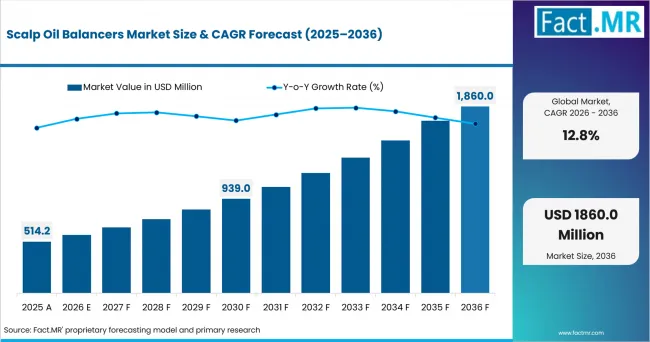
Scalp Oil Balancers Market Market Value Analysis | Source: Fact.MR
What are the defining numbers behind scalp oil balancers growth?
USD 1.30 billion absolute opportunity by 2036, led by South Korea and China.
- Demand Drivers in the Market
- Consumers are treating oily roots and scalp odor as recurring routine problems.
- Prestige retailers are giving active-led scalp treatments more shelf visibility.
- Dermocosmetic channels need clearer safety records before listing oil-control claims.
- Direct-to-consumer brands are packaging exfoliators, serums and dry refresh products as routine systems.
- Key Segments Analyzed
- By Sebum Control Mechanism: Zinc PCA is expected to hold 31.0% share in 2026 because it gives brands a direct oil-management active.
- By Active Base: Niacinamide is projected to capture 28.0% share in 2026 as shoppers prefer barrier-friendly oil control.
- By Hair Concern: Sebum Control is likely to account for 33.0% share in 2026 because oily roots trigger repeated wash cycles.
- By Channel: Prestige Beauty is projected to hold 30.0% share in 2026 as scalp care moves into treatment shelves.
- By Positioning: Scalp-first Routines are expected to hold 34.0% share in 2026 as buyers separate scalp treatment from shampoo replacement.
- By Geography: South Korea is projected to record 15.0% CAGR through 2036 as export-facing K-beauty brands scale scalp routine concepts.
- Analyst Opinion at Fact.MR
- Shambhu Nath Jha, Senior Analyst at Fact.MR, states, “Scalp oil control is becoming a routine purchase problem rather than an occasional shampoo decision. I see brands winning when they explain why a lightweight serum or tonic fits daily use. Retailers are asking for oil-control proof, United Statesge clarity and ingredient records before they expand these products beyond small trial shelves.”
- Strategic Implications
- Brands should build claim files before scaling zinc PCA and niacinamide scalp products.
- Retailers need usage guidance because overuse can create irritation complaints.
- Formulators should prioritize light textures that avoid residue on fine or oily hair.
- Specialist brands need routine bundles that connect exfoliation, oil control and wash extension.
Active cosmetic treatments for oily scalp and buildup form the core of this market. The broader scalp health category supports this shift because buyers now compare scalp care with facial-care routines.
The United States Food and Drug Administration requires cosmetic facility registrations to be renewed every two years. This supports demand for clearer product records before brands make oil-control and balancing claims in retail channels.
South Korea is projected to record 15.0% CAGR through 2036 as K-beauty export brands translate scalp-first routines quickly. China is expected to expand at 14.2% CAGR because online beauty platforms raise trial of active scalp formats. India is forecast to grow at 13.7% CAGR as direct-to-consumer personal care brands build oil-control routines for humid urban use. The United States is expected to advance at 13.2% CAGR as MoCRA listing discipline strengthens claim review. The United Kingdom is forecast at 12.6% CAGR as product safety checks shape marketplace acceptance. Germany is expected to post 11.9% CAGR as pharmacy and drugstore buyers favor documented claims. Japan is projected to rise at 11.2% CAGR as shoppers separate cosmetic scalp care from medicated scalp products.
How does the scalp oil balancers market break down by segment?
Zinc PCA leads at 31.0%; niacinamide leads at 28.0%.
Which sebum control mechanism dominates?
Zinc PCA holds 31.0% share in 2026.
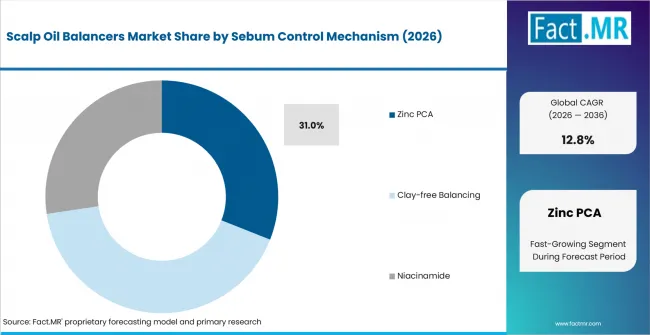
Scalp Oil Balancers Market Analysis By Sebum Control Mechanism | Source: Fact.MR
Zinc PCA is expected to hold 31.0% share in 2026 because it gives formulators a recognized oil-control route. This segment gains from premium beauty and personal care routines where shoppers expect active ingredients and simple benefit explanations.
Which active base dominates?
Niacinamide accounts for 28.0% share in 2026.
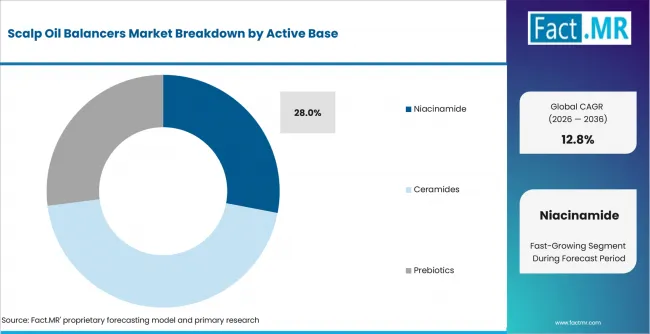
Scalp Oil Balancers Market Analysis By Active Base | Source: Fact.MR
Niacinamide leads because it supports oil-control positioning without a harsh stripping message. It also fits barrier repair and sensitivity claims, which matter when consumers use scalp serums more often than weekly exfoliators. Suppliers that combine niacinamide with clear usage instructions;can reduce repeat-purchase risk.
Which hair concern dominates?
Sebum Control holds 33.0% share in 2026.
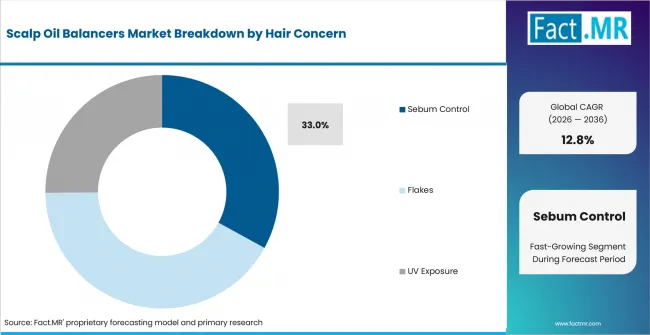
Scalp Oil Balancers Market Analysis By Hair Concern | Source: Fact.MR
Sebum Control leads early demand because oily roots are visible and affect wash frequency. The overlap with anti-dandruff shampoos gives brands a route to discuss flakes and oil without making drug-style treatment claims.
Which channel dominates?
Prestige Beauty leads with 30.0% share in 2026.
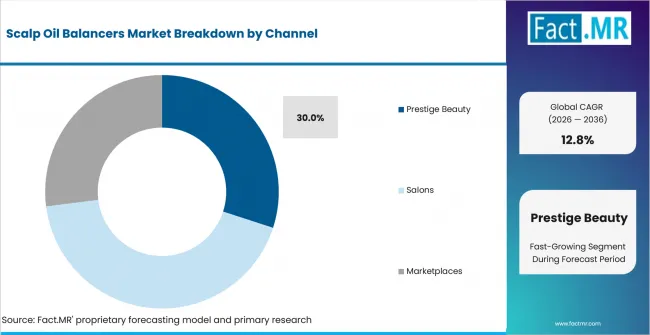
Scalp Oil Balancers Market Analysis By Channel | Source: Fact.MR
Prestige Beauty leads because scalp care is being merchandised beside serums, masks and treatment sets. The same buyer logic is visible in professional hair care products where salons and premium retailers compare treatment value before basic volume.
Which positioning dominates?
Scalp-first Routines hold 34.0% share in 2026.
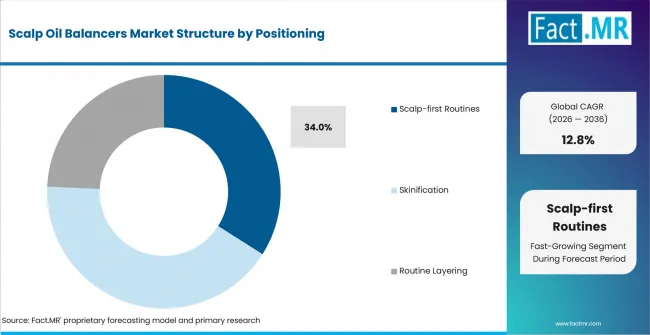
Scalp Oil Balancers Market Analysis By Positioning | Source: Fact.MR
Scalp-first Routines lead because shoppers are learning to treat oiliness before it reaches the hair shaft. The format favors pre-wash exfoliators, leave-on serums and routine bundles that can be explained in short retail copy.
What is accelerating scalp oil balancers adoption across beauty channels, and what is holding it back?
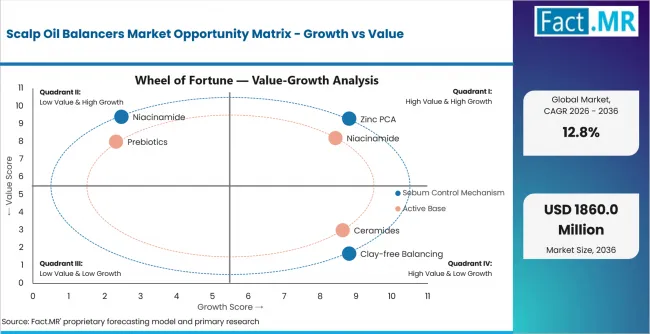
Scalp Oil Balancers Market Opportunity Matrix Growth Vs Value | Source: Fact.MR
Scalp-first routines and zinc PCA or niacinamide visibility drive adoption while exfoliation overuse and residue concerns restrain it.
Drivers Impact Analysis
| DRIVER | (~) % IMPACT ON CAGR |
GEOGRAPHIC RELEVANCE | IMPACT TIMELINE |
|---|---|---|---|
| Scalp care shifting from shampoo to treatment systems | +2.6% | Global, strongest in prestige beauty | Short term (≤ 2 years) |
| Zinc PCA and niacinamide gaining formula visibility | +2.2% | UNITED STATES, UNITED KINGDOM, Germany, South Korea | Medium term (2–4 years) |
| Online retailers making routine education easier | +1.9% | China, India, UNITED STATES, South Korea | Short term (≤ 2 years) |
| Cosmetic listing rules improving claim discipline | +1.5% | UNITED STATES, UNITED KINGDOM, Europe, China | Medium term (2–4 years) |
| Humid urban use cases supporting wash extension | +1.2% | India, China, South Korea, Japan | Long term (≥ 4 years) |
Source: Fact.MR analysis. Updated Jun 30, 2026
- Scalp routines replacing shampoo-only care: Scalp oil balancing is moving into treatment systems because consumers want cleaner roots without adding another wash. This creates room for serums, tonics and pre-wash products that complement waterless shampoo behavior. Brands gain when they show how each routine step changes wash timing or scalp feel.
- Actives gaining retail proof value: Retail buyers are asking for clearer active logic before they expand oily-scalp shelves. Zinc PCA and niacinamide give brands simple ingredient anchors that consumers already recognize from facial skincare. This mechanism supports higher pricing when brands connect active choice to routine frequency.
- Online education reducing trial barriers: Marketplaces and direct-to-consumer sites can explain usage frequencybetter than a small pack label. That matters because scalp exfoliators and oil-control serums need sequencing to avoid overuse. Better education improves trial conversion when oily-root shoppers compare routine sets.
Opportunity Impact Analysis
| OPPORTUNITY | (~) % IMPACT ON CAGR |
GEOGRAPHIC RELEVANCE | IMPACT TIMELINE |
|---|---|---|---|
| Oil-control serum systems for humid cities | +2.1% | India, China, South Korea, Japan | Medium term (2–4 years) |
| Retailer-exclusive scalp routine bundles | +1.8% | UNITED STATES, UNITED KINGDOM, Germany, South Korea | Short term (≤ 2 years) |
| Dermocosmetic claim files for sensitive scalps | +1.5% | Europe, UNITED STATES, Japan | Medium term (2–4 years) |
| Mini formats for first-time scalp users | +1.1% | India, China, UNITED STATES | Short term (≤ 2 years) |
| Salon education around wash extension | +0.9% | UNITED STATES, Germany, UNITED KINGDOM, Japan | Long term (≥ 4 years) |
Source: Fact.MR analysis. Updated Jun 30, 2026
- Humid-city serum systems: Humid urban markets give brands a practical use case because oily roots return quickly after washing. Lightweight serums can be sold as daily control products when they avoid residue and perfume overload. This favors suppliers that test sensory feel on fine hair and dense hair types.
- Routine bundles for retail shelves: Retailers can lift basket value by pairing exfoliators, serums and oil-absorbing refresh products. The opportunity overlaps with dry shampoo because shoppers already understand wash extension. Brands that explain order of use can win repeat purchases beyond single shampoo replacement.
- Sensitive-scalp claim files: Dermocosmetic retailers can expand oil-balancing products when suppliers provide ingredient records and irritation controls. This is connected to personal care and cosmetic preservatives because preservation and safety documentation affect product acceptance. Brands that keep claims simple are more likely to pass buyer review.
Restraints Impact Analysis
| RESTRAINT | (~) % IMPACT ON CAGR |
GEOGRAPHIC RELEVANCE | IMPACT TIMELINE |
|---|---|---|---|
| Overuse risk from exfoliating scalp acids | -1.8% | Global, strongest in sensitive-scalp users | Short term (≤ 2 years) |
| Residue concerns in leave-on formats | -1.5% | UNITED STATES, UNITED KINGDOM, Japan, South Korea | Medium term (2–4 years) |
| Unclear separation from drug dandruff claims | -1.2% | UNITED STATES, Europe, Japan, China | Medium term (2–4 years) |
| Low repeat if sensory feel is heavy | -1.0% | Global, strongest in fine-hair markets | Short term (≤ 2 years) |
| Ingredient-cost pressure in premium formulas | -0.7% | Europe, UNITED STATES, India, China | Long term (≥ 4 years) |
Source: Fact.MR analysis. Updated Jun 30, 2026
- Exfoliation frequency risk: Scalp acids can create trial because they address oil, flakes and buildup in one step. The constraint is usage frequencybecause excessive exfoliation can irritate sensitive skin. Brands need clear labels that keep treatment intensity within routine limits.
- Residue and sensory limits: Leave-on oil-control products must work without making hair feel coated. This is harder for users with fine hair or roots that turn oily quickly. Repeat sales weaken when the formula reduces oil but leaves visible residue.
- Claim boundaries with medicated care: Oil-balancing products sit close to dandruff and seborrheic-care language. Brands need to avoid drug-style claims unless the product follows the correct regulatory pathway. Similar boundary management appears in sulfate-free shampoo where consumer benefit language must stay clear and supportable.
Which countries are scaling scalp oil balancers fastest?
South Korea 15.0%, China 14.2%, India 13.7%, UNITED STATES 13.2%, UNITED KINGDOM 12.6%, Germany 11.9%, Japan 11.2%.
Based on regional analysis, the scalp oil balancers market is segmented into East Asia, Western Europe, North America, South Asia and Pacific, Latin America, and Middle East and Africa.
| Country | CAGR |
|---|---|
| South Korea | 15.0% |
| China | 14.2% |
| India | 13.7% |
| United States | 13.2% |
| United Kingdom | 12.6% |
| Germany | 11.9% |
| Japan | 11.2% |
Source: Fact.MR analysis. Updated Jun 30, 2026
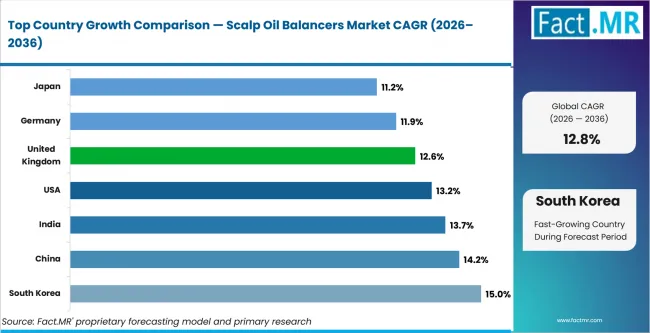
Scalp Oil Balancers Market Cagr Analysis By Country | Source: Fact.MR
What is powering South Korea’s lead?
15.0% CAGR, supported by K-beauty export reach and scalp-first routine translation.
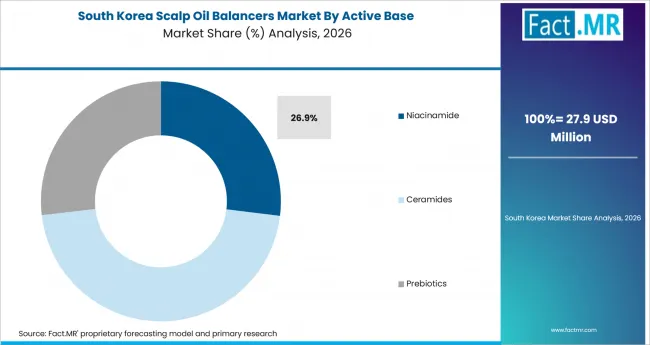
Scalp Oil Balancers Market South Korea Market Share Analysis By Active Base | Source: Fact.MR
South Korea is projected to record 15.0% CAGR through 2036 as export-facing beauty brands convert scalp care into global routines. The Ministry of Culture, Sports and Tourism of the Republic of Korea reported that cosmetics exports reached USD 11.4 billion in 2025. This export system gives scalp oil balancers faster format testing and wider regional visibility.
How is China scaling oil-balancing scalp care?
14.2% CAGR, driven by online beauty platforms and cosmetic retail scale.
China is expected to expand at 14.2% CAGR through 2036 because online content and marketplace reviews raise trial of active scalp formats. The National Bureau of Statistics of China reported cosmetics retail sales of 465.3 billion yuan in 2025. Local suppliers can scale pH-control tonics and lightweight serums when product pages explain texture and use frequency.
Why is India above the global average?
13.7% CAGR, supported by direct-to-consumer brands and humid urban scalp concerns.
India is forecast to grow at 13.7% CAGR through 2036 as direct-to-consumer personal care brands test oil-control routines in large cities. The Press Information Bureau of India reported that Basic Chemicals, Cosmetics and Dyes Export Promotion Council exports reached USD 21.20 billion from April to December 2024. This supplier base supports local product development for humid climates and quick-commerce trial packs.
What supports the United States outlook?
13.2% CAGR, backed by cosmetic listing discipline and proof-led retail review.
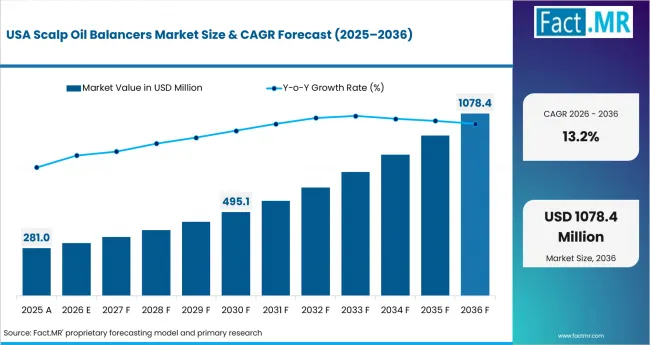
Scalp Oil Balancers Market Country Value Analysis | Source: Fact.MR
The United States is expected to advance at 13.2% CAGR through 2036 as cosmetic listing rules push brands to keep cleaner formula and claim records. The United States Food and Drug Administration guidance explains who must submit cosmetic product facility registrations and product listings. Retailers are therefore likely to favor suppliers that connect oil-control claims to safety documentation and complaint handling.
How does the United Kingdom perform?
12.6% CAGR, supported by product safety checks and marketplace enforcement.
The United Kingdom is forecast at 12.6% CAGR through 2036 as cosmetic sellers face close scrutiny on product documentation. The Office for Product Safety and Standards tested 184 cosmetics under its 2024 to 2025 sampling programme. This makes claim discipline important for scalp brands selling through marketplaces and specialty retailers.
What underpins Germany’s growth?
11.9% CAGR, backed by drugstore strength and documented beauty-care demand.
Germany is expected to post 11.9% CAGR through 2036 because drugstores and pharmacy-style buyers prefer clear product evidence. The German Cosmetic, Toiletry, Perfumery and Detergent Association reported domestic beauty and home care sales of EUR 23.9 billion in 2025. Suppliers with simple ingredient records and low-irritation positioning can gain better access to cautious retail buyers.
Why is Japan an important oil-balancing scalp market?
11.2% CAGR, driven by haircare shipment depth and conservative scalp-care routines.
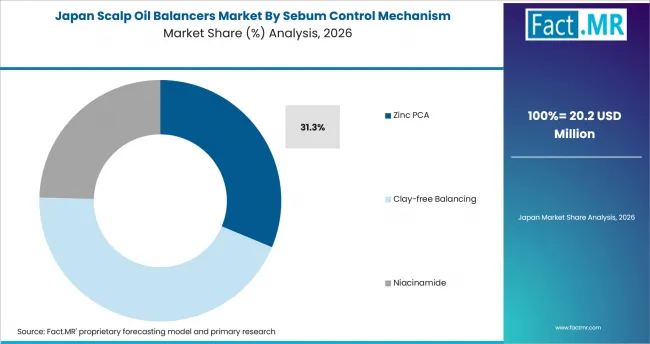
Scalp Oil Balancers Market Japan Market Share Analysis By Sebum Control Mechanism | Source: Fact.MR
Japan is projected to rise at 11.2% CAGR through 2036 as consumers separate cosmetic scalp routines from medicated scalp care. The Japan Cosmetic Industry Association reported cosmetic shipments of 1,302.4 billion yen in 2023. Brands need careful benefit language because Japanese shoppers expect visible scalp comfort without aggressive treatment claims.
Who leads the scalp oil balancers landscape?
Kérastase, Act+Acre and The INKEY List lead through active scalp routines and retail access.
Scalp oil balancers are sold by prestige haircare groups, active-led skincare brands and specialist scalp companies. Kérastase uses piroctone olamine and salicylic acid in Symbiose products for oily sensitive scalps. Act+Acre positions its Oil Control Pro System around a niacinamide serum and wash-extension routine. The INKEY List sells a salicylic acid scalp treatment that targets oil, flakes and buildup.
Portfolio depth matters because buyers compare scalp products against cleansing, treatment and styling alternatives. The connection with hair-care surfactants is important because cleansing feel shapes whether consumers keep using oil-control treatments.
L’Oréal’s June 2026 agreement to acquire a majority stake in Innovist confirms that large beauty groups are still buying digital-first personal care capability. This matters for scalp oil balancers because direct-to-consumer testing, quick-commerce visibility and formula storytelling can shorten launch cycles. Specialists can still compete when they give oily-scalp shoppers lighter textures and simple United Statesge rules.
Competition through 2036 is expected to depend on ingredient clarity, sensory proof and channel fit. Brands tied to natural and organic personal care claims need stronger documentation because oil-control buyers also ask whether formulas feel gentle. Providers with claim discipline and fast feedback loops are better placed than brands relying only on shampoo-line extensions.
Which companies are the key players?
L’Oréal Professionnel, Act+Acre, Briogeo, Kérastase, Living Proof, The INKEY List, Vegamour and Davines.
- L’Oréal Professionnel
- Act+Acre
- Briogeo
- Kérastase
- Living Proof
- The INKEY List
- Vegamour
- Davines
Bibliography
- U.S. Food and Drug Administration. (2026, April 14). Registration and listing of cosmetic product facilities and products. FDA.
- U.S. Food and Drug Administration. (2024, December 11). Guidance for industry: Registration and listing of cosmetic product facilities and products. FDA.
- Ministry of Culture, Sports and Tourism of the Republic of Korea. (2026, January 13). Cosmetics exports hit record USD 11.4B in 2025. Korea.net.
- National Bureau of Statistics of China. (2026, January 20). Total retail sales of consumer goods in December 2025. National Bureau of Statistics of China.
- Press Information Bureau of India. (2025, February 7). CHEMEXCIL to honour outstanding exporters at export awards ceremony. Government of India.
- Office for Product Safety and Standards. (2026, February 18). Product safety testing sampling protocol programme: April 2024 to March 2025. Government of the United Kingdom.
- Industrieverband Körperpflege- und Waschmittel e. V. (2025, December 3). Market data. IKW.
- Japan Cosmetic Industry Association. (2024, October 11). Cosmetic shipments. JCIA.
- Act+Acre. (2026). Oil Control Pro System. Act+Acre.
- The INKEY List. (2026). Salicylic Acid Exfoliating Scalp Treatment. The INKEY List.
- Kérastase Paris. (2026). Symbiose Bain Pureté Anti-Pelliculaire. Kérastase Paris.
- Briogeo. (2026). Oily scalp collection. Briogeo.
- Vegamour. (2026). GRO Scalp Detoxifying Serum. Vegamour.
- L’Oréal Groupe. (2026, June 18). L’Oréal to acquire a majority stake in Innovist, a leading digital-first Indian personal care house of brands. L’Oréal Groupe.
This Report Addresses
- Strategic intelligence on scalp oil balancers across sebum control mechanism, active base and channel.
- Segment analysis covering Zinc PCA, Niacinamide, Sebum Control, Prestige Beauty and Scalp-first Routines.
- Regional outlook covering South Korea, China, India, United States, United Kingdom, Germany and Japan.
- Competitive analysis of L’Oréal Professionnel, Act+Acre, Briogeo, Kérastase, Living Proof, The INKEY List, Vegamour and Davines.
- Product assessment covering leave-on scalp serums, tonics, exfoliators and oil-control routine systems.
- Claim assessment covering cosmetic listing discipline, usage frequencyand active ingredient communication.
- Primary interviews, official source review, provider checks and product portfolio mapping support the forecast.
What does the scalp oil balancers market cover?
Cosmetic scalp treatments that help manage excess sebum, oily roots, odor and buildup.
The scalp oil balancers market covers cosmetic scalp serums, tonics, exfoliators and routine systems that help manage excess oil. It includes zinc PCA products, niacinamide scalp serums and pH-control tonics. The market differs from medicated anti-dandruff products because the service focus is cosmetic balancing and routine fit.
What is included in the scope?
Leave-on oil-control scalp treatments and rinse-off products sold with sebum-balancing claims.
The scope includes zinc PCA scalp products and niacinamide oil-control serums. It covers botanical astringent tonics and clay-free balancing products. It includes scalp-first routines sold through prestige beauty, salons, dermocosmetic retail, direct-to-consumer stores and marketplaces.
What is excluded from the scope?
Prescription scalp products and drug anti-dandruff treatments without cosmetic oil-balancing positioning.
The scope excludes prescription scalp treatments and drug products that treat medical scalp disorders. It excludes general shampoos without active oil-balancing claims. It also excludes dry styling sprays unless they are sold as part of an oil-control scalp routine.
How was the analysis built?
120+ sources, 50+ company portfolios, 30+ countries, 25+ interviews.
- Primary Research: Primary research includes interviews with beauty buyers, haircare founders, cosmetic formulators and dermocosmetic retailers. It includes input from marketplace sellers and salon channel managers.
- Desk Research: Desk research reviews cosmetic registration rules, product safety guidance, official cosmetic statistics and company product pages. It covers active ingredient positioning and scalp routine claims.
- Market-Sizing and Forecasting: Forecasting uses client-provided value anchors and checks them against scalp health category size, active-led haircare products and channel observations. Segment shares are based on product mapping and buyer interviews.
- Data Validation and Update Cycle: Forecasts are reconciled against official cosmetic data, product listing signals and company portfolio checks. The model is updated when regulatory rules or major product launches change category access.
Segmentation
What is the report’s scope and coverage?
| Attribute | Details |
|---|---|
| Quantitative Units | USD Million in 2026 to USD Million by 2036 at CAGR |
| Market Definition | Cosmetic scalp treatments that help manage excess scalp sebum, oily roots, odor and buildup |
| Sebum Control Mechanism | Zinc PCA, Clay-free Balancing, Niacinamide, Botanical Astringents, pH-control Tonics |
| Active Base | Ceramides, Niacinamide, Peptides, Prebiotics, Sunscreens, Fermented Ingredients |
| Hair Concern | Barrier Repair, Dryness, Flakes, Sebum Control, Density, Sensitivity, UV Exposure |
| Channel | Prestige Beauty, Salons, Dermocosmetic Retail, Direct-to-Consumer, Marketplaces |
| Positioning | Skinification, Scalp-first Routines, Treatment Premiumization, Routine Layering |
| Regions Covered | East Asia, Western Europe, North America, South Asia and Pacific, Latin America, Middle East and Africa |
| Countries Covered | South Korea, China, India, United States, United Kingdom, Germany, Japan |
| Key Companies Profiled | L’Oréal Professionnel, Act+Acre, Briogeo, Kérastase, Living Proof, The INKEY List, Vegamour and Davines |
| Forecast Period | 2026 to 2036 |
| Approach | Hybrid top-down and bottom-up approach using product mapping, channel checks, official cosmetic data and provider validation |
Source: Fact.MR analysis. Updated Jun 30, 2026
How is the market segmented?
-
By Sebum Control Mechanism:
- Zinc PCA
- Clay-free Balancing
- Niacinamide
- Botanical Astringents
- pH-control Tonics
-
By Active Base:
- Ceramides
- Niacinamide
- Peptides
- Prebiotics
- Sunscreens
- Fermented Ingredients
-
By Hair Concern:
- Barrier Repair
- Dryness
- Flakes
- Sebum Control
- Density
- Sensitivity
- UV Exposure
-
By Channel:
- Prestige Beauty
- Salons
- Dermocosmetic Retail
- Direct-to-Consumer
- Marketplaces
-
By Positioning:
- Skinification
- Scalp-first Routines
- Treatment Premiumization
- Routine Layering
-
By Region:
- North America
- United States
- Canada
- Mexico
- Latin America
- Brazil
- Argentina
- Rest of Latin America
- Europe
- Germany
- United Kingdom
- France
- Italy
- Spain
- Rest of Europe
- Asia Pacific
- China
- India
- Japan
- South Korea
- ASEAN
- Middle East & Africa
- GCC Countries
- South Africa
- UAE
- Rest of Middle East & Africa
- North America
Frequently Asked Questions
Which sebum control mechanism leads the Scalp Oil Balancers Market?
Which country expands fastest in the Scalp Oil Balancers Market?
How does China perform in the Scalp Oil Balancers Market?
How does India perform in the Scalp Oil Balancers Market?
How does the United States perform in the Scalp Oil Balancers Market?
Which channel leads the Scalp Oil Balancers Market?
What is the primary driver in the Scalp Oil Balancers Market?
What is the main restraint in the Scalp Oil Balancers Market?
Why is niacinamide important in this market?
Who worked on this report


Preview the report firsthand - request a free sample
Free SampleGet the brochure for pricing and purchase details
Download PDF