Second-Life Automotive Battery Module Systems Market Size, Share, Growth and Forecast (2026 - 2036)

The Second-Life Automotive Battery Module Systems Market is segmented by Application, Battery Chemistry, and Region. Forecast for 2026 to 2036.

FACT.MR is of the opinion that the second-life automotive battery market is entering a phase of clear supply-quality bifurcation. Ungraded retired battery packs from legacy automakers are gradually giving way to certified, chemistry-aligned modules sourced from structured EV fleet programmes. This transition reflects a shift in market expectations toward reliability, traceability, and performance consistency.

Second-Life Automotive Battery Module Systems Market Forecast and Outlook by Fact.MR

  • In 2025, the second-life automotive battery module systems market was valued at USD 1.6 billion.
  • Based on Fact.MR analysis, demand for second-life automotive battery module systems is estimated to grow to USD 1.8 billion in 2026 and USD 14.8 billion by 2036.
  • FACT.MR projects a CAGR of 22.9% during the forecast period.

Second Life Automotive Battery Module Systems Market  Value Analysis

Metric Value
Estimated Value in 2026 USD 1.8 billion
Forecast Value in 2036 USD 14.8 billion
Forecast CAGR (2026 to 2036) 22.9%

Summary of the Second-Life Automotive Battery Module Systems Market

  • Market Definition
    • The market includes reconditioned automotive battery modules repurposed as stationary energy storage systems across utility, commercial, residential, and EV charging applications globally.
  • Demand Drivers
    • Rising EV fleet retirement volumes in China and Europe are generating high-volume supply of recoverable battery modules for second-life use.
    • IRA-linked procurement incentives in the United States are driving grid operators to source cost-competitive second-life battery storage over new pack installations.
    • EU Battery Regulation mandates are requiring automakers to document second-life pathways, accelerating structured reconditioning programmes.
  • Key Segments Analyzed
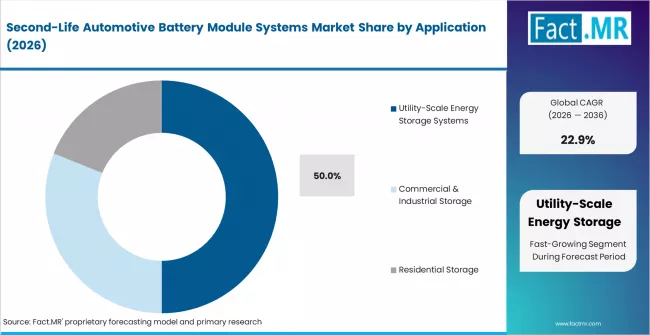
    • By Application: Utility-scale energy storage systems hold approximately 50% share in 2026, driven by grid-balancing and renewable integration demand.
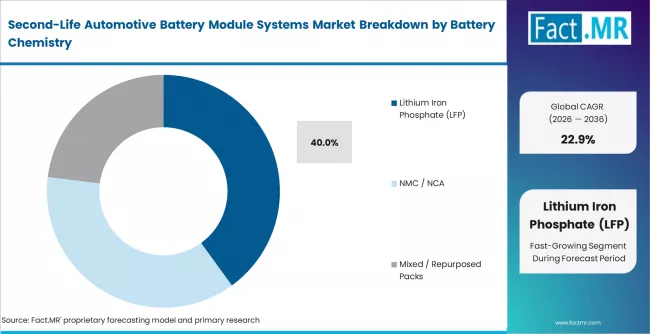
    • By Battery Chemistry: LFP holds approximately 40% share in 2026, preferred for its thermal stability and longer cycle life in second-use scenarios.
    • By Geography: China leads at 24.8% CAGR, supported by government-mandated battery lifecycle frameworks and large EV fleet retirement volumes.
  • Analyst Opinion at FACT.MR
    • Shambhu Nath Jha, Principal Consultant at Fact.MR, opines, ‘CXOs will find that competitive positioning in this market depends on reconditioning depth. It also depends on strong state-of-health certification. Module acquisition cost alone is no longer sufficient.’
  • Strategic Implications
    • Invest in automated state-of-health grading infrastructure to access utility-scale tender procurement channels.
    • Establish direct partnerships with EV fleet operators to secure consistent volume and chemistry-matched module supply.
    • Build regulatory compliance capability for EU and U.S. battery documentation standards to qualify for government-backed storage projects.
  • Methodology
    • Market sizing uses EV retirement schedules and reconditioning volumes, validated with 2024–2025 data.
    • Analysis includes IEA, DOE, EU regulation, and OEM company disclosures.
    • Forecasts account for EV adoption curves, battery chemistry transitions, and second-life deployment policy frameworks.

The market is expected to generate USD 13.0 billion in incremental revenue during the forecast period. Growth reflects accelerating electric vehicle fleet retirement volumes and cost advantages of repurposed cells over new battery packs. Expansion is constrained by inconsistent state-of-health grading standards and limited reconditioning infrastructure in emerging regions.

The shift from landfill disposal to structured second-life deployment is creating regulated procurement channels. Grid operators and industrial buyers are requiring certified module performance documentation. Suppliers lacking standardised grading capability are being excluded from utility-scale and commercial tenders, compressing margins in low-documentation supply tiers.

China leads with an estimated CAGR of 24.8% through 2036, supported by government-mandated battery recycling and second-life deployment frameworks. India follows at 23.6%, driven by cost-sensitive grid storage demand and PLI-backed battery processing. The United States records 22.1%, supported by IRA incentives and structured fleet retirement programmes. South Korea grows at 21.9%, driven by OEM-linked reconditioning infrastructure. Germany records 21.5%, supported by EU battery regulation compliance. Japan grows at 20.4%, with mature OEM programmes moderating pace.

Segmental Analysis

Second-Life Automotive Battery Module Systems Market Analysis by Application
Second Life Automotive Battery Module Systems Market Analysis By Application

Based on FACT.MR, utility-scale energy storage systems hold approximately 50% share in 2026. They dominate due to grid balancing needs. Renewable energy integration also supports demand. Second-life modules offer cost advantages. They are cheaper than new packs for non-critical grid buffer applications.

  • Renault Flins Reconditioning: Renault Group opened its Re-Factory at Flins in 2022. Capacity expansion continued in 2024. The facility supports utility and commercial applications. It processes retired Zoe and Megane E-Tech modules. These are deployed in grid storage systems [1].
  • Nissan xStorage Expansion: Nissan Motor Corporation partnered with Eaton to expand the xStorage programme in 2024. It covers commercial and residential markets in Europe. The system uses second-life Leaf battery packs. It supports building energy management. Installations crossed 500 in 2025 [2].
  • EV Charging Buffer Growth: According to the Global EV Outlook 2024 by the International Energy Agency, EV charging investment exceeded USD 70 billion. This occurred in 2024. Second-life battery buffers are being integrated into fast-charging stations. They reduce grid peak demand charges. Adoption is rising across China, the U.S., and Germany [3].

Second-Life Automotive Battery Module Systems Market Analysis by Battery Chemistry
Second Life Automotive Battery Module Systems Market Analysis By Battery Chemistry

Based on FACT.MR, lithium iron phosphate holds approximately 40% share in 2026. Lithium iron phosphate dominates second-life use. It offers strong thermal stability. It provides longer remaining cycle life. It shows lower degradation under partial-state-of-charge cycling. This suits stationary storage applications.

  • CATL EVOGO Programme: CATL scaled its EVOGO programme in 2024. It covers battery swap and second-life management. LFP packs are redeployed into grid storage buffers. The company reported deployments in over 20 cities by Q3 2024 [4].
  • LG Energy Solution Reuse Platform: LG Energy Solution launched a reuse and residual value platform in 2024. It targets NMC module reconditioning. Modules are sourced from Hyundai and GM EV fleets. The platform provides state-of-health grading documentation. It supports commercial storage buyers [5].
  • Mixed Pack Reconditioning Trend: The International Energy Agency reported global retired EV battery volumes at 200 GWh in 2024. Mixed chemistry packs are being aggregated. They are deployed in off-grid rural electrification projects. Key regions include India, Southeast Asia, and sub-Saharan Africa. These markets have less restrictive grading standards [6].

Drivers, Restraints, and Opportunities
Second Life Automotive Battery Module Systems Market Opportunity Matrix Growth Vs Value

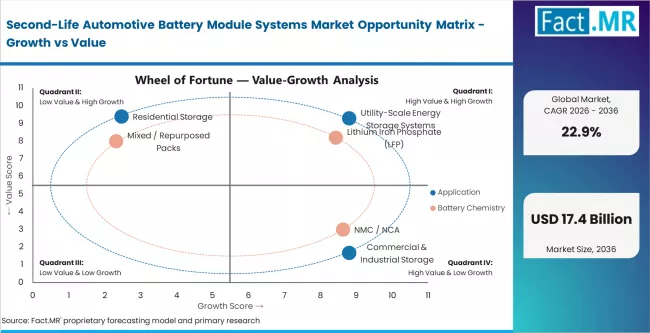
FACT.MR analysts observe that the market is supply-driven in its early phase. Retired EV battery volumes are rising rapidly. They are growing faster than reconditioning infrastructure. Utility-scale buyers absorb most of the available supply. They pay premium prices for documentation-validated modules. Commercial and residential segments are expanding. However, they lag in grading standards adoption.

Commodity second-life packs without state-of-health certification are losing ground. They are being replaced by documented, chemistry-matched modules. Utility buyers require standardised performance guarantees.

  • EU Battery Regulation Compliance: The EU Battery Regulation, effective from 2024, requires second-life and recyclability documentation. It applies to all EV battery manufacturers. It expands structured reconditioning demand. It excludes non-compliant pack reuse in European markets.
  • U.S. IRA Grid Storage Incentives: The Inflation Reduction Act provides investment tax credits for stationary battery storage. This includes second-life systems. U.S. utilities are accelerating procurement. They prefer cost-efficient repurposed modules. New pack prices remain elevated. This widens the economic case for second-life deployment.
  • China Mandatory Lifecycle Frameworks: China’s Ministry of Industry and Information Technology issued updated standards in 2024. These cover battery recycling and cascade utilisation. Government procurement requires certified second-life storage. This applies to grid and rural electrification projects. It drives structured module demand across the country.

Regional Analysis

The second-life automotive battery module systems market is assessed across Asia Pacific, North America, Europe, Latin America, and Middle East and Africa, covering 40+ countries with demand shaped by EV adoption rates, battery retirement volumes, reconditioning infrastructure, and government storage deployment mandates. The full report provides market attractiveness analysis by region and country.

Top Country Growth Comparison Second Life Automotive Battery Module Systems Market Cagr (2026 2036)

Country CAGR (2026 to 2036)
China 24.8%
India 23.6%
United States 22.1%
South Korea 21.9%
Germany 21.5%
Japan 20.4%

Source: Fact.MR (FACT.MR) analysis, based on proprietary forecasting model and primary research
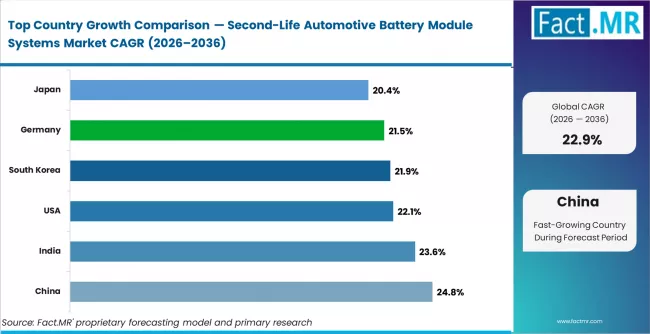
Second Life Automotive Battery Module Systems Market Cagr Analysis By Country

Asia Pacific Second-Life Automotive Battery Module Systems Market Analysis
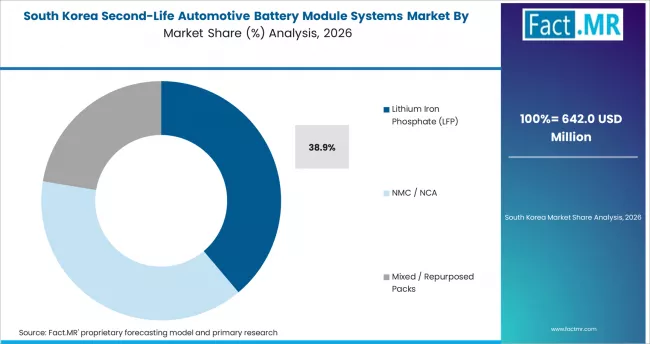
Second Life Automotive Battery Module Systems Market South Korea Market Share Analysis By Battery Chemistry

Asia Pacific is the fastest-growing region. China sets the pace through regulatory enforcement and large-scale deployment pipelines. India is emerging through cost-efficient reuse ecosystems and policy-backed recovery systems. South Korea is advancing through tightly integrated OEM-led battery value chains.

  • China: Expansion remains strongly policy-led, with a projected 24.8% CAGR through 2036. The 2024 cascade utilization rules enforce traceability and prioritise reuse before recycling. This is formalizing secondary battery flows at scale. CATL expanded EVOGO deployment across 25 cities. BYD channelled over 12 GWh of retired Blade batteries into second-life pathways. Grid-linked projects and state-backed rural electrification programmes are accelerating absorption.
  • India: A 23.6% CAGR through 2036 reflects structural momentum building from regulatory enforcement and cost sensitivity. Battery Waste Management Rules are strengthening collection and reuse compliance. Production-linked incentives are supporting domestic ecosystem development. Tata Motors and Mahindra & Mahindra are piloting reuse models for commercial fleets. Adoption is concentrated in price-driven applications such as rural microgrids and telecom infrastructure backup.
  • South Korea: With a projected 21.9% CAGR through 2036, growth is anchored in OEM-led integration and policy alignment. The 2024 national roadmap positions battery reuse within broader circular economy targets. LG Energy Solution introduced structured grading systems for NMC modules sourced from Hyundai and Kia fleets. Deployment volumes exceeded 3 GWh in 2024. Strong OEM coordination continues to differentiate execution efficiency.
  • Japan: A projected 20.4% CAGR through 2036 reflects steady but controlled expansion. Regulatory updates align with European documentation norms. Nissan Motor Corporation deployed over 2 GWh of reused Leaf batteries via 4R Energy Corporation. Toyota Motor Corporation introduced reuse initiatives for NiMH and LFP systems. Growth remains measured due to a mature EV base and OEM-controlled reuse channels.
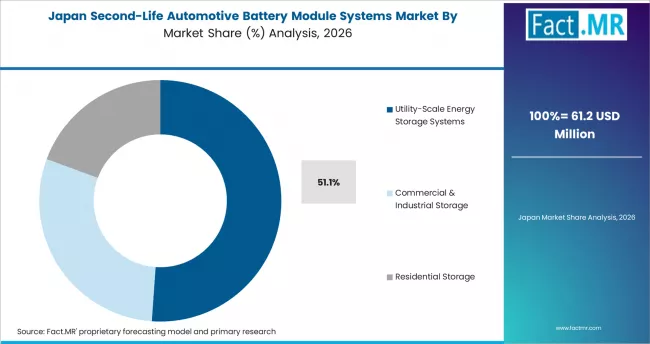
Second Life Automotive Battery Module Systems Market Japan Market Share Analysis By Application

Fact.MR covers China, India, South Korea, Japan, ASEAN, and ANZ. It includes regulatory frameworks, fleet retirement insights, and second-life deployment projections.

North America Second-Life Automotive Battery Module Systems Market Analysis
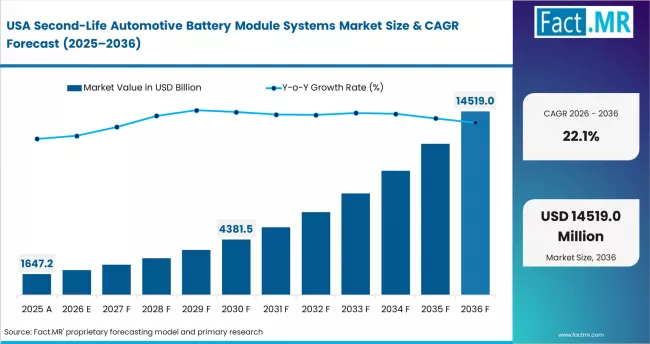
Second Life Automotive Battery Module Systems Market Country Value Analysis

North America reflects a policy-enabled expansion environment. Incentives under the Inflation Reduction Act are shaping investment behaviour. Tesla, Inc. and LG Energy Solution anchor supply pipelines. Utility procurement models are increasingly incorporating second-life storage alongside new systems.

  • United States: Growth is expected at a 22.1% CAGR through 2036, supported by fiscal incentives and infrastructure funding. Standalone storage tax credits are influencing procurement strategies. Tesla, Inc. supplied over 5 GWh of retired modules into secondary markets in 2024. Federal funding of USD 74 million was allocated to reuse and recycling infrastructure. California has introduced regulatory requirements to evaluate second-life batteries in distributed storage procurement.

Fact.MR covers the U.S., Canada, and Mexico. It includes incentive mechanisms, federal programme data, and forward-looking deployment trends.

Europe Second-Life Automotive Battery Module Systems Market Analysis
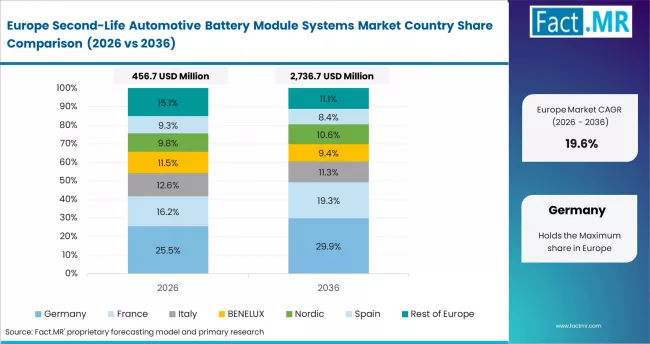
Second Life Automotive Battery Module Systems Market Europe Country Market Share Analysis, 2026 & 2036

Europe operates within a regulation-driven structure. The EU Battery Regulation defines compliance thresholds and documentation standards. Germany leads through established OEM-led reconditioning ecosystems. Renault Group, Volkswagen AG, and Umicore are central to structured reuse programmes aligned with lifecycle obligations.

  • Germany: Expansion is projected at 21.5% CAGR through 2036, driven by strict compliance requirements and OEM capacity investments. The digital battery passport requirement enforces lifecycle traceability. Volkswagen AG scaled its Salzgitter operations for second-life processing of ID-series modules. Umicore secured supply agreements for certified NMC packs in grid applications. Regulatory intensity is raising entry barriers and concentrating supply.

Fact.MR covers Germany, France, the UK, Italy, Spain, and the Rest of Europe. It includes regulatory benchmarks, OEM disclosures, and second-life deployment forecasts.

Competitive Aligners for Market Players
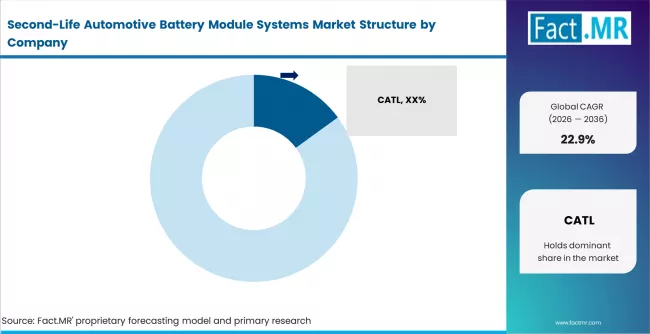
Second Life Automotive Battery Module Systems Market Analysis By Company

Competitive intensity in the second-life automotive battery module systems market is shaped by a combination of sourcing access, technical capability, and trust in performance data. Access to retired EV battery modules is not evenly distributed. OEM-linked reconditioning players hold a structural edge because they can source batteries directly from their own vehicle fleets. This provides consistent supply, better traceability, and higher confidence in module history. In contrast, independent remanufacturers rely on fragmented sourcing channels. They compete on pricing and processing efficiency, but often lack the documentation depth required for high-value applications.

Leading companies such as CATL, BYD, and LG Energy Solution have built integrated second-life ecosystems within their core battery businesses. They combine direct access to retired modules with proprietary state-of-health algorithms tailored to their own chemistries. This allows them to deliver standardized performance metrics and offer warranties that independent players cannot easily match. Their established relationships with utilities and grid operators further strengthen their position.

Automakers like Renault Group, Nissan Motor Corporation, and Tesla, Inc. contribute through structured fleet retirement programmes. These programmes supply certified modules into the secondary market. At the same time, large buyers such as utilities and industrial operators are becoming more selective. They increasingly require multi-source qualification, verified performance data, and financial guarantees. This shift is reducing the viability of undocumented supply and creating clear premium segments for certified, traceable battery systems.

Key Players

  • CATL
  • BYD
  • LG Energy Solution
  • Tesla, Inc.
  • Renault Group
  • Nissan Motor Co., Ltd.
  • Volkswagen AG
  • Umicore SA

Bibliography

  • [1] Renault Group. Re-Factory Flins: second-life battery reconditioning and circular economy programme update; 2024. Available from: renaultgroup.com/en/news-on-air/news/re-factory-flins
  • [2] Nissan Motor Co. / Eaton. xStorage commercial and residential second-life battery programme European expansion and installation milestones; 2024–2025. Available from: nissan-global.com/EN/INNOVATION/TECHNOLOGY/ARCHIVE/LEAF_TO_HOME
  • [3] International Energy Agency (IEA). Global EV Outlook 2024: EV charging infrastructure investment and second-life battery buffer integration for fast charging stations; 2024. Available from: iea.org/reports/global-ev-outlook-2024
  • [4] CATL. EVOGO battery swap programme Q3 2024 expansion update: second-life LFP module deployment in grid storage applications across 25 Chinese cities; October 2024. Available from: catl.com/en/news
  • [5] LG Energy Solution. Battery reuse and residual value management platform launch: NMC module reconditioning for commercial storage; March 2024. Available from: lgessbattery.com/eu/home/home.lg
  • [6] International Energy Agency (IEA). Global EV Outlook 2024: retired EV battery volumes, second-life deployment in off-grid and emerging market applications; 2024. Available from: iea.org/reports/global-ev-outlook-2024

This Report Addresses

  • Strategic insights on second-life battery module demand across China, India, the United States, South Korea, Germany, and Japan. Covers utility, commercial, residential, and EV charging applications.
  • Market forecast from USD 1.8 billion in 2026 to USD 14.8 billion by 2036, at 22.9% CAGR.
  • Opportunity mapping across China reconditioning expansion, U.S. IRA-driven procurement, India cost-led grid storage, South Korea OEM-linked supply, and Germany EU regulation compliance.
  • Segment analysis by application and battery chemistry. Covers utility-scale, commercial, residential, and EV charging use cases across LFP, NMC/NCA, and mixed pack systems.
  • Regional outlook covering Asia Pacific volume growth, North America policy-driven expansion, and Europe regulation-anchored deployment.
  • Competitive analysis of CATL, BYD, LG Energy Solution, Tesla, Renault, Nissan, Volkswagen AG, and Umicore SA.
  • Technology tracking on state-of-health grading systems, digital battery passports, LFP reconditioning platforms, and OEM-integrated second-life programmes.
  • Report delivery in PDF, Excel, and presentation formats with validated data and primary industry inputs.

Second-Life Automotive Battery Module Systems Market Definition

The market covers automotive battery modules retired from EV fleets and repurposed for stationary energy storage, grid services, and EV charging applications. Modules are reconditioned and graded for second-use deployment.

Second-Life Automotive Battery Module Systems Market Inclusions

Covers global and regional forecasts from 2026 to 2036 by application and battery chemistry. Includes LFP, NMC/NCA, and mixed repurposed pack systems. Covers utility, commercial, residential, and EV charging end uses across OEM, remanufacturer, and aggregator supply channels.

Second-Life Automotive Battery Module Systems Market Exclusions

Excludes new battery systems and purpose-built stationary storage cells. Omits battery raw material recycling and end-of-life shredding. Excludes EV drivetrains and non-module battery components. Focuses strictly on module-level second-life reconditioning and deployment.

Second-Life Automotive Battery Module Systems MarketResearch Methodology

  • Primary Research
    • Interviews with battery remanufacturers, grid storage operators, EV fleet managers, and procurement specialists across key markets.
  • Desk Research
    • Uses IEA battery data, EU battery regulation filings, CATL and LG Energy Solution disclosures, DOE programme reports, and IRA policy documentation from 2024–2025.
  • Market Sizing and Forecasting
    • Based on EV fleet retirement volumes, reconditioning cost benchmarks, and second-life deployment rates by application and chemistry type.
  • Data Validation and Update Cycle
    • Validated using OEM battery retirement schedules and project deployment data. Cross-checked with regulatory filings and updated regularly.

Scope of the Report

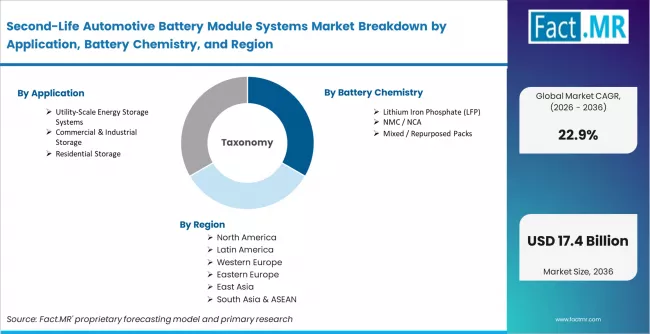
Second Life Automotive Battery Module Systems Market Breakdown By Application, Battery Chemistry, And Region

Quantitative Units USD 1.8 billion (2026) to USD 14.8 billion (2036), at a CAGR of 22.9%
Market Definition Repurposed automotive battery module systems used for stationary energy storage, EV charging, and grid-balancing applications across utility, commercial, and residential channels.
Application Segmentation Utility-Scale Energy Storage Systems, Commercial & Industrial Storage, Residential Storage, EV Charging Infrastructure
Battery Chemistry Segmentation Lithium Iron Phosphate (LFP), NMC / NCA, Mixed / Repurposed Packs
Application Coverage Grid-scale second-life battery deployment, commercial facility peak-shaving, residential backup power, EV charging station energy buffers, and off-grid power supply.
Regions Covered North America, Europe, Asia Pacific, Latin America, Middle East and Africa
Countries Covered USA, Canada, Mexico, Germany, UK, France, Italy, Spain, Nordic, BENELUX, China, Japan, South Korea, India, ASEAN, Australia and New Zealand, Brazil, Argentina, Chile, Saudi Arabia, GCC, Turkey, South Africa, Rest of MEA
Key Companies Profiled CATL, BYD, LG Energy Solution, Tesla, Renault, Nissan, Volkswagen AG, Umicore SA
Forecast Period 2026 to 2036
Approach Hybrid top-down and bottom-up model using second-life battery volume data by chemistry and application, average reconditioning and resale pricing, EV fleet retirement schedules, utility procurement benchmarks, and primary interviews with battery remanufacturers and grid operators.

Second-Life Automotive Battery Module Systems Market by Segments

  • By Application:

    • Utility-Scale Energy Storage Systems
    • Commercial & Industrial Storage
    • Residential Storage
    • EV Charging Infrastructure
  • By Battery Chemistry:

    • Lithium Iron Phosphate (LFP)
    • NMC / NCA
    • Mixed / Repurposed Packs
  • By Region:

    • North America
      • United States
      • Canada
      • Mexico
    • Latin America
      • Brazil
      • Mexico
      • Argentina
      • Chile
      • Rest of Latin America
    • Western Europe
      • Germany
      • United Kingdom
      • France
      • Italy
      • Spain
      • Nordic Countries
      • BENELUX
      • Rest of Western Europe
    • Eastern Europe
      • Russia
      • Poland
      • Hungary
      • Balkan and Baltic
      • Rest of Eastern Europe
    • East Asia
      • China
      • Japan
      • South Korea
      • South Asia and Pacific
      • India
      • ASEAN
      • Australia and New Zealand
      • Rest of South Asia and Pacific
    • Middle East and Africa
      • Kingdom of Saudi Arabia
      • Other GCC Countries
      • Turkey
      • South Africa
      • Rest of Middle East and Africa

- Frequently Asked Questions -

How large is the second-life automotive battery module systems market in 2025?

The market was valued at USD 1.6 billion in 2025.

What will the market size be in 2026?

The market is estimated to reach USD 1.8 billion in 2026.

What is the projected market size by 2036?

The market is projected to reach USD 14.8 billion by 2036.

What is the expected CAGR of the second-life automotive battery module systems market?

The market is expected to grow at a CAGR of 22.9% from 2026 to 2036.

What is the absolute dollar opportunity in this market?

The market is expected to create an absolute dollar opportunity of USD 13.0 billion between 2026 and 2036.

Which application segment leads the market?

Utility-scale energy storage systems lead with approximately 50% share in 2026.

Which battery chemistry segment is poised to lead?

Lithium iron phosphate (LFP) leads with approximately 40% share in 2026.

Which country shows the fastest growth?

China leads with a CAGR of 24.8% through 2036.

What are second-life automotive battery module systems used for?

They are used to repurpose retired EV battery modules for stationary grid storage, commercial energy management, and EV charging buffer applications.

What is driving market growth?

Growth is driven by rising EV fleet retirement volumes, IRA storage incentives, and EU battery regulation mandates requiring structured second-life deployment.

Which region leads market growth?

Asia Pacific leads due to high EV adoption, government-mandated second-life frameworks, and large battery retirement volumes in China and India.

What challenges does the market face?

Challenges include inconsistent state-of-health grading standards, limited reconditioning infrastructure in emerging regions, and concentrated module supply among OEM-linked operators.

Table of Content

  1. Executive Summary
    • Global Market Outlook
    • Demand to side Trends
    • Supply to side Trends
    • Technology Roadmap Analysis
    • Analysis and Recommendations
  2. Market Overview
    • Market Coverage / Taxonomy
    • Market Definition / Scope / Limitations
  3. Research Methodology
    • Chapter Orientation
    • Analytical Lens and Working Hypotheses
      • Market Structure, Signals, and Trend Drivers
      • Benchmarking and Cross-market Comparability
      • Market Sizing, Forecasting, and Opportunity Mapping
    • Research Design and Evidence Framework
      • Desk Research Programme (Secondary Evidence)
        • Company Annual and Sustainability Reports
        • Peer-reviewed Journals and Academic Literature
        • Corporate Websites, Product Literature, and Technical Notes
        • Earnings Decks and Investor Briefings
        • Statutory Filings and Regulatory Disclosures
        • Technical White Papers and Standards Notes
        • Trade Journals, Industry Magazines, and Analyst Briefs
        • Conference Proceedings, Webinars, and Seminar Materials
        • Government Statistics Portals and Public Data Releases
        • Press Releases and Reputable Media Coverage
        • Specialist Newsletters and Curated Briefings
        • Sector Databases and Reference Repositories
        • Fact.MR Internal Proprietary Databases and Historical Market Datasets
        • Subscription Datasets and Paid Sources
        • Social Channels, Communities, and Digital Listening Inputs
        • Additional Desk Sources
      • Expert Input and Fieldwork (Primary Evidence)
        • Primary Modes
          • Qualitative Interviews and Expert Elicitation
          • Quantitative Surveys and Structured Data Capture
          • Blended Approach
        • Why Primary Evidence is Used
        • Field Techniques
          • Interviews
          • Surveys
          • Focus Groups
          • Observational and In-context Research
          • Social and Community Interactions
        • Stakeholder Universe Engaged
          • C-suite Leaders
          • Board Members
          • Presidents and Vice Presidents
          • R&D and Innovation Heads
          • Technical Specialists
          • Domain Subject-matter Experts
          • Scientists
          • Physicians and Other Healthcare Professionals
        • Governance, Ethics, and Data Stewardship
          • Research Ethics
          • Data Integrity and Handling
      • Tooling, Models, and Reference Databases
    • Data Engineering and Model Build
      • Data Acquisition and Ingestion
      • Cleaning, Normalisation, and Verification
      • Synthesis, Triangulation, and Analysis
    • Quality Assurance and Audit Trail
  4. Market Background
    • Market Dynamics
      • Drivers
      • Restraints
      • Opportunity
      • Trends
    • Scenario Forecast
      • Demand in Optimistic Scenario
      • Demand in Likely Scenario
      • Demand in Conservative Scenario
    • Opportunity Map Analysis
    • Product Life Cycle Analysis
    • Supply Chain Analysis
    • Investment Feasibility Matrix
    • Value Chain Analysis
    • PESTLE and Porter’s Analysis
    • Regulatory Landscape
    • Regional Parent Market Outlook
    • Production and Consumption Statistics
    • Import and Export Statistics
  5. Global Market Analysis 2021 to 2025 and Forecast, 2026 to 2036
    • Historical Market Size Value (USD Million) Analysis, 2021 to 2025
    • Current and Future Market Size Value (USD Million) Projections, 2026 to 2036
      • Y to o to Y Growth Trend Analysis
      • Absolute $ Opportunity Analysis
  6. Global Market Pricing Analysis 2021 to 2025 and Forecast 2026 to 2036
  7. Global Market Analysis 2021 to 2025 and Forecast 2026 to 2036, By Product Type
    • Introduction / Key Findings
    • Historical Market Size Value (USD Million) Analysis By Product Type , 2021 to 2025
    • Current and Future Market Size Value (USD Million) Analysis and Forecast By Product Type , 2026 to 2036
      • Sealed Connectors
      • Heavy-Duty Connector Systems
      • Connector Terminals
    • Y to o to Y Growth Trend Analysis By Product Type , 2021 to 2025
    • Absolute $ Opportunity Analysis By Product Type , 2026 to 2036
  8. Global Market Analysis 2021 to 2025 and Forecast 2026 to 2036, By Application
    • Introduction / Key Findings
    • Historical Market Size Value (USD Million) Analysis By Application, 2021 to 2025
    • Current and Future Market Size Value (USD Million) Analysis and Forecast By Application, 2026 to 2036
      • Underhood Wiring
      • Chassis and Underbody Wiring
      • Exterior Lighting and Sensor Wiring
    • Y to o to Y Growth Trend Analysis By Application, 2021 to 2025
    • Absolute $ Opportunity Analysis By Application, 2026 to 2036
  9. Global Market Analysis 2021 to 2025 and Forecast 2026 to 2036, By Vehicle Type
    • Introduction / Key Findings
    • Historical Market Size Value (USD Million) Analysis By Vehicle Type, 2021 to 2025
    • Current and Future Market Size Value (USD Million) Analysis and Forecast By Vehicle Type, 2026 to 2036
      • Passenger Cars
      • Light Commercial Vehicles
      • Heavy Commercial Vehicles
    • Y to o to Y Growth Trend Analysis By Vehicle Type, 2021 to 2025
    • Absolute $ Opportunity Analysis By Vehicle Type, 2026 to 2036
  10. Global Market Analysis 2021 to 2025 and Forecast 2026 to 2036, By Region
    • Introduction
    • Historical Market Size Value (USD Million) Analysis By Region, 2021 to 2025
    • Current Market Size Value (USD Million) Analysis and Forecast By Region, 2026 to 2036
      • North America
      • Latin America
      • Western Europe
      • Eastern Europe
      • East Asia
      • South Asia and Pacific
      • Middle East & Africa
    • Market Attractiveness Analysis By Region
  11. North America Market Analysis 2021 to 2025 and Forecast 2026 to 2036, By Country
    • Historical Market Size Value (USD Million) Trend Analysis By Market Taxonomy, 2021 to 2025
    • Market Size Value (USD Million) Forecast By Market Taxonomy, 2026 to 2036
      • By Country
        • USA
        • Canada
        • Mexico
      • By Product Type
      • By Application
      • By Vehicle Type
    • Market Attractiveness Analysis
      • By Country
      • By Product Type
      • By Application
      • By Vehicle Type
    • Key Takeaways
  12. Latin America Market Analysis 2021 to 2025 and Forecast 2026 to 2036, By Country
    • Historical Market Size Value (USD Million) Trend Analysis By Market Taxonomy, 2021 to 2025
    • Market Size Value (USD Million) Forecast By Market Taxonomy, 2026 to 2036
      • By Country
        • Brazil
        • Chile
        • Rest of Latin America
      • By Product Type
      • By Application
      • By Vehicle Type
    • Market Attractiveness Analysis
      • By Country
      • By Product Type
      • By Application
      • By Vehicle Type
    • Key Takeaways
  13. Western Europe Market Analysis 2021 to 2025 and Forecast 2026 to 2036, By Country
    • Historical Market Size Value (USD Million) Trend Analysis By Market Taxonomy, 2021 to 2025
    • Market Size Value (USD Million) Forecast By Market Taxonomy, 2026 to 2036
      • By Country
        • Germany
        • UK
        • Italy
        • Spain
        • France
        • Nordic
        • BENELUX
        • Rest of Western Europe
      • By Product Type
      • By Application
      • By Vehicle Type
    • Market Attractiveness Analysis
      • By Country
      • By Product Type
      • By Application
      • By Vehicle Type
    • Key Takeaways
  14. Eastern Europe Market Analysis 2021 to 2025 and Forecast 2026 to 2036, By Country
    • Historical Market Size Value (USD Million) Trend Analysis By Market Taxonomy, 2021 to 2025
    • Market Size Value (USD Million) Forecast By Market Taxonomy, 2026 to 2036
      • By Country
        • Russia
        • Poland
        • Hungary
        • Balkan & Baltic
        • Rest of Eastern Europe
      • By Product Type
      • By Application
      • By Vehicle Type
    • Market Attractiveness Analysis
      • By Country
      • By Product Type
      • By Application
      • By Vehicle Type
    • Key Takeaways
  15. East Asia Market Analysis 2021 to 2025 and Forecast 2026 to 2036, By Country
    • Historical Market Size Value (USD Million) Trend Analysis By Market Taxonomy, 2021 to 2025
    • Market Size Value (USD Million) Forecast By Market Taxonomy, 2026 to 2036
      • By Country
        • China
        • Japan
        • South Korea
      • By Product Type
      • By Application
      • By Vehicle Type
    • Market Attractiveness Analysis
      • By Country
      • By Product Type
      • By Application
      • By Vehicle Type
    • Key Takeaways
  16. South Asia and Pacific Market Analysis 2021 to 2025 and Forecast 2026 to 2036, By Country
    • Historical Market Size Value (USD Million) Trend Analysis By Market Taxonomy, 2021 to 2025
    • Market Size Value (USD Million) Forecast By Market Taxonomy, 2026 to 2036
      • By Country
        • India
        • ASEAN
        • Australia & New Zealand
        • Rest of South Asia and Pacific
      • By Product Type
      • By Application
      • By Vehicle Type
    • Market Attractiveness Analysis
      • By Country
      • By Product Type
      • By Application
      • By Vehicle Type
    • Key Takeaways
  17. Middle East & Africa Market Analysis 2021 to 2025 and Forecast 2026 to 2036, By Country
    • Historical Market Size Value (USD Million) Trend Analysis By Market Taxonomy, 2021 to 2025
    • Market Size Value (USD Million) Forecast By Market Taxonomy, 2026 to 2036
      • By Country
        • Kingdom of Saudi Arabia
        • Other GCC Countries
        • Turkiye
        • South Africa
        • Other African Union
        • Rest of Middle East & Africa
      • By Product Type
      • By Application
      • By Vehicle Type
    • Market Attractiveness Analysis
      • By Country
      • By Product Type
      • By Application
      • By Vehicle Type
    • Key Takeaways
  18. Key Countries Market Analysis
    • USA
      • Pricing Analysis
      • Market Share Analysis, 2025
        • By Product Type
        • By Application
        • By Vehicle Type
    • Canada
      • Pricing Analysis
      • Market Share Analysis, 2025
        • By Product Type
        • By Application
        • By Vehicle Type
    • Mexico
      • Pricing Analysis
      • Market Share Analysis, 2025
        • By Product Type
        • By Application
        • By Vehicle Type
    • Brazil
      • Pricing Analysis
      • Market Share Analysis, 2025
        • By Product Type
        • By Application
        • By Vehicle Type
    • Chile
      • Pricing Analysis
      • Market Share Analysis, 2025
        • By Product Type
        • By Application
        • By Vehicle Type
    • Germany
      • Pricing Analysis
      • Market Share Analysis, 2025
        • By Product Type
        • By Application
        • By Vehicle Type
    • UK
      • Pricing Analysis
      • Market Share Analysis, 2025
        • By Product Type
        • By Application
        • By Vehicle Type
    • Italy
      • Pricing Analysis
      • Market Share Analysis, 2025
        • By Product Type
        • By Application
        • By Vehicle Type
    • Spain
      • Pricing Analysis
      • Market Share Analysis, 2025
        • By Product Type
        • By Application
        • By Vehicle Type
    • France
      • Pricing Analysis
      • Market Share Analysis, 2025
        • By Product Type
        • By Application
        • By Vehicle Type
    • India
      • Pricing Analysis
      • Market Share Analysis, 2025
        • By Product Type
        • By Application
        • By Vehicle Type
    • ASEAN
      • Pricing Analysis
      • Market Share Analysis, 2025
        • By Product Type
        • By Application
        • By Vehicle Type
    • Australia & New Zealand
      • Pricing Analysis
      • Market Share Analysis, 2025
        • By Product Type
        • By Application
        • By Vehicle Type
    • China
      • Pricing Analysis
      • Market Share Analysis, 2025
        • By Product Type
        • By Application
        • By Vehicle Type
    • Japan
      • Pricing Analysis
      • Market Share Analysis, 2025
        • By Product Type
        • By Application
        • By Vehicle Type
    • South Korea
      • Pricing Analysis
      • Market Share Analysis, 2025
        • By Product Type
        • By Application
        • By Vehicle Type
    • Russia
      • Pricing Analysis
      • Market Share Analysis, 2025
        • By Product Type
        • By Application
        • By Vehicle Type
    • Poland
      • Pricing Analysis
      • Market Share Analysis, 2025
        • By Product Type
        • By Application
        • By Vehicle Type
    • Hungary
      • Pricing Analysis
      • Market Share Analysis, 2025
        • By Product Type
        • By Application
        • By Vehicle Type
    • Kingdom of Saudi Arabia
      • Pricing Analysis
      • Market Share Analysis, 2025
        • By Product Type
        • By Application
        • By Vehicle Type
    • Turkiye
      • Pricing Analysis
      • Market Share Analysis, 2025
        • By Product Type
        • By Application
        • By Vehicle Type
    • South Africa
      • Pricing Analysis
      • Market Share Analysis, 2025
        • By Product Type
        • By Application
        • By Vehicle Type
  19. Market Structure Analysis
    • Competition Dashboard
    • Competition Benchmarking
    • Market Share Analysis of Top Players
      • By Regional
      • By Product Type
      • By Application
      • By Vehicle Type
  20. Competition Analysis
    • Competition Deep Dive
      • TE Connectivity
        • Overview
        • Product Portfolio
        • Profitability by Market Segments (Product/Age /Sales Channel/Region)
        • Sales Footprint
        • Strategy Overview
          • Marketing Strategy
          • Product Strategy
          • Channel Strategy
      • Aptiv PLC
      • Amphenol Sine Systems
      • Molex
      • Yazaki Corporation
      • Sumitomo Wiring Systems, Ltd.
      • LEONI AG
      • Lear Corporation
  21. Assumptions & Acronyms Used

List Of Table

  • Table 1: Global Market Value (USD Million) Forecast by Region, 2021 to 2036
  • Table 2: Global Market Value (USD Million) Forecast by Product Type , 2021 to 2036
  • Table 3: Global Market Value (USD Million) Forecast by Application, 2021 to 2036
  • Table 4: Global Market Value (USD Million) Forecast by Vehicle Type, 2021 to 2036
  • Table 5: North America Market Value (USD Million) Forecast by Country, 2021 to 2036
  • Table 6: North America Market Value (USD Million) Forecast by Product Type , 2021 to 2036
  • Table 7: North America Market Value (USD Million) Forecast by Application, 2021 to 2036
  • Table 8: North America Market Value (USD Million) Forecast by Vehicle Type, 2021 to 2036
  • Table 9: Latin America Market Value (USD Million) Forecast by Country, 2021 to 2036
  • Table 10: Latin America Market Value (USD Million) Forecast by Product Type , 2021 to 2036
  • Table 11: Latin America Market Value (USD Million) Forecast by Application, 2021 to 2036
  • Table 12: Latin America Market Value (USD Million) Forecast by Vehicle Type, 2021 to 2036
  • Table 13: Western Europe Market Value (USD Million) Forecast by Country, 2021 to 2036
  • Table 14: Western Europe Market Value (USD Million) Forecast by Product Type , 2021 to 2036
  • Table 15: Western Europe Market Value (USD Million) Forecast by Application, 2021 to 2036
  • Table 16: Western Europe Market Value (USD Million) Forecast by Vehicle Type, 2021 to 2036
  • Table 17: Eastern Europe Market Value (USD Million) Forecast by Country, 2021 to 2036
  • Table 18: Eastern Europe Market Value (USD Million) Forecast by Product Type , 2021 to 2036
  • Table 19: Eastern Europe Market Value (USD Million) Forecast by Application, 2021 to 2036
  • Table 20: Eastern Europe Market Value (USD Million) Forecast by Vehicle Type, 2021 to 2036
  • Table 21: East Asia Market Value (USD Million) Forecast by Country, 2021 to 2036
  • Table 22: East Asia Market Value (USD Million) Forecast by Product Type , 2021 to 2036
  • Table 23: East Asia Market Value (USD Million) Forecast by Application, 2021 to 2036
  • Table 24: East Asia Market Value (USD Million) Forecast by Vehicle Type, 2021 to 2036
  • Table 25: South Asia and Pacific Market Value (USD Million) Forecast by Country, 2021 to 2036
  • Table 26: South Asia and Pacific Market Value (USD Million) Forecast by Product Type , 2021 to 2036
  • Table 27: South Asia and Pacific Market Value (USD Million) Forecast by Application, 2021 to 2036
  • Table 28: South Asia and Pacific Market Value (USD Million) Forecast by Vehicle Type, 2021 to 2036
  • Table 29: Middle East & Africa Market Value (USD Million) Forecast by Country, 2021 to 2036
  • Table 30: Middle East & Africa Market Value (USD Million) Forecast by Product Type , 2021 to 2036
  • Table 31: Middle East & Africa Market Value (USD Million) Forecast by Application, 2021 to 2036
  • Table 32: Middle East & Africa Market Value (USD Million) Forecast by Vehicle Type, 2021 to 2036

List Of Figures

  • Figure 1: Global Market Pricing Analysis
  • Figure 2: Global Market Value (USD Million) Forecast 2021-2036
  • Figure 3: Global Market Value Share and BPS Analysis by Product Type, 2026 and 2036
  • Figure 4: Global Market Y-o-Y Growth Comparison by Product Type, 2026 to 2036
  • Figure 5: Global Market Attractiveness Analysis by Product Type
  • Figure 6: Global Market Value Share and BPS Analysis by Application, 2026 and 2036
  • Figure 7: Global Market Y-o-Y Growth Comparison by Application, 2026 to 2036
  • Figure 8: Global Market Attractiveness Analysis by Application
  • Figure 9: Global Market Value Share and BPS Analysis by Vehicle Type, 2026 and 2036
  • Figure 10: Global Market Y-o-Y Growth Comparison by Vehicle Type, 2026 to 2036
  • Figure 11: Global Market Attractiveness Analysis by Vehicle Type
  • Figure 12: Global Market Value (USD Million) Share and BPS Analysis by Region, 2026 and 2036
  • Figure 13: Global Market Y-o-Y Growth Comparison by Region, 2026 to 2036
  • Figure 14: Global Market Attractiveness Analysis by Region
  • Figure 15: North America Market Incremental Dollar Opportunity, 2026 to 2036
  • Figure 16: Latin America Market Incremental Dollar Opportunity, 2026 to 2036
  • Figure 17: Western Europe Market Incremental Dollar Opportunity, 2026 to 2036
  • Figure 18: Eastern Europe Market Incremental Dollar Opportunity, 2026 to 2036
  • Figure 19: East Asia Market Incremental Dollar Opportunity, 2026 to 2036
  • Figure 20: South Asia and Pacific Market Incremental Dollar Opportunity, 2026 to 2036
  • Figure 21: Middle East & Africa Market Incremental Dollar Opportunity, 2026 to 2036
  • Figure 22: North America Market Value Share and BPS Analysis by Country, 2026 and 2036
  • Figure 23: North America Market Value Share and BPS Analysis by Product Type, 2026 and 2036
  • Figure 24: North America Market Y-o-Y Growth Comparison by Product Type, 2026 to 2036
  • Figure 25: North America Market Attractiveness Analysis by Product Type
  • Figure 26: North America Market Value Share and BPS Analysis by Application, 2026 and 2036
  • Figure 27: North America Market Y-o-Y Growth Comparison by Application, 2026 to 2036
  • Figure 28: North America Market Attractiveness Analysis by Application
  • Figure 29: North America Market Value Share and BPS Analysis by Vehicle Type, 2026 and 2036
  • Figure 30: North America Market Y-o-Y Growth Comparison by Vehicle Type, 2026 to 2036
  • Figure 31: North America Market Attractiveness Analysis by Vehicle Type
  • Figure 32: Latin America Market Value Share and BPS Analysis by Country, 2026 and 2036
  • Figure 33: Latin America Market Value Share and BPS Analysis by Product Type, 2026 and 2036
  • Figure 34: Latin America Market Y-o-Y Growth Comparison by Product Type, 2026 to 2036
  • Figure 35: Latin America Market Attractiveness Analysis by Product Type
  • Figure 36: Latin America Market Value Share and BPS Analysis by Application, 2026 and 2036
  • Figure 37: Latin America Market Y-o-Y Growth Comparison by Application, 2026 to 2036
  • Figure 38: Latin America Market Attractiveness Analysis by Application
  • Figure 39: Latin America Market Value Share and BPS Analysis by Vehicle Type, 2026 and 2036
  • Figure 40: Latin America Market Y-o-Y Growth Comparison by Vehicle Type, 2026 to 2036
  • Figure 41: Latin America Market Attractiveness Analysis by Vehicle Type
  • Figure 42: Western Europe Market Value Share and BPS Analysis by Country, 2026 and 2036
  • Figure 43: Western Europe Market Value Share and BPS Analysis by Product Type, 2026 and 2036
  • Figure 44: Western Europe Market Y-o-Y Growth Comparison by Product Type, 2026 to 2036
  • Figure 45: Western Europe Market Attractiveness Analysis by Product Type
  • Figure 46: Western Europe Market Value Share and BPS Analysis by Application, 2026 and 2036
  • Figure 47: Western Europe Market Y-o-Y Growth Comparison by Application, 2026 to 2036
  • Figure 48: Western Europe Market Attractiveness Analysis by Application
  • Figure 49: Western Europe Market Value Share and BPS Analysis by Vehicle Type, 2026 and 2036
  • Figure 50: Western Europe Market Y-o-Y Growth Comparison by Vehicle Type, 2026 to 2036
  • Figure 51: Western Europe Market Attractiveness Analysis by Vehicle Type
  • Figure 52: Eastern Europe Market Value Share and BPS Analysis by Country, 2026 and 2036
  • Figure 53: Eastern Europe Market Value Share and BPS Analysis by Product Type, 2026 and 2036
  • Figure 54: Eastern Europe Market Y-o-Y Growth Comparison by Product Type, 2026 to 2036
  • Figure 55: Eastern Europe Market Attractiveness Analysis by Product Type
  • Figure 56: Eastern Europe Market Value Share and BPS Analysis by Application, 2026 and 2036
  • Figure 57: Eastern Europe Market Y-o-Y Growth Comparison by Application, 2026 to 2036
  • Figure 58: Eastern Europe Market Attractiveness Analysis by Application
  • Figure 59: Eastern Europe Market Value Share and BPS Analysis by Vehicle Type, 2026 and 2036
  • Figure 60: Eastern Europe Market Y-o-Y Growth Comparison by Vehicle Type, 2026 to 2036
  • Figure 61: Eastern Europe Market Attractiveness Analysis by Vehicle Type
  • Figure 62: East Asia Market Value Share and BPS Analysis by Country, 2026 and 2036
  • Figure 63: East Asia Market Value Share and BPS Analysis by Product Type, 2026 and 2036
  • Figure 64: East Asia Market Y-o-Y Growth Comparison by Product Type, 2026 to 2036
  • Figure 65: East Asia Market Attractiveness Analysis by Product Type
  • Figure 66: East Asia Market Value Share and BPS Analysis by Application, 2026 and 2036
  • Figure 67: East Asia Market Y-o-Y Growth Comparison by Application, 2026 to 2036
  • Figure 68: East Asia Market Attractiveness Analysis by Application
  • Figure 69: East Asia Market Value Share and BPS Analysis by Vehicle Type, 2026 and 2036
  • Figure 70: East Asia Market Y-o-Y Growth Comparison by Vehicle Type, 2026 to 2036
  • Figure 71: East Asia Market Attractiveness Analysis by Vehicle Type
  • Figure 72: South Asia and Pacific Market Value Share and BPS Analysis by Country, 2026 and 2036
  • Figure 73: South Asia and Pacific Market Value Share and BPS Analysis by Product Type, 2026 and 2036
  • Figure 74: South Asia and Pacific Market Y-o-Y Growth Comparison by Product Type, 2026 to 2036
  • Figure 75: South Asia and Pacific Market Attractiveness Analysis by Product Type
  • Figure 76: South Asia and Pacific Market Value Share and BPS Analysis by Application, 2026 and 2036
  • Figure 77: South Asia and Pacific Market Y-o-Y Growth Comparison by Application, 2026 to 2036
  • Figure 78: South Asia and Pacific Market Attractiveness Analysis by Application
  • Figure 79: South Asia and Pacific Market Value Share and BPS Analysis by Vehicle Type, 2026 and 2036
  • Figure 80: South Asia and Pacific Market Y-o-Y Growth Comparison by Vehicle Type, 2026 to 2036
  • Figure 81: South Asia and Pacific Market Attractiveness Analysis by Vehicle Type
  • Figure 82: Middle East & Africa Market Value Share and BPS Analysis by Country, 2026 and 2036
  • Figure 83: Middle East & Africa Market Value Share and BPS Analysis by Product Type, 2026 and 2036
  • Figure 84: Middle East & Africa Market Y-o-Y Growth Comparison by Product Type, 2026 to 2036
  • Figure 85: Middle East & Africa Market Attractiveness Analysis by Product Type
  • Figure 86: Middle East & Africa Market Value Share and BPS Analysis by Application, 2026 and 2036
  • Figure 87: Middle East & Africa Market Y-o-Y Growth Comparison by Application, 2026 to 2036
  • Figure 88: Middle East & Africa Market Attractiveness Analysis by Application
  • Figure 89: Middle East & Africa Market Value Share and BPS Analysis by Vehicle Type, 2026 and 2036
  • Figure 90: Middle East & Africa Market Y-o-Y Growth Comparison by Vehicle Type, 2026 to 2036
  • Figure 91: Middle East & Africa Market Attractiveness Analysis by Vehicle Type
  • Figure 92: Global Market - Tier Structure Analysis
  • Figure 93: Global Market - Company Share Analysis

Second-Life Automotive Battery Module Systems Market