Self-Healing Microcapsule Systems Market (2026 - 2036)
Self-Healing Microcapsule Systems Market Size and Share Forecast Outlook 2026 to 2036
Core Findings
Self-Healing Microcapsule Systems Market Forecast Outlook 2026 to 2036
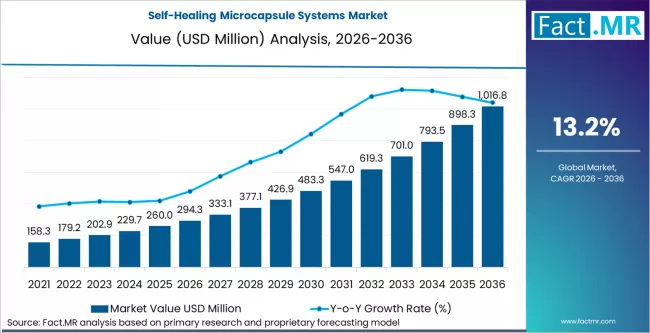
The self-healing microcapsule systems market is projected to reach USD 294.3 million in 2026 and grow to USD 1,016.9 million by 2036, reflecting a CAGR of 13.2%.
Key Takeaways from Self-Healing Microcapsule Systems Market
- Self-Healing Microcapsule Systems Market Value (2026): USD 294.3 million
- Self-Healing Microcapsule Systems Market Forecast Value (2036): USD 1,016.9 million
- Self-Healing Microcapsule Systems Market Forecast CAGR 2026 to 2036: 13.2%
- Leading Segment in Self-Healing Microcapsule Systems Market: Protective Coatings (45%)
- Key Growth Region in Self-Healing Microcapsule Systems Market: China (15.2% CAGR)
- Key Players in Self-Healing Microcapsule Systems Market: BASF SE, Evonik Industries AG, 3M Company, Dow Inc., Henkel AG & Co. KGaA, Akzo Nobel N.V., Nouryon B.V., Microtek Laboratories, Inc., Autonomic Materials, Inc., Solvay S.A.
Commercial realities in this space are shaped by a mix of pricing discipline, buyer leverage, and volume predictability. While the technology shows strong potential, pricing pressure remains a concern, particularly from buyers who are increasingly focused on cost efficiency. As demand grows, buyer leverage will shift, but price sensitivity in certain industries could delay widespread adoption.
Volume predictability is another challenge, with demand fluctuating based on sector needs, which impacts production planning and margins. Suppliers must balance innovation with cost control, as margins may be squeezed by competition and external economic factors. In this context, long-term commercial success will depend on the ability to align product offerings with buyer expectations while managing financial risks associated with scale and market volatility.
Self-Healing Microcapsule Systems Market
| Metric | Value |
|---|---|
| Estimated Value in (2026E) | USD 294.3 million |
| Forecast Value in (2036F) | USD 1,016.9 million |
| Forecast CAGR 2026 to 2036 | 13.2% |
Category
| Category | Sub-Segment |
|---|---|
| By Healing Mechanism | Polymerization-based microcapsules; Corrosion-inhibitor release capsules; Solvent/plasticizer release capsules; Multi-capsule hybrid systems; Others |
| By Capsule Shell Material | UF/MF resin shells; Polyurea/PU shells; Gelatin/biopolymer shells; Silica/inorganic shells; Others |
| By Target Application | Protective coatings; Composites; Adhesives & sealants; Concrete/structural materials; Electronics encapsulation |
| By End-Use Industry | Aerospace & defense; Automotive; Marine/offshore; Construction; Electronics |
| Region | North America; Europe; Asia Pacific; Latin America; Middle East & Africa |
Segmental Analysis
What is Driving the Dominance of Protective Coatings in the Self-Healing Microcapsule Systems Market?
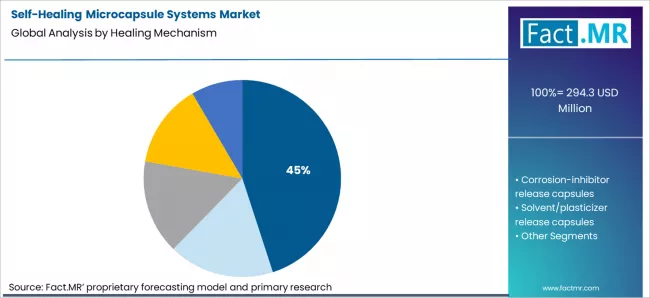
Protective Coatings account for 45% of the self-healing microcapsule systems market in 2026. This is driven by the increasing demand for coatings that can automatically repair damage, extending the lifespan and performance of materials in various applications such as automotive, aerospace, and construction. Self-healing coatings are particularly valuable in industries where durability and resistance to wear, scratches, and corrosion are essential. The ability to heal micro cracks and scratches in coatings improves the material's longevity and reduces maintenance costs, making them highly sought after in protective applications through self-repairing protective coatings.
What is the Role of Polymerization-Based Microcapsules in the Self-Healing Microcapsule Systems Market?
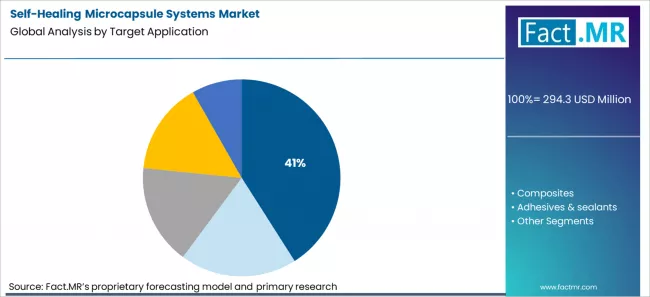
Polymerization-based microcapsules represent 41% of the market share in 2026. These microcapsules release healing agents that trigger polymerization when damage occurs, forming a polymeric network that repairs the cracks or damage. The polymerization process is ideal for self-healing systems, providing strong and durable repairs that restore the integrity of materials. This healing mechanism is especially effective in coatings, adhesives, and composite materials, where maintaining the structural integrity and surface properties is crucial. The growing adoption of polymerization-based systems in high-performance applications is driving their dominance in the market.
What are the Drivers, Restraints, and Key Trends in the SelfHealing Microcapsule Systems Market?
Demand for selfhealing microcapsule systems is shaped by requirements to extend service life and reduce maintenance in coatings, composites, adhesives, and electronic encapsulants across automotive, aerospace, infrastructure, and industrial equipment. Materials engineers specify microcapsules that release healing agents when cracks or mechanical damage occur, enabling insitu repair of polymer matrices and surface films. Procurement teams prioritize systems that deliver consistent encapsulation efficiency, controlled release profiles, and compatibility with base resin chemistries and processing conditions. Higher development and material costs constrain adoption where performance gains are marginal relative to price sensitivity. Variability in damage modes and environmental exposure conditions affects effectiveness, requiring applicationspecific testing and validation. Key trends include development of tunable microcapsule sizes and coreshell chemistries to match targeted healing mechanisms, and expansion of formulations that integrate with automated coating and composite manufacturing processes to support scalable implementation.
Analysis of the Self-Healing Microcapsule Systems Market by Key Country
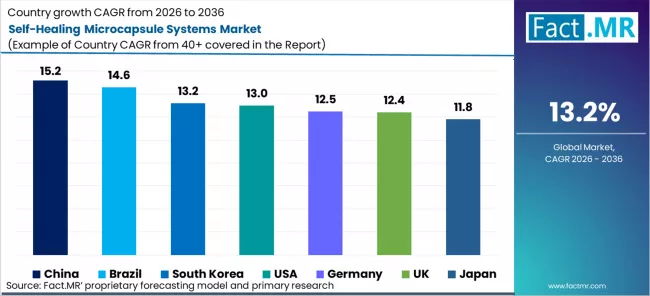
| Country | CAGR 2026 to 2036 |
|---|---|
| USA | 13.0% |
| Japan | 11.8% |
| South Korea | 13.2% |
| Germany | 12.5% |
| China | 15.2% |
| UK | 12.4% |
| Brazil | 14.6% |
The report covers an in-depth analysis of 40+ countries; top-performing countries are highlighted below.
What is Driving the Growth of the Self-Healing Microcapsule Systems Market in the USA?
The USA’s Self-Healing Microcapsule Systems market is projected to grow at 13.0%, fueled by advances in materials science and the increasing demand for durable, long-lasting products in industries such as automotive, construction, and consumer goods. Self-healing technologies, which can repair damage autonomously, are gaining traction in sectors that require high-performance materials, such as coatings and adhesives. As industries focus on reducing maintenance costs and improving product longevity, self-healing microcapsule systems are becoming an essential component of many high-performance applications, driving strong growth in the U.S. market.
How is the Self-Healing Microcapsule Systems Market Expanding in Japan?
Japan’s Self-Healing Microcapsule Systems market is growing at 11.8%, driven by the country’s advanced manufacturing capabilities and its leadership in electronics, automotive, and industrial applications. As Japanese manufacturers strive to enhance the durability and lifespan of their products, self-healing microcapsule systems are increasingly being incorporated into coatings, paints, and automotive components. The demand for self-healing technologies is also growing in the consumer electronics sector, where durability and performance are paramount. Japan’s emphasis on innovation and high-quality materials further fuels the market for self-healing microcapsules.
What Factors Are Fueling the Growth of the Self-Healing Microcapsule Systems Market in South Korea?
South Korea’s Self-Healing Microcapsule Systems market is projected to grow at 13.2%, supported by the country’s strong automotive and electronics industries. As South Korean companies increasingly prioritize product longevity and performance, the need for advanced self-healing technologies in automotive coatings, consumer electronics, and industrial equipment is growing. South Korea’s focus on research and development in materials science and its drive for innovation in manufacturing further enhance the adoption of self-healing microcapsule systems. These technologies are seen as critical to improving the durability and efficiency of products in highly competitive industries.
What is Contributing to the Growth of the Self-Healing Microcapsule Systems Market in Germany?
Germany’s Self-Healing Microcapsule Systems market is growing at 12.5%, driven by the country’s emphasis on high-performance materials in industries such as automotive, coatings, and construction. Germany’s automotive sector, known for its premium vehicles, is increasingly adopting self-healing microcapsule systems to improve the durability of paints and coatings. Additionally, Germany’s strong industrial base, coupled with its focus on sustainability and product longevity, supports the market growth for self-healing technologies. The adoption of these systems in protective coatings and infrastructure applications is expected to increase as industries look for innovative ways to reduce maintenance and enhance material lifespan.
How is the Self-Healing Microcapsule Systems Market Evolving in China?
China’s Self-Healing Microcapsule Systems market is expanding at 15.2%, driven by the country’s rapid industrialization and growing demand for high-performance materials across various sectors. As China continues to advance its automotive, electronics, and construction industries, the adoption of self-healing microcapsule systems is increasing. The demand for durable coatings and self-repairing materials is rising in industries focused on reducing maintenance costs and improving product life cycles. China’s expanding manufacturing capabilities, coupled with its focus on innovation and technological advancements, ensures strong growth in the self-healing microcapsule systems market, making it one of the fastest-growing regions globally.
What is Driving the Growth of the Self-Healing Microcapsule Systems Market in the UK?
The UK’s Self-Healing Microcapsule Systems market is growing at 12.4%, fueled by the increasing demand for innovative solutions in industries such as automotive, aerospace, and construction. As industries in the UK focus on enhancing the durability of materials and reducing maintenance costs, self-healing microcapsules are being increasingly adopted in coatings, adhesives, and other industrial applications. The UK’s strong emphasis on sustainability, alongside a push for high-performance materials in manufacturing, further contributes to the growing demand for self-healing microcapsules. Additionally, the automotive sector’s need for long-lasting, damage-resistant coatings drives significant market expansion in the UK.
What is Contributing to the Growth of the Self-Healing Microcapsule Systems Market in Brazil?
Brazil’s Self-Healing Microcapsule Systems market is expanding at 14.6%, supported by the country’s growing automotive and construction sectors. As Brazil continues to modernize its infrastructure and expand its industrial base, the demand for durable materials that require minimal maintenance is on the rise. Self-healing technologies, particularly in coatings and paints, are increasingly being adopted in Brazil’s automotive and infrastructure projects to enhance longevity and performance. With Brazil’s increasing focus on sustainability and reducing maintenance costs, the adoption of self-healing microcapsules is expected to grow steadily across various industries, making it one of the key markets in Latin America.
How Are Key Players Competing in the Self-Healing Microcapsule Systems Market?
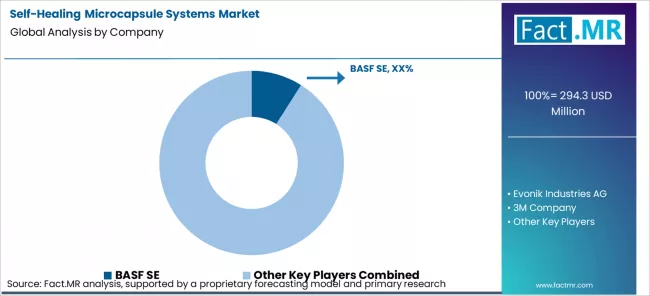
In the Self-Healing Microcapsule Systems market, BASF SE, Evonik Industries AG, and 3M Company are at the forefront, developing cutting-edge microcapsule technologies for diverse applications like coatings, automotive, and construction. Dow Inc. and Henkel AG & Co. KGaA focus on integrating self-healing functionalities into their existing product lines, enhancing durability and extending the lifespan of materials. Akzo Nobel N.V. and Nouryon B.V. are leveraging their expertise in chemicals to design high-performance microcapsule systems that contribute to improved material resilience. Microtek Laboratories, Inc. and Autonomic Materials, Inc. specialize in offering tailored solutions for niche markets, focusing on the scalability of self-healing materials. Solvay S.A. is advancing sustainable, high-performance microcapsule systems, positioning itself as a leader in eco-friendly self-healing technologies. The market is evolving towards providing innovative solutions that not only enhance material longevity but also offer environmental and economic benefits.
Recent Industry Developments
- Patent - Microparticle / Microcapsule Production Platform (Published Mar 16, 2023)This patent publication discloses an apparatus and method (continuous droplet generation with a coordinated nozzle setup) to manufacture uniform polymeric microparticles and capsule-like structures at scale, relevant for producing consistent healing-agent microcapsules used in self-healing systems. (Google Patents)
- Patent - Method and System for Forming Core-Shell Micro-Capsules (Published Apr 4, 2024)A patent publication describing a system that forms micro-capsules with a core surrounded by a shell using a jet-through-shell-liquid approach, targeting robust, repeatable core-shell formation-directly relevant to encapsulating liquid healing agents for self-healing materials. (Google Patents)
- Patent - Firmenich Process for Preparing Core-Shell Microcapsules (Published Feb 8, 2024)This patent publication covers a process to prepare core-shell microcapsules with a cross-linked protein/biopolymer shell (oil-in-water emulsion + crosslinking), supporting higher capsule stability and controlled release behavior applicable to microcapsule-based functional systems (including self-healing release triggers). (Google Patents)
Key Players of the Self-Healing Microcapsule Systems Market
- BASF SE
- Evonik Industries AG
- 3M Company
- Dow Inc.
- Henkel AG & Co. KGaA
- Akzo Nobel N.V.
- Nouryon B.V.
- Microtek Laboratories, Inc.
- Autonomic Materials, Inc.
- Solvay S.A.
Scope of the Report
| Items | Values |
|---|---|
| Quantitative Units (2026) | USD 294.3 Million |
| By Healing Mechanism | Polymerization-based Microcapsules, Corrosion-Inhibitor Release Capsules, Solvent/Plasticizer Release Capsules, Multi-Capsule Hybrid Systems, Others |
| By Capsule Shell Material | UF/MF Resin Shells, Polyurea/PU Shells, Gelatin/Biopolymer Shells, Silica/Inorganic Shells, Others |
| By Target Application | Protective Coatings, Composites, Adhesives & Sealants, Concrete/Structural Materials, Electronics Encapsulation |
| By End-Use Industry | Aerospace & Defense, Automotive, Marine/Offshore, Construction, Electronics |
| Regions Covered | North America, Europe, Asia Pacific, Latin America, Middle East & Africa |
| Countries Covered | United States, Canada, Mexico, Germany, United Kingdom, France, Japan, South Korea, China, India, Brazil, and other countries |
| Key Companies Profiled | BASF SE, Evonik Industries AG, 3M Company, Dow Inc., Henkel AG & Co. KGaA, Akzo Nobel N.V., Nouryon B.V., Microtek Laboratories, Inc., Autonomic Materials, Inc., Solvay S.A. |
| Additional Attributes | Dollar revenue by healing mechanism, capsule shell material, target application, end-use industry, and region; regional demand trends, competitive landscape, technological advancements in self-healing microcapsule systems, operational performance optimization initiatives, and product development strategies |
Self-Healing Microcapsule Systems Market Key Segments
-
By Healing Mechanism :
- Polymerization-based microcapsules
- Corrosion-inhibitor release capsules
- Solvent/plasticizer release capsules
- Multi-capsule hybrid systems
- Others
-
By Capsule Shell Material :
- UF/MF resin shells
- Polyurea/PU shells
- Gelatin/biopolymer shells
- Silica/inorganic shells
- Others
-
By Target Application :
- Protective coatings
- Composites
- Adhesives & sealants
- Concrete/structural materials
- Electronics encapsulation
-
By End-Use Industry :
- Aerospace & defense
- Automotive
- Marine/offshore
- Construction
- Electronics
-
Region :
- North America
- USA
- Canada
- Mexico
- Europe
- Germany
- UK
- France
- Italy
- Spain
- Nordic Countries
- BENELUX
- Rest of Europe
- Asia Pacific
- China
- Japan
- South Korea
- India
- Australia
- Rest of Asia Pacific
- Latin America
- Brazil
- Argentina
- Rest of Latin America
- Middle East and Africa
- Kingdom of Saudi Arabia
- United Arab Emirates
- South Africa
- Rest of Middle East and Africa
- Other Regions
- Oceania
- Central Asia
- Other Markets
- North America
Bibliographies
- National Institute of Standards and Technology (NIST). (2024). Polymeric microencapsulation methods for functional coatings and materials repair. NIST Materials Measurement Laboratory.
- European Commission Joint Research Centre (JRC). (2023). Smart materials and self-healing systems in protective coatings. European Commission.
- Defence Science and Technology Laboratory (DSTL), UK Ministry of Defence. (2024). Self-healing coatings for corrosion protection and asset longevity. UK Government.
- Organisation for Economic Co-operation and Development (OECD). (2023). Advanced functional materials and microencapsulation technologies: Safety and performance. OECD.
- International Organization for Standardization (ISO). (2023). ISO/TR on performance testing of smart and functional coating materials. ISO.
Table of Content
- Executive Summary
- Global Market Outlook
- Demand to side Trends
- Supply to side Trends
- Technology Roadmap Analysis
- Analysis and Recommendations
- Market Overview
- Market Coverage / Taxonomy
- Market Definition / Scope / Limitations
- Research Methodology
- Chapter Orientation
- Analytical Lens and Working Hypotheses
- Market Structure, Signals, and Trend Drivers
- Benchmarking and Cross-market Comparability
- Market Sizing, Forecasting, and Opportunity Mapping
- Research Design and Evidence Framework
- Desk Research Programme (Secondary Evidence)
- Company Annual and Sustainability Reports
- Peer-reviewed Journals and Academic Literature
- Corporate Websites, Product Literature, and Technical Notes
- Earnings Decks and Investor Briefings
- Statutory Filings and Regulatory Disclosures
- Technical White Papers and Standards Notes
- Trade Journals, Industry Magazines, and Analyst Briefs
- Conference Proceedings, Webinars, and Seminar Materials
- Government Statistics Portals and Public Data Releases
- Press Releases and Reputable Media Coverage
- Specialist Newsletters and Curated Briefings
- Sector Databases and Reference Repositories
- FMR Internal Proprietary Databases and Historical Market Datasets
- Subscription Datasets and Paid Sources
- Social Channels, Communities, and Digital Listening Inputs
- Additional Desk Sources
- Expert Input and Fieldwork (Primary Evidence)
- Primary Modes
- Qualitative Interviews and Expert Elicitation
- Quantitative Surveys and Structured Data Capture
- Blended Approach
- Why Primary Evidence is Used
- Field Techniques
- Interviews
- Surveys
- Focus Groups
- Observational and In-context Research
- Social and Community Interactions
- Stakeholder Universe Engaged
- C-suite Leaders
- Board Members
- Presidents and Vice Presidents
- R&D and Innovation Heads
- Technical Specialists
- Domain Subject-matter Experts
- Scientists
- Physicians and Other Healthcare Professionals
- Governance, Ethics, and Data Stewardship
- Research Ethics
- Data Integrity and Handling
- Primary Modes
- Tooling, Models, and Reference Databases
- Desk Research Programme (Secondary Evidence)
- Data Engineering and Model Build
- Data Acquisition and Ingestion
- Cleaning, Normalisation, and Verification
- Synthesis, Triangulation, and Analysis
- Quality Assurance and Audit Trail
- Market Background
- Market Dynamics
- Drivers
- Restraints
- Opportunity
- Trends
- Scenario Forecast
- Demand in Optimistic Scenario
- Demand in Likely Scenario
- Demand in Conservative Scenario
- Opportunity Map Analysis
- Product Life Cycle Analysis
- Supply Chain Analysis
- Investment Feasibility Matrix
- Value Chain Analysis
- PESTLE and Porter’s Analysis
- Regulatory Landscape
- Regional Parent Market Outlook
- Production and Consumption Statistics
- Import and Export Statistics
- Market Dynamics
- Global Market Analysis 2021 to 2025 and Forecast, 2026 to 2036
- Historical Market Size Value (USD Million) Analysis, 2021 to 2025
- Current and Future Market Size Value (USD Million) Projections, 2026 to 2036
- Y to o to Y Growth Trend Analysis
- Absolute $ Opportunity Analysis
- Global Market Pricing Analysis 2021 to 2025 and Forecast 2026 to 2036
- Global Market Analysis 2021 to 2025 and Forecast 2026 to 2036, By Healing Mechanism
- Introduction / Key Findings
- Historical Market Size Value (USD Million) Analysis By Healing Mechanism, 2021 to 2025
- Current and Future Market Size Value (USD Million) Analysis and Forecast By Healing Mechanism, 2026 to 2036
- Polymerization-based microcapsules
- Corrosion-inhibitor release capsules
- Solvent/plasticizer release capsules
- Multi-capsule hybrid systems
- Others
- Polymerization-based microcapsules
- Y to o to Y Growth Trend Analysis By Healing Mechanism, 2021 to 2025
- Absolute $ Opportunity Analysis By Healing Mechanism, 2026 to 2036
- Global Market Analysis 2021 to 2025 and Forecast 2026 to 2036, By Target Application
- Introduction / Key Findings
- Historical Market Size Value (USD Million) Analysis By Target Application, 2021 to 2025
- Current and Future Market Size Value (USD Million) Analysis and Forecast By Target Application, 2026 to 2036
- Protective coatings
- Composites
- Adhesives & sealants
- Concrete/structural materials
- Electronics encapsulation
- Protective coatings
- Y to o to Y Growth Trend Analysis By Target Application, 2021 to 2025
- Absolute $ Opportunity Analysis By Target Application, 2026 to 2036
- Global Market Analysis 2021 to 2025 and Forecast 2026 to 2036, By Region
- Introduction
- Historical Market Size Value (USD Million) Analysis By Region, 2021 to 2025
- Current Market Size Value (USD Million) Analysis and Forecast By Region, 2026 to 2036
- North America
- Latin America
- Western Europe
- Eastern Europe
- East Asia
- South Asia and Pacific
- Middle East & Africa
- Market Attractiveness Analysis By Region
- North America Market Analysis 2021 to 2025 and Forecast 2026 to 2036, By Country
- Historical Market Size Value (USD Million) Trend Analysis By Market Taxonomy, 2021 to 2025
- Market Size Value (USD Million) Forecast By Market Taxonomy, 2026 to 2036
- By Country
- USA
- Canada
- Mexico
- By Healing Mechanism
- By Target Application
- By Country
- Market Attractiveness Analysis
- By Country
- By Healing Mechanism
- By Target Application
- Key Takeaways
- Latin America Market Analysis 2021 to 2025 and Forecast 2026 to 2036, By Country
- Historical Market Size Value (USD Million) Trend Analysis By Market Taxonomy, 2021 to 2025
- Market Size Value (USD Million) Forecast By Market Taxonomy, 2026 to 2036
- By Country
- Brazil
- Chile
- Rest of Latin America
- By Healing Mechanism
- By Target Application
- By Country
- Market Attractiveness Analysis
- By Country
- By Healing Mechanism
- By Target Application
- Key Takeaways
- Western Europe Market Analysis 2021 to 2025 and Forecast 2026 to 2036, By Country
- Historical Market Size Value (USD Million) Trend Analysis By Market Taxonomy, 2021 to 2025
- Market Size Value (USD Million) Forecast By Market Taxonomy, 2026 to 2036
- By Country
- Germany
- UK
- Italy
- Spain
- France
- Nordic
- BENELUX
- Rest of Western Europe
- By Healing Mechanism
- By Target Application
- By Country
- Market Attractiveness Analysis
- By Country
- By Healing Mechanism
- By Target Application
- Key Takeaways
- Eastern Europe Market Analysis 2021 to 2025 and Forecast 2026 to 2036, By Country
- Historical Market Size Value (USD Million) Trend Analysis By Market Taxonomy, 2021 to 2025
- Market Size Value (USD Million) Forecast By Market Taxonomy, 2026 to 2036
- By Country
- Russia
- Poland
- Hungary
- Balkan & Baltic
- Rest of Eastern Europe
- By Healing Mechanism
- By Target Application
- By Country
- Market Attractiveness Analysis
- By Country
- By Healing Mechanism
- By Target Application
- Key Takeaways
- East Asia Market Analysis 2021 to 2025 and Forecast 2026 to 2036, By Country
- Historical Market Size Value (USD Million) Trend Analysis By Market Taxonomy, 2021 to 2025
- Market Size Value (USD Million) Forecast By Market Taxonomy, 2026 to 2036
- By Country
- China
- Japan
- South Korea
- By Healing Mechanism
- By Target Application
- By Country
- Market Attractiveness Analysis
- By Country
- By Healing Mechanism
- By Target Application
- Key Takeaways
- South Asia and Pacific Market Analysis 2021 to 2025 and Forecast 2026 to 2036, By Country
- Historical Market Size Value (USD Million) Trend Analysis By Market Taxonomy, 2021 to 2025
- Market Size Value (USD Million) Forecast By Market Taxonomy, 2026 to 2036
- By Country
- India
- ASEAN
- Australia & New Zealand
- Rest of South Asia and Pacific
- By Healing Mechanism
- By Target Application
- By Country
- Market Attractiveness Analysis
- By Country
- By Healing Mechanism
- By Target Application
- Key Takeaways
- Middle East & Africa Market Analysis 2021 to 2025 and Forecast 2026 to 2036, By Country
- Historical Market Size Value (USD Million) Trend Analysis By Market Taxonomy, 2021 to 2025
- Market Size Value (USD Million) Forecast By Market Taxonomy, 2026 to 2036
- By Country
- Kingdom of Saudi Arabia
- Other GCC Countries
- Turkiye
- South Africa
- Other African Union
- Rest of Middle East & Africa
- By Healing Mechanism
- By Target Application
- By Country
- Market Attractiveness Analysis
- By Country
- By Healing Mechanism
- By Target Application
- Key Takeaways
- Key Countries Market Analysis
- USA
- Pricing Analysis
- Market Share Analysis, 2025
- By Healing Mechanism
- By Target Application
- Canada
- Pricing Analysis
- Market Share Analysis, 2025
- By Healing Mechanism
- By Target Application
- Mexico
- Pricing Analysis
- Market Share Analysis, 2025
- By Healing Mechanism
- By Target Application
- Brazil
- Pricing Analysis
- Market Share Analysis, 2025
- By Healing Mechanism
- By Target Application
- Chile
- Pricing Analysis
- Market Share Analysis, 2025
- By Healing Mechanism
- By Target Application
- Germany
- Pricing Analysis
- Market Share Analysis, 2025
- By Healing Mechanism
- By Target Application
- UK
- Pricing Analysis
- Market Share Analysis, 2025
- By Healing Mechanism
- By Target Application
- Italy
- Pricing Analysis
- Market Share Analysis, 2025
- By Healing Mechanism
- By Target Application
- Spain
- Pricing Analysis
- Market Share Analysis, 2025
- By Healing Mechanism
- By Target Application
- France
- Pricing Analysis
- Market Share Analysis, 2025
- By Healing Mechanism
- By Target Application
- India
- Pricing Analysis
- Market Share Analysis, 2025
- By Healing Mechanism
- By Target Application
- ASEAN
- Pricing Analysis
- Market Share Analysis, 2025
- By Healing Mechanism
- By Target Application
- Australia & New Zealand
- Pricing Analysis
- Market Share Analysis, 2025
- By Healing Mechanism
- By Target Application
- China
- Pricing Analysis
- Market Share Analysis, 2025
- By Healing Mechanism
- By Target Application
- Japan
- Pricing Analysis
- Market Share Analysis, 2025
- By Healing Mechanism
- By Target Application
- South Korea
- Pricing Analysis
- Market Share Analysis, 2025
- By Healing Mechanism
- By Target Application
- Russia
- Pricing Analysis
- Market Share Analysis, 2025
- By Healing Mechanism
- By Target Application
- Poland
- Pricing Analysis
- Market Share Analysis, 2025
- By Healing Mechanism
- By Target Application
- Hungary
- Pricing Analysis
- Market Share Analysis, 2025
- By Healing Mechanism
- By Target Application
- Kingdom of Saudi Arabia
- Pricing Analysis
- Market Share Analysis, 2025
- By Healing Mechanism
- By Target Application
- Turkiye
- Pricing Analysis
- Market Share Analysis, 2025
- By Healing Mechanism
- By Target Application
- South Africa
- Pricing Analysis
- Market Share Analysis, 2025
- By Healing Mechanism
- By Target Application
- USA
- Market Structure Analysis
- Competition Dashboard
- Competition Benchmarking
- Market Share Analysis of Top Players
- By Regional
- By Healing Mechanism
- By Target Application
- Competition Analysis
- Competition Deep Dive
- BASF SE
- Overview
- Product Portfolio
- Profitability by Market Segments (Product/Age /Sales Channel/Region)
- Sales Footprint
- Strategy Overview
- Marketing Strategy
- Product Strategy
- Channel Strategy
- Evonik Industries AG
- 3M Company
- Dow Inc.
- Henkel AG & Co. KGaA
- Akzo Nobel N.V.
- Nouryon B.V.
- Microtek Laboratories, Inc.
- Autonomic Materials, Inc.
- Solvay S.A.
- BASF SE
- Competition Deep Dive
- Assumptions & Acronyms Used
List Of Table
- Table 1: Global Market Value (USD Million) Forecast by Region, 2021 to 2036
- Table 2: Global Market Value (USD Million) Forecast by Healing Mechanism, 2021 to 2036
- Table 3: Global Market Value (USD Million) Forecast by Target Application, 2021 to 2036
- Table 4: North America Market Value (USD Million) Forecast by Country, 2021 to 2036
- Table 5: North America Market Value (USD Million) Forecast by Healing Mechanism, 2021 to 2036
- Table 6: North America Market Value (USD Million) Forecast by Target Application, 2021 to 2036
- Table 7: Latin America Market Value (USD Million) Forecast by Country, 2021 to 2036
- Table 8: Latin America Market Value (USD Million) Forecast by Healing Mechanism, 2021 to 2036
- Table 9: Latin America Market Value (USD Million) Forecast by Target Application, 2021 to 2036
- Table 10: Western Europe Market Value (USD Million) Forecast by Country, 2021 to 2036
- Table 11: Western Europe Market Value (USD Million) Forecast by Healing Mechanism, 2021 to 2036
- Table 12: Western Europe Market Value (USD Million) Forecast by Target Application, 2021 to 2036
- Table 13: Eastern Europe Market Value (USD Million) Forecast by Country, 2021 to 2036
- Table 14: Eastern Europe Market Value (USD Million) Forecast by Healing Mechanism, 2021 to 2036
- Table 15: Eastern Europe Market Value (USD Million) Forecast by Target Application, 2021 to 2036
- Table 16: East Asia Market Value (USD Million) Forecast by Country, 2021 to 2036
- Table 17: East Asia Market Value (USD Million) Forecast by Healing Mechanism, 2021 to 2036
- Table 18: East Asia Market Value (USD Million) Forecast by Target Application, 2021 to 2036
- Table 19: South Asia and Pacific Market Value (USD Million) Forecast by Country, 2021 to 2036
- Table 20: South Asia and Pacific Market Value (USD Million) Forecast by Healing Mechanism, 2021 to 2036
- Table 21: South Asia and Pacific Market Value (USD Million) Forecast by Target Application, 2021 to 2036
- Table 22: Middle East & Africa Market Value (USD Million) Forecast by Country, 2021 to 2036
- Table 23: Middle East & Africa Market Value (USD Million) Forecast by Healing Mechanism, 2021 to 2036
- Table 24: Middle East & Africa Market Value (USD Million) Forecast by Target Application, 2021 to 2036
List Of Figures
- Figure 1: Global Market Pricing Analysis
- Figure 2: Global Market Value (USD Million) Forecast 2021 to 2036
- Figure 3: Global Market Value Share and BPS Analysis by Healing Mechanism, 2026 and 2036
- Figure 4: Global Market Y to o to Y Growth Comparison by Healing Mechanism, 2026 to 2036
- Figure 5: Global Market Attractiveness Analysis by Healing Mechanism
- Figure 6: Global Market Value Share and BPS Analysis by Target Application, 2026 and 2036
- Figure 7: Global Market Y to o to Y Growth Comparison by Target Application, 2026 to 2036
- Figure 8: Global Market Attractiveness Analysis by Target Application
- Figure 9: Global Market Value (USD Million) Share and BPS Analysis by Region, 2026 and 2036
- Figure 10: Global Market Y to o to Y Growth Comparison by Region, 2026 to 2036
- Figure 11: Global Market Attractiveness Analysis by Region
- Figure 12: North America Market Incremental Dollar Opportunity, 2026 to 2036
- Figure 13: Latin America Market Incremental Dollar Opportunity, 2026 to 2036
- Figure 14: Western Europe Market Incremental Dollar Opportunity, 2026 to 2036
- Figure 15: Eastern Europe Market Incremental Dollar Opportunity, 2026 to 2036
- Figure 16: East Asia Market Incremental Dollar Opportunity, 2026 to 2036
- Figure 17: South Asia and Pacific Market Incremental Dollar Opportunity, 2026 to 2036
- Figure 18: Middle East & Africa Market Incremental Dollar Opportunity, 2026 to 2036
- Figure 19: North America Market Value Share and BPS Analysis by Country, 2026 and 2036
- Figure 20: North America Market Value Share and BPS Analysis by Healing Mechanism, 2026 and 2036
- Figure 21: North America Market Y to o to Y Growth Comparison by Healing Mechanism, 2026 to 2036
- Figure 22: North America Market Attractiveness Analysis by Healing Mechanism
- Figure 23: North America Market Value Share and BPS Analysis by Target Application, 2026 and 2036
- Figure 24: North America Market Y to o to Y Growth Comparison by Target Application, 2026 to 2036
- Figure 25: North America Market Attractiveness Analysis by Target Application
- Figure 26: Latin America Market Value Share and BPS Analysis by Country, 2026 and 2036
- Figure 27: Latin America Market Value Share and BPS Analysis by Healing Mechanism, 2026 and 2036
- Figure 28: Latin America Market Y to o to Y Growth Comparison by Healing Mechanism, 2026 to 2036
- Figure 29: Latin America Market Attractiveness Analysis by Healing Mechanism
- Figure 30: Latin America Market Value Share and BPS Analysis by Target Application, 2026 and 2036
- Figure 31: Latin America Market Y to o to Y Growth Comparison by Target Application, 2026 to 2036
- Figure 32: Latin America Market Attractiveness Analysis by Target Application
- Figure 33: Western Europe Market Value Share and BPS Analysis by Country, 2026 and 2036
- Figure 34: Western Europe Market Value Share and BPS Analysis by Healing Mechanism, 2026 and 2036
- Figure 35: Western Europe Market Y to o to Y Growth Comparison by Healing Mechanism, 2026 to 2036
- Figure 36: Western Europe Market Attractiveness Analysis by Healing Mechanism
- Figure 37: Western Europe Market Value Share and BPS Analysis by Target Application, 2026 and 2036
- Figure 38: Western Europe Market Y to o to Y Growth Comparison by Target Application, 2026 to 2036
- Figure 39: Western Europe Market Attractiveness Analysis by Target Application
- Figure 40: Eastern Europe Market Value Share and BPS Analysis by Country, 2026 and 2036
- Figure 41: Eastern Europe Market Value Share and BPS Analysis by Healing Mechanism, 2026 and 2036
- Figure 42: Eastern Europe Market Y to o to Y Growth Comparison by Healing Mechanism, 2026 to 2036
- Figure 43: Eastern Europe Market Attractiveness Analysis by Healing Mechanism
- Figure 44: Eastern Europe Market Value Share and BPS Analysis by Target Application, 2026 and 2036
- Figure 45: Eastern Europe Market Y to o to Y Growth Comparison by Target Application, 2026 to 2036
- Figure 46: Eastern Europe Market Attractiveness Analysis by Target Application
- Figure 47: East Asia Market Value Share and BPS Analysis by Country, 2026 and 2036
- Figure 48: East Asia Market Value Share and BPS Analysis by Healing Mechanism, 2026 and 2036
- Figure 49: East Asia Market Y to o to Y Growth Comparison by Healing Mechanism, 2026 to 2036
- Figure 50: East Asia Market Attractiveness Analysis by Healing Mechanism
- Figure 51: East Asia Market Value Share and BPS Analysis by Target Application, 2026 and 2036
- Figure 52: East Asia Market Y to o to Y Growth Comparison by Target Application, 2026 to 2036
- Figure 53: East Asia Market Attractiveness Analysis by Target Application
- Figure 54: South Asia and Pacific Market Value Share and BPS Analysis by Country, 2026 and 2036
- Figure 55: South Asia and Pacific Market Value Share and BPS Analysis by Healing Mechanism, 2026 and 2036
- Figure 56: South Asia and Pacific Market Y to o to Y Growth Comparison by Healing Mechanism, 2026 to 2036
- Figure 57: South Asia and Pacific Market Attractiveness Analysis by Healing Mechanism
- Figure 58: South Asia and Pacific Market Value Share and BPS Analysis by Target Application, 2026 and 2036
- Figure 59: South Asia and Pacific Market Y to o to Y Growth Comparison by Target Application, 2026 to 2036
- Figure 60: South Asia and Pacific Market Attractiveness Analysis by Target Application
- Figure 61: Middle East & Africa Market Value Share and BPS Analysis by Country, 2026 and 2036
- Figure 62: Middle East & Africa Market Value Share and BPS Analysis by Healing Mechanism, 2026 and 2036
- Figure 63: Middle East & Africa Market Y to o to Y Growth Comparison by Healing Mechanism, 2026 to 2036
- Figure 64: Middle East & Africa Market Attractiveness Analysis by Healing Mechanism
- Figure 65: Middle East & Africa Market Value Share and BPS Analysis by Target Application, 2026 and 2036
- Figure 66: Middle East & Africa Market Y to o to Y Growth Comparison by Target Application, 2026 to 2036
- Figure 67: Middle East & Africa Market Attractiveness Analysis by Target Application
- Figure 68: Global Market - Tier Structure Analysis
- Figure 69: Global Market - Company Share Analysis
- FAQs -
How big is the self-healing microcapsule systems market in 2026?
The global self-healing microcapsule systems market is estimated to be valued at USD 294.3 million in 2026.
What will be the size of self-healing microcapsule systems market in 2036?
The market size for the self-healing microcapsule systems market is projected to reach USD 1,016.8 million by 2036.
How much will be the self-healing microcapsule systems market growth between 2026 and 2036?
The self-healing microcapsule systems market is expected to grow at a 13.2% CAGR between 2026 and 2036.
What are the key product types in the self-healing microcapsule systems market?
The key product types in self-healing microcapsule systems market are polymerization-based microcapsules, corrosion-inhibitor release capsules, solvent/plasticizer release capsules, multi-capsule hybrid systems and others.
Which target application segment to contribute significant share in the self-healing microcapsule systems market in 2026?
In terms of target application, protective coatings segment to command 41.0% share in the self-healing microcapsule systems market in 2026.