- Market Value (2025): USD 256.2 Mn
- Estimated Value (2026): USD 310 Mn
- Forecast Value (2036): USD 2086 Mn
- CAGR (2026-2036): 21.0%
What is the Self-Repairing Elastomers Market forecast to be worth by 2036?
USD 310 million in 2026 to USD 2,086 million by 2036 at a 21.0% CAGR.
- The self-repairing elastomers market reached USD 256.2 million in 2025.
- Demand is projected to increase from USD 310 million in 2026 to USD 2,086 million by 2036.
- The market is forecast to record 21.0% CAGR from 2026 to 2036 as soft robotics developers and wearable-device teams use repairable polymers to reduce part replacement.
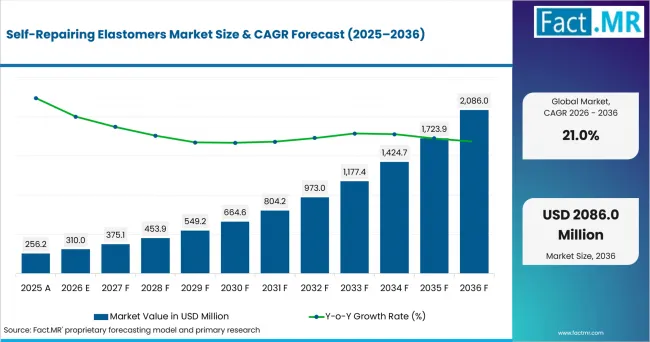
Self Repairing Elastomers Market Value Analysis | Source: Fact.MR
What are the defining numbers behind Self-Repairing Elastomers Market growth?
USD 1,776 million absolute opportunity between 2026 and 2036, led by soft robotics, polyurethane and Germany.
- Demand Drivers in the Market
- Soft-robotics developers need elastomers that recover after cuts or fatigue since grippers face repeated bending during daily handling cycles.
- Wearable-device teams need skin-contact polymers that tolerate sweat and scratching so straps and soft housings survive longer trials.
- Automotive electronics teams need silicone and polyurethane encapsulants that protect sensors and power modules while reducing vibration-related failure risk.
- Industrial maintenance teams need repairable wheels, seals and gaskets where downtime raises labor cost and replacement frequency.
- Power-electronics suppliers need soft dielectric protection. Dow launched DOWSIL EG-4175 Silicone Gel in September 2025; Dow states that the gel withstands temperatures up to 180°C and has self-healing properties that repair small cracks without external intervention.
- Key Segments Analyzed
- By Elastomer: Polyurethane is expected to hold 38.0% share in 2026 supported by processing familiarity and high tear resistance.
- By Chemistry: Disulfide exchange is projected to account for 28.0% share in 2026 owing to repeatable dynamic-bond repair under workable conditions.
- By Trigger: Ambient autonomous is anticipated to capture 37.0% share in 2026 where users prefer repair without ovens or extra service steps.
- By Application: Soft robotics is estimated to represent 49.0% share in 2026 driven by repeated flexing in grippers and protective skins.
- Analyst Opinion at Fact.MR
- Shambhu Nath Jha, Principal Consultant at Fact.MR, states, “Self-repairing elastomers are drawing attention because material failure is visible at the exact point where soft devices flex. Adoption is expected to move first in parts where a small tear stops the device or raises warranty risk. Suppliers should combine repair-cycle data, tear testing and practical molding support before asking engineers to change qualified elastomer recipes.”
- Strategic Implications
- Material suppliers should publish repair-cycle data beside tensile strength and tear resistance so engineers can judge service value.
- Compounders should offer polyurethane and silicone grades that fit existing molding routes before asking customers to redesign full parts.
- Soft-robotics integrators should test repairable skins under repeated grip cycles. IFR reported that U.S. industrial robot installations rose 11% to 38,000 units in 2025.
- Automotive electronics teams should separate encapsulation, vibration damping and seal applications because each use needs a different repair speed and heat tolerance.
Germany is projected to record 23.2% CAGR through 2036 supported by automotive elastomers and factory automation. The USA is forecast to post 17.9% CAGR as plastics and rubber manufacturing supports material trials. The UK is anticipated to reach 16.7% CAGR through engineering demand. Japan is estimated to advance at 15.9% CAGR, while South Korea is expected to hold 15.0% CAGR through automotive and electronics-linked elastomer use.
How does the Self-Repairing Elastomers Market break down by segment?
Polyurethane leads Elastomer at 38.0%; Soft robotics leads Application at 49.0%.
Which Elastomer dominates?
Polyurethane is expected to hold 38.0% share in 2026.
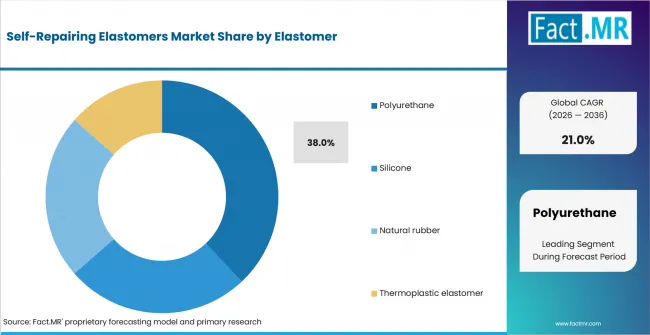
Self Repairing Elastomers Market Analysis By Elastomer | Source: Fact.MR
Polyurethane is expected to lead the Elastomer category owing to its known use in wheels, damping parts, coatings and soft mechanical components. That base gives developers a practical platform for disulfide exchange, microcapsules and other repair systems.
What leads the Chemistry segment?
Disulfide exchange is projected to account for 28.0% share in 2026.
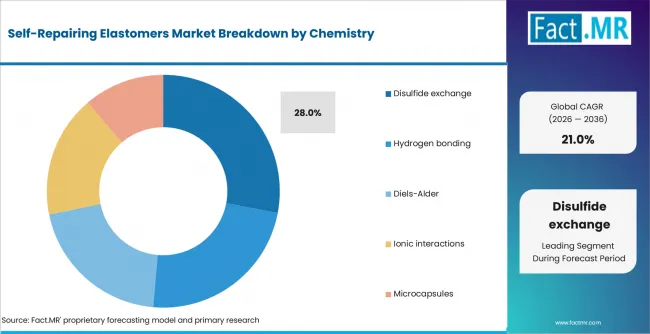
Self Repairing Elastomers Market Analysis By Chemistry | Source: Fact.MR
Disulfide exchange is projected to lead Chemistry because dynamic bonds can reform after controlled damage while keeping workable strength. Hydrogen bonding supports softer materials, and Diels-Alder systems suit parts where heat-triggered repair is acceptable.
How does Trigger shape demand?
Ambient autonomous is anticipated to lead with 37.0% share in 2026.
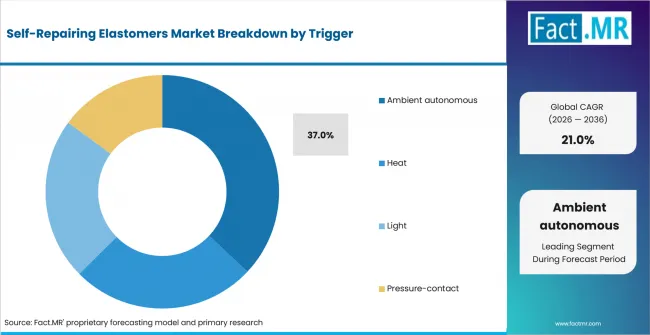
Self Repairing Elastomers Market Analysis By Trigger | Source: Fact.MR
Ambient autonomous systems are anticipated to lead Trigger demand since users prefer repair without ovens, lamps or added pressure. The trigger fits wearable straps, soft grippers and protective skins that stay in service after minor cuts. Heat and light systems still carry value where plants control the repair step, but field use favors recovery that happens without operator intervention.
What supports Soft robotics within Application?
Soft robotics is estimated to represent 49.0% share in 2026.
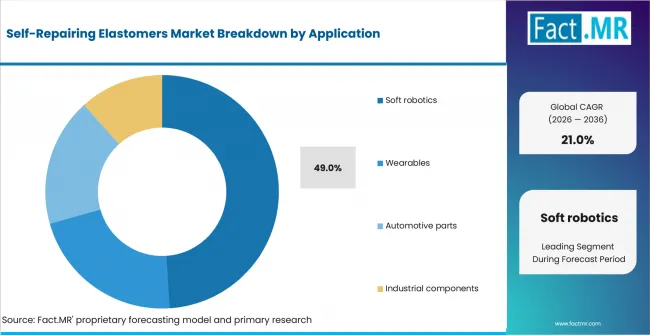
Self Repairing Elastomers Market Analysis By Application | Source: Fact.MR
Soft robotics is estimated to represent the leading Application share due to repeated bending and surface contact in compliant grippers. Repairable elastomers reduce replacement pressure where a small tear stops a gripper. IFR reported in July 2025 that Japan’s automotive industry installed about 13,000 industrial robots in 2024, the highest level since 2020.
What is accelerating Self-Repairing Elastomers Market adoption, and what is holding it back?
Soft-robotics durability drives it; qualification complexity restrains it.
Drivers Impact Analysis
| Driver | (~) % Impact on CAGR | Geographic Relevance | Impact Timeline |
|---|---|---|---|
| Soft-robotics durability needs | +2.0% | Global | Short term (<= 2 years) |
| Polyurethane processing familiarity | +1.6% | North America, Europe, East Asia | Medium term (2-4 years) |
| Dynamic-bond chemistry progress | +1.2% | Global | Medium term (2-4 years) |
| EV and wearable encapsulation demand | +0.9% | USA, Germany, Japan, South Korea | Long term (>= 4 years) |
| Industrial maintenance cost pressure | +0.7% | Europe, North America | Long term (>= 4 years) |
- Soft-robotics durability needs: Repeated bending makes small cuts costly in grippers and skins. Repairable materials are expected to reduce replacement pressure when the repaired part keeps acceptable tear strength.
- Polyurethane processing familiarity: Polyurethane gives developers a known base for casting, molding and performance testing. Familiar processing lowers the first barrier for plant engineers who want repair behavior without changing every tool.
- Dynamic-bond chemistry progress: Disulfide exchange and hydrogen bonding rebuild polymer networks when repair speed and strength retention hold. The chemistry is projected to gain more trials as suppliers publish repeat-cycle data.
- Industrial maintenance cost pressure: Wheels, seals and gaskets create downtime when replacement access is difficult. Repairable elastomers are expected to find early value where a small cut creates a larger service event.
Opportunity Impact Analysis
| Opportunity | (~) % Impact on CAGR | Geographic Relevance | Impact Timeline |
|---|---|---|---|
| Ambient autonomous grades | +1.3% | Global | Short term (<= 2 years) |
| Soft grippers and robot skins | +1.0% | USA, Germany, Japan, South Korea | Medium term (2-4 years) |
| High-temperature silicone gels | +0.8% | USA, Japan, South Korea | Medium term (2-4 years) |
| Recyclable polyurethane systems | +0.6% | Europe, Japan | Long term (>= 4 years) |
- Ambient autonomous grades: Repair without an external trigger gives product teams a simple user benefit in wearables and grippers. Adoption is expected to start where failure is visible but load bearing is moderate.
- High-temperature silicone gels: EV and power-electronics systems need soft materials that survive heat.
- Recyclable polyurethane systems: Repair and circularity are expected to work together when network chemistry is designed carefully.
Restraints Impact Analysis
| Restraint | (~) % Impact on CAGR | Geographic Relevance | Impact Timeline |
|---|---|---|---|
| Long qualification cycles | -0.7% | Global | Short term (<= 2 years) |
| Strength-repair trade-off | -0.5% | Europe, North America, East Asia | Medium term (2-4 years) |
| Processing and synthesis complexity | -0.4% | Global | Medium term (2-4 years) |
| Chemical compliance burden | -0.3% | Europe, South Korea, Japan | Long term (>= 4 years) |
- Long qualification cycles: Automotive and electronics customers require heat, aging and mechanical data before changing materials. This slows switching even when a repairable grade performs well in laboratory testing.
- Strength-repair trade-off: Softer networks repair faster but can lose load-bearing strength. Engineers are expected to compare repaired properties against conventional elastomers before approving production use.
- Processing and synthesis complexity: Dynamic bonds and microcapsules add formulation steps for smaller compounders. The added work can raise cost unless the part avoids enough downtime or warranty loss.
Which countries are scaling the Self-Repairing Elastomers Market through 2036?
- The country comparison spans 8.2 percentage points across the five profiled markets through 2036.
- Germany remains 5.3 percentage points above the USA through automotive elastomer demand, factory automation and a large vehicle-production base.
- The USA remains 1.2 percentage points above the UK as plastics and rubber manufacturing depth and rising industrial robot installations support material trials.
- The UK remains 0.8 percentage point above Japan through rubber-and-plastics production and automotive engineering demand.
- Japan remains 0.9 percentage point above South Korea as robotics activity and specialty-silicone capacity support repairable elastomer development.
- South Korea closes the displayed range through automotive exports and electronics-linked elastomer applications.
Comparable CAGRs can create different entry conditions due to automotive scale, robotics intensity, elastomer-processing capability and qualification requirements. Full report coverage includes North America, Latin America, Western Europe, Eastern Europe, East Asia, South Asia & Pacific, and Middle East & Africa.
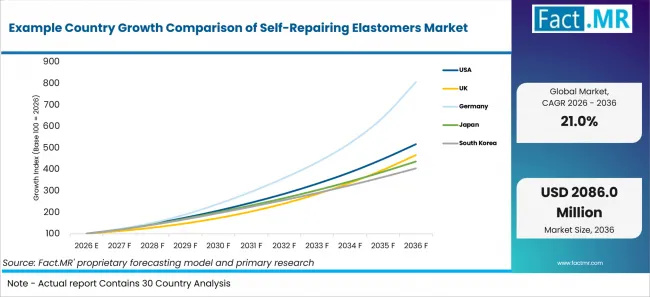
Example Country Growth Comparison Of Self Repairing Elastomers Market | Source: Fact.MR
| Country | CAGR |
|---|---|
| Germany | 23.2% |
| USA | 17.9% |
| UK | 16.7% |
| Japan | 15.9% |
| South Korea | 15.0% |
What is powering Germany’s lead?
23.2% CAGR through 2036, driven by automotive elastomers and factory automation.
Germany’s growth reflects its large automotive manufacturing base and high level of factory automation. VDA reported that Germany produced 4,148,836 passenger cars in 2025, or approximately 4.15 million, while IFR reported that Germany had a robot density of 449 operational industrial robots per 10,000 manufacturing employees in 2024.
How is the USA scaling demand?
17.9% CAGR through 2036, supported by plastics and rubber manufacturing depth.
The USA’s growth is supported by a broad plastics and rubber manufacturing base and increasing industrial automation. Federal Reserve G.17 data list NAICS 326 plastics and rubber products with a 2025 industrial-production proportion weight of 3.56, while IFR reported that U.S. industrial robot installations increased 11% year over year to 38,000 units in 2025, based on preliminary results.
What supports the UK outlook?
16.7% CAGR through 2036, backed by rubber and plastics production.
The UK’s growth reflects established rubber and plastics manufacturing alongside automotive engineering activity. ONS data released in August 2026 listed 2025 home sales for the manufacture of rubber and plastic products at GBP 20,484.2 million, while SMMT reported production of 717,371 cars, 47,344 commercial vehicles and 1.60 million engines in 2025. This industrial base supports trials of repairable elastomers in automotive and engineered components, although the figures provide sector context rather than direct evidence of market adoption.
What underpins Japan’s growth?
15.9% CAGR through 2036, led by robotics and specialty silicone capacity.
Japan’s growth is supported by advanced robotics activity and specialty silicone manufacturing capability. IFR reported that Japan’s automotive industry installed about 13,000 industrial robots in 2024, while Wacker commissioned a specialty-silicone production facility in Tsukuba in the first half of 2025.
How does South Korea perform?
15.0% CAGR through 2036, driven by automotive exports and electronics-linked elastomers.
South Korea’s growth reflects its large automotive and electronics manufacturing base. MOTIR reported that automobile exports reached USD 72.0 billion in 2025, while domestic automobile production totaled 4.1 million units, down 0.6% from 2024.
Who leads the Self-Healing Materials Market?
Autonomic Materials, Inc. and COMPPAIR TECHNOLOGIES LTD. show the clearest direct relevance to self-healing material technologies, while Dow, NEI Corporation, Adaptive Surface Technologies, Inc. and Arkema broaden the competitive landscape across polymers, coatings and functional materials.
Autonomic Materials develops self-healing technologies designed to repair damage and extend material service life. COMPPAIR contributes repairable composite technologies aimed at restoring performance after damage. Dow adds advanced polymer and silicone capabilities relevant to self-healing formulations. NEI Corporation strengthens the field through functional and protective coating technologies. Adaptive Surface Technologies contributes engineered surface solutions, while Arkema extends the competitive landscape through specialty polymers and advanced material platforms. Competition is expected to center on healing efficiency, durability, repeatability, processing compatibility and commercial-scale material integration.
Which companies are the key providers?
Key companies include Autonomic Materials, Inc., COMPPAIR TECHNOLOGIES LTD., Dow, NEI Corporation, Adaptive Surface Technologies, Inc., Arkema.
- Autonomic Materials, Inc.
- COMPPAIR TECHNOLOGIES LTD.
- Dow
- NEI Corporation
- Adaptive Surface Technologies, Inc.
- Arkema
Bibliography
- Federal Reserve Board. (2026, July 17). Industrial production and capacity utilization—G.17.
- International Federation of Robotics. (2025, July 15). Japan’s car industry has highest robot installations in five years.
- International Federation of Robotics. (2026, April 8). Robot density surges in Europe, Asia, and Americas.
- Ministry of Trade, Industry and Resources. (2026, January 15). Automobile exports hit record high of $72 billion in 2025.
- Office for National Statistics. (2026, July 16). UKProdTO: 22 - Manufacture of Rubber and Plastic Products HOME (£m).
- Society of Motor Manufacturers and Traders. (2026, February 20). SMMT Motor Industry Facts 2026.
This Report Answers
- The report explains use across elastomer type and chemistry, including polyurethane systems and disulfide exchange chemistry.
- Segment analysis identifies polyurethane at 38.0% and soft robotics at 49.0% in 2026.
- Country analysis covers Germany, USA, UK, Japan and South Korea, supported by official automotive and robotics statistics.
- Competitive analysis reviews Autonomic Materials, Inc., COMPPAIR TECHNOLOGIES LTD., Dow, NEI Corporation, Adaptive Surface Technologies, Inc. and Arkema.
- Application analysis considers soft robotics, wearables, automotive parts and industrial components.
What does the Self-Repairing Elastomers Market cover?
Polyurethane, silicone, natural rubber and thermoplastic elastomer systems used for autonomous or triggered repair.
The Self-Repairing Elastomers Market covers polymer materials that recover from small cuts, surface scratches or fatigue damage. It includes polyurethane, silicone, natural rubber and thermoplastic elastomer systems with dynamic bonds, microcapsules or autonomous network recovery.
Adjacent material demand is connected with wearable health silicone elastomers, conductive silicone rubber and automotive silicone where soft protection and electronics reliability shape application choices.
The scope differs from general elastomers because self-repairing behavior is part of the material value proposition. Conventional compounds are excluded unless validated healing performance is sold as a product function, even when they sit near elastomeric sealants or elastomeric coatings.
What is included in the scope?
Self-repairing elastomer systems used in soft robotics, wearables, automotive parts and industrial components.
The scope includes repairable polyurethane, silicone, natural rubber and thermoplastic elastomer systems across ambient autonomous, heat, light and pressure-contact triggers. It covers soft robotics skins, wearable straps, automotive encapsulants and industrial parts where repeat damage is a service problem. Related categories include two-part silicones, cold cast elastomers and circular elastomers when the application logic overlaps with repairable material behavior.
What is excluded from the scope?
Conventional elastomers and general protective coatings are outside the scope.
The scope excludes ordinary elastomer compounds that do not claim self-repairing performance. It also excludes adhesives, foams and self-healing industrial epoxy coatings when the product is not an elastomer used in the stated applications.
General rubber parts are excluded unless the supplier sells repairable behavior as a defined product function.
How was the analysis built?
120+ sources, 35+ company portfolios, 25+ countries, and more than 20 interviews.
- Primary Research: Discussions covered material suppliers, compounders, engineers, procurement teams, soft-robotics integrators and wearable-device developers. Interviews examined repair-cycle expectations and qualification barriers.
- Desk Research: Desk research reviewed government statistics, company product pages, annual reports, robotics associations and automotive releases. Selected public evidence sources cited in the analysis are listed in the bibliography.
- Market Sizing and Forecasting: Estimates combine market values, segment shares, application demand, country CAGRs and provider evidence. No market number, CAGR or share supplied for the article was changed.
- Data Validation and Update Cycle: Findings are validated through source checks, company review, country evidence and portfolio mapping. Updates track launches, material qualification and portfolio changes.
What is the report’s scope and coverage?
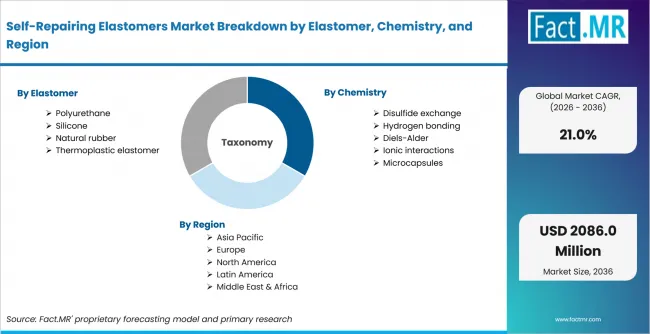
Self Repairing Elastomers Market Breakdown By Elastomer, Chemistry, And Region | Source: Fact.MR
| Attribute | Details |
|---|---|
| Quantitative Units | USD million |
| Market Definition | Elastomer materials designed to repair minor mechanical damage through dynamic bonds, encapsulated healing agents or autonomous polymer-network recovery. |
| Elastomer | Polyurethane; Silicone; Natural rubber; Thermoplastic elastomer |
| Chemistry | Disulfide exchange; Hydrogen bonding; Diels-Alder; Ionic interactions; Microcapsules |
| Trigger | Ambient autonomous; Heat; Light; Pressure-contact |
| Application | Soft robotics; Wearables; Automotive parts; Industrial components |
| Regions Covered | North America; Latin America; Western Europe; Eastern Europe; East Asia; South Asia & Pacific; Middle East & Africa |
| Countries Covered | USA; UK; Germany; Japan; South Korea |
| Key Companies Profiled | Autonomic Materials, Inc., COMPPAIR TECHNOLOGIES LTD., Dow, NEI Corporation, Adaptive Surface Technologies, Inc., Arkema |
| Forecast Period | 2026 to 2036 |
| Approach | Hybrid top-down and bottom-up approach using material adoption, application fit, country evidence, segment shares and provider portfolio review. |
How is the market segmented?
-
By Elastomer
- Polyurethane
- Silicone
- Natural rubber
- Thermoplastic elastomer
-
By Chemistry
- Disulfide exchange
- Hydrogen bonding
- Diels-Alder
- Ionic interactions
- Microcapsules
-
By Trigger
- Ambient autonomous
- Heat
- Light
- Pressure-contact
-
By Application
- Soft robotics
- Wearables
- Automotive parts
- Industrial components
-
By Region
- North America
- Latin America
- Western Europe
- Eastern Europe
- East Asia
- South Asia & Pacific
- Middle East & Africa